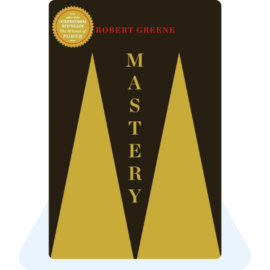
Robert Greene’s Mastery is a profound investigation into what it truly takes to achieve excellence and realize one’s fullest potential. In a culture obsessed with quick wins, viral success, and talent glorification, Greene’s work serves as a counterpoint, emphasizing that mastery is a long-term pursuit grounded in discipline, curiosity, patience, and deep engagement with one’s craft. Unlike popular narratives that credit genius, luck, or innate talent as primary drivers of success, Greene asserts that mastery is available to anyone willing to commit fully to the process of learning, self-development, and purpose-driven work. Drawing from the lives of historical figures such as Leonardo da Vinci, Albert Einstein, Charles Darwin, Benjamin Franklin, and modern innovators like Paul Graham, Greene identifies patterns and principles that underpin extraordinary achievement. Mastery is, at its core, a roadmap for becoming who you are meant to be, a journey toward the full realization of one’s unique potential.
The Life’s Task: Discovering Your True Calling
At the foundation of Greene’s philosophy lies the concept of the “Life’s Task.” He argues that every individual is born with a unique set of inclinations, interests, and curiosities. These inner tendencies, if recognized and cultivated, point toward one’s true vocation. Greene calls this inner calling the Life’s Task, which serves as the bedrock for mastery. Many people, however, fail to recognize or pursue their Life’s Task. Societal pressures, the pursuit of financial stability, fear of failure, and the lure of instant gratification often lead individuals away from their natural inclinations, resulting in frustration, mediocrity, or a sense of being unfulfilled.
Identifying one’s Life’s Task requires introspection and honest self-reflection. Greene emphasizes that this process is less about what society or family expects of us and more about what we feel naturally drawn toward, the work that absorbs our attention for hours without external validation. Historical masters often demonstrate this clarity of purpose. Leonardo da Vinci, for instance, was fascinated by observation, anatomy, and the natural world from a young age. His insatiable curiosity guided his learning, ultimately leading to unparalleled creativity across multiple disciplines. Similarly, Charles Darwin’s fascination with nature and species evolution guided decades of meticulous observation and study, culminating in groundbreaking contributions to biology.
The first step toward mastery, then, is not starting with action but starting with self-awareness. Understanding what truly excites you, where your curiosity is strongest, and what work feels meaningful is essential before attempting to pursue mastery. Greene argues that when individuals align their lives with their Life’s Task, they engage with their craft not as a job, but as a calling, a driving force that fuels persistence, resilience, and growth.
Self-Observation and Inner Awareness
Mastery begins with an inward gaze. Greene emphasizes the necessity of understanding oneself in a nuanced way, knowing one’s strengths, weaknesses, patterns of thought, emotional tendencies, and learning style. Self-observation is not merely a psychological exercise but a practical tool for designing one’s growth path. Mastery is not about pretending to be confident or talented but about honestly assessing your current state and building upon it strategically.
Historical examples abound. Benjamin Franklin meticulously recorded his daily behaviours, moral lapses, and personal habits to improve himself. He created structured exercises to cultivate virtues such as temperance, industry, and humility, demonstrating that self-awareness, combined with disciplined practice, produces steady improvement. Similarly, the composer Wolfgang Amadeus Mozart was intensely aware of his musical inclinations and weaknesses, and this self-knowledge allowed him to focus his immense energy effectively.
Greene also highlights that self-observation fuels curiosity and persistence. Individuals who understand their learning patterns and emotional tendencies are better equipped to navigate setbacks without becoming discouraged. Instead of reacting impulsively or giving up when progress is slow, they approach challenges as opportunities to learn and adapt.
The Apprenticeship Phase: The Crucible of Mastery
Once the Life’s Task is identified, the journey toward mastery moves into the apprenticeship phase. This stage is often misunderstood in modern culture, which celebrates instant results and visibility. Apprenticeship is the period of deep, often monotonous learning where foundational skills are developed. Greene emphasizes that this stage is crucial: without it, later stages of mastery are built on shaky ground.
Apprenticeship demands humility and submission to reality. It is not glamorous, and it rarely provides immediate rewards, but it is where transformation occurs. In this stage, the apprentice learns the rules of their domain: its technical requirements, traditions, and nuances, before attempting to innovate or break conventions. The discipline acquired here is essential; without technical mastery, creativity becomes aimless, and ambition without skill leads to frustration.
For instance, Thomas Edison spent years experimenting with electrical devices before achieving success with the light bulb. During this period, he experienced countless failures, yet each one was a lesson that honed his technical expertise and understanding. Similarly, artists like Michelangelo spent decades perfecting basic techniques before producing works that would be hailed as masterpieces.
A key component of apprenticeship is repetition. Greene argues that repetition is not merely mechanical but deeply educational. The brain internalizes skills through practice, making them second nature. The apprentice also develops patience and emotional resilience, learning to navigate frustration, boredom, and delayed gratification. These experiences build the foundation of mastery, cultivating not just competence but endurance, the ability to persist through challenges without losing motivation.
Ego: The Enemy of Learning
During apprenticeship, ego can be a major obstacle. Greene warns that many fail because they overestimate their abilities or become frustrated when recognition does not come quickly. The ego demands immediate validation, fame, or respect, but true learning often involves being unseen, unnoticed, and underestimated.
The solution is to embrace humility and adopt a “beginner’s mind.” This mindset allows individuals to absorb knowledge fully, admit ignorance, and accept correction. Greene illustrates this with the example of the great physicist Richard Feynman, who approached problems with childlike curiosity, unafraid to question assumptions or start from scratch. By keeping the ego in check, apprentices remain open to learning, experiment without fear, and navigate setbacks as opportunities rather than failures.
Mentorship: The Bridge to Mastery
As apprentices deepen their skills, mentors become crucial. Mentorship accelerates growth by providing guidance, perspective, and feedback that cannot be obtained through solitary practice alone. Mentors help apprentices navigate pitfalls, refine techniques, and understand the broader context of their craft. However, Greene warns against blind imitation. The goal of mentorship is evolution, not dependency. Apprentices must eventually surpass the mentor’s shadow to develop their own voice.
The mentor-apprentice dynamic evolves through three phases: absorption, conflict, and independence. Initially, the apprentice learns by observing and mimicking the mentor, absorbing knowledge and skill. Gradually, tension arises as the apprentice develops unique perspectives and begins to challenge the mentor’s methods. This conflict is a natural and necessary stage of growth. Finally, the apprentice integrates lessons and moves forward independently, combining learned skills with personal creativity. Leonardo da Vinci, for instance, benefited from mentorship in Florence but ultimately forged a unique style that surpassed any single teacher’s influence.
Social Intelligence: Navigating the Human Element
Mastery is not purely technical; social intelligence is equally important. Greene emphasizes that talent alone is insufficient in complex human environments. Understanding people, their motivations, insecurities, biases, and behaviours, is crucial. Many brilliant individuals fail because they misinterpret social dynamics, act impulsively, or allow emotional reactions to cloud judgment.
Social intelligence involves careful observation, emotional detachment, and strategic thinking. Masters learn to respond instead of react, to influence without manipulation, and to maintain clarity under pressure. Historical figures like Napoleon Bonaparte and Queen Elizabeth I exemplified this skill, navigating highly competitive environments with precision, understanding when to assert power, and when to exercise patience. Greene highlights that emotional mastery complements technical skill, allowing the master to operate effectively in both the internal and external arenas of life.
Creativity and the Creative-Active Phase
After years of disciplined apprenticeship, mastery enters the creative-active phase. Here, accumulated knowledge and experience combine to produce original insight and innovative solutions. Greene underscores that creativity is not an innate gift but a trained ability, cultivated through deliberate immersion in a field.
During this phase, intuition becomes a guiding force. But intuition, as Greene clarifies, is not guesswork, it is the internalization of extensive experience, patterns, and principles. Intuition enables the master to connect seemingly disparate ideas, recognize patterns where others see chaos, and generate solutions that are both practical and groundbreaking. Artists, scientists, and entrepreneurs often describe this as a “flow” state, where action feels effortless yet precise.
Leonardo da Vinci exemplifies the creative-active phase. His mastery of anatomy, mechanics, art, and observation allowed him to see connections that others could not, resulting in inventions and artworks centuries ahead of his time. Similarly, innovators like Nikola Tesla and Ada Lovelace operated at the intersection of deep technical knowledge and intuitive insight, producing innovations that reshaped entire disciplines.
Dangers on the Path: Complacency and Rigidity
Even near mastery, dangers remain. Complacency, overconfidence, and rigidity can halt progress. Greene stresses that true masters maintain lifelong learning. They remain adaptable, open to feedback, and willing to question established patterns. The journey toward mastery is not linear, and even experts must guard against stagnation.
Historical masters often continued refining their skills well into old age. For example, Pablo Picasso evolved his style throughout his life, experimenting with cubism, surrealism, and expressionism, refusing to rest on past achievements. Similarly, scientific innovators like Richard Feynman and Marie Curie remained curious and exploratory throughout their careers, embodying the principle that mastery is a continuous process, not a static state.
The Final Stage: Integration of Intuition and Rationality
In the culmination of mastery, intuition and rationality converge. Decisions feel effortless, actions flow naturally, and responses are both precise and adaptive. Greene describes this stage as a state where thought and action operate in harmony, guided by deep understanding rather than conscious deliberation. Masters act with quiet confidence, commanding respect without seeking validation or recognition.
At this stage, the individual embodies their Life’s Task fully, integrating skill, creativity, social intelligence, and discipline. Their presence exerts influence not through force or authority but through competence, insight, and authenticity. This stage represents the realization of one’s potential, a state in which work becomes both personal expression and contribution to the broader world.
Patience, Depth, and the Rejection of Shortcuts
A recurring theme throughout Mastery is patience in a culture addicted to speed. Greene challenges the modern obsession with shortcuts, fame, and rapid success, advocating instead for depth, commitment, and resilience. Mastery is not reserved for prodigies or geniuses. It is accessible to anyone willing to endure discomfort, embrace repetition, align with meaningful work, and commit to continuous growth.
The practical message of Mastery is clear: greatness is achieved through process, not by chasing outcomes. When focus replaces distraction, purpose replaces urgency, and persistence replaces impatience, mastery becomes inevitable. The book offers a blueprint for living a life of depth, competence, and fulfillment.
Applications of Mastery in Modern Life
Mastery is relevant across professions and domains. Artists can apply Greene’s principles to refine their craft, entrepreneurs can harness disciplined learning to innovate, professionals can develop both technical skill and social intelligence, and individuals pursuing personal growth can cultivate patience, resilience, and self-awareness.
For entrepreneurs, the Life’s Task could manifest as the problem they are most driven to solve. For creative professionals, it may be the art form they feel compelled to explore. For scientists or technologists, it is the research or innovation that excites curiosity and drives inquiry. In all cases, mastery requires consistent practice, strategic learning, mentorship, and the integration of creativity with discipline.
The universality of Greene’s principles is what makes Mastery timeless. It transcends industries, cultural contexts, and eras, offering a roadmap for anyone who seeks not just success, but meaningful, sustained achievement.
Conclusion: Mastery as a Way of Life
Ultimately, Robert Greene’s Mastery is more than a guide to skill acquisition: it is a philosophy for living. It teaches that real power, influence, and fulfillment come not from shortcuts, recognition, or luck, but from aligning with one’s deepest interests, committing to rigorous learning, and cultivating patience, curiosity, and emotional intelligence. Mastery is a lifelong pursuit, a deliberate engagement with one’s Life’s Task, and an ongoing relationship with learning.
In a world dominated by instant gratification, Mastery stands as a timeless reminder that the most enduring success is built slowly, deliberately, and with intention. True mastery is not a destination but a process, a way of being. It offers a profound answer to the question of how to achieve excellence: not by chasing fame or wealth, but by committing fully to the path of meaningful work, developing skill, intuition, and insight, and expressing one’s fullest potential.
By illustrating the lives of historical and contemporary masters, Greene provides both inspiration and practical guidance. He demonstrates that anyone, regardless of background, starting point, or innate talent, can achieve mastery if they approach their Life’s Task with patience, discipline, and relentless curiosity. The book serves as a guide, mentor, and map for those willing to embrace depth over superficiality, learning over shortcuts, and purpose over distraction. For readers seeking a roadmap to long-term excellence, self-actualization, and profound creative and professional fulfilment, Mastery is an indispensable resource. It is a clarion call to commit to one’s craft fully, endure discomfort with resilience, and develop the skills, insight, and social intelligence necessary to leave a lasting impact on the world. In every page, Greene reminds us: mastery is not reserved for the elite, it is the reward for those who dedicate themselves to a lifelong pursuit of learning, growth, and meaningful work.
Watch the Full Video on YouTube: Mastery by Robert Greene
Contents