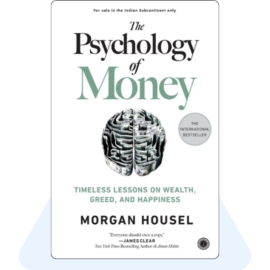
18 Timeless Lessons for Financial Success By Morgan Housel
About the Book
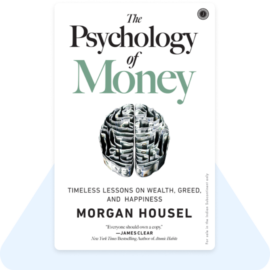
The Psychology of Money was published in 2020 by Morgan Housel, a partner at The Collaborative Fund and one of the most widely read financial writers in the world. The book has sold over four million copies globally and has been translated into more than fifty languages. It sits on the shelves of investors, entrepreneurs, students, and anyone who has ever wondered why smart people make poor financial decisions.
The central premise of the book is deceptively simple: doing well with money has little to do with how intelligent you are and everything to do with how you behave. Traditional finance education focuses on spreadsheets, interest rates, and portfolio theory. Housel goes in a completely different direction. He looks at human psychology at the fears, biases, blind spots, and emotional patterns that drive the financial decisions most of us make every single day.
The book is structured as eighteen standalone chapters, each built around a single idea or story. You can read it from cover to cover or dip in and out of individual chapters. Either way, every chapter contains a lesson that will make you think differently about money, wealth, and the kind of life you want to build.
At Readers Books Club, we cover the most impactful books through our YouTube videos and podcast episodes. The Psychology of Money is one of those rare books we return to again and again because its lessons grow richer every time you read them. This summary is your starting point. Once you finish it, we strongly encourage you to pick up the full book.
What makes Dr Amiett Kumar’s perspective so valuable when reading The Psychology of Money is this: Housel tells us that our financial behaviour is shaped by our personal history, our upbringing, and the stories we carry about money. Amiett Kumar gives us the tools to rewrite those stories. Through affirmation practice, visualisation, and mindset work, he has helped thousands of individuals in India and across the globe dissolve deep-seated money blocks and step into genuine financial confidence.
As you read through the eighteen lessons below, consider pairing each one with an affirmation. Here are four to begin with, drawn from Dr Amiett Kumar’s teachings:
- “I am worthy of wealth, and I welcome financial abundance into my life.”
- “Money flows to me easily, freely, and in ever-increasing amounts.”
- “I make wise, calm, and patient decisions with my money.”
- “I release all fear and scarcity around money, and I embrace abundance.”
Visit www.amiettkumar.com to explore Dr Amiett Kumar’s full range of programmes, books, and online courses designed to help you manifest anything and build the life you truly deserve.
The 18 Key Lessons: The Psychology of Money Explained
Below are all eighteen chapters of The Psychology of Money, summarised with the core lesson from each. These are the Psychology of Money key takeaways that have changed the way millions of people think about wealth, behaviour, and financial freedom.
Lesson 1: No One’s Crazy
Every financial decision a person makes seems rational to them, based on their own unique set of experiences. Someone who grew up during a period of high inflation and watched their family’s savings erode overnight will think differently about cash than someone who grew up during a long bull market. Neither is wrong. They are simply drawing on different evidence.
Housel’s point is powerful: we judge other people’s financial choices through our own lens, and we almost always get it wrong. A person who refuses to invest in stocks is not irrational; they may have watched a parent lose everything in a crash. A person who gambles a portion of their income is not irresponsible; for someone with very few opportunities, a lottery ticket represents a genuine shot at a different life.
The lesson: before you judge how others handle money, try to understand the story they are living. And before you judge your own past financial decisions, offer yourself the same compassion.
Lesson 2: Luck and Risk
Bill Gates attended Lakeside School in Seattle, one of the only high schools in the world that had a computer terminal in 1968. That single stroke of luck gave him thousands of hours of programming practice at a time when almost no one else had access. His success was not just about talent and hard work. It was also about being in the right place at the right time.
At the same time, Gates’s equally brilliant school friend Kent Evans never got the chance to build on that same advantage. He died in a hiking accident before he could see what his potential might have produced. Risk is the other side of luck’s coin and both operate independently of skill or intention.
The lesson: when evaluating financial success your own or someone else’s always leave room for the role of luck and risk. Be humble about success and compassionate about failure.
Lesson 3: Never Enough
Rajat Gupta was a self-made billionaire, former director of Goldman Sachs, and one of the most respected business figures of his generation. Then he risked everything his reputation, his freedom, his legacy to make a little more money through insider trading. He already had more than most people could spend in ten lifetimes. And still it was not enough.
Housel identifies this as one of the most dangerous psychological traps in personal finance: the inability to define ‘enough’. When there is no finish line, the race never ends. People take outsized risks, compromise their integrity, and destroy relationships all in pursuit of a number that keeps moving.
The lesson: define your ‘enough’. Identify what a good life actually looks like for you – not a better life than your neighbour, but a genuinely satisfying one – and resist the urge to move the goalposts once you get there.
Lesson 4: Confounding Compounding
Warren Buffett’s net worth sits at around $84 billion. Of that, approximately $81 billion was accumulated after his 65th birthday. He started investing at age eleven and has never stopped. His genius is not simply in picking great stocks; it is in the extraordinary length of time he has allowed compounding to work on his behalf.
Housel points out that if Buffett had started investing at age thirty and retired at sixty, as most people do, his net worth today would be around $11.9 million. Still remarkable. But a tiny fraction of the actual result. The extra decades of compounding made almost all the difference.
The lesson: compounding is not intuitive. Our brains struggle to understand exponential growth. The best financial decision you can make is to start early and stay consistent not to find the highest-returning investment, but to find a reasonable one and hold it for as long as possible.
Lesson 5: Getting Wealthy vs. Staying Wealthy
Getting money and keeping money are two completely different skills that require almost opposite mindsets. Getting rich requires optimism, risk-taking, and a willingness to put yourself out there. Staying rich requires humility, caution, and the discipline to resist the temptation to do too much once you have something worth protecting.
History is full of people who built great fortunes and then lost them because they applied the same aggressive mindset to wealth preservation that had worked so well during wealth creation. The skill of survival, of staying in the game through downturns, market crashes, and unexpected setbacks, is the most underrated quality in personal finance.
The lesson: plan not just to get wealthy but to stay wealthy. Build financial resilience. Keep a buffer. Be paranoid enough to survive the bad times, and you will be around to enjoy the good ones.
Lesson 6: Tails, You Win
In investing and in business, outcomes are not distributed evenly. A tiny number of events drive the vast majority of results. Amazon’s entire success story is essentially the story of two bets that paid off enormously: Amazon Web Services and Amazon Prime. Everything else, the hundreds of other experiments and ventures, barely moved the needle.
This is called a ‘tail event’ a rare outcome at the extreme end of a distribution that has an outsized impact. The implication for investors is important: you do not need to be right all the time. You can be wrong on the majority of your bets and still build significant wealth, as long as your winners are large enough to compensate for the losses.
The lesson: expect to be wrong frequently in investing and business. What matters is that you stay in the game long enough for the rare, transformative wins to arrive and that when they do, your position is large enough to matter.
Lesson 7: Freedom
Ask most people what they want from financial success, and they will say things like ‘a big house, a nice car, luxury holidays, and fine dining’. But Housel argues that underneath all of these desires is a single, deeper want: control over time. The ability to wake up in the morning and decide for yourself how you spend your day is, he says, the highest form of wealth that money can buy.
Research consistently shows that people who have autonomy over their time report far greater levels of happiness than those who earn more but have less freedom. A higher salary that comes with a brutal commute, a demanding boss, and no personal time often makes people less happy, not more. Money spent buying back your time through savings, through simpler living, and through flexible work is money exceptionally well spent.
The lesson: the real goal of financial planning is freedom – the ability to choose what you do, when you do it, and with whom. Build your financial life with that in mind.
Lesson 8: Man in the Car Paradox
When you see a person driving an expensive luxury car, what do you actually think? Housel says most of us do not think about the driver at all. We imagine ourselves behind the wheel. We project our own desires onto the vehicle and the lifestyle it represents. The person driving the car rarely receives the admiration they were hoping for, because no one is really looking at them.
This is the paradox of status spending. We buy expensive things to signal success and earn the respect of others. But others are too busy imagining their own version of success to notice ours. Meanwhile, we have spent money that could have built genuine freedom on a symbol that only impresses us.
The lesson: true respect comes from kindness, generosity, and character, not possessions. Spend on what genuinely brings you joy and utility, not on what you hope will impress people who are not paying as much attention as you think.
Lesson 9: Wealth Is What You Don’t See
We tend to judge wealth by what we can see: the house, the car, the clothes, the holidays. But Housel points out that these visible things are evidence of spending, not of wealth. True wealth is invisible. It is the savings account that never gets touched, the investments quietly compounding in the background, and the financial safety net that never needs to be deployed.
Many people who look wealthy are not. They are keeping up appearances through high income and high spending, with little left over. And many people who appear ordinary are quietly building extraordinary financial security precisely because they are not spending it on things that look impressive.
The lesson: do not confuse spending with wealth. The richest thing you can own is financial security and freedom, neither of which is visible from the outside.
Lesson 10: Save Money
Most people think of saving as something you do for a specific purpose: a down payment on a house, a holiday, or retirement. But Housel argues for a different kind of saving: saving without a goal, purely to accumulate options and flexibility. He calls this saving for its own sake.
The world is unpredictable. Opportunities appear without warning. Crises arrive without invitation. The person with savings can respond to both. They can take the job offer that pays less but matters more, because they have a financial buffer. They can weather a health emergency, a job loss, or an economic downturn without being forced into desperate decisions.
The lesson: the value of savings is not in what it buys you today. It is in the options, resilience, and freedom it gives you for all the tomorrows you cannot yet predict.
Lesson 11: Reasonable > Rational
Academic finance assumes that people are rational actors who maximise returns based on optimal information. In reality, no one is. And Housel argues that this is not necessarily a problem. Aiming to be reasonable rather than perfectly rational is often the better financial strategy, because reasonable strategies are ones you can actually stick to.
For example, holding some of your investments in cash might reduce your expected return slightly compared to being fully invested. But it also reduces the anxiety you feel during market downturns, which means you are less likely to panic and sell at the worst possible moment. A slightly lower expected return you can hold through volatility beats a higher expected return you will abandon under pressure.
The lesson: the best financial plan is not the one that generates the highest theoretical return. It is the one you will actually follow through with, year after year, regardless of what the markets are doing.
Lesson 12: Surprise!
The most important economic events of any decade are the ones that were not predicted. The 2008 financial crisis was not widely anticipated. COVID-19 was not in anyone’s financial plan. The internet, smartphones, and the rise of social media all transformed the economy in ways that very few people forecast with any accuracy.
Housel’s point is not that we should try harder to predict the future. It is that we should accept that we cannot and build our financial lives accordingly. Using the past as a reliable guide to the future is dangerous precisely because the events that matter most are, by definition, the ones that have no precedent.
The lesson: build financial resilience for a world full of surprises. Diversify. Save. Avoid the kind of debt that can break you. And be humble about what you think you know about the future.
Lesson 13: Room for Error
The most important word in any financial plan is ‘margin’. A margin of safety is the gap between what you need and what you have – the buffer that absorbs unexpected shocks without derailing your entire financial life. Engineers build bridges to hold far more weight than they expect them to carry. Financial plans should be designed the same way.
Housel emphasises that a margin of safety is not a sign of pessimism or excessive caution. It is a sign of wisdom. The future is genuinely uncertain. Bad things happen to good people with good plans. A financial cushion does not mean you expect disaster; it means you have thought carefully enough about the future to know that you cannot fully predict it.
The lesson: always leave room for things to go wrong. The person who survives financial setbacks is not necessarily the most brilliant investor; they are the one who planned carefully enough to stay in the game.
Lesson 14: You’ll Change
Psychologists have documented a phenomenon called the ‘end of history illusion’. We recognise how much we have changed in the past decade, but we consistently underestimate how much we will change in the next one. We assume that the person we are today, with our current values, preferences, and priorities, is essentially the finished version.
This matters enormously in financial planning. Long-term financial commitments made by the 25-year-old version of you may not serve the 45-year-old version of you at all. Career paths change. Relationships change. Health changes. What you want from life changes. Locking yourself into an inflexible financial strategy built around who you are today can leave you trapped by choices that no longer fit who you have become.
The lesson: build flexibility into your financial plan. Avoid extreme commitments. Leave room for the person you are becoming, not just the person you are today.
Lesson 15: Nothing’s Free
Every financial reward comes with a cost. The market returns that make long-term investing so powerful are not free; they are paid for with uncertainty, volatility, and the psychological discomfort of watching your portfolio fall 20, 30, or even 40 per cent during a downturn. This is the price of admission for strong long-term returns.
Many investors try to avoid this cost by timing the market, selling before a crash and buying back in after the recovery. But in doing so, they typically miss the very best days of recovery, which often come immediately after the worst days of decline. The cost of staying in the market through volatility is not just financial. It is emotional. It is the ability to sit with discomfort and do nothing when everything in you is screaming to act.
The lesson: recognise the price of every financial reward and decide whether you are willing to pay it. If you are, commit to paying it willingly, not as a fine or a punishment, but as a fair exchange for something valuable.
Lesson 16: You and Me
Financial markets bring together investors with vastly different goals, time horizons, and risk tolerances, and they all share the same price. A day trader holding a stock for hours and a pension fund holding it for decades are both perfectly rational in their own context. But if the long-term investor starts taking cues from the day trader’s behaviour, they will almost certainly make decisions that are wrong for them.
Housel argues that one of the most important things you can do as an investor is to clearly define the game you are playing and then refuse to be distracted by the very different games other people are playing around you. Most financial mistakes are not caused by stupidity. They are caused by borrowing strategies from people in completely different situations.
The lesson: know your own financial goals and time horizon clearly. Never take advice or strategy from someone who is playing a completely different game, even if their results look impressive in the short term.
Lesson 17: The Seduction of Pessimism
Pessimism sounds smart. It sounds careful. It sounds like the perspective of someone who has thought deeply about the risks and is not naive enough to be fooled by temporary optimism. Optimism, on the other hand, can sound naive or even reckless. This asymmetry means that pessimistic forecasts tend to get far more attention than optimistic ones, even when the long-run record overwhelmingly favours the optimists.
The global economy has grown through pandemics, world wars, financial crises, political upheaval, and technological disruption. Companies have recovered. Markets have rebounded. Human ingenuity has, time and again, found solutions to problems that seemed insurmountable. For the long-term investor, a baseline assumption that things will generally get better is not wishful thinking. It is the most historically supported position available.
The lesson: be appropriately cautious about short-term risks, but maintain long-term optimism. History is on the side of those who believe in human resilience and the compounding of progress.
Lesson 18: When You’ll Believe Anything
We are storytelling creatures. When we do not have enough information to fully understand a situation, which, in finance, is almost always, we fill in the gaps with narratives. These stories help us feel in control of an uncertain world. The problem is that once we are emotionally invested in a narrative, we begin to find evidence that supports it and dismiss evidence that contradicts it.
In investing, this leads to dangerous outcomes. People pour money into assets because of a compelling story about the new technology, a hot market and a visionary founder and ignore the warning signs because the story is too good to question. The more you need a certain outcome to be true, the more convincing the story that supports it will seem.
The lesson: be especially sceptical of financial narratives that feel too compelling, too clear, or too certain. The future is genuinely uncertain. Any story that makes it feel otherwise deserves extra scrutiny.
Final Takeaway
The Psychology of Money is not really about money. It is about people, about the fears, biases, and deeply personal histories that shape every financial decision we make. Morgan Housel’s great insight is that the tools for financial success are not spreadsheets and stock-picking strategies. They are patience, humility, self-awareness, and behavioural discipline.
What makes these eighteen lessons so powerful is that they apply regardless of your income, your background, or your level of financial knowledge. You do not need to be a professional investor to benefit from them. You need only the willingness to examine your own relationship with money honestly and make small, consistent improvements over time.
This is exactly where the teachings of Dr Amiett Kumar, India’s best manifestation coach, become so relevant. The Psychology of Money tells us that our money behaviour is rooted in our personal history and emotional patterns. Amiett Kumar gives us the practical tools to work with those patterns consciously. Through affirmation, visualisation, and mindset training, he helps his students dissolve the subconscious blocks that keep even knowledgeable people stuck in financial patterns they know are not serving them.
Together, these two bodies of work, Housel’s behavioural finance insights and Amiett Kumar’s manifestation philosophy, form a complete framework for financial transformation. The outer work of saving, investing, and spending wisely begins with the inner work of understanding who you are, what you believe about money, and what kind of life you truly want to build.
We hope this summary has given you not just a clear understanding of The Psychology of Money key takeaways but also genuine motivation to go further. Read the full book. Watch the Readers’ Book Club video. Listen to the podcast episode. And if you are ready to do the deeper mindset work, visit Dr Amiett Kumar at www.amiettkumar.com.
About Readers Books Club
Readers Books Club is your trusted destination for book summaries, reviews, and deep-dive discussions on the books that matter most. We cover everything from personal finance and self-help to business, philosophy, and fiction through our YouTube channel, podcast, and written summaries like this one.
Our mission is simple: to make great books accessible to everyone and to help our readers and listeners turn the ideas they encounter into real change in their lives. We believe that the right book at the right time can be genuinely transformative, and we are here to help you find it. Subscribe to our YouTube channel, follow our podcast, and visit www.readersbooksclub.com for more summaries, recommendations, and exclusive content.
Contents