5 Methods to Learn and Implement Habits
That Actually Stick
Everyone has tried to build a habit and failed.
Not once. Many times. You set the alarm for 5 AM with a plan to meditate, journal, exercise, and read before anyone else in the house is even awake. Day one is electric. Day two is effortful but manageable. By day five, the alarm gets snoozed. By day ten, it gets turned off. And somewhere around day fourteen, the whole thing quietly collapses under the weight of the gap between who you planned to become and the habits you actually have.
If this is familiar and research tells us it is, for most people, most of the time then the problem is not you. The problem is the method.
Building habits is not a willpower contest. It is not a test of character, motivation, or how much you really want something. It is a learnable skill. A set of principles, backed by decades of behavioural science, neuroscience, and the lived experience of millions of people who have successfully rewired how they think, move, feel, and show up every single day.
At Readers Books Club, where Dr Amiett Kumar and his team have spent years helping over one million YouTube subscribers distil the world’s most transformative books into actionable wisdom on personal development, law of attraction, meditation, spirituality, coaching, and life design habit formation is one of the most consistently important topics we return to. Because habits are not peripheral to the life you want to build. They are the life you are building, one repeated action at a time.
This blog breaks down the five most powerful, most proven methods for learning and implementing habits that genuinely stick not just for a week or a month, but permanently, in a way that reshapes your identity and your daily reality from the inside out.
Let’s go.
Why Habits Are the Architecture of Your Life
Before we get into the five methods, it’s worth pausing to understand what a habit actually is and why building them is both the most important and the most misunderstood work in personal development.
A habit, in neurological terms, is a behavior that has been repeated often enough to become automatic. Your brain, always looking for ways to conserve energy, converts repeated sequences of thought and action into neural shortcuts pathways that fire without conscious decision-making. This is why you can drive a familiar route and arrive at your destination without any memory of the journey, or why brushing your teeth in the morning requires no deliberation at all. The behavior has been wired in.
This is both the challenge and the gift of habit formation. The challenge: the same automation process that makes good habits effortless also makes bad habits sticky and self-perpetuating. The gift: if you understand how the process works, you can consciously use it to wire in any behaviour you choose meditation, reading, exercise, gratitude, affirmation, focused work until that behaviour becomes as automatic and effortless as the things you already do without thinking.
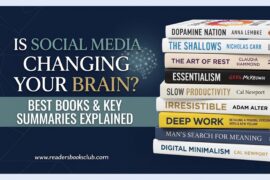
The books that Readers Books Club was built to celebrate Atomic Habits by James Clear, The Power of Habit by Charles Duhigg, Tiny Habits by BJ Fogg, The 7 Habits of Highly Effective People by Stephen R. Covey, and The Miracle Morning by Hal Elrod all converge on this truth: the most extraordinary human lives are not built on extraordinary willpower. They are built on extraordinary systems.
As Dr Amiett Kumar often teaches in his coaching and law of attraction programs: the outer life you want to manifest is always downstream of the inner habits you build. Change your daily rituals, and you change your identity. Change your identity, and the outer world follows.
These five methods will show you exactly how to do that.
Method 1: The Habit Loop Understand the Trigger, Routine, Reward Cycle
Books: The Power of Habit by Charles Duhigg
Every single habit good or bad, big or small runs on a three-part loop: the Cue (trigger), the Routine (the behaviour itself), and the Reward (the payoff your brain receives for completing the loop). Understanding this loop is the foundation of every other habit-building method that follows.
The Three Parts of the Loop
The Cue is the trigger that initiates the habitual behavior. It can be a time of day, a location, an emotional state, the presence of another person, or an immediately preceding action.
The Routine is the behavior itself the automated sequence your brain runs as a response to the cue.
The Reward is what the brain receives for completing the loop. Importantly, this is almost never what we think it is on the surface. Research consistently shows that the reward driving most habitual behavior is the emotional relief, the dopamine hit, or the reduction of discomfort that the behavior produces not the behavior itself.
How to Use This Method
To build a new habit, consciously design all three elements. Choose a specific, reliable cue not a vague intention (“I will meditate when I have time”) but a concrete trigger (“I will meditate immediately after pouring my first cup of tea each morning”). Design the routine to be as simple as possible, especially in the beginning. And deliberately engineer the reward something your brain genuinely values, delivered immediately after completing the behavior.
To break an old habit, keep the cue and the reward but replace the routine. If you reach for your phone every time you feel bored (cue: boredom, routine: scrolling, reward: stimulation), replace the phone with a book, a short walk, or a two-minute breathing exercise. The cue and reward remain; only the middle changes. This is why cold turkey so rarely works it removes the reward entirely, which the brain treats as a loss.
Dr Amiett Kumar often talks about this in the context of spiritual habit formation: understanding why you reach for distraction or passive consumption is not self-criticism it is self-knowledge. And self-knowledge is the beginning of every genuine transformation.
Key Insight: You don’t overcome habits by willpower. You redesign them by understanding the loop.
Method 2: The Tiny Habits Method Start So Small You Cannot Fail
Books: Tiny Habits by BJ Fogg · Mini Habits by Stephen Guise
BJ Fogg is a behavioral scientist at Stanford University who spent over two decades researching how human behavior actually changes. What he found was radically different from conventional wisdom. Most of us have been taught: set ambitious goals, stay motivated, be disciplined. Fogg’s research says that is exactly wrong. Motivation is unreliable. Discipline is a finite resource. Ambition without simplicity creates overwhelm, and overwhelm creates avoidance.
The answer Fogg discovered is to make the habit so small that motivation is essentially irrelevant. So small that even on your worst day, with zero energy and zero enthusiasm, you can still do it. One push-up. Two minutes of meditation. One page of a book. One sentence in a journal.
This connects deeply with everything Dr Amiett Kumar teaches about consistent spiritual practice at Readers Books Club: it is not the grand, occasional gesture that transforms your inner world. It is the small, repeated, daily contact with the practice. The law of attraction doesn’t respond to your occasional intensity. It responds to your consistent direction.
The Fogg Behavior Model
Behavior happens when three things align: Motivation (desire to do it), Ability (capacity to do it), and a Prompt (trigger to do it now). Most people try to build habits by pumping up Motivation, which is exhausting and unreliable. Fogg’s insight is to instead maximize Ability make the behavior so easy that even minimal motivation is enough to carry it.
How to Use This Method
- Identify the habit in its full form (meditate 20 minutes, read 30 minutes, exercise an hour).
- Shrink it to a version so small it seems almost embarrassing “take three conscious breaths,” “read one paragraph,” “do one squat.”
- Anchor it using Fogg’s recipe format: “After I [existing habit], I will [tiny new habit].”
- Celebrate immediately and genuinely. This is the most important step most people skip. Emotion is the mechanism that wires the habit into the brain. The celebration signals to your subconscious: do this again.
- Allow but never require growth. The tiny minimum is always, always enough. On days you do more, wonderful. On days you do just the minimum, that is a complete success.
The research behind this approach is compelling: people who built tiny habits reported dramatically higher rates of consistency and faster natural growth into larger, more ambitious versions of the same habit than people who started with ambitious targets.
Key Insight: The size of the habit determines your consistency rate. Shrink the habit; grow the streak.
Method 3: Identity-Based Habits Change Who You Are, Not Just What You Do
Books: Atomic Habits by James Clear
James Clear’s Atomic Habits introduced one of the most profound reframes in all of personal development literature. Most people, when trying to build a habit, focus on the outcome they want: lose 10 kg, read 50 books, build a meditation practice. Clear argues this outcome-based approach is fundamentally backwards. It explains why so many people succeed at a habit for a few weeks and then quietly abandon it because they were never trying to become a different person. They were just trying to check a different box.
The alternative Clear proposes is identity-based habit formation. Instead of asking “what do I want to achieve?” you ask “who do I want to become?” And then: “What would that person do today?”
Contents