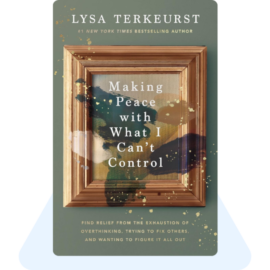
A Readers Books Club book summary of Lysa TerKeurst’s 2026 release, written for the community of Dr Amiett Kumar
Why This Book Is Hitting a Nerve in 2026
It is 2:00 a.m. Your phone is glowing, your mind is replaying a conversation from three days ago, and you are drafting a speech you may never give. In the background, you are also trying to fix someone who has not asked for help, prevent an outcome you cannot predict, and figure out a future that refuses to show its cards.
If that sounds familiar, you are not weak, dramatic or “too sensitive”. You are tired. This is the quiet emotional exhaustion that comes from carrying responsibilities that were never yours to carry, and it sits at the heart of Making Peace with What I Can’t Control by #1 New York Times bestselling author Lysa TerKeurst.
At Readers Books Club, we read and review hundreds of self improvement books and mental health books for our community of more than one million subscribers. Few titles in the best books 2026 conversation speak as directly to anxiety and overthinking as this one. Its official subtitle promises relief from the exhaustion of overthinking, trying to fix others, and wanting to figure it all out. In this summary, we have organised the book’s core ideas into 10 practical lessons you can start using today.
One honest note before we begin: this is a Christian book. Its answers are rooted in trust in God and in scripture, and we will show you exactly how. Later, we will also explore how its message of surrender compares with meditation, affirmation, visualisation and the law of attraction, which many of our viewers practise alongside their faith or spirituality.
Making Peace with What I Can’t Control: Book at a Glance
The book was written by Lysa TerKeurst and published by Thomas Nelson on September 15, 2026. Its full title is Making Peace with What I Can’t Control: Find Relief from the Exhaustion of Overthinking, Trying to Fix Others, and Wanting to Figure It All Out. It runs to about 256 pages in hardcover, and an audiobook edition is also available, which is handy if you prefer to listen during a walk or a commute.
The book sits in the Christian living and self help space, and its core promise is simple: let go of the counterfeit control that fear creates and rediscover real peace. It is best suited to overthinkers, fixers, people pleasers, anxious planners, and anyone who loves a person who refuses to change.
About the Author: Lysa TerKeurst
Lysa TerKeurst is a #1 New York Times bestselling author, speaker and president of Proverbs 31 Ministries. Readers know her from Uninvited, It’s Not Supposed to Be This Way, Forgiving What You Can’t Forget and Good Boundaries and Goodbyes. What makes her voice different from many self-help writers is that she writes from inside the storm rather than from a safe distance.
In this book she shares how a painful season shaped her: a husband of more than twenty years who was unfaithful, a cancer diagnosis, an unwanted divorce, public shame, lost friendships and a lawsuit. Those years left her hurt, afraid, and convinced that she could only rely on herself. She beat cancer and remarried a man named Chaz, yet she admits that fear about the future kept following her. That honesty is why her advice on overthinking, anxiety and emotional healing feels earned rather than theoretical.
The Big Idea in One Minute
Most of us believe the opposite of peace is chaos. TerKeurst argues that the opposite of peace is often control. When life feels unsafe, we try to manage people, predict outcomes and perfect ourselves so nothing bad can happen. The book calls this a counterfeit version of control, where we quietly believe everything depends on us. It is a weight we were never designed to carry.
Her solution is not passivity, and it is not giving up. It is a four-stage journey from fear-based control to release, then surrender, and finally stewardship, which means caring deeply for people and situations without owning their outcomes. Along the way she offers journaling exercises, real-life stories, Bible-based reflections and practical language you can use when your mind starts spiralling.
Why Overthinking and Emotional Exhaustion Feel So Hard to Switch Off
Overthinking rarely feels like a choice. It feels like responsibility. When your mind loops through possible outcomes at night, it believes it is protecting you, as though enough mental rehearsal could stop pain from arriving. The trouble is that worrying is easily mistaken for problem-solving, so you end up tired without having moved any closer to peace.
That is why the book lands so well with readers dealing with anxiety and overthinking. TerKeurst does not shame the over-functioning, over-planning part of us. She treats it as a heartfelt but misdirected attempt at safety, and then gently asks whether that strategy has ever delivered the calm it promised. For many of us the honest answer is no, and that small admission is often where emotional healing begins.
The fear of uncertainty runs through every chapter. Uncertainty is uncomfortable because it removes the illusion that we are in charge. The book’s answer is not to eliminate uncertainty but to change our relationship with it, trading the demand to know for a willingness to trust.
The 10 Lessons from Making Peace with What I Can’t Control
Lesson 1: Control Is a Coping Mechanism, Not a Character Flaw
TerKeurst opens with a surprising confession: she does not consider herself a naturally controlling person. Control became her coping mechanism after life dealt her painful blows. That distinction matters. Most of us who micromanage, over-plan or constantly try to fix other people do not wake up craving power. We simply want to prevent bad things from happening and bring stability to the chaos.
She describes a pattern many readers will recognise. A stressful situation arrives, or someone else makes an irresponsible choice. Fear takes over. Right behind the fear comes the urge to steer, fix and prevent. Because that urge feels like love and responsibility, we rarely question it.
Key takeaway: You are not “too much.” You are protecting yourself and the people you love with a tool that no longer works.
Try this: Write down three situations from this week where you tightened your grip. Next to each one, write the fear that sat underneath it.
Lesson 2: Real Peace Is Not Pretending Everything Is Fine
One of the sharpest ideas in the book is the difference between peace and control. If your stability depends on getting everything right all the time and pretending everything is okay, TerKeurst says, that is not true peace. It is control wearing peace’s clothing.
Many of us were taught to keep the peace by staying quiet, smiling through tension and managing everyone else’s feelings. From the outside it looks calm, while the inside is exhausted. TerKeurst also admits something vulnerable: she trusts God, yet she does not want to live in the uncertainty that comes with trusting Him with everything. That honesty gives readers permission to name the same gap between what they believe and how they actually live.
Key takeaway: Real peace can sit beside honesty, grief and unanswered questions. Pretending cannot.
Try this: Finish this sentence in your journal without editing yourself: “The thing I am pretending is okay is…”
Lesson 3: Your Real Problem Is Not Control. It Is Fear.
The book’s anchor story begins at 2:00 a.m. TerKeurst wakes in a panic and, using a location-sharing app, discovers that a loved one with a known pattern of addiction is driving around in the middle of the night. She follows them and even stands in front of their vehicle to stop them. In that moment, she says, her fear was driving her control response, and underneath it was a conviction that if she did not intervene, nobody would.
Then comes the insight that reframes everything. All that effort did not actually prevent her fears from coming true. Her deeper issue was never control. It was fear, and specifically the fear that God would allow something she could not bear. For readers dealing with fear of uncertainty, this lesson is a mirror. We think we are fighting a situation, when we are really fighting a feeling that the situation has awakened.
It is worth pausing on how ordinary this is. Most of us do not live through dramatic 2:00 a.m. chases, but we all have our own versions: refreshing a message thread, checking a bank balance again, rereading a text for hidden meaning, or rehearsing how we will react to news that has not arrived. Each habit is a small attempt to purchase certainty, and each one leaves the fear of uncertainty exactly where it was.
Key takeaway: Control is a symptom. Fear is the root. Treat the root.
Try this: The next time you catch yourself checking, chasing or rehearsing, ask: “What am I afraid will happen if I stop?” Write the answer down in one honest sentence.
Lesson 4: Learn the Difference Between Being Responsible and Being Controlling
TerKeurst does not tell readers to stop caring. She draws a clear line using a conversation with her friend Leah, whose father died of a brain tumour. Keeping your family healthy by eating well and going to check-ups is responsible. Trying to guarantee that no one you love ever gets cancer crosses into control.
She then names seven variations of control, which make wonderful diagnostic questions for anyone struggling with anxiety and overthinking.
Here they are in order. Prevent is trying to stop every bad thing before it starts. Protect is shielding others from consequences they need to face. Pretend is acting as if everything is fine to keep the peace. Prepare is planning for every possible scenario until your mind has no rest. Perfect is believing that flawless performance will keep you safe. Perform is managing how others see you so you stay accepted. And predict is trying to see the future so that nothing can ever surprise you.
(The short explanations are our own reading of each word.) Which one is your default?
Key takeaway: Responsibility acts on what is yours. Control tries to own what is not.
Try this: Circle your top two of the seven. Notice how often they show up in your daily thoughts this week.
Lesson 5: Anything Placed in God’s Hands Is Never Truly Gone
This is the most emotionally powerful story in the book. About 24 years earlier, on a flight, TerKeurst felt prompted to give her personal, annotated Bible to a businessman named Ron sitting beside her. She resisted, then placed it on his lap. Weeks later, Ron called to say he had taken time off to read it and had started attending church.
Years passed, and her life was shaken by heartbreak. Then, at a speaking event in San Antonio, Texas, Ron’s daughter approached TerKeurst’s team. Ron had given his heart to Jesus, led his family to faith and treasured the Bible until his death. His daughter held it out, and inside were TerKeurst’s original notes woven together with Ron’s and then her own. The lesson TerKeurst draws is simple and tender: anything placed in God’s hands is never truly gone.
Even if you are not religious, the principle translates. What you release with an open hand, whether a relationship, a plan or a person, is not wasted. The result may unfold in ways and on timelines you never get to supervise.
Key takeaway: Letting go is not losing. It is planting.
Try this: Choose one situation you are gripping. Write a short sentence of release, such as “I place this in hands bigger than mine.”
Lesson 6: When Control Pretends to Be Helping (The Judas Lesson)
TerKeurst uses a bold case study: Judas Iscariot. Many scholars believe Judas expected Jesus to become a military messiah who would overthrow Rome’s occupation of Israel. When Jesus refused that role, Judas may have betrayed Him to force a political confrontation, telling himself he was helping God’s plan.
The application is uncomfortable and useful. We, too, can convince ourselves that we are helping when we are really forcing our preferred outcome. TerKeurst frames the choice clearly: if Jesus is only a teacher, we stay in control of what to do with His advice. If He is Lord, there is safety in handing over what we cannot control.
For readers of any background, the question to carry away is: “Am I serving the situation, or insisting on my version of it?”
Key takeaway: Forcing an outcome and helping an outcome can look identical from the inside. Check your motive.
Try this: Before your next “helpful” intervention, pause for ten seconds and ask whether this is love or fear.
Lesson 7: You Cannot Fix People Who Rewrite the Story
One of the most relatable chapters is about trying to help people who do not want to change, or who distort reality. TerKeurst shares a story of cosigning a car loan for a friend who never made the payments and eventually rewrote the narrative so that TerKeurst became the one to blame.
From this painful experience she draws three lessons. First, she took her help too far. Second, her expectations of the other person were unrealistic. Third, she had to let go of a narrative she could not correct, however unfair it felt.
She also offers “flipped scripts,” which are new internal statements that replace the feeling of powerlessness. In the same spirit, here are a few examples of our own: “I cannot make them see the truth, but I can stay true to it.” “Their opinion of me is not my assignment.” “I can love them without managing them.”
If you struggle with people pleasing, boundaries or a relationship where you keep getting misunderstood, this lesson alone is worth the price of the book.
Key takeaway: Peace sometimes means leaving a false story uncorrected.
Try this: Write one flipped script for a situation where you feel powerless, and read it out loud three times today.
Lesson 8: Control Is Fear Disguised as Strength
In TerKeurst’s words, control is “fear disguised as strength.” From the outside, the person who plans everything and fixes everyone looks capable. On the inside, that person is frightened.
To explain why, she goes back to the Genesis story of the Tree of Life and the Tree of Knowledge of Good and Evil. Before Adam and Eve disobeyed, all their wisdom was processed in direct relationship with God. At the forbidden tree, they chose to gain knowledge outside His presence, and the resulting awareness overwhelmed them with fear and shame. TerKeurst sees the same choice in our daily lives. We can try to figure everything out alone, or we can turn to Jesus, whom she identifies as the Tree of Life for believers. Anyone who has lain awake trying to solve an unsolvable problem will recognise the first option.
The practical heart of this lesson is what she calls a marked moment of release. After a hard phone call in which a loved one announced a decision she strongly disagreed with, she worked through a journaling exercise built around four prompts.
The first prompt asks what her fear-driven impulses were telling her to do. The second asks which lies she was tempted to believe in that moment. The third asks what she was actually afraid of. The fourth, and perhaps the most grounding, asks what she could do as a responsible person. Moving through these questions in order separates the panic from the plan.
Then she paused and whispered to God that this person was His. When the loved one later shared the final decision, she simply said, “Okay,” and meant it. Some of what she feared did happen. But she found relief, because the situation became part of her life without consuming it.
Key takeaway: A conscious, even ceremonial, moment of release helps your nervous system and your beliefs agree that you are done carrying it.
Try this: Answer the four prompts in your journal about one situation, then close the page with a spoken sentence of release.
Lesson 9: Interrupt the Fear Response and Walk the Four Phases
TerKeurst offers a framework for interrupting fear by breaking it into four components: attention, perception, memory and reaction. Attention is largely outside our control, since our minds notice threats on their own. Perception and memory, however, can be worked on, and she points to therapeutic approaches such as EMDR (Eye Movement Desensitization and Reprocessing) as one way to process painful memories that keep triggering overreactions. If your anxiety feels heavy or constant, please consider speaking with a licensed therapist. This book can walk beside that support, but it is not a replacement for it.
She then maps recovery into four progressive phases. The journey begins with fear-based control, which is all the managing, fixing, predicting and gripping we do when we feel unsafe.
Next comes release, the marked moment where you stop carrying what is not yours. After that comes surrender, which means yielding the need to control the outcome without ignoring reality. The final phase is stewardship, in which you care for other people and situations without owning their issues.
One of the most freeing points is her definition of surrender. It is not pretending nothing is wrong, and it is not apathy. It is staying engaged and honest while giving up the demand that things turn out your way.
In chaotic relationships, she argues, the only form of control that works is self-control. She presents it as a virtue produced by God’s Spirit and listed among the fruits of the Spirit in Galatians 5:22–25, and she reframes it as the freedom to make good choices rather than only the ability to avoid bad ones. She also invites readers to see the relentlessness of everyday hardship as an invitation to notice something more relentless: Jesus’s love. She illustrates this with a charming story of two women at a conference who saw the return of a lost earring as a sign of personal care.
Key takeaway: You cannot control other people, but you can govern your own reactions, and that is where your power actually lives.
Try this: In your next tense conversation, pick one self-control action: pause, breathe, lower your voice, or say less.
Lesson 10: Trust Is the One Rule That Holds Everything Together
In the final chapter, TerKeurst names trust as the single principle underneath the entire book. She draws on Isaiah 30:15–18, written to the people of Judah during a time of political turmoil, and agrees with the commentator Alexander Maclaren that trust in God is the one rule of life for all of us.
From Isaiah 30:15 she pulls out four words that form the rhythm of recovery from control: repentance, rest, quietness and trust. Notice that none of them are strategies for fixing anything. They are postures of the heart.
Her closing image is unforgettable. In Florence, Michelangelo’s unfinished Prisoners statues show partially carved figures that seem trapped inside their blocks of marble. TerKeurst uses them as a metaphor for what happens when we refuse to let God keep shaping us: we stay half-free, struggling inside the stone of our own control.
The book ends with a personal journal entry in which she describes daring to untie the cape of control and discovering that she did not die from letting go. She started living. A practical appendix follows on why boundaries in difficult relationships may not be working, which is a valuable bonus for anyone who has set limits and still feels stuck.
Key takeaway: Peace is not the reward for finally figuring everything out. It is what grows when you stop needing to.
Try this: Spend ten quiet minutes today with no phone and no problem-solving. Practise only rest, quietness and trust.
How the Ten Lessons Fit Together
Read as a whole, the ten lessons form a clear arc. The first four help you see the problem: control is a coping mechanism, pretending is not peace, fear is the real root, and responsibility is different from control. The next three deepen your understanding through stories, showing what happens when we hold on too tightly, whether that means placing a treasured Bible into a stranger’s hands, trying to force God’s timetable like Judas, or attempting to correct a story that someone else has rewritten.
In the final three lessons the book turns to practice: marking a moment of release, interrupting the fear response while walking through release, surrender and stewardship, and anchoring everything in trust. If you only have energy for one step this week, begin with Lesson 3 and ask what you are really afraid of, because every other lesson becomes easier once the fear has a name.
It also helps to remember that the book is not asking you to become passive. Stewardship is active, caring and involved. What changes is the grip: you act on what is yours and let go of what is not.
Surrender, Manifestation and the Law of Attraction: Where This Book Fits
Many people who follow Readers Books Club also explore manifestation techniques, visualisation, affirmation, meditation and the law of attraction. So it is fair to ask how a faith-based book about surrender relates to the idea that you can manifest anything you focus on.
Where they differ. Manifestation teachings usually encourage you to set a clear intention and direct your energy towards a desired outcome. TerKeurst’s book is about something different: finding peace when the outcome is not in your hands. Her trust is in God, not in the universe responding to your thoughts, and she does not teach that your mindset can guarantee results. We want to be clear about that, because it would be dishonest to present this book as a manifestation guide.
Where they meet. Both approaches ask you to stop white-knuckling life. Both value quiet time, a settled mind and a calmer inner dialogue. Both recognise that fear shrinks us, and that a regulated, trusting heart makes better decisions. A visualisation or meditation practice can calm the overthinking mind, while surrender removes the pressure that makes you grip so tightly in the first place.
A balanced way to use both. If you practise manifestation, spirituality or coaching of any kind, here is a gentle combination: set your intention and take your inspired action, then consciously release attachment to how and when it arrives. In the language of the book, you do your part as a steward and hand over the rest. Whether you learn this from a life coach, a meditation teacher, a pastor or a Readers Books Club episode, the underlying skill is the same: hold your goals with open hands.
Affirmation and visualisation can also support the book’s message when they are used gently. An affirmation such as “I can do my part and release the rest” keeps you out of the all-or-nothing trap, because it holds action and surrender together. A visualisation of setting a heavy load down is a body-based way to practise the same release that TerKeurst describes in words. Used this way, these tools become companions to acceptance rather than tools of control, which is a distinction worth noticing if you have ever felt pressured by the idea that you must think perfectly to attract a good life.
A 7-Day Plan to Release Control and Stop Overthinking
Books only change lives when we practise them. Here is a simple week, built from the lessons above, one gentle step at a time.
On the first day, name the fear. Write down the biggest thing you are trying to control and the fear sitting underneath it. On the second day, look for the seven faces of control and notice whether prevent, protect, pretend, prepare, perfect, perform or predict shows up most often in your thoughts. On the third day, make two columns and sort your current worries into what is responsible and what is controlling.
The fourth day is for the four-prompt journal from Lesson 8, applied to one real situation. On the fifth day, make your own marked moment of release by speaking it out loud, in prayer, in meditation or on paper. On the sixth day, flip one script, replacing a powerless thought with a steady one, and set one kind boundary you have been avoiding.
On the seventh day, rest. Sit in quiet for ten minutes, then write down what felt lighter this week. Repeat the cycle for as long as you need, because letting go is a practice rather than a single decision.
A 5-Minute Meditation and Visualisation for Letting Go
This short practice is our own, inspired by the book’s themes. Sit comfortably and take five slow breaths, making each exhale longer than the inhale.
Picture yourself holding a heavy bundle in both arms. Each item in the bundle has a name: a person, a decision, a worry about the future. See yourself walking to a quiet place and setting the bundle down on solid ground. Notice what your shoulders do. Notice the space where your hands used to grip.
Now imagine the bundle held securely by something larger and steadier than you, whether that is God, the universe, or simply time. Silently say: I am responsible for my part, and I release the rest. Stay with that image for one minute, then open your eyes slowly.
Repeat this daily and your mind will begin to associate letting go with safety instead of danger.
Affirmations for Inner Peace and Acceptance
Use these as daily affirmations, adapting the wording to your own beliefs.
I can care deeply without carrying everything. My peace does not depend on everyone else’s choices. I am allowed to rest before I have figured it all out. Fear does not get to make my decisions today. I release what is not mine to control, and I keep what is mine to do.
Uncertainty is not the same as danger. I choose self-control over control of others. I can trust, even without seeing the whole path. Say them slowly, ideally after your morning meditation, and let your breath do half the work.
What We Loved and What Could Be Better
Strengths. Early reader responses describe the book as relatable, empathetic and comforting, with an approachable tone and practical guidance. The personal stories, from the 2:00 a.m. drive to the car loan to the Bible that came full circle, make abstract ideas about fear, trust and surrender feel real. The seven variations of control, the four-prompt journaling exercise and the four phases of recovery give readers something to do, not just something to think about.
Limitations. Some readers feel the book lacks depth or new solutions, particularly if they already know the ideas about overthinking and acceptance. Because the book is rooted in Christian faith and scripture, readers from other traditions or none may translate the language into their own framework, as we did above. And as with any self help book, it supports emotional healing but does not replace therapy, especially for trauma, addiction or severe anxiety.
Common Mistakes When You Try to Let Go
The first mistake is confusing surrender with giving up. TerKeurst is clear that surrender does not mean ignoring reality or abandoning the people you love. If you stop caring altogether, you have moved from control to detachment, which is just another way of avoiding fear.
The second mistake is expecting one dramatic moment to fix everything. A marked moment of release is powerful, but fear tends to return when the next phone call arrives or the next what-if appears. That is not failure. It is why the book treats recovery as a rhythm of rest, quietness and trust rather than a single decision.
The third mistake is using spiritual language to avoid honest feelings. Saying “I trust God” or “I release it to the universe” while swallowing anger or grief is simply pretending in new clothes. The healthiest practice pairs release with honesty, which is why the journaling prompts matter.
Finally, many people try to do all of this alone. If you are carrying trauma, addiction or severe anxiety, support from a counsellor, therapist or trusted community is not a sign that you are failing at surrender. It is part of stewardship.
Who Should Read Making Peace with What I Can’t Control?
This book is a strong fit for several kinds of reader.
It tends to resonate most with people who overthink conversations, decisions and worst-case scenarios, or who feel responsible for fixing and rescuing everyone around them. It speaks directly to anyone who loves someone caught in addiction, poor choices or a cycle that will not change, and to readers recovering from betrayal, divorce, illness or loss who fear what comes next. It is also a good match if you want a faith-based approach to anxiety, inner peace and personal growth.
It may be less suited to readers who want a purely secular or clinical guide, though many will still find its practical exercises useful.
Frequently Asked Questions
What is Making Peace with What I Can’t Control about? It is a book about releasing the exhausting need to manage outcomes, change other people and figure everything out. Lysa TerKeurst argues that control is rooted in fear and offers a path from control to release, surrender and stewardship.
Who is the author? Lysa TerKeurst, a #1 New York Times bestselling author and president of Proverbs 31 Ministries.
When was the book published? It was released on September 15, 2026 by Thomas Nelson, which is why it features on so many best books 2026 lists.
Is the book only for Christians? It is written from a Christian perspective and uses scripture throughout. Readers of other backgrounds can still benefit from its insights on fear, boundaries and letting go, though they may adapt the spiritual language.
How does the book help me stop overthinking? It traces overthinking to fear, shows you how to recognise the seven forms of control, and gives you journaling prompts and a marked moment of release to interrupt the spiral.
Is this the same as the law of attraction? No. The law of attraction focuses on shaping outcomes through thought and intention. This book focuses on finding peace regardless of the outcome. The two can be practised together if you hold your intentions loosely.
Can this book replace therapy? No. It can complement counselling, but anyone struggling with persistent anxiety, trauma or addiction should seek professional support.
Final Verdict: Is This Book Worth Reading?
If you have been running on the fumes of overthinking, this book offers something rare: not another productivity system, but permission to put the weight down. Its central message is simple and difficult at once. You are responsible for your part, and you were never designed to be responsible for the whole story.
We recommend it to readers who are tired of fixing, predicting and pretending, and who are ready to try rest, quietness and trust. Pair it with a journal, a quiet morning routine and a few honest conversations, and it can become a real turning point in your personal growth.
A final thought: you do not need to feel peaceful before you begin. Peace in this book is something that grows as you practise letting go, one decision and one breath at a time. Start small, stay honest, and let each act of release teach you that you are safer than your fear says you are.
About Readers Books Club and Dr Amiett Kumar
Readers Books Club is a YouTube channel and podcast community that shares book suggestions, summaries and ideas on finance, visualisation, manifestation and self improvement for a global audience of more than one million subscribers. It is led by Dr Amiett Kumar, known to his audience as a top manifestation coach and promoted as India’s best manifestation coach – Amiett Kumar, with a focus on meditation, affirmation, spirituality, coaching and helping people learn to manifest anything they are ready to work towards.
If this summary helped you, subscribe to the Readers Books Club YouTube channel, listen to the podcast, and visit readersbooksclub.com for more book summaries, reading lists and life coach style guidance on building a calmer, clearer mind.
Contents