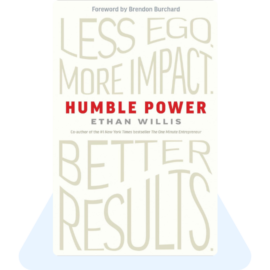
A Readers Books Club book summary of Humble Power: Less Ego. More Impact. Better Results. by Ethan Willis, presented by Dr Amiett Kumar
We live in an age of loud voices. Social media rewards whoever speaks first and shouts loudest, boardrooms often celebrate the confident personality over the curious one, and public life frequently treats admitting a mistake as a sign of weakness. Into that noise steps Humble Power, the new leadership and self-improvement book by Ethan Willis, with a bold and refreshing claim: humility is not a liability. It is the real competitive edge.
This Humble Power summary from Readers Books Club walks you through the book’s central message, its three-part road map, and ten practical lessons you can start applying today. It does not matter whether you lead a team of fifty, run your own business, manage a household, or simply want to become a better version of yourself. If you have been searching for a clear Humble Power book summary that is easy to read, honest about what the book does well, and connected to the wider world of personal growth, meditation, visualisation and success mindset, you are in the right place.
Humble Power was published by Hay House Business on 1 September 2026 and quickly attracted attention from some of the biggest names in personal growth. It appeared on the SUCCESS Bestsellers list on 1 October 2026, and early endorsements came from authors and podcasters including Jay Shetty, Mel Robbins, Angela Duckworth and Jamie Kern Lima. For readers following the conversation about the best leadership books 2026 has produced, and for anyone building a shortlist of the best books 2026 has to offer, this is a title worth understanding properly.
At Readers Books Club, the community built by Dr Amiett Kumar, we love books that change how a person thinks and not only how a person works. Humble Power does exactly that. It asks a deceptively simple question: what happens to your relationships, your results and your inner peace when you take ego out of the way? The rest of this summary answers that question, one lesson at a time.
A quick note on how this summary is organised. The book itself is built around three parts, and we have arranged its message into ten lessons spread across those parts. That way you can follow the logic from the inside out: first yourself, then your relationships, then your leadership.
Humble Power at a Glance
Humble Power: Less Ego. More Impact. Better Results. is written by Ethan Willis and published by Hay House Business. The print editions run to roughly 256 to 272 pages depending on the format, and the audiobook includes bonus Humble Power Reflections tracks along with a foreword narrated by Brendon Burchard. The publisher describes it as a research-backed, story-driven guide showing how humility, properly understood, multiplies personal growth, connection and influence. It sits comfortably alongside the best self improvement books on leadership, emotional intelligence and high performance, and it is suitable for managers, founders, coaches, students and anyone who wants to influence people without ego.
About the Author: Who Is Ethan Willis?
Ethan Willis is a best-selling author, entrepreneur and leadership coach with more than two decades of experience helping individuals and organisations grow with purpose. He is the co-author of The One Minute Entrepreneur, written with Ken Blanchard and Don Hutson, and of Prosper: Create the Life You Really Want, written with Randy Garn. His stated mission is to show that true greatness is found not in ego but in humility.
This background matters for anyone reading an Ethan Willis book summary, because Humble Power blends two sources of authority. On one side is research from behavioural, psychological and leadership studies. On the other is lived coaching experience and a wide range of stories drawn from the corporate world, the battlefield and popular culture. The mix keeps the ideas grounded in evidence while keeping the reading experience warm and human.
The Big Idea: Less Ego. More Impact. Better Results.
The central argument of Humble Power is a paradox. We are taught that to get ahead we must project confidence, take credit, protect our image and never show weakness. Willis argues that this approach quietly undermines the very success it promises. Ego distorts judgment, silences honest feedback, damages trust and turns every disagreement into a contest. Humility, by contrast, sharpens judgment, invites truth, builds trust and lets other people contribute their best work. In the book’s own summary, the formula is simple: less ego, more impact.
Crucially, Willis is careful about what he means by humility. He separates phony, self-deprecating behaviour from the real thing and makes the case that true humility is not thinking less of yourself. It is a clear-eyed willingness to see what is real, to learn from anyone, and to care about something bigger than your own image. According to coverage of the book, humility grows out of two core beliefs, one of which is that there is a power and purpose beyond our own. From that foundation come the attitudes of openness, curiosity and resilience, and from those attitudes come the behaviours of listening, learning and serving.
The publisher’s description adds three bold promises that shape the whole book. Admitting your mistakes can help you gain trust faster. Teams that prize accuracy over ego improve more quickly. And the best innovators are those willing to look beyond themselves. Each of these ideas challenges a common assumption about ego and success, and each is explored through stories and research rather than slogans. Willis also observes that society seems to be drifting away from humility, which is why he sees an urgent need for it today. He describes humble power as a force multiplier, and he puts the weight of ego into three plain words: ego is heavy.
The Three-Part Road Map of Humble Power
Willis organises the book into three sections that move steadily outward. Part One, Humble Self, is about the inner game: building a truthful inner narrative, exchanging ego for accuracy and aligning your life with purpose. Part Two, Humble Relationships, widens the lens to the people around you: creating psychological safety, inviting honest feedback and cultivating trust in every interaction. Part Three, Humble Leadership, turns to influence and organisational culture: leading with influence instead of control, giving power away so that others step up, and building a culture of accountability and growth.
This structure is one of the book’s quiet strengths. Many leadership books jump straight to tactics for managing others. Humble Power insists that you cannot lead others well until you have been honest with yourself, and that you cannot build a strong team until you have learned to build trust one relationship at a time. It is an inside-out philosophy, and it is why the book works just as well for personal growth as it does for management.
Part One: Humble Self (Lessons 1 to 3)
Lesson 1: Humility Is Strength, Not Weakness
Willis opens his case by clearing away a stubborn myth. Most of us picture a humble person as quiet, hesitant and a little invisible, someone who lets others take the credit and never pushes for what they want. The book draws a firm line between that picture and true humility, separating phony self-deprecation from the real thing. Genuine humility, as Willis presents it, is not about thinking less of yourself. It is about seeing yourself, other people and the world accurately, and staying willing to learn from all three.
That is why the word power sits right there in the title. Humble power is described as a force multiplier, something that makes your talents, your relationships and your decisions more effective instead of smaller. One reviewer captured the point neatly: humble power is not soft, it is the kind of strength that lasts. Egos can win a moment, a meeting or even a quarter, but they tend to exhaust people, including the person carrying them. Humility keeps you steady when the pressure rises.
In everyday life, this lesson shows up in small choices. It looks like saying “I don’t know, can you help me understand?” in a meeting where everyone else is pretending to know. It looks like giving credit publicly and taking responsibility privately. For anyone searching for how to become a better leader, this is the first and most important shift: stop treating humility as the opposite of ambition and start treating it as the foundation that lets ambition survive contact with reality.
Lesson 2: Trade Ego for Accuracy
If Lesson 1 is about what humility is, Lesson 2 is about what it does inside your head. The Humble Self section asks you to build a truthful inner narrative, which means exchanging ego for accuracy. We all tell ourselves a story about who we are, what we are good at and why things happen to us. Ego edits that story to keep us comfortable. We remember our wins clearly, explain away our failures, and quietly assume that anyone who disagrees simply does not understand.
Willis frames humility as an antidote to self-deception. It is the habit of asking not who is right but what is right, which opens the door to answers you could never find alone. This idea has a practical payoff far beyond personal comfort. According to the book’s central argument, teams that prize accuracy over ego improve more quickly, because their members spend less energy defending positions and more energy fixing problems. A leader who can say “the data does not support my idea” gives everyone else permission to be honest too.
This is also where humility meets emotional intelligence. Self-awareness, the ability to notice your triggers, blind spots and patterns, is the raw material of every other leadership skill. A simple way to practise it is to end each day with three questions. Where was I right today for the wrong reasons? Where was I defensive? What did I learn that I would have resisted yesterday? Over weeks, those honest answers quietly rewrite the story you tell yourself, and a more accurate story leads to better decisions, deeper personal growth and a stronger success mindset.
Lesson 3: Live for a Purpose Bigger Than Yourself
Humility does not grow in a vacuum. When you accept that you are part of something larger than your own résumé, ego loses much of its grip. You no longer need to win every conversation, because the point is no longer you. The point is the mission, the people you serve and the contribution you are making. This is the heart of purpose driven leadership, and it is why the Humble Self section asks you to align your life with purpose.
When purpose is bigger than status, feedback stops feeling like an attack and failure stops feeling like a verdict. From that foundation, the attitudes of openness, curiosity and resilience come naturally, and from those attitudes the everyday behaviours of listening, learning and serving follow. In other words, purpose is not a decorative extra. It is the engine that powers humble behaviour.
Willis illustrates these ideas with stories from many corners of life. Reviewers mention a NASA scientist whose humility helped map the moon, the ancient tale of David and Goliath, and a deeply personal memory of the humility his own father showed near the end of his life. The range of examples, from the corporate world to the battlefield to popular culture, is part of what makes the book feel research-backed yet human.
For readers who value spirituality, this lesson will feel familiar. Many wisdom traditions teach that a life is lived best in service of something beyond the self. Humble Power translates that timeless instinct into the language of modern leadership and high performance, so that a manager, a founder or a parent can apply it on an ordinary Tuesday.
Part Two: Humble Relationships (Lessons 4 to 7)
Lesson 4: Create Psychological Safety
Part Two moves from the inner world to the space between people. Its first demand is that you create psychological safety, an environment where people can speak up, ask questions, admit errors and offer unpopular ideas without fear of embarrassment or punishment. Willis presents humility as the thing that makes this possible, because people only feel safe around someone who does not need to be the smartest, most correct person in the room.
Think about the last time you hesitated to share an idea with a boss, a parent, a partner or a friend. Most likely you read their face, their tone and their history of reactions, and you decided it was not worth the risk. Ego-driven leaders unknowingly train everyone around them to stay quiet. The result is a team that nods in meetings and complains in corridors, and a leader who is forever surprised by problems that others saw coming months earlier.
The humble alternative is to make safety visible. Ask real questions and then actually listen to the answers. Thank the person who brings bad news. Admit your own uncertainty first, so others can follow. These behaviours are simple, but they are not easy, because each one asks ego to step aside. The reward is a relationship, a team or a family where the truth travels quickly, and where trust, the most valuable currency in any collaboration, grows with every honest exchange. This is how you build trust in practice, and it is the foundation of influence without ego.
Lesson 5: Treat Criticism as Information
One of the most quoted ideas from the book is a single sentence: “When ego isn’t in the way, criticism becomes information.” It captures the second lesson of Part Two, which is about inviting honest feedback. Most leaders say their door is always open, but few react well when someone actually walks through it with a hard truth. Ego hears criticism as a verdict on our worth, so we defend, explain, deflect or quietly punish the messenger. Humility hears the same words as data.
That shift changes everything. If criticism is information, you can be curious about it. You can ask which part is accurate, which part reflects the other person’s perspective, and which part you can act on today. Humility does not mean accepting every comment as gospel. It means evaluating feedback honestly instead of dismissing it by reflex, and that is exactly what the accuracy-over-ego principle demands.
To put this into practice, try asking three trusted people a single question: what is one thing I do that makes your work or your life harder? Then say thank you, and mean it. Follow up a few weeks later to show what you changed. Few habits do more for emotional intelligence, personal growth and leadership skills than a visible willingness to be corrected, and few habits make people trust you faster.
Lesson 6: Choose Collaboration Over Competition and Practise Forgiveness
Reviewers note that the chapters on relational humility explore how collaboration, rather than competition, strengthens our connections with others, and how forgiveness shapes those connections. Ego tends to see life as a scoreboard. If you win, I lose; if you are praised, I am overlooked. Humility replaces that zero-sum picture with a bigger one in which combining strengths produces results nobody could reach alone. This echoes the book’s promise that the best innovators are those willing to look beyond themselves.
Forgiveness belongs in this conversation because grudges are ego’s ledger. Every unpaid debt, every remembered slight and every rehearsed argument keeps us locked in a contest that the other person may not even know they are playing. Forgiveness is not the same as excusing harm or pretending nothing happened. It is the decision to stop letting the past dictate how you treat someone today, and it frees energy that can be spent on building instead of defending.
In practice, this lesson invites you to share credit generously, to celebrate a colleague’s success without comparing it to your own, and to repair strained relationships quickly instead of waiting for the other person to move first. Teams and families that practise this become places where people want to stay, and that retention, loyalty and goodwill are the hidden engine of long-term high performance.
Lesson 7: Admit Mistakes and Let Honesty Build Trust
Reviewers highlight the close relationship Willis draws between honesty and humility, and the publisher’s description makes a striking promise: admitting your mistakes can help you gain trust faster. This sounds backwards at first. We fear that confessing an error will make us look incompetent. But people usually notice mistakes long before we admit them, and what damages trust is rarely the mistake itself. It is the cover-up, the excuse or the blame that follows.
A humble admission does the opposite. It tells others that you value truth over image, that it is safe to be imperfect around you, and that problems will be solved rather than hidden. A simple three-part apology can help: name clearly what happened, own your part without qualifiers, and explain what you will do differently. Resist the urge to add a defence at the end, because that single sentence can cancel everything before it.
Leaders who practise this create a quiet competitive advantage. Their teams report problems early, take smart risks and learn from failure instead of burying it. In a world where trust is scarce, honesty delivered with humility becomes one of the fastest ways to build trust and one of the most reliable foundations for a success mindset.
Part Three: Humble Leadership (Lessons 8 to 10)
Lesson 8: Lead With Influence, Not Control
Part Three turns everything you have learned about yourself and your relationships into a way of leading. Willis encourages leaders to lead with influence instead of control and to give power away so that others step up. This is the opposite of the command-and-control instinct that ego loves. A controlling leader makes every decision, checks every detail and unintentionally becomes the bottleneck for the entire organisation. An influential leader shares purpose, clarity and authority, and then trusts capable people to act.
Giving power away is not abdication. It means being clear about the outcome you want, handing over genuine decision-making authority, and staying available for support rather than supervision. When people are trusted with real responsibility, they tend to rise to it, and their ownership produces better ideas and faster execution than any amount of micromanagement could.
Here the book’s core definition of humble leadership comes into focus. Leading with humble power is not about diminishing yourself. It is about amplifying others. Try this experiment: choose one decision you normally make yourself, hand it to someone on your team along with the context and the outcome you care about, and resist the urge to interfere. You will learn more about your team, and about your own ego, in that single week than in a month of meetings.
Lesson 9: Amplify Others and Build a Culture of Accountability and Growth
Humble leaders measure success by how many people around them grow, not by how impressive they look. The book’s third part asks you to build a culture of accountability and growth, and it treats those two ideas as partners rather than opposites. In an ego-driven culture, accountability usually means blame: someone must be found at fault so everyone else can feel safe. In a humble culture, accountability means ownership. People say what they are responsible for, report honestly on progress, and treat mistakes as lessons that make the whole team smarter.
This kind of culture starts with modelling. When a leader owns a failure openly, thanks a colleague for a correction and credits others for wins, the message spreads faster than any policy document. Growth follows naturally, because people who feel trusted and respected take on harder challenges and are more willing to ask for help.
To apply this lesson, close your next team meeting by asking each person what they are owning this week and what support they need. Celebrate one lesson learned from a failure, not only wins. Spend time developing the people you lead through mentoring, stretch assignments and honest conversations about their next step. Leaders who amplify others build teams that keep performing when the leader is not in the room, and that is the clearest sign of high performance.
Lesson 10: Stay Grounded and Build Results That Last
The final lesson ties everything together. Success is its own test, because the more we achieve, the more ego tends to grow. Praise, titles and applause can quietly convince us that we no longer need feedback, that our way is obviously right and that the rules of learning apply to someone else. Willis argues that humility is what keeps a leader grounded when things go well and resilient when they do not. Humble power, as reviewers describe it, is not soft. It is strong enough to last.
That durability is the real promise of the book’s subtitle: less ego, more impact, better results. Results built on fear, image management and control can look impressive for a season, but they depend on one person’s energy and tend to collapse under stress. Results built on trust, honest feedback, shared purpose and developed people are sustainable. They survive leadership changes, market shocks and personal setbacks, because the strength lives in the culture and not in a single ego.
So the final practice is to stay teachable. Keep asking questions, keep inviting correction and keep connecting your work to a purpose larger than yourself. When you notice ego rising, treat it as a signal and not as an enemy: pause, breathe and ask what is actually true. That small, repeatable habit is how a success mindset becomes a lifelong one.
Humble Power, Meditation, Visualisation and the Law of Attraction: The Readers Books Club Perspective
A quick clarification before we go further. Humble Power is a leadership and personal growth book grounded in research and stories, and Ethan Willis does not present it as a manifestation manual. What follows is the Readers Books Club perspective on how its ideas pair with practices that our community already loves, including meditation, affirmation, visualisation and the law of attraction.
Many people drawn to manifest anything techniques discover a hidden trap. Manifestation can quietly become an ego project: wanting more, proving more, claiming more. Humble Power offers a healthy correction. Its first instruction, to build a truthful inner narrative, reminds us that real manifestation begins with an honest picture of where we stand. Its call to live for a purpose bigger than ourselves turns desire into contribution, which is a more stable foundation for any goal.
Meditation is the most natural partner. Sitting quietly and watching your thoughts teaches you to notice defensiveness, comparison and the urge to be right without obeying them, which is exactly the skill humility requires. Affirmation works best when it is honest and not inflated. Instead of repeating that you are the best, try statements such as: I am willing to learn from anyone, I can hear feedback without losing my worth, and I lead by lifting others up.
Visualisation becomes more powerful when it includes the humble behaviours themselves. Picture yourself listening patiently in a tense meeting, receiving criticism calmly, crediting a teammate in public and handing a decision to someone who is ready for it. Mental rehearsal makes those behaviours easier to choose when real pressure arrives. Add a spiritual lens, in which your work serves something beyond you, and you have a rounded daily practice for inner peace and outer results.
This is also where coaching earns its place. A good life coach acts as a mirror for blind spots, and blind spots are precisely what the Humble Self section asks you to confront. Dr Amiett Kumar, described by his community as a top manifestation coach and often called India’s best manifestation coach, has built Readers Books Club around this combination of wise books and practical inner work. Humble Power fits that mission beautifully.
A 30-Day Humble Power Practice Plan
Reading a book is easy; changing habits is harder. Here is a simple month-long plan that turns the ten lessons into action.
In week one, focus on the Humble Self. Spend ten minutes each morning on meditation and one honest affirmation, and end each day with the three reflection questions from Lesson 2. Write a sentence describing the purpose behind your work or your life.
In week two, focus on relationships. Ask three trusted people what you do that makes their life harder, thank them without defending yourself, and make one small change in response. Practise asking a real question and listening fully in at least one conversation each day.
In week three, practise honesty and forgiveness. Admit one mistake using the three-part apology, release one grudge you have been carrying, and celebrate someone else’s success without comparing it to your own.
In week four, step into humble leadership. Hand one decision to someone else, ask your team or family what each person is owning, and spend time developing one person. Close the month by repeating the feedback question from week two and notice what has changed. Visualise the humble behaviours for a few minutes each morning throughout the month so they feel familiar when the moment comes.
Key Takeaways From Humble Power
If you remember only the essentials, remember this. Humility is a strength that multiplies your talents rather than diminishing them. Accuracy beats ego because it lets you and your team improve faster. A purpose bigger than yourself loosens ego’s grip. Psychological safety, honest feedback, collaboration, forgiveness and admitting mistakes are the habits that build trust. And leaders who lead with influence, give power away, amplify others and stay grounded create results that last. Less ego, more impact, better results.
Who Should Read Humble Power, and a Balanced View
Humble Power is a strong fit for managers and founders who want to build healthier teams, for coaches and life coaches who help clients with personal growth, for students preparing for leadership roles, and for anyone who senses that their own ego is getting in the way of connection. It is also useful for readers of the best self improvement books who want a research-backed and story-driven take on a topic that is often treated as a platitude.
In fairness, readers who have already explored humility-centred leadership books such as Good to Great or Dare to Lead may recognise some themes. The value of Humble Power lies in how it organises those ideas into a clear three-part path from self to relationships to leadership, and in the warmth of its storytelling. Like every book on character, it also cannot do the work for you. Humility is a daily practice and not a one-time insight, so the real test is what you do on the day someone criticises you.
This summary is based on the publisher’s description, the author’s published material and reviews of the book. It is meant to help you decide whether to read the full text, and it is not a substitute for the author’s own words, stories and research.
Final Thoughts: Is Humble Power Worth Reading?
For anyone asking how to become a better leader in 2026, the answer may be less about adding new skills and more about removing an old obstacle. Humble Power makes a persuasive case that ego is that obstacle, and that humility, properly understood, is the quiet strength that unlocks trust, influence and long-term success.
Whether you are leading a company, raising a family, building a coaching practice or simply working on yourself, the ten lessons in this Humble Power summary offer a clear path. Start with an honest look inward, build trust one conversation at a time, give power away, and stay teachable as you grow. If this summary resonated with you, pick up the book, pair it with a daily meditation and visualisation practice, and share your biggest takeaway with the Readers Books Club community.
Frequently Asked Questions About Humble Power
Who wrote Humble Power? Humble Power: Less Ego. More Impact. Better Results. was written by Ethan Willis, a best-selling author, entrepreneur and leadership coach, and published by Hay House Business in September 2026.
What is the main message of Humble Power? The book argues that humility, not ego, is the real competitive edge. Through a three-part road map of Humble Self, Humble Relationships and Humble Leadership, it shows how honesty, trust and service multiply personal growth and influence.
Is Humble Power one of the best leadership books of 2026? It is certainly one of the most talked-about. It reached the SUCCESS Bestsellers list on 1 October 2026 and drew praise from well-known authors, though the best test is whether its ideas help you.
Who should read Humble Power? Leaders, managers, entrepreneurs, coaches, students and anyone interested in emotional intelligence, personal growth and a stronger success mindset.
Can humility really improve high performance? According to the book’s argument, yes. Humility improves accuracy, invites honest feedback, builds trust and develops people, and those are the conditions in which teams perform at their best.
About Readers Books Club and Dr Amiett Kumar
Readers Books Club is a YouTube and podcast community that shares book suggestions, finance ideas and visualisation practices with a following of more than one million subscribers. It was created to help people learn from great books and apply them to real life, from meditation and affirmation to spirituality, coaching and the law of attraction. Its host, Dr Amiett Kumar, is known to his audience as a top manifestation coach and life coach, and is widely described as India’s best manifestation coach. To explore more summaries, videos and podcasts, visit Readers Books Club and Amiett Kumar, and subscribe to the Readers Books Club channel on YouTube.
Contents