A Practical Book Summary for Mindset, Communication, and Personal Transformation
| “Awareness of a pattern can create more choice in how you respond.” |
Have you ever wondered why two people can experience the same event but remember it in completely different ways? Why does one person hear feedback and feel motivated, while another hears the same words and feels attacked? Why do certain memories instantly change our mood, and why do some conversations create trust while others create resistance?
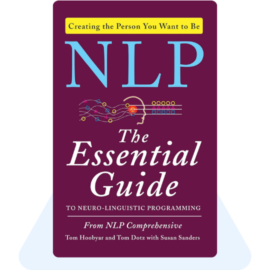
NLP: The Essential Guide to Neuro-Linguistic Programming by Tom Hoobyar, Tom Dotz, and Susan Sanders tries to answer these questions by exploring the relationship between our nervous system, language, mental images, emotions, and behaviour. Published in 2013 by William Morrow/HarperCollins, the book is presented as a practical, step-by-step guide for understanding how people construct their inner experience and how they may develop greater flexibility in thinking, feeling, communicating, and acting.
The guide is filled with observations, stories, “discoveries”, and exercises that help readers notice their mental pictures, inner language, sensations, and assumptions. Its central message is simple: awareness of a pattern can create more choice in how you respond.
That focus fits the Readers Books Club audience. Founded by Dr Amiett Kumar, the platform connects books with practical self-improvement, podcasts, coaching, meditation, spirituality, the law of attraction, and daily implementation. This summary follows the same spirit by translating the book’s main ideas into clear lessons.
Book at a Glance
| Title | NLP: The Essential Guide to Neuro-Linguistic Programming |
| Authors | Tom Hoobyar, Tom Dotz, and Susan Sanders |
| Publisher | William Morrow/HarperCollins |
| First published | 2013 |
| Category | Psychology, communication, self-help, coaching, personal growth |
| Best for | Beginners in NLP, coaches, leaders, teachers, sales professionals, creators, parents, and anyone interested in mindset and communication |
| Core idea | Your experience is shaped not only by what happens, but by how your mind represents, interprets, and communicates what happens. |
What Is Neuro-Linguistic Programming?
The term Neuro-Linguistic Programming can sound highly technical, but the book presents it in an accessible way.
“Neuro” refers to the nervous system and the way we process experience through sight, sound, sensation, taste, and smell. “Linguistic” refers to language, both the words we speak and the inner dialogue we use to describe life to ourselves. “Programming” refers to learned patterns, habits, associations, and strategies that influence our behaviour.
In simple terms, NLP studies how people organise their inner world and how those patterns affect their emotions, choices, relationships, and results.
The authors argue that people respond to an internal map of reality shaped by memory, beliefs, expectations, culture, attention, and sensory experience. Because every person builds a different map, misunderstandings are natural. Instead of assuming another person is unreasonable, ask: What might they be seeing, hearing, feeling, or believing that I am missing?
Part One: Understanding and Managing Your Inner World
1. Your Mind Creates an Internal Representation of Experience
The first major section of the book focuses on how we think. According to the NLP model described by the authors, we do not store experience as a perfect recording. We encode it through internal pictures, sounds, sensations, words, and meanings.
Think about a pleasant memory. You may notice a picture, perhaps bright and close. You may hear a voice or music. You may feel warmth in your chest. Now think about an uncomfortable memory. The image may be darker, larger, closer, or more intense. The sound may be sharp. Your body may tighten.
NLP calls the qualities of these experiences submodalities. A picture can be bright or dim, close or distant; a sound can be loud or soft; a sensation can be heavy or light. The authors invite readers to experiment: move a troubling picture farther away, soften a critical inner voice, or brighten a motivating image of the future. The purpose is not denial, but awareness of how the mind already edits experience.
| Practical takeaway: I am aware of the pictures, sounds, sensations, and words shaping my emotions, and I pause to create space between what happens and how I respond. |
2. State Management: Emotions as Information, Not Permanent Commands
A major promise of the book is emotional flexibility. Instead of treating a feeling as an identity (“I am anxious” or “I am a failure”), it encourages language such as “I am experiencing anxiety” or “I notice a discouraging pattern.” The shift separates the person from the temporary state.
The book explores methods for recalling resourceful states such as confidence, calmness, focus, courage, humour, and determination. One common NLP technique is anchoring: deliberately linking a specific cue – a touch, gesture, word, image, or breath – to a useful emotional state. The idea is similar to how a song can instantly bring back a memory. The difference is that an anchor is created intentionally.
For example, you might vividly recall a confident moment, adopt the associated posture and breathing, and connect it to a simple cue. With repetition, the cue may become a useful reminder. Meditation offers a related lesson: thoughts and feelings can be observed without being automatically obeyed. Both approaches aim to create space between reaction and response.
| Practical takeaway: I am preparing both my words and my emotional state before every important meeting, presentation, podcast, interview, or difficult conversation. I breathe slowly, recall a resourceful experience, adjust my posture, and mentally rehearse the response I want to embody. |
3. Recognizing Incongruence
Have you ever said yes while every part of your body wanted to say no? Have you smiled while feeling uncomfortable? Have you committed to a goal while secretly expecting to fail?
The book calls this incongruence a mismatch between different parts of experience. Words may say one thing while tone, posture, facial expression, or inner feeling says another.
Incongruence may signal unresolved conflict. A person can want success while associating it with pressure or rejection, want a relationship while fearing vulnerability, or want a business while fearing visibility. Instead of labelling resistance as laziness, the authors ask what it is trying to protect and what positive intention may lie behind it.
| Practical takeaway: I am honest about what I want and curious about what I fear might happen if I achieve it. I am willing to understand and resolve the hidden conflict behind my resistance. |
4. Reducing Internal Resistance and Finding the “Brake”
The section sometimes described as “Whoa Is My Brake?” explores why motivation can suddenly disappear. The authors suggest that people often have an internal brake, a belief, fear, association, or competing value that slows action.
Imagine that you want to become more successful. Consciously, the goal sounds attractive. Yet perhaps you learnt that successful people become selfish, have no time for family, or face constant criticism. Your mind may protect you from the goal because the goal has been linked with danger.
The book recommends looking beyond the surface goal and identifying the outcome you truly want. You may not want “more money” as an abstract object; you may want security, freedom, contribution, choice, or peace. When the deeper outcome becomes clear, you can design multiple ways to reach it.
This is where the well-formed outcome becomes useful. The outcome should be positive, specific, recognisable, connected to your own actions, and compatible with the larger context of your life. In coaching, the deeper questions are: What will the goal give you? How will you know you achieved it? What could stop you? What resources do you have? What is the first manageable action?
| Practical takeaway: I am turning vague goals into clear, specific, and observable actions. I am speaking clearly for five minutes in my next team meeting while maintaining steady breathing and comfortable eye contact. |
5. Upgrading Your Self-Concept
One of the most meaningful parts of the book examines self-concept, the collection of mental representations through which we answer the question, “Who am I?”
People rarely hold a single neutral fact about themselves. They build an internal database. A person who believes “I am not disciplined” may repeatedly replay memories of unfinished tasks while ignoring hundreds of moments when they kept promises, supported family members, or completed difficult work. The self-concept becomes selective.
The authors encourage readers to explore how identity is constructed. Which memories are included? Which are excluded? How are they arranged? Are negative examples large and vivid while positive examples are distant and weak?
The aim is not to create a false identity. It is to build a more balanced and useful one. A person can acknowledge mistakes without turning those mistakes into a permanent definition.
This insight connects with habit books and spirituality. Change becomes easier when behaviour supports identity, “I am becoming a reader” or “I recover after setbacks”. Spiritual traditions similarly invite us to examine the stories of the mind rather than assuming they are the whole truth.
| Practical takeaway: I am strengthening my courage by remembering the moments, large and small, when I acted despite uncertainty. I am using this evidence to support myself whenever courage is required. |
Part Two: Understanding and Communicating with Other People
6. Rapport: Making Comfortable Connections
The second half of the book shifts from self-management to interpersonal communication. A central concept is rapport: the feeling of safety, connection, and mutual responsiveness that makes communication easier.
Rapport does not mean pretending to agree. It means meeting another person’s experience with enough respect and attention that they feel understood.
The authors discuss rhythm, posture, breathing, tone, vocabulary, and pace. Matching and mirroring may support rapport, but mechanical imitation feels manipulative. The deeper principle is attentiveness: Does the person want detail or the big picture? Are they focused on possibilities or risks? Communication improves when speakers adapt without losing authenticity.
| Practical takeaway: I am listening carefully to each person’s pace, language, and preferred level of detail. I am responding in a way that is easy for them to understand while remaining authentic to myself. |
7. Listening for Preferred Language and Missing Information
The book explains that people often reveal aspects of their thinking through language. One person may say, “I see what you mean.” Another may say, “That sounds right.” Another may say, “I can’t get a grip on this.”
These expressions may reflect visual, auditory, or kinaesthetic language preferences. The authors recommend noticing these predicates and using language that resonates with the listener. Again, this is not a rigid personality test. It is a way to become more flexible and attentive.
The book also explores what is missing from language. People naturally delete, distort, and generalise information. Statements such as “Nobody respects me”, “This always happens”, or “They made me feel terrible” may contain assumptions that deserve examination.
Precision questions can reopen possibility.
Who specifically does not respect you?
Always, even in every situation?
How exactly did their action lead to that feeling?
What would respect look like in observable behaviour?
What prevents you from responding differently?
These questions resemble the NLP Meta Model, a method for recovering detail from vague language. Used respectfully, it can help coaching and problem-solving; used aggressively, it feels like interrogation.
| Practical takeaway: I am replacing arguments with curiosity when I hear an absolute statement. I am asking for a specific example and exploring at least one possible exception. |
8. Nonverbal Communication and “More Than Mind Reading”
The book uses the attractive idea of “mind reading”, but its real focus is careful observation, not supernatural ability. Facial expression, breathing, gesture, posture, voice quality, timing, and hesitation can provide clues about a person’s internal response.
The authors teach readers to notice changes rather than rely on universal rules. Crossed arms do not always mean defensiveness; the person may simply feel cold. Looking away does not always mean dishonesty; the person may be thinking. Context matters.
A better question is ‘What changed? Did breathing become shallow, the voice quieter, or the posture more relaxed? Such observations should remain hypotheses, not verdicts. Check them openly: “I noticed you became quieter when we discussed the deadline. What is happening for you?”
| Practical takeaway: I am observing body-language clues with care, and I am verifying my interpretation instead of treating an assumption as certainty. |
9. Making Your Point with Clarity, Safety, and Stories
Communication fails when people focus only on proving their point. The book argues that influence becomes easier when the listener first feels understood and safe.
The authors explore framing, metaphor, and storytelling. A direct instruction may create resistance, while a story lets a person discover meaning. Books, podcasts, YouTube videos, coaching, and leadership all use this principle: demonstrate understanding before offering advice, then use examples that fit the listener’s world.
| Practical takeaway: I am seeking to understand the other person’s position before presenting my own. I am describing their viewpoint fairly so that mutual understanding can reduce unnecessary resistance. |
10. Perceptual Positions, Collaboration, and Conflict Resolution
One of the book’s most practical conflict-resolution tools is the use of perceptual positions. When stuck in conflict, people usually experience the situation from the first position: their own eyes, feelings, needs, and interpretation.
The second position means imaginatively stepping into the other person’s perspective. What might they be seeing? What matters to them? What are they protecting? What do they fear?
The third position means observing the interaction from a neutral distance, as if watching both people in a film. What pattern becomes visible? How does each person’s behaviour influence the other?
These shifts expand the available information. Both sides may be protecting positive intentions, respect, security, autonomy, fairness, or belonging while their strategies clash. Conflict integration looks for a higher-level outcome that honours both. One team member may want speed and another accuracy; the conflict may be between two valuable priorities.
| Practical takeaway: I am looking at conflict through my perspective, the other person’s possible perspective, and the view of a neutral observer. I am identifying an outcome that both sides can genuinely share. |
Maintaining Momentum: Turning Insight into Practice
A common weakness of personal development books is that readers feel inspired but fail to practise. NLP: The Essential Guide tries to prevent that by making learning experiential. Its “discoveries” are invitations to test ideas, notice responses, and build skill through repetition.
The book’s practical philosophy can be summarised in four stages:
Awareness: Notice the current pattern without immediate judgement.
Outcome: Decide what you want instead.
Flexibility: Try different internal or external responses.
Feedback: Observe what happens and adjust.
This framework remains useful even for readers who question some NLP claims. It encourages experimentation over self-blame: change the method, context, language, cue, or level of difficulty.
A Simple NLP Practice Routine
A practical daily routine can be simple: define one clear outcome in the morning, rehearse a calm or confident state for two minutes, challenge one absolute statement, practise attentive listening in one conversation, and review one success and one improvement at night.
NLP, Meditation, Spirituality, and the Law of Attraction
Readers Books Club frequently explores the connection between books, meditation, spirituality, the subconscious mind, the law of attraction, coaching, and personal transformation. NLP can be discussed within that wider context, provided the ideas are used responsibly.
Meditation develops awareness of thoughts and reactions; NLP examines how those thoughts are pictured, voiced, and felt. Spirituality invites people to question rigid ego stories, while NLP’s self-concept and perceptual-position exercises show that one interpretation is not the only one. The law of attraction emphasises intention and emotional alignment; the well-formed outcome adds resources, consequences, and action steps. Coaching can use related tools such as reframing, perspective-taking, rapport, and mental rehearsal.
The practical message is this: visualisation should be connected to behaviour. Affirmations should be believable enough to practise. Meditation should improve awareness. Spirituality should deepen responsibility and compassion. Coaching should produce clear action. A life coach can support the process, but the client must still make choices and take steps.
What the Book Does Well
The book’s greatest strength is practicality. It explains internal representation, state, congruence, rapport, questioning, and perspective-taking through stories and exercises. It also emphasises flexibility, empathy, and the connection between personal mindset and interpersonal communication.
A Responsible Evidence Note
| NLP is influential in coaching, communication training, business, and personal development, but many of its broad scientific and therapeutic claims remain debated. A systematic review published in the British Journal of General Practice found limited, low-quality evidence for NLP interventions on health-related outcomes. Another evidence review found no suitable clinical evidence supporting NLP as a treatment for PTSD, generalised anxiety disorder, or depression. |
| That does not mean every exercise in this book is useless. Practices such as goal clarification, perspective-taking, careful listening, mental rehearsal, and examining self-talk may overlap with established coaching and psychological methods. However, NLP should not be presented as a proven cure for medical or mental-health conditions. |
| Use the book as a personal development and communication guide, not as a replacement for qualified medical care, psychotherapy, or evidence-based treatment. Anyone experiencing severe anxiety, trauma, depression, or another mental-health concern should consult a licensed professional. |
Who Should Read This Book?
This book may be useful for:
- Readers who enjoy practical self-improvement books
- Life coaches and coaching students
- Managers, leaders, and entrepreneurs
- Teachers, trainers, and public speakers
- Sales and communication professionals
- Podcast hosts, interviewers, and content creators
- People who want to understand emotional triggers
- Anyone interested in limiting beliefs, confidence, goals, or relationships
- Readers exploring meditation, spirituality, or the law of attraction who also want structured action
It is less suitable for readers seeking a tightly academic textbook, a very short introduction, or a clinically validated therapy manual.
Ten Key Lessons from NLP: The Essential Guide
- Your experience is filtered through an internal map; it is not a perfect copy of reality.
- Thoughts have sensory structure. Pictures, sounds, sensations, and inner language influence emotion.
- A state is an experience, not an identity. You can observe it and sometimes shift how you relate to it.
- Resistance may contain a protective intention. Understand it before trying to overpower it.
- Goals become stronger when they are specific, observable, self-directed, and connected to a meaningful outcome.
- Self-concept is built from selected evidence. A more balanced identity can support better behaviour.
- Rapport begins with attention, respect, and flexibility, not manipulation.
- Language deletes and generalises information. Precise questions can recover choices.
- Conflict becomes easier to resolve when you explore multiple perspectives and shared intentions.
- Insight becomes transformation only through practice, feedback, and consistent action.
Frequently Asked Questions
What is the main idea of NLP: The Essential Guide?
The main idea is that people can gain more flexibility by understanding how they internally represent experience through images, sounds, sensations, language, beliefs, and learned patterns. The book then applies that awareness to emotion, self-concept, communication, relationships, influence, conflict resolution, and goal-setting.
Is this book suitable for beginners?
Yes. It is written as an accessible, practical introduction and uses stories and exercises rather than relying only on technical definitions. However, it is a detailed book, so beginners may benefit from reading slowly and practising one concept at a time.
Can NLP help with confidence and communication?
The book offers exercises intended to support confidence, emotional state management, rapport, listening, precise questioning, mental rehearsal, and perspective-taking. These may be useful as personal development or coaching tools. Results will vary, and clinical claims should be treated cautiously.
How are NLP and meditation connected?
Both can increase awareness of internal experience. Meditation usually emphasises observation and non-attachment, while NLP emphasises the structure of thoughts, language, and sensory representation. Used together, meditation may create calm awareness, while NLP-style questions may help clarify patterns and desired responses.
Is NLP the same as the law of attraction?
No. NLP is a model of communication and subjective experience, while the law of attraction is a broader belief about focus, intention, emotion, and manifestation. They can overlap in practices such as visualisation and goal clarity, but NLP places stronger emphasis on communication patterns, sensory detail, feedback, and behavioural flexibility.
Does NLP replace therapy or professional coaching?
No. A book can support reflection and skill-building, but it cannot diagnose or treat a health condition. For mental-health concerns, consult a licensed professional. For personal or professional goals, an ethical, qualified life coach may provide structure but should remain within their professional scope.
Final Thoughts: Change the Pattern, Expand the Choice
NLP: The Essential Guide to Neuro-Linguistic Programming is ultimately a book about choice.
It asks you to notice the mental pictures you replay, the voices you believe, the meanings you assign, the identities you defend, and the communication habits you repeat. It then asks a liberating question: Is there another way to represent this, respond to this, or communicate this?
Its most valuable lesson is not that every difficulty can be solved instantly, but that awareness and flexibility can widen the space in which better decisions become possible.
For the Readers Books Club community, that lesson is especially relevant. Books become transformative only when ideas move from the page into daily life. Dr Amiett Kumar’s work across books, podcasts, meditation, spirituality, law of attraction, coaching, and self-development repeatedly emphasises implementation. Reading gives you language for change; practice gives you evidence of change.
Begin with one pattern. Notice it without shame. Decide what you want instead. Choose a small experiment. Observe the result. Adjust and repeat.
Your mind is not a machine that must remain programmed forever. It is a living system capable of learning. And every time you pause, become aware, and choose a more useful response, you strengthen the possibility of a different future.
Learn More from Dr Amiett Kumar:
Contents