Have you ever promised yourself that this time you would change? Perhaps you made a vision board, downloaded a habit tracker, repeated a confident affirmation, and imagined a completely different future. For a week, everything felt possible. Then an awkward conversation, a rejected application, an unexpected bill, or one difficult morning brought back the old thought: “This is just who I am.” Your goal remained attractive, but your familiar reactions returned. It can feel as though two versions of you are competing for control: the person who wants a different life and the person who knows every shortcut back to the old one.
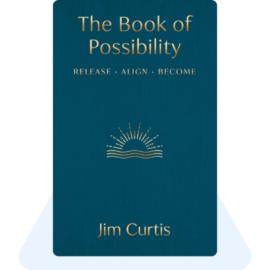
That tension is the doorway into The Book of Possibility: Release. Align. Become. by Jim Curtis. The book’s central proposition is that personal change involves more than rearranging circumstances. Curtis asks readers to examine their self-image, learned beliefs, emotional habits, and everyday choices. Its three-part framework is simple enough to remember: release fear-based conditioning, align with what matters, and become someone who practices the new identity in real life. The official publisher describes an experiential format combining reading, guided listening, reflective writing, coaching questions, and hypno-meditations.
For Readers Books Club, this is an appealing bridge between self-improvement books and the practical questions readers bring to our conversations: How can I stop repeating a pattern I understand but cannot seem to change? What should I do when positive thinking collides with uncomfortable facts? How do meditation, spirituality, motivation, and disciplined action fit together? This Jim Curtis book summary takes the verified central ideas and explores them through everyday scenarios, critical reflection, and actionable exercises. It is a thematic guide based on the publisher’s and author’s publicly available materials, not a claim to reproduce or document every page or chapter of the book. The extra checklists and experiments are original Readers Books Club applications, not quotations or exercises attributed to Curtis.
One distinction will guide the entire article. The author presents a transformational coaching and spiritual framework, and it may be meaningful to readers. Research on mindfulness offers some support for managing stress and attention, but it does not establish that thoughts automatically attract money, love, or medical recovery. A changed mindset can help you notice options and act differently; it cannot guarantee another person’s choices or erase structural obstacles. Hold that realistic perspective, and the book’s invitation becomes more useful: instead of demanding instant magic, start building a different relationship with yourself and your next decision.
Quick Book Facts: What Is The Book of Possibility About?
The Book of Possibility is a self-help title by transformational coach and wellness leader Jim Curtis. Simon & Schuster lists the US hardcover publication date as September 8, 2026, with 336 pages and ISBN 9781668246498. The subtitle is Release. Align. Become. and the publisher identifies the intended themes as subconscious patterns, identity, relationships, confidence, healing, and meaningful change. Curtis has worked in wellness leadership, including roles at WebMD, Everyday Health, and the Institute for Integrative Nutrition; the publisher also says his approach was shaped by personal experiences with illness and childhood trauma.
Rather than offering only an inspirational argument, the official description emphasises an interactive reading experience. The book invites readers to read, listen, and write. According to the author’s dedicated website, its companion offering provides six guided hypno-meditations covering Release, Align, Become, Health, Wealth, and Love. The website also mentions self-hypnosis, a happiness toolkit, and a recipe for transformation that combines a goal, awareness of limiting beliefs, small actions, and repeated practice. Those are author-described features, not independently verified treatments or promised outcomes.
Who might be interested? Someone stuck in repeated relationship dynamics, someone attempting a career change but struggling with self-doubt, a reader exploring manifestation and the subconscious mind, or a person who enjoys reflective personal growth books rather than a strict productivity manual. Its tone, as the publisher presents it, resembles a compassionate coaching conversation. It asks you to consider what you have learned about yourself, whether those conclusions still serve you, and what you could practice next. It is not a financial plan, medical manual, or substitute for licensed mental-health care.
The best way to approach this summary is to imagine a three-part journey. Release means understanding the weight you carry. Align means choosing a direction that fits your actual values. Become means behaving in small, repeatable ways consistent with that direction. The sequence matters: a new action plan built on unexamined fear may become another exhausting performance; reflection without action may become endless journaling. Together, the three stages make a useful structure for turning insight into everyday behaviour.
The Core Message: A New Life Begins With a New Relationship to Yourself
Imagine two people who want to speak confidently at work. Both take the same public-speaking course. One treats a nervous presentation as proof of permanent inadequacy. The other treats it as a skill they can strengthen with practice, useful feedback, and preparation. They may feel equal discomfort, but they interpret the moment differently. That interpretation changes what they do next: withdraw, ask for help, rehearse, or try again. The point is not that one person can think themselves guaranteed success. It is that self-concept influences attention, interpretation, and choices.
Curtis frames identity as something operating beneath outward goals. If a person has internalized the story “I always disappoint people,” they may over-apologize, avoid necessary conversations, or interpret a neutral message as rejection. Someone who believes “I cannot handle money” might avoid checking a bank balance because the information feels threatening. These are illustrative scenarios created for this article, not case studies supplied by the book. Their purpose is to show how an old belief can become a practical obstacle even when a new goal is sincerely desired.
The idea of possibility here is not an instruction to deny reality. A person dealing with debt still needs a budget and perhaps professional advice. A person recovering from a difficult relationship still needs boundaries and trustworthy support. A person living with illness needs appropriate medical care. An identity-based approach asks what beliefs and behaviours might help alongside those real-world resources. It should never turn hardship into an accusation that someone simply failed to think positively enough.
For a reader interested in mindset transformation, the most powerful question is therefore not “How do I force the universe to give me an outcome?” It is “Which story about myself is shaping the next action I take?” A story is worth examining when it sounds permanent, absolute, or inherited: “people like me never succeed,” “asking for help makes me weak,” or “nothing changes.” Some of these statements may have arisen from painful experiences and deserve compassion rather than blame. Noticing them allows a person to test whether they are accurate today and whether a more useful interpretation is possible.
Part One RELEASE: Notice the Old Patterns Without Attacking Yourself
The first stage of Curtis’s signature framework is Release: becoming aware of and loosening fear-based conditioning. In ordinary life, conditioning can look unremarkable. Perhaps you learned that earning approval requires constant availability. Now you agree to unreasonable requests, feel resentful, and then conclude that relationships are exhausting. Perhaps criticism during school taught you to associate mistakes with humiliation. Years later, you delay submitting your work until it is perfect, missing opportunities you could have explored with a rough first attempt.
Release begins with curiosity rather than a dramatic declaration that the past no longer matters. Ask when an old reaction shows up, what situation triggers it, and what it is trying to protect. A need to control every detail might have developed when life once felt unsafe. Avoiding difficult conversations might have been a sensible childhood strategy that now blocks an honest adult relationship. Naming that history does not make the behaviour automatically helpful today. It does, however, replace the question “What is wrong with me?” with the more workable “What did I learn, and what can I choose now?”
Notice the difference between guilt and responsibility. Guilt keeps replaying a failure as an identity: “I am careless.” Responsibility describes behaviour precisely: “I missed this deadline; I need a reminder system and a conversation with my colleague.” The second sentence gives you an action. It also protects self-respect. If changing a mindset requires constant self-criticism, the process will become another source of exhaustion rather than freedom. Treating yourself with compassion does not excuse harmful behaviour; it makes it easier to face behaviour honestly without collapsing into shame.
Readers Books Club exercise The recurring-story audit: On a page, write one situation that repeatedly troubles you. Describe the facts without interpreting motives. Next, record your automatic thought, the emotion it brings, and the action you usually take. Finally, ask: “What else might be true?” and “What would a small, respectful response look like?” For example: “My manager requested revisions” is a fact; “They regret hiring me” is an interpretation. You may still need to improve the work, but you no longer have to treat mind-reading as evidence.
Some patterns carry trauma, severe anxiety, or persistent distress that are difficult to address alone. If reflection becomes overwhelming, pause and seek qualified support. The book’s companion practices are described by the author’s website as supportive tools rather than replacements for professional health or mental-health care. Release is not about forcing yourself to revisit everything at once. It can begin by making one reaction visible, letting it be understood, and responding a little differently the next time.
Release and the Subconscious Mind: What Is Helpful, and What Needs Caution?
“Subconscious mind” is a popular term in self-help, coaching, and manifestation discussions. In this context, it points toward learned associations, familiar reactions, habits, and assumptions that can influence behaviour without being the focus of conscious attention. Curtis uses this language to connect current patterns with deeper identity. His work also blends spirituality, hypnotherapy, mindfulness, and neuroscience, according to the publisher. Readers should understand that a book’s use of scientific language does not mean every spiritual or therapeutic claim has the same level of experimental support.
Consider a person who opens social media whenever a difficult project becomes uncomfortable. The sequence may run automatically: uncertainty appears, attention moves to the phone, short-term relief arrives, and the project gets harder to restart. Calling this a “subconscious pattern” can help the person notice its repetitive character. But the practical solution might be surprisingly ordinary: remove the app from the home screen, break the assignment into ten-minute stages, and learn to tolerate a little discomfort. Your past matters, but your environment and habits matter too.
A useful approach is to separate three layers. First, identify the experience: “I feel threatened by this conversation.” Second, consider possible explanations without claiming certainty: “Perhaps previous criticism makes this feel familiar.” Third, choose a response you can evaluate: “I will write down my point, ask one question, and review what actually happened afterward.” That method respects emotional complexity while maintaining contact with observable reality. It does not require pretending that every feeling is a hidden message from the universe or that every challenge is caused by a limiting belief.
If you are exploring hypno-meditation or self-hypnosis, remember that the published evidence for hypnosis varies by application. The US National Center for Complementary and Integrative Health notes promising findings for some anxiety-related settings but says the overall evidence is not conclusive. Mindfulness likewise has possible benefits and limitations, including occasional negative experiences. Use such practices gently, avoid exaggerated promises, and consult qualified professionals for significant health concerns. The useful invitation in this book is self-observation, not replacing evidence-based care with a belief that the mind controls every outcome.
Seven Limiting Stories Worth Examining Before You Try to Change
The following seven stories are an original Readers Books Club reflection tool, not a published list of chapters from Curtis. Their value is that each story has a corresponding experiment. “I must feel ready before I start” can be tested by taking a ten-minute first step while nervous. “Everyone must approve of me” can be tested by stating a polite preference even when another person disagrees. “My past predicts my whole future” can be tested by listing one way you now respond differently from five years ago.
“I am either successful or a failure” makes an ordinary setback feel like an identity verdict. Replace that binary with a specific measure: Did I complete the application? Did I practise a new skill? What feedback did I receive? “I need to solve everything alone” can keep people from mentors, coaching, and collaborative problem-solving. Try asking one informed person a focused question. “I am too late” can be challenged by identifying an opportunity available this month instead of comparing your timeline with a stranger’s highlight reel. “If I rest, I am lazy” can be tested by scheduling sufficient recovery and observing the quality of your next focused session.
Do not turn these alternatives into forced affirmations. If “I am endlessly confident” feels false, your mind may resist it. A grounded statement is more useful: “Confidence can grow through preparation and repeated attempts.” This is not a lesser version of belief. It makes room for honest uncertainty and offers a path through it. Some limitations come from discrimination, financial constraints, disability, or other barriers no journal can wish away. In those cases, a constructive mindset includes seeking resources, changing the environment where possible, working with others, and refusing to confuse a difficult situation with a defective self.
A short evening review can help: Which limiting story spoke loudest today? What evidence supported it? What evidence complicated it? What action would express my values tomorrow? Keep the questions concrete. The purpose of Release is not to dig forever for the perfect explanation; it is to remove enough confusion that the next honest choice becomes visible.
Part Two ALIGN: Choose a Direction That Fits Your Values
After Release comes Align. Curtis describes this stage as reconnecting with clarity, healing, possibility, and an authentic sense of self. His official book site talks about aligning with love and forming a compelling vision for who you are becoming. This is different from creating an impressive list of goals. A goal can look wonderful on social media and still be wrong for your actual life. You might pursue a prestigious role mainly because your relatives admire the title, or chase a lifestyle that requires working hours you do not want to live. Alignment begins when you can identify what you want beyond the applause.
Try the following thought experiment. Imagine that nobody could see your achievements for a year: no Instagram announcement, no promotion post, no compliments from relatives, and no public display of your purchases. Which goals would still matter? Perhaps you would still want to improve your finances because security matters. Perhaps you would learn a skill because the work itself interests you. Perhaps you would prioritize a nourishing friendship because connection feels important even without an audience. The answers do not need to be dramatic. They help distinguish your values from borrowed expectations.
Alignment also requires looking at competing commitments. You can value health and still have limited time. You can value family and still need boundaries. You can want financial freedom while supporting other people. The aim is not a magically frictionless life in which every desire fits. It is to choose consciously among real trade-offs. Ask yourself which two or three values deserve priority during this season, what you are willing to do for them, and what you will stop doing to make room. An aligned plan has a calendar, not just an attractive sentence on a vision board.
Readers Books Club exercise The values-to-action bridge: Write three values, such as learning, stability, and connection. Under each, choose one behaviour that someone could observe. Learning becomes twenty minutes of reading four evenings a week. Stability becomes reviewing expenses on Sunday. Connection becomes a phone call during which you listen without multitasking. If a stated value never appears in behaviour, consider whether it is truly important now or whether your plan needs to become smaller and more realistic. Alignment is measured by coherence between priorities and choices, not by how inspirational a description sounds.
This stage can be especially useful to readers interested in law of attraction and manifestation. A spiritual practice may help clarify intention and strengthen motivation; it cannot settle the practical questions for you. If you are visualising a new career, research the role and identify the skills required. If you are imagining a fulfilling relationship, practice respectful communication and notice whether the other person reciprocates. Do not confuse an emotionally vivid internal experience with evidence that an external result is guaranteed. Alignment makes aspiration responsible by connecting it with action and reality.
The Role of Self-Love: A Better Relationship With Yourself Is Not Self-Obsession
The author’s site connects the book’s relationships material with self-love and the idea that meaningful connection begins partly with how you relate to yourself. That deserves careful interpretation. Self-love is not assuming you are always correct, refusing feedback, or demanding that others meet every preference. Nor does it mean a person who is lonely or mistreated has failed to value themselves sufficiently. A workable version of self-love is a consistent practice of honesty, dignity, self-respect, and willingness to learn.
Suppose you cancel your own plans whenever a friend asks for a favour. You may tell yourself that kindness requires unlimited availability. Over time, you feel invisible, and resentment grows. Self-respect might sound like this: “I care about you, but I cannot help tonight. I can talk tomorrow.” Nothing in that sentence requires you to stop caring. It requires you to admit that your time and needs exist too. A person who respects their own needs may be better able to offer help without secretly keeping score, because their yes is more genuinely voluntary.
Self-love also includes taking responsibility when you hurt someone. If you promised to call and repeatedly did not, a kind approach does not mean reassuring yourself that every behaviour is fine. It means acknowledging the impact, apologizing without elaborate excuses, and changing the system that led to the problem. This makes self-respect compatible with accountability. You are neither your worst mistake nor exempt from repairing it. Confidence built on this foundation is more durable than confidence that depends on always appearing flawless.
For a daily practice, write down one thing you handled with care, one situation where you ignored your needs, and one adjustment for tomorrow. Make the entries specific. “I paused before answering an angry message” is more useful than “I am a perfect person.” “I will leave work at a realistic time on Friday” is more actionable than “I deserve everything.” These sentences demonstrate that changing your inner story is not merely a matter of positive words. It is also the slow construction of trustworthy behaviour toward yourself and other people.
Visualisation and Affirmations: Rehearse Your Direction, Not a Guaranteed Outcome
Readers who follow Amiett Kumar and Readers Books Club may already be familiar with affirmation, visualisation, and meditation. Those practices overlap in theme with Curtis’s invitation to imagine and embody a different identity, although this is an editorial connection rather than evidence that the two coaches teach exactly the same method. The book’s official material describes hypno-meditations and reflective writing as part of its approach. The question for a practical reader is how to use those tools without slipping into wishful thinking.
Consider someone hoping to become a confident public speaker. An outcome-only visualisation might show a room applauding. A more useful process visualisation might include opening the slide deck, noticing a racing heartbeat, taking a comfortable breath, speaking the first sentence slowly, and responding calmly when a question is difficult. The second picture gives the mind a rehearsal of behaviour that is within the speaker’s influence. The applause remains uncertain, but preparation becomes possible. The same principle applies to job interviews, studying, money management, and difficult family conversations.
Affirmations work better as credible directions than as demands that you deny current feelings. You do not have to say “I have no fear” when fear is present. You might try “I can prepare even when I am afraid,” or “I am learning to make thoughtful decisions about money.” These statements leave room for real circumstances and highlight a choice you can practice. If a phrase intensifies distress or feels like an obligation to suppress emotion, change it. A coaching phrase is useful only if it helps you engage with life more honestly.
Here is an original three-minute exercise. First, name one meaningful goal in ordinary language. Second, picture the next action, including a likely obstacle and a realistic response. Third, speak an affirmation linked to that action: “I can take the first step and ask for support when needed.” Finally, do something concrete before closing the notebook: send an email, organize your desk, or schedule a practice session. This protects the distinction between internal rehearsal and external change. The point of visualisation is to help you prepare, not to claim control over forces outside your reach.
Meditation, Mindfulness, and the Meaning of Alignment
What might a short meditation add to this process? It can create a pause between a trigger and your response. When you receive an unpleasant message, the first impulse may be to defend yourself immediately. Sitting quietly for a few minutes, noticing your breathing without forcing it, and allowing thoughts to come and go can make room for a different decision. That pause is not mystical proof that a desired future is arriving. It is a chance to respond with more awareness rather than with pure reflex.
The evidence needs to be stated carefully. The US National Center for Complementary and Integrative Health summarizes research suggesting mindfulness-based approaches may help some people with anxiety, stress, or depression, while noting uneven study quality and limitations. It also reports that meditation can sometimes lead to negative experiences, so it should not be portrayed as universally harmless or a substitute for treatment. You do not need to make extraordinary claims about frequencies, quantum mechanics, or guaranteed manifestation to explain why a person may find a modest attention practice useful.
Readers Books Club meditation Notice, name, choose: Sit in a comfortable position, or simply pause with your feet supported. Allow your breathing to remain natural. Notice the current feeling without trying to fix it; name it in neutral words such as “worry,” “frustration,” or “excitement.” Ask, “What matters in this situation?” Then identify one action you can take later today. If closing your eyes or focusing on breath is uncomfortable, keep your eyes open and attend to sounds or the contact of your feet with the floor. Stop if the exercise increases distress.
Spirituality can give people language for purpose, gratitude, and interconnectedness. A reader may interpret alignment through prayer, meditation, personal faith, or a secular reflection practice. The book’s spiritual framing may appeal to some and not to others. You can engage with its questions without accepting every metaphysical explanation: What kind of person do I want to be? What do I need to release? Which practice helps me act with greater care? A flexible reading approach respects individual beliefs and avoids turning a single wellness method into a compulsory prescription for everyone.
Part Three BECOME: The Identity Shift Must Reach Your Calendar
The final word of the framework is Become. According to the publisher and author, this stage involves stepping into a more capable identity and closing the distance between the old self-image and the person you can become. This is where an inspiring personal-development book either earns its place on your desk or remains an enjoyable reading experience. Insight cannot carry every ordinary Tuesday. You need routines for the moments when enthusiasm disappears, a reminder of why the work matters, and permission to begin imperfectly.
If you want to become someone who reads regularly, do not wait for an entirely different personality. Put one interesting book beside your bed, silence notifications for ten minutes, and read. If you want to be more financially responsible, begin by looking at the last month’s expenses without judging yourself. If you want to become a calmer communicator, practice a single sentence that buys time: “I want to respond thoughtfully; can we revisit this in an hour?” Each repeated behaviour gives you evidence that your identity is not frozen. None requires pretending that change is immediate.
Think of identity as a description that should follow practice rather than a label you must prove in one dramatic moment. “I am a disciplined person” can become an exhausting identity performance if any missed day feels like failure. “I am building a repeatable practice” leaves space for real life. Missing one workout, forgetting one journal entry, or receiving one rejection does not erase progress. The more useful question is how quickly and kindly you can return to an important action after interruption. Consistency has room for repair.
Readers Books Club exercise Identity evidence log: Choose one desired identity with a behavioural definition: “I am learning to communicate directly.” At the end of each day, record one tiny piece of evidence for or against the practice, such as asking a clear question instead of assuming someone’s meaning. Note what made it easier or harder. After two weeks, review the pattern and adjust your environment. The purpose is not to prove your worth. It is to learn which circumstances support the behaviour you want to repeat. Becoming is a process you can observe, not a certificate awarded by an imaginary future self.
The Read–Listen–Write Experience: Why This Is More Than a Standard Self-Help Book
An unusual feature of The Book of Possibility is its described design. The official publisher says chapters bring together reading, guided listening, and reflective writing. The author’s website calls the sequence Read, Listen, and Write and states that book owners can access guided hypno-meditations through a companion offering. This makes the book a potentially interactive experience rather than simply a collection of ideas. Be aware, however, that describing a product feature is not the same as verifying claims about how quickly it changes neural pathways or how reliably it produces transformation.
Reading offers language and structure. You encounter an argument and can compare it with your experience. Listening offers a different kind of attention; a guided practice may help some people engage emotionally with what they have read. Writing creates an opportunity to turn general principles into personal questions, concrete actions, or a record of what actually happened. These methods can complement one another, especially for readers who enjoy coaching prompts. Still, no format guarantees insight, and the quality of the questions matters more than the novelty of the technology.
You can borrow the structure without reproducing proprietary scripts. Read a few pages of the actual book. Pause for a quiet reflection or another optional practice that feels comfortable. Then write in your own words: “What idea do I accept? What do I question? What will I test?” The third question is important because transformation language can become vague. Testing a small behavioural change, such as preparing tomorrow’s lunch or holding a necessary conversation, gives you information that a beautiful notebook entry alone cannot provide.
The companion materials include sessions for health, wealth, and love, according to the author’s site. Treat these as categories for personal reflection, not as medical treatments, financial advice, or methods for controlling another person. A health-related session should not replace professional assessment. A wealth-oriented reflection needs practical budgeting, income, and risk considerations. A love-oriented exercise can support self-awareness but cannot guarantee reciprocation. A thoughtful reader can appreciate the experiential design while retaining the freedom to evaluate both its claims and its effects.
How the Framework Applies to Relationships, Without Trying to Control Someone Else
Picture someone who checks a partner’s last-seen status repeatedly and interprets every delayed reply as evidence that love is disappearing. The emotional alarm is real, but the interpretation might be incomplete. Release would involve noticing the fear-driven story and the urge to seek reassurance through constant monitoring. Align would clarify the person’s values: respectful communication, privacy, emotional safety, and mutual commitment. Become would involve practising a conversation about expectations, investing in friendships and interests outside the relationship, and noticing whether the partner behaves consistently over time.
That is an example created for this summary, not a scene verified from Curtis’s book. It illustrates how the three steps may be used without claiming they can manipulate a specific person into loving you. A healthy relationship requires another person’s freedom and participation. If someone is consistently dismissive or unsafe, positive affirmations are not a substitute for boundaries or support. Self-concept work can help you recognise that you deserve respect; it cannot make an unwilling person provide it.
For people who feel they lose themselves in relationships, try defining one independent commitment for the week. It could be a book-club meeting, a walk with a friend, or an hour spent on a neglected interest. Then identify one request you have avoided making. State it calmly and specifically. Notice the response without interpreting it through the most hopeful or fearful story available. Over time, your aim is a relationship that can tolerate two full human beings, not a fantasy in which one person’s needs disappear for the sake of harmony.
The book’s language of self-love may be useful here when paired with reciprocal behaviour. Ask whether you show yourself the honesty you ask from a partner, whether you expect mind-reading, and whether you can hear a boundary without immediately interpreting it as rejection. Personal growth includes responsibility for your side of the interaction. It does not mean accepting mistreatment, staying in a harmful situation to prove spiritual maturity, or making yourself responsible for healing everyone around you.
Money, Work, and Health: Possibility Needs Practical Support
The author’s official site identifies wealth, health, and love as areas of application. These are meaningful topics, but they also deserve the strongest guardrails because the consequences of bad advice can be serious. Someone hoping to improve their financial situation can examine a scarcity narrative without pretending that income, debt, family obligations, and economic conditions are imaginary. Release might mean recognising that embarrassment is keeping them from opening bills. Align might mean identifying the goal of stability rather than status. Become might mean tracking expenses, building an appropriate emergency fund, and seeking qualified guidance when decisions are complex.
At work, the three-part process could look like this: release the belief that asking questions proves incompetence; align with learning and dependable performance; and become the person who prepares questions before a meeting and requests useful feedback. If the workplace itself is exploitative or unsafe, changing your mindset may help you plan a response, but it does not make the problem your responsibility to tolerate. Sometimes alignment involves changing a system, joining with colleagues, or finding a different environment rather than coaching yourself to accept harm.
Health requires even more care. A person’s thoughts, stress, relationships, and routines can influence well-being, yet no mindset exercise guarantees recovery from illness. If you live with ongoing symptoms, use the book’s reflective practices, if they suit you, alongside appropriate medical assessment and treatment. Release might involve letting go of shame about needing assistance; align might involve choosing realistic, clinician-informed priorities; and become might mean maintaining appointments or making a manageable change to sleep or activity. Never interpret a setback as proof that you have failed to visualise correctly or that someone else has attracted their illness.
For each life domain, write two columns: “What I can influence” and “What I cannot control.” The first may include seeking information, making a plan, requesting help, practising a skill, or communicating clearly. The second may include another person’s feelings, market performance, a doctor’s diagnosis, or the timing of a hiring decision. This exercise creates space for hopeful action without making promises no book can keep. Possibility becomes less about unlimited personal control and more about a thoughtful response to the real choices available.
A 21-Day Readers Books Club Integration Plan
The following plan is an original editorial application of the three stages, not a program copied from the book. It is deliberately modest. You can begin with a notebook, a few minutes each day, and one clearly defined area of life. The aim is to gather information about how you think and act rather than to prove that you have achieved a complete identity transformation in three weeks.
Days 1–7: Release. On the first day, write a goal and identify your usual response when it becomes difficult. On days two and three, notice the situations that activate an old story, including the facts, feelings, and interpretation. On day four, ask where the belief might have come from without forcing a certain explanation. On day five, identify a helpful alternative thought. On day six, experiment with one different response. On day seven, review what you learned, what remains unresolved, and whether you need a conversation or professional support. Take a break from reflection if it becomes overwhelming.
Days 8–14: Align. Choose two values that matter for your goal. Describe what they mean in observable actions, not abstract slogans. Reduce one distraction that competes with your chosen practice, and identify someone who could offer constructive feedback or companionship. Create a short visualisation of performing the next step despite normal discomfort. Write one credible affirmation linked to effort. At the end of the week, compare the goal with your actual responsibilities. If the plan is unrealistic, revise it without treating revision as a moral failure.
Days 15–21: Become. Repeat one behaviour at a sustainable frequency. Set a reminder or change your environment so starting becomes easier. After each attempt, record what happened rather than whether you felt sufficiently positive. Expect an interruption and write a restart plan in advance: “If I miss a day, I return the following day with a smaller task.” On day twenty-one, review not only outcomes but process: What did I learn? Which circumstances helped? What deserves another month of attention? A genuine identity shift is not a deadline. The plan is a beginning that you are allowed to adapt.
Common Mistakes When Trying to Change Your Mindset
One mistake is using spirituality to avoid a difficult conversation, a necessary medical appointment, or a financial decision. Meditation and prayer may support composure, but they do not complete a job application or resolve a disagreement. Another mistake is turning every delay into a personal failure of belief. External outcomes depend on many factors, including luck, resources, timing, and other people’s choices. A third is repeatedly purchasing new coaching programs while avoiding the small action the previous program already identified. New information can feel productive, but the amount of content consumed is not a measure of personal change.
A fourth mistake is expecting every emotion to improve immediately. Fear may remain while you take a sensible step. Sadness may remain after a meaningful boundary. Compassionate growth allows emotions to exist without treating them as commands. A fifth mistake is claiming that neuroscience proves every affirmation, hypno-meditation, or manifestation technique will work. Research on mindfulness and hypnosis has promising but limited findings for particular outcomes; neither guarantees the life results promoted in broad spiritual language. Ask what evidence supports a specific claim and whether the practice fits your needs.
Finally, do not confuse a new identity with a new performance for other people. If your “transformation” requires constantly posting about progress, you may simply have exchanged one approval-seeking pattern for another. Private improvements count: checking your bank account, asking for help, going to bed, reading a book, and speaking honestly. Often the less photogenic behaviours are precisely the ones that make tomorrow different from yesterday.
Frequently Asked Questions About The Book of Possibility
What is the central lesson of The Book of Possibility? The publisher presents its central message as changing identity and learned patterns from within rather than relying only on external circumstances. Curtis organises this process as Release, Align, and Become. In practical terms, this means observing old assumptions, clarifying values, and taking repeatable actions. It does not mean personal beliefs can guarantee outcomes beyond your control.
Who wrote The Book of Possibility, and when was it published? Jim Curtis wrote the book. Simon & Schuster lists the US hardcover release on September 8, 2026, at 336 pages. The full title includes the subtitle Release. Align. Become.
Is this book about manifestation or psychology? Its publisher describes a blend of spirituality, mindfulness, hypnotherapy, and neuroscience. It also discusses subconscious patterns, identity, and personal change. Those approaches have different evidentiary foundations, so readers should distinguish coaching interpretations from established research and evaluate claims individually.
Does the book include exercises and guided meditation? Yes. The publisher describes reading, guided listening, and reflective writing. The author’s official site lists companion guided hypno-meditations for Release, Align, Become, Health, Wealth, and Love. Availability or access details may change, so check the official site for current instructions.
Can changing mindset help with money or relationships? A different attitude may influence choices such as budgeting, asking for help, setting boundaries, or communicating clearly. It cannot guarantee investment returns, cure an illness, or make another person reciprocate feelings. Use appropriate financial, legal, or health professionals when needed.
How is this different from ordinary positive thinking? In the framework presented by Curtis, the focus is not merely repeating pleasant sentences. It includes acknowledging fear-based patterns, clarifying an authentic direction, and stepping into a more useful identity. This article recommends making those ideas concrete through observation, realistic goals, and behavioural practice.
What should I read next after this Jim Curtis book summary? Readers interested in related themes could explore established books on habits, psychological flexibility, self-compassion, or attention, alongside other Readers Books Club summaries. Compare authors’ approaches rather than assuming they make identical claims. For a meaningful reading habit, start with one book and write down what you agree with, what you question, and what you will test.
Final Takeaway: Possibility Is a Practice, Not a Promise
The Book of Possibility gives readers a memorable pathway: Release what no longer helps, Align with what matters, and become through a different way of living. Its central appeal is compassionate rather than punitive. You do not need to decide that everything about your past was wrong in order to learn something new. You do not have to feel fearless before you begin. You can be honest about limitations and still look for room to act.
The most useful way to close this summary is with one question: “What is the smallest action my next self would thank me for?” Perhaps you need to open an overdue letter, ask for feedback, spend ten minutes reading, or set one respectful boundary. Choose something real. Make space for uncertainty. Record what happens. Repeat when it helps and adjust when it does not. This is how a compelling inner story becomes a life that is gradually shaped by your choices rather than only by your wishes.
If you enjoy thoughtful book summaries, personal growth books, self-improvement books, meditation, and discussions about spirituality and the law of attraction, explore more reading recommendations from Readers Books Club and Amiett Kumar. Our invitation is to read actively, question confidently, and use the ideas that genuinely improve your next decision. A book can open a door; the work of walking through it, with care and reality in view, belongs to you.
Contents