Introduction: Why This Short Book Feels So Relevant Now
You pick up your phone to reply to one message. A notification pulls you into another app. A short video becomes ten. Then you check email, open a shopping tab, refresh the news, and somehow thirty minutes disappear. When you finally return to the work you planned to do, the task feels strangely dull. You know it matters, but your attention wants something faster, easier, newer, and more stimulating.
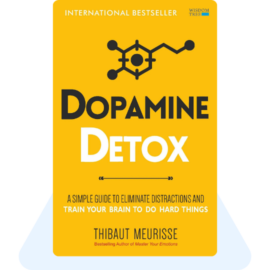
That is the problem Thibaut Meurisse addresses in Dopamine Detox: A Short Guide to Remove Distractions and Get Your Brain to Do Hard Things. The book is part of his Productivity Series and is built around a simple promise: reduce overstimulation, reclaim focus, and make important tasks easier to begin. Its public audiobook description presents it as a practical guide for people who procrastinate, feel restless, struggle to focus on meaningful goals, and repeatedly choose easy stimulation over demanding work.
The title “dopamine detox” is catchy, but it needs one scientific clarification before we go further. Dopamine is not a toxin, and you cannot literally detox it from your brain. Dopamine is a normal neurotransmitter involved in motivation, learning, movement, attention, and reinforcement. Harvard Health has pointed out that the popular phrase “dopamine fasting” is misleading when taken literally. The useful part of the idea is behavioural: step away from compulsive, high-stimulation habits long enough to notice your triggers and rebuild a healthier relationship with attention.
This Readers Books Club summary keeps the practical spirit of Meurisse’s book while separating metaphor from neuroscience. The aim is not to demonise pleasure, smartphones, entertainment, food, or social media. The aim is to stop living in a state where every difficult task loses against the easiest available reward. If you have ever felt that your ability to read books, meditate, study, write, work deeply, or remain present has been weakened by constant stimulation, this framework is worth exploring.
Readers Books Club is built around turning the ideas inside books into actions people can use. That is especially important here. A book about focus can easily become one more piece of content you consume while avoiding the work that needs your focus. So as you read, keep one question in mind: What will I actually change after this summary?
Book at a Glance: What Dopamine Detox Is About
Dopamine Detox is written by Thibaut Meurisse, a personal-development author whose work focuses on mindset, productivity, goals, habits, motivation, meditation, and self-awareness. Apple Books lists Dopamine Detox as Book 1 in his Productivity Series, while Audible describes the book as a guide to lowering overstimulation and regaining focus in “48 hours or less.” The central concerns are distractions, procrastination, focus, stimulation, and the difficulty of doing meaningful but demanding work.
The book’s strength is simplicity. It is not a neuroscience textbook. It is a short self-improvement guide designed to make you look at your environment and ask why easy rewards keep defeating important goals. Its public description highlights understanding dopamine, reducing stimulation, eliminating distractions, improving focus, and using practical exercises to stay on key tasks.
The most useful way to read it is not as a medical claim that you can “reset dopamine levels”, but as a productivity framework: reduce unnecessary stimulation, create friction around distractions, make your important work easier to enter, and practise tolerating the boredom or discomfort that often appears before deep focus.
That framing also explains why this book fits naturally beside Readers Books Club topics such as Atomic Habits, Deep Work, Digital Minimalism, mindfulness, meditation, personal growth, coaching, and life lessons. The book may be short, but the problem it addresses is one of the defining problems of modern attention.
What Dopamine Actually Does – and Why the Word “Detox” Can Mislead
Dopamine is often called the “pleasure chemical”, but that label is incomplete. According to the U.S. National Institute on Drug Abuse and major medical references, dopamine is involved in reward, motivation, learning, attention, movement, and the reinforcement of behaviours. When something feels rewarding or predicts a reward, dopamine-related circuits help the brain learn what is worth repeating.
That is useful. A healthy reward system helps you learn, eat, socialise, pursue goals, explore, and repeat behaviours that matter. The problem is not dopamine itself. The problem is that modern environments offer extremely convenient rewards: notifications, short videos, gaming, shopping, endless feeds, pornography, junk food, breaking news, and constant novelty. You can move from one reward cue to another without effort or delay.
A literal “dopamine detox” would make no biological sense. You need dopamine. You cannot simply flush it out by avoiding Instagram for a weekend. Harvard Health has described dopamine fasting as a misunderstanding when people interpret it as lowering or cleansing dopamine. Even the original behavioural idea behind dopamine fasting was closer to reducing impulsive behaviours through principles related to cognitive behavioural therapy, not trying to remove a neurotransmitter.
So when this summary uses the phrase “reset your brain”, treat it as a metaphor for resetting habits, attention, environment, and expectations around stimulation. You are not draining dopamine. You are reducing the number of cues that repeatedly pull you toward instant gratification so you can practise choosing slower, more meaningful rewards again.
This distinction matters because it makes the book more useful, not less. You do not need pseudoscience to justify turning off notifications, reading without your phone, doing difficult work before entertainment, or learning to sit with boredom. Those are practical attention-management strategies on their own.
| Science Check: Dopamine is not a toxin and is not simply a “pleasure chemical”. It supports motivation, learning, attention, movement and reinforcement. Use “detox” as shorthand for changing behaviour and stimulation, not for removing dopamine. |
Lesson 1: Overstimulation Makes Important Work Feel Too Quiet
One of the strongest ideas associated with dopamine detox is overstimulation. If your day is filled with rapid novelty, the ordinary tasks that build a meaningful life can feel painfully slow. Reading a chapter, studying, preparing a presentation, exercising, writing, budgeting, practising a skill, or meditating may not provide an immediate reward. They ask you to stay before they become satisfying.
Compare that with a feed. The next image appears instantly. The next message may contain social approval. The next headline may contain a threat or surprise. The next video is only a swipe away. When your attention is repeatedly trained on fast-changing rewards, slow tasks can feel less compelling even when you intellectually know they are more valuable.
Meurisse’s practical message is to lower stimulation so your attention has a chance to recover. You do not need to make life joyless. You need contrast. If every spare second is filled with entertainment, there is no empty space in which reading, reflection, creativity, or difficult work can become rewarding again.
Try an experiment: for the first hour after waking, avoid entertainment feeds, short-form video, unnecessary news, and random browsing. Use the time for breakfast, movement, planning, meditation, journaling, or one important task. Notice whether your mind feels calmer before it has been flooded with novelty.
The lesson is not “pleasure is bad”. It is “constant stimulation has a cost”. Focus becomes easier when not every quiet moment has to compete with something louder.
Lesson 2: Instant Gratification Is Easy; Meaningful Rewards Are Delayed
Many of the goals people care about are built through delayed rewards. A strong body takes repeated workouts. A business takes repeated offers, conversations, mistakes, and improvements. A book takes pages. Meditation develops through returning attention again and again. Financial stability depends on choices that may not feel exciting today. Relationships depend on conversations and consistency that are less stimulating than fantasy.
Instant gratification reverses the timeline. It gives a small reward now and often sends the cost later. Doomscroll now, lose sleep later. Impulse-buy now, regret the budget later. Skip the difficult task now; feel stress when the deadline arrives. Watch one more episode now; wake up tired tomorrow.
The book encourages the reader to become conscious of this trade. Every distraction has a reward, or you would not repeat it. The question is whether the reward is worth the cost. When you understand what you are getting from a habit – relief, novelty, connection, avoidance, excitement, validation – you can find another way to meet the need.
A useful exercise is the two-column test. On the left, write “Immediate reward”. On the right, write “Long-term cost”. Do this for your top three distractions. Then reverse it for one difficult habit: “Immediate cost” and “Long-term reward”. The exercise turns vague guilt into a clear decision.
Self-improvement is often the ability to choose which timeline matters more. A dopamine detox, interpreted responsibly, is a short period in which you deliberately make the long-term timeline easier to see.
Lesson 3: Your Environment Is Stronger Than Motivation
People often assume the solution to distraction is stronger willpower. But willpower has to fight the same cues again and again. If your phone sits beside your laptop, notifications appear on the screen, social apps are logged in, and entertainment is one click away, you are asking your attention to win hundreds of small battles every day.
A better strategy is environmental design. Remove the battle before it begins. Put the phone outside the room during a focus block. Disable non-essential notifications. Log out of websites that trap you. Use website blockers during study or deep work. Keep the book you want to read visible and the distracting device less convenient.
Research on smartphone distraction supports the general principle that devices can pull on attention. Experimental work has found that notifications can disrupt performance, and some studies suggest that even the mere presence of a smartphone can reduce cognitive performance in certain tasks. That does not mean phones are universally harmful; it means attention is sensitive to cues.
Readers Books Club readers can apply this directly to reading. Create a “book-first environment”. Put a physical book where your hand normally reaches for the phone. Keep a notebook beside it. Charge the phone across the room or outside the bedroom. The new environment should make the desired behaviour easier than the default distraction.
Motivation changes hour to hour. The environment keeps making suggestions. Make sure your environment suggests the life you actually want.
Lesson 4: Boredom Is Not an Emergency
Modern technology has made boredom unusually easy to escape. Waiting in a queue? Phone. Sitting in a cab? Phone. Eating alone? Video. Walking? Podcast. Going to bed? Feed. Even a thirty-second pause can trigger the reflex to search for stimulation.
The cost is subtle. If every trace of boredom is immediately removed, you never practise staying with low stimulation. Then the early stages of difficult work feel intolerable. A textbook feels slow. A meditation session feels restless. A long conversation feels demanding. A book loses to a reel because the reel asks for less patience.
A dopamine detox often works because it reintroduces boredom. Not as punishment, but as training. You discover that an urge can rise and fall without being obeyed. You can stand in a line without opening an app. You can eat one meal without a screen. You can walk for ten minutes without audio. You can sit before beginning work and feel restlessness without interpreting it as a command to escape.
Meditation fits naturally here. During meditation, the mind wanders, generates thoughts, and looks for something more interesting. The practice is to notice and return. NCCIH describes mindfulness as involving focused attention and present-moment awareness, and research suggests it may help some people with stress and sleep. It is not a magical concentration hack, but it can help you practise the exact skill distraction weakens: noticing an impulse before acting on it.
Boredom creates space. In that space, you may discover an idea, an emotion, a problem you have been avoiding, or simply the ability to be still. Do not fill every gap.
Lesson 5: Do the Hard Thing Before You Flood Your Brain With Easy Rewards
One of the most practical lessons you can take from the book is sequencing. What you do first changes what feels attractive next. If your morning begins with forty minutes of fast entertainment, switching to a demanding task can feel like slamming the brakes. If you begin with the demanding task, attention has not yet spent an hour chasing novelty.
Try the “hard thing first” rule. Identify the one task that would make the day meaningful: study the chapter, write the proposal, rehearse the presentation, edit the video, make the sales call, exercise, or complete thirty minutes of focused creation. Do it before recreational scrolling.
The task does not need to be huge. The point is priority. Even twenty-five protected minutes can change your relationship with work because you prove that entertainment does not automatically receive your best attention.
This idea is useful for students, creators, entrepreneurs, coaches, professionals, and anyone whose work depends on concentration. It also supports the identity behind personal growth: I am someone who can do important work before I reward myself with easy stimulation.
The reward is still allowed. A detox is not a life sentence. You are teaching your day an order: purpose first, entertainment second – rather than entertainment until purpose becomes urgent.
Lesson 6: Procrastination Often Protects You From Discomfort
Procrastination is easy to explain as laziness, but difficult tasks often trigger emotional discomfort: uncertainty, fear of failure, confusion, perfectionism, boredom, or the possibility that you may discover your current skill is not enough. A distraction offers fast relief.
That is why the phone becomes attractive precisely when the task becomes difficult. You are not necessarily seeking pleasure; you may be escaping discomfort. The reward of checking a message is that you do not have to feel stuck for the next thirty seconds.
A useful dopamine-detox approach is to stop negotiating with the whole task. Define the smallest visible next action. Not “finish the report”, but “open the document and write the first heading.” Not “study chemistry”, but “solve question one”. Not “build my business”, but “send one follow-up”.
Then use a short focus sprint. Set a timer for ten or twenty-five minutes. During that window, boredom, confusion, and imperfection are allowed. The only rule is that you do not switch to a high-stimulation escape.
This is where coaching can help. A life coach or performance coach may help you identify whether the real problem is distraction, unclear priorities, fear, poor systems, or unrealistic workload. Removing Instagram will not fix a goal that is undefined. The best system solves the actual bottleneck.
Lesson 7: The Goal Is Not Zero Dopamine – It Is More Intentional Reward
Extreme versions of “dopamine fasting” sometimes encourage people to avoid almost every pleasurable activity: conversation, music, exercise, good food, reading, or even eye contact. That is not necessary, and the science does not support treating dopamine as something you need to suppress as much as possible.
The better goal is intentional reward. Keep the activities that enrich life and reduce the ones that repeatedly hijack it. A walk can be rewarding and healthy. Reading can be rewarding. Cooking can be rewarding. Time with friends can be rewarding. Exercise, meditation, creativity, nature, music, meaningful work, and spirituality can all be part of a rich life.
The question is whether the reward leaves you stronger or more fragmented. Does the activity restore you, connect you, teach you, move your body, deepen a relationship, or create something? Or does it leave you restless and immediately searching for the next hit of novelty?
A Readers Books Club version of a dopamine detox should therefore not become an anti-joy challenge. It should become a value filter. Replace low-quality stimulation with higher-quality engagement. Replace endless clips with a chapter. Replace reactive checking with a planned call. Replace compulsive shopping with a walk or journal entry. Replace background noise with ten minutes of silence.
You are not trying to become a monk against your will. You are trying to make pleasure serve your life instead of quietly directing it.
Lesson 8: Rebuild Focus Through Repetition, Not One Dramatic Weekend
A 48-hour reset can be useful because it gives you contrast. You notice what happens when the usual triggers disappear. You see how often your hand reaches automatically for the phone. You discover which emotions show up when entertainment is removed. You may sleep earlier, read more, or find that work feels easier simply because there are fewer competing options.
But two days cannot permanently redesign a life if Monday returns you to the same environment. The real value of a short detox is information. Which app was hardest to avoid? Which time of day produced the strongest urge? Which task did you finally complete? Which lower-stimulation activity actually felt good?
Use that information to create permanent rules. Maybe social media stays off the home screen. Maybe your phone never enters the bedroom. Maybe you check the news once at lunch instead of all morning. Maybe the first ninety minutes of the workday become notification-free. Maybe you read ten pages before evening entertainment.
Habit change is repetition. The new behaviour has to survive ordinary days, not just motivational weekends. A sustainable plan should be slightly inconvenient for distractions and easy enough for meaningful work that you can repeat it when energy is low.
The “reset” is not a one-time neurological event. It is the moment you stop letting your habits run without review.
The Readers Books Club 48-Hour Dopamine Detox Plan
The public description of Meurisse’s book emphasises a short, practical detox and regaining focus within 48 hours. The following Readers Books Club plan translates that theme into a safe, realistic behavioural reset. It is not a medical protocol and does not attempt to lower dopamine itself.
Before you begin, choose the behaviours you want to pause or tightly limit for two days. Good candidates are activities you repeatedly use without intention: short-form video, social feeds, gaming, online shopping, pornography, compulsive news checking, random YouTube browsing, or constant email refresh. Do not remove prescribed medication, necessary work communication, meals, exercise, relationships, or healthy recreation.
Day 1 morning: remove cues. Disable non-essential notifications. Log out of the worst apps. Place the phone out of reach. Write your top three priorities for the day. Complete one focus block before recreational media.
Day 1 afternoon: tolerate the gap. Take one meal without a screen. Walk for at least ten minutes without entertainment. Read a physical book for twenty minutes. Notice the moments when you want stimulation and write the trigger: boredom, stress, loneliness, fatigue, uncertainty, or habit.
Day 1 evening: reduce intensity. Avoid fast-moving entertainment for the final hour before bed. Journal what you noticed. What did you reach for automatically? What did you finally do because the distraction was unavailable?
Day 2 morning: repeat the protected start. Add five to ten minutes of meditation or quiet breathing. Then begin the hardest meaningful task.
Day 2 afternoon: choose higher-quality rewards. Exercise, read, cook, meet someone, work on a hobby, sit in nature, or complete a creative task. The point is not deprivation. It is discovering rewards that do not require endless novelty.
Day 2 evening: design the next thirty days. Decide what comes back, how often, and under what rules. A detox that ends with every trigger returning unchanged becomes a pause, not a reset.
| Safety Rule: Do not stop prescribed medication, food, necessary communication, healthy exercise or supportive relationships in the name of a dopamine detox. The reset should target compulsive distractions, not essential health needs. |
A 7-Day Focus Rebuild After the Detox
Day 1: Keep one distracting app off your phone. Use the browser only if needed. Added friction reveals how much use is intentional.
Day 2: Create one 30-minute deep-focus block. Phone outside the room. One task. No multitasking.
Day 3: Practise boredom. Take a ten-minute walk with no audio. Let thoughts arrive without immediately consuming something.
Day 4: Build a book habit. Read ten pages before opening your evening entertainment. Readers Books Club summaries can help you choose what to read, but the goal is sustained attention.
Day 5: Audit instant gratification. Identify your three most frequent quick rewards and the situations that trigger them.
Day 6: Replace one escape. When the urge to scroll appears during work, stand, stretch, breathe, and return for five more minutes before deciding whether you still need a break.
Day 7: Review. Which change improved focus most? Which felt unrealistic? Keep two rules for the next three weeks. Sustainable focus grows from a few reliable rules, not a complicated lifestyle performance.
Dopamine Detox for Students
Students are especially vulnerable to fragmented attention because studying competes directly with phones, messaging, streaming, games, and social media. The hard part is that the device often contains both the textbook and the distraction.
Create separation. If possible, use a laptop for study and keep entertainment apps on the phone, then place the phone outside reach. If you must study on the phone, use app blocking and download the material so you do not need to remain inside a feed-driven environment.
Study in clear blocks. Decide the chapter, question set, or revision objective before the timer begins. Vague study produces vague distraction. A specific finish line makes focus easier.
Use rewards after effort rather than during effort. Checking messages every five minutes feels harmless, but it repeatedly resets attention. Finish twenty-five or forty-five minutes first, then take a planned break.
Most importantly, do not use “dopamine detox” as a substitute for seeking help if concentration problems are severe or persistent. Attention difficulties can have many causes, including sleep problems, stress, anxiety, depression, ADHD, learning difficulties, or an overloaded schedule. A productivity book cannot diagnose them.
Dopamine Detox for Creators, Entrepreneurs and Professionals
Digital work creates a unique trap: the same platforms that grow your career can destroy your focus. A creator may need Instagram but not need to scroll for two hours. An entrepreneur may need email but not refresh it every five minutes. A coach may need WhatsApp but not respond to every message instantly.
The solution is not total disconnection. It is role separation. Create a “producer mode” and a “consumer mode”. During producer mode, you write, record, design, analyse, sell, teach, or build. During consumer mode, you research, respond, browse, or engage. Do not let the modes constantly overlap.
Schedule communication windows. If your work allows, check messages at predetermined times rather than every time a notification arrives. Batch low-value administrative tasks. Protect at least one block where other people cannot rent your attention.
Amiett Kumar and Readers Books Club operate in a world of YouTube, podcasts, coaching, books, manifestation, meditation, and digital content. That makes focus a business asset as much as a wellness habit. The ability to create before consuming can separate meaningful output from permanent reaction.
Ask one question each morning: What must exist by the end of today that does not exist now? Build that before entering the feed.
Meditation and Dopamine Detox: Training the Pause
Meditation is one of the most natural supporting practices for a behavioural dopamine detox because it teaches you to observe an urge without automatically following it. You sit, attention wanders, and you return. The practice is almost the opposite of scrolling, where every new impulse is instantly rewarded with new content.
NCCIH notes that meditation and mindfulness have been studied for stress, anxiety, depression, pain, and sleep, with evidence varying by condition and study quality. It should not be marketed as a guaranteed cure for distraction, but it can be used as attention training and a transition into lower-stimulation activities.
Try a five-minute pre-work meditation. Sit comfortably. Breathe naturally. When a thought appears – “check messages”, “get coffee”, “open YouTube” – simply label it “urge”. Do not fight it. Return to the breath. At five minutes, begin the planned task immediately.
For people interested in spirituality, this can become a deeper question: where is my life energy going? Spirituality does not have to mean rejecting technology. It can mean becoming more conscious of what repeatedly receives your attention. Attention is finite. What you repeatedly feed becomes a major part of your experience.
The goal is not a perfectly silent mind. The goal is choice.
Dopamine Detox and the Law of Attraction: A Grounded Connection
The Law of Attraction is commonly discussed in terms of focus, intention, belief, visualisation, and emotional alignment. A dopamine-detox framework can connect to that conversation in one practical way: your stated intention and your daily attention should not be moving in opposite directions.
You may say you want to manifest a business while spending your best hours consuming other people’s content. You may visualise a peaceful mind while feeding it constant outrage. You may repeat an affirmation about confidence while checking every few minutes for external validation. The issue is not that scrolling creates a mystical “block”. The issue is that behaviour is contradicting intention.
Use visualisation to rehearse the process, not only the outcome. See yourself sitting down, doing the work, tolerating discomfort, publishing, studying, exercising, saving, communicating, or practising. Then reduce the distractions that make that process less likely.
A grounded affirmation might be: “I protect my attention and use it for what matters.” Another is: “I can choose meaningful progress over automatic stimulation.” The statement becomes powerful when your environment provides evidence.
Manifestation, in this practical sense, is less about forcing the universe and more about bringing attention, identity, and action into better alignment.
Can Coaching or a Life Coach Help?
Sometimes distraction is obvious, but the reason behind it is not. You know you scroll too much, but you do not know whether the underlying problem is stress, fear of failure, lack of purpose, poor planning, loneliness, burnout, or simply habit. This is where coaching can be useful.
A responsible life coach, productivity coach, or performance coach can help you clarify priorities, design routines, create accountability, and review patterns. Coaching can also expose contradictions: you say you want deep work, but your calendar has no protected time; you say you want meditation, but your phone is the first and last object you touch each day.
The role of coaching is not to “control dopamine”. It is to help you build behaviour that matches your goals. A coach should also know the limits of coaching. If compulsive technology use is significantly affecting mental health, sleep, relationships, work, or safety, a qualified mental-health professional may be more appropriate.
For Readers Books Club audiences interested in Amiett Kumar, meditation, spirituality, the Law of Attraction, and self-improvement books, the useful bridge is implementation. Insight is valuable. A system is better. Accountability can turn the system into repetition.
Common Dopamine Detox Mistakes
Mistake 1: Believing dopamine is toxic. It is a necessary neurotransmitter. The target is problematic behaviour, not dopamine itself.
Mistake 2: Removing every pleasurable activity. Healthy pleasure, relationships, exercise, hobbies, books, nature, music, and good food do not need to be treated as enemies.
Mistake 3: Doing an extreme detox and returning to the same environment. If every notification, app, cue, and routine comes back unchanged, the effect will likely be temporary.
Mistake 4: Using detox as avoidance. You can spend days designing the perfect reset while still refusing to start the difficult project. The goal is focused action.
Mistake 5: Confusing discomfort with damage. Boredom and restlessness are often expected when you stop a frequent habit. But severe distress, withdrawal related to substances, eating problems, or mental-health symptoms require professional guidance.
Mistake 6: Turning the detox into moral superiority. People are not better because they use fewer apps. Technology is a tool. The point is intentional use.
Mistake 7: Expecting motivation to stay high forever. Focus is supported by sleep, clarity, environment, health, workload, and repetition. No two-day challenge eliminates ordinary human fluctuation.
Mistake 8: Measuring success only by screen time. The better question is what the saved attention produced: reading, work, rest, relationships, creativity, meditation, or genuine leisure.
10 Practical Rules to Reclaim Your Focus
1. Do not begin the day with recreational scrolling. Give your own priorities the first chance at attention.
2. Keep the phone physically away during your most important work block.
3. Turn off non-essential notifications. A notification is a request for attention, not a command.
4. Decide what you will do before you open a device. Intentional use begins with a purpose.
5. Create at least one low-stimulation activity every day: reading, walking, journaling, meditation, cooking, or quiet conversation.
6. Use entertainment after a meaningful task when possible, not as the automatic default before it.
7. Practise finishing small difficult things. Focus becomes an identity through evidence.
8. When you procrastinate, name the feeling you are escaping before you blame the app.
9. Review your digital environment weekly. New apps and habits quietly accumulate.
10. Protect sleep. A tired brain will usually choose the easier reward. Focus is not only discipline; it is also energy management.
How Dopamine Detox Compares With Other Focus Books
Dopamine Detox becomes easier to understand when you place it beside other popular self-improvement books. Digital Minimalism by Cal Newport asks a broad question about which technologies deserve a place in your life. Deep work focuses on building long periods of distraction-free concentration. Atomic Habits explains how cues, environment, repetition and identity shape behaviour. Dopamine Detox is shorter and more immediate: it asks what happens when you temporarily lower stimulation and stop feeding the distractions that keep important work from feeling attractive.
These books are complementary rather than competitive. Use Dopamine Detox when you need a quick interruption to an overstimulated routine. Use digital minimalism when you need a philosophy for long-term technology use. Use deep work when you need a structure for cognitively demanding work. Use Atomic Habits when you understand the problem but need better systems to make the solution repeatable.
Readers Books Club readers can turn these ideas into a sequence. First, observe which behaviours are stealing attention. Second, remove or reduce the worst triggers for forty-eight hours. Third, create one protected focus block. Fourth, make the focus block a habit by attaching it to a reliable time and environment. Finally, review which technologies actually support your values and which merely consume time.
The larger lesson across these books is that focus is designed. You do not need to become a naturally disciplined person before you can concentrate. You need fewer competing cues, a clear task, a realistic time block and enough repetition for the behaviour to become familiar. Dopamine detox is best seen as the reset button that helps you begin that design process.
A 30-Day System to Make the Reset Last
After the first 48 hours and the seven-day challenge, use a 30-day system so the change does not disappear. Week 1 is awareness: track the apps, times, places and emotions that trigger unplanned stimulation. Do not try to fix everything at once. Identify the one pattern creating the biggest cost.
Week 2 is friction. Make the unwanted behaviour slightly harder. Remove the app, log out, disable notifications, move the charger, use a blocker or keep the phone outside the room. At the same time, make the desired behaviour easier. Leave the book open, prepare the study material, write the first task on paper, or place exercise clothes where you can see them.
Week 3 is focus capacity. Add one daily block of single-task work. Start at twenty-five minutes and increase only if concentration is stable. After each block, record what distracted you. The objective is not a perfect streak; it is learning the conditions under which your attention performs best.
Week 4 is intentional reintroduction. Decide which digital rewards genuinely improve your life and which ones repeatedly create regret. Bring useful tools back with rules: specific checking windows, no phone in bed, entertainment after priority work, or a weekly screen-time review. The end goal is not permanent deprivation. It is a digital environment in which you remain the decision-maker.
At Day 30, measure results beyond screen time. Did you read more books? Finish more work? Sleep earlier? Meditate more consistently? Feel less reactive? Spend more time with people? If the answer is yes, the detox worked because behaviour changed – not because dopamine was removed.
Frequently Asked Questions
What is Dopamine Detox by Thibaut Meurisse about? It is a short productivity and self-improvement guide about reducing overstimulation, eliminating distractions, overcoming procrastination, and regaining focus so you can work on meaningful goals.
Can you actually detox dopamine? No. Dopamine is a normal neurotransmitter, not a toxin. “Dopamine detox” is best understood as a behavioural metaphor for reducing compulsive high-stimulation activities and rebuilding more intentional habits.
How long does the book’s detox take? The public Audible description says the book aims to help readers reduce stimulation and regain focus in 48 hours or less. Sustainable habit change, however, usually requires continued practice after the short reset.
What should I avoid during a dopamine detox? Focus on behaviours you use compulsively or without intention, such as endless scrolling, short-form video, gaming, shopping, or constant news checking. Do not remove necessary medication, food, healthy relationships, exercise, or essential communication.
Is a dopamine detox good for phone addiction? A short break can help you notice triggers and reduce automatic use, but severe or compulsive technology problems may need more structured support. The phrase “phone addiction” can also oversimplify different patterns, so seek professional help when use significantly harms daily life.
Can meditation help during a dopamine detox? Meditation can support awareness and the ability to pause before acting on an urge. It is a useful companion practice, though not a guaranteed treatment for compulsive behaviour.
Which category does this book fit into? It fits best under Self Improvement and Productivity, with strong overlap with Build Habits, Psychology, Motivation, and Mental Health topics.
Is this book useful for students? Yes, especially for students who struggle with digital distraction, procrastination, and beginning difficult study tasks. Students with persistent attention difficulties should also consider whether sleep, stress, ADHD, anxiety, or other factors require professional assessment.
How does Dopamine Detox connect with spirituality? A grounded spiritual connection is attention: choosing what deserves your limited time and awareness. Meditation, silence, reading, reflection, and meaningful work can all become alternatives to constant stimulation.
Should I read the full book after this summary? If distraction and procrastination are recurring problems, the full book offers the author’s complete short-form framework and exercises. This Readers Books Club summary is designed to help you understand the core ideas and decide how relevant they are to your life.
Final Thoughts: The Real Reset Is Reclaiming Choice
Dopamine Detox succeeds because it addresses a feeling many people recognise: modern life can become so stimulating that meaningful work starts to feel unusually hard. The book gives that problem a memorable label and encourages a short reset from distraction.
The science requires a correction: dopamine is not something to cleanse from the brain, and a weekend without social media does not literally restore dopamine to a magical baseline. But the behavioural insight survives the correction. Your attention can become fragmented. Your environment can train automatic checking. Easy rewards can repeatedly defeat goals that require patience. Those patterns can be redesigned.
The most useful detox is therefore not a war on pleasure. It is a return to choice. Can you use the phone because you decided to, not because your hand moved automatically? Can you read ten pages without switching? Can you sit in meditation for five minutes without treating restlessness as an emergency? Can you begin the difficult task before the easy reward?
That is where books, meditation, spirituality, the Law of Attraction, coaching, and self-improvement can meet in a practical way. They all ask, in different languages, what you will do with your attention. Readers Books Club turns books into lessons; your job is to turn the lesson into behaviour.
Choose one distraction to reduce, one meaningful activity to protect, and one rule you can maintain for the next thirty days. You do not need a perfectly “detoxed” brain. You need an environment and identity that make focused choices easier to repeat.
Contents