Introduction: What If Success Is Not the Same as Meaning?
There are moments in life when everything can look fine from the outside and still feel strangely incomplete on the inside. You may have a job, responsibilities, people around you, a growing list of achievements and even the comforts you once wanted. Yet a quiet question keeps returning: What is all this for?
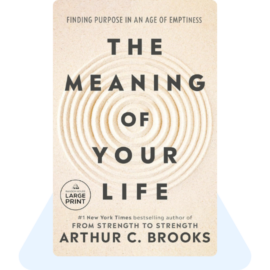
That question sits at the heart of The Meaning of Your Life: Finding Purpose in an Age of Emptiness by Arthur C. Brooks. Published in 2026, the book examines why people can be productive, ambitious and outwardly successful while still feeling disconnected from a deeper sense of direction. Brooks does not treat meaning as a luxury reserved for philosophers, spiritual teachers or people who have already figured life out. He presents it as a practical human need that influences how we understand our past, choose our future and relate to the people around us.
This The Meaning of Your Life book summary explores the central ideas of Arthur C Brooks in simple, engaging language. If you have ever searched for how to find purpose in life, how to find your purpose, how to become happier without endlessly chasing achievements, or how to build a stronger sense of life purpose, this book speaks directly to those concerns.
For the Readers Books Club audience, the book is especially relevant because it sits at the intersection of psychology, philosophy, spirituality, relationships and personal growth. Readers Books Club has long discussed books that help people think differently about success, mindset and self-discovery. The same questions also appear in conversations around meditation, coaching, the law of attraction and the work of a life coach: What do I really want? Why am I here? What gives my life direction? What makes achievement feel worthwhile?
Brooks’s answer is not a single motivational slogan. He argues that meaning has several parts, and a meaningful life is built rather than accidentally discovered. Purpose matters, but purpose alone is not enough. You also need a sense that your experiences fit into a larger story and a feeling that your existence matters beyond your own private ambitions.
That is why this book is useful even for readers who already have clear goals. You can be extremely goal-orientated and still be uncertain about meaning. You can be disciplined and still feel empty. You can practice positive thinking and still avoid life’s most important questions. You can consume hundreds of self help books and still remain disconnected from the people, values and experiences that make your life feel real.
The central invitation of The Meaning of Your Life is therefore simple but demanding: stop treating the biggest questions as distractions from ordinary life. Make them part of ordinary life. Instead of waiting for a crisis before asking what matters, begin asking now. Instead of hoping that money, recognition or productivity will eventually create meaning, become intentional about the sources from which meaning actually grows.
About The Meaning of Your Life and Arthur C. Brooks
The Meaning of Your Life: Finding Purpose in an Age of Emptiness was published by Portfolio on March 31, 2026. The hardcover edition runs 304 pages. The publisher describes it as a guide to understanding why modern life can make meaning harder to perceive and how readers can rebuild a stronger sense of purpose and significance.
Arthur C. Brooks is a social scientist, author and professor at Harvard. His earlier books include From Strength to Strength and Build the Life You Want, written with Oprah Winfrey. Much of his public work focuses on happiness, work, relationships, human flourishing and the habits that help people build a good life.
This background matters because Brooks approaches the meaning of life from more than one direction. He uses research from psychology and social science, but he also brings in philosophy, literature, religious traditions and personal experience. The result is neither a purely academic book nor a purely spiritual book. It is an attempt to connect measurable aspects of well-being with questions that cannot be reduced to productivity hacks.
The book is aimed particularly at people who strive. A striver is someone who likes progress, accomplishment, goals, recognition and forward movement. Strivers can be students, entrepreneurs, professionals, creators, leaders, parents or anyone who is continually trying to improve. Their strength is ambition. Their danger is assuming that the next achievement will solve an inner problem that achievement was never designed to solve.
That is one reason The Meaning of Your Life belongs among current personal growth books. It does not argue against success. Instead, it asks success to take its proper place. Achievement can be satisfying, but satisfaction is not identical to meaning. Pleasure can make life enjoyable, but enjoyment is not identical to meaning either. A truly good life needs something deeper: a reason to care, a sense of direction and relationships or commitments that make your existence matter.
The Core Idea: Meaning Is More Than Purpose
The most important framework in the book is Brooks’s explanation of meaning through three connected elements: coherence, purpose and significance.
Coherence is the sense that your life forms a story you can understand. It does not mean that every event is pleasant or that every tragedy has an obvious explanation. It means you have some way of interpreting what happens to you. Your experiences are not merely disconnected incidents. You can place them within a larger worldview, belief system, personal story or philosophy.
Purpose is direction. It is the feeling that your life is moving toward something. Goals are part of purpose, but purpose is larger than a checklist. A goal may be to get a promotion, start a company, finish a degree or improve your health. Purpose asks why those goals matter and what kind of person or contribution they are meant to serve.
Significance is the sense that your life matters. This is not the same as fame. You do not need millions of followers, a public legacy or a famous name. Significance can be very intimate. Your presence matters to your family. Your work makes someone’s life easier. Your care changes a friend’s difficult week. Your existence adds value to people and communities beyond yourself.
This framework immediately improves the usual conversation about how to find purpose in life. Many people search only for purpose. They ask: What career should I choose? What is my passion? What is my mission? What should I build? Those questions are important, but if they are separated from coherence and significance, purpose can become another form of performance.
Imagine someone with a clear professional goal who has no coherent philosophy for handling failure and no meaningful relationships outside work. That person may have purpose in a narrow sense, but their life can still feel fragile. A missed promotion or failed business may collapse their entire identity. In contrast, someone with coherence understands that setbacks can belong to a larger life story, and someone with significance knows their value does not disappear when a target is missed.
This is one of the strongest lessons in The Meaning of Your Life Summary: do not reduce meaning to ambition. Meaning asks three questions at once. Why does my life make sense? Where am I going? Why does my life matter?
When those questions work together, purpose becomes healthier. It is less about proving your worth and more about expressing it. You stop asking only, “What can I achieve?” and begin asking, “What is worth giving myself to?”
1. Coherence: Build a Story That Can Hold Your Life
Human beings naturally turn experience into stories. We remember beginnings and endings. We connect causes with consequences. We interpret losses, opportunities, relationships and turning points. Coherence is the structure that helps these experiences fit together.
Without coherence, life can feel random. One event happens, then another, then another. You react to each situation, but nothing seems connected. This is exhausting because every difficulty feels like an isolated interruption. There is no larger frame in which to understand it.
Coherence does not require pretending that everything happens for a pleasant reason. That kind of forced positivity can become emotionally dishonest. Some events are unfair. Some losses are painful for years. Some questions remain unanswered. Coherence is more mature than saying, “Everything is perfect.” It is the ability to hold uncertainty while still believing your life can have direction.
For one person, coherence may come from faith and spirituality. For another, it may come from a philosophical commitment to service, responsibility or human dignity. Someone else may build coherence by seeing life as a process of learning, growth and contribution. The specific worldview can differ, but the psychological function is similar: it gives your experiences a context.
This is where self discovery becomes important. You cannot build coherence entirely from borrowed slogans. You need to examine the beliefs you actually live by. What do you think makes a good person? What do you believe about suffering? What is success for? What responsibilities do you have toward other people? What remains valuable when circumstances change?
A useful exercise is to write a short narrative of your life without listing achievements. Instead, identify the themes. Perhaps one theme is resilience. Maybe another is teaching, protecting, creating, healing, learning or bringing people together. Then ask which moments felt most alive and which felt most disconnected. Patterns often appear when you stop looking at your life as a résumé.
Meditation can support this process because it creates mental space between experience and reaction. Meditation does not automatically answer philosophical questions, but it can help you notice the stories your mind repeats. You may discover that your inner narrative is dominated by comparison, guilt, fear or the need for approval. Seeing those patterns clearly is the beginning of choosing a more truthful story.
In a coaching or life coach context, coherence is also powerful because many clients do not lack goals; they lack an organizing story. They have several ambitions that pull in different directions. Clarifying values can bring those goals under one larger principle.
The deeper point is that meaning is not only about what happens to you. It is also about the framework through which you understand what happens. A coherent life is not a perfectly predictable life. It is a life whose chapters can belong to the same book.
2. Purpose: Direction Matters More Than Constant Achievement
Purpose is the part of meaning most people recognize first. We want to know what we are supposed to do with our time, talents and attention. Yet Brooks makes an important distinction: purpose is not simply having more goals.
Modern productivity culture often encourages people to turn life into a sequence of targets. Study hard, get the job, earn more, grow the business, buy the house, build the audience, reach the next milestone. Each achievement offers a burst of satisfaction, but the feeling quickly becomes normal. Then another target appears.
This cycle can produce a strange form of emptiness. You are always moving, yet you are not sure where the movement ultimately leads. You have a calendar full of activity but no clear answer to the question, “Why am I doing this?”
Purpose gives direction to effort. It helps you distinguish an important goal from an impressive-looking goal. If your deeper purpose involves helping people learn, for example, then becoming a teacher, author, mentor, coach, parent, content creator or leader may all express that purpose in different seasons. The role can change while the underlying direction remains.
That flexibility matters because many people become anxious about discovering one perfect life purpose. They imagine there is a hidden answer somewhere, and if they choose the wrong career or relationship, they have failed to find it. The book offers a more useful way to think. Purpose can evolve. Your responsibilities at 25 may differ from those at 45 or 70. The important thing is to keep a meaningful direction rather than worship a fixed label.
If you are asking how to find your purpose, start with responsibility before passion. Who needs something from you? What problem are you willing to work on repeatedly? What kind of effort leaves you tired but proud rather than merely drained? Which strengths are valuable to other people? What would you continue caring about even if applause decreased?
Purpose is also strengthened by limits. If everything is equally important, nothing is truly prioritised. A meaningful life therefore requires saying no. You may need to reject opportunities that increase status but reduce time for family, health, spiritual growth or service.
This is especially relevant for ambitious readers. The goal is not to become less capable. It is to make capability serve something worthy. When your goals become expressions of purpose rather than substitutes for identity, achievement becomes less desperate and more satisfying.
3. Significance: Your Life Must Matter Beyond Your Ego
Significance is perhaps the most emotionally powerful part of the meaning framework. It asks whether your life matters to anyone beyond yourself.
A culture focused on visibility can confuse significance with attention. Social media numbers, professional recognition and public reputation can create the appearance of importance. But attention is unstable. It changes with trends, algorithms, markets and other people’s opinions.
Significance is quieter. It grows through usefulness, love, responsibility and presence. A parent who consistently shows up for a child has significance. A friend who listens during a crisis has significance. A nurse, teacher, colleague, volunteer, neighbour or mentor may profoundly affect lives without ever becoming publicly known.
This is liberating because it removes the pressure to become extraordinary in order to matter. You do not have to dominate a field to have a meaningful life. Meaning can exist in ordinary commitments done with unusual sincerity.
One of the best questions for self-discovery is, Whose life becomes better because I am in it? Do not answer only with financial contribution. Think about encouragement, wisdom, humour, care, reliability, protection, teaching, patience and emotional presence. These forms of value are difficult to measure but central to significance.
The opposite question is also useful: Where have I become so self-focused that I no longer notice what other people need? Modern self-improvement can accidentally increase self-absorption. We monitor our goals, habits, emotions, productivity, appearance and progress until life becomes one long personal dashboard. Brooks’s emphasis on significance pushes the reader outward.
This is where spirituality often becomes practical. Spiritual growth is not only an internal feeling of peace. Across many traditions, it includes compassion, humility, service and a reduction of excessive self-centeredness. A spiritual practice that never changes how we treat people is incomplete.
A life coach or coaching process can use significance as an important corrective. A client may arrive asking how to earn more or become more confident. Those goals are valid. But deeper progress can happen when the person also asks: What will my growth allow me to give? Confidence becomes more meaningful when it helps someone lead, teach, protect, create or love more effectively.
Significance transforms success from “Look what I achieved” into “Look what this achievement made possible for others.” That shift is small in language but enormous in meaning.
Why Modern Life Can Feel Empty Even When It Is Full
A major argument of The Meaning of Your Life is that modern conditions can make depth harder to experience. Brooks points toward cultural and technological patterns that fill attention with stimulation while weakening our ability to sit with mystery, boredom, reflection and difficult questions.
This feels familiar. Many people begin the day with a phone and end the day with a phone. Every silent moment can be filled immediately. Waiting in a queue, sitting in a taxi, eating alone or even walking for five minutes becomes an opportunity to check messages, videos, news, notifications or short-form content.
The problem is not that technology is inherently bad. Technology is useful and often life-changing. The deeper issue is attention. If every empty space is filled, the mind has fewer opportunities to wander, integrate experiences and ask questions that do not have instant answers.
Meaning develops slowly. It is difficult to think deeply about your values while switching between twenty streams of information. It is difficult to feel awe while constantly evaluating whether an experience is post-worthy. It is difficult to hear an uncomfortable inner question if you can distract yourself within two seconds.
The book’s critique therefore connects strongly with meditation and mindful living. Meditation trains the capacity to remain present without immediately escaping into stimulation. Even a few minutes of quiet can reveal how restless the mind has become. That restlessness is not failure; it is information.
Readers interested in the law of attraction may notice a related lesson about attention. The Meaning of Your Life is not a manifestation manual, and Brooks does not argue that thoughts magically control external reality. However, there is a meaningful overlap in the emphasis on what you repeatedly attend to. Attention shapes perception, choices and behaviour. If you spend your day feeding comparison, fear and distraction, you are training a certain kind of mind. If you intentionally create space for gratitude, values, relationships and purposeful action, you are training another.
The practical lesson is to recover unoccupied attention. Take a walk without audio. Eat one meal without a screen. Sit quietly after meditation instead of immediately opening an app. Create a technology-free first 20 minutes of the morning. Leave some boredom in your day.
These habits may look small, but they create the mental conditions in which meaning can be noticed. The question is not only how much information you consume. It is whether your attention remains available for your own life.
Love: Meaning Grows When You Give Your Heart Away
One of the book’s most important movements is away from individual achievement and toward love. Brooks argues that meaning is not found by endlessly optimizing the self. It grows through relationships in which we give attention, loyalty, affection and care.
This is challenging because relationships are inefficient. People interrupt plans. Families require sacrifice. Friendship takes time. Romantic love involves vulnerability. If your life is organized only around productivity, deep relationships can start to look like obstacles.
Yet many of the experiences people later describe as most meaningful are relational. A conversation with a parent. Supporting a partner through difficulty. Raising a child. Being present when a friend needs help. Sharing a long journey with someone. These moments may not improve a résumé, but they strengthen significance.
Love also corrects the ego’s tendency to make meaning self-referential. If the question is always “How can I become happier?” happiness itself can become exhausting. Love changes the question to “How can I contribute to this person’s good?” Paradoxically, that outward movement often deepens our own well-being.
For readers interested in spirituality, this is essential. Many spiritual traditions place love above self-image. Compassion, devotion, forgiveness, generosity and service are not side practices; they are central disciplines because they weaken the illusion that life is only about the separate self.
Meditation can help here when it is used not only for calm but for connection. Loving-kindness meditation, gratitude practice or simply reflecting on the people who have supported you can shift attention from self-protection to appreciation.
The law of attraction is sometimes presented online in a way that makes relationships sound transactional: become a certain vibration and the ideal person will appear. The deeper lesson from Brooks is more demanding. Meaning in relationships comes not from attracting the perfect person but from becoming capable of real love – presence, patience, commitment, honesty and generosity.
If you want purpose and happiness, invest in people before you urgently need them. Call the friend. Eat dinner without the phone. Ask a parent a question about their life. Listen without planning your response. Express appreciation while the person can still hear it.
A meaningful life is not only a life in which you are loved. It is a life in which you become someone who knows how to love.
Transcendence: Look Beyond the Small Self
Transcendence is the experience of moving beyond the narrow boundaries of the ego. It can come through faith, prayer, meditation, nature, art, service, moral commitment or experiences of awe. The details differ across people and traditions, but the function is similar: life becomes larger than your immediate wants and worries.
Brooks draws on religious and philosophical traditions because meaning is not fully explained by achievement. A purely material account of life may answer how to do many things, but people still ask why existence matters, why love feels sacred, why beauty moves us, why suffering changes us and whether there is something greater than individual desire.
Spirituality creates a vocabulary for those questions. For some readers, spirituality means a formal religious path and relationship with God. For others, it may mean contemplation, a sense of interconnectedness, reverence for life or disciplined inquiry into consciousness. The important point is that transcendence interrupts excessive self-focus.
Meditation is one of the most accessible practices for exploring this. In meditation, you can observe thoughts without treating every thought as an order. You begin to see that the voice saying “I need more,” “I am behind,” or “They must approve of me” is a mental event, not the whole of reality. That distance can create humility.
Transcendence also appears through service. Helping another person without turning the act into a performance temporarily moves the center of the world away from “me.” This can be deeply meaningful because it connects significance with action.
For readers attracted to manifestation or the law of attraction, transcendence offers a useful balance. Desire is natural. Goals are good. Visualization can clarify direction. But a mature spiritual life also asks whether the desire serves something larger. Instead of only “How can I manifest what I want?” ask “Why do I want it, who will I become while pursuing it, and what good can it create?”
That question changes manifestation from wish-fulfillment into alignment. It asks your mindset, behavior, relationships and values to point in the same direction.
Transcendence does not require withdrawing from ordinary life. It can make ordinary life more meaningful. Work becomes service. Relationships become sacred responsibilities. Beauty becomes something to receive rather than consume. Silence becomes nourishment rather than emptiness.
Calling: Turn Work Into Contribution, Not Identity
Work occupies a large portion of adult life, so it naturally becomes part of the search for meaning. But work is also dangerous when it becomes the only source of identity.
Brooks explores the idea of calling – work experienced not merely as a way to earn money or gain status but as a form of contribution. A calling connects ability with service. You use what you can do to create value that matters.
This does not mean everyone needs a glamorous dream job. Meaningful work can be ordinary. The key is the relationship between effort and contribution. A person may find calling in building systems, caring for patients, teaching children, repairing machines, managing a team, creating art, running a small business or supporting a family.
The search for calling becomes unhealthy when people believe the perfect job must satisfy every emotional and spiritual need. No career can carry that weight. Work can provide purpose, but love, spirituality, community and leisure also matter.
A practical exercise is to separate three questions. First: What am I good at or willing to become good at? Second: Who benefits when I do this well? Third: What kind of problems am I willing to stay with long enough to become useful?
This is where coaching can be especially valuable. A life coach should not simply ask what job sounds exciting. Good coaching helps a person examine strengths, values, constraints, responsibilities and the people they hope to serve. The result may be a career change, but it may also be a new way of approaching the existing career.
Brooks’s broader message protects ambitious people from making work their religion. When identity is fused with professional success, criticism feels like personal rejection and retirement can feel like disappearance. When work is understood as one arena of contribution, you can care deeply without making it the measure of your entire worth.
Purpose and happiness improve when work is important but not absolute. Earn, build and achieve – but keep love, health, spiritual growth and character outside the reach of your job title.
Suffering: Do Not Waste the Hardest Parts of Your Story
No serious discussion of the meaning of life can avoid suffering. A philosophy that works only when circumstances are pleasant is too weak for real life.
Brooks does not suggest that pain is automatically good. Illness, grief, rejection, failure and loss can be devastating. The meaningful question is not whether suffering should have happened but what relationship we will develop with it after it has happened.
One possibility is bitterness. Another is denial. A third is integration. Integration means allowing the experience to become part of your story without allowing it to become the whole story.
Suffering can clarify values. A health scare may reveal that work had become too dominant. A breakup may expose patterns that need healing. Failure may separate ego-driven goals from deeper purpose. Grief may intensify gratitude for relationships that remain.
This does not mean every painful event comes with a neat lesson. Some suffering stays mysterious. Coherence is not the same as explanation. You may never understand why something occurred, yet you can still decide what kind of person you will become in response.
Meditation can support this process by teaching non-avoidance. Sitting with difficult sensations and emotions in a safe, gradual way can help a person see that pain changes moment by moment. However, meditation should not be used to bypass grief or professional mental-health care when those are needed.
Spirituality can also give suffering a larger frame. Religious traditions have long asked how pain, sacrifice, mortality and compassion fit into a meaningful life. Even secular readers can benefit from the basic insight that difficulty often deepens empathy. People who have known pain can become unusually capable of recognizing it in others.
A life coach should be careful here. Coaching is not therapy, and serious trauma may require qualified clinical support. But within appropriate boundaries, coaching can help a person ask forward-looking questions: What does this experience make more important now? What boundary needs to change? What strength did I discover? What can I contribute because I understand this struggle?
The phrase “do not waste your suffering” should never mean “be grateful that you suffered.” It means: if pain has already entered your life, do not let it have the final word. Let it deepen wisdom, compassion or courage where possible.
The Meaning of Your Life and the Law of Attraction: Where They Meet and Where They Differ
Because Readers Books Club audiences often explore meditation, spirituality and the law of attraction, it is useful to clarify how Brooks’s ideas relate to manifestation culture.
The Meaning of Your Life is not a law of attraction book. It does not teach that the universe delivers outcomes simply because a person thinks about them intensely. Its framework is grounded more in psychology, philosophy, relationships, faith traditions and purposeful behaviour.
Still, there are areas of meaningful overlap. First is clarity. Manifestation practices often ask people to define what they want. Brooks goes one level deeper and asks why the desire matters. A clear goal without a meaningful reason can become another empty achievement.
Second is attention. Visualization, affirmations and meditation all work partly by directing attention. When you repeatedly focus on a value or goal, you may become more likely to notice relevant opportunities, make consistent choices and recognise behaviour that conflicts with your intentions. This does not guarantee a specific external result, but it can change how you participate in your life.
Third is identity. Many law of attraction discussions emphasize becoming the person who can receive or create a desired future. Brooks’s framework strengthens this idea by adding significance and service. The question becomes not only “Who must I become to achieve this?” but “Who benefits if I become this person?”
Fourth is detachment from shallow rewards. Manifestation can become stressful when every delay is treated as a failure of belief. A meaning-centered approach is steadier. You can pursue an outcome strongly while keeping your worth rooted in relationships, values and contribution.
If you practice affirmations, try shifting some from possession to meaning. Instead of only “I am successful,” consider “I use my strengths in ways that create value.” Instead of only “Everything comes easily to me,” consider “I can meet difficulty with courage and purpose.” Instead of only “I attract love,” consider “I practice honesty, presence and generosity in love.”
This is a more grounded bridge between manifestation and meaningful living. Desire becomes direction, attention becomes action, and personal growth becomes contribution.
How Meditation Can Help You Find Meaning
Meditation appears repeatedly in modern conversations about happiness, but its relationship with meaning deserves special attention.
Meditation does not hand you a life purpose like an answer on a screen. What it can do is reduce noise. It creates a space in which you can observe what repeatedly pulls at your attention.
When you sit quietly, unfinished thoughts appear. Worries appear. Desires appear. Memories appear. At first, this can feel like more noise rather than less. But with practice, you begin recognizing patterns. You see which goals are driven by fear, which relationships carry unresolved pain and which values continue returning even when no one is watching.
That awareness supports coherence. You understand your inner story more clearly. It supports purpose because you can distinguish genuine direction from social pressure. And it supports significance because many meditation traditions encourage compassion and reduced self-centeredness.
A simple meaning meditation can take ten minutes. Sit comfortably and breathe naturally. For the first few minutes, notice the breath. Then ask silently: What matters enough for me to give my time to it? Do not force an answer. Notice what arises. Next ask: Who needs my presence, care or contribution? Finally ask: What is one action today that would make my life more aligned with what matters?
Write down any useful insight afterward. The purpose is not mystical certainty. It is honest attention.
Meditation can also help people tolerate unanswered questions. That may be one of its greatest contributions to the meaning of life. Not every mystery can be solved immediately. Sometimes maturity is the capacity to keep living, loving and acting while the answer develops slowly.
10 Practical Lessons You Can Apply From This Book
The Meaning of Your Life becomes most useful when its ideas move from reflection into behavior. Here are ten practical lessons that can be applied without waiting for a major life change.
1. Ask three questions, not one. Instead of asking only “What is my purpose?” ask: What makes my life coherent? Where am I going? Why does my life matter to other people?
2. Protect unoccupied attention. Leave some moments without content. Walk, sit, commute or drink tea without automatically filling the silence. Meaning needs room.
3. Measure relationships by presence, not contact frequency. Messaging someone every day is not the same as being emotionally available. Give important people undivided attention regularly.
4. Turn one career goal into a contribution goal. If you want a promotion, ask what value you want to create with greater responsibility. If you want more income, ask what that income will allow you to support or build.
5. Create a personal philosophy for setbacks. Decide before the next failure how you want to interpret difficulty. Your philosophy might include learning, faith, resilience, responsibility or service.
6. Practice one form of transcendence. Pray, meditate, spend time in nature, volunteer, study a spiritual text, make art or engage deeply with music. Choose something that shifts attention beyond the ego.
7. Notice beauty every day. Record one beautiful moment for a week. This trains depth of attention and makes ordinary life feel less mechanical.
8. Use suffering carefully. Do not force a lesson from fresh pain. But when enough time has passed, ask what the experience has clarified about your values, boundaries or compassion.
9. Reduce one doom loop. Identify a source of compulsive negative information and place a limit around it. The goal is not denial; it is deliberate consumption.
10. Build significance through service. Do one useful thing each week that is unlikely to produce applause. Quiet usefulness is one of the strongest antidotes to emptiness.
These practices are simple, but they touch the book’s deepest idea: meaning is not merely something you think about. It is something you repeatedly enact.
What This Book Gets Right – and Where Readers May Disagree
A strong book summary should not treat every idea as unquestionable. The Meaning of Your Life has clear strengths, but it also invites debate.
Its biggest strength is accessibility. The phrase “meaning of life” can sound intimidating or abstract. Brooks makes it easier to work with by separating meaning into coherence, purpose and significance. That structure gives readers practical questions rather than vague inspiration.
The second strength is balance. The book refuses to make career achievement the center of life. It gives serious attention to love, spirituality, transcendence, beauty and suffering – areas that conventional productivity advice often ignores.
The third strength is relevance. The discussion of distraction and modern stimulation addresses a genuine experience for many readers: being constantly occupied while rarely feeling deeply engaged.
However, critics have raised concerns. Some reviewers argue that Brooks simplifies complex philosophical and scientific questions too much or packages them into formulas that may feel cleaner than real life. Others argue that meaning cannot be grounded only in personal choice; it may also depend on truth, tradition, community, religion or moral commitments that are larger than the individual.
Those critiques are worth considering. Coherence can be psychologically comforting without necessarily being true. A person can have a strong purpose that is harmful. A group can provide significance while demanding unhealthy loyalty. Meaning therefore needs ethical examination, not just emotional intensity.
Readers should treat the book as a framework for inquiry rather than a final answer to philosophy. Its greatest value may be that it encourages serious questions in an age that provides endless distractions from them.
For some people, the book will lead toward deeper spirituality. For others, it may lead toward repairing relationships, rethinking work or reducing digital noise. The destination can differ. The important movement is from passive emptiness toward active reflection and responsible living.
Who Should Read The Meaning of Your Life?
This book is especially suitable for people who are outwardly doing well but inwardly asking whether their life feels meaningful.
Read it if you are successful but restless; if you keep reaching goals and quickly moving to the next one; if you are changing careers or entering a new stage of life; if retirement, parenthood, a breakup, grief or professional change has disrupted your identity; if you are interested in self discovery but tired of shallow motivational advice; or if you want a bridge between social science and spirituality.
It is also useful for readers of personal growth books and self help books who want to move beyond habit optimization. Habits matter, but the reason for the habits matters more. Productivity can help you use time efficiently; meaning helps you decide what deserves the time.
People working in coaching, leadership or as a life coach may also find the framework useful because coherence, purpose and significance are strong prompts for deeper conversations. They help move clients from “What goal should I set?” to “What kind of life is this goal serving?”
Readers interested in meditation and spiritual growth will find useful connections, even though the book is not written from a single spiritual tradition. It encourages transcendence and serious engagement with life’s mysterious questions.
If you want a purely tactical career book or a simple formula for getting rich, this is not that book. If you want a book that makes you examine why achievement matters in the first place, it is worth your attention.
Final Takeaway: Meaning Is a Practice, Not a Prize
The Meaning of Your Life: Finding Purpose in an Age of Emptiness asks a question that sounds philosophical but turns out to be deeply practical: What makes a life worth living from the inside?
Arthur C Brooks’s answer is not that everyone needs one dramatic mission. Meaning grows when three things become stronger together. Your life has coherence: you can place your experiences within a story or worldview. Your life has purpose: you have direction and goals that serve something meaningful. Your life has significance: your existence contributes to people and commitments beyond your own ego.
The rest of the book expands this framework through love, transcendence, calling, beauty and suffering. These themes remind us that meaning is rarely found through achievement alone. It grows in relationships, service, spiritual depth, courageous attention and the way we respond to experiences we did not choose.
If you are searching for how to find purpose in life, do not begin by demanding a perfect answer. Begin by reducing noise. Pay attention. Strengthen the relationships that matter. Decide what kind of work is worth your energy. Build a worldview that can hold both joy and pain. Practice meditation or another reflective discipline that helps you hear your own life more clearly. Let spirituality, if it is part of your path, become a source of humility and service rather than escape.
And remember that purpose and happiness are not destinations you unlock after enough self-improvement. Happiness is supported by the way you live now. Purpose becomes visible through repeated commitments. Meaning is built through attention, love and responsibility.
That is perhaps the most valuable lesson from this The Meaning of Your Life Summary: you do not have to wait for life to become extraordinary before it can become meaningful. Meaning can begin in the next conversation, the next honest decision, the next act of service, the next quiet moment and the next step taken in a direction you truly believe is worth following.
Contents