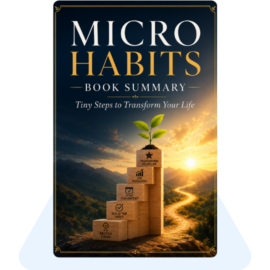
Tiny Steps to Transform Your Life
There is a moment that almost everyone who has tried to change their life has lived through.
You decide, with full conviction, that tomorrow is the day. Tomorrow you will wake up at 5 a.m., meditate for thirty minutes, write three pages in your journal, exercise for an hour, and finally become the disciplined, successful, aligned version of yourself you have been promising yourself for years.
Tomorrow comes. You manage two days. Maybe five, if you’re lucky. And then life happens: a late night, a stressful morning, a missed alarm and the whole beautifully ambitious plan collapses. Not because you are lazy. Not because you lack willpower. But because the plan itself was built on a flawed assumption: that big change requires big action.
This is exactly the myth that the philosophy of micro habits exists to dismantle.
At Readers Books Club, where we distil the world’s most transformative books on personal growth, spirituality, and self-mastery for our one-million-strong YouTube community, few ideas have proved as quietly powerful as the concept of micro habits – the radical idea that the smallest possible action, repeated consistently, creates far more lasting change than dramatic, unsustainable overhauls. This blog is a comprehensive book summary of the micro habits philosophy, drawn primarily from Stephen Guise’s bestselling book Mini Habits: Smaller Habits, Bigger Results, along with the broader behavioural science of tiny, sustainable change that Dr Amiett Kumar often weaves into his teachings on meditation, the law of attraction, coaching, and spirituality.
If you’ve ever felt like you fail at every habit you try to build, waking up early, meditating daily, reading more, exercising, journaling, or practising gratitude, this blog will show you why the failure was never about you. It was about the size of the step you were trying to take.
Let’s begin.
What Are Micro Habits, Exactly?
A micro-habit, sometimes called a mini-habit or a tiny habit, is a version of a desired behaviour so small that it becomes almost impossible to fail at. Instead of committing to “exercise for an hour every day”, a micro-habit version of that same goal might be “do one push-up”. Instead of “meditate for thirty minutes”, it might be “sit and take three conscious breaths”.
It sounds almost laughably small. And that is precisely the point.
Stephen Guise, the author who popularised this approach in his book Mini Habits, discovered the power of this method by accident. After years of failing to build a consistent exercise habit despite genuinely wanting to get fitter, he had a moment of surrender one evening. Too tired and unmotivated to do his usual ambitious workout, he set himself an almost embarrassingly small goal: one push-up. Just one.
He did the push-up. And then, almost without deciding to, he did a few more. That single moment, choosing an action so small that resistance had nothing to grab onto, became the seed of an entirely new approach to habit formation, self-improvement, and behaviour change.
This is the essence of the micro-habits philosophy: shrink the action until willpower is no longer required to begin.
Why Traditional Goal-Setting and Big Habits Fail
Before we get into how to actually build micro habits, it’s worth understanding why the conventional approach to self-improvement so often collapses.
1. Motivation Is Unreliable
Most people build their habits and goals around motivation, the feeling of inspiration, excitement, or determination that makes action feel easy. The problem is that motivation fluctuates constantly. It depends on your mood, your sleep, your stress levels, your hormones, and even the weather. If your habit depends on feeling motivated, you have built your transformation on one of the most unstable foundations available to you.
Micro habits remove motivation from the equation almost entirely. The action is so small that you can do it whether you feel inspired or completely depleted. You don’t need to feel like meditating to sit for ten seconds. You don’t need to feel like writing to type one sentence.
2. Big Goals Trigger Resistance
There is a psychological phenomenon often described in behavioural science: the bigger and more disruptive a change feels to your brain, the more resistance your brain generates against it. This is sometimes connected to the way your nervous system interprets large, unfamiliar changes as a kind of threat to your existing equilibrium.
When you tell yourself you must meditate for an hour, write a thousand words, or run five kilometres starting tomorrow, some part of your mind quietly begins building reasons why tomorrow isn’t the right day. A micro-habit is too small to trigger this resistance. There is nothing to resist when the goal is “open the meditation app and sit down for ten seconds.”
3. All-or-Nothing Thinking Destroys Consistency
Most people who try to build a habit operate from an unconscious all-or-nothing belief: if I can’t do the full version of the habit, doing a small version isn’t worth doing at all. This belief is one of the most consistency-destroying patterns in personal development. It means a single missed “perfect” day can spiral into weeks or months of abandoning the habit altogether, simply because the all-or-nothing standard was broken once.
Micro habits dissolve this trap completely. Because the minimum requirement is so small, there is always a version of the habit you can complete even on your busiest, most exhausted, most chaotic day. And completing the smallest version keeps the identity and the neural pathway alive, which matters far more than the size of any single session.
4. Willpower Is a Limited, Depletable Resource
Decades of psychological research point to the idea that willpower behaves somewhat like a muscle: it can be strengthened over time, but in any given moment, it is a finite resource that depletes as you use it throughout the day. This is why your best intentions in the morning so often dissolve into exhausted inaction by evening.
Because micro habits require almost no willpower to execute, they sidestep this depletion problem. You’re not spending precious willpower forcing yourself through an hour-long session. You’re simply doing something so small that it barely registers as effort at all.
The Science Behind Why Tiny Steps Create Massive Change
It’s worth pausing here to ask: if the action is this small, how does it actually create transformation? This is where the science of habit formation and the spirituality of consistent practice meet in a fascinating way.
Neural Pathways and Repetition
Every habit, at a biological level, is a neural pathway, a pattern of connections in your brain that becomes stronger and more automatic each time you repeat the corresponding behaviour. What matters for strengthening this pathway is not the intensity or duration of a single session, but the frequency and consistency of repetition over time.
This means a tiny action performed daily can build a stronger neural pathway than an intense session performed occasionally. Doing one push-up every single day for sixty days builds more lasting behavioural wiring in your brain than doing fifty push-ups once a week, even though the second option involves more total repetitions.
The Identity Shift Hidden Inside Every Tiny Action
This is perhaps the deepest and most spiritually resonant part of the micro-habits philosophy and one that aligns closely with the law of attraction principles Dr Amiett Kumar teaches through Readers Books Club: every action you take, no matter how small, is a vote for the kind of person you believe yourself to be.
When you do one push-up, you are not just exercising your body in some negligible way. You are casting a vote for the identity of “a person who exercises”. When you write one sentence in a journal, you are voting for the identity of “a writer” or “a person who reflects”. When you sit in meditation for ten seconds, you are voting for the identity of “a person who meditates”.
Over weeks and months, these tiny votes accumulate into an undeniable body of evidence. You can no longer tell yourself the old story “I’m not disciplined,” “I’m not someone who meditates,” or “I always give up” because the tiny habit has quietly, consistently proven that story wrong, one micro-action at a time. This is precisely the mechanism that Dr Amiett Kumar refers to when he speaks about manifestation not as wishful thinking but as embodied, repeated, consistent practice that gradually transforms your subconscious beliefs about who you are and what you are capable of.
Momentum and the “Bonus Repetitions” Effect
One of the most consistently reported phenomena among people who adopt micro habits is what Guise calls the “bonus repetitions” effect. Because the bar is set so low – one push-up, one sentence, ten seconds of meditation – people frequently find that once they begin, they naturally continue beyond the minimum. The hardest part of almost any habit is not the doing; it is the starting. Micro habits are specifically engineered to dismantle the resistance around starting, and once you’ve started, momentum very often carries you further than you originally committed to.
Crucially, the bonus repetitions are a welcome surprise, never a requirement. The actual commitment remains the tiny minimum one push-up, one sentence, so the habit never depends on motivation showing up. Some days you’ll do far more. Other days, you’ll do exactly the minimum. Both outcomes count as a complete success.
How to Build Your Own Micro Habits: A Step-by-Step Framework
Now let’s translate this philosophy into a concrete, actionable framework you can begin applying today whether your goal involves meditation, fitness, reading, spirituality, gratitude, or any form of personal transformation.
Step 1: Choose One Habit You Genuinely Want to Build
Resist the urge to overhaul five areas of your life simultaneously. Pick one habit that genuinely matters to you, perhaps a daily meditation practice, a reading habit, a gratitude journal, a fitness routine, or a consistent affirmation practice.
Specificity matters here too. “Become healthier” is too vague. “Do one bodyweight exercise” or “drink one glass of water before each meal” gives your mind something concrete to act on.
Step 2: Shrink It Until It Feels Almost Embarrassingly Easy
This is the single most important step and the one most people resist because it feels counterintuitive. Whatever habit size you initially think is “reasonable”, shrink it further. If you think “I’ll meditate for ten minutes” is small, shrink it to “I’ll sit and take three breaths.” If you think “I’ll read one chapter” is manageable, shrink it to “I’ll read one page” or even one paragraph.
The test for whether your micro-habit is small enough is simple: you should be able to imagine doing it even on your worst, busiest, most exhausted day, without any internal resistance at all.
Step 3: Anchor It to an Existing Routine
One of the most effective ways to ensure consistency is to attach your new micro-habit to something you already do reliably every day: brushing your teeth, making your morning tea, sitting down at your desk, or getting into bed. This existing routine becomes a natural prompt or trigger for your new tiny behaviour, removing the need to remember or rely on willpower to initiate it.
For example: “After I pour my morning tea, I will write one line of gratitude in my journal.” Or: “Before I check my phone in the morning, I will take three conscious breaths.”
Step 4: Celebrate Immediately After Completing It
This step is frequently skipped, and it is one of the most important. The moment you complete your micro-habit, even if it took you ten seconds, pause and genuinely acknowledge it. A small internal celebration, a feeling of “Yes, I did it”, or even saying “Good job” to yourself triggers a positive emotional response that your brain associates with the habit. This emotional reinforcement, more than repetition alone, is what cements a behaviour into a lasting habit.
This is deeply aligned with the gratitude and affirmation practices taught within meditation and law of attraction traditions: positive emotion is the glue that makes any practice spiritual or behavioural stick.
Step 5: Allow (But Never Require) Bonus Repetitions
After completing your minimum micro-habit, you are always free to continue if you feel like it. If one push-up turns into ten, wonderful. If three breaths turn into a full ten-minute meditation, even better. But the moment you make the bonus repetitions mandatory, you’ve recreated the same all-or-nothing trap that made the original big habit collapse. The tiny minimum must always remain the actual goal; everything beyond it is simply a welcome bonus.
Step 6: Track Your Consistency, Not Your Intensity
Keep a simple record of whether you completed your micro-habit each day a checkmark, a journal entry, an app, anything visual that lets you see your unbroken (or broken) streak. What you are tracking is not how much you did, but whether you showed up at all. This single shift in what you measure frequency over intensity is often the difference between a habit that lasts a lifetime and one that fades after a few weeks.
Step 7: Resist the Urge to Increase the Size Too Quickly
As your micro-habit starts to feel automatic, often after several weeks of consistency, you may feel the temptation to scale it up significantly. Resist this urge, or at least approach it with caution. If you do increase the size of your habit, increase it gradually, and be willing to shrink it back down again if you notice resistance returning. The goal is not to eventually force yourself back into the same unsustainable, motivation-dependent big habits that failed before. The goal is sustainable, compounding consistency.
Micro Habit Ideas Across Different Areas of Life
To make this practical, here are examples of how the micro-habits philosophy applies across different domains of personal growth, many of which align closely with the meditation, spirituality, and coaching practices taught within the Readers Books Club community.
Meditation and Mindfulness
- Sit and take three conscious breaths each morning.
- Close your eyes and silently say one affirmation before getting out of bed.
- Notice one thing you’re grateful for before falling asleep.
Reading and Learning
- Read one page of a book each day.
- Highlight one sentence in whatever you’re reading that resonates with you.
- Watch one short educational video instead of scrolling social media.
Fitness and Physical Health
- Do one push-up, one squat, or one stretch.
- Drink one glass of water before each meal.
- Walk to the end of your street and back.
Spirituality and Law of Attraction Practice
- Write one affirmation in your journal.
- Spend ten seconds visualising your desired outcome with genuine feeling.
- Say one sentence of gratitude out loud each morning.
Relationships and Emotional Wellbeing
- Send one message of appreciation to someone each day.
- Write one sentence in a journal about how you’re feeling.
- Give one genuine compliment to someone you interact with.
Productivity and Focus
- Write one sentence of whatever you’re trying to create an email, a report, or a book.
- Clear one item from your inbox.
- Set a timer and focus on one task for two minutes.
Notice the pattern across every category: the action is so small that “I don’t have time” or “I don’t have the energy” stops being a valid excuse. This is, by design, the entire power of the approach.
Common Mistakes People Make With Micro Habits
Even a method this simple can be undermined by a few common errors. Here’s what to watch for.
Mistake 1: Secretly Expecting the Bonus Repetitions Every Day
If you tell yourself the goal is “one push-up” but secretly feel disappointed or like a failure on days you only do the minimum, you haven’t actually adopted the micro-habits mindset; you’ve just relabelled your old all-or-nothing goal. The minimum must genuinely count as a full, complete success, every single time.
Mistake 2: Choosing a Habit You Don’t Actually Want
Micro habits make starting easier, but they cannot manufacture genuine desire for a goal that isn’t truly yours. If you’re building a meditation habit because you feel you “should”, rather than because some part of you genuinely wants the benefits of stillness and clarity, the habit will struggle to take root no matter how small you make it. Choose habits connected to who you actually want to become.
Mistake 3: Skipping the Celebration Step
It feels unnecessary, even silly, to celebrate something as small as one push-up or one sentence written. But skipping this step removes one of the most important psychological mechanisms that converts a single action into a lasting habit. The celebration doesn’t need to be elaborate; a quiet internal acknowledgement is enough.
Mistake 4: Trying to Build Too Many Micro Habits at Once
Even though each individual micro habit requires minimal willpower, attempting to build five or six new tiny habits simultaneously can still overwhelm your capacity for new routines and prompts. Start with one or two. Let them become automatic. Then add another.
Mistake 5: Abandoning the Habit After Missing a Day
Missing a day does not erase your progress, and it certainly doesn’t mean you’ve failed. The only real failure in the micro habits philosophy is deciding to stop entirely. If you miss a day, simply return to your micro habit the next day, without guilt, without a dramatic restart, without treating the missed day as evidence that the whole approach doesn’t work for you.
How Micro Habits Connect to Meditation, Spirituality, and the Law of Attraction
There is a profound spiritual dimension hidden inside the seemingly simple, almost mundane philosophy of micro habits, one that Dr Amiett Kumar often highlights in his coaching, meditation sessions, and law of attraction teachings to the Readers Books Club community.
At its core, manifestation is not a single dramatic act of wishing. It is an accumulation of aligned thought, aligned emotion, and aligned action, repeated consistently until your subconscious mind genuinely believes the new reality you are creating. This is precisely what micro-habits accomplish at the behavioural level. Each tiny, consistent action – one affirmation, one breath of meditation, one moment of gratitude – is a small but real signal to your subconscious mind: this is who I am now. This is what I do now. This is what I believe about myself now.
A single grand gesture of manifestation, one powerful visualisation session, or one intense affirmation practice rarely creates lasting transformation on its own, for the same reason one massive workout rarely creates lasting fitness. What creates lasting transformation, in both the physical and spiritual senses, is the daily, humble, almost unremarkable repetition of a small, aligned action.
This is why so many of the most effective spiritual and coaching practices, daily morning meditation, daily affirmation writing, and daily gratitude journaling are built around small, repeatable, sustainable units of practice rather than occasional intense retreats or sessions. The wisdom of micro-habits and the wisdom of consistent meditation and manifestation practice are, in this sense, the same wisdom wearing different clothes: lasting change is built through small, repeated, embodied practice, not through isolated bursts of intensity.
A Simple 21-Day Micro Habits Starter Plan
If you want to put this book summary into practice immediately, here is a simple structure to follow for the next twenty-one days, a timeframe widely associated with the early stages of habit and belief reprogramming within both behavioural science and the spiritual coaching traditions taught through Readers Books Club.
Days 1–7: Choose and Shrink
Pick one habit. Shrink it to its smallest possible version. Anchor it to an existing daily routine. Complete it every day, celebrating immediately each time, regardless of how small the action feels.
Days 8–14: Track and Reflect
Continue your micro-habit daily, now tracking your consistency visually with a journal, a calendar, or an app. At the end of each day, briefly reflect on how the tiny action made you feel, and notice any “bonus repetition” days where you naturally did more than the minimum.
Days 15–21: Notice the Identity Shift
By this stage, many people begin to notice a subtle but real shift: the habit starts to feel like “something I do” rather than “something I’m forcing myself to do”. Pay attention to this identity shift. Journal about how you see yourself differently. This is the true marker of a micro-habit becoming a permanent part of who you are: not the size of the action, but the transformation of self-belief underneath it.
After day 21, you can choose to maintain your micro-habit at its current size indefinitely or gradually expand it always being willing to shrink back down if resistance reappears.
Final Thoughts: The Quiet Power of Starting Small
The deepest lesson inside the micro habits philosophy is not really about push-ups, journal entries, or breathing exercises. It is about a fundamental shift in how you relate to your own capacity for change.
Most people believe transformation requires heroic effort, dramatic willpower, intense motivation, and an all-or-nothing leap into a completely new version of life. The micro-habits philosophy gently, persistently dismantles this belief. It suggests, instead, that transformation is built through humility: the willingness to start so small that your ego might even resist calling it meaningful, and the patience to trust that consistency, not intensity, is what creates lasting change.
This is a lesson that echoes throughout the wisdom shared across Readers Books Club, in the meditation practices, affirmation work, and law of attraction coaching that Dr Amiett Kumar teaches to his one-million-strong YouTube community: you do not need to overhaul your entire life today. You need to take one tiny, consistent step in the direction of who you want to become and trust that the accumulation of these tiny steps is, quietly and almost invisibly, the entire mechanism of transformation.
So today, choose one habit. Shrink it down until it feels almost too small to matter. Do it. Celebrate it. And tomorrow, do it again.
That is the whole secret. That is the entire book. And that, quietly, is how a life gets transformed – not in one dramatic leap, but one tiny, repeated step at a time.
If this summary resonated with you, explore more transformative book summaries, guided meditations, affirmation practices, and law of attraction coaching content on the Readers Books Club YouTube channel and at www.readersbooksclub.com, where Dr Amiett Kumar and the Readers Books Club team continue distilling the world’s most powerful books into simple, actionable wisdom you can apply starting today.
Learn More from Readers Books Club:
Contents