Introduction
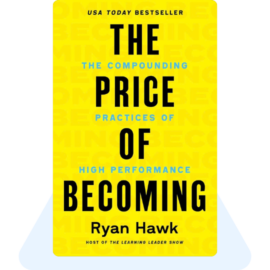
Every year, the shelves fill up with books promising a shortcut to a better life a hack, a morning routine, a five-minute trick that changes everything. The Price of Becoming: The Compounding Practices of High Performance by Ryan Hawk is refreshingly different. It doesn’t sell a shortcut. It makes an argument, backed by more than 700 conversations with world-class leaders, that there isn’t one and that the people who look like overnight successes are almost always the ones who quietly did the unglamorous work for years before anyone was watching.
If you’re building a reading list of the best books 2026 has to offer in the personal growth and mindset transformation space, this is one of the titles worth understanding in depth. It sits at the intersection of leadership, psychology of success, habit formation and self-discipline, and it speaks directly to anyone who has ever wondered why willpower and motivation alone never seem to be enough to create real, lasting change.
This complete The Price of Becoming book summary breaks down everything you need to know about the book its central philosophy, its three-part framework, its key lessons, and how its ideas about consistent daily action connect with the broader personal growth, mindset and manifestation work we explore here at Readers Books Club. Whether you’re deciding if this book belongs on your shelf, searching for a reliable The Price of Becoming summary before you buy, or simply want the core ideas without reading all 300-plus pages yourself, this Ryan Hawk book summary will give you a genuine, practical understanding of what he’s teaching and how to apply it.
How to Use This The Price of Becoming Summary
Before diving in, it’s worth being upfront about what this guide is and isn’t. This is a detailed The Price of Becoming Ryan Hawk summary an honest breakdown of the book’s structure, arguments and key ideas, written to help you understand its core philosophy and decide how it fits into your own personal growth journey. It isn’t a substitute for the book itself, and it won’t walk through every story, interview excerpt or page in sequence. If the ideas below resonate with you, the full book is where Hawk’s 700+ conversations, detailed case studies and complete arguments are laid out in his own words.
Think of this summary the way you’d think of a trusted friend describing a book they loved over coffee enough detail to know exactly what you’re getting, enough honesty to know if it’s right for you, and enough structure to start applying the ideas immediately, whether or not you go on to read the full book. That’s the same spirit behind every book breakdown we publish at Readers Books Club.
About the Author: Who Is Ryan Hawk?
To understand The Price of Becoming, it helps to understand where it came from. Ryan Hawk is the creator and host of The Learning Leader Show, a leadership and business podcast that has been running for over a decade, has been downloaded millions of times across more than 150 countries, and regularly ranks among the top business podcasts on Apple. Forbes has called it one of the most dynamic leadership podcasts in the space.
Hawk’s own background is rooted in competition and repetition; he spent his early life as a quarterback in high school and college sports, grew up in a household full of ambitious, competitive people, and later moved into a sales career where he studied and imitated the habits of the top performers around him. That same curiosity, the drive to understand exactly what separates people who keep improving from people who plateau, eventually turned into an eleven-year project of interviewing coaches, CEOs, elite athletes, military leaders, scientists, and quiet high performers most people have never heard of.
The Price of Becoming is best understood as the synthesis of that entire body of work, Hawk’s own lived experience combined with patterns he noticed again and again across hundreds of conversations with people at the top of their respective fields. Rather than another collection of motivational anecdotes, the book positions itself as a practical, evidence-informed framework one built specifically for readers who are more interested in continuous learning and sustainable growth than in a quick emotional high that fades by the following week.
What makes Hawk a credible narrator for this particular subject is that his own career is itself a case study in the book’s central argument. He didn’t arrive at insight through a single flash of inspiration; he built it through more than a decade of consistent, disciplined repetition: showing up to record a podcast episode every single week, preparing rigorously for each conversation, and slowly, deliberately refining his own thinking one interview at a time. In many ways, The Price of Becoming is less a book he decided to write and more a body of evidence that accumulated until it demanded to be organised into one.
What Is The Price of Becoming About?
At its heart, The Price of Becoming answers one deceptively simple question that Ryan Hawk says he has asked leader after leader throughout his interviews: what do you intentionally do each day to make sure you go to bed just a little bit better than you were when you woke up?
The book’s central argument is that meaningful personal growth doesn’t come from big, dramatic leaps. It comes from small, unglamorous, repeated actions – the kind that feel boring in the moment and only reveal their power when you zoom out and look at months or years of accumulated effort. Hawk borrows the language of compound interest to describe this: just as a small amount of money, left to grow steadily over time, eventually produces disproportionate returns, small consistent inputs into your skills, your relationships and your decision-making eventually produce disproportionate results in your life and career.
This is also where the book’s title comes from. Becoming a better version of yourself, a better leader, communicator, decision-maker or creator, has a price, and that price is paid daily, in the form of unremarkable, easy-to-skip actions: an extra rep of practice, a difficult conversation you choose not to postpone, time spent writing or reflecting instead of scrolling. None of these actions look impressive on their own. Their power only becomes visible in hindsight, once they’ve compounded.
Structurally, Hawk organises the book’s practical framework into three sections: Learn, Work and Lead, each representing a different stage of the compounding process. Together, they form a complete cycle: you take in ideas and perspective (Learn), you convert that input into consistent action (Work), and you multiply your own growth by helping others grow too (Lead). It’s worth understanding each of these three sections in more depth, because they form the real backbone of the book’s actionable advice.
Part One: Learn Fuelling Your Intake Engine
The first section of the book focuses on the inputs that shape everything else: what you read, who you learn from, and how curious and honest you’re willing to be about your own blind spots. A recurring idea here is that genuine mastery rarely starts with originality. Instead, it tends to start with mindful imitation, deliberately studying people who are already excellent at what you want to become good at, borrowing pieces of their approach, and only later, once you’ve absorbed enough patterns, developing something that feels distinctly your own. This mirrors Hawk’s own story of studying top performers in his first sales job before eventually developing his own style.
This section also emphasises the role of asking better questions. Rather than accepting assumptions about how things “should” be done, Hawk encourages readers to interrogate their own thinking to ask the kind of questions that create genuine openings for growth, rather than questions designed to confirm what you already believe. This is closely tied to continuous learning as a discipline rather than an occasional event: reading widely, staying curious well past the point where curiosity is convenient, and treating every conversation or setback as a source of data rather than simply an experience to get through.
For readers focused on mindset transformation, this part of the book is a useful reminder that input quality shapes output quality. If your daily intake the books you read, the people you surround yourself with, the questions you ask yourself stays shallow or unchallenged, it becomes very difficult to produce genuinely new levels of performance, no matter how hard you work afterward.
There’s also a practical, almost architectural idea running through this section: your environment shapes your intake far more than your willpower does. Trying to force curiosity and continuous learning through sheer discipline alone tends to burn out quickly. It’s far more sustainable to change your environment so that better inputs are the default following people who challenge your thinking rather than confirm it, keep a book within reach instead of a phone, and structure your week so that reflection and learning have a protected place rather than competing for leftover time and energy.
Chapter Themes Inside Learn: Curiosity as a Daily Practice
Woven through this section is a distinction worth sitting with: the difference between being interested and being genuinely curious. Interest is passive; you enjoy consuming an idea when it happens to cross your path. Curiosity, as this section frames it, is active, and daily it looks like deliberately seeking out perspectives that might be uncomfortable, asking a follow-up question instead of nodding along, and treating your own current level of understanding as a starting point rather than a finish line.
This is where the book’s compounding logic first becomes visible in a very concrete way. A single good question or a single well-chosen book rarely changes a career. But a habit of asking better questions and choosing better inputs, sustained over years, quietly reshapes how you think, which is precisely the kind of durable, invisible-until-it-isn’t change the rest of the book goes on to build upon.
Part Two: Work Taking Action When It’s Hard, Boring or Unrewarding
If the Learn section is about input, the Work section is about the unglamorous middle stretch where most people quietly give up. Hawk makes the case that most personal growth and leadership advice fails not because the advice itself is wrong, but because it focuses entirely on what to do while ignoring the much harder problem of how to keep doing it once the initial motivation fades which, realistically, describes the vast majority of the time.
One of the more counterintuitive ideas in this section is the reframing of difficulty itself. Rather than treating “the hard way” as an obstacle to route around, Hawk argues that difficulty is often a feature, not a flaw; the very friction that makes a habit or a skill valuable is frequently the same friction that filters out everyone unwilling to sustain it. This connects directly to self-discipline and habit formation: the goal isn’t to make hard things feel easy, but to build enough structure, identity and consistency around a practice that you keep doing it even when it doesn’t feel rewarding.
This section also introduces a subtle but important shift in how progress should be measured. Instead of judging yourself day to day where progress is often invisible or even feels like it’s moving backward Hawk encourages measuring growth in years, not days. This reframing alone tends to relieve an enormous amount of unnecessary pressure, because it acknowledges that compounding, by definition, looks unremarkable in the short term and only becomes obvious in retrospect.
Communication also plays a bigger role in this section than readers might expect from a book about daily discipline. Hawk treats writing and articulate communication as leadership tools in their own right the ability to clearly express an idea, make a case, or write something worth reading is treated not as a “soft skill” on the side, but as a direct multiplier of whatever technical or professional skill you’re building. For anyone working on communication skills or decision-making under pressure, this section offers a genuinely practical bridge between “doing the work” and being able to explain, sell and lead through that work.
Chapter Themes Inside Work: Building Self-Discipline That Outlasts Motivation
A closer look at this section reveals a consistent pattern in how Hawk frames self-discipline: not as a fixed personality trait some people simply have and others don’t, but as a structure you build around yourself. Rather than relying on morning motivation to decide whether a habit happens, the more durable approach is to remove the decision entirely the same time each day, the same trigger, and the same minimum threshold you commit to regardless of mood.
This connects back to the environment principle introduced earlier. Self-discipline, in this framing, has far less to do with resisting temptation through sheer force of will and far more to do with proactively designing your day so that the disciplined choice requires less resistance to begin with. Change your environment, your schedule, and your visible cues; the friction around your best and worst habits and self-discipline becomes something closer to inertia than effort.
Decision-making under pressure gets particular attention here as well. Hawk’s interviews with elite performers across sport, the military and business repeatedly surface the same insight: people who make sound decisions under pressure aren’t necessarily calmer by nature; they’ve simply rehearsed the decision, or a version of it, enough times in lower-stakes moments that the high-pressure version feels familiar rather than novel. This is compounding applied directly to judgement itself.
Part Three: Lead Multiplying Your Growth by Teaching Others
The final section shifts the focus outward. Having built a foundation through learning and reinforced it through consistent work, Hawk argues that the next stage of compounding comes from leadership specifically, from teaching, mentoring and leading before you feel fully “ready” or officially entitled to do so.
A central idea here is that leadership doesn’t require waiting for a title or formal permission. Hawk highlights the small, often invisible signals that someone is ready to lead long before any promotion arrives taking ownership of outcomes, helping others improve, and modelling the standards you want a team or community to hold, regardless of your current position. This is a particularly useful reframe for readers who feel stuck waiting for external validation before they’re willing to step up.
This section also returns to the theme of reflection, the deliberate practice of pausing to review what’s working, what isn’t, and what your next intentional step should be. Hawk positions this kind of reflective practice, paired with clear intention-setting, as one of the quiet differentiators between leaders who plateau and leaders who keep compounding their growth over the long run.
Finally, the book closes its framework with what might be its most important idea: teaching others isn’t just generous, it’s strategically one of the fastest ways to deepen your own mastery. Having to explain a concept clearly, answer someone else’s questions about it, or coach another person through the same struggles you once faced forces a level of clarity that simply reading or practising alone rarely produces. In this way, the “Lead” section closes the loop that the book opened with “Learn” teaching becomes its own high-value form of learning, restarting the compounding cycle at a higher level.
Chapter Themes Inside Lead: Coaching, Mentorship and Multiplying Impact
This final section is where the book’s philosophy starts to resemble coaching in the fullest sense of the word not simply managing outcomes, but developing people. Hawk’s years of conversations with coaches, team leaders and mentors surface a recurring theme: the leaders who build the most lasting impact tend to measure their success not by their own output, but by the growth of the people around them.
This has a direct, practical implication for anyone in a coaching or life coach capacity, formally or informally. Leadership, in this framing, isn’t a title-based role reserved for people with direct reports it’s a daily practice available to a team captain, an older sibling, a small business owner, or anyone willing to model consistency and help someone else get better. The compounding logic applies here too: a single piece of mentorship rarely transforms a career, but a habit of consistently investing in other people’s growth, sustained over years, tends to come back around in ways that are difficult to predict in advance and easy to underestimate at the time.
Key Lessons and Takeaways from The Price of Becoming
Pulling the book’s three-part framework together, a handful of core lessons stand out as the ideas most worth carrying with you:
- Growth compounds like interest. Small, consistent inputs into your skills, relationships and decisions accumulate into results that look disproportionate from the outside, even though each individual action felt minor at the time.
- Discipline matters more than motivation. Motivation is unreliable by nature; the people who keep improving are the ones who’ve built enough structure and identity around their habits that they continue even when motivation disappears.
- Difficulty is often a feature, not an obstacle. The friction in a hard habit is frequently what makes it valuable and what filters out everyone unwilling to sustain it.
- Mindful imitation comes before originality. Studying and borrowing from people who are already excellent is a legitimate, often necessary first step toward developing your own voice or style.
- Progress should be measured in years, not days. Short-term measurement of compounding habits is almost always discouraging; long-term measurement is where the real payoff becomes visible.
- Communication is a core leadership skill, not an accessory. Clear writing and articulate speech multiply the value of whatever else you’re building.
- You don’t need permission to start leading. Ownership, consistency and helping others improve are available to you regardless of title or seniority.
- Reflection and intention are quiet multipliers. Regularly reviewing what’s working and setting a clear next intention keeps compounding progress from stalling out.
- Teaching accelerates your own mastery. Explaining an idea to someone else is one of the fastest ways to deepen your own understanding of it.
Taken together, these lessons form less of a checklist and more of a mindset one centred on self-belief built through evidence of your own consistency, rather than self-belief built on hope alone.
The Psychology of Success Behind The Price of Becoming
While The Price of Becoming is built primarily on interviews rather than laboratory research, its core arguments line up closely with well-established ideas in the psychology of success. The book’s emphasis on identity-driven habits doing something because it reflects who you’re becoming, not simply because you’re chasing an outcome echoes decades of behavioural research showing that habits anchored to identity tend to be far more durable than habits anchored to willpower alone.
Its insistence on measuring progress in years rather than days also reflects a well-documented psychological trap: humans are generally poor at perceiving gradual, compounding change in real time, which is exactly why so many people abandon good habits just before they would have started paying off. By explicitly reframing the time horizon, Hawk is addressing a genuine cognitive bias rather than simply offering encouragement.
Finally, the book’s focus on discomfort as a signal rather than a warning sign connects to research on deliberate practice the idea that meaningful skill development happens specifically at the edge of your current ability, in the uncomfortable zone just past what feels easy. Comfortable repetition rarely produces growth; targeted, slightly uncomfortable repetition, sustained consistently, is what compounds. Understanding this psychological backdrop makes the book’s practical advice feel less like personal opinion and more like an application of principles many readers may have already encountered elsewhere, now organized around a single, memorable framework.
Common Criticisms and Limitations
No book is universally perfect for every reader, and it’s worth being honest about where The Price of Becoming may not land as well for everyone. Its central message that meaningful results take years of consistent, often unglamorous effort is deliberately unhurried, which means readers looking for urgent, immediate solutions to a pressing problem may find its pace frustrating rather than reassuring.
Some readers may also notice that, because the book draws heavily on leadership, business and elite performance contexts, a number of its illustrative examples lean toward professional and competitive settings. Readers applying its ideas to more personal contexts relationships, creative pursuits, spiritual growth will likely need to do some translation work themselves, adapting the underlying compounding principle to a different setting than the one it’s most directly illustrated in.
Finally, because the book’s philosophy is intentionally repetitive by design reinforcing the same core idea of compounding from multiple angles across Learn, Work and Lead readers looking for a large volume of entirely new frameworks in every chapter may find that the book rewards depth over breadth. For readers who value a single, well-reinforced idea over a long list of separate tactics, this repetition is a strength rather than a weakness.
The Voices Behind the Book
Part of what gives The Price of Becoming its credibility is the sheer range of people Ryan Hawk has spoken with over more than a decade of hosting The Learning Leader Show. The book draws on patterns Hawk noticed across more than 700 conversations with leaders, athletes, authors, military commanders and entrepreneurs, including well-known names such as Jim Collins, Simon Sinek, Adam Grant, Tony Robbins, James Clear, Susan Cain, Seth Godin, Angela Duckworth, Liz Wiseman, General Stanley McChrystal and Admiral William McRaven, among many others.
Rather than functioning as a collection of separate interviews, the book distills the recurring patterns Hawk noticed across this enormous range of perspectives from elite sport, the military, business leadership and academic psychology into a single, coherent framework. This is arguably one of the book’s biggest strengths for readers interested in personal growth and mindset transformation: instead of relying on one person’s individual philosophy, it reflects patterns that show up consistently across very different fields and very different definitions of success.
This breadth is also what separates The Price of Becoming from many single-perspective self improvement books. A founder’s advice on discipline can be shaped heavily by their specific industry; a coach’s advice on leadership can be shaped by the particular sport or team culture they came up in. By synthesizing patterns across hundreds of very different contexts combat sports commentary, Navy SEAL leadership, Fortune 500 executives, championship coaches and behavioural scientists alike Hawk’s framework is built to hold up across a much wider range of readers’ actual lives, rather than only making sense within one narrow professional context.
Ideas Worth Remembering From The Price of Becoming
A few of the book’s framing devices are worth carrying with you long after you’ve finished reading, because they tend to reshape how you evaluate your own progress:
- Progress that’s real rarely feels impressive while it’s happening it only looks impressive in hindsight, once enough of it has accumulated.
- The willingness to keep showing up after the initial motivation fades is a far better predictor of long-term success than talent or a strong start.
- Borrowing from people who are already excellent isn’t a lack of originality it’s usually the fastest route toward eventually developing your own.
- The size of a habit matters far less than its consistency; a small action repeated for years will typically outperform a large action attempted once.
- Teaching what you know, even before you feel like an expert, is one of the most reliable ways to actually become one.
These aren’t complicated ideas, and that’s very much by design. Hawk’s larger argument is that the constraint was never a lack of good ideas it was always the discipline to keep acting on simple ones, day after day, long enough for them to compound.
Why This Book Matters for Personal Growth in 2026
Among the best books 2026 has offered so far in the self-improvement and mindset transformation space, The Price of Becoming stands out for taking a clear, almost contrarian position: it explicitly pushes back against the idea that hacks, shortcuts or a single mindset shift can substitute for sustained daily effort.
This matters because the broader personal growth and self-improvement books category has, in recent years, leaned heavily into speed quick frameworks, rapid transformation promises, and content built for short attention spans. Hawk’s book asks readers to do something almost countercultural in that environment: slow down, commit to years rather than weeks, and accept that most of the meaningful work of self-improvement is invisible until it isn’t.
For readers who have tried motivation-based approaches to change and found them short-lived, this book offers a more durable alternative rooted in the psychology of success: habits, identity and consistency, reinforced by evidence drawn from thousands of hours of conversation with people who have actually sustained excellence over long periods of time, rather than achieved it briefly and burned out.
How This Connects to Manifestation, Meditation and the Law of Attraction
At Readers Books Club, many of the books we cover including titles on manifestation, meditation and the Law of Attraction focus on the inner side of transformation: aligning your thoughts, emotions and beliefs with the life you want to create. The Price of Becoming is a valuable companion to that work because it focuses on the outer, practical side of the same process: the consistent daily action that turns an aligned intention into an actual, lived result.
This connects closely to the philosophy taught by Dr Amiett Kumar, founder of Readers Books Club and a well-known voice in manifestation and life coaching. Amiett Kumar’s teaching consistently emphasizes that manifestation isn’t passive that visualisation, affirmation and a clear, focused mindset work best when they’re paired with real-world discipline and consistent action, not held separately from it. Spirituality and practical discipline, in this view, aren’t opposites; they’re two halves of the same process of intentional becoming.
Read this way, The Price of Becoming isn’t a departure from manifestation and Law of Attraction principles; it’s a practical extension of them. A clear, aligned intention tells you what you’re moving toward; Hawk’s compounding framework tells you how to actually walk there, one unremarkable, repeated action at a time. For anyone building a personal growth reading list that blends inner mindset work with outer discipline meditation and affirmation alongside habit formation and consistent action pairing this book with more spiritually orientated reading is a natural, complementary combination, and exactly the kind of well-rounded personal growth library we encourage as part of the Readers Books Club community.
Who Should Read The Price of Becoming (and Who Shouldn’t)
This book is best suited to ambitious readers who genuinely want to improve their performance, leadership or craft, and who are willing to accept that meaningful change takes sustained effort over a long period of time. If you’re drawn to the slow, steady power of consistency over the promise of a quick win, you’re precisely the reader this book was written for whether you’re a business leader, an athlete, a creative professional, a student, or simply someone committed to ongoing personal growth.
On the other hand, if you’re looking for a fast hack, a single mindset shift, or an overnight transformation, this probably isn’t the right book for you at this moment. Hawk is explicit that the book has little interest in shortcuts; its entire philosophy is built around the idea that anything genuinely valuable is built slowly, through repeated, sometimes unglamorous effort. Readers looking for flashy, immediate results are likely to find the book’s message frustrating rather than motivating.
Practical Ways to Apply the Book’s Lessons Starting Today
A summary is only useful if it leads to action. Here are a few practical ways to start applying The Price of Becoming’s core ideas immediately:
- Identify one small daily input reading, a skill-building rep, a difficult conversation and commit to it consistently for a defined period, rather than depending on daily motivation to decide whether you’ll show up.
- Change your environment to support the habit, rather than relying on willpower alone. Remove friction from the behaviour you want more of, and add friction to the behaviour you want less of.
- Study and imitate someone excellent in the specific skill you’re building, rather than trying to invent your approach from scratch. Give yourself permission to borrow before you innovate.
- Set a measurement window in months or years, not days, for any habit you’re building. Judge the habit by whether you’re still doing it consistently, not by how dramatic this week’s progress looks.
- Practice one uncomfortable but valuable action you’d normally avoid a hard conversation, honest feedback, a task outside your comfort zone and treat the discomfort itself as a sign you’re on the right track.
- Build a short weekly reflection habit a few minutes reviewing what worked, what didn’t, and what your intention is for the week ahead.
- Teach or explain what you’re learning to someone else, even informally, as a way of deepening and testing your own understanding.
None of these actions are dramatic on their own which is exactly the point the book is making. Their value comes from repetition, not intensity.
A Simple Framework for Daily Improvement
If you want a single, repeatable structure to build a genuine success mindset from this summary, try anchoring your week around three questions drawn directly from the book’s Learn–Work–Lead framework: What did I learn today that I didn’t know yesterday? What did I do today, even though it was hard, boring or unrewarding? And who did I help move forward today, even in a small way? Answering these honestly, even briefly, turns daily improvement from an abstract goal into a concrete, trackable practice and it’s a simple enough ritual to sustain for years, which, as the book repeatedly reminds us, is exactly the point.
How The Price of Becoming Compares to Other Personal Growth Classics
Readers familiar with other titles in the personal growth and self improvement books space will notice clear connections between The Price of Becoming and ideas found in books like Atomic Habits, which similarly emphasizes small, compounding behavioural change, or Range, which explores how varied experience and mindful imitation contribute to long-term mastery. Where The Price of Becoming distinguishes itself is in its foundation: rather than building its framework primarily around behavioural science research, it’s built from real, direct conversations with hundreds of high performers across dramatically different fields sport, the military, business and the arts giving its conclusions a distinctly practitioner-driven, rather than purely theoretical, feel.
If your personal growth library already includes habit-formation classics, The Price of Becoming is a natural next read less a replacement for those books than a complementary field guide, focused specifically on leadership, communication and the discipline required to sustain compounding growth once you already understand the basic mechanics of habit formation.
Final Thoughts: Is The Price of Becoming Worth Reading?
The Price of Becoming earns its place among the best books 2026 has to offer in the personal growth and leadership space precisely because it refuses to oversimplify. It doesn’t promise transformation by next week. Instead, it makes a patient, well-supported case that real transformation is available to almost anyone willing to trade the appeal of quick wins for the much less glamorous, far more reliable power of consistent, compounding daily action.
For readers serious about mindset transformation, whether your focus is leadership, communication, decision making, or simply becoming a more disciplined, self-aware version of yourself this book offers a clear, evidence-informed framework rather than another round of generic motivation. It’s a demanding read in the best sense: it asks you to change how you measure progress, not just what you do each day.
Who this book is genuinely for: ambitious readers, leaders, coaches, and anyone committed to continuous learning who is willing to trade quick wins for durable, compounding growth.
Who might want to look elsewhere: readers in the middle of an urgent crisis needing immediate, tactical solutions rather than a long-term framework for daily improvement.
Best paired with: a personal reflection journal, a specific skill or habit you’re currently trying to build, and for readers also working on their inner mindset a complementary read from the manifestation, meditation or spirituality space.
Frequently Asked Questions About The Price of Becoming
What is The Price of Becoming by Ryan Hawk about?
The Price of Becoming is a personal growth and leadership book that argues meaningful change comes from small, consistent daily actions that compound over time, rather than from motivation, hacks or dramatic one-time transformations. It’s built around a three-part framework Learn, Work and Lead.
Who is Ryan Hawk?
Ryan Hawk is the host of The Learning Leader Show, a long-running leadership and business podcast featuring conversations with elite leaders, athletes, authors and thinkers. The Price of Becoming distills patterns from more than 700 of these conversations into a single practical framework.
What are the three parts of The Price of Becoming?
The book is organized into three sections: Learn (building your intake through curiosity, mindful imitation and better questions), Work (taking consistent action, especially when it’s hard, boring or unrewarding), and Lead (teaching and leading others as a way of multiplying your own growth).
Is The Price of Becoming a good book for beginners in personal growth?
Yes while some of its examples are drawn from leadership and business contexts, its core ideas about habit formation, self-discipline and compounding effort apply broadly, making it accessible to readers at any stage of their personal growth journey.
How does the idea of compounding apply to habits and personal growth?
Just as small amounts of money grow disproportionately over time through compound interest, small consistent actions a daily practice rep, a difficult conversation, a few minutes of focused learning accumulate into significant results over months and years, even though each individual action feels minor in isolation.
Does The Price of Becoming relate to manifestation or the Law of Attraction?
While it isn’t a manifestation or spirituality book in the traditional sense, its emphasis on consistent action pairs naturally with manifestation and Law of Attraction principles, which focus more on aligning intention, belief and emotional state. Together, they offer a complete picture: aligned intention paired with sustained, compounding action.
What is one key takeaway from The Price of Becoming?
Perhaps the book’s most important idea is that difficulty is often a feature, not an obstacle the friction involved in a valuable habit is frequently what makes it worthwhile, and learning to stay consistent through that friction is what separates people who keep growing from people who plateau.
How can this book help with communication skills and decision making?
The book treats clear writing and articulate speech as leadership tools that multiply the value of whatever else you’re building, and it links good decision making under pressure to rehearsal making smaller, similar decisions repeatedly in lower-stakes moments so that high-pressure decisions feel familiar rather than overwhelming.
Does The Price of Becoming talk about changing your environment to build better habits?
Yes a recurring idea throughout the book is that willpower alone is an unreliable foundation for habit formation. Designing your environment so that good inputs and disciplined choices require less resistance is treated as far more sustainable than relying on daily motivation.
Is The Price of Becoming worth reading if I’ve already read other self improvement books?
If you’ve read other personal growth or self-improvement books focused on habits or behavioural science, The Price of Becoming is a strong complementary read, because its conclusions are drawn primarily from direct interviews with high performers rather than research studies, giving it a more practitioner-driven, real-world flavour alongside the frameworks you may already know.
Conclusion
The Price of Becoming is a reminder that lasting change was never meant to be dramatic. It’s meant to be quiet, repeated and, most of the time, a little bit boring which is precisely why so few people are willing to sustain it, and why the ones who do end up standing out. If you’re building a personal growth reading list for 2026, pairing Ryan Hawk’s practical, discipline-focused framework with the mindset, meditation and manifestation resources we cover here at Readers Books Club gives you both halves of the equation: a clear inner intention, and the consistent outer action needed to actually become it.
Explore more book summaries, mindset transformation resources, and coaching insights on the Readers Books Club YouTube channel and podcast, and if you’re ready to go deeper into the manifestation and life coaching side of this work, discover more from Dr Amiett Kumar. Your becoming, like the book reminds us, isn’t paid for all at once it’s paid daily, one consistent choice at a time.
Contents