Introduction: A Guidebook for the Parts of Life Nobody Teaches Us
There are moments when life feels less like a clear road and more like standing at a complicated intersection without a map. A relationship changes. A parent becomes ill. A friendship fades. Work stops feeling meaningful. Your body changes. Grief arrives. You know you have survived difficult seasons before, yet when a new one begins, the wisdom you once had can suddenly feel unavailable.
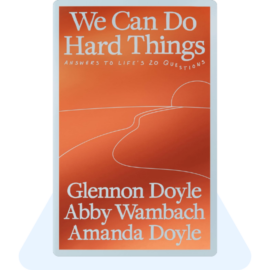
That is the emotional territory of We Can Do Hard Things: Answers to Life’s 20 Questions by Glennon Doyle, Abby Wambach, and Amanda Doyle. Rather than pretending that adulthood eventually gives us permanent certainty, the book starts from a more honest premise: the same human questions return again and again. We may be older, wiser, more experienced, and still find ourselves asking, “Why am I like this?”, “How do I know what to do?”, “How do I let go?”, “How do I forgive?”, or “What is the point?”
The book grew out of the authors’ podcast of the same name and the conversations they had with one another and with 118 “wayfinders” from different fields and life experiences. According to the publisher, the project took shape during a period when all three authors were dealing with serious personal difficulty at the same time. Their response was not to build a perfect formula for life. It was to gather lived wisdom from people who had already walked through similar terrain.
That makes this book different from many traditional self-help books. It does not offer one single theory and then apply it to every problem. It behaves more like a collection of compasses. Each of the twenty questions opens a different door: identity, courage, grief, friendship, love, parenting, body image, anger, forgiveness, purpose, and the challenge of moving forward when you are tired or unsure.
For Readers Books Club, that format is especially useful. The best books do more than give us information; they give us language for experiences we have struggled to name. Once you can name a pattern, emotion, fear, or desire, you can work with it more consciously. This is where reading meets self-awareness, meditation, spirituality, coaching, and practical personal growth.
This summary distils the book’s twenty questions into twenty life-changing lessons. It also adds a Readers Books Club application layer: how to use the ideas through reflection, journaling, meditation, healthy boundaries, intentional action, and, where appropriate, support from a coach, life coach, therapist, mentor, friend, or community. The goal is not to replace the original book. The goal is to help you understand its central map and decide which question you most need to sit with right now.
What Can We Do Hard Things About?
We Can Do Hard Things is a 2025 personal-improvement book by Glennon Doyle, Abby Wambach, and Amanda Doyle, published by The Dial Press. The U.S. hardcover edition is 512 pages. The publisher describes it as a guidebook for being alive and says it draws on deep conversations with 118 people whose experiences helped the authors think through the recurring questions of human life. In 2026, the book won the Libby Book Award for Best Personal Improvement, giving it fresh momentum among readers interested in self-improvement, emotional resilience, relationships, and personal growth.
The title can sound like a motivational slogan, but the book’s deeper message is not “be tougher”. It is closer to “do not do life alone”. The word we matter. Hard things become more survivable when we can borrow perspective, language, strength, or hope from people who have crossed similar ground. Wisdom is not only something we manufacture privately. It can be shared, remembered, and passed forward.
The twenty-question structure also makes the book practical. You do not have to read it as one continuous argument. You can return to the question that matches your current life: identity when you feel lost, friendship when you feel lonely, anger when you feel reactive, forgiveness when you are carrying old pain, or purpose when daily life feels empty.
The following twenty lessons follow the book’s published question sequence. Each lesson is a paraphrased Readers Books Club interpretation of the book’s broader themes, not a reproduction of its text.
Lesson 1: “Why Am I Like This?” Replace Self-Judgement with Curiosity
The first life-changing shift is to stop treating your own patterns as evidence that something is fundamentally wrong with you. “Why am I like this?” can be asked as an accusation, but it can also become an invitation to investigate. The tone of the question changes everything.
Many reactions that frustrate us have a history. People-pleasing may have developed because approval once felt like safety. Perfectionism may have protected you from criticism. Emotional distance may have helped you survive disappointment. Overworking may have become a way to feel worthy. The behaviour that is limiting you today may once have been an intelligent adaptation to an earlier environment.
That does not mean every pattern should be kept. It means change becomes easier when shame is replaced by understanding. If you only say, “I am too sensitive,” “I am lazy,” or “I always ruin things,” you create a fixed identity. Curiosity asks better questions: When does this pattern appear? What triggers it? What is it trying to protect? What does it cost me now? What would a healthier response look like?
Lesson 2: “Who Am I Really?” Separate Your Identity from Your Roles
Most of us can answer the question “Who are you?” with a list: profession, relationship status, family role, achievements, responsibilities, beliefs, or labels. Those descriptions are real, but they are not the whole self. Trouble begins when a role becomes the only mirror we use.
If your identity is entirely “successful professional”, losing a job can feel like losing yourself. If your identity is “the strong one”, needing help may feel shameful. If you are always “the good daughter”, “the perfect parent”, or “the reliable friend”, you may keep performing a role long after it has become emotionally expensive.
The deeper work is to notice what remains when applause, productivity, titles, and other people’s expectations become quiet. What values do you want to live by? What makes you feel internally honest? What do you care about even when nobody is watching? Which parts of your personality appear when you are not trying to be useful or impressive?
This is one reason books on spirituality and self-awareness often return to the distinction between the observing self and the social self. Spirituality, at its most grounded, can help you remember that your worth is not identical to your output. You can change careers without disappearing. You can disappoint someone without becoming a bad person. You can outgrow an identity without betraying your past.
Lesson 3: “How Do I Know When I’ve Lost Myself?” Notice the Cost of Constant Self-Abandonment
Losing yourself rarely happens in one dramatic moment. More often, it happens through a hundred small decisions in which you repeatedly leave your own truth to maintain approval, peace, belonging, or control.
You say yes while your body is saying no. You stop expressing an opinion because someone becomes uncomfortable. You build your week around everybody else’s priorities. You edit your personality in a relationship. You keep returning to situations that require you to shrink. Eventually, the problem is not simply exhaustion; it is disconnection. You can no longer tell what you want because you have become highly skilled at monitoring what everyone else wants.
Common signs include resentment, numbness, chronic indecision, envy of people who seem free, unexplained irritability, and the feeling that your life looks acceptable from the outside but does not feel like yours from the inside. These are not always proof that you need to leave a job, relationship, or family role. They are signals that some part of you needs attention.
Lesson 4: “How Do I Return to Myself?” Come Back Through Small Honest Actions
If losing yourself happens gradually, returning to yourself can also happen gradually. The way back is not usually one dramatic breakthrough. It is a collection of small moments in which your outer life begins to match your inner knowing again.
Start with what is easiest to hear: the body. Before the mind creates explanations, the body often gives information through tension, heaviness, relief, energy, fatigue, openness, or dread. This does not mean every uncomfortable sensation is a command. It means your internal experience deserves a place in the decision-making process.
Silence also matters. When every empty moment is filled with scrolling, opinions, podcasts, messages, and advice, your own voice has no room to become audible. Meditation can function as a return practice because it temporarily removes the need to perform. You sit, breathe, notice, and allow experience to be present without immediately solving it.
Journaling can do something similar. Try writing for ten minutes without asking, “What should I do?” Instead ask, “What do I already know that I keep arguing with?” The answer may be uncomfortable. You may know you need a boundary, a conversation, a rest period, a career change, an apology, or a new routine. Returning to yourself does not guarantee an easy next step; it gives you a more honest starting point.
Lesson 5: “How Do I Figure Out What I Want?” Desire Needs Quiet, Permission, and Specificity
Many people believe they do not know what they want when the deeper issue is that they do not feel allowed to want it. Desire is filtered through responsibility, fear, family expectations, money, culture, comparison, and the question, “What will people think?” By the time those filters finish speaking, your original preference can be difficult to hear.
One useful distinction is between wanting an outcome and wanting a feeling. You may say you want a promotion, but perhaps you really want respect, freedom, challenge, or financial security. You may want a relationship, but perhaps you are longing for companionship, intimacy, safety, or shared growth. When you identify the deeper need, you stop treating one specific form as the only route to fulfilment.
A practical exercise is the “more/less” list. Instead of forcing yourself to create a ten-year life plan, write what you want more of and less of over the next year. More creativity, sleep, meaningful work, intimacy, learning, nature, financial stability, or play. Less rushing, resentment, debt, comparison, performative relationships, or digital noise. Patterns will appear.
Lesson 6: “How Do I Know What to Do?” Stop Waiting for Perfect Certainty
A major source of paralysis is the belief that a good decision should feel completely certain. Real life rarely offers that luxury. Important choices often contain incomplete information, competing values, risk, and the possibility of regret.
Instead of asking, “What guarantees the best outcome?”, ask, “What choice is most consistent with what I know, value, and can responsibly do now?” That is a more human standard. Good decisions are not always rewarded immediately, and bad decisions do not always fail quickly. You can only make the clearest choice available with the information you have.
When anxiety is high, reduce the size of the decision. You may not know whether to change careers, but you can schedule three conversations with people in another field. You may not know whether a relationship can be repaired, but you can have one honest conversation and observe the response. You may not know whether you are ready to start a business, but you can test one offer with real customers.
Meditation can support decision-making by lowering reactivity, but it should not be used as a magical certainty machine. The goal is not to meditate until the universe gives you a perfect sign. The goal is to become calm enough to notice fear without automatically obeying it and clear enough to separate intuition from panic, impulse, or pressure.
Lesson 7: “How Do I Do the Hard Thing?” Courage Is a Practice, Not a Personality Type
Hard things are hard precisely because they involve discomfort, risk, grief, uncertainty, conflict, effort, or loss. Waiting until the hard thing feels easy is often another way of waiting forever.
Courage is not the absence of fear. It is the decision that something else matters enough to move with fear present. The hard thing may be leaving, staying, apologising, setting a boundary, asking for treatment, admitting you were wrong, telling the truth, starting again, ending a pattern, or beginning before you feel ready.
One of the most useful ideas connected to the title is the importance of we. People often turn resilience into a private performance: “I should be able to handle this alone.” But human beings regulate emotion and survive difficulty through connection. Support is not evidence that you failed the challenge. Support is often part of how the challenge gets done.
Build a “hard-things” team. It might include one friend who tells you the truth, one person who can help practically, one professional when specialised support is needed, and one community where you do not have to explain everything from the beginning. A life coach or mentor may help with accountability and action; a therapist or qualified clinician may be appropriate when the difficulty involves mental health, trauma, addiction, or severe distress.
Lesson 8: “How Do I Let Go?” Release the Fantasy of Controlling Everything
Letting go is difficult because attachment often carries a hidden bargain: if I think about this enough, explain myself perfectly, try harder, or remain available, maybe I can control the ending. Sometimes you can influence what happens. Sometimes the outcome belongs partly or entirely to another person, time, biology, chance, or reality.
Letting go does not mean saying the thing never mattered. It means stopping the endless attempt to negotiate with what has already become true. A friendship may have changed. Someone may not choose you. A dream may need a new form. A younger version of yourself may no longer fit the life you have now.
This lesson connects strongly with Readers Books Club content around The Let Them Theory. Acceptance is not passivity. You can accept another person’s choice while deciding your own boundary. You can accept that the past happened while choosing what you will carry forward. You can accept uncertainty while still taking action.
Lesson 9: “How Do I Go On?” Grief Changes the Shape of Life, Not the Value of Life
There are hard things that can be solved and hard things that must be carried. Grief belongs to the second category. You do not “win” against the death of someone you love, a serious diagnosis, the end of a family structure, or another irreversible loss. You learn how to live in a world that now has a different shape.
The pressure to “move on” can make grief lonelier. Moving forward is different. You can carry love, memory, anger, confusion, and sadness while still building a life. Some days resilience looks like returning to work. Other days it looks like eating, showering, asking someone to sit with you, or getting through the next hour.
The question “How do I go on?” becomes more manageable when the time horizon becomes smaller. You may not know how to handle the next year. What does the next day require? What does the next meal require? Who can help with the next practical task?
Spirituality can offer meaning, ritual, community, or a sense of connection larger than the self, but it should not be used to rush grief. Statements like “everything happens for a reason” may feel comforting to one person and cruel to another. Respect the grieving person’s own framework.
Lesson 10: “How Do I Make Peace with My Body?” Move from Control to Relationship
Many people experience the body primarily as a project: something to shrink, improve, discipline, hide, compare, or correct. That relationship can become exhausting because bodies are alive. They age, change, heal, get sick, recover, carry stress, respond to hormones, and refuse to remain frozen in one culturally approved form.
Making peace with the body does not require loving every part of your appearance every day. A more realistic starting point is respect. Can you treat the body as something you live with rather than something you are permanently evaluating?
Try shifting from appearance questions to function and experience questions. What helps your body feel rested? What movement feels supportive? What foods help you feel nourished and stable? What medical care have you been postponing? What happens to your mood after sleep, sunlight, movement, or too much screen time?
This topic also requires care. Body image struggles can overlap with eating disorders and other serious conditions. The book’s own creation was shaped partly by Glennon Doyle’s experience with an anorexia diagnosis, according to the publisher. If food, exercise, weight, or body image is causing significant distress or unsafe behaviour, a qualified health professional is more appropriate than self-help alone.
Lesson 11: “How Do I Make and Keep Real Friends?” Friendship Requires Intention, Honesty, and Maintenance
Adult friendship is often treated as something that should happen naturally, yet the conditions that made friendship easy in school or college disappear. People move, marry, have children, change jobs, care for parents, travel, and develop different schedules. Without intention, meaningful friendships can slowly become occasional updates.
Real friendship requires more than history. It requires current attention. That may mean initiating the call instead of waiting, scheduling time weeks in advance, naming hurt instead of silently disappearing, and allowing the friendship to evolve rather than demanding that it remain exactly as it was ten years ago.
One important sign of a real friend is not constant agreement but emotional safety. Can you be honest without performing? Can you celebrate each other without turning every achievement into comparison? Can you disagree without threatening the entire relationship? Can you ask for help and also respect a no?
Create a relationship audit with three questions: Who helps me feel more like myself? Who do I want to know more deeply, not just more frequently? Which friendship needs an honest repair conversation? Then take one action. Send the message. Plan the meal. Apologise. Ask the deeper question.
Lesson 12: “How Do I Love My Person?” Love Is a Verb, Not a Permanent Feeling
Long-term love cannot survive on intensity alone. Feelings change with stress, sleep, health, work, parenting, money, hormones, grief, and ordinary familiarity. Expecting to feel romantic certainty every day can make normal fluctuations seem like evidence that the relationship is failing.
A more useful question is: what does love require in practice? Listening when you would rather defend yourself. Repairing after conflict. Sharing invisible labour. Making space for two different nervous systems, histories, preferences, and ways of communicating. Continuing to learn a person instead of assuming you already know everything about them.
Healthy partnership also requires differentiation. Loving someone does not mean merging into one identity. Each person needs room for friendships, interests, growth, privacy, and self-respect. The relationship becomes stronger when closeness is chosen rather than demanded through control.
Try a weekly relationship question: “What made you feel loved this week, and what made you feel alone?” Listen without immediately correcting the other person’s interpretation. The goal is not to prove intent; it is to understand impact.
Lesson 13: “Sex: Am I Doing This Right?” Replace Performance with Communication and Consent
Sex is often surrounded by silent comparison. People compare frequency, desire, bodies, confidence, technique, and relationship milestones against what they imagine is normal. That can turn intimacy into performance instead of connection.
A healthier framework begins with communication, consent, safety, curiosity, and the recognition that desire varies across people and across seasons of life. Stress, health, medication, parenting, grief, body image, relationship conflict, hormones, and fatigue can all affect sexual interest. There is no single universal schedule that proves a relationship is healthy.
The question “Am I doing this right?” becomes more useful when changed to “Does this feel safe, mutual, respectful, honest, and wanted by the people involved?” That shifts attention from external standards to the quality of the actual experience.
Intimacy also benefits from the same self-awareness discussed throughout the book. Can you name what you enjoy, dislike, fear, or need? Can you hear a partner’s preference without treating it as a verdict on your worth? Can you say no without punishment and hear no without pressure?
For couples who struggle to communicate about sex, qualified relationship or sex therapy can be more effective than trying to solve everything privately. A life coach should not present themselves as a substitute for licensed clinical care when the issue requires specialised treatment.
Lesson 14: “Parenting: Am I Doing This Right?” Trade Perfection for Repair and Presence
Parenting creates a uniquely intense version of self-doubt because the stakes feel enormous. Every mistake can seem as if it will permanently shape another human being. The result is often anxiety, overcontrol, guilt, or constant comparison with other parents.
There is no perfectly regulated, infinitely patient parent. Children do not need an adult who never makes mistakes; they need adults who can notice mistakes, repair them, and keep learning. A sincere apology teaches something powerful: authority does not remove responsibility.
Parenting also requires recognising that a child is not a manifestation project. You can guide, protect, teach, and create structure, but you cannot design another person’s personality, interests, identity, friendships, or entire future. The more tightly a parent tries to control the final product, the harder it becomes to meet the actual child standing in front of them.
A practical end-of-day reflection is, “Where did I connect? Where did I control? Where do I need repair?” This is more useful than asking whether you were a perfect parent.
Lesson 15: “Why Can’t I Be Happy?” Stop Treating Happiness as a Permanent Destination
One of the most exhausting expectations in modern self-help is the idea that successful personal growth should produce near-constant happiness. When sadness, frustration, boredom, grief, jealousy, or fear return, people conclude that their mindset is broken.
But happiness is an emotion, not a permanent residence. A meaningful life contains many emotional states. You can love your life and still have a terrible day. You can be grateful and angry. You can be spiritually committed and still feel lonely. Emotional range is not evidence of failure.
Ask a better question than “How do I stay happy?” Try: “What makes my life feel meaningful, connected, and alive even when I am not happy?” The answer may include relationships, service, creativity, learning, faith, nature, exercise, meditation, purposeful work, or contribution.
Lesson 16: “Why Am I So Angry?” Anger Is Information; Responsibility Is What You Do with It
Anger has a reputation problem. Some people are taught that anger is dangerous or unattractive, so they suppress it until it becomes resentment, sarcasm, shutdown, or physical stress. Others treat anger as permission to say or do anything. Neither approach is healthy.
Anger can carry information. It may signal a crossed boundary, unfairness, exhaustion, grief, fear, humiliation, or a need that has been ignored for too long. The goal is not to worship anger as always correct. The goal is to become curious about what it is pointing toward.
A useful sequence is pause, locate, name, choose. Pause before acting. Locate the anger in the body. Name the possible message: “I feel disrespected.” “I am overloaded,” “I am scared,” “I expected something different.” Then choose a response that protects dignity without creating unnecessary damage.
Try an anger journal with three questions: What happened? What story did I tell myself about what happened? What boundary, request, grief, or action might be underneath the anger? Often the first story is “They do not respect me.” The deeper need may be rest, communication, clearer expectations, or permission to leave.
Lesson 17: “How Do I Forgive?” Forgiveness Is Not the Same as Reconciliation
Forgiveness becomes confusing when people treat it as a moral command with one fixed meaning. Does forgiveness mean forgetting? Trusting again? Returning to the relationship? Excusing what happened? Pretending you are no longer hurt? It does not have to mean any of those things.
A more useful approach is to separate forgiveness from access. You can release the desire to spend your life emotionally chained to an injury and still decide that the person does not get the same place in your life. You can wish someone no harm without trusting them. You can stop rehearsing revenge without denying accountability.
Forgiveness may also be gradual. Sometimes the first honest step is simply admitting the depth of the hurt. Rushing to forgiveness because you want to be “spiritual” can bury anger that still needs to be understood.
This is where boundaries matter. A boundary says, “Because this happened, here is what I will do to protect my wellbeing.” It is not punishment. It is information about the conditions under which a relationship is possible.
Self-forgiveness can be equally difficult. People often believe they must continue punishing themselves to prove they understand the harm they caused. But guilt is useful only if it leads to responsibility: acknowledge, apologise, repair where possible, change the behaviour, and accept that another person may still choose distance.
Lesson 18: “How Do I Get Unstuck?” Movement Creates Momentum Before Motivation Arrives
Feeling stuck often looks like inactivity, but internally it can be extremely busy. You may be researching, overthinking, comparing, planning, predicting, and waiting for a level of certainty or energy that never comes. The mind is moving constantly while life remains in the same place.
Getting unstuck usually requires action small enough that the nervous system does not interpret it as a complete life overhaul. If you hate your job, update one section of your resume. If your home feels chaotic, clear one surface. If you want to write a book, write two hundred words. If you want a stronger social life, invite one person to coffee.
This principle is familiar in habit books such as Atomic Habits: repeated small behaviours change identity and environment over time. The same logic can support emotional growth. You do not need to become a completely confident person before taking a confident action.
Use the 15-minute rule. Choose one avoided task and work on it for fifteen minutes with no requirement to finish. At the end, you can stop. The purpose is not productivity theatre; it is to prove that motion is available.
Lesson 19: “How Do I Feel Better Right Now?” Build a Personal Emergency Kit for Difficult Moments
Some life questions are philosophical. Others are immediate. When you are overwhelmed, panicked, heartbroken, exhausted, or emotionally flooded, “What is my life purpose?” may be the wrong question. First, you need to get through the next ten minutes.
Create a personal list of things that reliably lower intensity without causing new harm. Drink water. Eat something nourishing if you have not eaten. Step outside. Take a shower. Put your feet on the floor and name five things you can see. Call a trusted person. Turn off the app that is escalating you. Breathe slowly. Walk. Sleep if you are exhausted. Write the thoughts down instead of sending the message immediately.
The lesson is to distinguish “feel better” from “solve everything”. You may not be able to solve grief tonight, but you can make tonight safer. You may not know what to do about the relationship, but you can avoid making a major decision while severely sleep-deprived and emotionally flooded.
Build your list when you are calm. Include three people you can contact, three physical actions that help, three places that feel safe, and three reminders you need when your thinking becomes extreme. This is practical self-coaching: preparing wisdom in advance because difficult moments reduce access to wisdom.
Lesson 20: “What Is the Point?” Meaning Is Built Through Connection, Presence, and Contribution
The final question is the largest one. What is the point of doing all this healing, trying, loving, losing, beginning again when life remains uncertain?
The book’s broad structure suggests an answer through community rather than certainty. We may never receive a final explanation for every loss or a universal formula for purpose. But we can become fellow travellers who make the road less lonely for one another.
Meaning often appears through relationship: loving someone, raising a child, helping a friend, making art, building something useful, caring for a parent, teaching, learning, serving, creating, protecting, or showing up honestly. These acts may not look dramatic, but they give ordinary days direction.
Spirituality can deepen this question by asking what you believe your life is in service of. For one person the answer is God, dharma, compassion, or awakening. For another it is family, justice, creativity, science, community, or leaving the world slightly kinder. The form can differ. What matters is that purpose moves attention beyond constant self-evaluation.
The Biggest Message of the Book: The “We” Is as Important as the “Hard Things”
Self-help culture often celebrates independence. Improve your mindset. Fix your habits. Regulate your emotions. Build discipline. Become unstoppable. These ideas can be useful, but they can accidentally create the belief that a strong person should need nobody.
We Can Do Hard Things pushes against that idea simply through its title. The promise is collective. Human beings survive difficulty through information, care, stories, practical help, humour, witness, mentorship, professional support, community, and the knowledge that someone else has felt something similar.
This is one reason the authors built the book from many voices rather than presenting themselves as three people with all the answers. The publisher says they gathered wisdom from 118 “wayfinders.” The method itself becomes part of the message: when you are lost, ask people who have travelled the road.
That does not mean copying another person’s life. Advice must be filtered through your values, culture, health, responsibilities, and circumstances. But isolation makes almost every hard thing harder. The right question may be less “Why can’t I handle this?” and more “Who belongs on my team while I handle this?”
Readers Books Club embodies a similar idea around books. A book allows someone else’s lived experience to become available when you need language or perspective. A podcast lets you hear how people think through complexity. A community turns private struggle into shared learning. The value is not that somebody else gives you a perfect answer. The value is that you no longer have to invent every answer from zero.
We Can Do Hard Things, Meditation, and Spirituality
Meditation fits naturally beside the book because both practices create space between experience and automatic reaction. The book asks questions. Meditation teaches you to stay long enough to hear what is happening inside you before rushing toward an answer.
A simple practice is to choose one of the twenty questions and sit with it for five minutes. Do not force an answer. Breathe and notice what appears: thoughts, memories, resistance, bodily sensations, images, or emotion. Afterward, journal for ten minutes. This turns reading into reflection rather than passive consumption.
Spirituality can deepen the same process by asking who you want to be in relationship with difficulty. Do you want hardship to make you more closed or more compassionate? What practices help you remain connected to meaning? What do you believe about suffering, service, forgiveness, and purpose? Different spiritual traditions answer these questions differently, so the goal is not to force one belief system onto every reader.
For Amiett Kumar’s audience, this is where book wisdom and inner practice can meet. Meditation, visualisation, affirmations, and reflection are most useful when they increase honesty and intentional action. They should not become methods for avoiding grief, anger, conflict, or necessary decisions. Inner work should help you meet life more clearly, not disappear from it.
We Can Do Hard Things and the Law of Attraction: A Grounded Connection
The book is not a Law of Attraction manual, so it is important not to pretend that it is. However, Readers Books Club readers who follow manifestation teachings can make a grounded connection through attention, identity, and action.
The Law of Attraction is often discussed in terms of focus, belief, emotional alignment, and visualisation. The twenty questions add something important: self-honesty. Before you repeatedly affirm the life you want, ask who you are becoming, what you truly want, what you need to let go of, which relationship patterns require boundaries, and what hard action your vision requires.
A manifestation practice without self-awareness can become fantasy. You may visualise a peaceful relationship while avoiding the conversation that peace requires. You may affirm abundance while refusing to look at your finances. You may imagine confidence while continuously abandoning your own preferences to keep everyone happy.
A more practical formula is: clarify the desire, notice the internal pattern, regulate the reaction, choose the aligned action, and release obsessive control of the outcome. This keeps spirituality connected to behaviour.
An affirmation inspired by the book’s philosophy might be: “I can meet uncertainty with courage, ask for support, and take the next honest step.” Another might be: “I do not need every answer before I begin.” The value of an affirmation increases when your behaviour starts giving it evidence.
Coaching and Life Coach Applications: Turning Insight into Behaviour
Books can create insight very quickly. Behaviour often changes more slowly. You can understand that boundaries matter and still struggle to set one. You can know that you need to stop overthinking and still spend three hours analysing a text message. This is where coaching can be useful when the challenge fits the scope of coaching.
A life coach can help you turn a broad question into an action plan. “How do I figure out what I want?” can become a values exercise, decision criteria, and experiments. “How do I get unstuck?” can become a weekly commitment and accountability structure. “How do I return to myself?” can become protected time, reduced obligations, and specific boundaries.
The best coaching does not create dependence on the coach. It strengthens your ability to make decisions, observe patterns, and follow through. It also respects the limits of coaching. Trauma, eating disorders, severe anxiety, depression, addiction, suicidality, and other clinical concerns require appropriately qualified health professionals.
For Readers Books Club, the practical question after any book summary is simple: what will you do differently? Insight becomes transformation when it changes a conversation, schedule, habit, boundary, or decision.
The Readers Books Club 7-Day “Hard Things” Practice
Day 1: Identify Your Question
Read the twenty questions and choose the one that creates the strongest emotional reaction. Do not choose the one that sounds most impressive. Choose the one that feels alive. Write why it matters now.
Day 2: Observe Without Fixing
Spend ten minutes in meditation or quiet reflection. Notice the thoughts and emotions connected to your question. Your only task is to observe. Later, write what you noticed without judging yourself.
Day 3: Ask a Wayfinder
Talk to someone who has travelled similar terrain. Ask what they learned rather than asking them to decide your life. Listen for principles, not instructions.
Day 4: Take One Honest Action
Choose the smallest action that matches what you know. Send the message, make the appointment, decline the invitation, update the resume, apologise, rest, or begin the project.
Day 5: Practise a Boundary
Identify one place where resentment is being created by an unclear yes. Communicate one respectful boundary or adjust your own behaviour.
Day 6: Replace Performance with Connection
Have one conversation in which you do not try to sound impressive, strong, or perfectly fine. Share something real with a safe person and allow them to respond.
Day 7: Define the Next 30 Days
Review what changed. Choose one habit, one relationship action, and one inner practice to continue for a month. Keep the system small enough that you can repeat it on ordinary days.
Who Should Read We Can Do Hard Things?
This book is especially relevant for readers who enjoy personal-growth books but are tired of advice that makes life sound simple. It is a good fit for people navigating transitions, relationships, identity changes, grief, parenting, body image, anger, forgiveness, uncertainty, or the question of purpose.
It may also appeal to fans of Glennon Doyle’s Untamed, listeners of the We Can Do Hard Things podcast, and readers who like books built from many perspectives rather than one expert framework.
If you prefer highly structured productivity systems, financial strategies, or scientific textbooks, this may feel less linear. Its strength is emotional language, reflection, lived wisdom, and companionship through recurring questions.
For Readers Books Club audiences interested in meditation, spirituality, Law of Attraction, coaching, and the work of Amiett Kumar, the book can serve as a reality-based companion to inner-development practices. It reminds us that spiritual growth is not about avoiding hard things. It is about meeting them with greater awareness, support, honesty, and choice.
How This Book Compares with Other Popular Self-Improvement Books
The Let Them Theory is useful when you need to stop trying to control other people and return attention to your own choices. Stop Letting Everything Affect You focuses more directly on emotional reactivity, overthinking, boundaries, and protecting your peace. Atomic Habits is stronger when the problem is behaviour design and consistency. The Power of Now offers a spiritual framework for presence and identification with thought.
We Can Do Hard Things is broader and more relational. It asks what to remember when life becomes complicated. It does not reduce every struggle to one rule. Instead, it gives twenty doors into the human experience and reminds you to seek wisdom rather than isolation.
That makes it particularly suitable for a Readers Books Club summary because it can lead readers toward many other books. If your biggest question is habits, move toward Atomic Habits. If it is control, read The Let Them Theory. If it is presence, explore The Power of Now. If it is meaning in suffering, read Man’s Search for Meaning. The right book often depends on the question life is asking you now.
Frequently Asked Questions
What is We Can Do Hard Things about?
It is a personal-improvement book by Glennon Doyle, Abby Wambach, and Amanda Doyle organised around twenty recurring life questions involving identity, decisions, courage, grief, body image, friendship, love, parenting, happiness, anger, forgiveness, getting unstuck, and purpose. It gathers wisdom from the authors and many people they describe as wayfinders.
Who wrote We Can Do Hard Things?
The book was written by Glennon Doyle, Abby Wambach, and Amanda Doyle, the co-hosts of the We Can Do Hard Things podcast.
When was We Can Do Hard Things published?
The U.S. edition was published by The Dial Press on May 6, 2025.
Is We Can Do Hard Things a bestseller?
Penguin Random House describes the book as a New York Times and #1 national bestseller. It also won the 2026 Libby Book Award for Best Personal Improvement.
What are the main lessons of We Can Do Hard Things?
The central lessons include understanding yourself with curiosity, separating identity from roles, returning to your values, making decisions without perfect certainty, doing difficult things with support, letting go of control, allowing grief, building honest relationships, setting boundaries, understanding anger, practising forgiveness without confusing it with reconciliation, and creating meaning through connection and contribution.
Is We Can Do Hard Things good for overthinking?
It can be useful because many of its questions redirect overthinking toward reflection and action. Rather than demanding total certainty, the book’s broader philosophy encourages shared wisdom, honest self-inquiry, and the next useful step.
Does the book discuss meditation or the Law of Attraction?
The book is not primarily a meditation or Law of Attraction guide. Those connections in this Readers Books Club summary are editorial applications for readers interested in meditation, spirituality, manifestation, coaching, and Amiett Kumar’s broader personal-growth ecosystem.
Is the book useful for relationships?
Yes. Several of its twenty questions deal directly with friendship, romantic partnership, sex, parenting, anger, forgiveness, and the ways people stay connected through difficult seasons.
Is this book only for women?
No. Although the authors’ community and many of their conversations may resonate strongly with women, the questions themselves – identity, grief, friendship, love, anger, purpose, and uncertainty – are universal human concerns.
Should I read the full book after this summary?
Yes, if the questions resonate with your current life. A summary can provide the map, but the full book contains the authors’ original writing and the voices of the many contributors whose stories and perspectives give the project its depth.
Final Thoughts: You Do Not Need to Know Everything to Keep Going
The most comforting thing about We Can Do Hard Things may be that it does not treat uncertainty as a defect. You can be wise and confused. Experienced and afraid. Grateful and grieving. Strong and in need of help. Human life keeps asking old questions in new forms.
This is where books become more than information. A book can sit beside you at the exact moment your old map stops working. Readers Books Club exists to make that kind of wisdom easier to access through book summaries, recommendations, podcasts, and videos. The goal is not to finish more books simply to say you finished them. The goal is to use the best ideas to live with more awareness.
For people drawn to meditation, spirituality, the Law of Attraction, coaching, or the teachings associated with Amiett Kumar, this book offers an important grounding lesson: inner growth is not measured by whether difficult experiences stop happening. It is measured by how consciously you meet them, how honestly you respond, how wisely you ask for help, and how willing you are to keep choosing what matters.
You do not need to become fearless before you take the next step. You do not need to heal every wound before you deserve connection. You do not need a perfect plan before you begin. And you do not need to travel alone.
Sometimes the most useful sentence is the simplest one: this is hard, and we can do hard things.
Contents