Introduction
You know the pattern. The people-pleasing that leaves you feeling hollow afterward. The way you shut down in the middle of a conversation that actually matters. The quiet habit of pulling away just as something good starts to take shape. Chances are, you’ve even traced these patterns back to where they began a childhood home, a parent who couldn’t show up the way you needed, an early moment when you learned it wasn’t safe to simply be yourself. And yet, understanding where a pattern comes from rarely makes it stop.
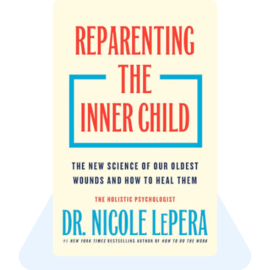
This is the exact gap that Dr. Nicole LePera’s Reparenting the Inner Child: The New Science of Our Oldest Wounds and How to Heal Them sets out to close. An instant #1 New York Times bestseller from the author of How to Do the Work, this book moves past simply naming your childhood wounds and into the much harder, much more useful territory of actually healing them using the nervous system, not just the thinking mind, as the real site of change.
If you’re building a personal growth and mindset transformation reading list from the best books 2026 has offered so far, this is one of the most talked-about titles in the self improvement books space right now, and for good reason. It sits at the intersection of psychology of success, emotional healing, and habit formation, and it speaks directly to anyone who has ever felt that willpower and insight alone weren’t enough to break a pattern they’d already understood for years.
This complete Reparenting the Inner Child book summary walks through everything you need to know about Dr. LePera’s book her core philosophy, her four-part healing framework, her key lessons, and how the deep inner work she describes connects to the broader personal growth, meditation and manifestation work we explore here at Readers Books Club. Whether you’re deciding if this book belongs on your shelf, or you simply want a genuine understanding of what Dr. LePera is teaching before committing to all 384 pages, this Nicole LePera book summary will give you a practical, honest picture of the book and how to start applying it.
How to Use This Summary
Before going further, it’s worth being upfront about what this guide is and isn’t. This is a detailed breakdown of Reparenting the Inner Child’s structure, arguments and core ideas written to help you understand its philosophy and decide how it fits into your own healing and personal growth journey. It is not a substitute for the book itself, and it will not walk through every exercise, case story or guided reflection in sequence. If what’s below resonates with you, the full book is where Dr. LePera’s complete tools, somatic practices and reflections are laid out in her own words, alongside the guided exercises designed to be done, not just read about.
Think of this summary as a clear, honest map of the territory enough detail to know exactly what the book offers, enough honesty to know whether it’s right for you right now, and enough structure that you can begin applying its core ideas immediately, whether or not you go on to read the whole book. That’s the same spirit behind every book breakdown we publish at Readers Books Club.
About the Author: Who Is Dr. Nicole LePera?
To understand Reparenting the Inner Child, it helps to understand the body of work it builds on. Dr. Nicole LePera, widely known online as “The Holistic Psychologist,” is a clinical psychologist trained at Cornell University and The New School for Social Research, with further training at the Institute for Modern Psychoanalysis of Philadelphia. Rather than staying within the traditional one-hour-a-week therapy model, LePera became known for taking psychological concepts nervous system regulation, attachment theory, trauma responses and translating them into plain, usable language for a massive online audience, building what she calls the #SelfHealers movement.
What set LePera apart early on was her willingness to publish daily, digestible breakdowns of clinical concepts directly to a general audience, at a moment when most of that language stayed inside academic papers and therapy rooms. That consistency showing up, day after day, with practical, plainly explained tools became the foundation of a community numbering in the millions, and it mirrors the very philosophy her books teach: that meaningful change comes from continuous learning and steady daily practice rather than occasional bursts of motivation.
Her first book, How to Do the Work, became a #1 New York Times bestseller and introduced millions of readers to the idea that healing is a daily, active practice rather than a single breakthrough moment. She followed it with How to Be the Love You Seek, focused on relational patterns, and a companion workbook, How to Meet Your Self. Reparenting the Inner Child is best understood as the next, deeper chapter in this same body of work less about identifying your patterns for the first time, and much more about the specific, repeatable practices required to actually change them.
What makes LePera a credible guide for this particular subject is that her approach is explicitly holistic rather than purely cognitive. She doesn’t treat emotional patterns as something you can simply think your way out of. Her clinical training, combined with years of hearing directly from her enormous online community about which tools actually created lasting change, shaped a book that treats the mind and body as inseparable parts of the same healing process.
What Is Reparenting the Inner Child About?
At its core, Reparenting the Inner Child makes one central argument: the irrational-feeling patterns that show up in your adult life shutting down, over-explaining, people-pleasing until resentment builds, sabotaging good things just as they start to work are not character flaws. They are survival strategies your nervous system learned in childhood, often before you had the words to describe what was happening to you.
Growing up, LePera explains, different parts of us were met with different responses. Some parts were met with love and encouragement. Other parts our anger, our needs, our sadness, our boundaries were met with silence, criticism or disapproval. To survive in that environment, we adapted. Some of us learned to over-perform to earn approval. Some of us learned to hide our real feelings to avoid conflict. Some of us learned to stay small so we wouldn’t take up too much space. Almost none of us made it through childhood with every part of ourselves fully welcomed most of us made it through with some mixture of love and lack, and we’re still, as adults, protecting the parts of ourselves that once felt unsafe.
The book’s central promise follows directly from this: while you cannot change what actually happened to you in childhood, you can change how those experiences continue to live inside you and shape your life today. This is the literal meaning of “reparenting” learning to give yourself, in the present, the safety, attunement, structure and unconditional regard that you may not have consistently received the first time around, so that your nervous system can finally learn a different pattern.
Structurally, the book is organized as a practical, exercise-driven guide rather than a purely theoretical one. Each chapter builds LePera’s holistic framework for individual development, and most chapters close with concrete practices journal prompts, somatic exercises and guided reflections designed to move the reader from simply understanding a pattern to actually experiencing a different one in their body. This hands-on structure is a deliberate departure from books that stay at the level of insight; LePera is explicit that awareness on its own has never been enough to change a nervous system pattern.
Understanding Where Inner Child Wounds Actually Come From
Before offering tools for healing, the book spends real time helping readers understand how these patterns are formed in the first place and this grounding matters, because “inner child work” has become such a common phrase online that it risks losing any real meaning. LePera is careful to move past the watered-down version of the concept picturing your younger self and offering a comforting hug and into a more precise, more useful understanding of what actually happened developmentally.
As children, we depend completely on the adults around us not just for physical survival, but for learning what’s emotionally safe to express. When a child’s anger is met with punishment, that child learns, at a nervous-system level, that anger is dangerous not simply as an idea, but as a felt, physiological association. When a child’s needs are met with inconsistency, that child often develops a heightened, anxious alertness to other people’s moods, since predicting them became a survival skill. These aren’t abstract psychological theories in the book; they’re presented as the literal origin of very concrete adult patterns why you shut down in arguments, why you people-please until resentment takes over, why some relationships feel quietly tense even when you can’t explain exactly why.
This reframe carries an important emotional shift. Patterns that once looked like personal failings being “too sensitive,” being “too avoidant,” being “too much” or “not enough” are reframed as intelligent, protective adaptations that made complete sense in the environment where they were formed. They stop making sense only when that environment no longer exists, but the nervous system hasn’t yet learned that the danger has passed.
The Four Pillars of Reparenting
At the structural heart of the book is a framework LePera refers to as the Four Pillars of Reparenting: Loving Discipline, Self-Care, Joy and Emotional Regulation. Together, these four areas map out what it actually looks like to give yourself, as an adult, the consistent developmental foundation many of us didn’t fully receive as children.
Loving Discipline addresses the idea that healthy boundaries and structure are themselves an act of care, not punishment. Many adults associate discipline with the harsh, critical voice they may have grown up with, and as a result, swing toward either self-criticism or a total absence of structure. LePera reframes discipline as something closer to reliable, consistent follow-through with yourself showing up for your own commitments the way a secure, attuned parent would show up for a child, without shame attached to the process.
Self-Care, in this framework, goes beyond the commercialized version of the term bubble baths and spa days and into the more fundamental question of whether you consistently meet your own basic physical and emotional needs. For many people who grew up learning to prioritize other people’s needs over their own, genuinely tending to their own needs can feel unfamiliar or even guilt-inducing at first, which is precisely why LePera treats it as a skill requiring deliberate practice rather than something that simply happens naturally.
Joy is included as its own pillar because, for many readers, the capacity for genuine pleasure and play was quietly discouraged growing up perhaps in households where seriousness, achievement or vigilance were rewarded far more than lightness. Reclaiming joy, in this framework, isn’t a luxury; it’s treated as a necessary signal to the nervous system that it’s safe to relax, which is itself part of healing.
Emotional Regulation is the pillar most closely tied to the book’s nervous-system focus, and it treats the capacity to stay calm and grounded during difficult emotions as a learnable skill rather than a fixed personality trait. If your nervous system never had reliable models of regulation growing up an adult who could stay calm during conflict, soothe distress without shutting it down, or tolerate big emotions without becoming overwhelmed by them it makes sense that regulation would feel difficult now. LePera’s message is that this specific gap can be closed at any age, given the right, repeated practice.
The Nervous System Connection: Why Insight Alone Isn’t Enough
Perhaps the most distinctive element of Reparenting the Inner Child is how consistently it refuses to separate emotional patterns from the body. Anxious attachment, avoidant withdrawal, the habit of disappearing emotionally when a relationship gets close the book treats these not as fixed identities or character flaws, but as nervous-system survival strategies that were learned before the reader had the language to describe what was happening.
This is where the book’s subtitle “the new science of our oldest wounds” becomes most relevant. LePera draws on the basic architecture of the nervous system’s threat-response and calming systems to explain why simply understanding a pattern intellectually so rarely changes it: insight lives largely in the thinking brain, while these patterns are stored and triggered at a more automatic, physiological level. Knowing why you shut down in conflict, in other words, is a completely different thing from your body no longer shutting down in conflict.
This is also where the book introduces what might be its most practically useful idea: what LePera describes as “reparenting moments” small, repeated, embodied experiences of safety that, over time, teach the nervous system a new pattern the way the original wound was learned in the first place, through repetition rather than a single insight. A single moment of self-soothing during a triggering situation won’t undo years of a learned pattern, but consistently offering yourself that same steadiness, again and again, gradually does.
Because of this, somatic tools breathwork, gentle movement, body awareness practices are treated in the book not as optional extras but as essential components of the work, alongside journaling and cognitive reflection. Thinking alone, LePera argues, will not change what your body still feels; changing what your body feels requires working with the body directly, not just around it.
The Attachment Style Foundation
Running underneath the book’s four pillars is a foundation in attachment theory the idea that our earliest relationships teach us a template for what closeness, safety and conflict are supposed to feel like, a template we then unconsciously carry into adult relationships. The book includes a short, practical self-assessment early on, designed to help readers identify which attachment patterns anxious, avoidant, secure, or a mix are most active in their own relationships.
This isn’t presented as a way to permanently label yourself, but as a diagnostic starting point: understanding your dominant attachment pattern helps clarify exactly which of the Four Pillars is likely to need the most deliberate attention. A reader with a more anxious attachment pattern, for example, might find the Emotional Regulation pillar especially relevant, since anxious patterns often involve heightened nervous-system reactivity to perceived rejection. A reader with a more avoidant pattern might find Joy and Self-Care particularly challenging, since avoidant patterns often develop specifically around minimizing emotional need altogether.
Key Lessons and Takeaways from Reparenting the Inner Child
Pulling the book’s framework together, a handful of core lessons stand out as the ideas most worth carrying with you:
- Your patterns made sense once. Behaviors that look irrational in your adult life shutting down, over-explaining, self-sabotage were originally intelligent adaptations to a childhood environment where they served a real protective purpose.
- Insight is the beginning of healing, not the end of it. Understanding where a pattern comes from is necessary, but it rarely changes the pattern on its own; the nervous system needs repeated, embodied experience, not just intellectual understanding.
- Discipline can be an act of love, not punishment. Reliable follow-through with yourself, offered without harsh self-criticism, is one of the clearest ways to give yourself the structure a secure childhood would have provided. This matters because self discipline built on shame rarely survives contact with a hard week, while self discipline built on genuine care for yourself tends to hold up far better over time and doesn’t depend on motivation alone to keep it going.
- Genuine self-care is a practiced skill, not a personality trait. For many people, tending to their own needs first requires deliberately unlearning a lifetime of prioritizing everyone else’s needs instead.
- Joy and play are part of healing, not a distraction from it. Reclaiming the capacity for lightness signals safety to the nervous system, which is itself a necessary condition for deeper change.
- Emotional regulation can be learned at any age. A lack of early modeling for calm, grounded emotional responses is a gap in skill-building, not a permanent character flaw, and it can be addressed later in life with the right practice.
- Your attachment style is a starting point, not a life sentence. Identifying your dominant relational pattern helps target where to focus your healing work, without becoming a fixed label for who you are.
- The body keeps score of what the mind has already moved past. Somatic tools breath, movement, physical awareness are necessary alongside journaling and reflection, because thinking alone rarely changes what the body still holds.
- Reparenting happens in small, repeated moments, not one dramatic breakthrough. Lasting change comes from consistently offering yourself the safety and structure you needed, moment after moment, rather than from a single cathartic realization.
Taken together, these lessons form less of a checklist and more of a daily practice one centered on building genuine self-belief through the lived, repeated experience of treating yourself differently, rather than self-belief built purely on affirmation or hope.
The Psychology and Science Behind the Book
While Reparenting the Inner Child is written for a general audience rather than as an academic text, its core arguments draw on well-established territory in modern psychology. Attachment theory the study of how early caregiver relationships shape our adult expectations of closeness and safety has decades of research behind it, and LePera’s application of it to everyday adult patterns (people-pleasing, conflict avoidance, anxious reactivity) reflects a fairly mainstream clinical understanding rather than a fringe theory.
The book’s nervous-system framing also aligns with a broader shift happening across psychology and self improvement books more generally: a growing recognition that trauma and chronic stress are stored and expressed physiologically, not just cognitively, and that purely talk-based or insight-based approaches often have real limits when a pattern is deeply nervous-system-based rather than purely a matter of belief. This is part of why the book treats somatic tools as essential rather than supplementary it’s consistent with a wider movement in trauma-informed psychology that treats the body as a primary site of both injury and healing.
Internal Family Systems (IFS) a therapeutic model that understands the mind as made up of different “parts,” each formed to protect us in a specific way is another clear influence throughout the book, particularly in how LePera talks about the parts of ourselves that learned to over-perform, hide or stay small. Rather than treating these parts as problems to eliminate, the book’s framing treats them with the same compassion IFS emphasizes: as protectors that were doing their best with the information and resources they had at the time.
Why This Work Matters Beyond Relationships: Leadership, Communication and Decision Making
Although Reparenting the Inner Child is framed primarily around personal and relational healing, its core ideas carry directly into professional life as well a connection worth drawing out for anyone reading it through a broader personal growth or career-development lens. Emotional regulation, the book’s fourth pillar, is also one of the most well-established predictors of effective leadership: leaders who can stay grounded during conflict, tolerate disagreement without becoming defensive, and respond rather than react under pressure consistently build more trust and psychological safety within their teams than leaders who cannot.
The same is true of communication skills. Much of what LePera describes as childhood adaptation over-explaining to avoid conflict, staying silent to avoid disapproval, people-pleasing instead of stating a genuine need shows up almost identically in workplace communication patterns. A person who learned early on that expressing needs directly wasn’t safe often struggles to give direct feedback, negotiate confidently, or set clear expectations as an adult, regardless of how capable they are technically. Healing the underlying nervous-system pattern, in other words, doesn’t just improve personal relationships; it frequently improves communication at work as well.
Decision making under pressure follows a similar logic. A nervous system that’s frequently activated into fight, flight or freeze responses tends to make more reactive, short-term decisions, while a regulated nervous system has far more access to the kind of calm, longer-term thinking good decisions require. Continuous learning and a genuine success mindset both depend, to a surprising degree, on this same underlying capacity for regulation it’s difficult to stay curious, coachable and open to feedback when your baseline nervous-system state is defensive or anxious. Read this way, the personal healing work at the center of this book quietly supports nearly every other kind of growth a reader might be pursuing, professional or otherwise.
Common Criticisms and Limitations
No book fits every reader perfectly, and it’s worth being honest about where Reparenting the Inner Child may land differently for different people. Because the book distills complex clinical concepts attachment theory, nervous system regulation, Internal Family Systems into an accessible, general-audience format, some readers with a background in psychology may find certain explanations simplified compared to the clinical literature they draw from. This is a deliberate trade-off for accessibility rather than an oversight, but it’s worth knowing going in.
Some readers have also noted that certain sections in the middle of the book can feel somewhat repetitive, as several chapters return to closely related nervous-system concepts from slightly different angles. For readers who prefer a large volume of entirely distinct frameworks, this repetition might feel like padding; for readers who benefit from a concept being reinforced multiple times before it truly lands, the same repetition functions as useful reinforcement rather than a flaw.
Finally, because the book is fundamentally about slow, repeated nervous-system change rather than quick cognitive reframes, readers looking for fast, dramatic relief from acute distress may find its pace frustrating. This is explicitly not a crisis-intervention book; it’s a long-term framework for gradually changing deep-seated patterns, and it asks for patience and consistent practice rather than promising rapid results.
Who Should Read Reparenting the Inner Child (and Who Shouldn’t)
This book is best suited to readers who already have some baseline awareness of their own recurring patterns people-pleasing, conflict avoidance, self-sabotage, difficulty with boundaries and who are ready to move from simply understanding those patterns into the slower, more embodied work of actually shifting them. It’s especially valuable for readers already familiar with LePera’s earlier work, or for anyone drawn to a holistic approach that treats the body, not just the mind, as central to real healing.
On the other hand, readers currently in the middle of an acute mental health crisis, or dealing with more severe trauma histories, will likely benefit more from working directly with a licensed therapist alongside this material, rather than relying on the book alone. LePera’s own framing supports this: the book is designed as a complement to ongoing self-work and, where needed, professional support not a replacement for clinical care when that level of support is genuinely required.
Practical Ways to Apply the Book’s Lessons Starting Today
A summary is only useful if it leads to action. Here are a few practical ways to start applying Reparenting the Inner Child’s core ideas immediately:
- Name one pattern without judgment. Choose a single recurring reaction shutting down, over-explaining, people-pleasing and simply notice it this week without trying to immediately fix it. Awareness without self-criticism is the necessary first step.
- Practice one small act of Loving Discipline. Pick one commitment to yourself, however small, and follow through on it consistently for a week, treating any slip-ups with the same compassion a secure parent would offer a learning child.
- Build in one non-negotiable act of genuine self-care daily. Choose something that meets an actual need rest, movement, a boundary held rather than something purely indulgent, and treat it as non-negotiable rather than optional.
- Deliberately schedule something joyful, even briefly, with no productive purpose attached. Let your nervous system experience that lightness and safety are allowed.
- Try a simple somatic practice during a triggering moment a few slow breaths, feeling your feet on the ground, gently noticing physical sensation rather than only trying to think your way through the reaction.
- Take the attachment style self-assessment early on to identify which of the Four Pillars is likely to need your most deliberate attention right now.
- Change your environment where you can. Nervous-system regulation is shaped heavily by surroundings, not just willpower reducing chaotic or overstimulating environments, and adding small cues of calm and safety to your physical space, makes consistent self-discipline noticeably easier to sustain.
- Offer yourself a small “reparenting moment” this week a brief, repeated act of self-soothing or self-validation in a moment that would once have triggered an old pattern, understanding that consistency over time, not a single instance, is what creates lasting change.
None of these actions are dramatic on their own and that’s consistent with the book’s larger argument. Nervous-system change comes from consistent, repeated practice, not a single breakthrough moment.
A Simple Daily Check-In Framework
If you want one repeatable structure to carry forward from this summary, try a short daily check-in built around the book’s four pillars: Where did I offer myself loving discipline today, rather than either harshness or avoidance? Where did I meet an actual need of my own? Did I let myself experience any real joy? And how did I handle a moment of difficult emotion did I regulate, or did an old pattern take over? Answering these honestly, even briefly, turns the book’s framework from an abstract idea into a concrete daily improvement practice you can sustain well beyond your first read.
How Reparenting the Inner Child Connects to Manifestation, Meditation and the Law of Attraction
At Readers Books Club, many of the books we cover including titles on manifestation, meditation and the Law of Attraction focus on aligning your thoughts, beliefs and emotional state with the life you want to create. Reparenting the Inner Child is a valuable companion to that work because it addresses something manifestation-focused content doesn’t always name directly: it’s very difficult to consistently hold a high, aligned, abundant vibration when your nervous system is still operating from old patterns of scarcity, unworthiness or hypervigilance formed in childhood.
This connects closely to the philosophy taught by Dr Amiett Kumar, founder of Readers Books Club and a well-known voice in manifestation and life coaching. Amiett Kumar’s teaching consistently emphasizes that manifestation isn’t simply about repeating the right affirmation it’s about becoming an aligned, coherent version of yourself, inside and out, so that what you’re asking for and what you’re energetically broadcasting actually match. A nervous system still running old survival patterns, however unconsciously, will often quietly work against even the most sincere visualisation or affirmation practice.
Read this way, Reparenting the Inner Child isn’t separate from manifestation and Law of Attraction work it’s foundational to it. Before you can consistently manifest abundance, you often need to heal the parts of you that learned, early on, that wanting things openly wasn’t safe, or that you had to earn love and safety through over-performing or shrinking yourself. Meditation and inner child work pair especially well here: the same nervous-system regulation LePera teaches through somatic practice is very close to what a consistent meditation practice cultivates over time a body that can stay calm, present and open rather than defended. For anyone building a personal growth library that blends inner healing with manifestation and spirituality, pairing this book with more overtly manifestation-focused reading is a natural, complementary combination – exactly the kind of well-rounded approach we encourage as part of the Readers Books Club community.
How Reparenting the Inner Child Compares to Other Personal Growth Classics
Readers familiar with the broader self-improvement books and psychology space will notice clear connections between Reparenting the Inner Child and other influential titles, Bessel van der Kolk’s The Body Keeps the Score, which similarly argues that trauma is stored physiologically and must be addressed somatically, or Lindsay Gibson’s work on emotionally immature parents, which explores how growing up with under-attuned caregivers shapes adult patterns. Where LePera’s book distinguishes itself is in its format: rather than staying primarily descriptive or clinical, it’s built around a specific, repeatable framework, the Four Pillars, paired with chapter-by-chapter exercises designed for a general reader to actually practise, not just understand intellectually.
Compared to LePera’s own earlier work, Reparenting the Inner Child represents a clear evolution. Where How to Do the Work focused heavily on building initial awareness of your patterns and their origins, this book assumes a baseline of that awareness already and focuses almost entirely on the practical “how” of change, making it a natural next read for anyone who found her first book insightful but was left wanting more concrete tools for actually shifting what they’d identified.
Final Thoughts: Is Reparenting the Inner Child Worth Reading?
Reparenting the Inner Child earns its place among the most talked-about personal growth and mindset transformation books of 2026 because it takes seriously a problem most self-help content glosses over: that understanding a pattern and changing a pattern are two entirely different processes, requiring two entirely different kinds of work. It doesn’t promise a single dramatic breakthrough. Instead, it offers a patient, structured, nervous-system-informed framework for the kind of change that actually holds up over time.
For readers serious about personal growth, whether your focus is healing childhood wounds, improving your relationships, building genuine emotional regulation, or simply becoming a more grounded, self-aware version of yourself, this book offers real, practical tools rather than another round of generic affirmation. It asks something specific and demanding of its readers: not just to understand yourself better, but to consistently practise treating yourself differently, in small, repeated ways, until your nervous system finally believes it.
Who this book is genuinely for: readers with some existing self-awareness who are ready to move from insight into embodied practice, anyone interested in holistic or somatic approaches to healing, and readers already familiar with Dr. LePera’s earlier work who want deeper, more actionable tools.
Who might want additional support first: readers currently in acute crisis or working through severe trauma, who will likely benefit from pairing this book with support from a licensed therapist rather than using it alone.
Best paired with: a consistent meditation or breathwork practice, a personal journal for the book’s guided reflections, and for readers also working on their outer goals a complementary manifestation or Law of Attraction resource to bring the same alignment work outward into your daily intentions.
Frequently Asked Questions About Reparenting the Inner Child
What is Reparenting the Inner Child by Dr. Nicole LePera about?
Reparenting the Inner Child is a personal growth and psychology book that argues adult patterns like people-pleasing, shutting down or self-sabotage are nervous-system survival strategies formed in childhood, and that healing them requires repeated, embodied practice not just intellectual insight. It’s organized around a Four Pillars framework: Loving Discipline, Self-Care, Joy and Emotional Regulation.
Who is Dr. Nicole LePera?
Dr. Nicole LePera, known online as The Holistic Psychologist, is a clinical psychologist trained at Cornell University and The New School for Social Research. She is the #1 New York Times bestselling author of How to Do the Work and How to Be the Love You Seek, and the creator of the #SelfHealers movement.
What are the Four Pillars of Reparenting?
The book organizes its framework into four areas: Loving Discipline (reliable, compassionate follow-through with yourself), Self-Care (consistently meeting your own real needs), Joy (reclaiming genuine pleasure and play as part of healing), and Emotional Regulation (learning to stay calm and grounded during difficult emotions).
Is Reparenting the Inner Child a good book for beginners in personal growth or inner child work?
Yes, though it’s most effective for readers who already have some baseline self-awareness of their own patterns. Its core ideas about nervous-system healing, self-discipline and emotional regulation are accessible to readers at various stages of their personal growth journey, though a background in her earlier book can help.
How does inner child work relate to habit formation and self-discipline?
The book reframes self-discipline as an act of self-care rather than self-punishment, arguing that reliable, compassionate follow-through with yourself similar to how a secure parent would show up for a child builds the foundation for lasting habit change more effectively than harsh self-criticism does.
Does Reparenting the Inner Child relate to manifestation or the Law of Attraction?
While it isn’t a manifestation or spirituality book in the traditional sense, its focus on healing nervous-system patterns of scarcity and unworthiness pairs naturally with manifestation and Law of Attraction principles, which depend on consistently holding an aligned, abundant emotional state. Healing the inner patterns this book addresses can make that alignment far more sustainable.
What is one key takeaway from Reparenting the Inner Child?
Perhaps the book’s most important idea is that insight alone rarely changes a nervous-system pattern lasting change comes from small, repeated, embodied “reparenting moments” that teach your nervous system a new, safer response over time, the same way the original pattern was learned through repetition.
How is this book different from Dr. LePera’s earlier book, How to Do the Work?
How to Do the Work focused primarily on helping readers identify and understand their patterns and where they came from. Reparenting the Inner Child assumes that baseline awareness and goes deeper into the specific, practical tools somatic exercises, the Four Pillars framework, guided reflections needed to actually change those patterns.
Key Takeaways
- Adult patterns like people-pleasing, shutting down and self-sabotage are nervous-system survival strategies formed in childhood, not personal failings.
- Insight alone rarely changes a pattern lasting change requires repeated, embodied “reparenting moments,” not a single breakthrough.
- The book’s Four Pillars Loving Discipline, Self-Care, Joy and Emotional Regulation offer a practical structure for healing, applicable well beyond relationships into leadership, communication skills and decision making at work.
- A success mindset and continuous learning both depend on a regulated nervous system; it’s hard to stay open, coachable and curious from a defensive or anxious baseline.
- Somatic tools breath, movement, body awareness are treated as essential, not optional, alongside journaling and reflection.
- This work pairs naturally with meditation, spirituality and manifestation practices, since a healed nervous system makes it far easier to sustain the aligned, abundant emotional state manifestation work depends on.
Conclusion
Reparenting the Inner Child is a reminder that real healing was never going to come from insight alone. It comes from something slower and more repetitive: showing up for yourself, again and again, in small moments, until your nervous system finally learns it’s safe to respond differently. If you’re building a personal growth and mindset transformation reading list for 2026, pairing Dr. LePera’s nervous-system-informed framework with the meditation, spirituality and manifestation resources we cover here at Readers Books Club gives you a genuinely complete picture: healing the old patterns that hold you back, and consciously building the aligned, intentional life you actually want.
Explore more book summaries, mindset transformation resources and coaching insights on the Readers Books Club YouTube channel and podcast, and if you’re ready to go deeper into the manifestation and life coaching side of this work, discover more from Dr Amiett Kumar. As this book reminds us, you can’t change what already happened, but you can, moment by moment, change how it lives inside you today.
Contents