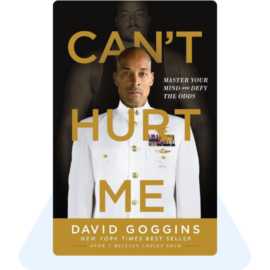
What if the biggest limits in your life are not physical, financial, or external but mental? That is the challenge at the heart of Can’t Hurt Me: Master Your Mind and Defy the Odds by David Goggins. Part memoir, part mental-performance manual, the book follows Goggins from an extremely difficult childhood and years of fear, insecurity, poor health, and low self-belief to an identity built around discipline, endurance, personal responsibility, and relentless self-mastery. This Can’t Hurt Me summary is designed for readers who want the key lessons without losing the emotional power of the book. It is especially useful if you are interested in mental toughness, self-discipline, motivation, resilience, personal growth, performance psychology, mindset transformation, meditation, visualisation, affirmations, subconscious mind work, or the broader idea of becoming mentally stronger.
For the Readers Books Club audience, the most important takeaway is not that everyone should copy David Goggins’ extreme physical challenges. The deeper lesson is that most of us live far below our potential because we accept discomfort, fear, self-doubt, and old identity stories as final truths. Goggins’ message is intense: your mind will often ask you to stop long before your real capacity is exhausted. If you train your response to discomfort, you can discover abilities you did not know you had. The official description of Can’t Hurt Me emphasizes Goggins’ transformation through self-discipline, mental toughness, and hard work, and introduces his famous “40% Rule”, the idea that when we feel finished, we may still have significant untapped capacity. The book was first published in 2018 and has remained enormously popular with readers interested in self-improvement and resilience.
This article breaks the book into ten practical lessons you can apply to work, fitness, career, relationships, leadership, personal goals, and spiritual growth.
About David Goggins and Can’t Hurt Me
David Goggins is known as a former Navy SEAL, endurance athlete, author, and public speaker. His story became widely known because of the contrast between his early life and the person he later became. He writes openly about poverty, abuse, racism, fear, academic struggles, insecurity, weight gain, and a period in which he felt trapped in a life he did not respect. Instead of presenting success as an overnight breakthrough, the book shows a long process of confronting weaknesses, building discipline, failing, trying again, and repeatedly choosing difficult action over comfortable avoidance.
That is one reason the book connects so strongly with readers. Most people do not need another motivational line telling them to “believe in yourself”. They want to know what to do on the day when belief is low, energy is low, the goal feels far away, and the mind starts creating excuses. Goggins’ answer is action. His answer is not perfect or glamorous action, and certainly not action only when motivation is high. It is repeated action: doing the useful thing often enough that discipline begins to replace negotiation. This is what makes Can’t Hurt Me relevant to people interested in self-improvement books, personal growth books, mental strength, discipline, mindset transformation, and success mindset.
The book’s chapter titles themselves reveal its direction: facing painful truths, taking on impossible tasks, building an “armoured mind”, rejecting trophy-based motivation, developing discipline, becoming uncommon, learning from failure, and asking “what if?” instead of assuming something cannot be done.
Why This Book Became So Popular
Many self-help books focus on comfort, positive thinking, or emotional reassurance. Can’t Hurt Me stands out because it is deliberately uncomfortable. It asks questions such as: Are you being completely honest about your current life? Where are you making excuses? What do you avoid because it makes you uncomfortable? Which identity have you accepted without challenging it? How quickly do you quit when progress becomes painful? How much of your potential remains unexplored? The tone is not gentle, but the underlying principle is empowering: you are not required to remain the person you have been.
You can train, change your standards, and gradually expand what your mind considers normal. For readers interested in meditation, affirmation, visualisation, law of attraction, manifestation techniques, spirituality, coaching, or working with a life coach, this book provides an important balancing idea: inner work becomes more powerful when it is connected to disciplined behaviour. Visualising a stronger future self can create direction. Affirmations can influence self-talk. Meditation can improve awareness and mental clarity. Manifestation can clarify intention. But at some point, the future self must act. That is where the Goggins philosophy becomes especially useful.
Lesson 1: Face the Truth About Your Current Life
The first step toward transformation is radical honesty. One of the central ideas in Can’t Hurt Me is that you cannot change a life you refuse to examine. Many people protect themselves from uncomfortable truths by creating explanations: “I don’t have time.” “I’m not talented.” “I was not born confident.” “My family is different.” “My circumstances are harder.” “I will start next month.” “I work better under pressure.” “I need more motivation first.” Some explanations are real. Circumstances matter. Trauma, money, health, family responsibilities, opportunity, and environment all influence what a person can do.
But Goggins pushes readers to ask a second question: What part is still under my control? That question is powerful because it returns attention to agency. Suppose you want to improve your health. You may not control genetics, previous injuries, work demands, or every stressor. But perhaps you can control today’s food choice, bedtime, ten-minute walk, or medical appointment. Suppose you want a better career. You may not control the economy, hiring decisions, or competition. But you can control whether you improve a skill, update your portfolio, apply, network, or ask for feedback.
Suppose you want greater mental clarity. You may not control every thought, but you can decide whether the first thirty minutes of your morning go to meditation or endless scrolling. This lesson is not about blaming yourself for everything. It is about finding the part you can influence.
The Accountability Mirror
Goggins describes a practice often referred to as the “accountability mirror”. The principle is simple: look honestly at where you are and identify what needs to change. In practical terms, you can create your own accountability review by writing: Ask yourself five direct questions: What am I unhappy with right now? What excuse do I repeat most often? What am I avoiding? Which habit is keeping me stuck? And what is one action I can take today? Writing honest answers turns vague dissatisfaction into something concrete enough to work on.
You do not need to insult yourself. You need accurate information. There is a difference between honesty and self-hatred. Honesty says: “I am not currently consistent.” Self-hatred says: “I am useless.” The first creates a path. The second creates paralysis. This distinction matters for mental toughness. Real strength begins when you can see the truth without collapsing under it.
Lesson 2: Build Discipline Instead of Depending on Motivation
Motivation feels powerful, but it is unreliable. Some days you feel inspired. Some days you feel tired. Some days you feel confident. Some days you question everything. If your progress depends on motivation, your progress will become emotional. Goggins builds his philosophy around discipline instead. Discipline is the ability to do what supports your goal even when the emotional desire is missing. This is one of the biggest reasons Can’t Hurt Me is frequently recommended among books about mental toughness and self-discipline.
Motivation Asks, “Do I Feel Like It?”
Discipline asks, “What did I decide?” That difference sounds simple, but it changes behaviour. Imagine that your goal is to write a book. Motivation says: “I’ll write when I feel creative.” Discipline says: “I write for forty-five minutes at 7:00 AM.” If the goal is meditation: Motivation says: “I’ll meditate when I feel peaceful.” Discipline says: “I sit for ten minutes, including on restless days.” If the goal is fitness: Motivation says: “I’ll exercise when I feel energetic.” Discipline says: “I follow the plan unless there is a legitimate reason to change it.”
This is how identity begins shifting. Every time you keep a promise to yourself, you collect evidence that you can be trusted.
Discipline and the Subconscious Mind
Repeated behaviour also affects self-concept. If you repeatedly delay, avoid, or quit, your subconscious mind begins learning: “I am someone who does not follow through.” If you repeatedly complete small commitments, a different message is created: “I am someone who acts.” This is why discipline can be more powerful than repeating a hundred affirmations without behavioural change. An affirmation such as “I am disciplined” becomes much stronger when you can point to evidence. A practical version might be: Affirmation: “I keep the promises I make to myself.” Then choose one promise small enough to keep every day.
That is how affirmation and action can reinforce each other.
Lesson 3: Use the 40% Rule to Question Your Limits
The “40% Rule” is probably the most famous concept associated with David Goggins. The basic idea is that when your mind tells you that you are finished, you may have far more capacity available than you think. This should not be interpreted as a medical rule or a reason to ignore injury, illness, or professional advice. Instead, treat it as a mental model: Your first feeling of discomfort is not always your actual limit. This applies far beyond physical endurance. You may feel “done” after twenty minutes of difficult study. You may want to stop after the first business rejection. You may want to abandon a new routine after one bad week. You may feel incapable after one embarrassing presentation. You may believe your meditation practice “is not working” because the mind remains noisy.
The 40% Rule asks you to question the first impulse to quit.
Ask: “Am I Unable, or Am I Uncomfortable?”
That is one of the most useful questions in the entire book. There is a huge difference between danger and discomfort. Danger requires intelligence and often stopping. Discomfort often requires training. Your muscles may feel tired during a safe workout. Your mind may resist difficult study. Your ego may dislike receiving criticism. Your nervous system may feel uncomfortable when you speak in public. Your identity may feel threatened when you start behaving differently. The brain often treats unfamiliarity as a reason to retreat. Mental toughness develops when you learn not to automatically obey that signal.
A Safe Way to Apply the 40% Rule
Do not use the concept to glorify injury or self-neglect. Use it in ordinary life: Read five more pages. Stay focused ten more minutes. Make one more sales call. Practise the difficult skill one more time. Complete one additional repetition if your training plan allows it. Sit with a difficult emotion for one more mindful minute. Small extensions expand your mental definition of what you can handle. Over time, the sentence changes from: “I can’t do this.” to: “This is uncomfortable, but I have handled discomfort before.” That is mental strength.
Lesson 4: Build a Cookie Jar of Past Victories
One of the most practical ideas in the book is what Goggins calls the “Cookie Jar.” The concept is simple: store memories of moments when you overcame something difficult. When you feel weak, discouraged, or doubtful, mentally reach into that jar and remember your evidence. Maybe you: finished a difficult course, survived a painful year, recovered from a breakup, changed careers, lost weight, built a business, raised a child through a hard period, passed an exam, learned a new skill, stood up for yourself, completed a difficult project, started again after failure.
These memories matter because self-doubt has selective memory. When you are struggling, the mind often remembers every failure and forgets every victory. The Cookie Jar corrects that bias.
Create a Confidence Evidence List
Write twenty moments in which you did something difficult. Do not only include major achievements. Include: the conversation you were afraid to have, the morning you got up despite low mood, the boundary you set, the presentation you completed, the time you asked for help, the day you did not quit. Before a difficult task, review three items. This is not empty positive thinking. It is evidence-based self-belief.
Connection with Visualisation
This technique also works beautifully with future self visualization. First, remember a real moment when you were strong. Close your eyes. Recreate the details: Where were you? What did your body feel like? What did you do? What happened after you refused to quit? Then visualise your current challenge. Bring the same identity into the new situation. Instead of imagining a fantasy version of yourself, you are extending a strength that already exists. This is a practical bridge between the ideas in Can’t Hurt Me and visualisation-based mindset work.
Lesson 5: Make Discomfort a Training Ground
Comfort is attractive because it feels safe. But too much comfort can reduce adaptability. Goggins repeatedly chooses difficult situations because he believes hardship can train the mind. You do not need to copy his extremes to understand the principle. You can deliberately practise manageable discomfort. Wake up when the alarm rings. Take a cold shower if appropriate for your health. Put the phone away during focused work. Speak when you would normally stay silent. Choose the difficult task first. Finish the workout you planned. Say no to a distraction. Sit with boredom instead of immediately reaching for entertainment.
These actions teach a powerful lesson: I do not need immediate comfort to be okay.
Why This Matters in Modern Life
Modern technology has reduced friction. Food can arrive quickly. Entertainment is endless. Notifications provide constant stimulation. Shopping requires almost no effort. AI can solve many basic tasks. Social media offers fast emotional rewards. These tools are useful, but they can also train the mind to expect immediate ease. Then when real life demands patience, uncertainty, repetition, or failure, discomfort feels unusually intense. Training discomfort restores balance.
Mental Toughness Is Not Self-Punishment
This is important. The goal is not to suffer for the sake of suffering. The goal is to become less controlled by the need for comfort. A strong person can rest. A strong person can ask for help. A strong person can change a plan. A strong person can recover. Mental toughness is not destroying the body or ignoring emotions. It is increasing your capacity to choose wisely when comfort is pulling you in the opposite direction.
Lesson 6: Develop an “Armored Mind”
One of the book’s most memorable phrases is the idea of an “armored mind.” Armor here does not mean becoming emotionally numb. It means strengthening the mind through repeated exposure to challenges until situations that once intimidated you become manageable. Think about public speaking. The first presentation may feel terrifying. After ten presentations, the fear may still exist, but your nervous system has more evidence. After fifty, the situation becomes familiar. That is mental armor. The same applies to: sales, leadership, difficult conversations, creative work, exercise, entrepreneurship, content creation, exams, interviews, meditation, or handling criticism.
Build Mental Armor Through Repetition
Choose one situation you avoid. Break it into smaller exposures. If you fear speaking: ask one question in a meeting, record a one-minute video, speak in front of three people, then gradually increase difficulty. If you fear rejection: make one request, submit one application, pitch one idea, ask one potential client. The aim is not immediate success. The aim is training. Every exposure teaches your mind: “I can experience this and continue.”
Meditation and the Armored Mind
Meditation can play an important role here. It teaches you to notice internal discomfort without immediately escaping it. A thought appears. An emotion appears. Restlessness appears. You observe. You return to the breath. That simple pattern is a form of mental training. You learn: “An uncomfortable internal experience does not control my next action.” This is one reason meditation can complement the discipline philosophy of Can’t Hurt Me.
Lesson 7: Stop Seeking Validation and Build Internal Standards
External validation is addictive. Compliments feel good. Likes feel good. Awards feel good. Recognition feels good. But if your confidence depends completely on other people’s approval, your confidence will become unstable. Goggins repeatedly emphasizes internal standards. The question becomes: Did I meet my own standard today? This changes the scoreboard. Instead of asking: “Did people praise me?” Ask: “Did I prepare honestly?” Instead of: “Did my post go viral?” Ask: “Did I create the best work I could and publish consistently?” Instead of: “Did I win?” Ask: “Did I execute my process?”
Instead of: “Does everyone believe in me?” Ask: “Did I behave like someone I respect?” This mindset is especially powerful in the age of social media.
Internal Standards and Manifestation
There is also a useful connection to manifestation. Many people focus almost entirely on external outcomes: money, followers, relationships, status, opportunities. But an identity-based manifestation approach asks: “Who must I become to handle the reality I say I want?” If you want leadership, build responsibility. If you want financial growth, build discipline. If you want influence, build communication. If you want peace, build emotional regulation. If you want confidence, build self-trust. The future becomes more sustainable when the internal identity develops alongside the external goal.
Lesson 8: Use Failure as Information, Not Identity
Failure is painful because people often convert an event into an identity. “I failed” becomes “I am a failure.” That is one of the most damaging mental habits. Goggins’ life contains repeated failures, setbacks, injuries, training difficulties, and moments when a goal did not unfold as expected. The lesson is not that failure disappears when you become mentally tough. The lesson is that your relationship with failure changes. You stop asking: “What does this prove about me?” And start asking: “What is this teaching me?”
The After-Action Review
After a setback, write: What happened? What did I do well? What did I do poorly? What was outside my control? What will I change? What is the next action? This converts emotion into information.
Why Failure Can Build Confidence
At first this sounds strange. How can failure build confidence? Because confidence does not have to mean: “I always succeed.” A stronger form of confidence is: “I can recover.” That belief is far more durable. If your confidence requires perfect results, one failure can destroy it. If your confidence is based on recovery, learning, and persistence, failure becomes survivable. This is also useful in coaching and life coach work. Good coaching does not promise a mistake-free life. It helps people develop better responses. Mental strength is not avoiding every fall.
It is becoming skilled at getting back up.
Lesson 9: Become “Uncommon Amongst Uncommon”
Goggins does not encourage readers to settle for average personal standards. One of the book’s ideas is to keep raising the standard even after you enter a high-performing environment. This is what he describes as becoming “uncommon amongst uncommon.” The point is not to look down on other people. The useful interpretation is: Do not stop growing just because you are now surrounded by successful people. You may become the strongest person in your old environment. Then you enter a stronger environment and discover that you still have room to grow.
That is healthy.
Choose Environments That Challenge You
If you are always the most disciplined person in the room, find people with stronger discipline. If you are always the best speaker, study better communicators. If you are the most knowledgeable person in your group, spend time with people who expose your gaps. If your business has reached one level, learn from people operating at the next. This principle aligns strongly with Readers Books Club, personal development, and coaching culture. Books are one way to enter stronger mental environments. A powerful book introduces you to standards you may not see in your immediate surroundings.
Change Your Environment, Change Your Normal
Human beings adapt to what feels normal. If everyone around you complains, complaining feels normal. If everyone around you trains, learning discipline feels normal. If everyone around you reads, studies, creates, and improves, growth feels normal. Environment does not determine everything, but it influences identity. Choose what becomes normal around you.
Lesson 10: Ask “What If?” Instead of “Why Me?”
The final lesson is a shift from limitation to possibility. “What if I fail?” is a common question. Goggins flips it. What if you succeed? What if you are capable of more? What if the limitation is not permanent? What if the identity you carry is outdated? What if your next year looks completely different? What if you keep going? This question is powerful because it interrupts certainty. Fear often speaks in absolute language: “I can’t.” “I’ll never.” “It’s impossible.” “I’m not that type of person.” “What if?” creates a crack in that certainty.
Use What If? as a Daily Mental Practice
Write one limiting statement. “I will never become disciplined.” Now rewrite it: “What if I become more disciplined than I have ever been?” Then add action: “What would I do today if that future were possible?” This is where mindset becomes behaviour.
Connection with Law of Attraction and Visualisation
Readers interested in law of attraction, manifest anything, affirmation, visualisation, and manifestation techniques can use this question as a bridge between imagination and action. Visualisation: “What would my strongest future self look like?” Affirmation: “I am becoming more disciplined every day.” Action: “What would that version of me do in the next hour?” That final question is crucial. The philosophy of Can’t Hurt Me reminds us that belief becomes stronger when behaviour supports it.
The 40% Rule and the Law of Attraction: Where They Meet
At first, David Goggins’ philosophy and law of attraction teachings may appear very different. One emphasizes hardship, discipline, and discomfort. The other is often associated with belief, alignment, visualization, and positive expectation. But there is a practical point where they can meet: Identity. Your beliefs influence what you attempt. Your actions influence what you believe. When both move in the same direction, transformation becomes more powerful. For example: You visualise yourself as confident. Then you practise speaking. You affirm that you are disciplined. Then you keep your morning commitment. You meditate for mental clarity. Then you use that clarity to make the difficult decision.
You set an intention for financial growth. Then you improve skills, save money, negotiate, create, and take intelligent risks. This creates a loop: Belief → action → evidence → stronger belief. That is a grounded way to connect manifestation with discipline.
Why Positive Thinking Alone Is Not Enough
Positive thinking can help shift attention, emotion, and possibility. But positive thinking without action can become avoidance. Imagine saying: “I am strong.” But every time discomfort appears, you quit. Eventually, your mind notices the contradiction. Now imagine saying: “I am becoming stronger.” Then you complete one difficult action. The statement gains evidence. For readers who follow Dr Amiett Kumar, Amiett Kumar, manifestation, meditation, affirmation, spirituality, visualisation, or Readers Books Club, this is an important idea: Inner work and outer work do not have to compete. Meditation can make you aware. Affirmations can improve self-talk. Visualisation can clarify identity. Discipline can turn identity into evidence.
Can’t Hurt Me and the Subconscious Mind
The subconscious mind is strongly influenced by repetition. Repeated thoughts. Repeated emotional reactions. Repeated behaviours. Repeated identity statements. If you repeatedly avoid difficult situations, your mind may learn: “Discomfort means danger.” If you repeatedly face manageable challenges, it may begin learning: “Discomfort is something I can handle.” This is one reason disciplined action can reshape self-concept. You are teaching the mind through experience.
Create a New Identity Script
Instead of: “I am lazy.” Use: “I am training consistency.” Instead of: “I always quit.” Use: “I am becoming someone who finishes.” Instead of: “I cannot handle pressure.” Use: “I am learning to stay steady under pressure.” Then attach a behaviour. If you want to become someone who finishes, complete one unfinished task. If you want to become consistent, repeat one small habit for thirty days. The subconscious mind responds better when words and actions agree.
Mental Toughness Is Not Toxic Positivity
It is important to clarify what this book should not be used to justify. Mental toughness does not mean ignoring mental health, hiding every emotion, refusing support, working through serious injury, never resting, judging people for struggling, or pretending circumstances do not matter. You can be mentally strong and go to therapy. You can be disciplined and take a recovery day. You can be resilient and ask for help. You can pursue growth while respecting your body. A useful reading of Can’t Hurt Me is not: “Pain is always good.”
It is: “Do not let avoidable discomfort automatically control your decisions.” That distinction makes the lessons much healthier and more sustainable.
A 30-Day Can’t Hurt Me Challenge
You do not need an ultramarathon to test the ideas in this book. Try this thirty-day version.
Days 1–5: Radical Honesty
Write down your biggest goal, your biggest excuse, your weakest daily habit, your strongest daily habit, and the one change that would create the biggest difference. Do not judge. Measure.
Days 6–10: Build One Discipline Habit
Choose one daily action: 10 minutes of meditation, 20 minutes of reading, 30 minutes of exercise, 45 minutes of focused work, or one difficult task before social media. Keep it small enough to repeat.
Days 11–15: Build Your Cookie Jar
Write 20 difficult situations you have already survived or overcome. Read five before a difficult task.
Days 16–20: Train Discomfort
Choose one manageable discomfort each day. Examples: delay entertainment, wake up on time, finish the planned task, speak up, take a difficult call, practise longer, or avoid unnecessary scrolling.
Days 21–25: Review Failure
Choose three recent setbacks. For each, write: lesson, adjustment, next action.
Days 26–30: Future Self Integration
Every morning ask: “What would the disciplined version of me do today?” Every evening ask: “Did I behave like that person?” This is identity-based growth.
Who Should Read Can’t Hurt Me?
This book can be particularly useful for: People who repeatedly start and stop habits. Anyone struggling with procrastination. Athletes interested in mental endurance. Entrepreneurs facing uncertainty and rejection. Students preparing for difficult exams. Professionals who want stronger self-discipline. Creators dealing with criticism. Leaders who need resilience. Readers interested in mindset transformation. People who enjoy self improvement books and personal growth books. Anyone exploring mental strength, motivation, resilience, meditation, coaching, or performance psychology. It may be less suitable for readers looking for a gentle, reflective style. Goggins is intentionally intense.
Is Can’t Hurt Me Worth Reading?
If you like books that challenge you rather than comfort you, Can’t Hurt Me is worth considering. Its greatest strength is the credibility created by lived experience. The lessons come from a person repeatedly testing his mind and body in extreme environments. You do not need to agree with every method to benefit from the larger questions: Where am I underestimating myself? What discomfort am I avoiding? What promise do I need to keep? Which excuse needs to end? How do I respond to failure? What evidence do I have that I can handle more? What would happen if I stopped negotiating with every difficult habit?
Those questions can create meaningful change.
10 Powerful Lessons from Can’t Hurt Me Quick Recap
- Tell yourself the truth. Growth begins with honest self-assessment.
- Choose discipline over motivation. Motivation changes; systems remain.
- Question your first limit. Discomfort does not always mean you are finished.
- Build a Cookie Jar. Remember past victories when self-doubt appears.
- Train discomfort. Do hard but safe things deliberately.
- Build an armored mind. Repetition makes difficult situations familiar.
- Create internal standards. Do not let validation become your scoreboard.
- Turn failure into data. Learn, adjust, continue.
- Raise your environment. Surround yourself with stronger standards.
- Ask “What if?” Possibility begins when limitation is questioned.
Frequently Asked Questions
What is Can’t Hurt Me about?
Can’t Hurt Me is David Goggins’ memoir and self-development book about overcoming difficult circumstances through discipline, mental toughness, accountability, and persistence. It combines his life story with practical mental challenges.
What is the 40% Rule?
The 40% Rule is Goggins’ idea that people often stop far before their real capacity is exhausted. It is best understood as a motivational mental model rather than a scientific or medical rule.
What is the Cookie Jar technique?
The Cookie Jar is a mental collection of past victories and difficult experiences you successfully handled. When doubt appears, you remember that evidence to strengthen confidence.
Is Can’t Hurt Me a self-help book?
Yes. It is a memoir, but it is also structured around self-development, discipline, resilience, personal responsibility, and mental-performance lessons.
What is the biggest lesson from Can’t Hurt Me?
The biggest lesson is that mental limits can often be trained. You may have more capacity than your first emotional reaction suggests.
Can Can’t Hurt Me help with discipline?
Yes. Much of the book focuses on doing difficult but meaningful actions consistently instead of depending on motivation.
How can meditation support mental toughness?
Meditation can improve awareness, attention, and emotional regulation. It helps you notice discomfort without immediately reacting, which complements the book’s emphasis on mental control.
Is Can’t Hurt Me useful for manifestation?
The book is not primarily about manifestation, but its focus on identity, belief, persistence, and disciplined action can complement manifestation practices such as affirmation and visualization.
What are the best keywords related to Can’t Hurt Me?
Useful search terms include: Can’t Hurt Me summary, Can’t Hurt Me book summary, David Goggins book summary, David Goggins motivation, mental toughness, self discipline, mental strength, 40% Rule, Cookie Jar technique, resilience, mindset transformation, and personal growth books.
Who is David Goggins?
David Goggins is a former Navy SEAL, endurance athlete, author, and public speaker known for his focus on mental toughness, self-discipline, and pushing beyond perceived limits.
Final Thoughts
Can’t Hurt Me is not really a book about running, Navy SEAL training, or extreme physical pain. At its core, it is a book about identity. It asks: Who do you become when the motivation disappears? Who do you become when nobody is watching? Who do you become after failure? Who do you become when the comfortable choice is available? Who do you become when your mind says “enough”? The answer is built through habits. Every difficult action becomes a vote. Every kept promise becomes evidence. Every recovered failure becomes mental armor.
Every moment of honesty makes the next decision clearer. For readers of Readers Books Club, the most valuable way to use this book is not to imitate David Goggins’ life literally. It is to identify your own version of the challenge. Your challenge might be: writing, fitness, money, career, meditation, healing, business, confidence, communication, discipline, or building a stronger future self. The principle remains the same. Start where you are. Tell the truth. Choose one standard. Keep one promise. Then repeat. This is where mental toughness becomes real. Not in motivational quotes.
Not in one dramatic day. But in the ordinary moment when your old identity asks you to stop and you choose a better response. That is the deeper meaning of Can’t Hurt Me. Your mind may create limits. But many limits can be questioned, trained, expanded, and rewritten. And once you prove that to yourself, even in one area of life, the way you see your future can change completely.
Contents