Introduction: Every Conversation Is a Negotiation
Think about the last time you asked for a raise, haggled over a price, tried to change a family plan, or explained an idea to a stubborn colleague. Every one of those moments was a negotiation. Yet most of us were never taught how to negotiate. We were told to stay logical, stay polite and “meet in the middle.” Then we wonder why so many conversations leave us feeling unheard, pressured or short-changed.
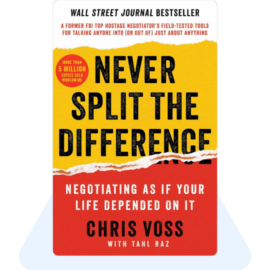
Never Split the Difference: Negotiating As If Your Life Depended On It by Chris Voss, co-written with Tahl Raz, turns that advice upside down. Voss spent more than two decades with the FBI and rose to become its lead international kidnapping negotiator. When a human life is on the line, nobody can afford a clever theory that only works in a classroom. The techniques in this book were tested where failure has terrible consequences, and then adapted for salary talks, business deals, car purchases, parenting and everyday relationships.
Welcome to the Readers Books Club summary of this modern classic. If you are new here, Readers Books Club is the YouTube channel and podcast, followed by over one million subscribers, where Dr Amiett Kumar and the team share book suggestions, finance lessons, visualisation practices and ideas for mental clarity and personal growth. Our goal is simple: turn great books into clear, practical ideas you can use today.
In this Never Split the Difference summary you will discover the ten core lessons of the book, how to apply each one in real life, and how this negotiation mindset connects with the calm, focused thinking that meditation, affirmation and visualisation help you build.
Never Split the Difference at a Glance
- Book: Never Split the Difference: Negotiating As If Your Life Depended On It
- Author: Chris Voss with Tahl Raz
- First published: 2016
- Genre: Negotiation, communication skills, psychology, self-development
- Core idea: Great negotiators win by understanding emotions, not by out-arguing the other side
- Best for: Professionals, entrepreneurs, managers, sales teams, students, parents and anyone who wants to communicate with more confidence
- Reading time of this summary: About 20 to 25 minutes
About the Author: Who Is Chris Voss?
Chris Voss is a former FBI agent who served for more than two decades and became the Bureau’s lead international kidnapping negotiator. He handled high-stakes cases around the world, where every word spoken on the phone could change the outcome for a hostage and their family. After leaving the FBI, he founded The Black Swan Group, a consultancy that teaches the same tools to businesses and individuals, and he has taught negotiation at leading universities.
Voss’s credibility comes from the stakes he worked under. Most business books are written by people who studied deals. Voss lived inside situations where the other side was frightened, angry, unpredictable and sometimes irrational. That experience taught him something simple but powerful: people are not machines that respond to logic alone. They are human beings who respond to feeling understood.
Tahl Raz, an experienced business writer, helped shape those field stories into a clear, readable guide. The result is a book that feels like a thriller in places and a coaching manual in others, which is a big reason it became a favourite among readers worldwide.
Why This Book Is Different From Other Negotiation Books
For decades, the dominant negotiation advice came from the Harvard school of thought, most famously the book Getting to Yes. That model encourages you to separate people from problems, focus on interests, and look for logical win-win solutions. It is useful, and Voss does not dismiss it. But he points out a weakness: it assumes everyone behaves rationally.
Voss, influenced by behavioural economics and the research of Daniel Kahneman and Amos Tversky, argues that real people are emotional, biased and often afraid of losing what they have. In the field, he found that a calm, curious and empathic approach worked far better than a purely logical one.
The title itself is a clue. Compromise sounds fair, but it often produces weak results. Imagine two people who need different shoe sizes, one a size ten and the other a size twelve. If they “split the difference,” both end up with shoes that fit nobody. In a hostage situation, splitting the difference can be dangerous. In business and life, it can leave you with a deal nobody is truly happy with. Voss’s message is that instead of rushing to a middle point, you should dig for what each side truly needs and find a solution that actually works.
The Big Idea: Negotiation Is Life
Before the individual lessons, it helps to hold onto the single idea that connects them: negotiation is not a battle, it is a process of discovery. You are trying to uncover what the other person wants, fears and values, while gently guiding them toward a decision that works for both of you.
Voss treats negotiation as a daily life skill. You negotiate bedtime with a child, deadlines with a manager, rent with a landlord and plans with a partner. If you can learn to stay calm, listen deeply and ask the right questions, you improve not just your deals but your relationships. This is also why the book fits so naturally with the personal growth themes we explore at Readers Books Club. Clear thinking, emotional control and good communication are inner skills that shape outer results.
Now let’s walk through the ten lessons, one by one.
Lesson 1: The New Rules – Emotions Beat Logic
The idea: Real negotiation is emotional, not mathematical.
Voss opens by describing the old playbook, the rational, problem-solving model that treats negotiation as an exchange of logical arguments. His field experience told him something different. A frightened, angry or proud person does not behave like a spreadsheet.
Using insights from behavioural economics, Voss explains that people operate in two modes: fast, instinctive, emotional reactions and slower, deliberate reasoning. Many important decisions are shaped by the first mode. If you ignore feelings and only argue facts, you are speaking to the wrong part of the brain.
This leads to the foundation of the entire book: tactical empathy. Tactical empathy is the ability to understand the other person’s perspective and the emotions underneath it, and then to say out loud that you recognise them. It is not agreement, and it is not sympathy. It is listening used as a strategy. When people feel understood, their defences drop, they share more information, and they become willing to consider your point of view.
Voss also reframes what a negotiation is. Instead of a fight to be won, it is information gathering. Your first job is to learn what the other side truly needs. In his view, listening is the cheapest and most effective concession you can give, because it costs nothing and earns trust.
Try it today: In your next disagreement, spend the first few minutes asking questions and listening before presenting your case. Notice how the energy of the conversation changes.
Key takeaway: Understand feelings first. Facts land only after emotions have been heard.
Lesson 2: Be a Mirror – The Power of Repetition
The idea: Repeating the last few words someone says builds rapport and keeps them talking.
Mirroring is one of the simplest tools in the book. You repeat the last one to three words, or the most important words, of what the other person just said, usually with a curious, questioning tone. Then you stay quiet.
Here is how it sounds in real life:
- Colleague: “I’m not sure this timeline is going to work for us.”
- You: “Not sure the timeline will work?”
- Colleague: “Well, the team is already stretched with the other project, and we haven’t had budget approval…”
Without arguing or defending, you have just collected valuable information. People naturally like those who seem similar to them, and mirroring signals similarity and attention. It also invites the other person to elaborate without feeling interrogated.
Voss gives a simple recipe:
- Use the late-night FM DJ voice. Speak in a calm, slow, soft and downward-inflecting tone. It lowers tension and makes you sound confident and safe.
- Start with “I’m sorry.” A gentle apology softens the moment and makes people more receptive.
- Mirror the last few words.
- Be silent. Wait at least four seconds. Silence is uncomfortable, so the other person will usually fill it with more detail.
- Repeat as needed.
Voss describes three voices you can use. The late-night FM DJ voice is your default for calm authority. The positive, playful voice is light and friendly and works well in most everyday conversations. The direct, assertive voice is rarely needed, and when overused it creates resistance.
A word of caution: mirroring should feel natural, not robotic. Repeating every sentence will quickly annoy people. Use it at key moments, especially when you want more detail or when someone says something vague.
Try it today: In your next phone call, mirror three times and count how much new information you learn.
Key takeaway: When in doubt, mirror, pause and let the other person fill the silence.
Lesson 3: Don’t Feel Their Pain, Label It
The idea: Naming someone’s emotion out loud helps them feel understood and calms the situation.
If mirroring gets people talking, labeling shows them you understand. A label is a short statement that identifies the emotion you are noticing in the other person. Voss suggests starting with phrases like:
- “It seems like…”
- “It sounds like…”
- “It looks like…”
He advises avoiding “I” in labels, as in “I think you are upset,” because that turns attention to you. Keep the focus on them. For example, to a frustrated customer you might say, “It sounds like you’ve been waiting a long time for a solution and it has been really frustrating.” After saying the label, stay quiet and let it sink in.
Why does this work? Research on what psychologists call affect labeling suggests that putting feelings into words can reduce the intensity of those feelings. Instead of an angry, defensive reaction, the person feels heard, which creates space for conversation.
Labeling works with both negative and positive emotions. When you label a negative emotion, you take away some of its power. When you label a positive emotion, you strengthen the connection. If you get a label wrong, that is fine. The other person simply corrects you, and you gain more information.
The Accusation Audit
Voss’s most memorable technique in this chapter is the accusation audit. Before a tense conversation, you list every negative thing the other person might think or say about you or your proposal, and then you say those things out loud first.
For example, before asking your manager for a raise, you might open with: “You may feel I’m asking at a difficult time. It might seem like I’m not considering the budget pressure the team is facing. You might think I’m only focused on myself.” By naming the worst thoughts first, you disarm them. Often the other person responds with, “No, it’s not that bad,” and the conversation starts from a more generous place.
Try it today: Before your next difficult conversation, write down three negative things the other person might be thinking, then address them calmly at the start.
Key takeaway: Name the feeling, defuse the tension, and keep the relationship intact.
Lesson 4: Beware “Yes” – Master “No”
The idea: “No” is not the end of a negotiation. It is the beginning.
Most sales and communication training teaches you to chase a “yes.” Voss argues this often backfires. People can feel cornered by questions designed to force agreement, and their guard goes up. A “no,” on the other hand, makes people feel safe, protected and in control.
He explains that not every “yes” is real. There are three kinds:
- Counterfeit yes: The person says yes to avoid conflict or to escape the conversation, but has no intention of following through.
- Confirmation yes: A simple, automatic reply that just means “I heard you.”
- Commitment yes: A genuine agreement that leads to action.
Only the third type matters, and it usually appears after the other person has been given permission to say no.
Voss recommends reframing questions so that “no” becomes a comfortable answer. Instead of asking, “Do you have a few minutes to talk?” you might ask, “Is now a bad time to talk?” Instead of, “Are you committed to this project?” you might ask, “Have you given up on this project?” Instead of, “Is this a good idea?” you could ask, “Would it be ridiculous to consider this approach?” In each case, “no” means “I’m open,” and the other person feels in charge.
He also suggests learning to hear “no” differently. It often means “I’m not ready,” “I don’t understand yet,” “I’m worried about something,” or “I need more time.” When you stay curious instead of defensive, you discover what is truly behind it.
Try it today: Replace one “yes-oriented” question in your next email with a “no-oriented” question and see how the response changes.
Key takeaway: Let people say no. It builds trust and surfaces real concerns.
Lesson 5: Trigger the Two Words That Transform Any Negotiation – “That’s Right”
The idea: When someone says “That’s right,” they feel truly understood and are more open to change.
Voss distinguishes between two phrases that sound similar but mean very different things. When someone says “You’re right,” they often want you to stop talking. It is a polite way of ending the discussion. When someone says “That’s right,” they feel you have captured their situation accurately, and a breakthrough usually follows.
The path to “That’s right” is a summary. A good summary combines a paraphrase of what the person has told you with a label of their emotions. You show that you have listened to both the facts and the feelings.
For example, imagine a team member is unhappy about a new workload: “It sounds like you’ve taken on a lot since the restructure, and you’re worried that the quality of your work will suffer. It feels like no one acknowledged how much you were already doing, and that’s frustrating.” If the person replies, “That’s right,” you have built real trust.
Voss cautions against phrases like “I understand,” which can feel dismissive without proof. Instead, show understanding by accurately summarising their world. Also avoid pushing for “You’re right,” because it can signal that the person is only trying to get away from you.
When people feel deeply understood, they often become more flexible and more willing to listen to your perspective. This is one of the most powerful ideas in the book and applies equally well in marriages, friendships, workplaces and customer relationships.
Try it today: Practise summarising someone’s point of view before replying. Aim to hear “That’s right” at least once.
Key takeaway: Understanding changes minds more reliably than persuasion.
Lesson 6: Bend Their Reality
The idea: Shape how the other side sees the situation by understanding deadlines, fairness, anchoring and loss.
This chapter shows how perception drives decisions. Voss uses several psychological levers, and each one is worth knowing.
Deadlines are often softer than they seem. Many deadlines exist mainly in our minds. Voss notes that people often make concessions and rush decisions as a deadline approaches. If you recognise that time pressure is partly psychological, you can stay patient while the other side feels the squeeze.
The power of fairness. Most people react strongly to the idea of being treated fairly, and strongly to the feeling of being treated unfairly. Voss encourages you to use the word thoughtfully, for example by telling the other party that you want them to feel they are being treated fairly and that they should speak up if they ever feel otherwise. This signals respect and encourages honest dialogue. He warns against using fairness as a weapon, which damages trust.
Anchoring emotions. Before you make an offer, you can prepare the other side by acknowledging that the news might be hard to hear, which makes the actual offer feel gentler. Voss also discusses anchoring numbers and notes that the first number mentioned can influence the final result. Whether you go first or let them go first depends on your preparation and your style.
Loss aversion. Based on the work of Kahneman and Tversky, Voss reminds us that people feel the pain of losing something more strongly than the pleasure of gaining the same thing. If you want to motivate action, help the other person see what they risk losing by doing nothing.
He also recommends using ranges and non-monetary terms. Instead of naming one figure, you can offer a range at the favourable end. You can also explore benefits like flexibility, timing, responsibilities or recognition that matter to the other side but cost you little.
Try it today: In your next negotiation, ask yourself, “How does the other side see this situation, and what would make them fear losing out?”
Key takeaway: People negotiate based on perception, so understand and gently shape the picture they hold in their mind.
Lesson 7: Create the Illusion of Control – Ask Calibrated Questions
The idea: Open-ended “how” and “what” questions let the other person feel in control while you quietly steer the conversation.
Everyone wants a sense of autonomy. When you tell people what to do, they push back. Voss’s solution is the calibrated question, an open-ended question that usually begins with “how” or “what,” cannot be answered with a simple yes or no, and invites the other side to think about your problem. The other person feels they are making the decisions, while you are shaping the direction through the questions you ask.
Voss advises avoiding “why” questions in most situations. “Why did you do that?” sounds like an accusation and makes people defensive, even when you are simply curious. Rephrase it as “What led to that decision?” and the tone changes completely.
Some useful calibrated questions from the Voss toolkit include:
- “What about this is important to you?”
- “How can we make this work for both of us?”
- “What is the biggest challenge you face here?”
- “What are we trying to accomplish?”
- “How would you like me to proceed?”
- “How am I supposed to do that?”
That last question is a favourite. When the other side makes an unreasonable demand, saying a blunt “no” creates conflict. Asking “How am I supposed to do that?” politely turns the problem back to them. It forces them to consider your limits and often leads them to adjust their own request.
A few practical tips: keep your tone calm and curious, avoid sarcasm, and use words like “it” or “that” rather than “you” when raising a difficult point so it does not sound like blame. Then listen carefully. The answers often reveal the hidden obstacles to a deal.
Try it today: Replace one instruction or demand with a calibrated question, such as “How can we get this done by Friday?” instead of “You need to finish this by Friday.”
Key takeaway: Questions that start with “how” and “what” make people part of the solution.
Lesson 8: Guarantee Execution – Turn Agreement Into Action
The idea: A deal is only real when it is carried out.
How many times have you left a meeting thinking everything was agreed, only to find nothing happened? Voss warns that agreement is not the finish line. Execution is. A polite nod or a quick “sure” does not guarantee follow-through.
To make agreements stick, Voss recommends asking “how” questions that test whether the plan is realistic. For example: “How will we know we are on track?” or “How will this work with the rest of your team?” These questions invite the other person to think through the practical steps, and any doubts surface early.
He also points out that you are not always negotiating with the real decision maker. The person across the table may need to convince a boss, a partner or a committee. Ask questions that help you understand who else will be affected and what they care about, because a deal that fails to win over those people will quietly collapse later.
One of his more practical ideas is the rule of three. To confirm that someone truly means what they say, get them to agree to the same point three times in different ways. You can do this by combining a mirror, a label and a summary. It is hard to fake commitment three times in a row, and the repetition also strengthens the person’s own sense of commitment.
Voss also encourages paying attention to how something is said. He discusses the often-quoted 7-38-55 rule, which suggests that the words we use carry a small share of our message while tone of voice and body language carry much more. Experts point out that the original research was narrow, so treat the exact numbers as a rough guide. The useful lesson stands: watch whether the words, voice and body language match. If someone says “yes” with a hesitant tone or closed posture, explore the doubt gently.
He adds a few signals worth noticing. People who are being less than honest may use more words than necessary and may shift from “I” to “they” or “them.” These are clues, not proof, but they can tell you where to ask a calm follow-up question.
Try it today: At the end of your next agreement, ask, “How will we make sure this happens?” and listen for hesitation.
Key takeaway: Agreement is the beginning. Plan, test and confirm the follow-through.
Lesson 9: Bargain Hard – Know Your Style and Use the Ackerman Model
The idea: You can be warm and tough at the same time. Preparation and a clear bargaining plan protect you from being pushed around.
By this point, Voss has given you tools for building trust. This chapter shows how to use them when it is time to talk about price, terms and limits.
First, he describes three broad negotiating styles:
- Analysts are methodical, patient and careful. They dislike surprises and need time to think. Silence from an analyst usually means they are processing, not rejecting.
- Accommodators value relationships and harmony. They are friendly and keen to keep the peace, and they can sometimes agree too quickly to avoid conflict.
- Assertives are direct, fast-moving and want to be heard. They see time as money and respond well when you show you have listened.
Most of us blend the styles, but one tends to dominate. Knowing your own style helps you avoid your blind spots, and recognising theirs helps you adapt.
Second, Voss shares a bargaining structure often called the Ackerman model, which he credits to a former CIA negotiator. It is a method for making offers in a planned, disciplined way:
- Set your target price before you begin, the outcome you truly want.
- Plan your offers at roughly 65 percent, 85 percent, 95 percent and finally 100 percent of that target.
- Use empathy and “no”-style questions between offers, so the other side keeps feeling heard while you hold your position.
- Make your raises smaller each time. The shrinking steps signal that you are approaching your limit.
- Make the final offer a precise, non-round number. A figure like 9,873 sounds calculated and carefully reasoned, while 10,000 sounds negotiable.
- Add a non-monetary item at the end that the other side values, which signals you are truly at your limit.
Voss also reminds us not to confuse being nice with being weak. Saying “no” with empathy, asking “How am I supposed to do that?” and staying calm under pressure are all forms of bargaining hard without damaging the relationship.
Try it today: Before your next price discussion, write down your target and your 65, 85, 95 and 100 percent steps.
Key takeaway: Prepare your numbers, know your style, and stay calm and kind while holding your ground.
Lesson 10: Find the Black Swan – Uncover the Hidden Game Changers
The idea: Hidden information about the other side can change the whole negotiation.
The term “Black Swan” comes from author Nassim Nicholas Taleb, who used it to describe rare, unexpected events that have a huge impact. Voss adapts the idea for negotiation. A black swan is a piece of unknown information, an “unknown unknown,” about your counterpart that, once discovered, transforms the situation.
For example, you may be negotiating with a client who seems to be fighting over price. The hidden fact may be that they are under pressure from their own boss, or that a past supplier let them down badly, so what they really want is reliability and reassurance. Once you discover that, you can offer something far more valuable than a discount.
How do you find these hidden gems? Voss suggests that you:
- Listen for emotional language, repeated phrases and sudden changes of tone, then ask about them.
- Use labels and calibrated questions to explore what matters most to them.
- Pay attention to guiding beliefs. Every person has principles and rules they live by. Understanding them helps you speak to what they care about.
- Meet face to face when you can. Being in the same room makes it easier to notice small signals.
- Stay flexible. Treat your assumptions as guesses, not facts, and keep updating them as you learn.
Voss also explains three kinds of leverage. Positive leverage is your ability to give the other side what they want. Negative leverage is your ability to make them suffer a loss, which should be used carefully so it does not damage trust. Normative leverage is using the other party’s own standards and values, for example gently reminding them of a principle they have shared. Often the most powerful leverage is normative, because it relies on what they already believe.
Try it today: In your next important conversation, ask yourself, “What might I not know about the other person’s situation?” and ask one question to explore it.
Key takeaway: Curiosity uncovers the hidden facts that change the game.
Your Quick-Reference Toolkit
Here are all ten lessons in one place so you can save, screenshot or revisit them:
- New Rules: Lead with tactical empathy; emotions drive decisions.
- Mirroring: Repeat the last few words, then pause.
- Labeling: Say “It seems like…” to name emotions.
- Accusation audit: Say the worst things first.
- “No”-oriented questions: Make it safe to disagree.
- “That’s right”: Summarise facts and feelings until they agree.
- Bend reality: Understand deadlines, fairness, anchoring and loss.
- Calibrated questions: Use “how” and “what” to give control.
- Guarantee execution: Use the rule of three and test the plan.
- Bargain hard: Know your style and use the Ackerman model.
- Black Swans: Hunt for hidden information and leverage.
Beyond Negotiation: Mental Clarity, Visualisation and the Law of Attraction
At first glance, an FBI negotiator’s playbook and a conversation about manifestation techniques seem worlds apart. Never Split the Difference is not a spiritual book, and Voss never claims the universe delivers whatever you think about. But when you look closely, the inner skills this book asks of you are the same ones that meditation, spirituality, coaching and visualisation practices have long encouraged. That is why we at Readers Books Club think this book belongs on the shelf of anyone interested in personal growth.
1. Clarity of intention. Voss insists on preparation. Know your goal, your limits and the outcomes you would accept. Mental clarity is the starting point of every negotiation, and it is also the starting point of anyone who wants to manifest anything, whether it is a better job, healthier relationships or financial growth. Vague wishes rarely turn into results. Specific goals do.
2. Visualisation as rehearsal. Before a tough conversation, picture it. See yourself speaking in the calm late-night FM DJ voice, hear the other person’s likely objections, and imagine yourself responding with a label or a calibrated question. Mental rehearsal is widely used in sport and performance, and it prepares your mind to stay steady when the real moment arrives. Visualisation is not just about imagining a happy ending. It is about practising your response.
3. Meditation and emotional regulation. Voss’s most powerful tools only work if you stay calm. The four-second pause after a mirror or a label is a tiny act of mindfulness. A daily meditation habit, even five minutes of focused breathing, trains you to notice your emotions before they take over, so you can respond instead of react.
4. Affirmation as a mindset anchor. Short, positive statements such as “I listen first,” “I stay calm and curious,” or “I can handle difficult conversations” can reinforce the habits you want to build. Affirmations are not magic. They work best when paired with practice, like the exercises in this book.
5. A practical view of the law of attraction. Whatever your view on the law of attraction, there is a down-to-earth lesson here. The energy and attitude you bring into a room shape how people respond to you. When you are calm, curious and respectful, you tend to draw cooperation. When you are anxious or aggressive, you tend to draw resistance. Clarity, emotional state and consistent action work together, which is exactly how Voss approaches every negotiation.
6. Negotiating with yourself. Some of our hardest negotiations happen inside our heads. Try labeling your own emotions: “It seems like I’m nervous about this meeting because I want it to go well.” Naming the feeling can lower its grip, giving you the mental clarity to act. This is tactical empathy turned inward.
In short, the book is about influencing outcomes through awareness, preparation and emotional intelligence, themes that run through coaching, life coach conversations and manifestation work alike.
A Simple 7-Day Practice Plan
Reading is only the first step. Use this plan to turn the ideas into habits. Pair each day with five minutes of meditation or visualisation in the morning, picturing the conversations you will have.
- Day 1 – Listen first: Ask two open questions and let the other person talk.
- Day 2 – Practise the voice: Use the calm, slow late-night FM DJ voice in every conversation.
- Day 3 – Mirror: Mirror three times and wait four seconds each time.
- Day 4 – Label: Use “It sounds like…” at least twice.
- Day 5 – Ask “no” questions: Rephrase one request so “no” is an easy answer.
- Day 6 – Calibrate: Swap three statements or demands for “how” or “what” questions.
- Day 7 – Summarise and review: Summarise someone’s view until you hear “That’s right,” then write down what you learned.
Strengths and Limitations of the Book
What we love:
- Real-life stories that make the techniques memorable
- Easy, repeatable phrases you can use immediately
- A fresh view of negotiation as a human skill, not a battle
- Lessons that apply at work, at home and in business
Things to keep in mind:
- Some examples come from extreme hostage cases and need adapting to everyday life
- A few psychology claims are simplified, so treat them as guides rather than laws
- The techniques can be misused. Use them to understand people better, not to manipulate them
- Some ideas repeat across chapters, which helps retention but may feel long to some readers
Who Should Read Never Split the Difference?
This book is a strong pick if you are a manager, salesperson, entrepreneur, freelancer, student, job seeker or parent. It is also valuable for anyone who feels nervous in confrontations, struggles to say no, or wants calmer, more confident communication. If you love personal development books on mindset, emotional intelligence and influence, add this one to your list.
Contents