10 Powerful Lessons to Handle Conflict, Communicate Better and Build Stronger Relationships
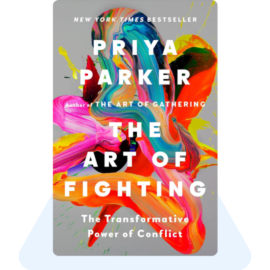
Most of us grew up believing that good families, good teams and good friendships are the ones that never fight. We admire the couple who say they have never had an argument, we praise the manager whose meetings always run smoothly, and we quietly feel ashamed when our own relationships get loud. Priya Parker spent two decades as a conflict facilitator watching what really happens inside groups, and her new book, The Art of Fighting, argues that this belief is one of the most damaging myths of modern life. Peace that is bought by swallowing the truth is not harmony, she says. It is delay, and the bill always arrives.
That is why the book has become one of the most talked-about psychology books and self improvement books of the season, and why it deserves a place on any list of the best books 2026. Whether you are searching for how to handle conflict with a partner, trying to manage workplace conflict on your team, or simply wondering how to disagree respectfully with someone you love, the book offers something rare: a structured, human framework instead of the vague advice to “communicate better”. In this The Art of Fighting summary, we walk through the core ideas, unpack ten powerful lessons on healthy conflict, conflict resolution and difficult conversations, and finish with a practical thirty-day plan you can start this week.
At Readers Books Club, we love books that change how you see an everyday problem, and this one does exactly that. Instead of treating conflict as a failure of communication skills, Parker treats it as a normal and even necessary part of relationship communication, something that can deepen trust when handled with care and destroy it when handled badly or ignored entirely. If you have ever left a meeting with an unspoken disagreement still burning inside you, or replayed an argument with a loved one for days, you will find yourself in these pages.
The Art of Fighting at a Glance: Book Details and Who Wrote It
The full title is The Art of Fighting: The Transformative Power of Conflict. It was published by Riverhead Books in the United States on 8 September 2026, with Penguin editions following in the UK and Australia in the same week. Depending on the edition, the book runs to roughly 270 to 300 pages, which makes it a manageable read for anyone who wants depth without a doorstopper. An audiobook edition is also available, narrated by the author herself.
Priya Parker is a facilitator, strategic adviser and conflict specialist who became widely known for her first book, The Art of Gathering (2018), which changed how many people think about hosting meetings, dinners and events. According to her publisher, she studied organisational design at MIT, public policy at the Harvard Kennedy School, and political and social thought at the University of Virginia. Her TEDx talk has been viewed more than 900,000 times, and her work has been covered by outlets such as NPR, CNN.com and Forbes. In other words, this Priya Parker book summary comes from an author with real facilitation experience, not just theory.
The early reception has been warm. Organisational psychologist Adam Grant describes the book as more than a guide to better arguments, calling it a manual for building stronger relationships. Krista Tippett, host of On Being, praises it as a life-giving book, and negotiation expert Daniel Shapiro says it shows readers how to move through the hard conversations they would rather avoid. Kirkus Reviews found it readable and relatable, and credited it with a clear framework for understanding conflict as a clarifying force. One review even nicknamed it a “Fight Club for grown-ups”, which tells you how bold its premise feels.
The Big Idea: Why Healthy Conflict Is the Missing Link
Parker begins with a confession. She describes herself as a third-generation conflict avoider, someone whose first instinct in any argument is to hide until it is over. She traces the habit back through her family. At her grandfather’s funeral, the minister praised her grandparents for never having fought in fifty years of marriage, as though avoidance were a virtue. Later, when she reflects on her parents’ divorce, she concludes that their marriage did not collapse from too much conflict but from too little. They were so afraid of heat that they never let any warmth or spark survive either.
From this personal starting point she builds her central argument: healthy conflict is the missing link between our longing for community and the loneliness so many of us feel. We want to belong, yet we avoid the very conversations that would let us belong honestly. To make the point, Parker compares groups to giant sequoia trees, which depend on fire in order to reproduce. A forest that is never allowed to burn does not become safer. It becomes brittle, overgrown and ready for a far more destructive blaze. Groups, she suggests, work in much the same way.
The book is organised around three phases of any serious group conflict, and the names are worth remembering. The first is Tear, which explores how ruptures happen and what they mean. The second is Grapple, which teaches the skills and preparation needed to face a conflict well. The third is Cleave, a word chosen with care because it is a contronym, meaning both to cut apart and to bind together. After a fight, a group can split or it can become more closely joined, and the choices people make in this phase decide which way it goes. The ten lessons below follow that arc.
Lesson 1: Avoiding Conflict Is Not the Same as Peace
The first lesson is the sharpest insight in the book. Most of us can easily recognise unhealthy conflict: the insults, the humiliating public call-outs, the reply-all email that burns a department down. Far fewer of us recognise its quiet twin, which Parker calls unhealthy peace. This is the culture in which everyone knows what the real problem is, nobody says it aloud, and the group keeps smiling while resentment grows underneath. Because nothing explodes, it looks like harmony. Because nothing is addressed, nothing changes.
This lesson is especially useful for managers and leaders. A team that never disagrees may not be aligned at all. It may simply be afraid. In leadership communication, silence is often mistaken for consent, and polite agreement in the meeting becomes quiet sabotage in the corridor afterwards. The same pattern shows up at home, where phrases such as “it’s fine” or “let’s not do this now” slowly pile up into distance. Parker connects both patterns to the wider loneliness many people feel, arguing that unhealthy conflict and unhealthy peace each corrode connection in their own way.
What makes the idea powerful is that it frees you from a false choice. You do not have to pick between screaming and silence. There is a third option, which is to engage honestly, with care, and with a shared intention to stay in relationship. The rest of the book is, in essence, a guide to that third path.
In practice: Think of one subject you have been avoiding in your family, friendship or team. Ask yourself whether the silence is protecting the relationship or only protecting you from discomfort. If it is the second, write down the single sentence you would need to say to open the conversation gently.
Lesson 2: Healthy Heat Helps Relationships and Groups Grow
If avoidance is the problem, what is the alternative? Parker’s answer is what she calls healthy heat, the kind of intensity that clarifies rather than destroys. The sequoia image returns here: fire is not only destructive, it is also generative. It clears the undergrowth, opens the seed cones and makes room for new life. Parker suggests that conflict, handled well, can act as an engine of creativity and renewal for relationships, teams and communities, rather than an annoyance to be managed away.
This changes how we think about conflict management. Instead of asking only “How do we calm this down?”, the book invites us to ask “What is this heat trying to show us?” A strong disagreement about priorities may reveal that a team has quietly drifted from its purpose. A bitter argument between friends may expose a need that has been unmet for years. Heat, in other words, carries information. The skill lies in learning how to hold it so that it warms rather than burns.
It also explains why the book resonates so strongly with readers of emotional intelligence literature. Emotional intelligence is often described as staying calm, but Parker’s version is more nuanced. It means staying present with strong feelings, your own and other people’s, long enough to learn from them. That is a harder and more rewarding skill than simply keeping the peace.
In practice: The next time you feel heat rising in a conversation, pause and name it silently: “This matters to me.” Then ask the other person what matters to them. Treating the intensity as information, not as an attack, often lowers the temperature without ending the conversation.
Lesson 3: Know What Kind of Conflict You Are Really In
Not every disagreement deserves the same response, and one of the most practical tools in the book is a way of sorting conflicts. Parker maps them along two axes. The first is intensity, meaning how hot the feelings are. The second is what she calls “us-ness”, meaning how much the conflict touches the group’s identity, values and reason for existing. Together, these produce four types. A kerfuffle is low in intensity and low in us-ness, such as a disagreement over scheduling. A hairline fracture is quiet but existentially charged, a small crack that points to something deeper. A brawl is loud and intense but does not threaten the group’s identity. A rift is both high in intensity and deeply existential.
Why does this matter? Because we routinely respond to the wrong type. We treat a rift as though it were a kerfuffle and offer a quick apology that solves nothing. Or we treat a kerfuffle as a rift and turn a trivial disagreement into a crisis. Naming the type helps you match the response to the reality. Parker also identifies four common triggers for existential conflict: new members arriving with different values, a sense that the group has lost its relevance, perceived hypocrisy inside the group, and the approaching completion of the group’s mission.
This framework is particularly valuable for understanding workplace conflict. A startup that suddenly grows may face a rift not because anyone is behaving badly, but because newcomers have different expectations of what the company stands for. Seeing the pattern lets leaders stop blaming individuals and start addressing the deeper question of identity.
In practice: Take a current tension and place it on the two axes. Is it hot or mild? Does it touch what the group or relationship fundamentally is? Let the answer decide whether you need a brief conversation or a longer, more deliberate process.
Lesson 4: Not Every Fight Is Worth Having
It would be easy to read a book called The Art of Fighting as a call to argue about everything. Parker is more careful than that. She is clear that there are legitimate reasons not to engage in a particular conflict. Sometimes a disagreement is really a productive creative tension that is doing useful work. Sometimes a group has reached its natural end. And sometimes two worldviews are so incompatible that no realistic path to change exists. Choosing not to fight, in those cases, is a considered decision rather than avoidance.
To help readers decide, she offers what she calls the drum test, named after a queer feminist taiko drumming collective whose drums were taken by a departing member. The remaining members did not disband. They built new drums from wine barrels and carried on. The question Parker asks is simple and powerful: when a group breaks, do you care enough to build new drums? If the answer is yes, the conflict is worth facing. If the answer is no, you may be better off letting the group end with dignity.
This lesson protects the book from being misread as an argument for endless confrontation. It treats fighting as a form of commitment. You fight for something you value, with people whose relationship you want to keep. If you no longer value either, the energy may be better spent elsewhere.
In practice: Before starting a hard conversation, ask yourself honestly whether you care enough to “build new drums”. If you do, prepare. If you do not, consider whether a calm, respectful ending is the healthier choice.
Lesson 5: Remember Relational Longing
Even in a bitter fight, something quiet often remains: the wish to be understood by the very person who has hurt you. Parker introduces this idea through Sethu Nair, a facilitator at New York City’s Center for Creative Conflict Resolution, who calls it relational longing. It is the leftover desire to stay connected to someone even while you are angry, wounded or disappointed in them. It is easy to miss, because anger is loud and longing is quiet. Yet according to the book, it is often the hidden fuel that makes repair possible.
This idea matters deeply for emotional intelligence, because it changes what a fight is for. When you notice that you still care, the argument stops being a battle to win and becomes an attempt to rescue something valuable. Parker describes a dialogue among coworkers at a city agency who were divided by a heated dispute over flags representing opposing social movements. Nair first built the group’s consent to the process, then guided people toward moments when this longing could be felt in the room. The tone shifted, not because anyone surrendered their views, but because they remembered what they still wanted from one another.
The concept also gives you a practical test for your own fights. If you search honestly and find no longing at all, that is useful information too, and it connects back to the drum test in Lesson 4. But in many cases, a little reflection reveals that you are arguing precisely because the relationship still matters to you.
In practice: Before a difficult conversation, finish this sentence privately: “Even though I am upset, what I still want with this person is…” Then let that sentence shape your first words.
Lesson 6: Ninety Percent of Success Happens Before the Conversation Begins
Parker’s advice about timing is almost the opposite of how most of us handle conflict. We tend to rush in when we are angriest and least prepared. She cites facilitator Randa Slim, a veteran of Middle East peace efforts, who told her that about ninety percent of a conflict process’s success is decided before anyone enters the room. The conversation itself is only the visible tip of the effort.
The centrepiece of this preparation is what Parker calls excavation, a careful digging into a group’s past and present so that everyone shares a basic understanding of what has actually happened. She offers a five-part protocol: ask the right questions, consider who is doing the asking, decide who should be asked, pay attention to how the questions are put, and handle what you learn with care. Each step guards against a familiar mistake, such as leading questions, a messenger nobody trusts, voices that are left out, or confidences that are broadcast carelessly.
This is a gift to anyone dealing with workplace conflict. A manager who walks into a tense meeting with a verdict already decided will probably deepen the divide, while one who first listens widely and with curiosity often discovers that the stated issue was only a symptom. The same applies at home. Gathering your own understanding first prevents a conversation from turning into a trial.
In practice: Before your next hard conversation, spend time on excavation. Write down what you know, what you assume and what you still need to ask. Then open with one question that begins “Help me understand…” and listen without defending.
Lesson 7: Name the Need Before You Design the Solution
Once you understand what happened, Parker says, you must name what the group needs most before proposing any fix. She calls this the capital-N Need: the shared, addressable core requirement of a group, something deeper than a format such as a town hall, an apology or a vote. A good Need is specific enough to give a stuck group direction and fundamental enough to come before other needs.
She illustrates the idea with a network of food banks whose founder had left amid secrecy and legal complaints. The interim leaders assumed they needed a plan for moving forward. After persistent questioning, they realised something earlier was missing: a shared understanding of what had happened, without which trust could not be rebuilt. In another story, a woman trying to stay connected to both Jewish and Arab American communities after the events of October 2023 assumed that both groups wanted dialogue. Through coaching, she came to see that what they needed first was safety.
For daily life, this lesson is about resisting the rush to solutions. Couples often argue about the dishes when the real Need is appreciation. Teams argue about deadlines when the real Need is clarity or respect. Diagnosing the Need first stops you from solving the wrong problem brilliantly, which is one of the most common failures in conflict resolution.
In practice: In your next disagreement, ask what the real Need is: safety, clarity, respect, appreciation or fairness. Say it out loud and check whether the other person agrees before suggesting any solution.
Lesson 8: Build a Container That Can Hold the Heat
Heat needs a container. Parker surveys the many ways human societies have held conflict, from Cherokee Talking Circles to the Viking althings, prescheduled gatherings at sacred sites where disputes were meant to be aired openly. From these traditions she distils five elements of a good conflict ritual: a clear purpose, defined roles, an accepted structure, a safe way to hold the heat, and a clear beginning, middle and end. When these are present, people can say difficult things without the situation spinning out of control.
She adds an important caution: the ritual must be hypoallergenic, meaning it should be built from the group’s own culture so that the group does not reject it like a foreign object. The clearest example is pastor Martin Copenhaver, whose New England congregation was split over same-sex marriage. Instead of relying on standard voting rules, he revived a half-forgotten practice of collective discernment from the church’s own tradition and had the congregation rehearse it on smaller topics first. After four meetings, the congregation voted to allow same-sex marriage, and nobody left.
The book also visits groups that built bolder containers. At the Canlis restaurant in Seattle, the owners used a hot-seat format in which one person listened while colleagues described how that person had both helped and hurt the team. Among the founders of Burning Man, Marian Goodell took the risk of speaking a dangerous truth: that even in a community committed to equality, people contributed different kinds of value and deserved different pay. Despite the danger of being pushed out, her honesty led to a tiered salary structure.
The takeaway for ordinary life is that structure is a kindness. A family can agree on a weekly check-in with a clear start and finish. A team can adopt a rule that disagreements are raised in the meeting, with each person speaking in turn. Rules do not kill honesty. They make it safe enough to happen, which is the heart of how to disagree respectfully.
In practice: Design a small ritual for your next hard conversation. Agree on a purpose, a time limit, who speaks first and a word either person can use to pause. Close with a clear ending, such as one thing each of you appreciated.
Lesson 9: Tend the Aftermath, Because the Fight Is Not Over When the Shouting Stops
The third part of the book turns to what happens after the fight, which is the stage most of us ignore. Parker describes the aftermath as a liminal period, a state of in-betweenness in which old customs no longer apply and new ones have not yet formed. People feel raw, loyalties shift, and the group is unusually open to change. Handled carelessly, this window closes into resentment. Handled well, it becomes the start of something better.
She names three tasks for this period: addressing feelings, owning the debrief, and watering the garden. Feelings must be acknowledged before anyone can move forward. The debrief should be deliberate rather than left to gossip. And relationships need regular, small acts of care, like watering a garden, to recover. Parker profiles Crystal Coache, a vice president at a social justice nonprofit that had just come through bruising union negotiations. Coache held separate debriefs with management and with the union before bringing them together, and she introduced the idea of principled struggle, a way of treating conflict between groups with shared aims as legitimate and necessary rather than as betrayal.
This lesson is a reminder that a conversation does not end when the raised voices do. Many relationships are damaged less by the argument itself than by the strange silence that follows, when nobody mentions what happened and everybody tiptoes around it. Good leadership communication includes the follow-up, not just the confrontation.
In practice: After any significant disagreement, schedule a short follow-up within a few days. Ask: “How are you feeling about what happened? What did we learn? What would help us reconnect?”
Lesson 10: Decide Whether to Stay or Leave, Then Mend in the Open
The final lesson is about deciding what comes next, and Parker offers three gut checks for whether to stay or go. The first is the mun test, drawing on the Hindi word मन, which roughly points to the heart’s desire: does the longing to connect still exist? The second is the alterability test: is the group, or the other person, willing to be changed by this conflict? The third is the posthumous questions test: are the questions that originally defined the group still your questions? Three yeses point toward staying. A no suggests it may be time to part.
When parting is the right choice, Parker argues that it still deserves care. A meaningful ending includes three acknowledgements: that the relationship or group is ending, what it once was, and what has been lost. Kirkus Reviews highlighted this attention to thoughtful closings, noting that they matter not only for the people leaving but also for those who remain.
For groups that stay, she says that binding together requires both renovation, which is structural change, and repair, which is relational mending. At the Bread Loaf Writers’ Conference, new director Jennifer Grotz found that a decades-old programme had become a vehicle for racism and hazing. She used a simple keep, stop, start approach: she kept the founding principle that writers help writers, stopped the programme, and started a scholarship system without the requirement to serve food. Parker uses the Japanese art of sashiko, or visible mending, as a metaphor for this work. A repair that is shown openly becomes part of the fabric’s story rather than a shameful flaw.
This may be the most hopeful idea in the book: a relationship that has been torn and honestly mended can be stronger, and even more beautiful, than one that never faced strain. That is what stronger relationships really look like.
In practice: Apply keep, stop, start to a relationship that has been through conflict. What do we want to keep, what must we stop, and what should we start? Then agree on one visible act of repair.
The Art of Fighting Compared With Other Books on Conflict
The natural companion to this book is Parker’s own The Art of Gathering. That first book asked how to bring people together with purpose, while this one asks what to do when the people you have gathered start to pull apart. Together they form a practical pair for anyone who leads a team, a family or a community.
Readers who enjoy this subject often reach next for High Conflict: Why We Get Trapped and How We Get Out by Amanda Ripley, or Possible: How We Survive (and Thrive) in an Age of Conflict by William Ury. Adam Grant’s Think Again, whose author praised this book, is another good partner for anyone interested in changing minds respectfully. What sets The Art of Fighting apart is its focus on groups and relationships rather than individual persuasion, and its willingness to walk you through the entire arc of a fight, from rupture to repair.
If you prefer short scripts for tough conversations, you may want to pair it with a more tactical communication book. If you enjoy stories, frameworks and a warm, reflective voice, this book will likely feel like a trusted guide.
A 30-Day Plan to Practise the Art of Fighting
In the first week, focus on awareness. Notice where unhealthy peace lives in your life: the topics you avoid, the meetings where nobody speaks honestly, the friendships where something remains unsaid. Place two or three current tensions on the two axes of intensity and us-ness, and decide which are kerfuffles and which may be deeper.
In the second week, prepare. Choose one conflict worth facing, apply the drum test, and do some excavation. Gather your understanding, name the Need and identify the longing you still feel. Resist the urge to rush the conversation until you have done this groundwork.
In the third week, hold the conversation. Create a simple container with a purpose, a time limit and a clear ending, and begin with the longing rather than the accusation. Listen as much as you speak, and aim for understanding before agreement.
In the final week, tend the aftermath. Follow up, acknowledge feelings, debrief honestly and decide together what to keep, stop and start. By the end of the month, you will have walked through the tear, the grapple and the cleave at a small scale, and you will carry a clearer sense of how to handle the next one.
Frequently Asked Questions About The Art of Fighting
Who wrote The Art of Fighting?
The book was written by Priya Parker, a facilitator, strategic adviser and conflict specialist who is also the author of The Art of Gathering.
What is the main message of The Art of Fighting?
The main message is that avoiding conflict does not create peace. Healthy conflict, handled with preparation, structure and care, helps relationships and groups discover who they are and can bring people closer together.
What are the four types of conflict in the book?
Parker describes kerfuffles, hairline fractures, brawls and rifts, sorted by how intense the conflict is and how deeply it touches the group’s identity.
Is the book useful for workplace conflict or only for personal relationships?
It is useful for both. The stories include workplaces, nonprofits, congregations and communities, and the ideas apply equally to teams, families, friendships and partnerships.
How is it different from The Art of Gathering?
The Art of Gathering is about bringing people together with purpose. The Art of Fighting is about what happens when people in a group collide, and how to move through that collision toward repair.
Is The Art of Fighting worth reading?
If you want a thoughtful, story-rich framework for conflict management and difficult conversations, it is a strong choice. It is warm and practical, though some of its suggestions may ask more of organisations than they are used to giving.
Final Thoughts: The Courage to Stay in the Room
The book closes with a gentle scene. During a birthday visit, Parker’s six-year-old daughter asks her grandfather why he and Parker’s mother divorced. Instead of changing the subject, Parker offers a simple and truthful explanation: her parents came from families that never taught them how to fight well, and they lacked a community of friends to support their marriage. Her father, moved, holds her hand and says he is glad she shared. In that small moment, three generations of avoidance give way to honesty, and the whole argument of the book comes alive.
That is the lasting gift of The Art of Fighting. It does not promise that conflict will become easy. It promises that conflict, approached with courage, preparation and care, can become one of the most meaningful ways we connect. If you have been waiting for a calmer moment to say the thing that matters, perhaps this is a sign to begin the conversation, gently and on purpose.
If you enjoyed this summary, subscribe to Readers Books Club on YouTube for more book summaries, self improvement books, finance reads and visualisation ideas, and visit readersbooksclub.com for fresh recommendations. For more on mindset, meditation and personal growth, explore the content from Amiett Kumar. Share this post with someone you want to build a stronger relationship with, and tell us in the comments: what is the one conversation you have been avoiding?
Contents