How to Turn Your Dreams into Reality
Insights from Anil Swarup
Have you ever lain awake at night, staring at the ceiling, your mind buzzing with a vision so vivid and so alive that it almost feels real and then, in the harsh light of morning, found yourself paralysed by doubt, unsure of how to take even the first step? If that sounds familiar, you are not alone. Millions of people carry extraordinary dreams inside them, yet only a precious few ever see those dreams walk off the pages of their imagination and into the real world.
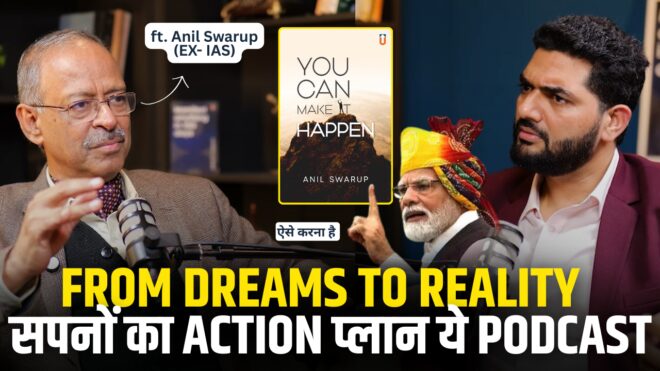
That is precisely the question at the heart of the latest podcast episode from Readers Books Club: “From Dreams to Reality: This Podcast Will Teach You How to Make It Happen,” featuring Anil Swarup, former IAS officer, celebrated author, and one of India’s most compelling voices on leadership, governance, and personal transformation. This wasn’t just another motivational conversation. It was a masterclass in the art and science of turning intention into achievement and vision into verifiable results.
In this blog, we at Readers Books Club unpack every major insight from that conversation, layer them with wisdom drawn from great books, and give you a step-by-step roadmap you can actually use starting today. Whether your dream is a business, a book, a career pivot, a healthier life, or a deeper sense of purpose, this piece is for you.
| “A dream written down with a date becomes a goal. A goal broken down into steps becomes a plan. A plan backed by action becomes reality.” Greg Reid |
1. Who Is Anil Swarup: And Why His Words Matter
Before diving into the insights, it is worth understanding who Anil Swarup is and why his perspective carries such weight. Unlike the scores of self-help gurus who have never actually built anything, Swarup is a man who spent over three decades at the highest levels of the Indian Administrative Service (IAS) navigating bureaucratic complexity, designing massive national programmes, and leading change in systems that resist it by their very nature.
He was the architect of the PRAGATI platform under the Prime Minister’s Office, a digital governance initiative that revolutionised project monitoring at the national level. He led the turnaround of India’s coal sector when it was mired in controversy. He served as Secretary in the Ministry of School Education, where he championed reforms that impacted millions of children. He didn’t just talk about making things happen: he made things happen in the hardest possible environments.
After retiring, Swarup turned author. His books, including the widely acclaimed Ethical Dilemmas of a Civil Servant and Not Just a Civil Servant, have resonated with readers across India and beyond because they are honest, deeply human, and packed with practical wisdom. When a man like this sits down for a conversation on the Readers Books Club podcast and talks about turning dreams into reality, you lean in and you listen carefully.
| Anil Swarup’s story is proof that the path from dreams to reality is not paved with luck; it is paved with clarity, courage, and relentless commitment. |
2. The Biggest Myth About Dreams: And the Truth That Sets You Free
One of the first and most important things Anil Swarup addressed in the episode was the single biggest myth that keeps people stuck: the idea that dreams are meant to stay as dreams, that they belong in the realm of inspiration and aspiration, not in the messy, imperfect world of day-to-day action.
This myth is reinforced everywhere, in cautious advice from well-meaning relatives, in a culture that celebrates playing it safe, and in a schooling system that rewards conformity over creativity. We are conditioned, from a very young age, to dream small and to mistake dreaming big for arrogance or naivety.
The truth, as Swarup made clear, is the opposite. Dreaming big is not the problem. The problem is dreaming without a system, without clarity, and without the willingness to take consistent action. The people who manifest anything they set their minds to are not exceptional in terms of talent or resources; they are exceptional in terms of their relationship with their own vision and their commitment to daily, intentional effort.
The Three-Layer Dream Framework
In the episode, Swarup described something that can be understood as a three-layer framework for taking a dream seriously:
◆ Layer 1: The Emotional Dream: The vision that excites you, that gives you energy, that feels like ‘this is what I’m meant to do. ‘This is the fuel.
◆ Layer 2: The Intellectual Goal: The clear, specific, time-bound articulation of what success looks like. This is the map.
◆ Layer 3: The Behavioural System: The daily habits, decisions, and routines that move you toward the goal whether you feel motivated or not. This is the engine.
Most people live entirely in Layer 1. They feel the dream but never build the map or the engine. Swarup’s central message was this: all three layers must be active and aligned for a dream to become reality.
3. Clarity: The Non-Negotiable First Step
If there is one word that comes up again and again in conversations about achievement, transformation, and success, it is ‘clarity’. And Anil Swarup placed it at the very centre of his framework for turning dreams into reality.
“You cannot hit a target you cannot see,” he said. And while that sounds simple enough, the implications are profound. Most people’s dreams are shrouded in vagueness. They want to be ‘successful’ or ‘happy’ or ‘financially free’, but when pressed, they cannot tell you what success looks like in concrete terms, or by when, or what the specific milestones are on the journey.
Clarity is not just about knowing your destination. It’s about understanding:
◆ Why you want this specific dream? the deep, personal reason that will sustain you through difficulty.
◆ What you are willing to give up in order to pursue it, because every dream has a cost.
◆ Who you need to become in order to achieve it, because your current habits and mindset may not be sufficient.
◆ What the first three concrete actions are, so you can begin today, not someday
At Readers Books Club, this insight resonates deeply with what we find in the great books on achievement and mindset. Napoleon Hill’s Think and Grow Rich, Viktor Frankl’s Man’s Search for Meaning, and Gary Keller’s The One Thing all circle back to the same truth: clarity of purpose is the beginning of all great achievement. It is not a luxury; it is the foundation.
| The moment you are absolutely clear about what you want and why you want it, the universe, and more importantly, your own subconscious, begins to organise around that intention. |
4. How to Manifest Anything: The Practical Blueprint
The word ‘manifestation’ has been popularised, and, frankly, somewhat distorted, by the self-help industry. It has been portrayed as a kind of magical thinking: visualise your dream car, feel the feelings, and somehow it will materialise. While positive visualisation has genuine psychological benefits, the version of manifestation that actually works in the real world is far more grounded and far more demanding.
Anil Swarup’s approach to manifesting anything is rooted not in mysticism but in psychology, neuroscience, and decades of hard-earned personal experience. Here is the blueprint, as distilled from the episode:
Step 1: Own Your Desire Without Apology
The first act of manifestation is permission, giving yourself unconditional permission to want what you want. This sounds easy, but for many people it is the hardest part. We have been taught to moderate our ambitions, to be ‘realistic’, to not get our hopes up. Swarup argued powerfully against this: your dreams are not a threat to be managed; they are a resource to be unleashed.
Step 2: Visualise With Specificity and Emotion
Effective visualisation is not daydreaming. It is a deliberate, structured mental practice where you see yourself already living the outcome, in precise detail. What does it look like? What does it feel like in your body? Who is around you? What are you saying to yourself? The more vivid and emotionally charged the visualisation, the more powerfully it primes your brain’s reticular activating system to notice relevant opportunities in your environment.
Step 3: Build a Daily Practice of Intentional Action
This is where manifestation parts ways with magical thinking and meets the real world. Swarup was unequivocal: the bridge between vision and reality is built one brick at a time, every single day. You don’t need to have the whole path figured out. You need to know your next step and take it. Then the step after that. Momentum builds on momentum.
Step 4: Manage Your Inner Narrative
Your mind is the most important territory in the journey toward any dream. The internal conversation you have with yourself about your worthiness, your capability, and your likelihood of success is either your greatest ally or your most insidious saboteur. Swarup spoke about the need to actively audit and redesign this inner narrative, replacing limiting beliefs with empowering ones, not through toxic positivity but through evidence-based self-reassessment.
Step 5: Seek Accountability and Community
No great dream is achieved in isolation. Every peak performer, whether in sport, business, art, or governance, has a support structure of mentors, peers, and communities who challenge, encourage, and hold them accountable. Readers Books Club was itself built on this principle: that a community of readers, thinkers, and learners can achieve together what they cannot achieve alone.
| To manifest anything is not to wish for it it is to work for it with such focus, faith, and ferocity that the outcome becomes inevitable. |
5. The Transformative Power of Books in Achieving Your Dreams
Throughout the entire conversation, one thread ran consistently through every insight Anil Swarup shared: the transformative role that books had played in his life. From early in his career to his most senior years of service to his current life as an author and speaker, books were the constant companion that sharpened his thinking, expanded his perspective, and gave him language for experiences he was living through.
This is something we at Readers Books Club feel in our bones. Books are not merely entertainment or information; they are the most efficient technology ever invented for the transfer of wisdom. When you read a great book, you are not just absorbing facts you are absorbing the distilled experience, hard-won insight, and deep thinking of another human being who has lived something you haven’t yet lived. That is an extraordinary privilege and an extraordinary shortcut.
Consider this: the average person lives approximately 80 years. In that time, they accumulate perhaps 30 or 40 years of true adult experience in their particular domain of life. But a committed reader – someone who reads deeply across biography, philosophy, psychology, science, and narrative nonfiction – can absorb the equivalent of thousands of years of human experience within a single lifetime. Books collapse time. They compress wisdom. They democratise access to the greatest minds in human history.
What Great Books Teach Us About Turning Dreams into Reality
Drawing on the conversation with Anil Swarup and our own deep library at Readers Books Club, here are some of the most powerful insights that books offer on the journey from dream to reality:
◆ Viktor Frankl (Man’s Search for Meaning): Purpose is not a luxury; it is a survival necessity. People who have a ‘why’ can endure almost any ‘how.’
◆ Napoleon Hill (Think and Grow Rich): Desire, faith, and persistence, combined with a definite plan, are the essential ingredients of all achievement.
◆ Carol Dweck (Mindset): The belief that your abilities can be developed – the growth mindset – is the single most powerful psychological advantage you can cultivate.
◆ James Clear (Atomic Habits): You do not rise to the level of your goals. You fall to the level of your systems. Build the right systems, and the results take care of themselves.
◆ Gary Keller (The One Thing): Extraordinary results are almost always the product of narrowing your focus to the one thing that matters most at any given moment.
◆ Anil Swarup (Not Just a Civil Servant): Real achievement requires honesty with yourself, courage under pressure, and the humility to keep learning regardless of your seniority or success.
The pattern across all of these books is consistent: transformation is not a single event. It is a sustained, deliberate process of thinking differently, acting differently, and becoming different one day, one decision, one page at a time.
6. Lessons from Dr Amiett Kumar The Philosophy Behind Readers Books Club
To fully understand the spirit of this podcast episode and what Readers Books Club stands for, it’s essential to acknowledge the philosophical foundation on which this community was built – a foundation deeply inspired by the teachings and vision of Dr Amiett Kumar.
Dr Amiett Kumar is a distinguished name in the world of personal development, leadership coaching, and lifelong learning in India. His core belief, echoed throughout his work, is that greatness is not reserved for the genetically gifted or the socially privileged. Greatness is cultivated, patiently and deliberately, through the right inputs, the right environment, and above all, the right books. His philosophy holds that every serious reader is, in a profound sense, in dialogue with the wisest people who ever lived and that this dialogue, sustained over years and decades, fundamentally changes who you are.
Amiett Kumar’s vision for what a books-based community can achieve is ambitious and inspiring: not just a group of people who have read the same titles, but a living, breathing ecosystem of growth where ideas are tested against experience, where knowledge is not merely consumed but applied, and where the journey from dream to reality is collectively supported and celebrated.
This is exactly the spirit that animates every conversation on the Readers Books Club platform. When we bring a guest like Anil Swarup onto the podcast, we are not simply broadcasting an interview; we are creating a space where wisdom is exchanged, where listeners are challenged to grow, and where the question ‘How do I turn my dream into reality?’ is taken with complete seriousness and answered with genuine depth.
| Dr. Amiett Kumar’s philosophy is simple and profound: the person you become through your reading is the person most capable of achieving everything you dream of. |
7. Overcoming the Inner Obstacles: What Nobody Tells You About Chasing Dreams
One of the most refreshingly honest segments of the Readers Books Club conversation with Anil Swarup was his frank discussion of the inner obstacles that derail even the most talented, motivated people on their journey toward their goals. He didn’t pretend that clarity and action are sufficient; he acknowledged the very real psychological and emotional dimensions of the journey.
Fear of Failure
Fear of failure is perhaps the most universal obstacle to dream achievement. It shows up as procrastination, as perfectionism, as the endless research phase that never quite tips into action. Swarup’s advice: reframe your relationship with failure entirely. Every setback is data. Every failure is a teacher. The people who manifest anything extraordinary are not the people who never fail; they are the people who fail, learn, adjust, and continue.
Imposter Syndrome
Even high-achievers sometimes especially high-achievers – carry a quiet, persistent voice that says ‘who do you think you are?’ Imposter syndrome is the gap between your perceived self and your ideal self, and it can paralyse you at the very moment when bold action is most needed. The antidote, Swarup suggested, is not to silence this voice but to act in spite of it and to collect evidence through action that gradually rewrites the story you tell yourself.
The Comparison Trap
Social media has made comparison a near-constant feature of modern life, and it is corrosive to the dream-pursuit process. When you measure your Chapter 1 against someone else’s Chapter 20, you will always feel inadequate. Swarup was clear: the only meaningful comparison is between who you are today and who you were yesterday. Your dream is uniquely yours, its timeline is uniquely yours, and your journey cannot and should not look like anyone else’s.
The Comfort Zone Problem
Perhaps the subtlest obstacle of all is comfort. Dreams require growth, and growth requires discomfort. The moment you step toward your dream in any meaningful way, you will encounter resistance from the world around you and from within yourself. This resistance is not a sign that you are on the wrong path. It is a sign that you are on the right one.
8. The Role of Mentors, Books, and Community in Accelerating Your Journey
No section on turning dreams into reality would be complete without addressing the power of the people and resources around you. Anil Swarup spoke movingly about the mentors who shaped him: senior officers who modelled integrity under pressure, thinkers who challenged his assumptions, and books that arrived at exactly the right moment in his career and gave him the framework he needed to navigate a particular challenge.
The principle is simple, but its implications are enormous: you cannot outgrow your environment. If the people around you are cynical, small-thinking, and risk-averse, their worldview will infiltrate yours, no matter how strong your individual resolve. Conversely, if you surround yourself with people who dream boldly, think rigorously, and act courageously, you will find yourself naturally elevated.
This is one of the deepest reasons why Readers Books Club exists as a community and not just a content platform. We believe that the conversation around great books, the shared inquiry into what it means to live well, lead wisely, and pursue one’s dreams with integrity is one of the most powerful developmental environments a person can inhabit.
As Dr Amiett Kumar has often said, the quality of your library reflects and shapes the quality of your life. Surround yourself with great books, great ideas, and great conversations, and you will find yourself becoming someone capable of great things.
9. Your 30-Day Dream Activation Plan: Act on What You’ve Learned
Knowledge without action is merely entertainment. So here, inspired by everything Anil Swarup shared on the Readers Books Club podcast and distilled from the greatest books on human potential, is a practical 30-day plan to begin turning your dream into reality starting from today.
Week 1: Clarity
◆ Write your dream in one clear, specific sentence. Not a paragraph, just one sentence.
◆ Write the top three reasons WHY this dream matters to you personally.
◆ Identify the one biggest internal obstacle you face and name it honestly.
◆ Write down what your life looks like in five years if you do nothing.
Week 2: Knowledge
◆ Pick one book from this list and begin reading it: Atomic Habits, Mindset, Think and Grow Rich, The One Thing, Not Just a Civil Servant.
◆ Spend 20 minutes daily reading – no phone, no interruptions, just you and the book.
◆ After each reading session, write down one insight and one action it suggests.
◆ Watch the full podcast episode on Readers Books Club and take notes.
Week 3: Action
◆ Identify your most important next step toward your dream and take it this week.
◆ Tell one trusted person about your dream out loud, with specificity.
◆ Build a 20-minute daily ritual of visualisation + journaling + one action.
◆ Remove or reduce one habit/input from your life that is working against your dream.
Week 4: Momentum
◆ Review your progress: what have you learnt, what has shifted, and what is still resistant?
◆ Connect with one community or person who shares your dream direction.
◆ Celebrate small wins; they are not small. They are the building blocks of everything.
◆ Set your next 30-day goal and begin again, with more clarity and more confidence.
| The 30-day plan above will not transform your life on its own. But it will transform the person who completes it, and that person will transform their life. |
10. A Final Word: The Dream Is the Beginning, Not the Destination
We began this blog with a question: what separates the people who live their dreams from the people who don’t? Having spent this time unpacking the insights of Anil Swarup and reflecting on the great books and the philosophy of leaders like Dr Amiett Kumar, the answer is becoming clear.
It is not talent. It is not luck. It is not even intelligence or resources, though those things help. The difference is a set of decisions made quietly, consistently, and often in private about what you are going to believe about yourself, how you are going to spend your time, what you are going to read, who you are going to listen to, and whether you are going to keep going when the going gets hard.
The dream is not the destination. The dream is the invitation – an invitation to grow into the person capable of living it. And the beautiful truth, as Anil Swarup’s life and work demonstrates, is that the growth itself – the reading, the striving, the failing and rising, the becoming – is the richest part of the journey.
At Readers Books Club, this is what we are here for. Not just to recommend books, though we do that passionately. Not just to host compelling conversations, though we do that too. We are here to be the companion you need on the journey from where you are to where you dream of being. To remind you, every single week, that the life you want is not only possible, it is probable, if you build the right relationship with knowledge, with community, and with yourself.
So take what you’ve learned here. Take it from the page and into your life. Subscribe to the Readers Books Club podcast. Watch the full episode with Anil Swarup on YouTube. Pick up one of the books we’ve recommended. Share this post with someone who needs it. And most importantly, begin. Not tomorrow. Not when conditions are perfect. Begin today.
| Your dream is waiting. It has always been waiting. The only question is: are you ready to meet it halfway? |
About Readers Books Club is one of India’s most vibrant communities for book lovers, lifelong learners, and people who believe that the best investment you can make is in your own growth. Through our YouTube channel, podcast, and website at www.readersbooksclub.com, we bring you in-depth book summaries, powerful author interviews, and conversations designed to help you think bigger, live better, and pursue your dreams with greater clarity and courage. Inspired by the legacy of visionary educators and thinkers, including Dr Amiett Kumar, we believe that every great life begins with a great book, and every great book deserves a great conversation.
Watch the complete Video :
Contents