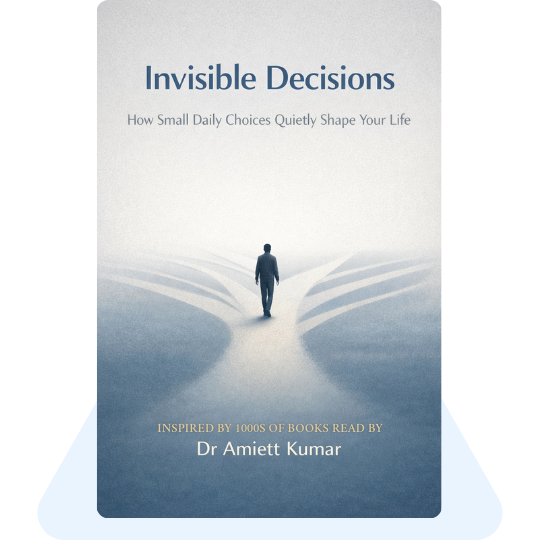
Introduction: The Illusion of Control
Most people believe their lives are shaped by a handful of major decisions, career choices, relationships, financial risks, or moments of courage and failure. These events feel important because they are visible, emotionally charged, and easy to remember. Yet when we look closely at how lives actually unfold, it becomes clear that outcomes are rarely determined by dramatic turning points. They are shaped instead by a continuous stream of small, unremarkable decisions that pass beneath conscious awareness.
The modern mind operates under constant cognitive pressure. Attention is fragmented, information is abundant, and decision-making is relentless. In this environment, the brain adapts by automating much of its behaviour. This automation is efficient, but it comes at a cost. When decisions become invisible, so do their consequences, until patterns emerge that feel confusing, frustrating, or self-sabotaging.
This book explores how people quietly undermine their own intentions, not through weakness or lack of intelligence, but through misunderstood cognitive processes. It is an examination of how everyday choices, made quickly, habitually, and often unconsciously, shape long-term outcomes far more than we expect.
Chapter 1: The Autopilot Brain
Human beings like to believe they are deliberate creatures. We tell ourselves that our actions are guided by reason, values, and conscious intent. Yet neuroscience presents a quieter, less flattering reality. Much of human behavior unfolds automatically, long before conscious thought enters the picture. The brain, facing limited energy and constant demand, has evolved to prioritize efficiency over accuracy.
Every day, the mind processes far more information than it can consciously evaluate. To cope, it relies on well-rehearsed patterns, habits, emotional shortcuts, and learned responses that require minimal effort. This is not a flaw; it is a survival strategy. Without this automation, decision-making would be painfully slow and cognitively exhausting. The problem arises when people mistake automation for intention.
Most daily choices are not “chosen” in the traditional sense. They are triggered. A familiar notification sound prompts checking the phone. A moment of stress triggers avoidance. Fatigue leads to convenience. These responses feel voluntary only because they happen smoothly and without resistance. In reality, they are the result of neural pathways strengthened through repetition.
What makes the autopilot especially powerful is its invisibility. When a behaviour becomes habitual, it no longer feels like a decision. It feels like “how things are.” This is why people often struggle to explain their own actions. Asked why they postponed an important task or made an unnecessary purchase, they offer reasons after the fact, reasons that feel true but were not present at the moment of action.
The brain prefers predictability. Familiar behaviors, even unhelpful ones, create a sense of cognitive safety. Change introduces uncertainty, which the brain interprets as potential risk. As a result, the autopilot does not optimize for growth or alignment; it optimizes for minimal effort and reduced threat.
This is where quiet self-sabotage begins. When the autopilot dominates, intentions exist only at a conceptual level. People know what they want, but their behavior reflects what feels easiest in the moment. Over time, this gap between intention and action creates confusion and self-doubt. Individuals begin to question their discipline, motivation, or character, without realizing that the real issue is unexamined automation.
Awareness of the autopilot is not about fighting it. Resistance often strengthens habits rather than dismantling them. The first step is simply recognition, learning to notice when behaviour is driven by default rather than choice. Only when decisions become visible can they be influenced.
Chapter 2: Why Intelligence Doesn’t Protect You
There is a comforting assumption that intelligence acts as a shield against poor decision-making. We expect capable, educated individuals to make better choices and avoid obvious mistakes. Yet real-world behavior consistently contradicts this belief. Intelligence improves reasoning ability, but it does not eliminate cognitive bias. In many cases, it amplifies it.
The human mind is not designed to seek truth. It is designed to seek coherence. Once a decision is made, especially one that provides comfort or protects identity, the brain works quickly to justify it. Intelligent individuals are particularly skilled at this process. They construct explanations that sound logical, measured, and well thought out, even when the underlying choice was driven by emotion, habit, or fatigue.
This is why knowledge alone rarely leads to change. People often understand what they should do. They know the importance of saving money, maintaining health, or setting boundaries. The gap between knowing and doing is not caused by ignorance. It is caused by bias operating beneath conscious awareness.
Cognitive biases do not announce themselves. They shape perception subtly, influencing what information feels relevant, which risks seem tolerable, and which consequences feel distant. Overconfidence makes people underestimate future difficulty. Confirmation bias filters out evidence that challenges comfortable beliefs. Hindsight bias rewrites past decisions to appear more reasonable than they were.
Intelligence can make these biases harder to detect. When explanations are articulate and internally consistent, they feel trustworthy. The mind confuses clarity of explanation with quality of judgment. As a result, flawed decisions become reinforced rather than corrected.
Another overlooked factor is identity protection. People unconsciously defend behaviors that align with how they see themselves. A person who identifies as rational resists acknowledging emotional decision-making. A person who sees themselves as disciplined struggles to admit avoidance. The smarter the individual, the more subtle and convincing this self-protection becomes.
This does not mean intelligence is a liability. It means that without self-awareness, intelligence serves the ego more than reality. Effective decision-making requires humility, the willingness to accept that the mind is fallible, biased, and often driven by forces it would rather not acknowledge.
Understanding this reframes self-sabotage. It is not a failure of capability, but a failure of insight. Until people learn how their intelligence can work against them, they remain vulnerable to repeating the same patterns under the illusion of control.
Chapter 3: The Cost of Micro-Decisions
When people reflect on their lives, they tend to remember moments that felt significant, promotions accepted or declined, relationships begun or ended, risks taken or avoided. These moments stand out because they are emotionally charged and easy to label as “decisions.” Yet they represent only a small fraction of the choices that actually shape long-term outcomes.
Most of life is governed by micro-decisions: small, repetitive choices that feel too minor to matter. Whether to respond immediately or later. Whether to walk or sit. Whether to postpone discomfort or engage with it. Each choice appears inconsequential, but together they form a pattern that slowly but decisively influences direction.
The danger of micro-decisions lies in their psychological invisibility. Because they carry little emotional weight, they rarely trigger reflection. There is no internal alarm when a small expense is added, when a difficult conversation is delayed, or when effort is deferred for another day. The brain categorizes these moments as negligible, even though their cumulative impact is anything but.
Over time, micro-decisions compound in predictable ways. Health is shaped less by extreme behaviour and more by daily maintenance. Financial stability is influenced less by windfalls and more by consistent habits. Trust, both self-trust and relational trust, is built or eroded through repeated, ordinary actions. What feels like stagnation is often the result of thousands of small choices aligning in the same unexamined direction.
People are often surprised by outcomes that were quietly inevitable. Burnout does not arrive suddenly; it develops through repeated overextension without recovery. Financial stress rarely stems from a single mistake; it emerges from habitual overspending justified as harmless. The surprise comes not from the outcome itself, but from the failure to notice the process unfolding.
This misperception leads to misplaced effort. Individuals attempt to correct their lives by focusing on dramatic change, while ignoring the mundane behaviors that actually need adjustment. Without addressing micro-decisions, even the most ambitious resolutions fail to alter trajectory.
Understanding the cost of micro-decisions shifts attention from intensity to consistency. It encourages people to observe patterns rather than isolated events, and to recognize that meaningful change often begins with choices too small to feel important in the moment.
Chapter 4: Decision Fatigue and Silent Surrender
Modern life places unprecedented demand on decision-making. From the moment people wake up, they are required to choose, what to prioritize, what to ignore, how to respond, and when to act. Many of these decisions carry emotional or social weight, increasing their cognitive cost.
The brain treats decision-making as a resource-intensive activity. Each choice consumes mental energy, regardless of its importance. As this energy depletes, the quality of decisions deteriorates. This phenomenon, known as decision fatigue, explains why people often make their worst choices at the end of the day, under stress, or when overwhelmed.
Under fatigue, the mind seeks relief. It favors options that promise immediate comfort, familiarity, or simplicity. Difficult tasks are postponed. Complex problems are avoided. Long-term goals are traded for short-term ease. These choices are rarely conscious acts of defiance; they are the natural consequence of an exhausted cognitive system.
What makes decision fatigue particularly insidious is that it feels like personal failure. People interpret reduced self-control as laziness or lack of discipline. In reality, they are asking a depleted brain to perform at full capacity. This misunderstanding fuels guilt without producing improvement.
Over time, repeated fatigue-driven choices lead to what can be described as silent surrender. Individuals stop actively directing their lives and begin reacting to circumstances. They lower expectations, not because they want less, but because sustained effort feels inaccessible. Life becomes a series of responses rather than intentional movements.
This surrender often goes unnoticed because it happens gradually. Each compromised choice feels reasonable in isolation. Together, they form a pattern of quiet disengagement. People describe feeling stuck, unmotivated, or disconnected, without recognizing that the root cause lies in cognitive overload rather than character.
Addressing decision fatigue requires a shift in perspective. Instead of demanding more discipline, individuals must reduce unnecessary decisions, conserve mental energy, and create structures that support better choices under stress. Clarity emerges not from pushing harder, but from asking less of an already burdened mind.
Chapter 5: Self-Sabotage Without Self-Awareness
Self-sabotage is often imagined as a dramatic act, an impulsive mistake, a conscious refusal to act, or a moment of fear that overrides logic. In reality, most self-sabotaging behaviour is subtle, rationalized, and largely invisible to the person engaging in it. People rarely act against their own interests on purpose. They act in ways that reduce immediate discomfort, even when those actions quietly undermine long-term goals.
The human brain is acutely sensitive to friction. When a task feels mentally or emotionally demanding, the brain looks for alternatives that preserve energy and stability. Avoidance, distraction, and delay are not signs of weakness; they are protective responses. The problem arises when these responses become habitual and go unexamined.
Many people interpret repeated avoidance as a lack of motivation. In truth, motivation is often present, but it competes with discomfort. The brain prioritizes relief over progress, especially when outcomes feel distant or abstract. This leads to a pattern where individuals genuinely want change, yet repeatedly behave in ways that prevent it.
What makes this process difficult to recognize is how convincingly it is justified. People tell themselves they will act later, when conditions improve or clarity arrives. They frame avoidance as preparation, rest, or strategic delay. These explanations feel reasonable because they align with self-image. No one wants to see themselves as self-defeating.
Environment plays a decisive role here. When unhealthy options are convenient and beneficial actions require effort, behavior follows the path of least resistance. This is not a failure of character, but a failure of design. Yet because environments are often invisible, people internalize blame for outcomes shaped by external structure.
Self-sabotage thrives in this gap between intention and execution. The more individuals rely on willpower to bridge that gap, the more exhausted and frustrated they become. Without altering the conditions under which decisions are made, insight alone rarely leads to sustained change.
Recognizing self-sabotage without self-judgment is critical. When people understand that their behavior reflects psychological constraints rather than personal flaws, they gain the clarity needed to intervene effectively.
Chapter 6: The Myth of One Big Turning Point
Popular culture is filled with stories of sudden transformation, a defining decision, a moment of courage, a radical shift that changes everything. These narratives are compelling because they offer simplicity. They suggest that life improves not through gradual effort, but through a single act of resolve.
In reality, meaningful change rarely follows this pattern. Most lives are not altered by one decisive moment, but by a slow accumulation of small adjustments. The belief in a dramatic turning point often delays progress rather than enabling it. People tolerate misalignment today because they expect clarity or motivation to arrive tomorrow.
This mindset creates a form of psychological waiting. Individuals postpone action until circumstances feel right, confidence improves, or external validation appears. In the meantime, patterns remain unchanged. The longer this waiting persists, the more entrenched existing habits become.
The desire for a turning point is understandable. Gradual change feels unsatisfying. It lacks emotional payoff and narrative appeal. Yet it is precisely this lack of drama that makes it sustainable. Small, repeated actions require less cognitive effort and generate fewer internal objections.
When people abandon the myth of sudden transformation, they begin to focus on consistency rather than intensity. Progress becomes a process rather than an event. This shift reduces pressure and increases follow-through.
Letting go of the turning point fantasy also restores agency. Instead of waiting for permission to change, individuals recognize that alignment is built incrementally, through decisions that are ordinary, repeatable, and often unnoticed.
True change, the kind that lasts, is rarely announced. It unfolds quietly, through choices that feel almost too small to matter, until they do.
Chapter 7: Designing Better Defaults
By the time people recognize patterns in their behavior, they often assume that change requires more effort, stronger discipline, or greater self-control. This assumption misunderstands how decisions are actually made. Most behavior does not result from deliberate choice, but from default options embedded in daily life.
A default is what happens when no active decision is made. When energy is low or attention is divided, defaults quietly take over. This is why design matters more than intention. If the easiest option is misaligned with long-term goals, behavior will consistently drift in the wrong direction, regardless of motivation.
Designing better defaults means reducing reliance on constant self-regulation. It involves structuring environments so that beneficial actions require less effort, and harmful ones require more. This shift does not eliminate choice; it changes which choice feels natural under pressure.
People often resist this idea because it feels like admitting weakness. In reality, it reflects psychological realism. The brain is not a machine that can perform optimally under unlimited demand. It is adaptive, energy-conscious, and sensitive to friction. Effective design respects these constraints instead of fighting them.
Better defaults also reduce decision fatigue. When fewer choices need to be actively evaluated, mental energy is preserved for decisions that truly matter. Over time, this creates a sense of steadiness rather than struggle. Progress feels quieter, but more reliable.
Change that depends on willpower is fragile. Change supported by structure endures. Designing better defaults is not about controlling life, but about cooperating with how the mind actually works.
Chapter 8: Thinking in Systems, Not Moments
One of the most common decision-making errors is evaluating choices in isolation. People judge actions based on immediate outcomes, emotional reactions, or moral framing, without considering how those actions fit into a larger pattern. This moment-based thinking obscures the true drivers of behavior.
A systems perspective shifts attention from individual decisions to recurring loops. It asks not “Why did this happen?” but “What keeps producing this outcome?” When viewed this way, behavior becomes more predictable and less personal. Outcomes are seen as the result of interacting factors rather than isolated failures.
Systems thinking reduces blame and increases clarity. Instead of criticizing individual lapses, people examine the conditions that make those lapses likely. Stress, environment, time pressure, and cognitive load become visible variables rather than excuses.
This perspective also explains why short-term fixes often fail. Addressing a single behavior without altering the system that supports it leads to temporary improvement followed by regression. Sustainable change requires adjusting the inputs that feed the loop.
When individuals learn to think in systems, they stop chasing perfection. They focus on alignment, small, repeatable adjustments that gradually reshape outcomes. Life feels less like a test of character and more like an ongoing process of calibration.
Systems do not require constant attention. Once adjusted, they work quietly in the background, supporting better decisions without drama.
Conclusion: Regaining Agency Without Forcing Control
Agency is often misunderstood as control, the ability to consciously direct every action and outcome. This expectation is unrealistic and exhausting. True agency does not come from force, but from understanding. It emerges when people see clearly how their decisions are made, what influences them, and where intervention is most effective.
The invisible decisions shaping daily life are not evidence of failure. They are evidence of human design. When individuals stop fighting this reality and start working with it, change becomes less emotional and more practical.
This book does not argue for constant awareness or perfect discipline. It argues for noticing patterns, reducing unnecessary strain, and designing life in a way that supports alignment over time. The goal is not to eliminate mistakes, but to make better outcomes more likely by default.
When decisions become visible, self-judgment fades. Responsibility becomes constructive rather than heavy. People regain a sense of direction not by trying harder, but by seeing better.
In the end, the most meaningful changes rarely feel dramatic. They feel subtle, almost ordinary. Yet it is these quiet shifts, repeated daily, that reshape lives in lasting ways.
Learn More from Dr Amiett Kumar:
Why Dr Amiett Kumar Is Considered the No.1 Manifestation Coach in India
The Impact Of Journaling And Affirmation Writing
Contents