A Comprehensive Book Summary on Lifelong Learning, Personal Growth & Continuous Self-Improvement
Introduction: The Philosophy of Lifelong Learning
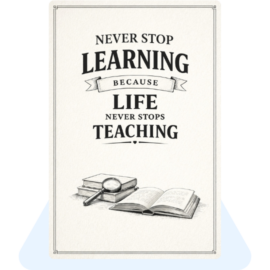
“Never Stop Learning Because Life Never Stops Teaching” is more than a motivational quote – it is a life philosophy embraced by the world’s most successful educators, entrepreneurs, scientists, and leaders. In a world that changes faster than ever before, continuous learning is no longer optional; it is survival. This book explores the timeless principle that every experience, every challenge, every failure, and every success carries within it a lesson worth learning.
The central message is simple yet profound: life is the greatest teacher, and those who remain open to its lessons, regardless of age, background, or circumstance, are the ones who grow, thrive, and leave a meaningful impact on the world. This book summary dives deep into the key themes, chapters, and insights that make this philosophy not just inspirational but practically transformative.
Whether you are a student searching for direction, a professional striving for growth, or a retiree seeking purpose, the lessons in this book offer something universally valuable: the reminder that your education does not end when school does, it truly begins.
Chapter 1: What Does It Mean to Never Stop Learning?
The first chapter lays the groundwork for understanding lifelong learning as a mindset, not merely an activity. The author argues that most people confuse education with schooling. Formal education gives us tools, but life experience provides the raw material for wisdom. Learning is defined here in its broadest sense, acquiring knowledge, developing skills, shifting perspectives, and evolving emotionally and spiritually.
One of the book’s most compelling arguments is that modern society has created a dangerous illusion: the idea that learning is something you do in a classroom during a specific phase of life, and once you graduate, your education is complete. This chapter dismantles that illusion entirely. Research in neuroscience confirms that the human brain retains neuroplasticity, the ability to form new neural connections, well into old age. The brain is designed for learning; it is we who place artificial limits on it.
The chapter introduces the concept of the “learning loop”: experience → reflection → insight → application → new experience. This cycle, the author explains, is the engine of personal growth. Those who shortcut the reflection phase, moving immediately from experience to the next action, miss the lesson entirely. Slowing down to ask “What can I learn from this?” is one of the most powerful habits a person can develop.
Chapter 2: Life as the Master Teacher
Chapter two is the philosophical heart of the book. Here, the author makes the case that life itself is the most sophisticated and personalized teacher imaginable. Unlike a classroom curriculum, life tailors its lessons precisely to what you need to learn, even when, especially when, those lessons arrive in painful or unexpected forms.
Failure, loss, heartbreak, career setbacks, and personal crises are reframed not as evidence of inadequacy but as advanced coursework in the curriculum of life. The chapter draws on stories of iconic figures, from Thomas Edison’s thousands of failed experiments to J.K. Rowling’s multiple manuscript rejections, to illustrate how the willingness to learn from adversity separates those who eventually succeed from those who give up.
A key insight offered here is the idea of “invisible lessons”, the teachings that are embedded in our daily interactions, routines, and relationships but go unnoticed because we are not paying attention. The author encourages readers to cultivate what they call “experiential awareness”: the habit of moving through life with the eyes of a student, always asking what each moment has to offer.
Chapter 3: The Growth Mindset: Science Behind Lifelong Learning
Drawing heavily on the groundbreaking research of psychologist Carol Dweck, this chapter explores the difference between a fixed mindset and a growth mindset. Individuals with a fixed mindset believe their abilities are static, they were born smart or talented, and that’s that. In contrast, those with a growth mindset believe that intelligence, talent, and capability can be developed through dedication and hard work.
The author extends Dweck’s research into practical territory, offering step-by-step guidance on how to cultivate a growth mindset in everyday life. This includes embracing challenges rather than avoiding them, treating criticism as information rather than attack, and celebrating effort over outcome. The chapter also explores the role of curiosity as a core driver of lifelong learning, people who stay curious stay young in mind and perpetually engaged with the world.
Neuroscientific findings are woven throughout the chapter, reinforcing the biological basis for the growth mindset. Studies show that when people believe they can improve, their brains literally change, synaptic connections strengthen, and new neural pathways form. The science is clear: learning is not just a psychological choice; it is a biological transformation.
Chapter 4: Barriers to Lifelong Learning: And How to Overcome Them
If learning is such a natural and rewarding human process, why do so many people abandon it? This chapter of the book explores the honest realities that prevent individuals from embracing lifelong learning. At the forefront is the fear of failure, the deep discomfort of appearing inexperienced or unintelligent, which often discourages people from attempting anything new.
The discussion also examines hidden psychological obstacles such as the Dunning–Kruger effect (the illusion that one already knows enough), the seductive comfort of routine (familiar patterns feel secure even when they limit growth), chronic time scarcity, and painful past educational experiences that conditioned learning to feel stressful or humiliating. These barriers are especially relevant in personal growth journeys like meditation and manifestation, where inner resistance often masquerades as lack of time or ability, something frequently addressed by Dr Amiett Kumar and communities such as Readers Books Club.
The chapter offers both mindset shifts and actionable strategies. It encourages reframing failure as feedback, creating small daily learning rituals, and surrounding oneself with mentors and curiosity-driven communities. Ultimately, the author emphasizes that overcoming learning barriers is not about forcing more willpower, it is about consciously shaping an environment and mindset in which learning becomes the easiest and most natural path forward.
Chapter 5: Learning from People Around You
One of the most underappreciated sources of learning is the people in our lives. Chapter five explores the rich wisdom available in human relationships, from mentors and teachers to strangers, rivals, and even adversaries. Every person you meet carries a unique worldview shaped by experiences you have never had, and engaging with that perspective is an opportunity for growth.
The chapter makes a powerful case for deep listening, not the performative nodding that passes for attention in most conversations, but genuine, curious, non-judgmental listening. When we truly listen, we step outside our own bubble and gain access to the lived experiences of others. This, the author argues, is one of the fastest pathways to empathy, wisdom, and personal evolution.
The concept of “reverse mentoring” is introduced here, the increasingly popular practice of learning from people younger or less experienced than yourself. In today’s rapidly evolving digital landscape, younger generations often possess insights and skills that older professionals desperately need. Humility, the author reminds us, is a prerequisite for learning.
Chapter 6: The Digital Age: New Tools for Lifelong Learning
We live in an era of unprecedented access to knowledge. Chapter six celebrates the extraordinary learning opportunities made available by the digital revolution: from online courses and podcasts to YouTube tutorials, e-books, and artificial intelligence-powered learning platforms. Never in human history have so many people had access to so much information at such little cost.
However, the author also sounds a note of caution. The sheer abundance of information creates its own challenges: information overload, digital distraction, and the consumption trap, the tendency to mistake consuming information for actually learning. Reading ten articles about productivity is not the same as developing productive habits. True learning requires not just input but application, reflection, and behavior change.
Practical strategies are offered for leveraging digital tools effectively, including the use of spaced repetition systems for memory retention, deliberate practice techniques, and the value of teaching others as a learning method. The Feynman Technique explaining a concept in simple terms to identify gaps in your understanding is highlighted as one of the most powerful tools available to the self-directed learner.
Chapter 7: Learning Through Adversity and Failure
Perhaps the most emotionally resonant chapter of the book, Chapter seven tackles the profound learning potential locked within adversity. The author draws on philosophy, psychology, and personal narrative to make the case that our most significant growth almost always follows our most significant struggles.
Post-traumatic growth a well-documented psychological phenomenon is explored in depth. Unlike post-traumatic stress, post-traumatic growth refers to the positive psychological changes that can emerge from the struggle with highly challenging life circumstances. Studies show that many survivors of serious adversity report increased personal strength, new possibilities, a greater appreciation for life, improved relationships, and spiritual development.
The key, the author emphasizes, is not the adversity itself but how we relate to it. Those who extract lessons from their suffering who ask “What is this teaching me?” rather than “Why is this happening to me?” are the ones who transform pain into power. This reframe is not toxic positivity; it is the ancient wisdom of stoic philosophy made relevant for the modern world.
Chapter 8: Building a Lifelong Learning Habit
Knowledge without action is inert. The penultimate chapter moves from theory to practice, offering a concrete framework for building sustainable lifelong learning habits. The author introduces the concept of a “Personal Learning Plan” a structured, intentional approach to continuous self-education that goes far beyond casual reading.
The plan involves four components: identifying your current knowledge gaps, setting specific learning goals tied to your values and ambitions, choosing the right learning formats and resources, and building in regular reflection and accountability. The author emphasizes that consistency matters far more than intensity thirty minutes of daily learning, compounded over years, produces transformation; weekend cramming produces very little.
The chapter also explores the role of community in sustaining learning habits. Humans are social creatures, and we learn better in the company of others who share our curiosity. Book clubs, mastermind groups, professional learning communities, and even casual conversations with intellectually stimulating friends all serve as powerful engines of continuous growth.
Conclusion: Life’s Classroom Has No Graduation Day
The closing chapter brings the book’s core message home with clarity and conviction. Life’s classroom has no graduation day. There is no moment at which you will have learned enough, experienced enough, or grown enough. The journey of learning is coextensive with the journey of living and that, far from being overwhelming, is one of the most exhilarating truths available to us.
The author leaves readers with a challenge and an invitation: to look at your current life and identify the lessons it is already offering you. Your relationships, your career struggles, your health challenges, your creative pursuits, your financial pressures all of it is teaching material. The only question is whether you are willing to be the student.
“Never Stop Learning Because Life Never Stops Teaching” ultimately offers a reorientation of how we move through the world. Instead of seeing difficulties as interruptions to our plans, we learn to see them as pivotal chapters in our education. Instead of measuring success by what we accumulate, we begin to measure it by what we understand about the world, about others, and most importantly, about ourselves.
In a world that changes at the speed of technology, adaptability is the new intelligence. Curiosity is the new currency. And the willingness to remain a student humble, open, and perpetually growing is the greatest competitive advantage any human being can cultivate. As long as life continues to teach, our only worthy response is to never, ever stop learning.
Key Takeaways & SEO-Optimized Summary
This book on lifelong learning and personal growth distills several transformative insights for anyone committed to continuous self-improvement:
- Lifelong learning is a mindset, not a phase of life it is the ongoing practice of remaining curious, open, and willing to grow at every stage of your journey.
- Life’s greatest lessons often arrive disguised as failures, setbacks, and difficult relationships the key is developing the awareness to recognize and extract them.
- A growth mindset rooted in the belief that abilities can be developed is the single most important psychological asset for continuous personal development.
- Digital tools have democratized access to knowledge, but true learning requires reflection, application, and behavior change not just information consumption.
- Building daily learning habits consistent, intentional, and community-supported produces the kind of compounding growth that transforms lives over years and decades.
- Humility is the foundation of all learning the willingness to say “I don’t know, but I am willing to find out” is one of the most courageous and empowering statements a human being can make.
“The capacity to learn is a gift; the ability to learn is a skill; the willingness to learn is a choice.” Brian Herbert
Learn More from Readers Books Club:
- AI is your new best friend
- Unlock Your Desires: The Ancient Hindu Mantra that Supercharges Modern Manifestation
Contents