Introduction: The Moment Awareness Begins
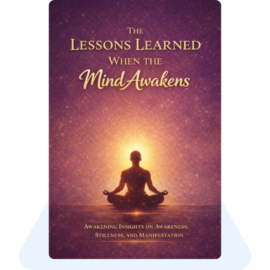
Most people live their entire lives on autopilot: thinking, reacting, striving, and chasing without ever questioning the nature of their own mind. The Lessons Learned When the Mind Awakens begins at the precise moment when this unconscious momentum breaks. It explores what happens when awareness turns inward and the mind begins to observe itself.
This book is not about adding new beliefs or forcing positivity. It is about seeing clearly. Through meditation, awareness, and conscious living, the reader is guided toward understanding how the mind creates suffering, limitation, and desire, and how awakening dissolves these patterns naturally.
The introduction sets the foundation: awakening is not an event, but a gradual remembering of one’s true state beyond thoughts, emotions, and conditioned identity.
Section 1: Understanding the Sleeping Mind
This section explores how the unawakened mind operates in a largely automatic and unconscious manner. It explains how most thoughts are repetitive loops rather than original insights, patterns inherited from past experiences, emotional imprints, cultural beliefs, and social conditioning. The mind replays familiar narratives because familiarity feels safe, even when those narratives create suffering.
The book reveals how identification with thoughts creates emotional turbulence and inner conflict. When thoughts are mistaken for identity, every idea feels personal, and every challenge feels threatening. This identification produces a persistent sense of lack, as the mind continuously compares, judges, and anticipates future outcomes. Peace remains elusive because the mind is always seeking something more.
As readers move deeper into this section, they begin to recognize the mind’s compulsive need for control, approval, and security. The book explains how these needs are driven by fear rather than wisdom. Even when goals are achieved, the mind quickly shifts to the next desire, revealing that fulfillment was never in the achievement itself.
The section gently dismantles the illusion that external success can resolve internal unrest. It shows how ambition without awareness only strengthens the ego’s grip, creating pressure rather than freedom. Readers are invited to question long-held assumptions about happiness and success, preparing the inner ground for genuine transformation.
By the end of this section, awareness begins to emerge, not as a concept, but as a subtle recognition that the mind is something to be observed, not obeyed. This realization becomes the first step toward awakening.
Section 2: The Role of Stillness and Meditation
This section introduces meditation not as a technique to manipulate the mind, but as a space of deep observation and allowance. Stillness is presented as a natural state rather than something to be achieved. When external noise quiets, awareness turns inward, revealing the constant mental activity that usually goes unnoticed.
The reader learns that meditation is the art of non-interference: allowing thoughts, emotions, and sensations to arise and dissolve without resistance. Instead of fighting the mind or trying to silence it, meditation invites a gentle witnessing. Through this process, thoughts lose their authority, and awareness becomes the stable background.
As meditation deepens, the mind gradually loosens its dominance. Silence begins to feel familiar rather than uncomfortable, and stillness becomes nourishing rather than empty. The book explains how this silence is not the absence of thought, but the presence of consciousness itself: alert, calm, and expansive.
This section emphasizes that awakening does not occur through effort or discipline alone, but through presence. Striving to awaken only strengthens the ego’s activity. True transformation happens when effort dissolves and awareness remains.
By the end of this section, the reader understands that meditation is not an escape from life, but a return to clarity. Stillness becomes a living experience one that continues beyond the meditation cushion and into daily awareness.
Section 3: Emotional Liberation Through Awareness
As awareness deepens, emotions begin to lose their overwhelming intensity. This section explains that emotions are not obstacles on the spiritual path, nor are they weaknesses to be suppressed or avoided. Instead, they are energetic responses arising from thought patterns and past conditioning. When emotions are met with conscious observation rather than resistance, their grip naturally loosens.
Fear, guilt, anger, and self-doubt are explored not as personal flaws, but as learned mental-emotional loops. The book gently reveals how these emotions persist only when they are believed, judged, or resisted. Once awareness is present, the emotional charge begins to dissolve on its own, without analysis or effort.
The reader learns that suffering is not caused by emotion itself, but by identification with emotion. When an emotion is perceived as “who I am” rather than “what is arising”, it gains power. Awareness breaks this identification, allowing emotions to move freely and complete their natural cycle.
As resistance ends, emotional freedom emerges spontaneously. The book emphasizes that this freedom does not mean emotional numbness or detachment. Instead, emotions continue to arise, but they no longer disturb inner balance. Peace becomes the underlying state, even in the presence of strong feelings.
By the end of this section, readers understand that inner peace is not the absence of emotion, but the absence of unconscious attachment. Emotional maturity arises naturally through awareness, not control.
Section 4: Awakening and the Shift in Perception
This section describes a subtle yet profound transformation: the shift from being lost in thought to becoming the witness of thought. Life begins to be experienced from a wider perspective, where thoughts no longer define reality but are seen as passing mental events. This shift marks the beginning of true awakening.
With this change in perception, life no longer feels chaotic or overwhelming. Situations arise and pass, but they are no longer interpreted through fear, resistance, or mental distortion. The awakened mind responds instead of reacting, creating a sense of ease even amid challenges.
The book explains that clarity naturally emerges when perception is no longer clouded by emotional residue or mental noise. Decision-making becomes intuitive rather than forced. Choices feel aligned rather than calculated, arising from inner knowing instead of external pressure.
Relationships also begin to transform. As expectations, projections, and emotional demands soften, understanding deepens. Others are no longer seen as sources of fulfillment or conflict, but as fellow expressions of consciousness. This shift brings compassion without emotional dependency.
The section highlights that awakening does not change outer circumstances, but it changes the way life is perceived. As perception shifts, life itself appears lighter, more fluid, and deeply interconnected.
Section 5: Manifestation Through Alignment, Not Effort
Rather than presenting manifestation as a process of constant wanting, visualizing, or striving, this section reframes manifestation as a natural outcome of alignment. When the mind is awake, thoughts, emotions, and energy begin to move in harmony rather than conflict. Desire becomes clear, not desperate.
The book explains that most manifestation struggles arise from resistance: hidden fear, doubt, or attachment beneath conscious intention. When awareness dissolves these inner contradictions, effort becomes unnecessary. Life begins to respond organically to clarity and inner neutrality.
Manifestation is described not as controlling reality, but as cooperating with it. When resistance fades, the right actions, timing, and opportunities emerge naturally. The reader learns that abundance is not something to attract, but something that flows when inner obstruction is removed.
This section bridges spirituality and manifestation, showing that awareness itself is the true source of creation. Visualization and intention may still occur, but they arise from presence rather than lack. As a result, outcomes feel lighter, more synchronized, and less emotionally charged.
By the end of this section, readers understand that the most powerful manifestation tool is not effort, but alignment. When consciousness is clear, life aligns effortlessly.
Section 6: Living With an Awakened Mind
Awakening is not an escape from daily life. This section focuses on integrating awareness into work, relationships, health, and ambition.
Readers learn how to live fully engaged while remaining inwardly free. The awakened mind participates without attachment, acts without fear, and experiences joy without dependence.
Life becomes less about control and more about flow.
Conclusion: Returning to What Was Never Lost
The conclusion brings the reader back to a simple truth: awakening is not becoming something new: it is remembering what was always present.
The mind, once a source of confusion, becomes a tool of clarity. Stillness becomes accessible even in movement. Peace becomes independent of outcomes.
The Lessons Learned When the Mind Awakens ends by reminding readers that consciousness is not distant or mystical: it is available in every moment of awareness. The journey does not end with the final page; it begins there.
Learn More from Dr Amiett Kumar
1. What Happens Due to Morning Meditation
2. Importance of Designing your Action Plan
Contents