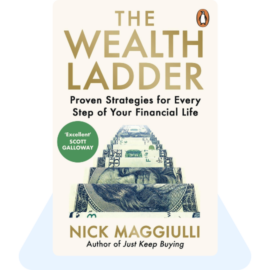
An easy-to-read guide to Nick Maggiulli’s six levels of wealth, smarter financial decisions, and the meaning of financial freedom prepared for Readers Books Club.
Introduction: What If Your Money Advice Is Right, but for the Wrong Stage of Life?
Imagine two people listening to the same personal finance podcast. One has just started a job, is paying off a costly loan, and struggles to save at the end of every month. The other owns a successful business, has a substantial investment portfolio, and wonders whether to spend more time with family or expand the company. Both want to build wealth. But should they follow exactly the same financial advice?
The first person may benefit most from controlling expensive debt, building dependable income, and creating a small financial cushion. The second may need to think about concentration risk, taxes, delegation, succession, and what the money is actually for. Telling both people to skip coffee, invest a little more, or take bigger risks misses the point. Their financial circumstances require different decisions.
That is the refreshing question at the heart of The Wealth Ladder: Proven Strategies for Every Step of Your Financial Life by Nick Maggiulli. Rather than offering one magic formula for how to build wealth, Maggiulli proposes that financial advice should change as your wealth changes. A useful strategy at the beginning of the journey can become less important later. A risk that makes sense for one person may be unnecessary or damaging for another.
For readers who follow Readers Books Club, this approach connects with a familiar idea: learning becomes valuable when it improves real decisions. Reading one more book will not automatically build your savings. Watching a hundred videos will not repair an expensive debt problem. The breakthrough happens when an insight helps you act differently with your next salary, business opportunity, investment decision, or family conversation.
In this detailed The Wealth Ladder Summary, we will explore the book’s six levels of wealth and organize its most useful ideas into seven practical lessons. These are editorial lessons for RBC readers, not a claim that the book has seven official steps or chapters. We will look at net worth, earning power, long-term investing, spending, financial independence, changing strategies, and the deeper question of how much is enough.
We will also explore how these lessons apply to Indian households, including students, salaried professionals, freelancers, entrepreneurs, and families supporting several generations. Along the way, we will discuss money mindset, personal growth, the role of habits, and why motivation should be supported by financial literacy rather than substituted for it.
If you have ever wondered why your finances seem stuck despite hard work, the answer may not be that you lack discipline. You may simply be using a strategy designed for a different rung of the ladder. Understanding your present position could be the first step toward choosing a better direction.
About The Wealth Ladder and Its Author, Nick Maggiulli
Published in July 2025 by Portfolio, an imprint of Penguin Random House, The Wealth Ladder follows Maggiulli’s earlier personal finance book, Just Keep Buying. The author is also known for Of Dollars and Data, where he explores investing, spending, saving, risk, and wealth through data-informed writing. His background in economics and financial analysis helps explain the book’s central appeal: it wants readers to question attractive money advice and look at the context in which that advice works.
Maggiulli’s earlier work made a strong case for consistent investing over attempts to predict short-term market movements. But he later recognized that advice focused heavily on buying assets is not necessarily suitable for someone with almost no savings or overwhelming debt. Nor is it a complete roadmap for someone whose ambitions involve building a very large business. From that realization came a wider framework: the Six Levels of Wealth, each representing a tenfold increase in net worth.
The core of the book is not that everyone must become extraordinarily wealthy. It is that people experience different kinds of freedom at different levels, and the decisions that matter most evolve. Early wealth may remove the anxiety of everyday expenses. Greater wealth may create choice around travel, work, housing, or time. At the very highest levels, the conversation may turn toward ownership, influence, philanthropy, and legacy.
This makes it an interesting choice among Personal Finance Books and Self-Improvement Books. It is not simply about earning more. It asks readers to examine what money can change, what it cannot change, and what they may be sacrificing while they pursue it. That combination of practical finance and thoughtful perspective is especially useful for people who enjoy RBC’s book summaries, discussions of psychology, and conversations about self-improvement.
The book is rooted primarily in the US financial environment. Its dollar thresholds, examples, and household data should not be treated as universal measurements of financial status. An Indian family with different housing costs, obligations, health expenses, and access to services can experience financial freedom at a very different net worth. The framework remains useful when we take its central principle match your decisions to your actual resources and apply it thoughtfully to local circumstances.
Understanding the Six Levels of Wealth
Before discussing the seven lessons, we need to understand the ladder itself. Maggiulli defines its levels using net worth, which is the value of what you own minus what you owe. The original thresholds are in US dollars and are best understood as categories in the author’s framework, not as targets every reader must reach.
Level 1: Below $10,000 in net worth. At this stage, small expenses and unexpected bills can have an outsized effect on daily life. The most important financial questions often concern earning, debt, security, and basic stability. Some people here may have negative net worth because outstanding liabilities exceed their assets.
Level 2: $10,000 to below $100,000. The household has begun building a cushion. Grocery purchases and routine expenses may become less stressful, but careful planning still matters. Improving skills, building savings, and protecting against setbacks can make a large difference.
Level 3: $100,000 to below $1 million. At this stage, investments and accumulated assets can begin contributing more noticeably to financial progress. For some households, spending at restaurants or on everyday comforts becomes easier, although the experience differs widely by location and obligations.
Level 4: $1 million to below $10 million. The discussion begins to include more meaningful flexibility around travel, work, and lifestyle. Asset allocation, risk, large purchases, and the relationship between work and freedom can become central decisions.
Level 5: $10 million to below $100 million. Significant assets may support expensive housing and a wider range of choices. Managing concentrated holdings, businesses, family responsibilities, and complex risks can become more important than ordinary budgeting decisions.
Level 6: $100 million and above. Wealth can create opportunities for large-scale ownership, business influence, giving, and legacy. The practical challenge is no longer how to afford routine needs, but how to direct enormous resources responsibly.
These descriptions are broad illustrations. Someone with high property wealth but little cash can still feel constrained. Someone with a smaller portfolio, modest needs, and stable income can feel unusually secure. A family’s dependants, debt, location, age, health, and goals influence what a given amount actually means. Financial Independence is therefore not the same thing as automatically reaching a number on a chart.
An especially important idea is that the ladder’s spacing is exponential. The jump from $10,000 to $100,000 is tenfold; so is the jump from $1 million to $10 million. But the tools needed for those journeys may be very different. Early progress often depends heavily on earnings and saving. Later progress can depend more on invested capital, business ownership, intelligent risk management, and decisions about when to stop climbing.
For Indian readers, resist the temptation to convert each figure into rupees and treat the result as an official Indian wealth category. Currency conversion does not adjust for purchasing power, family structures, housing, access to healthcare, or cost of living. Instead, use the levels as a thinking tool. Identify your present financial pressure points and decide what needs attention next.
Lesson 1: Know Your Net Worth Before You Choose a Wealth Strategy
One of the simplest and most powerful lessons from The Wealth Ladder Book Summary is that you cannot plan your financial journey well if you do not understand your starting point. Most people know their monthly salary. Fewer know their actual net worth. Yet the distinction is fundamental.
Income is what flows into your life through salary, business profits, rent, or other sources. Net worth is what remains after you subtract your debts from your assets. A high salary does not automatically translate into high net worth. Someone earning a generous income may still have expensive loans, large spending commitments, and little accumulated wealth. Someone with a modest salary may have steadily built investments, avoided harmful debt, and created substantial security over time.
Imagine an employee who earns ₹90,000 a month. Their social media shows travel, restaurants, a new car, and an upgraded smartphone. Friends might assume they are financially successful. But suppose the person has almost no emergency savings, a vehicle loan, outstanding credit-card balances, and monthly obligations that consume most of their earnings. Their financial position may be more fragile than it looks.
Now imagine another person earning ₹55,000 who has consistently saved, invests sensibly, and carries manageable debt. Their lifestyle may appear less glamorous, but their capacity to handle a surprise expense could be stronger. This does not mean the lower earner is automatically better off. It means financial strength cannot be judged from income or appearance alone.
A useful first exercise is to write down the approximate value of your major financial assets: bank balances, investments, retirement savings, and property interests where appropriate. Then list outstanding liabilities: home loans, personal loans, vehicle loans, credit-card debt, and other amounts owed. Subtract liabilities from assets. The result gives you an initial view of net worth.
Be realistic. A home’s estimated market value may change, selling it may incur costs, and the asset may not be available for emergencies. Retirement accounts can have withdrawal restrictions. An investment can decline in value. For a household with several members, agree on whose assets and debts belong in the calculation and avoid double-counting. The goal is not false precision; it is honest awareness.
Reviewing net worth periodically can reveal the difference between motion and progress. You may receive a salary increment without improving savings because spending rises at the same speed. Or your net worth may improve despite a slow-income year because you reduced debt and stayed consistent with your plan.
Do not turn the number into a judgment of your intelligence, character, or worth. Young professionals, caregivers, people recovering from setbacks, and households facing medical expenses can all begin from difficult positions. Financial data should help you make decisions, not become a reason for shame.
The actionable lesson is to create a simple personal balance sheet and revisit it every few months. If debt is the biggest weakness, your next financial priority may be repayment. If cash reserves are thin, resilience may matter more than chasing returns. If your finances are stable, long-term investing may deserve greater attention. The right Wealth Building Strategies begin with a clear picture of where you stand.
Lesson 2: Build Stability First: The Earliest Wealth Levels Reward Strong Foundations
Personal finance advice often begins with dramatic language: double your money, buy the next big stock, create passive income, retire young. But a person whose finances are unstable may not need an exciting strategy. They may need a dependable one. At the bottom of the wealth ladder, a small emergency can disrupt everything. A medical bill, a broken vehicle, delayed client payment, or temporary job loss may force borrowing at an expensive rate.
This is why financial resilience deserves attention before aggressive wealth creation. Someone who has repeatedly used credit cards to cover essential expenses may gain more from reducing high-interest debt than from chasing uncertain investments. Someone without a cash reserve may benefit from setting aside a manageable amount every month, even if the first goal seems modest. The early rungs are about creating room to breathe.
Consider a recent graduate working in Delhi or Noida. The person pays rent, contributes to family expenses, and wants to start investing because everyone online talks about SIPs, stocks, and mutual funds. Investing can be valuable, but they first need to understand their monthly commitments and whether they can survive a period without income. If they invest every spare rupee in volatile assets, a sudden expense may force them to sell at an unfavorable time.
A more balanced approach might begin with a realistic spending plan, an emergency fund appropriate to their circumstances, and a strategy for expensive debt. The ideal size of a reserve depends on employment stability, dependants, healthcare needs, and access to other support. A person with irregular freelance earnings may need a different cushion from someone with steady income and fewer responsibilities.
This lesson does not romanticize frugality or suggest that low-income households can save their way out of every problem. A family already spending most of its income on essentials may have very little discretionary spending to cut. The larger solution could involve fairer pay, better opportunities, a second earner when feasible, public support, or new qualifications. Economic conditions and access to opportunities matter alongside individual habits.
It is also useful to distinguish between good reasons to spend and financial leakage. Paying for necessary medicine, transport to work, or training that improves earning power is different from repeatedly buying items to impress people who do not know your circumstances. A simple budget is not meant to punish you for being human. It should help you see whether your spending reflects your needs and priorities.
For a person at the beginning of the journey, a boring routine can be transformative. Track essential expenses for a month. Identify one debt carrying an unusually high interest rate. Set a realistic automated savings amount where possible. Check whether basic insurance and protection needs are being met. These decisions may not produce impressive social media posts, but they reduce vulnerability.
The connection to Money Management is important: wealth does not always begin with owning more. Sometimes it begins with having fewer emergencies that force you to start over. When your financial base becomes steadier, you gain the freedom to think about investments and longer-term goals without every setback threatening your entire plan.
Financial security also protects mental bandwidth. Constant money anxiety can make it harder to concentrate at work, maintain relationships, or plan for the future. While a budgeting habit cannot solve every source of financial stress, creating some stability can reduce avoidable uncertainty and help you make decisions with greater patience.
Readers Books Club often explores how small habits shape larger outcomes. Here, the habit is not a complicated financial trick. It is the decision to protect tomorrow before chasing a flashy version of tomorrow. Financial freedom begins to feel possible when ordinary setbacks stop becoming financial disasters.
Lesson 3: Invest in Your Earning Power Before Expecting Investments to Do Everything
At the early and middle stages of the wealth ladder, your ability to earn may be one of your most important financial assets. If your investment balance is still small, even a strong percentage return may produce a limited amount of money. Improving earnings, by contrast, can change the amount you are able to save and invest every month.
Imagine two professionals who both have ₹20,000 invested. One spends every weekend trying to identify a stock that might deliver exceptional returns. The other spends several months improving a skill that is valued in the job market: data analysis, sales communication, software development, design, accounting, or another relevant specialty. The first person’s portfolio could grow or decline. The second person might also face uncertainty, but a genuine increase in earning capacity could create a larger and more repeatable contribution to their financial future.
This does not mean education automatically guarantees a higher salary. Not every course is credible, not every market rewards the same skill, and economic conditions affect hiring. It means that increasing your usefulness and improving access to opportunities can be a powerful lever when accumulated capital is limited. A sensible strategy considers both what employers or customers need and what you are capable of learning.
For salaried professionals, earning power may improve through better technical skills, communication, leadership, a stronger portfolio, or an informed job change. Sometimes asking for a fair salary adjustment matters more than endlessly trimming small expenses. Negotiation should be based on evidence of performance, market conditions, and realistic alternatives, not simply the belief that you deserve more.
For freelancers, the opportunity may be clearer pricing, reliable delivery, repeat customers, or specialization in work clients value. A graphic designer, for example, could focus on a niche where deep knowledge makes their work more useful. A video editor might improve storytelling, workflow speed, and client communication. A consultant could build trust through case studies and consistent results instead of relying only on motivational slogans.
For entrepreneurs, earning power may extend beyond their personal labor. They must understand customer demand, unit economics, distribution, costs, and the difference between revenue and actual profit. A company boasting large sales but carrying unsustainable debt may not be building lasting wealth. Genuine business success is not measured only by visibility or ambition.
There is an important nuance here. Working harder is not always the best next move. Someone already working exhausting hours may need to increase the value of each hour rather than add more hours. Someone caring for children or elderly parents may need flexible learning options, a supportive environment, or a longer timeline. Building wealth should not require ignoring health and relationships indefinitely.
A practical exercise is to ask what one skill could materially improve your income opportunities over the next twelve months. Then investigate the evidence. Look at job descriptions, speak with people in the field, review credible training, and identify a low-cost way to test the skill. Set a clear learning schedule, create proof of competence, and evaluate whether your market value is actually increasing.
This lesson also explains why Self-Belief and Mindset Transformation can be useful when they lead to behaviour. Believing that you can learn may encourage effort and persistence. But confidence alone is not a job qualification or a business model. The strongest combination is realistic optimism plus deliberate practice, feedback, and opportunity awareness.
For RBC readers who enjoy personal growth, this is a powerful reframing: rather than asking only, “What investment will make me rich?” ask, “What value can I learn to create, and how can I turn that value into sustainable earnings?” An investment account matters, but for many young readers, their future skills and earning capacity are equally deserving of attention.
Lesson 4: Let Long-Term Investing Support You, but Match the Risk to Your Stage
As financial stability improves and savings accumulate, investing becomes increasingly important. At first, most of the growth in net worth may come from money you personally set aside. Over longer periods, investment returns can contribute more noticeably. This is one reason Nick Maggiulli emphasises that different levels of the ladder call for different relationships with capital.
A common mistake is treating investing as a competition to discover the fastest return. Someone sees a friend profit from an unfamiliar stock, hears a bold prediction online, or watches a video promising a shortcut to wealth. The possibility of quick success becomes more exciting than the question of whether the risk is suitable.
But investing does not begin with a prediction. It begins with an understanding of your goals, time horizon, liquidity needs, and ability to absorb losses. Money you may need for rent or medical expenses next month should not generally be exposed to the same kind of market risk as money intended for a distant retirement. The reason is simple: investments can fall in value at exactly the wrong time.
For Indian investors, this may involve learning about diversified mutual funds, index funds, regulated investment products, retirement vehicles, and the role of safer assets. Terms such as SIP, asset allocation, diversification, and expense ratio are worth understanding before choosing an investment. A systematic investment plan is a method of investing regularly, not a guarantee of profits. Past returns do not prove that a particular fund will deliver the same results in the future.
Consider a professional who invests a fixed amount every month for a long-term goal. Over time, contributions and market performance may build a meaningful portfolio, although results are uncertain. The person may benefit more from maintaining an appropriate long-term plan than from repeatedly switching strategies after every headline. At the same time, someone approaching a major expense may need to review risk and liquidity rather than blindly continue an aggressive approach.
Diversification matters because concentrated bets create the possibility of severe losses. If most of a household’s wealth is tied to one company, one property, or one business, its financial future may depend excessively on a single outcome. Spreading exposure across suitable assets cannot eliminate risk, but it can reduce dependence on one source of return.
Investment decisions also change as wealth grows. Someone with a modest portfolio may be primarily focused on building the habit of contributing. Someone with larger holdings may care more about allocation, taxation, estate planning, cash-flow needs, and avoiding catastrophic loss. In other words, the role of investing evolves from accumulation toward preservation, flexibility, and purposeful use.
The difference between Investing for Beginners and investing with significant assets is not merely technical knowledge. It is the scale of consequences. A mistake that costs a new investor a small amount can be painful but recoverable. A poorly managed concentration risk in a large portfolio can affect several generations. The appropriate level of caution depends on what is at stake.
The book does not suggest that everyone should take maximum risk until they become wealthy. In fact, as more money accumulates, protecting an established standard of living may become increasingly valuable. A person who already has enough to fund important goals may not need to gamble that security for a lifestyle upgrade they barely want.
To apply this lesson, write down the purpose of each major pool of money. Is it for emergencies, education, a home purchase, a business, or retirement? Match the investment approach to the goal rather than to the excitement of the moment. If your circumstances are complex, consult a suitably qualified financial professional who understands your local market and regulatory setting.
The most sustainable investment plan is rarely the most entertaining one. Long-term wealth creation depends not only on potential returns, but also on whether your decisions let you remain financially resilient when markets disappoint.
Lesson 5: Your Spending Should Fit Your Wealth, Not Someone Else’s Lifestyle
One of the memorable ideas associated with Maggiulli’s framework is the 0.01% rule, a rough way to think about whether a small purchase is financially significant relative to your net worth. For example, 0.01% of $100,000 is $10. The calculation is not a universal spending permission slip; it is a reminder that the same price can represent very different burdens for different households.
A ₹1,000 purchase may be trivial for one person, while for another it competes directly with groceries or loan repayments. This is why advice that labels every coffee, taxi ride, or restaurant meal an irresponsible expense is too simplistic. The effect depends on your resources and how often you spend, not merely on whether the item appears luxurious.
There is also a limit to the rule. Net worth can include illiquid property or investments that have declined in value. A person may own an expensive flat with a large outstanding loan and still struggle to manage monthly cash flow. Spending decisions should therefore consider income, cash availability, obligations, and the frequency of purchases, not just an elegant percentage.
The larger principle is to avoid lifestyle inflation that outruns financial progress. Suppose a professional receives a raise and immediately upgrades housing, transportation, subscriptions, and entertainment. Their income rises, but financial breathing room stays unchanged. They may feel successful while becoming increasingly dependent on an uninterrupted salary.
A more deliberate approach could involve deciding in advance how to divide a raise among better living conditions, saving, investing, and meaningful experiences. Enjoying life today is legitimate. So is protecting the future. Healthy Money Mindset does not demand extreme sacrifice; it asks whether a purchase is worth what you give up to obtain it.
Another trap is comparison. Social media displays travel, luxury cars, expensive restaurants, and perfect-looking homes without showing the debt, family support, business revenue, or financial trade-offs behind them. Copying that lifestyle without knowing the underlying resources can turn other people’s highlights into your financial obligations.
Try asking a different question before an important purchase: “Would I still want this if nobody else knew I owned it?” That question can help separate genuine enjoyment from status anxiety. A second question is equally valuable: “Will paying for this weaken something I care about more?” It might reveal that an expensive phone matters less to you than a future course, emergency cushion, or family trip.
At higher wealth levels, the opposite problem can arise. Someone who can comfortably afford useful experiences may continue living with unnecessary anxiety about minor spending. The financial habit that helped them accumulate money might become restrictive long after their circumstances have changed. Learning to spend thoughtfully can be as important as learning to save.
The Wealth Ladder Summary therefore offers a more mature view of financial freedom: a good spending decision is not automatically the cheapest decision. It is one that fits your actual financial position and your values. Money is a tool for building a life, not simply a score to maximize or an image to maintain.
Lesson 6: The Strategy That Gets You to One Level May Not Reach the Next
The most important shift in this book is not the exact dollar value of the six levels. It is the recognition that the dominant engine of wealth can change. Saving a small amount consistently may transform someone with no buffer. Increasing earnings may create the next major step. Long-term investing can build on an established base. At much higher levels, business equity, ownership, and the management of very large assets may become central.
Imagine a household that has recently escaped expensive debt. Their first priority was survival and stability. Once they have a healthy cash reserve, continuing to focus exclusively on small expense cuts may produce diminishing benefits. They might gain more from career development or an appropriate long-term investment plan. The skill is recognizing when a previously useful habit is no longer the biggest opportunity.
Now imagine a person with a strong investment portfolio who wishes to build a company. Owning a business may offer significant upside, but it also introduces very different risks: market demand, employees, operating costs, cash flow, regulation, and the possibility of failure. Entrepreneurship should not be presented as a guaranteed route to financial independence or as something everyone must pursue.
Maggiulli’s framework invites readers to examine the source of their wealth. Is their progress mainly coming from their salary? Savings? Investment gains? Property? A business? An inheritance? These sources carry different risks and require different planning. A concentrated business can make someone wealthy on paper while exposing the household to a single source of income and asset value.
Sometimes the best next step is diversification, not another ambitious expansion. A founder whose company accounts for nearly all family wealth may eventually need to reduce concentration, establish professional systems, or plan for a future sale. A high-earning employee may need to consider what happens if their industry changes. A retiree may care less about maximizing growth and more about sustainable withdrawals and peace of mind.
This is also where change your environment becomes a practical idea rather than a motivational slogan. Your decisions are influenced by the information, incentives, and people around you. A professional seeking advancement may benefit from constructive mentors, serious learning communities, and reliable financial education. An entrepreneur may need a team that challenges assumptions rather than constantly agreeing with them.
But do not confuse a wealthy social circle with a financial strategy. Surrounding yourself with successful people does not transfer their results to you. The real benefit is access to better questions, accurate feedback, professional standards, and opportunities to learn. Your environment should make thoughtful decisions easier, not encourage reckless status competition.
If you want to know How to Build Wealth, periodically ask what is currently limiting your progress. Perhaps the bottleneck is debt. Perhaps it is income. Perhaps it is an undiversified portfolio, unmanaged spending, or an unclear retirement plan. A person who identifies the wrong bottleneck may work extremely hard without moving efficiently toward a goal.
The lesson is simple but demanding: do not become emotionally attached to a financial strategy just because it worked before. Your life changes, markets change, and responsibilities change. The appropriate response is not constant reinvention, but a willingness to reassess priorities when the evidence suggests that your financial situation has entered a different stage.
Lesson 7: Financial Freedom Means Knowing When Money Has Done Enough
Many finance stories focus on climbing. More salary, a larger portfolio, a bigger house, another business, the next milestone. Maggiulli’s framework introduces a more difficult question: What level of wealth would actually support the life you want?
This question matters because more money can expand your choices without solving every personal problem. A higher bank balance cannot guarantee a healthy relationship, a meaningful career, emotional security, or good physical health. Those outcomes are shaped by many factors, some of which money can support but cannot purchase outright.
One person may dream of traveling with family once a year, living without expensive debt, and having the flexibility to change jobs. Another may want to build an organization that employs thousands of people. Their financial targets will differ because their desired lives differ. Neither goal automatically makes someone more admirable or fulfilled.
The distinction between wealth and wellbeing is especially important in conversations about manifestation, Law of Attraction, and spirituality. Imagining a meaningful future, using affirmations, or practicing meditation may help some people clarify values and maintain focus. However, thoughts alone are not proven to attract money through supernatural forces. Financial outcomes depend on earnings, opportunity, decisions, institutions, luck, markets, and sometimes circumstances outside an individual’s control.
For readers familiar with Dr Amiett Kumar, and RBC’s broader discussions of mindset transformation, there is a valuable bridge here. Reflective practices can help you ask what you really want from financial success. Practical finance can then help you judge whether your plans are realistic. A person might use a short meditation to reduce distraction before reviewing a budget, but that calm state should support analysis rather than replace it.
In coaching and personal development, a useful life coach encourages clarity, accountability, and realistic next steps. The same discipline applies to money. If your goal is independence, define what independence means in your household. Does it mean having no high-interest debt? Being able to cover essential living costs without full-time work? Having enough savings to choose a less stressful career? Supporting family members without placing yourself at risk?
Once you define the goal, you can estimate the resources and trade-offs involved. You may discover that freedom requires less spending rather than dramatically higher income, or that you need additional income because your responsibilities are substantial. You might choose to keep working even after reaching financial independence because the work itself is meaningful.
The highest level of the ladder is not necessarily the right destination for everyone. Pursuing extraordinary wealth may require long hours, concentrated risk, business pressures, and sacrifices that some people do not want. Choosing a lower financial target after careful thought is not a failure of ambition. It may represent a mature understanding of priorities.
A healthy relationship with wealth therefore includes the ability to say both “I want to improve my finances” and “I do not need to sacrifice everything for more.” That balance is not easy. It requires self-awareness, communication with family, and periodic reassessment as life changes.
The strongest message of this book may be that the ladder is meant to serve your life your life is not meant to serve the ladder.
Applying The Wealth Ladder in India: A Practical Example
Consider an illustrative household with two earners, one dependent parent, a home loan, and a child approaching school age. Their monthly income appears respectable, but a large portion goes toward housing, education, transport, and healthcare. Their net worth may look strong because of property equity, yet their cash reserve may be modest. How should they use Maggiulli’s ideas?
First, they should avoid treating property value as money that can immediately pay an unexpected bill. They may need a liquid emergency reserve and appropriate protection before increasing risky investments. Second, they should consider how stable each source of income is. If one earner works on short-term contracts, planning must reflect that uncertainty. Third, they should identify which long-term goals actually require investment growth and which require reliable cash in the near term.
Now compare a younger professional living with family who has lower obligations and a steady salary. That person may be able to save a greater percentage of income, develop professional skills, and invest for longer horizons. Their net worth could initially be lower, yet their ability to build it may be strong. Neither household can sensibly copy the other’s plan without considering personal circumstances.
Indian readers should also remember that tax treatment, retirement options, property markets, inflation, and regulations differ from those in the United States. Products such as EPF, PPF, NPS, mutual funds, and bank deposits serve different purposes and have different restrictions or risks. Understanding the local details is essential before acting on advice from an American personal finance book.
A useful monthly financial review does not require complex software. A notebook or spreadsheet can track income, essential spending, outstanding debts, liquid savings, investments, and major upcoming obligations. Keep the system simple enough that you actually use it. Over time, this can reveal whether your choices are improving resilience or only increasing consumption.
The key lesson for Indian families is not to obsess over US wealth brackets. It is to identify the next decision that would meaningfully improve security, flexibility, and financial wellbeing in your specific circumstances.
The Wealth Ladder Book Review: What Works, and What Needs Context?
As a Personal Finance Book, The Wealth Ladder succeeds because it challenges the idea that everyone should follow identical money advice. Its most useful contribution is a framework for prioritization. Readers can ask whether their current financial problem is one of stability, earning power, investment management, risk, or purpose. That is a more productive question than seeking the next fashionable money tip.
The book is also valuable because it places spending and lifestyle in the financial conversation. Building wealth is not simply about watching a portfolio rise. Money affects what choices become available, what risks we can tolerate, and how we distribute our time. The framework gives readers a vocabulary for those changes.
There are limitations. The six dollar bands are extremely broad and based on a US-centered context. Two households within the same bracket may have completely different levels of financial security. The model does not eliminate the need to examine health, dependants, liquidity, local costs, and investment risk. Its rules of thumb should be understood as prompts for judgment, not universal laws.
Readers also should not interpret the book as proof that anyone can become very wealthy simply by choosing a superior strategy. Access to education, capital, networks, employment, safety, and luck shapes real financial outcomes. A responsible book summary must recognize that individual financial habits operate within wider economic conditions.
Who should read it? Students learning financial literacy, young professionals exploring wealth creation, families planning for the future, and entrepreneurs managing growing assets can all gain different insights. If you enjoy Nick Maggiulli’s Just Keep Buying, The Psychology of Money, or other data-informed books, this is a useful companion because it asks which advice matters at which stage.
For Readers Books Club, the lasting value is not in memorizing six thresholds. It is in learning to think more clearly about money, limitations, choices, and the life you want your finances to support.
A Simple 21-Day Plan to Start Building Wealth More Intentionally
You do not need to change your entire financial life overnight. In the first week, understand your starting point. Calculate net worth, review essential monthly expenses, and identify the largest source of financial pressure. In the second week, choose one specific improvement, such as organizing debt repayment, setting up a realistic savings habit, or researching a skill that could strengthen earning potential. In the third week, create a repeatable review routine and discuss major goals with anyone who shares financial responsibilities with you.
If investing is appropriate for your circumstances, learn the basics before committing money. If your finances are fragile, stabilize them first. Keep the plan realistic enough that you can continue after the initial motivation fades. The most useful lesson from The Wealth Ladder is not to rush upward at any cost, but to choose a next step suited to the ground beneath your feet.
Frequently Asked Questions About The Wealth Ladder
What is The Wealth Ladder by Nick Maggiulli about?
The Wealth Ladder explains why financial strategies should change as a person’s net worth grows. Nick Maggiulli divides wealth into six levels and explores how income, saving, investing, spending, risk, and lifestyle choices become more or less important at different stages. The central message is that a strategy that works for a beginner may not suit someone with significant assets. It is a framework for making context-sensitive decisions, not a promise that everyone can reach the highest level.
What are the Six Levels of Wealth?
The book defines Level 1 as net worth below $10,000; Level 2 as $10,000 to below $100,000; Level 3 as $100,000 to below $1 million; Level 4 as $1 million to below $10 million; Level 5 as $10 million to below $100 million; and Level 6 as $100 million or more. These are the author’s original US-dollar categories. They should not be mistaken for official wealth classifications in India or any other country.
Is The Wealth Ladder suitable for beginners in personal finance?
Yes, beginners can learn from its focus on identifying the correct financial priority. The book helps explain why managing debt and establishing a basic cushion may be more urgent than searching for unusually high investment returns. However, beginners may also need additional introductory resources to understand budgeting, financial products, investing risk, taxes, and insurance in their own country. Start with concepts that apply to your actual circumstances.
How can I build wealth with a small salary?
Begin by understanding essential expenses, debt, and available savings capacity. Look for realistic ways to improve earning power through skills or opportunities, while protecting against avoidable financial shocks. When appropriate, learn about diversified long-term investing. A small salary can make saving difficult, and not every household has discretionary money available. Focus on achievable improvements instead of comparing yourself with people who have different resources, family responsibilities, or economic advantages.
What is the 0.01% spending rule?
Maggiulli discusses 0.01% of net worth as a rough guide for understanding when an expense may be relatively small compared with someone’s financial resources. It illustrates why the same purchase feels very different to people at different wealth levels. It is not a rule that automatically makes spending safe. Cash flow, outstanding debts, financial goals, and repeated purchases still matter. Use it as a perspective tool rather than a substitute for a budget.
Can mindset and manifestation help me become financially independent?
Mindset practices may help people clarify goals, improve focus, and persist with difficult tasks. Meditation can be useful for some people as a reflective habit, while affirmations may encourage realistic self-belief. But there is no established evidence that positive thinking alone creates wealth through the Law of Attraction. Financial independence also depends on income, saving, investment decisions, opportunity, market conditions, and risk. Use personal-development practices to support practical action, not to replace it.
Conclusion: Build the Financial Life That Fits You
The Wealth Ladder gives us a useful reminder: good financial advice depends on the stage of life and wealth at which we receive it. Someone facing expensive debt needs a different immediate plan from someone managing a diversified portfolio. Someone who has accumulated enough for a meaningful life may need to reconsider whether more wealth is worth additional risk or sacrifice.
The seven lessons in this Readers Books Club summary encourage you to understand net worth, build stability, improve earning power, invest thoughtfully, spend in line with your resources, adapt as circumstances change, and define your own version of enough. None of these ideas offers a shortcut. Together, they provide a better way to think about long-term financial choices.
Through Readers Books Club, book discussions, podcasts, and the broader educational content associated with Dr Amiett Kumar, readers can continue exploring personal growth, money psychology, and self-improvement. Read with curiosity, question simple promises, and translate what you learn into decisions that genuinely improve your life. The goal is not merely to reach the top of somebody else’s ladder. It is to build a financial future that gives you greater security, purpose, and choice.
Contents