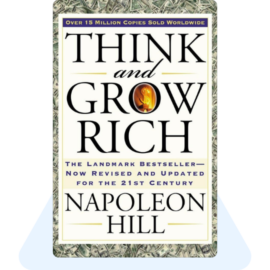
Introduction: Riches Begin With a State of Mind
What separates a wish from a goal and a goal from a result? Napoleon Hill’s classic book Think and Grow Rich argues that achievement begins long before money reaches your bank account. It begins in the mind with a definite desire, a clear plan, persistent action and the ability to keep moving when the first plan fails.
First published in 1937, Think and Grow Rich became one of the most influential books in personal development. The title sounds as if the book were only about financial wealth, but Hill uses the word “riches” in a broader sense. Riches may include meaningful work, confidence, leadership, creative freedom, strong relationships, peace of mind and the ability to direct your own life. Money is important in the book, yet it is treated as one result of disciplined thinking and organised effort rather than as a magical reward.
This Think and Grow Rich summary explains the book’s 13 principles in simple, practical language. It also connects Hill’s ideas with modern themes such as mindset, goal setting, meditation, spirituality, the law of attraction, coaching and personal responsibility. Readers Books Club presents books and book suggestions for people who want to learn, grow and apply powerful ideas in daily life. If you enjoy the videos, podcasts and book discussions by Readers Books Club and Amiett Kumar, this detailed guide will help you understand why Think and Grow Rich continues to attract readers across generations.
One important note: Think and Grow Rich is a motivational and philosophical book, not a scientific or financial manual. Some of Hill’s stories are historical anecdotes, and several claims should be read as principles for reflection rather than guaranteed formulas. The greatest value of the book comes from using its ideas to improve clarity, confidence, planning and action.
About the Book and Its Central Idea
Napoleon Hill developed the book around a simple proposition: thoughts become powerful when they are joined with purpose, emotion, planning and persistence. A passing thought has little effect. A definite thought, repeated and supported by action, begins to shape attention and behaviour. You notice opportunities connected to your goal, develop relevant skills, meet useful people and become more willing to take calculated risks.
This idea is sometimes linked with the law of attraction. However, Hill’s method is more active than merely imagining an outcome. His philosophy asks the reader to define a desire, create a plan, seek specialised knowledge, make decisions, build a supportive alliance and continue working through setbacks. In other words, the mind provides direction, but effort builds the road.
The book is organised around 13 principles. Each principle strengthens a different part of the success process. Desire gives direction. Faith gives emotional certainty. Autosuggestion influences repeated thought. Specialised knowledge builds competence. Imagination produces ideas. Organised planning converts ideas into steps. Decision prevents endless hesitation. Persistence carries the plan through difficulty. The mastermind brings collective intelligence. Sex transmutation redirects strong human energy. The subconscious mind stores emotional patterns. The brain represents communication and mental influence. The sixth sense represents intuition developed through experience and inner awareness.
Principle 1: Desire The Starting Point of All Achievement
Hill begins with desire because vague wishes rarely create focused action. Many people say they want more money, a better career or a successful business, but they have not decided what the result should look like. A definite desire is specific enough to guide daily choices.
Hill recommends naming the exact amount or goal, deciding what you will give in return, setting a date, creating a plan and writing a clear statement. Although modern readers may adapt the language, the structure remains useful. A goal becomes stronger when it includes a measurable result, a personal reason and a commitment to provide value.
For example, “I want to be wealthy” is unclear. A stronger version would be: “Over the next three years, I will build a profitable education business by creating useful courses, publishing consistent content and serving a defined audience.” This statement does not guarantee the result, but it gives the mind and the calendar a direction.
Readers Books Club takeaway: Do not begin with motivation; begin with definition. Write one important goal and answer three questions: What exactly do I want? Why does it matter? What value am I prepared to create in exchange?
Principle 2: Faith Believing Before the Evidence Is Complete
Faith in Think and Grow ‘Rich’ means confidence in a chosen purpose. It is not blind denial of difficulty. It is the ability to continue acting before the final evidence appears. Every meaningful project begins with uncertainty. A new business has no guaranteed customers. A new creator has no guaranteed audience. A student preparing for a competitive examination has no guaranteed result. Without some degree of faith, people stop before their efforts have time to compound.
Hill connects faith with repeated emotional thought. When a person repeatedly imagines a goal and speaks about it with conviction, the goal begins to feel more familiar and possible. This can influence posture, decisions and persistence. In modern language, faith supports self-efficacy, the belief that you can organise and execute the actions required for a task.
Affirmations may help when they are believable and connected with behaviour. Instead of repeating, “I am instantly rich”, a grounded affirmation might be: “I am becoming more disciplined, valuable and financially aware every day.” “I statement encourages identity change without demanding that you ignore present reality.
A short meditation practice can also strengthen faith by reducing mental noise. Sit quietly, breathe slowly and visualise yourself completing the next useful action, not only enjoying the final reward. Faith becomes practical when it helps you act with steadiness.
Principle 3: Autosuggestion Directing the Inner Conversation
Autosuggestion is Hill’s term for influencing the subconscious mind through repeated, emotionally charged statements. Whether or not one accepts every explanation in the book, the practical lesson is clear: repeated thoughts shape attention and self-talk.
A person who continually thinks, “I always fail,” may avoid opportunities, interpret neutral feedback as rejection and stop early. A person who repeatedly asks, “What can I learn and improve?” is more likely to search for options. The difference is not magic; it is the direction of attention.
Effective autosuggestion requires more than mechanical repetition. Read your goal statement slowly. Imagine what it would feel like to make progress. Connect the words with a real action. If your affirmation is about becoming a successful writer, write. If it is about financial growth, track your spending, learn a valuable skill or make an offer. Repetition without action becomes fantasy; repetition with action becomes conditioning.
Try this daily statement: “My purpose is clear. I am developing the knowledge, discipline and relationships required to achieve it. Today I will take one measurable step.”
Principle 4: Specialised Knowledge Learn What the Goal Requires
Hill distinguishes general knowledge from specialised knowledge. Knowing many interesting facts does not automatically create income or achievement. Knowledge becomes economically useful when it is organised and applied to a definite purpose.
This principle is especially relevant today. Information is everywhere, but attention and application are scarce. You can watch hundreds of videos, listen to podcasts and read many books without changing your results. Learning becomes valuable when it solves a problem, improves a skill or helps someone make a better decision.
Start by asking what your goal requires. A creator may need storytelling, video production, audience research and sales. A coach may need listening, programme design, communication and ethical marketing. An entrepreneur may need customer discovery, finance, operations and leadership. You do not need to master everything yourself; you can collaborate with people whose knowledge complements your own.
Readers Books Club encourages learning through book summaries and book suggestions, but a summary should be the beginning of study, not the end. Choose one idea, practise it and measure the outcome. Applied knowledge is more powerful than accumulated information.
Principle 5: Imagination The Workshop of the Mind
Imagination allows you to combine existing ideas into new solutions. Hill describes two forms: synthetic imagination, which rearranges known concepts, and creative imagination, which produces fresh insights. Most innovation uses both.
A business idea may come from combining a familiar service with a new audience. A YouTube format may combine education, storytelling and entertainment. A career opportunity may emerge when you connect two skills that are usually kept separate. Imagination does not require waiting for inspiration; it can be trained by asking better questions.
Try these prompts: How could this problem be solved more simply? What would make this experience ten times more useful? What can I combine that others keep separate? What would I attempt if the first version did not need to be perfect?
Visualisation is one practical use of imagination. See the desired outcome clearly, but also imagine the process: researching, practising, presenting, negotiating and recovering from mistakes. Process visualisation prepares you for reality. The most productive imagination creates a picture and then asks for a plan.
Principle 6: Organised Planning Turn Desire Into a Roadmap
A strong desire without a plan often becomes frustration. Hill’s sixth principle asks readers to organise action, work with capable people and replace plans that fail. He is direct about an important truth: a failed plan does not necessarily mean a failed goal.
Organised planning begins by breaking the objective into projects, milestones and daily actions. Suppose you want to build a coaching practice. The plan might include defining the audience, creating a pilot programme, speaking with potential clients, collecting feedback, improving the offer and publishing helpful content. Each step should have a date and an owner.
Planning also requires feedback. Many people become emotionally attached to their first idea. When the market, audience or situation responds differently, they see it as rejection. Hill recommends changing the plan while keeping the purpose alive. This is a key lesson in resilience.
A weekly review can make the principle practical. Ask: What moved forward? What created resistance? What did I learn? What should I stop, start or improve next week? A plan should guide action, not become a rigid document that prevents adaptation.
Principle 7: Decision Defeating Procrastination
According to Hill, successful people make decisions promptly and change them carefully, while unsuccessful people often delay decisions and change them frequently. The wording may be broad, but the central warning is valuable: indecision consumes energy.
People delay because they want certainty, approval or a perfect option. Yet many decisions become clear only after action produces information. Choosing a direction does not mean you can never adjust. It means you stop using endless analysis as protection from discomfort.
One way to improve decision-making is to separate reversible and irreversible choices. A small experiment, new content format or short course is usually reversible. You can test it quickly. A major financial commitment requires more research. Give each decision an appropriate deadline.
The decision also protects your goals from excessive opinion. Listen to qualified advice, but do not allow every casual comment to rewrite your purpose. A clear decision concentrates energy.
Principle 8: Persistence The Habit That Carries Desire Forward
Persistence is the bridge between intention and achievement. Most goals require more time, revision and repetition than expected. The early stage is especially difficult because effort is visible while results are small.
Hill identifies desire, self-reliance, organised plans, accurate knowledge, cooperation, willpower and habit as foundations of persistence. Modern readers can add emotional regulation and realistic rest. Persistence is not forcing yourself without limits. It is returning to the purpose after disappointment and adjusting intelligently.
When motivation falls, reduce the size of the action rather than abandoning the direction. Write one page. Make one call. Study for twenty minutes. Record one short video. Consistency keeps identity alive: “I am still a person who does this.”
Meditation can support persistence by helping you observe frustration without immediately obeying it. A few minutes of slow breathing can create enough space to choose the next step instead of reacting to temporary emotion.
Principle 9: The Master Mind Success Through Coordinated Support
Hill defines the Master Mind as the coordination of knowledge and effort between people working in harmony toward a definite purpose. No major achievement is created in complete isolation. Even a solo creator relies on audiences, mentors, editors, collaborators, technology and communities.
A strong Master Mind is not simply a social group. It has purpose, trust, complementary ability and accountability. The members challenge one another without destroying confidence. They share ideas, introductions and honest feedback.
You can create a small Master Mind with two to five people. Meet regularly and use a simple structure: progress since the last meeting, current obstacle, feedback requested and commitment before the next meeting. Protect confidentiality and avoid turning every conversation into a complaint.
Coaching can play a related role. A capable coach or life coach helps a person clarify goals, notice patterns and remain accountable. However, good coaching should strengthen independent judgement rather than create dependence.
Principle 10: Sex Transmutation Redirecting Powerful Energy
This is one of the most discussed and misunderstood chapters in the book. Hill uses “sex transmutation” to describe redirecting strong sexual and emotional energy into creativity, ambition, leadership and productive work. His language reflects the era in which the book was written and may feel unusual to modern readers.
The practical interpretation is that intense human drives can be channelled. Energy that would otherwise become distraction, obsession or impulsiveness can support art, enterprise, physical training or meaningful service. The goal is not repression; it is conscious direction.
People often perform at their best when they care deeply about something. Passion gives work emotional force. The challenge is to combine passion with discipline so that energy becomes a completed project rather than scattered excitement.
Spirituality and meditation may help with this principle by building awareness of impulses. When you can notice an urge without immediately acting on it, you gain the freedom to choose where your energy goes.
Principle 11: The Subconscious Mind Where Emotion and Repetition Meet
Hill presents the subconscious mind as a connecting link between conscious thought and behaviour. Contemporary psychology uses different models, but the everyday observation remains familiar: much of what we do is influenced by habits, emotional associations and learned expectations.
If a person consciously wants wealth but repeatedly associates money with guilt, danger or conflict, that belief may affect pricing, negotiation and opportunity. If someone wants visibility but expects criticism, they may keep delaying publication. These patterns are not always removed by positive statements alone.
Use journaling to identify the hidden story. Complete sentences such as “Successful people are…”, “Money always…”, “If I become visible, then…” and “People like me cannot…” Examine the answers with curiosity. Replace limiting beliefs with grounded alternatives and support them through new experiences.
Meditation allows thoughts to be observed rather than automatically accepted. This makes it easier to choose a more useful response. The subconscious mind is influenced not only by words but by repeated evidence. Keep promises to yourself, complete small tasks and let action teach your mind that change is possible.
Principle 12: The Brain A Network for Thought and Influence
Hill describes the brain using the language and scientific understanding available in his time. Some explanations in this chapter are speculative and should not be treated as modern neuroscience. Still, the practical idea is relevant: human minds influence one another through communication, emotion, attention and environment.
Spend time with fearful, cynical conversation, and your thinking may become narrower. Spend time with thoughtful, ambitious and ethical people, and you are exposed to different standards and possibilities. Books, podcasts and educational videos also form part of the mental environment.
Choose your inputs deliberately. This does not mean avoiding all negative information or disagreement. It means protecting attention from constant noise. Ask whether a piece of content informs action, expands understanding or merely creates agitation.
Readers Books Club is built around the idea that books can upgrade the quality of thought. A strong reading habit places you in conversation with authors, researchers, leaders and thinkers you may never meet. The mind grows through the quality of questions it repeatedly encounters.
Principle 13: The Sixth Sense Developing Informed Intuition
Hill’s final principle is the sixth sense, which he describes as a form of creative intuition. Readers may interpret this spiritually, psychologically or as the result of accumulated experience. In practical terms, intuition often appears when the mind recognises patterns before it can explain them fully.
Intuition is most useful when combined with knowledge and reality testing. An experienced professional may sense that a deal is wrong because subtle details do not match previous successful patterns. A creator may feel that an idea will connect because years of audience feedback have trained judgement.
Silence, meditation and reflection can make intuition easier to hear because they reduce constant mental stimulation. However, not every fear or impulse is intuition. Test inner guidance against evidence, values and consequences.
Hill places the sixth sense last because it cannot be forced at the beginning. It develops as desire, faith, knowledge, planning, decision and persistence become integrated.
The Six Ghosts of Fear
Near the end of the book, Hill discusses six common fears: poverty, criticism, ill health, loss of love, old age and death. Fear matters because it can quietly control decisions. A person may call it “being practical” while avoiding every uncertain opportunity. Another may seek endless approval because criticism feels unbearable.
The solution is not pretending fear does not exist. Name it, investigate it and choose action proportionate to the real risk. Financial fear may require savings, budgeting and skill development. Fear of criticism may require publishing small pieces and learning to tolerate feedback. Fear becomes more manageable when it is converted into a plan.
A useful question is: “What would I do next if I respected this fear but did not allow it to lead?” This approach combines courage with responsibility.
How Think and Grow Rich Connects With the Law of Attraction
Think and Grow Rich is often grouped with law of attraction books because it emphasises thought, belief, emotion and visualisation. The connection is understandable, but Hill’s full system includes far more than attraction. It requires specialised knowledge, organised planning, decision-making, persistence and cooperation.
A balanced reading is, therefore, your dominant thoughts influence what you notice, how you feel and how you act; those actions affect the results you create. Visualisation may prepare the mind, but it should lead to a phone call, proposal, practice session, financial plan or courageous conversation.
Spirituality can give purpose to ambition. Instead of asking only, “How can I receive more?” ask, “What value can I create? Whom can I serve? What kind of person must I become to hold this success responsibly?” Wealth without character can create new problems. Hill’s best ideas become stronger when joined with ethics, contribution and self-awareness.
A 30-Day Think and Grow Rich Action Plan
Days 1–3: Choose one definite goal. Write the result, deadline, reason and value you will provide.
Days 4–6: Create a grounded affirmation and read it morning and evening. Visualise one process action.
Days 7–10: List the specialised knowledge required. Select one book, course, mentor or practice plan.
Days 11–14: Build an organised plan with weekly milestones and one daily priority.
Days 15–17: Make one decision you have been postponing. Set a deadline and act.
Days 18–21: Identify the most likely point at which you usually quit. Design a smaller action for difficult days.
Days 22–24: Create or strengthen a mastermind. Ask for specific feedback, not general encouragement.
Days 25–27: Review your subconscious beliefs about money, success and visibility. Write healthier bridge beliefs.
Days 28–30: Review evidence. What improved? What failed? What did you learn? Update the plan and begin the next 30-day cycle.
The purpose of this plan is not to become rich in 30 days. It is to build the thinking and behaviour that make long-term achievement more likely.
Key Lessons From Think and Grow Rich
Clarity is more powerful than a vague wish. A definite goal directs attention and effort.
Belief grows through repeated thought, emotional connection and evidence created by action.
Knowledge becomes valuable when it is specialised, organised and applied.
Imagination creates options, but planning converts options into progress.
Decision protects energy from endless hesitation.
Persistence does not mean repeating a failed method forever; it means adapting without abandoning the purpose too quickly.
Supportive relationships multiply intelligence, courage and opportunity.
Fear should be examined and planned for, not allowed to make every decision.
Thought is the beginning of achievement, not the entire process.
Frequently Asked Questions
What is the main message of Think and Grow Rich?
The main message is that a definite purpose, supported by belief, specialised knowledge, planning, decision and persistence, can greatly improve a person’s ability to achieve wealth and success.
What are the 13 principles of Think and Grow Rich?
The 13 principles are desire, faith, autosuggestion, specialised knowledge, imagination, organised planning, decision, persistence, the master mind, sex transmutation, the subconscious mind, the brain and the sixth sense.
Is Think and Grow Rich only about money?
No. Although the title focuses on riches, many principles apply to careers, entrepreneurship, leadership, creative work, relationships and personal growth.
Does Think and Grow Rich teach the law of attraction?
It shares themes with the law of attraction, including focused thought, belief and visualisation. However, the book also strongly emphasises planning, knowledge, cooperation and persistent action.
How can beginners apply the book?
Begin with one clear goal. Write it down, identify the skills required, create a weekly plan and take one measurable action every day. Review the plan rather than relying only on motivation.
Can meditation help with the principles in the book?
Meditation can support focus, emotional regulation and self-awareness. It may help readers notice fear, clarify intention and visualise useful actions, but it does not replace practical effort.
Final Summary
Think and Grow Rich remains influential because it gives ambition a structure. It tells the reader to stop treating success as a lucky event and begin treating it as a deliberate process. Define the desire. Strengthen belief. Train the inner conversation. Learn what the goal requires. Use imagination. Create a plan. Decide. Persist. Build the right relationships. Direct your energy. Understand your inner patterns. Protect your mental environment. Develop informed intuition.
The book’s language and some of its explanations belong to another era, so it should be read thoughtfully rather than accepted uncritically. Yet its central discipline remains useful: a clear purpose repeatedly supported by learning and action can change the direction of a life.
For readers exploring books on money mindset, personal development, spirituality, meditation, coaching, the law of attraction and success, Think and Grow Rich offers a powerful foundation. Read it not as a promise that thought alone creates wealth but as an invitation to become more intentional about what you think, learn, decide and repeatedly do.
Readers Books Club helps make important books easier to understand through engaging summaries, videos, podcasts and practical discussions. Explore more book suggestions and personal-growth lessons from Readers Books Club and Amiett Kumar, and choose one idea from this summary to apply today. Knowledge becomes transformation only when it enters your behaviour.
| Continue Your Reading JourneyExplore more practical book summaries, book suggestions, podcasts and personal-growth videos from Readers Books Club and Amiett Kumar. |
Contents