15 Lessons to Build a Richer Life
Introduction: What If Your Definition of Wealth Is Incomplete?
Imagine two people.
The first earns an extraordinary income. The calendar is full, the phone never stops, and the bank balance is impressive. Yet dinner with family is regularly interrupted by work. Sleep is inconsistent. Exercise happens only when there is time left over. Old friendships are reduced to birthday messages. The person has more money than ever but almost no freedom over the day.
The second person may earn less but has enough. There is control over the schedule, time to exercise, strong relationships, meaningful work, room to think, and financial systems that create security rather than constant fear. This person does not have everything, yet life feels abundant.
Who is wealthier?
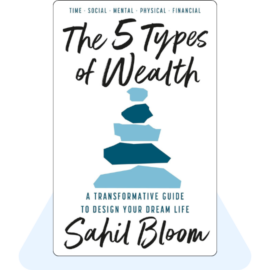
That question sits at the heart of Sahil Bloom’s The 5 Types of Wealth. The book challenges one of the most deeply embedded assumptions in modern life: that wealth is mainly financial. Income, net worth, salary, valuation, property, and status are easy to measure, so they become the default scoreboard. But Bloom argues that when money becomes the only scoreboard, we can win financially while quietly losing in the areas that make the victory worth having.
His alternative is simple enough to remember and broad enough to change how you think about success. A truly wealthy life contains five forms of wealth: time wealth, social wealth, mental wealth, physical wealth, and financial wealth.
Time wealth is freedom over how you spend your hours. Social wealth is the depth and breadth of your relationships. Mental Wealth includes purpose, growth, curiosity, and space to think. Physical Wealth is health, vitality, energy, and the capacity to participate fully in life. Financial Wealth is money, security, independence, and, importantly, an understanding of what “enough” means for you.
At Readers Books Club, books are most useful when they move from information to implementation. A good summary should not merely tell you what Sahil Bloom wrote. It should help you look at your own calendar, friendships, thoughts, body, and bank account differently by the time you reach the end.
This summary therefore turns the five types of wealth into 15 practical lessons. Each lesson asks not only “What does the book mean?” but also “What can I do with this idea?” Along the way, we will connect Bloom’s framework with meditation, spirituality, Law of Attraction, coaching, life coaching, money mindset, self mastery, and the wider personal-growth ecosystem familiar to Readers Books Club audiences and followers of Amiett Kumar.
That idea can change the way you make decisions. A higher salary may be a great move if it expands your opportunities without destroying your health. A lower-paying role may be a great move if it gives you more freedom and meaning. A luxury purchase may be worth it if it creates lasting joy, while an expensive status purchase may leave you feeling emptier. A busy week can be productive; a busy decade can become a life you never consciously chose.
The central challenge is to reject the default path and live by design.
Before continuing, ask yourself five questions:
1. How much control do I have over my time?
2. Are my relationships deep, supportive, and alive?
3. Do I have purpose, curiosity, and space to think?
4. Does my body give me energy for the life I want?
5. Does my money create security and freedom, or only more comparison?
Your answers are a first approximation of your real net worth.
The Five Types of Wealth: A New Scoreboard for Life
Bloom’s framework is powerful because it changes measurement. We naturally optimize what we measure. If success is measured only through salary, promotions, revenue, or net worth, those numbers begin to direct behaviour. We accept meetings that steal family time, postpone exercise, sacrifice sleep, and tell ourselves that relationships can be repaired later. The financial number goes up while invisible forms of wealth decline.
The five-wealth model makes the invisible visible.
Time Wealth asks whether you control your time or whether other people and systems control it for you.
Social Wealth asks whether you have people to celebrate with, struggle with, learn from, and love.
Mental Wealth asks whether you feel purposeful, curious, spacious, and mentally alive.
Physical Wealth asks whether your health and energy allow you to participate in your ambitions and relationships.
Financial Wealth asks whether money supports your life, protects you from avoidable stress, and creates optionality.
Bloom has also published a “Wealth Score” concept that invites people to assess themselves across all five categories rather than relying on a purely financial measure. The deeper lesson is not the number itself. The lesson is that awareness changes behaviour. Once you can see that your Social Wealth is deteriorating or your Time Wealth is nearly empty, the trade-off becomes harder to ignore.
The next 15 lessons turn that scoreboard into action.
Time Wealth: Freedom Is the Real Luxury
Lesson 1: Treat Time as Your Most Irreplaceable Asset
Money can be lost and earned again. Time only moves in one direction.
This sounds obvious, yet most people behave as if the opposite were true. We guard small amounts of money carefully while giving away hours to low-value meetings, unnecessary scrolling, obligations we never questioned, and tasks that could have been deleted, delegated, automated, or simply ignored.
Time Wealth begins with accepting scarcity. Your life is finite. That is not meant to create panic. It is meant to create clarity.
If you knew that you had only a limited number of dinners left with your parents, weekends while your children are young, summers with your closest friends, or physically energetic years in which you can travel easily, those moments would feel different. Their value rises when you stop treating them as infinitely renewable.
Bloom’s work repeatedly pushes readers to notice the passage of time and act accordingly. A wealthy calendar is not necessarily an empty calendar. It is a calendar in which the important things are present on purpose.
This creates a practical rule: do not only budget money; budget life.
Look at the next seven days. Where are your hours going? Separate activities into four categories: necessary, meaningful, growth-producing, and low-value. You may discover that you are saying “I don’t have time” for reading, meditation, exercise, or relationships while spending several hours on content you barely remember.
The lesson is not to become hyper-productive. Time Wealth is not about squeezing more output from every minute. It is about increasing ownership.
A person can be highly productive and still time-poor if every hour belongs to someone else’s agenda. Another person may work intensely but remain time-wealthy because the work is chosen, bounded, and connected to a personally meaningful goal.
Lesson 2: Protect Attention, Not Just Hours
You can have two free hours and still have no usable time.
Why? Because time without attention is fragmented wealth.
A person sits down to work, read, meditate, or have a conversation. The phone lights up. A notification creates a quick response. Then there is another tab, another message, another impulse. The two hours technically existed, but the mind never settled deeply enough to use them.
This is why Time Wealth and Mental Wealth overlap. Your schedule can be free while your attention remains occupied.
A practical interpretation of Bloom’s framework is to treat attention as the spending power of time. If time is the currency, attention determines what you can actually buy with it.
Create protected blocks for high-value activities. During those blocks, remove the phone, close unnecessary tabs, and define one purpose. A thirty-minute focused conversation with a family member may create more Social Wealth than three hours in the same room while everyone scrolls. Forty-five minutes of focused reading may create more Mental Wealth than an entire evening of fragmented information consumption.
This principle also explains why meditation fits naturally into a five-wealth life. Meditation does not manufacture more hours, but it can train awareness of where attention is going. You notice the urge to react. You notice the thought asking you to check something. You notice restlessness without automatically obeying it. That pause is a form of ownership.
Time Wealth grows when your attention stops leaking everywhere.
Lesson 3: Balance Life by Seasons, Not by Perfect Days
One of the most relieving ideas associated with Bloom’s framework is that life balance does not need to look perfect every day.
The fantasy of daily balance is exhausting. You imagine that every twenty-four hours should contain excellent work, deep family time, meaningful friendships, exercise, nutritious meals, reading, meditation, financial planning, eight hours of sleep, and perhaps a hobby. When real life fails to match the fantasy, you assume you are doing something wrong.
Bloom’s “dimmer switch” mentality offers a better model. Different areas of life can be turned up or down depending on the season, but important areas should not remain fully switched off.
During an exam month, mental wealth and career-related effort may be turned up. Social life may temporarily be quieter, but one weekly call with a close friend keeps the relationship alive. During a new baby’s first months, family and physical wealth may demand most of the available energy. Financial optimization can continue at maintenance level through automated systems. During a business launch, work intensity may rise, but sleep and movement should not fall to zero.
This is more realistic than equal allocation.
The practical question is: What season am I in, and what must not be allowed to disappear?
Write down the five types of wealth. Give each one a “dimmer setting” from 1 to 10 for the next ninety days. Choose one or two areas to emphasize. Then define a minimum viable investment for every other area.
This approach reduces guilt because you are no longer demanding everything at full intensity. It also protects you from the dangerous phrase “I will come back to this later.” Years can disappear inside “later.”
A wealthy life is not balanced like a photograph. It is balanced like a moving body: constantly adjusting while staying upright.
Social Wealth: Relationships Are a Form of Capital
Lesson 4: Measure Success by the People You Can Call
Imagine receiving wonderful news. Who are the first three people you want to tell?
Now imagine receiving terrible news. Who are the first three people you would call?
Those names reveal part of your social wealth.
Modern success culture encourages visible metrics: followers, connections, audience size, professional network, likes, invitations, and contacts. But Bloom’s model distinguishes breadth from depth. A large network may create opportunities, while a few deep relationships create belonging, trust, support, and identity. Both can matter, but they are not the same thing.
A rich social life is not about knowing everyone. It is about not becoming emotionally alone while appearing socially connected.
Social Wealth compounds through small deposits: checking in, remembering details, showing up, listening, helping, celebrating, apologizing, forgiving, and creating shared memories.
The challenge is that these actions often feel non-urgent. A work email has a deadline. A friendship rarely does. That makes relationships easy to postpone.
Try creating a relationship list with three circles. Circle one contains your inner five: the people you most want to keep close. Circle two contains the wider group of meaningful friends, mentors, relatives, or colleagues. Circle three contains new relationships worth developing.
Each week, make one deliberate investment in every circle.
This is not networking as transaction. It is relationship stewardship.
For Readers Books Club, books can become a social tool. Send someone a summary that reminded you of them. Start a small reading group. Discuss one idea at dinner. Recommend a book with a handwritten note. Ideas deepen when they become conversations.
A bank account protects you from some kinds of crisis. A relationship account protects you from others.
Lesson 5: Your Environment Quietly Shapes Your Standards
The people around you influence what feels normal.
If everyone in your environment complains constantly, complaint becomes normal. If your close circle exercises, reads, creates, saves, keeps promises, and encourages ambitious thinking, those behaviours begin to feel more normal too.
This is not mystical energy transfer. It is social influence, expectation, modelling, and reinforcement.
Bloom has written about how supportive environments can affect confidence and outcomes. The larger lesson is to curate proximity carefully. You do not need to abandon people who are struggling or turn relationships into performance filters. But you should notice whether your environment consistently expands or shrinks your sense of possibility.
Ask three questions about the people you spend the most time with:
1. What behaviours become easier around them?
2. What behaviours become harder?
3. Who do I become after spending time with them?
The final question matters most.
Social Wealth is not simply the amount of company you have. Some relationships are emotionally expensive. They demand constant performance, comparison, gossip, or conflict. Other relationships produce energy, honesty, courage, laughter, and perspective.
A strong environment also includes people who challenge you. Support does not mean permanent agreement. The best friends, mentors, and coaches may tell you when your story is weak, your priorities are confused, or your behaviour is contradicting your values.
In Law of Attraction language, people sometimes say, “Protect your energy.” A grounded interpretation is simple: protect the environments that shape your attention, expectations, and behaviour.
Your circle does not determine your destiny, but it influences your defaults.
Lesson 6: Be Present Enough to Create Memories
Social Wealth is built in moments that can easily look unproductive.
A long meal. A walk with a friend. Sitting beside a parent without an agenda. Playing with a child. Travelling with siblings. A conversation that does not produce a measurable output.
The productivity mind can undervalue these moments because they do not create obvious economic returns. Yet later in life, they often become the moments people value most.
Presence is what converts shared time into shared life.
You can spend an entire weekend with someone while giving them only fragments of attention. The body is there; the mind is elsewhere. Messages, feeds, work concerns, and mental planning constantly interrupt the experience. Social Wealth requires more than proximity.
Try a simple ritual: create device-free zones around one meal, one walk, or one hour each day. During that time, resist the urge to document everything. Ask better questions. Listen past the first answer.
This idea also connects to meditation. Mindfulness is often taught as present-moment awareness. The most meaningful test of that practice may not be whether you can follow your breath for ten minutes, but whether you can listen to another person without preparing your reply.
Spirituality, at its best, should make relationships more human not turn inward practice into another form of self-absorption.
A wealthy life includes people who felt loved while you were with them.
Mental Wealth: Purpose, Growth, and Space
Lesson 7: Purpose Is Built Through Engagement, Not Found Like Treasure
People often imagine purpose as a hidden object: somewhere in the world there is one perfect calling, and your job is to discover it.
That belief can create paralysis. If every career choice is treated as a test of “my true purpose,” ordinary exploration feels dangerous.
Mental Wealth offers a more useful approach. Purpose can grow through engagement. You try things, develop skills, solve problems, notice what gives energy, observe where you are useful, and allow meaning to evolve.
Bloom describes Mental Wealth in terms that include purpose, growth, and space. Purpose does not have to mean becoming famous or building a global mission. It can be raising a family well, mastering a craft, teaching, serving, building a company, caring for people, creating art, learning, or contributing to a community.
The key is connection between action and meaning.
Ask yourself:
- What work makes me lose track of time?
- What problems do people naturally ask me to help solve?
- What kind of effort leaves me tired but satisfied?
- What would I continue learning about even if nobody applauded?
- Which part of my current life feels most meaningful, and why?
Patterns will appear.
The Law of Attraction often speaks about clarity of desire. A grounded version is equally valuable: when you know what matters, you notice opportunities, make different trade-offs, and persist longer in aligned directions.
You do not need a perfect life mission before beginning. Begin where curiosity, usefulness, skill, and meaning overlap. Let purpose become the result of movement.
Lesson 8: Create Space Before You Ask for Better Thinking
Mental Wealth requires empty space.
This is difficult in a culture that rewards constant input. Podcasts while walking. Messages while eating. News before sleep. Videos during breaks. Music during work. Feeds during queues. Even relaxation becomes content consumption.
But insight often appears when inputs stop.
Bloom has written about a “Think Day,” a scheduled period for reading, reflection, questioning assumptions, and stepping away from ordinary communication. The concept reflects a broader truth: if every mental surface is covered with incoming information, there is little room to integrate what you already know.
A Think Day does not require a cabin in the forest. Start with two hours.
Turn off notifications. Bring a notebook. Review your calendar, goals, relationships, health, and financial decisions. Ask questions you normally avoid because the day is too noisy.
Journaling works well here because writing slows thought enough to make patterns visible.
Meditation serves a related purpose. It creates a structured gap between stimulus and response. You do not need to force the mind blank. You notice what arises when you stop feeding it new material.
For spirituality, silence has always mattered. Across traditions, periods of prayer, contemplation, retreat, and solitude create space for values to become louder than social noise.
Mental Wealth is not just having more knowledge. It is having enough space to know what the knowledge means for your life.
Lesson 9: Stay Curious Enough to Update Your Identity
Growth requires the ability to change your mind.
This is harder than it sounds because beliefs often become identities. Once you call yourself a certain kind of person bad with money, not athletic, introverted, unlucky, not creative, too old to learn, incapable of leadership new evidence can feel threatening.
Bloom has described treating new information like “software updates” for the brain. The metaphor is useful. A mind that never updates eventually operates on an outdated model of reality.
Mental Wealth therefore includes intellectual humility: the willingness to ask, “What if I am wrong?”
This does not mean changing opinions constantly or becoming easily influenced. It means staying loyal to truth rather than ego.
Create an “update list.” Write three beliefs you hold strongly about yourself, work, money, relationships, or success. For each one, ask: What evidence would make me revise this belief?
If the answer is “nothing,” you are not holding a belief; you are protecting an identity.
This connects powerfully with personal growth books. The purpose of reading is not to collect quotes that confirm what you already think. The highest-value books often irritate you because they challenge a model you have been using unconsciously.
The same is true in coaching. A good life coach does not simply motivate you. They ask questions that expose the gap between your current story and observable behaviour.
Physical Wealth: Health Makes Every Other Wealth More Usable
Lesson 10: Protect Energy Before You Optimize Output
A person can have money, relationships, knowledge, and freedom but if the body cannot participate, the experience of wealth changes dramatically.
Physical Wealth is the capacity to live your life with energy.
This is why health should not be treated as the hobby you fit around “real work.” Health is infrastructure. It supports attention, mood, relationships, ambition, creativity, and the ability to enjoy financial freedom once you achieve it.
The productivity world often asks, “How can I get more done?” Physical Wealth asks an earlier question: “What gives me the energy to do anything well?”
Start with foundations rather than optimization hacks: adequate sleep, regular movement, strength, cardiovascular fitness, nutritious food patterns, recovery, medical care when needed, and stress management.
Do not turn wellness into another perfection contest. The person who walks daily and sleeps consistently may build more Physical Wealth than someone who follows an extreme routine for three weeks and abandons it.
Use the minimum-effective-dose principle. Choose one habit that is almost too easy to fail:
- ten minutes of walking after lunch,
- a consistent bedtime window,
- two strength sessions each week,
- protein and vegetables at one meal,
- sunlight and movement after waking.
Once stable, add more.
This section also requires an important distinction. Meditation can support well-being and stress management for many people, but it does not replace medical care, sleep, nutrition, exercise, or mental-health treatment. Spirituality can deepen meaning, but the body still needs practical care.
Physical Wealth is not about looking impressive. It is about having enough health and vitality to say yes to your life.
Lesson 11: Build Health Systems That Survive Busy Seasons
The true test of a health routine is not whether it works during a perfect week. It is whether some version survives a difficult one.
Busy seasons expose fragile systems. Travel, deadlines, family responsibilities, illness, celebrations, and unexpected problems disrupt ideal routines. If health depends on ninety uninterrupted minutes at the gym, a perfectly prepared kitchen, and zero schedule changes, it may disappear when life gets real.
This is where the dimmer-switch mentality becomes practical again.
Create a “full version” and a “maintenance version” of your Physical Wealth routine.
Full version:
- four workouts,
- meal preparation,
- eight hours in bed,
- long walks,
- structured recovery.
Maintenance version:
- twenty minutes of movement,
- one simple nutritious meal choice,
- protect bedtime from unnecessary scrolling,
- take stairs or walk during calls,
- five minutes of breathing before sleep.
Maintenance is not failure. It is continuity.
Anything above zero can compound. The danger is the all-or-nothing mindset that says, “If I cannot do the full routine, there is no point.”
This lesson applies beyond fitness. Reading five pages keeps Mental Wealth alive. Sending one meaningful message keeps Social Wealth alive. Saving a small automatic amount keeps Financial Wealth alive. A ten-minute quiet walk protects Time and Mental Wealth.
The richest systems are designed for imperfect humans living imperfect weeks.
Lesson 12: Use Your Body to Expand the Life You Can Experience
Physical Wealth is not only about preventing disease. It expands possibility.
A strong, mobile, energetic body increases the range of experiences available to you. You can travel more comfortably, play with children, hike with friends, explore cities, recover from demanding days, and remain independent longer.
This turns exercise from punishment into capacity-building.
Instead of asking, “How many calories did I burn?” ask, “What kind of life am I training for?”
If you want to trek in the mountains, your routine should build endurance and leg strength. If you want to play with grandchildren decades from now, strength and mobility matter. If you want focused work, sleep and aerobic health affect cognition and energy. If you want emotional resilience, regular movement can be one supportive component of a broader well-being plan.
This future-oriented view also connects with visualization. Imagine yourself ten or twenty years from now doing something you deeply value. What physical capacities does that future require? Train those capacities now.
In manifestation language, this is aligned action. You are not only visualising the future; you are preparing the body that must live inside it.
Financial Wealth: Money Is a Tool, Not the Entire Scoreboard
Lesson 13: Define “Enough” Before More Becomes Infinite
One of the most important financial questions is not “How much can I earn?” It is “What is enough for the life I actually want?”
Without an answer, the target moves forever.
A salary goal becomes a larger salary goal. A net-worth target becomes the next target. Lifestyle expands, comparison resets expectations, and financial success never produces the feeling of arrival it was supposed to create.
Bloom describes Financial Wealth as money plus an awareness of enough. That second part changes everything.
Enough does not mean a lack of ambition. It means defining the role money is meant to play.
Start with a “wealthy life budget,” not only an expense budget. Write the life you want in concrete terms: housing, education, travel, health, family support, generosity, time freedom, hobbies, security, and experiences. Estimate what that life reasonably costs. Then separate genuine desires from status competition.
Money is useful when it protects and enables your priorities. More money is not automatically better if earning it destroys the priorities it is supposed to support.
This connects with money mindset and Law of Attraction conversations common among Readers Books Club audiences. Abundance should not mean endless consumption or pretending constraints do not exist. A healthier abundance mindset combines openness to opportunity with gratitude, financial competence, saving, investing, earning capacity, generosity, and a clear sense of enough.
The question “What is enough?” may be one of the most spiritually important financial questions because it separates desire from comparison.
Lesson 14: Build Financial Wealth Through Boring, Repeatable Systems
Financial freedom is rarely created by one brilliant decision. It is more often built through repeated behaviour.
Bloom’s published framework for Financial Wealth emphasizes three pillars: income generation, expense management, and long-term investment. The simplicity is the point.
Increase your capacity to earn. Keep expenses below income. Invest the difference efficiently for the long term.
None of these ideas is glamorous, but their compounding effect can be enormous.
Start by knowing four numbers:
1. monthly take-home income,
2. essential monthly expenses,
3. savings/investment rate,
4. emergency reserves.
If you do not know those numbers, Financial Wealth remains a feeling instead of a system.
Then automate what you can. Automatic transfers reduce the number of decisions required. Build emergency savings. Avoid high-cost debt where possible. Learn basic investing. Keep lifestyle inflation slower than income growth. Protect yourself with appropriate insurance. Develop skills that increase earning power.
The details vary by country and individual circumstances, so personal financial advice may require a qualified professional. The principle remains universal: systems beat financial intention.
For readers interested in manifestation, this is where inner work must meet outer structure. An affirmation such as “I manage money wisely and calmly” becomes meaningful when you open the statement, create the budget, automate the investment, and make the difficult decision.
Belief can support behaviour. Behaviour builds evidence.
Lesson 15: Use Money to Buy Back the Other Four Types of Wealth
The highest use of Financial Wealth may be its ability to strengthen the other four.
Money can buy time by allowing you to outsource low-value tasks, reduce working hours, take parental leave, retire earlier, or create a financial runway for meaningful work.
Money can support Social Wealth by making visits, shared experiences, celebrations, travel, and generosity possible.
Money can support Mental Wealth through education, books, courses, retreats, therapy, coaching, creative space, or time away from survival-mode work.
Money can support Physical Wealth through nutritious food, healthcare, safer environments, fitness resources, and recovery.
This is a much more useful goal than money for status alone.
Bloom has written that some of the best uses of money create time, experiences, purpose, or health. That is a powerful filter for spending.
Before a meaningful purchase, ask:
- Does this create time?
- Does it deepen an experience or relationship?
- Does it support purpose or growth?
- Does it protect health?
- Does it increase long-term freedom?
Not every purchase needs to meet one of these standards. Fun matters. Beauty matters. Pleasure matters. But the filter reveals the difference between spending that enriches life and spending that mainly signals success to other people.
The paradox is that Financial Wealth becomes more satisfying when it stops being the only objective.
How the Five Types Work Together
The five types of wealth are not separate accounts. They constantly affect one another.
A demanding job may increase Financial Wealth while reducing Time and Physical Wealth. A strong exercise routine may improve Physical Wealth, which improves Mental Wealth through greater energy and concentration. Deep friendships create Social Wealth and often strengthen Mental and Physical well-being. Financial reserves can create Time Wealth by giving you the freedom to leave a harmful job. Meditation may support Mental Wealth and improve the quality of attention you bring to relationships.
This is why decisions should be evaluated across the full scoreboard.
Before a major decision, create a simple five-column table. Rate the likely effect on Time, Social, Mental, Physical, and Financial Wealth from -2 to +2.
Suppose you are considering a promotion.
- Financial: +2
- Mental growth: +1
- Time: -2
- Physical: -1
- Social: -1
The promotion may still be the right decision, but now the trade-off is visible. You can ask what protections would reduce the cost: negotiate flexibility, set boundaries, schedule exercise, or limit the intense season to twelve months.
This is what life design looks like in practice. You stop pretending choices are one-dimensional.
The Readers Books Club 5-Wealth Audit
Use the following exercise once every quarter.
Step 1: Score Each Wealth from 1 to 10
Time Wealth: How much control do you have over your schedule and attention?
Social Wealth: How strong, honest, and nourishing are your key relationships?
Mental Wealth: How much purpose, curiosity, growth, and thinking space do you experience?
Physical Wealth: How strong are your health, vitality, energy, sleep, and movement habits?
Financial Wealth: How secure, intentional, and freedom-producing is your financial life?
Do not overthink the score. Your first instinct is enough.
Step 2: Identify the Lowest Score
Do not immediately choose your favourite category to improve. Start with the weakest area, especially if it threatens the others.
Step 3: Choose One High-Leverage Action
Examples:
- Time: remove one recurring low-value commitment.
- Social: schedule a weekly family meal.
- Mental: create a two-hour Think Block.
- Physical: walk thirty minutes daily.
- Financial: automate a monthly investment.
Step 4: Define a Maintenance Minimum for the Other Four
This prevents a growth sprint in one area from destroying the rest.
Step 5: Review After 30 Days
What improved? What was unrealistic? What became easier? What did you learn about your definition of wealth?
| Key IdeaThe goal is not a perfect 10/10 in every category. The goal is intentional movement. |
A 7-Day “Build a Richer Life” Challenge
Day 1: Time Wealth – Reclaim One Hour
Audit tomorrow’s schedule and remove, shorten, delegate, or batch enough low-value activity to reclaim sixty minutes. Spend the hour on something you say matters but rarely schedule.
Day 2: Social Wealth – Make One Real Connection
Call someone instead of liking their post. Ask a meaningful question. Listen without multitasking.
Day 3: Mental Wealth – Create Silence
Spend thirty minutes without content. No podcast, music, feed, or messaging. Walk, journal, meditate, or think.
Day 4: Physical Wealth – Move With Purpose
Complete thirty minutes of movement appropriate for your current health and ability. Treat it as an investment in future capacity, not punishment.
Day 5: Financial Wealth – Know Your Numbers
Calculate monthly income, essential expenses, savings/investments, and emergency reserves. Awareness is the first form of financial control.
Day 6: Integration – Spend Money to Create Another Wealth
Use a small amount of money intentionally to create Time, Social, Mental, or Physical Wealth: buy a book, share a meal, pay for a useful service, or invest in health.
Day 7: Design Your Next Season
Choose the one wealth category to turn up for the next ninety days and define a minimum habit for the other four.
Meditation, Spirituality, and the Five Types of Wealth
Meditation and spirituality are not central categories in Bloom’s five-part model, but they can support the framework when used responsibly.
Meditation can strengthen awareness of how attention is spent, which supports Time Wealth. It can create mental space, which supports Mental Wealth. Practised with compassion, it may improve the quality of listening and presence in relationships, supporting Social Wealth. It may also be part of a broader stress-management routine that sits alongside sleep, movement, healthcare, and other elements of Physical Wealth.
Spirituality can contribute to the question of “enough.” Many spiritual traditions ask whether endless acquisition can ever satisfy a mind trained to compare. They emphasize gratitude, service, presence, generosity, and meaning ideas that fit naturally with a definition of wealth broader than money.
The 5 Types of Wealth and the Law of Attraction: A Grounded Connection
The Law of Attraction is often discussed through attention, belief, visualization, emotional alignment, and action. Bloom’s framework can make that conversation more concrete.
Instead of visualising “wealth” as an abstract pile of money, define the life you actually want to experience. What does Time Wealth look like? Who is present in your Social Wealth? What work creates mental wealth? What kind of health supports your Physical Wealth? How much Financial Wealth is enough to make the whole design sustainable?
Visualization becomes more useful when the image is specific enough to guide behaviour.
If you visualize a wealthy life but schedule no time for health, ignore relationships, and spend beyond your means to look successful, your daily actions contradict the vision.
A grounded affirmation might be:
“I am building a wealthy life across my time, relationships, mind, body, and finances.”
Then create evidence:
- protect one hour,
- call one person,
- read ten pages,
- move your body,
- save or invest a fixed amount.
That is where manifestation becomes behaviourally useful. The inner picture helps define direction; repeated action builds the life.
How Amiett Kumar’s Audience Can Apply the Framework
Readers Books Club audiences often explore books alongside the work of Amiett Kumar in manifestation, meditation, mindset, spirituality, coaching, and personal development. The 5 Types of Wealth provides a useful bridge between inner transformation and external life design.
If you practise affirmation, use it to reinforce identity and action across all five wealth categories rather than focusing only on money. If you practise visualization, picture how a wealthy ordinary Tuesday actually looks: what time you wake, who you speak to, how you work, how your body feels, how you spend, and how much space exists in the day. If you practise meditation, use the awareness it creates to notice whether your real behaviour matches your stated values.
A manifestation coach or life coach can also use the five-wealth framework as a diagnostic conversation. A client may say “I want more money,” but deeper questions may reveal that the desired outcome is actually freedom, safety, respect, family time, or purpose. Clarifying the true desired wealth can change the strategy completely.
The framework is most powerful when it stops you from chasing a proxy. Sometimes you do need more money. Sometimes you need to repair a relationship, create space, protect your health, or redesign your calendar.
Common Mistakes When Building the Five Types of Wealth
Mistake 1: Turning the Framework Into Another Perfection Score
| Key IdeaThe point is not to achieve 10/10 everywhere. That would recreate the same optimization anxiety the framework is meant to reduce. |
Mistake 2: Treating Money as the Enemy
Financial Wealth matters. Lack of money can create real stress and restrict choices. The goal is integration, not rejection.
Mistake 3: Confusing Busyness With Time Wealth
A packed calendar can contain meaningful chosen work. An empty calendar can still be filled with distraction. The real metric is ownership.
Mistake 4: Counting Contacts Instead of Relationships
Followers and networking can create breadth. Social Wealth also requires depth, trust, and presence.
Mistake 5: Consuming Self-Improvement Without Creating Mental Space
More books, podcasts, and courses do not automatically create Mental Wealth. Reflection and application matter.
Mistake 6: Waiting for Motivation to Build Physical Wealth
Health systems need to work on low-energy days. Design minimum habits.
Mistake 7: Never Defining Enough
Without “enough,” Financial Wealth becomes an endless race with a moving finish line.
Mistake 8: Sacrificing One Wealth for Too Long
Temporary imbalance is normal. Permanent neglect is dangerous.
Mistake 9: Copying Someone Else’s Wealthy Life
A founder, parent, artist, student, retiree, and monk may define wealth differently. The framework is personal.
Mistake 10: Forgetting That Seasons Change
A plan that was right last year may be wrong now. Review the scoreboard regularly.
How The 5 Types of Wealth Compares With Other Popular Books
The Psychology of Money by Morgan Housel explores how behaviour, luck, risk, enough, and time shape financial outcomes. The 5 Types of Wealth starts where a purely financial conversation ends and asks what money is ultimately for.
Atomic Habits by James Clear focuses on behaviour change through systems, cues, identity, and small improvements. Bloom’s framework provides the categories in which those habits can be designed.
Designing Your Life by Bill Burnett and Dave Evans applies design thinking to life and career decisions. Bloom offers a simpler five-part scoreboard for the life being designed.
Die With Zero by Bill Perkins challenges readers to think about the timing of experiences and the relationship between money, time, and memory. That idea overlaps strongly with Time Wealth and using Financial Wealth to create experiences.
The Almanack of Naval Ravikant explores wealth, leverage, happiness, judgment, and freedom. Bloom’s model is more structured and deliberately balanced across multiple dimensions.
For Readers Books Club, these books can form a powerful reading sequence: understand financial psychology, learn habit systems, define comprehensive wealth, and then redesign daily behaviour around the life you actually want.
Frequently Asked Questions
What are the 5 types of wealth according to Sahil Bloom?
The five types are Time Wealth, Social Wealth, Mental Wealth, Physical Wealth, and Financial Wealth. Together they provide a broader way to define and measure a rich life.
What is the main message of The 5 Types of Wealth?
The main message is that money is only one form of wealth. Lasting fulfillment depends on designing a life that also includes freedom over time, strong relationships, purpose and growth, health and vitality, and financial security.
Is The 5 Types of Wealth a finance book?
Partly, but it is broader than personal finance. It combines life design, relationships, purpose, health, productivity, and money into one framework.
What is Time Wealth?
Time Wealth is freedom and control over how you spend your time. It includes both schedule ownership and the ability to direct attention toward what matters.
What is Social Wealth?
Social Wealth refers to the quality and breadth of your relationships: family, friends, community, mentors, colleagues, and people who provide belonging and support.
What is Mental Wealth?
Mental Wealth includes purpose, curiosity, growth, clarity, and enough mental space to think rather than remaining permanently reactive.
What is Physical Wealth?
Physical Wealth is health and vitality: the energy, strength, mobility, recovery, and well-being required to participate fully in life.
What is Financial Wealth?
Financial Wealth is money, security, independence, and an awareness of what “enough” means for the life you want.
Does Sahil Bloom say money is unimportant?
No. The framework treats Financial Wealth as one of five essential categories. The argument is that money should not become the only measure of success.
How can meditation support the five types of wealth?
Meditation may support awareness, focus, and mental space. It can help you notice how attention is being spent and improve the quality of presence you bring to relationships. It should be treated as a supportive practice, not a substitute for medical, financial, or psychological care.
How does the book connect with the Law of Attraction?
The connection is most useful when Law of Attraction practices are grounded in specific life design. Visualization and affirmations can clarify what a rich life means, while action across all five wealth categories turns that vision into behaviour.
Is this book useful for a life coach or coaching client?
Yes. The five categories provide a simple diagnostic framework for reviewing priorities, hidden trade-offs, goals, and definitions of enough. Coaches should still respect professional boundaries in finance and health.
Is The 5 Types of Wealth worth reading after this summary?
Yes, especially if the framework reveals an imbalance in your own life. The full book contains Sahil Bloom’s stories, research, questions, history, and practical action guides in much greater detail than any summary can provide.
Final Thoughts: A Rich Life Is More Than a Rich Bank Account
The most powerful idea in The 5 Types of Wealth is also the simplest: your scoreboard determines your game.
If you measure life only by money, you will naturally make decisions that maximize money. Sometimes that is exactly what a season requires. But if the financial number becomes the permanent master metric, other forms of wealth can quietly become collateral damage.
A better scoreboard asks five questions.
Do you own enough of your time to live deliberately?
Do you have people with whom life feels shared?
Does your mind have purpose, curiosity, and space?
Does your body have enough vitality to participate in your ambitions?
Does your money create security, optionality, and a sense of enough?
These questions do not produce a universal formula. They produce something more useful: a personal definition of success.
For Readers Books Club readers, the next step is implementation. Choose one category that feels depleted. Do not redesign your entire life tonight. Choose one action small enough to complete within twenty-four hours.
Protect an hour.
Call someone.
Create space to think.
Move your body.
Automate a financial decision.
Then repeat.
A rich life is not built by one dramatic breakthrough. It is built by thousands of ordinary decisions that place your time, relationships, mind, body, and money in service of what actually matters.
Contents