
A Complete Book Summary by Readers Books Club
Why This Book Has Sold 40 Million Copies
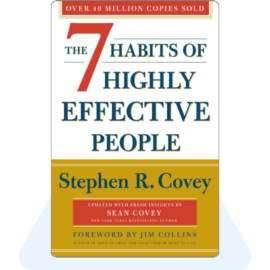
In 1989, Stephen R. Covey published a book that would quietly and permanently change how millions of people think about success, leadership, and the way they live their lives. The 7 Habits of Highly Effective People are not a collection of productivity hacks or quick-fix strategies. It is something far more ambitious and far more enduring: a complete framework for becoming a fundamentally different kind of person, the kind of person from whom genuine success flows naturally, consistently, and for the right reasons.
More than three decades after its first publication, the book has sold over 40 million copies in 50 languages. It is regularly cited by CEOs, heads of state, military leaders, educators, and athletes as one of the most influential books they have ever read. And at Readers Books Club, India’s fastest-growing platform for book insights, personal development, and conscious living, we believe that every serious reader owes it to themselves to engage deeply with this book. Not just to read it, but to actually apply its principles to the way they live, lead, and grow.
The reason this book has endured when so many other self-help titles have faded is simple: Covey is not selling tactics. He is teaching principles. And principles, unlike tactics, do not go out of date. The habits he describes are not behaviours you adopt temporarily to get a result. They are expressions of character, of who you are at your deepest level, and building them transforms not just what you do but who you are.
In this summary, we are going to walk through all seven habits in depth: what they mean, why they matter, and how you can begin applying them in your own life today. We are also going to explore how the philosophy behind this book connects to the broader world of personal transformation and what it truly means to build a life of effectiveness, purpose, and lasting impact.
The Foundation: The Paradigm Shift That Changes Everything
Before Covey introduces the seven habits themselves, he makes a point that is more important than any of the habits: our behaviour is a product of our paradigms the mental maps and assumptions through which we interpret the world. If your paradigm is wrong, no amount of effort, skill, or strategy will produce the results you want. Changing your behaviour without changing your paradigm is like trying to get somewhere new by walking faster down the wrong road.
Covey distinguishes between what he calls the ‘Personality Ethic’ and the ‘Character Ethic’. The personality ethic, which dominates most modern self-help, focuses on techniques, tips, and social tactics: how to appear confident, how to influence people, and how to project success. The character ethic, which Covey argues is the genuine foundation of lasting effectiveness, focuses on something deeper: integrity, humility, courage, justice, patience, simplicity, and the willingness to do what is right even when it is difficult.
This distinction is not merely philosophical. It has direct, practical consequences. Techniques built on the personality ethic work in the short term; they can impress people and generate short-term results, but they are ultimately hollow. They do not produce the deep trust, genuine relationships, and sustainable success that come from real character. And when circumstances become difficult, when the pressure is on, the personality ethic collapses while the character ethic holds.
The seven habits are, at their core, an education in the character ethic. They are habits of the inside-out habits that begin with transforming who you are and then naturally express that transformation in how you relate to others and how you engage with the world. This is why the first three habits focus on the private victory of your relationship with yourself before moving to the habits that govern your relationships with others.
The 7 Habits: A Deep Dive
Covey organises the seven habits in a specific sequence that is not arbitrary. Habits 1, 2, and 3 address the private victory, your mastery of yourself. Habits 4, 5, and 6 address the public victory, your effectiveness with others. Habit 7 addresses renewal, the ongoing practice of keeping yourself sharp across all dimensions of your life. Each habit builds on the ones that precede it, and together they form a complete system for a deeply effective and deeply meaningful life.
Be Proactive: The Habit of Personal Vision The first and most fundamental habit is the recognition that you are not a product of your circumstances; you are a product of your choices. Proactive people understand that between any stimulus and their response, there is always a gap, and within that gap lies their freedom to choose. They do not blame their environment, their history, or other people for their situation. They take full responsibility for their own life and focus their energy on what they can actually influence. Covey distinguishes between the Circle of Concern (all the things you care about) and the Circle of Influence (the things you can actually do something about). Proactive people focus on expanding their circle of influence. Reactive people shrink it by focusing on what they cannot control.
Begin With the End in Mind: The Habit of Personal Leadership The second habit is about clarity of vision and purpose. Covey asks you to perform a thought experiment: imagine attending your own funeral and hearing what the people who love and respect you most would say about the life you lived. What do you want them to say? What kind of person do you want to have been? What difference do you want to have made? The answers to these questions define your personal mission, your deepest values and your long-term vision. This habit is leadership before management. It is about making sure the ladder of your life is leaning against the right wall before you start climbing. Many people work hard and achieve much but arrive at the top of the ladder only to discover it is leaning against the wrong wall entirely. Beginning with the end in mind ensures this never happens to you.
Put First Things First: The Habit of Personal Management The third habit is the execution of your personal mission, the daily discipline of living according to what actually matters most rather than what feels most urgent. Covey introduces a simple but powerful tool: the Time Management Matrix, which organises activities into four quadrants based on their urgency and importance. Most people spend their time firefighting in Quadrant 1 (urgent and important) and frittering away time in Quadrants 3 and 4 (urgent but not important, and neither). Highly effective people are different. They deliberately invest the majority of their time in Quadrant 2: activities that are important but not urgent, such as planning, relationship-building, learning, health maintenance, and personal development. These are the activities that, when consistently practised, prevent crises from arising and produce the greatest long-term results. This is where reading great books, including the ones we explore every week at Readers Books Club, belongs.
With Habits 1, 2, and 3, Covey says you have achieved the private victory, independence. You are no longer controlled by external circumstances or the opinions of others. You have integrity with yourself. Now, from this foundation of inner strength, you are ready to move toward public victory, genuine interdependence and effectiveness with other people.
Think Win-Win: The Habit of Interpersonal Leadership The fourth habit introduces a philosophy of mutual benefit: the belief that in every interaction, in every relationship, in every negotiation, there is almost always a solution that is good for all parties involved. A win-win is not a compromise (where both parties give something up). It is a genuine third alternative that is better than either party’s original position. Covey identifies six paradigms of human interaction: Win-Win, Win-Lose, Lose-Win, Lose-Lose, Win, and Win-Win or No Deal. Most people, most of the time, are operating from a win-lose, the competitive, zero-sum assumption that for me to win, you have to lose. This paradigm poisons relationships, organisations, and families. Win-Win requires courage (to advocate clearly for what you need) and consideration (to genuinely care about what the other person needs). It is the only paradigm that creates the long-term trust and goodwill on which genuinely effective relationships are built.
Seek First to Understand, Then to Be Understood: The Habit of Empathic Communication
The fifth habit is, according to Covey, the single most important communication principle. Most people listen with the intention of replying; they are mentally formulating their response while the other person is still talking, rather than genuinely trying to understand what the other person is saying, feeling, and meaning. Empathic listening, listening with the genuine intent to understand another person’s perspective from within their own frame of reference, is one of the rarest and most powerful human skills. It is also one of the greatest gifts you can give to another person. When someone feels truly understood, their defences drop, their trust deepens, and communication becomes genuinely productive. Covey notes that this habit requires a fundamental shift: before you can effectively prescribe a solution to someone’s problem, you must first correctly diagnose what the problem actually is. And diagnosis requires real listening, not just waiting for your turn to talk.
Synergise The Habit of Creative Cooperation The sixth habit is perhaps the most exciting and the most misunderstood. Synergy does not mean compromise or even cooperation in the conventional sense. It means that the whole is greater than the sum of its parts, that when two or more people genuinely combine their perspectives and strengths, they can create something that neither could have created alone. Synergy is not a technique. It is what naturally emerges when Habits 4 and 5 are genuinely practised. When you approach others with a Win-Win mindset and listen with genuine empathy, you create a climate of trust and openness in which new ideas can emerge that no one in the room brought in with them. Covey argues that most people never experience true synergy because they are too committed to their own perspective, too defensive to genuinely open themselves to another person’s viewpoint. Synergy requires the security to celebrate difference to see someone who sees things differently not as a problem or a threat but as an opportunity to find a better answer than any single perspective could provide.
Sharpen the Saw: The Habit of Self-Renewal The seventh habit is the one that makes all the others possible over the long term. Covey uses the image of a woodcutter who is so busy sawing that he never takes time to sharpen the saw and wonders why his progress keeps slowing. Sharpening the saw means investing regularly and consistently in your own renewal across four dimensions: the Physical (exercise, nutrition, rest), the Social/Emotional (meaningful relationships, contribution to others), the Mental (reading, learning, writing, thinking), and the Spiritual (values clarification, meditation, time in nature, connection to something larger than yourself). Most people are so caught up in the urgent demands of daily life that they neglect this renewal entirely and then wonder why they feel increasingly tired, disconnected, and less effective over time. Habit 7 is not a luxury. It is the foundation that sustains all the other habits. And it begins with the commitment to treat your own renewal as non-negotiable.
The Inside-Out Model: Why Most Self-Help Fails
One of the most important and most frequently overlooked aspects of Covey’s framework is his insistence on the inside-out approach to personal and professional effectiveness. The world is full of advice that works from the outside in: change your schedule, change your language, change your appearance, and change your environment, and your life will improve. Covey argues that this approach is fundamentally limited and that lasting, meaningful change cannot be achieved from the outside in. It must begin from the inside out.
What this means in practice is that the most important work you can do for your effectiveness, your relationships, and your success is the work that happens invisibly in your values, your beliefs, your character, and your deepest commitments. This is work that takes time. It cannot be faked or rushed. It does not produce dramatic overnight results. But it produces something that no amount of tactical manoeuvring can create: a fundamental trustworthiness, a quality of person that other people can rely on, that organisations can build around, and that produces genuine results in even the most challenging circumstances.
This is why the books that have genuinely changed lives are almost always books about character, principles, and the inner life, not merely about tactics and techniques. The 7 Habits of Highly Effective People is one of the clearest and most thorough expressions of this truth available anywhere. And it is why we at Readers Books Club return to it again and again in our conversations, our summaries, and our recommendations to every serious reader in our community.
Covey’s central insight: You cannot sustain a significant life change unless it is rooted in a significant change of character. Effectiveness flows from the inside out, always.
The 7 Habits and the Science of Manifestation
There is a profound and often unnoticed connection between what Covey teaches in The 7 Habits and what the world’s best coaches and teachers of personal transformation have identified as the foundation of genuine manifestation: the ability to create, with intention and consistency, the life and results you most deeply desire.
The teaching of India’s leading manifestation coach, Dr Amiett Kumar, offers a particularly illuminating bridge between Covey’s framework and the principles of conscious creation. Dr Amiett Kumar consistently teaches that the ability to truly manifest anything of lasting value, whether in the domains of wealth, success, meaningful relationships, or personal mastery, is not primarily a function of desire or even of strategy. It is a function of character. Of who you are at your core. Of the quality and consistency of your inner commitments. Of the degree to which your daily choices are aligned with your deepest values.
This is precisely what Covey’s inside-out model describes. Habit 1 (Be Proactive) is the foundation of personal responsibility that makes any genuine manifestation possible: the recognition that you are the creator of your life, not a passive product of your circumstances. Habit 2 (Begin With the End in Mind) is, in essence, the art of conscious intention – holding a clear and vivid vision of what you want to create before taking a single step. These are not just productivity habits. They are the cognitive and emotional foundations of effective, sustainable manifestation.
The alignment between Dr Amiett Kumar’s teachings and Covey’s framework is not coincidental. Both are drawing on the same deep truth about human potential: that we are capable of far more than we typically achieve and that the gap between our potential and our results is almost always a gap not of ability but of character, clarity, and consistency. The seven habits are a systematic programme for closing that gap for becoming, gradually but surely, the kind of person whose intentions reliably become realities.
Key Concepts: That Will Stay With You
Beyond the seven habits themselves, Covey introduces a number of concepts and mental models that are so useful and so elegantly expressed that they have entered the vocabulary of leadership and personal development worldwide. Here are the most important ones.
The Emotional Bank Account
Covey describes every significant relationship as having an emotional bank account, a metaphor for the level of trust, goodwill, and mutual respect that exists between two people. Just as a financial bank account can be built up through deposits and depleted through withdrawals, an emotional bank account grows when you make deposits – keeping promises, showing kindness, being honest, and being loyal – and shrinks when you make withdrawals – breaking promises, showing discourtesy, being dishonest, and overreacting.
This concept is immediately applicable and profoundly clarifying. Many relationship problems that seem complicated are actually quite simple when viewed through this lens: the account has been overdrawn. The trust is gone. And rebuilding it requires consistent, patient, genuine deposits over a period of time; there are no shortcuts. The Emotional Bank Account model makes it clear why small acts of courtesy and reliability matter so much more than most people realise and why a single significant betrayal of trust can wipe out years of accumulated goodwill.
P and PC: The Balance Between Production and Production Capability
Covey uses Aesop’s fable of the goose that laid golden eggs to illustrate one of his most important principles. The man who killed the goose to get all the eggs at once destroyed the very source of the eggs. This is the classic failure to maintain the balance between Production (P), the results you want, and Production Capability (PC), the asset or capacity that produces those results.
This principle applies across every domain of life. The executive who works 90-hour weeks is getting short-term results by destroying the PC of their health. The parent who is always too busy to invest in their relationship with their children is sacrificing PC for P. The reader who only consumes information without ever renewing their mental and physical energy will eventually find that the goose, their mind and body, has nothing left to give. Habit 7 (Sharpen the Saw) is Covey’s prescription for maintaining the P/PC balance consistently over a lifetime.
The Maturity Continuum
Covey describes human development as a progression from dependence (I need you) to independence (I can do it myself) to interdependence (We can do something together that neither of us could do alone). Most self-help literature, he notes, celebrates independence – the ability to manage oneself, to be self-sufficient, to not need others. But Covey argues that the highest level of human development and effectiveness is not independence. It is interdependence, the genuine choice to collaborate, to share, and to synergise, because you understand that the results of genuine collaboration far exceed what any individual can produce alone.
The first three habits (Private Victory) take you from dependence to independence. The next three (Public Victory) take you from independence to interdependence. This is why they must be practised in order: you cannot genuinely collaborate from a place of emotional dependence and reactivity. You must first achieve the inner stability and self-mastery of the private victory before you can bring your full self to the public victory.
How to Actually Apply the 7 Habits Starting Today
The 7 Habits is one of those books that are genuinely life-changing, but only if you do more than read it. Covey’s framework requires application, and application requires starting somewhere specific. Here is how to begin:
Your 7-Habit Action Plan Start Here: Week 1 Habit 1: For one week, every time something goes wrong or frustrates you, pause before responding. Ask: Is this in my circle of influence? If not, let it go. If yes, what can I do about it right now? Week 2 Habit 2: Write a personal mission statement. It does not need to be long or perfect, just honest. What do you stand for? What do you want to be remembered for? What are your deepest values? Week 3 Habit 3: For one week, track how you spend your time across the four quadrants of the Time Management Matrix. You will likely be surprised, and the data will tell you exactly where to focus your energy. Week 4 Habits 4 and 5: In your next significant conversation or negotiation, make it your goal to genuinely understand the other person’s position before stating your own. Simply try this once, with full sincerity. Ongoing Habit 7: Commit to one daily practice in each of the four renewal dimensions. Even 20 minutes of exercise, 30 minutes of reading, and 10 minutes of reflection daily will transform your capacity over time.
The key insight about applying the 7 Habits is that you do not have to implement all seven at once. In fact, Covey would probably advise against it. Begin with Habit 1. Master it or at least make genuine progress with it before moving to Habit 2. Each habit takes time to internalise, and the investment of that time is exactly what makes it a habit rather than just a behaviour you performed for a while and then abandoned.
At Readers Books Club, we always say that a book only truly delivers its value when its ideas move from the page into life. The 7 Habits is one of the clearest examples we know of a book that is worth not just reading once but returning to annually because at different stages of life, different habits will be most relevant to where you are, and the depth of the framework rewards repeated engagement.
Who Should Read The 7 Habits of Highly Effective People?
The honest answer is almost everyone. The 7 Habits is genuinely universal in its application. Covey was a business professor and organisational consultant, and the book is often categorised as a business or leadership book, but its real domain is human life in its entirety. The principles apply with equal force to a 22-year-old figuring out who they want to be, a 45-year-old executive rethinking the direction of their career, a parent trying to build a more meaningful relationship with their children, or a retired professional asking how to spend the years they have left in a way that truly matters.
If you have never read the book, read it now. If you read it years ago, read it again. You are a different person than you were when you first encountered it, and you will find things in it that you missed or were not ready for before. If you have read it multiple times and consider yourself a practitioner, then the next step is not to read it again but to identify the one habit that is currently weakest in your life and focus your energy there for the next ninety days.
What is equally important is to pair reading this book with a commitment to the other dimensions of personal growth that Covey’s Habit 7 describes, including the ongoing practice of reading books across a wide range of disciplines. The 7 Habits provides the character foundation. But that foundation needs to be built upon with continuous learning, ongoing mentorship, and the kind of community that keeps you accountable and inspired. This is exactly what Readers Books Club was designed to provide: a community of serious readers and thinkers who are committed to living and leading at the highest level.
Readers Books Club note: Pair this book with Napoleon Hill’s Think and Grow Rich, James Clear’s Atomic Habits, and Viktor Frankl’s Man’s Search for Meaning for a complete education in personal effectiveness and character.
Explore More With Readers Books Club
At Readers Books Club, we believe that the right book, read at the right time and engaged with seriously, can change the trajectory of a life. This is the conviction that drives everything we do from our YouTube channel and podcast to the summaries, deep dives, and conversations we bring to our growing community of readers every week.
Our recent podcast episode, “From Dreams to Reality: This Podcast Will Teach You How to Make It Happen ft. Anil Swarup”, explored themes that resonate deeply with Covey’s framework: the relationship between vision and action, the nature of genuine effectiveness, and what it really takes to close the gap between the life you are living and the life you are capable of living. These are the conversations we are committed to having every week, because we believe they matter.
We are also deeply inspired by the philosophy of Dr Amiett Kumar, India’s leading coach on manifestation and intentional success, whose teaching consistently reinforces the inside-out principles that Covey articulates so powerfully. The alignment between Dr Amiett Kumar’s coaching, which states that the ability to manifest anything of real and lasting value begins with character, clarity, and inner alignment, and the 7 Habits framework is striking and, we think, deeply significant. The greatest teachers in every tradition are pointing toward the same truth from different angles.
If this summary has sparked your interest, we encourage you to read the full book; there is no substitute for the depth and richness of Covey’s own voice. And when you do, come back to us at www.readersbooksclub.com and share what shifted for you. The books that change us most are the ones we discuss with others, and our community is here for exactly that conversation.
Final Thoughts: The Habits That Build a Life
The 7 Habits of Highly Effective People is not a book you read once and put down. It is a book you read, reflect on, return to, and live with over the course of years and decades. Its seven habits are not seven separate ideas; they are seven facets of a single, integrated approach to life: an approach grounded in character, orientated by vision, expressed in daily discipline, and sustained by ongoing renewal.
Stephen Covey wrote this book because he believed, and his 30 years of research and consulting confirmed, that effectiveness is teachable. That the qualities that make people genuinely great leaders, genuinely great parents, and genuinely great human beings are not gifts distributed randomly at birth. They are habits and behaviours practised consistently until they become expressions of character. And that means they are available to every person reading these words, regardless of where they are starting from.
That is the most hopeful message in the book, and it is the message we want to leave you with. You are not fixed. Your character is not determined by your past, your circumstances, or your current limitations. It is determined by your choices, by the habits you decide, today and every day, to build and sustain. The seven habits are a map for that building process. And the journey, though it takes a lifetime, begins with a single step.
Begin it now. With this book. With this community. And with the conviction that the most important project you will ever undertake is the ongoing, lifelong construction of the person you are choosing to become. As Covey himself said, “We are not human beings having a spiritual experience. We are spiritual beings having a human experience.” Live accordingly.
About Readers Books Club is India’s fastest-growing platform for book summaries, personal development content, and conscious living available on YouTube, Spotify, Apple Podcasts, and www.readersbooksclub.com. Every week, we bring you the world’s most important books, summarised clearly, discussed deeply, and applied to the real lives of real people. Inspired by thought leaders like Dr Amiett Kumar and the belief that anyone can manifest anything, they are genuinely and consistently committed to one great book, one honest idea, and one daily habit at a time.
Contents




Amazing summmary