10 Books to Stop Doomscrolling and Reclaim Your Focus
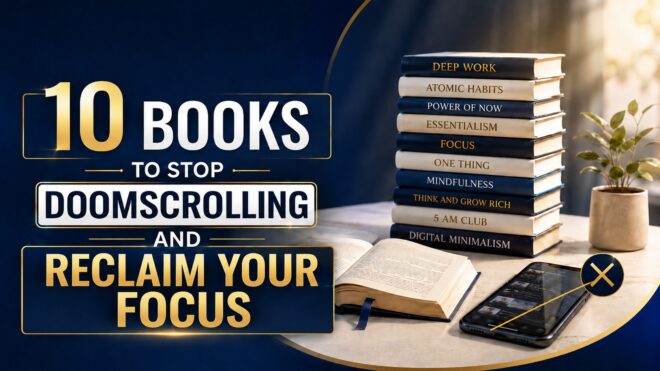
You open your phone to check one message. Ten minutes later, you are watching a reel. Twenty minutes later, you are reading a disturbing headline. Then another. Then another. By the time you finally put the phone down, your mind feels crowded, your attention feels weak, and the book you wanted to read is still untouched on the table. This cycle has a name: doomscrolling.
Doomscrolling is commonly used to describe compulsively consuming a stream of negative, alarming, emotionally charged, or simply endless online content. The problem is not that every minute on a phone is harmful. Smartphones help us work, learn, connect, navigate, create, and stay informed. The problem begins when intentional use turns into automatic use and our attention is repeatedly pulled away from what we actually wanted to do.
That is exactly why this topic matters to Readers Books Club. Books demand something that the modern feed rarely asks from us: sustained attention. A good book does not refresh every second. It does not need to shout to keep you. It invites you to slow down, follow an idea, imagine a world, test your assumptions, and remain with a thought long enough for it to change you.
In 2026, the pushback against constant connectivity has become increasingly visible. Phone-free clubs, digital-detox gatherings, silent book clubs, screen-free retreats, and other offline experiences are gaining attention as people search for a healthier relationship with technology. Research also continues to examine how attentional interference in digital environments can reduce reading comprehension and how compulsive social-media use can relate to attention difficulties and lower well-being.
The answer, however, is not to declare war on technology. The better question is, how can you use technology without giving it ownership of your attention? The ten books in this guide approach that question from different directions. Some focus on digital minimalism. Some teach concentration. Some explore habits and rewards. Some help you understand why distraction is so persuasive. And some challenge the deeper assumption that every spare second must be filled.
This is not a list of books to buy and forget on a shelf. It is a practical reading roadmap. For each book, you will learn why it is relevant to doomscrolling, the most useful idea to take from it, how to apply that idea immediately, and who should read it first. If you follow the final reading plan, you can turn these books into a personal system for reclaiming focus.
Why Doomscrolling and Focus Matter More Right Now
Doomscrolling thrives on a simple mismatch: your conscious intention is slow, but the feed is fast. You may intend to check one update, but platforms are built around continuous content, recommendations, notifications, novelty, and frictionless switching. When the next item is always one swipe away, stopping requires a deliberate choice.
A 2025 meta-analysis of 32 studies on digital reading found a negative effect of attentional interference in networked environments on reading comprehension. That does not mean digital reading is bad by definition. It means distraction matters. If every paragraph competes with alerts, tabs, messages, and impulses to switch, deeper understanding becomes harder.
Doomscrolling is also emotionally sticky. Research has linked higher doomscrolling with poorer mental well-being, while mindfulness may play a protective role in that relationship. One bad evening of scrolling does not define your mental health, but the habit deserves attention when it repeatedly leaves you agitated, drained, numb, or unable to stop.
The current cultural response is revealing. People are paying for phone-free dinners, joining silent reading clubs, attending digital-detox retreats, and returning to analogue hobbies. The desire is not really for an older world. It is for presence. Reading is one of the simplest ways to practise that presence because it gives the mind a single object of attention for an extended period.
For Readers Books Club, which was created around extracting practical learning from books, this trend is especially relevant. The goal is not to read more pages merely to feel productive. It is to build a mind that can choose where attention goes. That skill supports study, work, creativity, relationships, meditation, coaching, spirituality, and even reflective practices connected with the Law of Attraction because all of them become shallow when the mind is constantly fragmented.
1. Digital Minimalism Cal Newport
| Best for Best for people who feel their phone has become the default setting of daily life. |
Cal Newport’s Digital Minimalism is the most direct starting point for anyone who wants to stop doomscrolling without becoming anti-technology. Newport’s central idea is not that modern tools are inherently bad. It is that we adopted many of them casually, one app and one notification at a time, without first deciding what role they deserved in our lives. Digital minimalism reverses that process: start with what you value, then allow only the technologies that meaningfully support those values.
This is powerful for doomscrolling because most doomscrolling is not a conscious value. Almost nobody writes, “My priority tonight is to spend ninety minutes absorbing random alarming content.” It happens because the phone is available, the apps are easy to open, and the habit has become automatic. Digital Minimalism asks you to move from convenience-based technology use to value-based technology use.
One practical lesson is to stop asking whether an app has any benefit. Almost every app can provide some benefit. Ask instead whether it is the best way to obtain that benefit and whether the cost in time, attention, mood, or fragmentation is worth it. News may inform you, but checking it thirty times a day rarely makes you thirty times more informed. Social media may connect you, but constant checking may reduce the quality of the conversations happening in front of you.
Try this Readers Books Club experiment: choose one seven-day period and remove the easiest entry points to doomscrolling. Log out of the apps that trap you, remove them from the home screen, disable non-essential notifications, and create two fixed windows for news and social media. Then deliberately fill the recovered time with higher-quality activities: reading, walking, journaling, exercise, meditation, conversation, or focused work. The important part is replacement. Empty time without a plan often sends you back to the same feed.
Read Digital Minimalism first if you have already tried screen-time limits but keep overriding them. The problem may not be discipline; it may be that you have never defined your philosophy of technology. This book helps you do that.
| Try This Today Remove one distracting app from your home screen and replace its position with your reading app or a note that says: “What did I intend to do?” |
2. Deep Work Cal Newport
| Best for Best for rebuilding concentration after years of fragmented attention. |
If digital minimalism helps you decide what to remove, deep work helps you decide what to build. Cal Newport describes deep work as focused, distraction-free effort on cognitively demanding tasks. The book is especially useful for readers who can put a phone in another room but still find their mind jumping every few minutes.
Doomscrolling trains switching. Deep work trains staying. Every time you abandon a difficult paragraph to check a message, your brain learns that discomfort is a signal to escape. Every time you remain with the paragraph, solve the problem, finish the chapter, or write through the difficult section, you teach the opposite lesson: discomfort can be tolerated and attention can be sustained.
The mistake many people make is waiting to feel focused before beginning. Focus is often an outcome of structure. A scheduled block, a clear task, a visible end time, and a distraction-free environment remove dozens of tiny decisions. You do not have to decide every three minutes whether you should continue; the block has already decided for you.
Use a reading version of deep work. Start with twenty-five minutes. Put the phone outside the room or at least out of reach and out of sight. Choose one book and one reading objective. During the block, do not highlight everything, research every unfamiliar term, or open another app. Read. At the end, write three sentences from memory about what you understood. That final step converts reading from passive consumption into active learning.
Deep Work is ideal for students, creators, professionals, entrepreneurs, coaches, and anyone whose income or confidence depends on the ability to think clearly. It is also relevant to meditation: both practices involve noticing the impulse to leave and returning attention to a chosen object. The contexts differ, but the discipline of returning is shared.
3. Stolen Focus: Johann Hari
| Best for Best for readers who blame themselves for distraction and want a wider explanation. |
Johann Hari’s Stolen Focus broadens the conversation beyond personal willpower. Instead of treating attention failure as a private moral weakness, the book explores a range of forces that can undermine sustained attention, including technology design, stress, sleep, information overload, and broader social conditions.
This perspective matters because shame is a poor attention strategy. If you tell yourself, “I am lazy, weak, and addicted to my phone,” you may create more stress without changing the environment that triggers the behaviour. Stolen Focus encourages you to ask a more useful question: what conditions make focus difficult, and which of those conditions can I change?
For doomscrolling, that could mean noticing that the habit becomes strongest when you are tired, lonely, anxious, or avoiding a difficult task. It could mean recognising that you scroll more when the phone is beside the bed, when news notifications are active, or when you have no planned form of rest. These are conditions, not character flaws. Conditions can be redesigned.
A practical exercise is to create an attention audit. For three days, do not try to become perfect. Simply record when you lose twenty minutes or more to unplanned scrolling. Write the time, location, emotional state, app, and what you were supposed to be doing. Patterns appear quickly. Once you see the pattern, choose one environmental change rather than ten motivational promises.
Stolen Focus is a strong choice if you want the broader story of why concentration feels harder in the modern world. It can also make your approach more compassionate. Personal responsibility still matters, but responsibility works better when it is informed by an honest understanding of the systems competing for your attention.
4. Indistractable Nir Eyal
| Best for Best for people who repeatedly escape discomfort through their phone. |
Nir Eyal’s Indistractable is especially useful because it does not treat distraction as something caused only by external technology. Notifications matter, but Eyal places strong emphasis on internal triggers: boredom, uncertainty, anxiety, loneliness, frustration, fatigue, and the discomfort of doing something difficult.
That insight changes how you fight doomscrolling. If scrolling is your fastest route away from discomfort, simply deleting one app may cause the same escape pattern to appear somewhere else. You may begin checking email, shopping, watching videos, cleaning, or opening a news site. The surface behaviour changes while the underlying trigger remains.
One of the most practical ideas in the book is to distinguish traction from distraction. Traction is action that moves you towards what you intended to do. Distraction is action that pulls you away from that intention. The same activity can be either. Watching YouTube for a planned educational session may be traction; opening it during a reading block and losing forty minutes may be a distraction.
Try timeboxing. Before the day becomes busy, give important activities a place on the calendar: reading, exercise, work, meditation, family time, and even intentional social media. When leisure is planned, you do not need to feel guilty about it. The aim is not constant productivity. The aim is to make your time reflect your priorities rather than the strongest notification.
Indistractable belongs high on the list for anyone working in coaching, entrepreneurship, content, or a digital profession, because complete disconnection is unrealistic. You need technology, but you also need agency. This book is about keeping both.
5. Dopamine Nation Anna Lembke, MD
| Best for Best for understanding why endless novelty can become compulsive. |
Dopamine Nation by psychiatrist Anna Lembke examines pleasure, pain, reward, and compulsive overconsumption in a world where highly stimulating experiences are available almost continuously. The book is not specifically a guide to doomscrolling, yet it is highly relevant because the smartphone can deliver novelty, entertainment, social approval, outrage, shopping, gaming, and news without meaningful friction.
A common mistake in popular discussions is to say dopamine is simply the “pleasure chemical”. Human neurobiology is more complex than that slogan. Lembke’s broader message is more useful: when rewarding stimuli are abundant and easily repeated, balance becomes difficult. The challenge is not to eliminate pleasure but to regain choice around consumption.
Think about how this applies to reading. A book often gives slower rewards. The first five pages may require effort before curiosity grows. A feed gives immediate novelty. If your mind becomes accustomed to constant small rewards, the slower reward of reading can initially feel dull. That does not prove your attention is permanently damaged. It means the contrast between high-speed stimulation and slow engagement may be very large.
A practical reset is to create periods of lower stimulation around reading. Do not try to move directly from thirty minutes of rapid reels to a difficult nonfiction chapter and then conclude that you “cannot focus.” Take a short walk, make tea, sit quietly, or practise five minutes of meditation before reading. Give your nervous system and attention a transition.
Dopamine Nation is most useful for readers who notice compulsive patterns across more than one area: social media, gaming, shopping, food, entertainment, or constant novelty. It invites a deeper look at consumption, not just screen-time statistics.
| Transition Rule Before reading, spend five minutes away from fast-moving content. Walk, breathe, make tea or sit quietly. Give your attention a slower starting point. |
6. Atomic Habits James Clear
| Best for Best for turning a digital-detox intention into a repeatable daily system. |
James Clear’s Atomic Habits is not a technology book, which is exactly why it belongs on this list. Doomscrolling is a habit problem as much as an information problem. You do not need to understand every feature of every platform if you can redesign the cue, routine, environment, and identity surrounding your phone use.
The strength of Atomic Habits is its focus on small systems. People often respond to a bad week of screen time with a dramatic promise: no social media, two hours of reading every day, daily meditation, and a 5 a.m. routine starting tomorrow. The plan fails because it requires a completely different person overnight. Small habits work by lowering the friction of the behaviour you want and raising the friction of the behaviour you do not want.
For reading, make the first step almost too easy. Put the book on your pillow in the morning so it is waiting at night. Commit to five pages before opening social media after dinner. Keep a physical bookmark and a pen beside the book. If you want to reduce doomscrolling, move social apps into a folder, log out after every session, use app limits, or charge the phone in another room. Each tiny barrier creates a moment in which you can choose.
The identity idea is especially useful: instead of saying, “I am trying to read more,” begin acting like “I am a reader who protects my attention.” Identity is strengthened through evidence. Every ten-minute reading session is a vote for that identity. Every time you close an app when you notice automatic scrolling, you cast another vote. You do not need a perfect streak; you need enough repetitions to make the new pattern familiar.
Atomic Habits is the ideal bridge between inspiration and implementation. If Readers Books Club introduces you to great books but you struggle to make reading consistent, start here. It gives you a practical system for turning book recommendations into actual reading behaviour.
7. Make Time Jake Knapp and John Zeratsky
| Best for Best for people who end the day wondering where all their time went. |
Make Time was written by Jake Knapp and John Zeratsky, who both worked in the technology world and became frustrated with the always-connected culture surrounding modern work. Their framework is simple enough to remember and practical enough to use: choose a highlight, create laser mode, energise the body, and reflect on what worked.
The highlight is the most important idea for doomscrollers. If you do not decide what deserves your attention today, your inbox, social feeds, breaking news, and other people’s priorities will decide for you. A highlight can be meaningful rather than impressive: read thirty pages, finish a proposal, have dinner with family, walk for forty minutes, or complete a meditation practice.
Laser mode is about defending that priority. Instead of relying on heroic willpower, the authors encourage changes that make distraction less convenient. A phone can become less attractive by turning off notifications, removing addictive shortcuts, logging out, or physically separating the device from the activity that matters. The goal is not punishment; it is to give your chosen priority a fair chance.
The Energise step is easy to ignore, but focus is not purely mental. Sleep, movement, food, light, and rest influence how easily we reach for quick stimulation. When you are exhausted, doomscrolling can feel like the only form of rest available, even though it may leave you more depleted. A short walk, a proper meal, or earlier bedtime may do more for attention than another productivity app.
Use Make Time when your schedule feels reactive. At the start of each morning, write one Highlight. At night, ask: did I protect it? What pulled me away? What small change would make tomorrow easier? This turns attention into a daily experiment rather than a personality judgement.
8. The Shallows Nicholas Carr
| Best for Best for understanding the deeper relationship between the internet and how we read. |
Nicholas Carr’s The Shallows became influential because it asked a question many readers had quietly noticed: is heavy internet use changing the way we think and read? Carr explores the intellectual and cultural consequences of internet habits, especially the shift from sustained linear attention towards scanning, linking, switching, and fragmented consumption.
The relevance to doomscrolling is obvious. The feed rewards breadth without depth. You can encounter war, celebrity news, financial advice, health claims, memes, politics, motivation, and personal updates within two minutes. Your mind processes constant context changes. A book, by contrast, develops an argument or story across pages and chapters. It requires memory of what came before and patience for what comes next.
Reading The Shallows can make you notice the difference between information and understanding. Consuming more information does not necessarily mean understanding more. If you read fifty headlines but cannot explain one issue clearly, you may be informed in fragments but not in depth. Books give context, sequence, nuance, and room for uncertainty.
Try a “single-text” practice inspired by this contrast. For thirty minutes, read one physical book with no second screen. When you feel the urge to search for something, mark the page with a small dot and continue. Look up the marked items only after the session. This prevents every curiosity from becoming a browser session and teaches you that not every question requires immediate resolution.
The Shallows is a strong choice for readers interested in psychology, media, education, technology, and the future of reading. It also makes a compelling companion to Readers Books Club summaries: use summaries to discover and orient yourself, then periodically choose a full book to practise sustained reading.
9. Four Thousand Weeks Oliver Burkeman
| Best for Best for people who scroll because they feel overwhelmed by everything they should be doing. |
Oliver Burkeman’s Four Thousand Weeks approaches focus from an unexpected direction: mortality and limitation. If a human life lasts around eighty years, it contains roughly four thousand weeks. That number is not meant to create panic. It is meant to expose the fantasy that one day we will finally complete everything, master every system, read every article, answer every message, and become fully caught up.
Doomscrolling feeds on the opposite fantasy. The feed has no end, yet part of the mind behaves as if one more swipe might finally make us informed enough, certain enough, or safe enough. The result is an impossible project: finishing the internet. Burkeman’s perspective offers relief. You cannot consume everything. Choosing what to ignore is not failure; it is a necessary part of choosing a life.
This can radically change your reading habits. Instead of maintaining a guilt-inducing list of 300 books, choose the next three. Instead of saving hundreds of articles “for later”, delete most of them. Instead of trying to keep up with every news cycle, decide which sources and times are sufficient. Finite attention becomes something to invest, not something to scatter.
There is a spiritual dimension to this idea even without adopting any particular belief system. Spirituality often asks us to confront presence, meaning, and the limits of control. Four Thousand Weeks does something similar through time. It encourages you to live inside the day you actually have instead of constantly postponing meaningful activity until after you have “caught up”. You will never catch up completely.
Read this book if productivity advice itself has become another form of scrolling. It can help you stop optimising every minute and start protecting the few things that matter enough to deserve your finite attention.
10. The Power of Habit Charles Duhigg
| Best for Best for understanding the routines that keep sending your hand back to the phone. |
Charles Duhigg’s The Power of Habit popularised a useful way of thinking about repeated behaviour: habits often involve cues, routines, and rewards. Although modern habit science is broader than any single model, the framework remains practical for observing automatic patterns without turning them into moral failures.
Consider a common doomscrolling loop. Cue: you feel stuck while working. Routine: you unlock the phone and open a social app. Reward: relief from the difficult task, novelty, or a momentary feeling of connection. If you only attack the routine without understanding the reward, the habit may return. But if you identify the reward, you can experiment with alternatives.
If the reward is mental relief, try standing up, stretching, or walking for two minutes. If it is a connection, send one intentional message to a friend instead of entering an endless feed. If it is stimulation, keep a puzzle, notebook, or short essay nearby. If it is uncertainty about work, define the next tiny task. The replacement should satisfy something similar without carrying the same cost.
Create a cue map for one week. Every time you catch yourself doomscrolling, write five things: time, place, emotional state, what happened immediately before, and what you seemed to want from the phone. Do not overanalyse each entry. At the end of the week, look for repeated cues. Habit change becomes easier when the trigger is visible.
The Power of Habit works well for readers who love stories, psychology, behaviour change, and practical self-improvement books. It pairs naturally with Atomic Habits: Duhigg helps you understand loops and organisational patterns, while Clear gives you a highly actionable system for redesigning everyday behaviour.
| Habit Audit For seven days, record the cue that preceded unplanned scrolling. Look for repeated times, places and emotions before changing the routine. |
The Missing Practice: Turn the List Into a Reading Habit
A list of ten books can become another form of consumption if you simply save it, share it, and move on. The missing “book” is the practice of reading itself. This final recommendation is intentionally different: turn the ideas from the previous nine titles into a personal reading ritual before you buy anything else.
Choose one book from this list based on your biggest problem. If you cannot stop checking your phone, begin with Digital Minimalism or Indistractable. If you can put the phone away but cannot concentrate, choose Deep Work or Stolen Focus. If endless novelty feels compulsive, choose Dopamine Nation. If your routines collapse after three days, choose Atomic Habits or The Power of Habit. If you feel time-poor and overwhelmed, choose Make Time or Four Thousand Weeks. If you want a deeper cultural explanation, choose The Shallows.
Then set a minimum dose: twenty minutes or ten pages a day. Keep it small enough to survive a bad day. Read at the same trigger point whenever possible – after breakfast, during a commute, before dinner, or before bed. Track sessions rather than pages because some books require slower thought. The goal is not speed. The goal is rebuilding the ability to stay.
Use meditation as a transition if your mind is restless. Sit for three minutes, breathe naturally, and notice the urge to reach for stimulation without obeying it. Then open the book. This is not a mystical trick, and it is not a guaranteed cure for compulsive technology use. It is simply a way to create a pause between one mode of attention and another.
Readers Books Club was built around the idea that books contain implementable lessons. Make this article an implementation point. One book. One protected reading block. One week. Your attention is not reclaimed by knowing more about focus; it is reclaimed by repeatedly practising focus.
How to Choose the Right Book for Your Doomscrolling Pattern
Not every distraction problem needs the same solution. The quickest way to waste this list is to begin with whichever title sounds most impressive rather than the one that matches your actual behaviour. Before choosing, identify what usually happens in the five minutes before you start scrolling.
If you reach for the phone whenever you are bored, anxious, lonely, or avoiding a task, begin with Indistractable or The Power of Habit. Both help you study the trigger instead of fighting only the app. If your main problem is that your digital life feels crowded and noisy, Digital Minimalism gives you a philosophy for deciding which tools deserve access to you.
If you have already reduced notifications but still struggle to read, write, or study for more than a few minutes, choose Deep Work. If you want to understand why attention is difficult at both the individual and societal levels, Stolen Focus and The Shallows offer a wider perspective. If constant novelty feels compulsive across news, shopping, entertainment, food, or gaming, Dopamine Nation is the more relevant starting point.
If your problem is inconsistency, Atomic Habits is difficult to beat. If every day disappears into other people’s priorities, Make Time gives you a practical daily structure. And if you are exhausted by the idea that you should optimise every moment, Four Thousand Weeks can help you replace productivity anxiety with deliberate choice.
There is no prize for finishing all ten books quickly. A single idea applied for six months can be more valuable than ten books completed in six weeks. Readers Books Club has always focused on extracting useful lessons from books; use the same philosophy here. Choose the book that solves today’s bottleneck, implement one idea, and only then move to the next.
A 7-Step Digital Reset You Can Start Today
- Step 1: Measure without judging. Check your current screen-time report and identify the two apps that consume the most unplanned time. The purpose is not to feel guilty. You need a baseline before you can change a pattern.
- Step 2: Remove unnecessary cues. Turn off non-essential notifications, remove distracting apps from the home screen, and stop using your phone as the first object you touch after waking. Cues are powerful because they start behaviour before a conscious decision has fully formed.
- Step 3: Create friction. Log out after use, use website blockers during reading or work, charge the phone away from the bed, and keep the device outside the room during one daily focus block. A small inconvenience can restore the pause in which choice becomes possible.
- Step 4: Schedule intentional checking. Decide when you will read news, social media, and messages instead of checking whenever an urge appears. You do not have to become unreachable. You are simply moving from reactive checking to planned checking.
- Step 5: Replace, do not merely remove. Keep a physical book, notebook, walking shoes, or another low-friction alternative where the phone used to be. A habit leaves a vacuum when removed. If the vacuum is empty, the old behaviour has an advantage.
- Step 6: Practise one daily focus block. Begin with twenty minutes of reading, meditation, study, or deep work. Protect the block from notifications and multitasking. Your target is not maximum output; it is a clean period of single-task attention.
- Step 7: Review weekly. Ask what worked, what triggered scrolling, and which environment changes helped. Adjust the system instead of attacking your self-worth. Sustainable focus is designed through feedback.
Books, Meditation, Spirituality and the Law of Attraction
Readers Books Club covers more than productivity books. Its broader audience is interested in meditation, spirituality, coaching, mindset, and the Law of Attraction. These themes can connect naturally with the problem of doomscrolling when they are approached in a grounded way.
Meditation trains awareness of attention. During a simple practice, you notice thoughts, sensations, and urges without needing to follow each one. That skill can transfer to digital life. When you feel the impulse to check your phone, the goal is not to suppress the urge. Notice it, pause, and decide whether checking serves your current intention.
Spirituality can add another question: what deserves your limited life energy? A feed can keep you informed and entertained, but it cannot decide what is meaningful for you. Reading, reflection, prayer, journaling, service, or quiet time can create space to identify values that are easily drowned out by constant stimulation.
The Law of Attraction is sometimes discussed as if focus alone guarantees external results. A more practical use is to treat attention as part of alignment: what you repeatedly focus on influences what you notice, rehearse, learn, and act upon. Visualising a goal while spending every free hour in automatic scrolling creates a mismatch between intention and behaviour. Use affirmations or visualisation as reminders of the person you want to become, then support them with concrete habits.
For example, an affirmation such as “I protect my attention and use technology intentionally” becomes more credible when your phone sleeps outside the bedroom and a book is waiting on the bedside table. Mindset is strongest when behaviour supplies evidence.
Can Coaching or a Life Coach Help With Focus?
Sometimes the problem is not lack of information. You already know you should use the phone less, sleep earlier, read more, and protect your mornings. What is missing is structure, accountability, or clarity. This is where coaching can be useful.
A responsible life coach or performance coach can help you define priorities, build routines, review setbacks, and create accountability. Coaching can also reveal hidden conflicts. You may say that reading matters, but your calendar may show that every evening is overloaded. You may say you want less social media, but your work requires constant online presence. The solution needs to fit the real life you have.
Amiett Kumar and Readers Books Club often present books as tools for implementation rather than decoration. That is the right attitude for coaching as well. A coach should not make you dependent on motivation. The objective is to help you build a system that eventually works without constant external pressure.
If doomscrolling feels compulsive to the point that it significantly interferes with sleep, work, relationships, or mental well-being, a qualified mental-health professional may be more appropriate than productivity coaching. The best form of support depends on the nature and severity of the problem.
A 14-Day Reading and Focus Challenge
- Days 1-2: Observe. Record your screen time, most-used apps, and three moments when you scrolled longer than intended. Do not change everything yet.
- Days 3-4: Clean the environment. Disable non-essential notifications, move distracting apps, and choose one place where the phone will stay during reading.
- Days 5-6: Begin with ten pages a day. Read one book from this list at a fixed time. Stop while the habit still feels manageable rather than proving how much you can read.
- Day 7: Review the first week. What time produced the best reading? Which trigger caused the most scrolling? Make one adjustment.
- Days 8-9: Increase the reading block to twenty-five minutes. Use a timer that does not require touching your phone if possible. Write three key ideas after each session.
- Days 10-11: Add five minutes of meditation or quiet breathing before reading. Notice the impulse to seek novelty and let the urge pass without turning it into a battle.
- Day 12: Have one low-scroll evening. Use the phone for necessary communication, but remove entertainment feeds for the evening. Read, walk, talk, journal, or rest.
- Day 13: Teach one idea from your book to another person or write a short summary. Teaching reveals whether you understood the material and strengthens memory.
- Day 14: Decide your permanent rule. Examples: no social media before breakfast, no phone during the first thirty minutes after waking, thirty minutes of reading before entertainment, or two fixed news windows per day. Choose one rule you can actually keep.
Frequently Asked Questions
What is the best book to stop doomscrolling? Digital Minimalism is the strongest all-round starting point if the phone itself feels too dominant. Indistractable is better if emotional triggers drive the behaviour, while Atomic Habits is excellent if you understand the problem but struggle to make new routines stick.
Can reading really improve my focus? Reading provides a practical environment for sustained attention, especially when distractions are removed. It is not a medical treatment, and individual attention difficulties can have many causes, but regular distraction-free reading is a useful way to practise staying with one stream of information.
Should I delete social media completely? Not necessarily. For some people, temporary removal creates useful distance. Others can use social media successfully with scheduled windows, disabled notifications, or device boundaries. The correct strategy is the one that restores intentional use without creating unnecessary problems for work or relationships.
How long should I read every day? Start with a duration that you can repeat. Ten to twenty minutes is enough to establish a routine. Increase it only after consistency is stable. A reliable twenty-minute practice is more valuable than a two-hour session followed by ten days of nothing.
Is doomscrolling the same as being informed? No. Staying informed is intentional and bounded. Doomscrolling tends to become repetitive, emotionally charged, and difficult to stop. A useful question is whether the next ten minutes of content will meaningfully change what you understand or what you need to do.
Can meditation stop phone addiction? Meditation can strengthen awareness and self-regulation for some people, but it is not a guaranteed treatment for compulsive technology use. Use it as one tool alongside environmental changes, habits, social support, and professional help when needed.
Which book should students read first? Deep work is highly relevant for study concentration, while Atomic Habits can help students build consistent study and reading routines. If the main problem is phone distraction, digital minimalism is an excellent companion.
Which book is best for entrepreneurs and creators? Deep work, making time, and indistractable form a strong combination. They address focused production, daily priorities, and distraction management without requiring complete disconnection from technology.
Final Thoughts: Your Attention Is a Reading Asset
The most important lesson from these books is not that phones are evil or that every reader should disappear from the internet. Technology is part of modern life and can be genuinely useful. The deeper lesson is that attention becomes valuable precisely because so many systems compete for it.
You do not need to win a permanent battle against distraction. You need to make the next good choice easier: put the phone farther away, open the book, protect twenty minutes, notice the urge to switch, and return. Focus is not a feeling you wait for. It is a behaviour you practise.
Readers Books Club was founded to bring the knowledge hidden inside books into practical life. Use this list in that spirit. Do not collect all ten titles as another digital wishlist. Choose one. Read it slowly. Apply one idea for a week. Then ask whether your attention, reading, work, relationships, meditation, or inner calm have improved.
The feed will still be there when you return. The question is whether you will return to it by choice or by reflex. Every page you read without switching is a small act of reclaiming that choice.
Contents