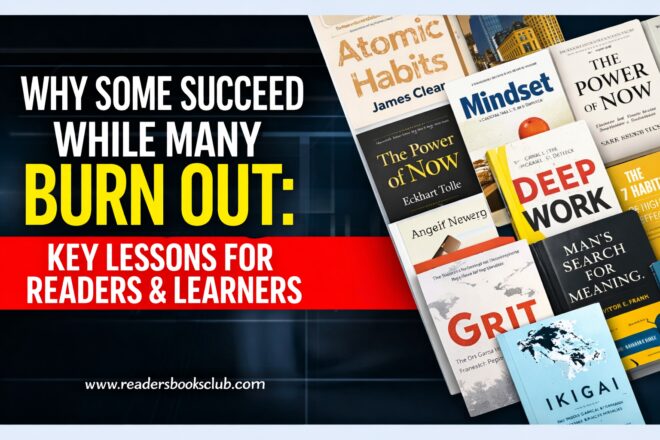
Why Some Succeed While Many Burn Out: Key Lessons for Readers and Lifelong Learners
Introduction
In today’s hyper-connected, achievement-driven world, success has never looked more glamorous – or burnout more common. Social media highlights overnight wins, high-performing careers, and perfectly balanced lives, yet behind the scenes, countless individuals feel exhausted, overwhelmed, and quietly disillusioned. This contrast raises an important question: why do some people achieve long-term success with clarity and fulfilment while many others burn out despite equal talent and effort?
The answer is not intelligence, luck, or even hard work alone. The difference lies in mindset, learning habits, emotional regulation, purpose alignment, and sustainable growth strategies. For readers and learners, whether students, professionals, entrepreneurs, or spiritual seekers – understanding these differences can be life-changing. This article explores the deeper reasons behind success and burnout, uncovering timeless lessons that help individuals grow without losing themselves in the process.
The Hidden Cost of Chasing Success Without Direction
Many people begin their journey with enthusiasm and ambition, but without a clear internal compass. They chase goals that society celebrates rather than those that align with their own values. Over time, this misalignment creates internal resistance. When effort is not supported by meaning, even small tasks feel heavy, and motivation slowly erodes.
Those who succeed sustainably tend to define success on their own terms. They understand why they are pursuing a goal and how it fits into their broader life vision. This clarity allows them to remain emotionally invested without becoming mentally drained. Burnout often occurs when people confuse movement with progress, staying busy without feeling fulfilled.
The Role of Mindset in Long-Term Achievement
One of the most powerful differences between those who succeed and those who burn out is mindset. Successful learners adopt a long-term, growth-oriented perspective. They see challenges as feedback rather than failure and treat setbacks as temporary phases rather than personal shortcomings.
In contrast, burnout thrives in a perfectionist mindset. When individuals tie their self-worth to results, every delay feels like a threat, and every mistake feels catastrophic. Over time, this constant pressure triggers emotional fatigue. Sustainable success comes from self-compassion, realistic expectations, and the willingness to learn rather than prove.
Learning Depth Versus Information Overload
Modern learners consume more information than any generation before them, yet deep understanding is increasingly rare. Many burn out not because they learn too little, but because they learn too much without integration. Jumping from one book, course, or strategy to another creates mental clutter and a constant feeling of being behind.
Successful learners focus on depth rather than volume. They revisit concepts, apply lessons in real life, and allow time for reflection. This approach builds confidence and mastery instead of anxiety. True learning is not about how much you know, but how well you embody what you know.
Energy Management Is More Important Than Time Management
Burnout is often mistaken as a time problem when it is actually an energy problem. People who succeed over the long term understand their natural rhythms. They know when they are most creative, when they need rest, and when to push forward.
Many burned-out individuals ignore their physical and emotional signals in the name of productivity. Skipping rest, suppressing emotions, and glorifying hustle eventually lead to diminished focus and health issues. Sustainable achievers respect recovery as part of growth. They see rest not as laziness, but as strategic renewal.
Emotional Awareness as a Success Skill
Emotional intelligence plays a crucial role in determining who thrives and who collapses under pressure. Successful individuals are not emotionless; they are emotionally aware. They recognize stress early, process frustration constructively, and communicate boundaries clearly.
Burnout often arises when emotions are ignored or suppressed for long periods. Unexpressed stress accumulates, turning into exhaustion, resentment, or loss of motivation. Readers and learners who cultivate emotional awareness build resilience. They learn to pause, recalibrate, and respond rather than react.
Emotional awareness also strengthens decision-making under pressure. When individuals can accurately identify what they are feeling, whether it is fear, frustration, excitement, or doubt, they are less likely to make impulsive choices. Instead of reacting emotionally, they gain the ability to pause and respond thoughtfully. This self-regulation helps them conserve mental energy, avoid unnecessary conflicts, and stay aligned with long-term goals even during stressful situations.
For readers and learners, emotional awareness creates a healthier relationship with growth itself. Learning often involves uncertainty, comparison, and moments of self-doubt. Those who acknowledge these emotions without judgment are better equipped to move forward without internal resistance. Rather than interpreting discomfort as a sign to quit, emotionally aware learners see it as a natural part of expansion. This acceptance prevents emotional overload and allows progress to continue steadily without leading to burnout.
Consistency Beats Intensity Every Time
Many people start their goals with extreme intensity, working long hours and expecting fast results. While this approach may produce short-term wins, it is rarely sustainable. Burnout follows when the body and mind cannot keep up with unrealistic demands.
Those who succeed adopt consistency over intensity. They show up regularly, even on low-energy days, and allow progress to compound over time. This steady rhythm reduces pressure and builds trust in the process. Success becomes a natural outcome rather than a forced achievement.
Consistency also builds psychological safety within the mind. When individuals commit to small, repeatable actions, the brain learns to trust the process. This trust reduces anxiety and internal pressure because progress no longer feels unpredictable or dependent on bursts of motivation. Over time, consistency creates a stable rhythm where effort feels manageable, allowing learners and achievers to stay engaged without overwhelming their nervous system.
Moreover, consistency encourages identity-based growth rather than outcome-based obsession. When people show up daily, even in modest ways, they begin to see themselves as disciplined, committed, and capable. This shift in self-perception is powerful. Instead of chasing results to feel successful, they act from a place of self-belief. Burnout often stems from constantly trying to prove worth through intensity, while consistency quietly reinforces confidence, making success a natural extension of who a person becomes rather than something they desperately chase.
Purpose-Driven Learning Creates Endurance
When learning is driven by curiosity and purpose, it becomes energizing rather than draining. Successful learners connect what they study to their personal growth, service, or long-term vision. This emotional connection fuels persistence even during difficult phases.
Burnout occurs when learning becomes purely transactional, focused only on certificates, income, or external validation. Without a deeper reason, effort feels empty. Purpose transforms struggle into meaning, making the journey as rewarding as the destination.
Purpose-driven learning also reshapes how effort is perceived. When the purpose is clear, effort no longer feels like pressure but like contribution. Learners begin to view challenges as meaningful milestones rather than obstacles to escape. This mindset reduces emotional resistance and transforms discipline into devotion. Instead of constantly needing external motivation, purpose becomes an internal fuel source that sustains focus, curiosity, and resilience over long periods of growth.
Adaptability in a Rapidly Changing World
In an era defined by rapid technological shifts, evolving career landscapes, and constant information flow, adaptability has become one of the most critical success skills. Those who succeed long term understand that stability no longer comes from rigid plans but from the ability to respond intelligently to change. They remain mentally flexible, emotionally grounded, and open to redefining their approach when circumstances demand it.
Successful individuals treat change as a neutral force rather than a threat. Instead of resisting uncertainty, they learn to work with it. This mindset allows them to pivot without panic, experiment without fear, and learn without ego. When a strategy stops working, they adjust rather than collapse. This ability to recalibrate keeps their energy intact and prevents the emotional exhaustion that often leads to burnout.
Many people burn out because they attach their identity to a fixed role, goal, or outcome. When the external environment changes, whether through job disruption, market shifts, or personal transitions, they experience deep internal conflict. This rigidity creates stress because reality no longer matches expectations. Adaptable learners, on the other hand, separate their identity from their methods. They understand that who they are is not dependent on how things unfold.
Adaptability also requires continuous unlearning. In a fast-moving world, outdated beliefs, habits, and assumptions can become liabilities. Those who succeed make space to question what once worked and release what no longer serves them. This process keeps their thinking fresh and their actions relevant, allowing growth to feel expansive rather than burdensome.
Inner Alignment Creates Outer Results
At the core of sustainable success is inner alignment. When thoughts, emotions, actions, and goals move in the same direction, effort feels lighter and results flow more naturally. Successful people invest time in self-reflection, mindfulness, or spiritual practices that keep them grounded.
Burnout is often a signal of misalignment. It is the body and mind’s way of asking for recalibration. Ignoring this signal only deepens exhaustion. Listening to it can lead to profound transformation.
Conclusion
The difference between those who succeed and those who burn out is not a matter of talent or luck, but of awareness, alignment, and sustainability. True success is not about how fast you achieve your goals, but how whole you remain while pursuing them. For readers and learners, the real lesson is to grow consciously rather than compulsively.
When learning is purposeful, effort is balanced, emotions are honored, and consistency replaces intensity, success becomes a natural by product rather than a painful chase. Burnout is not a failure, it is a message. Those who listen, adapt, and realign often emerge stronger, wiser, and more fulfilled than before.
In a world obsessed with speed and results, the greatest achievement may be learning how to succeed without losing yourself along the way.
Learn More from Dr Amiett Kumar:
1. Step-by-Step Law of Attraction Mantra Practice for Deep Meditation & Manifesting Results
Contents