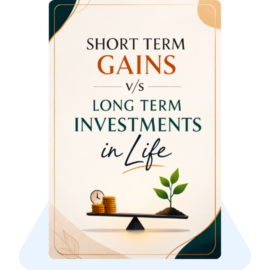
There is a question that quietly shapes the direction of almost every human life, yet very few people ever sit down and consciously answer it. That question is this: are you living for today, or are you building for tomorrow?
It sounds simple. But the answer to that question, played out across thousands of small daily decisions, is ultimately what separates people who look back on their lives with deep satisfaction from those who look back with regret.
At Readers Books Club, we spend our time exploring the most powerful ideas in the world of books, and we can tell you honestly that the theme of short-term thinking versus long-term investment appears, in one form or another, in almost every great book ever written on success, wealth, health, relationships, and happiness. It is not a niche idea. It is the idea. And in our most recent podcast episode and YouTube video, we decided to explore it head-on.
This blog is an expanded companion to that episode. Whether you watched the video, listened to the podcast, or are coming to this for the first time, we hope this piece gives you something genuinely useful, a shift in perspective that you will still be thinking about a week from now.
Why the Short Term Always Feels More Compelling
Let us start with something uncomfortable: the short term is not just tempting; it is neurologically designed to win. Human beings evolved in environments where the future was deeply uncertain. Food might not be available tomorrow. The threat around the corner might never come. In that world, taking the reward now made complete survival sense.
Our brains have not caught up with modern life. The psychological principle known as hyperbolic discounting describes our tendency to assign dramatically more value to immediate rewards than to future ones, even when the future reward is objectively larger. Research in behavioural economics has shown, time and again, that people make choices in the present that their future selves would absolutely not endorse.
This is why the takeaway beats the home-cooked meal. Why the night out beats the savings account. Why scrolling through your phone at midnight beats the good night’s sleep you desperately need. None of these decisions are made by bad people or stupid people. They are made by normal human beings doing exactly what their biology is nudging them to do.
The problem arises when short-term thinking stops being an occasional indulgence and becomes your default operating mode. When every financial decision, every health decision, every career decision and every relationship decision is made primarily on the basis of what feels good right now; you are quietly making withdrawals from a future you have not yet met.
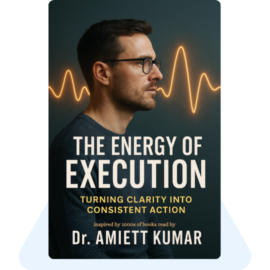
Understanding this is the first step. Because once you can see the pattern clearly, you can begin to interrupt it , not with willpower, which runs out, but with awareness, systems, and identity. This is precisely the territory that the books we feature at Readers Books Club explore so brilliantly, and it is the territory that thinkers like Dr Amiett Kumar have dedicated their work to.
The Philosophy of Dr Amiett Kumar: Manifest Anything Through Long-Term Alignment
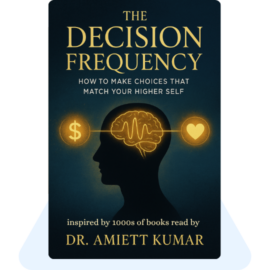
Few voices have resonated as deeply with our Readers Books Club community as that of Dr Amiett Kumar. His work sits at the intersection of mindset, discipline, and what he describes as the art of being able to manifest anything , not through passive wishing, but through the active, daily alignment of your choices with your deepest vision for your life.
Dr Amiett Kumar’s core teaching is deceptively straightforward: the life you want already exists as a possibility. What determines whether you reach it is not luck, not talent, and not circumstance; it is the quality and consistency of the daily decisions you make. Every single day, you are either building a bridge toward that life or tearing one down.
This framing changes everything. When you understand that your future is not something that happens to you but something you are actively constructing, brick by brick, choice by choice, the short-term versus long-term question takes on an entirely different weight. Suddenly, the extra hour of sleep instead of late-night scrolling is not just a health choice. It is a statement about who you are becoming. The book you read instead of the mindless television is not just personal development. It is an investment in the version of yourself who can manifest anything you genuinely desire.
What Amiett Kumar brings to this conversation that goes beyond the typical self-help messaging is his emphasis on identity. He does not simply ask you to make better choices. He asks you to become the kind of person who naturally makes those choices, because they are an expression of who you are, not a constant battle against who you are. This distinction is enormously important, and it is one we will return to later in this piece.
For anyone who wants to go deeper into this philosophy, we strongly encourage you to explore Dr Amiett Kumar’s work directly. It pairs beautifully with the books we summarise and discuss here at Readers Books Club, and together they form a genuinely powerful framework for long-term living.
The Books That Define the Long-Term Mindset
At Readers Books Club, we believe that books are the single fastest shortcut to the distilled wisdom of people who have already made the mistakes, done the experiments, and lived the lessons. Here are the key books that shaped our thinking on this topic , each one a masterclass in long-term investment thinking.
The Compound Effect by Darren Hardy
This is perhaps the most direct book ever written on the power of long-term consistency. Hardy’s central argument is simple: small, seemingly insignificant actions, repeated consistently over time, compound into results that look like overnight success from the outside. The person who reads ten pages a day reads over thirty books a year. The person who walks for thirty minutes each morning will have walked over 180 hours by year’s end. None of it looks dramatic. All of it is transformational. The Compound Effect is essential reading for anyone who has ever felt that their small efforts were not making a difference, because they are. You just cannot see it yet.
Atomic Habits by James Clear
James Clear’s landmark book builds on a deceptively simple idea: you do not rise to the level of your goals; you fall to the level of your systems. Atomic Habits teaches that lasting change is not about motivation or willpower; it is about designing your environment and your daily routines so that the right behaviour is the easy behaviour. For the short-term versus long-term conversation, this book is vital. It shows that the way to consistently choose the long term is not to try harder in the moment. It is to set things up in advance so that the long-term choice becomes the path of least resistance.
The Psychology of Money by Morgan Housel
Morgan Housel’s brilliant exploration of wealth and human behaviour is one of the most important books of the last decade. His core insight, that financial success has far more to do with behaviour and time than with intelligence or income, cuts right to the heart of our topic. Housel shows, with both data and beautiful storytelling, that the investors who win are not the cleverest ones. They are the ones who stay in the game the longest. Patience and consistency, compounding quietly over decades, produce results that no short-term strategy can match.
Think and Grow Rich by Napoleon Hill
Written nearly a century ago and still as relevant as ever, Napoleon Hill’s classic is a study in the psychology of long-term achievement. Hill spent decades interviewing the most successful people of his era and distilled their wisdom into a set of principles centred on desire, faith, persistence, and what he called a definite chief aim. The book is a reminder that people who achieve great things do not do so because of a single lucky break. They do so because they hold a clear vision, refuse to be derailed by short-term setbacks, and commit to their path over the long haul. This is exactly the mindset that Dr Amiett Kumar and the Readers Books Club community champion.
The Infinite Game by Simon Sinek
Simon Sinek’s The Infinite Game makes a crucial distinction between finite players , those who play to win, and infinite players, those who play to keep playing. In business, relationships, and life, the infinite player is not focused on the next quarter or the next milestone. They are focused on building something sustainable, something that lasts. This perspective is a powerful antidote to the short-term thinking that dominates so much of modern culture. It asks: what are you building, and are you building it to endure?
Five Life Areas and the Long-Term Choice in Each
Theory is useful. But change happens in the specific, practical moments of daily life. Here is how the short-term versus long-term tension plays out in five areas that matter most, and what the long-term choice looks like in each.
Career and Professional Growth
Short-term thinking in a career looks like taking the highest-paying job available right now, regardless of whether it builds skills or opens doors. It looks like avoiding uncomfortable projects, staying in your comfort zone, and prioritising immediate recognition over genuine growth. Long-term thinking looks like asking where this role, this skill, this relationship is taking you in five to ten years. It looks like investing time in learning even when there is no immediate reward. It looks like building a reputation slowly and carefully, knowing that reputation is one of the most powerful compounding assets a person can have. The books we feature at Readers Books Club again and again return to this theme: mastery takes time, and the people who are willing to invest that time are the ones who eventually become irreplaceable.
Financial Decisions
This is perhaps the area where the compound effect is most mathematically visible. Every pound spent today on something that does not serve your long-term goals is a pound that could have been growing. The Psychology of Money shows us that ordinary people on ordinary incomes who invest consistently and patiently over decades end up with extraordinary wealth , not because of genius, but because of time. The short-term choice is the new car, the impulse purchase, the upgraded lifestyle. The long-term choice is the investment account, the emergency fund, and the discipline to say no to yourself today so that your future self has genuine freedom.
Health and Physical Wellbeing
Almost no area of life illustrates the compounding nature of long-term choices more vividly than health. The single workout does nothing. The single salad changes nothing. But the person who moves their body every day for ten years, who makes mostly good food choices most of the time, and who prioritises sleep and manages stress, that person looks and feels radically different at fifty than the person who chose comfort at every turn. Dr Amiett Kumar speaks to this directly: your body in ten years is the sum total of every small decision you make today. This is not about perfection. It is about direction.
Relationships and Communication
One of the most overlooked areas of long-term investment is in our relationships. Short-term thinking in relationships looks like avoiding conflict to keep the peace, saying yes when you mean no, and never having the difficult conversations that need to happen. It feels comfortable in the moment and slowly hollows out the connection over time. Long-term investment in relationships looks like honesty, even when it is uncomfortable. It looks like showing up consistently rather than dramatically. It looks like being the kind of person that others can trust absolutely, because trust, like compound interest, builds slowly and is extraordinarily valuable once it exists.
Learning and Intellectual Growth
Here at Readers Books Club, this one is close to our hearts. Reading one book a month sounds unremarkable. Over five years, that is sixty books. Over ten years, one hundred and twenty books. The cumulative wisdom, perspective, and mental models you build through that kind of sustained reading create a compounding intellectual advantage that shows up in every area of your life. Short-term thinking scrolls for forty-five minutes. Long-term thinking reads for thirty. The difference in outcomes, over a decade, is almost impossible to overstate.
The Identity Gap: Why Knowing Is Not Enough
Here is the difficult truth that we want to address directly in this post. Most people reading this already know most of what we have shared here. They have heard it before, in books, in podcasts, perhaps even in a previous Readers Books Club episode. They felt inspired. They decided to change. And within a week or two, the old patterns quietly returned.
This is not a failure of intelligence or willpower. It is a failure of identity.
As long as you see yourself as someone who is trying to make better long-term choices, you will always be fighting against your default self. Every decision will feel like a battle. And battles are exhausting. You will win some and lose many, and slowly the effort of fighting will drain you back to your baseline.
The insight that Dr Amiett Kumar and the best books in personal development keep returning to is this: the goal is not to make better choices. The goal is to become a different person, one for whom the better choice is simply what they naturally do. James Clear calls this identity-based habit change. You do not aim to read more books. You become a reader. You do not aim to exercise more. You become someone who moves their body every day. You do not aim to save more money. You become someone who invests first and spends what remains.
When your identity shifts, the decisions become easy. They stop being choices and start being expressions of who you are. This is how you manifest anything you genuinely desire, not through heroic willpower, but through the quiet, steady, identity-level commitment to the long game.
A Practical Starting Point
We never want to leave a Readers Books Club post, podcast, or video without giving you something concrete to take into your week. So here is a simple starting point for shifting from short-term reactive to long-term intentional:
- Write down your ten-year vision. Not vaguely, specifically. What does your health look like? Your finances? Your relationships? Your work? Give your future self a clear, vivid picture to move toward.
- Identify your three most common short-term traps. The decisions you keep making that you know are pulling you away from that vision. Name them. Own them. Patterns lose power when they are named.
- For each trap, design one small environmental or habitual change that makes the long-term choice slightly easier. Remove friction from the good choice. Add friction to the short-term one.
- Read one of the books mentioned in this post. Start with Atomic Habits or The Compound Effect if you are new to this thinking. Let someone else’s decade of insight do some of the heavy lifting for you.
- Revisit your ten-year vision every month. The long game requires you to keep reconnecting with the bigger picture, especially in the moments when the short-term choice is screaming loudest.
None of this is revolutionary. But consistent application of simple principles over a long period of time is, in fact, the closest thing to a guaranteed formula for a meaningful life. That is the message at the heart of everything we do at Readers Books Club.
Final Thoughts
Short-term gains are real. They are sometimes genuinely necessary. There are moments in every life when the immediate is the right call. We are not here to tell you to delay every pleasure and sacrifice every comfort on the altar of some future self.
But we are here to say this: if you have never consciously examined the balance between short-term and long-term thinking in your own life , if you have simply been responding to whatever each day throws at you without asking whether those responses are building the life you actually want, then now is a good time to start.
The insights of Dr Amiett Kumar, the wisdom of the books we explore at Readers Books Club, the research in behavioural psychology, and the stories of every person who has built something genuinely worth having all point in the same direction. The long game wins. Not always quickly. Not always visibly. But reliably, inevitably, and beautifully.
Your future self is watching the choices you make today. Make them count.
If this piece resonated with you, please share it with someone who needs to hear it. Watch our full podcast episode and YouTube video for an even deeper dive into this topic , and subscribe to Readers Books Club for weekly book summaries, reviews, and conversations designed to make you think.
Learn More from Readers Books Club:
- Never Stop Learning Because Life Never Stops Teaching
- How the Energy of Your Name Impacts Your Manifestation
Contents