How to Stop Scrolling and Start Living
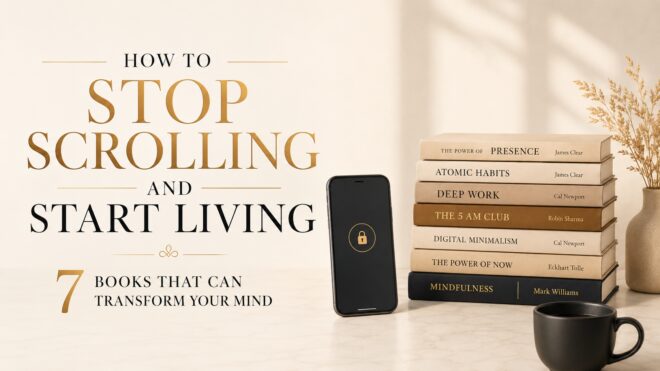
7 Books That Can Transform Your Mind
Introduction: When Your Attention Stops Belonging to You
You open your phone to reply to one message. A notification pulls you into another app. One short video becomes ten, ten become fifty, and suddenly twenty-five minutes have disappeared. You put the phone down, but your mind still feels busy. You have consumed a lot, yet you cannot remember much of it.
This is one of the strangest problems of modern life. We have more information than any generation before us, but less uninterrupted attention. We are connected to everyone, yet often disconnected from our own thoughts. We save posts about productivity, meditation, spirituality, personal growth, and the law of attraction but struggle to sit quietly long enough to apply even one idea.
The solution is not to hate technology or disappear from the internet. The real goal is to stop using digital tools unconsciously. Your phone should serve your life; your life should not become a waiting room between notifications.
Books can help because reading trains the opposite mental muscles from scrolling. Scrolling rewards speed, novelty, and reaction. Reading develops patience, reflection, imagination, and sustained attention. A meaningful book does not simply give you information. It creates enough silence for you to notice how you are living.
At Readers Books Club, books are explored as tools for implementation, not as decorations for a shelf. Through book summaries, YouTube videos, podcasts, and coaching-orientated content, Amiett Kumar and the Readers Books Club community have helped millions of viewers turn powerful ideas into practical action. The seven books in this guide offer a complete path from digital distraction to intentional living.
Why Scrolling Feels Almost Automatic
Before exploring the seven books, it helps to understand why scrolling is so difficult to control. Most people assume the problem is laziness or weak willpower. That explanation is incomplete.
Digital platforms are built around rapid feedback. Every refresh may reveal a new message, video, reaction, opportunity, or surprise. Because the reward is unpredictable, the mind keeps checking. The next swipe might be boring, or it might be exactly what you wanted. This uncertainty creates a powerful loop.
Scrolling is also an easy escape from discomfort. When a task feels difficult, when a conversation leaves us uneasy, or when we feel lonely, bored, uncertain, or tired, the phone offers immediate relief. The screen does not solve the feeling, but it interrupts it. Over time, the mind learns a simple rule: discomfort means check the phone.
There is also an environmental problem. A person may genuinely want to read, meditate, write, exercise, visualise a goal, or work deeply, but the phone is nearby, notifications are active, and entertainment is available in one tap. In that environment, distraction is not an occasional temptation. It is the default option.
This is why vague advice such as “use your phone less” rarely creates lasting change. You need a better understanding of attention, a clear philosophy for technology, systems that reduce temptation, meaningful alternatives, and daily rituals that make focused living easier. The seven books below provide those pieces.
1. Stolen Focus by Johann Hari: Understand What Is Stealing Your Mind
Johann Hari’s Stolen Focus is the best place to begin because it changes the way you interpret your struggle. Instead of treating distraction as a private moral failure, the book examines the wider forces that make sustained attention difficult.
Hari explores how constant interruptions, stress, poor sleep, information overload, fragmented work, and technology-driven business models can weaken our ability to concentrate. His central message is deeply relieving: your attention has not disappeared because you are uniquely undisciplined. You are living inside systems that compete aggressively for it.
That does not remove personal responsibility. It makes personal responsibility more intelligent. When you understand that attention is shaped by environment, culture, health, and technology, you stop relying only on motivation. You begin changing the conditions in which your mind operates.
The most practical lesson from Stolen Focus is to identify every major force stealing your attention. Is it notifications? Multitasking? Lack of sleep? Constant urgency? A work environment that expects immediate replies? Anxiety that you are trying to escape? The goal is not to blame one app. It is to see the entire attention ecosystem.
Try an attention audit for three days. Each time you become distracted, record what you were doing, what interrupted you, and what emotion you felt immediately before switching. You may discover that the phone is not always the original problem. Sometimes the trigger is fatigue, confusion, fear of failure, or a task that has not been clearly defined.
Stolen Focus transforms your mind by replacing self-criticism with awareness. You cannot reclaim what you have not yet understood.
2. Digital Minimalism by Cal Newport: Use Technology With Purpose
Once you understand the problem, Digital Minimalism by Cal Newport helps you develop a philosophy. Many people try random digital detoxes. They delete an app, return a few days later, and feel disappointed. Newport argues that temporary restriction is not enough. You need clear principles for deciding which technologies deserve a place in your life.
Digital minimalism does not mean rejecting every device or living without social media. It means using technology intentionally, in ways that strongly support your values, and refusing low-value digital noise.
The better question is not whether an app is good or bad, but whether the way you use it supports the life you want.
Newport recommends a period of digital decluttering in which optional technologies are removed or sharply limited. During that period, you rediscover meaningful offline activities. This second part is essential. If you only remove scrolling, you create a vacuum. The mind will eventually refill that vacuum with the easiest available stimulation.
Choose high-quality alternatives: walking, journaling, exercise, deep conversation, creative work, spiritual study, meditation, volunteering, or reading physical books. These activities may feel slower at first because they do not deliver constant novelty. With repetition, however, they produce a deeper kind of satisfaction.
Create a personal technology policy. Decide which apps you will use, why you will use them, when you will use them, and what boundaries will protect you. For example: social media only on a computer, messages checked at three fixed times, no phone during meals, and no entertainment apps in the bedroom.
Digital minimalism transforms your mind by teaching you that access is not the same as value. You do not need to consume everything available. A focused life is built through deliberate exclusion.
3. Deep Work by Cal Newport: Rebuild Your Ability to Concentrate
Deep Work, also by Cal Newport, focuses on what becomes possible when distraction is reduced. Deep work is the ability to concentrate without interruption on a cognitively demanding task. It is the state in which you learn difficult skills, solve complex problems, produce original work, and make meaningful progress.
Many people spend their day in shallow activity: checking messages, attending unnecessary meetings, switching between tabs, reacting to requests, and repeatedly organising work without doing the work. They feel busy but not fulfilled because activity and achievement are not the same.
The book’s strongest lesson is that focus must be scheduled. Waiting to feel inspired is unreliable. If deep work matters, it needs a protected place in your calendar.
Begin with a small focus block. Choose one important task and work on it for thirty minutes with the phone in another room. Close unrelated tabs. Keep a sheet of paper nearby; when another thought appears, write it down instead of acting on it. Increase the block gradually as your concentration improves.
Newport also recommends embracing boredom. This sounds unusual, but it addresses a major reason scrolling becomes compulsive. If every quiet moment is filled with stimulation, the brain never practises being unstimulated. Then, whenever work slows down or meditation becomes uncomfortable, the urge for novelty feels unbearable.
Practise waiting without entertainment. Stand in a queue without checking your phone. Sit for five minutes after lunch. Walk without audio. Allow the mind to settle. Boredom is not empty time; it is the training ground for attention.
Focused attention also improves visualisation and affirmation by helping the mind hold an intention long enough to connect it with action.
Deep Work transforms your mind by showing that concentration is not a personality trait. It is a skill, and skills improve through structured practice.
4. Indistractable by Nir Eyal: Understand the Emotion Behind the Scroll
Indistractable by Nir Eyal adds an important psychological layer. It explains that external triggers – notifications, sounds, icons, and messages – are only part of distraction. Many distractions begin internally.
We often reach for the phone because we want to change how we feel. A difficult task creates uncertainty, so we check email. A quiet evening creates loneliness, so we scroll. A moment of self-doubt appears, so we search for motivation. The action looks digital, but the trigger is emotional.
Eyal separates traction from distraction. Traction is any action that moves you toward what you intended to do. Distraction is any action that pulls you away from that intention. This means the same activity can be either one. Watching a Readers Books Club summary you intentionally scheduled may be traction. Watching recommendations for two hours when you planned to sleep is a distraction.
The practical solution begins with naming the discomfort. When you feel the urge to scroll, pause and ask: what sensation or emotion am I trying to escape? Do not judge it. Observe it. Urges often rise, peak, and fall when they are not immediately obeyed.
Then make time for traction. Put important activities on the calendar, including rest, family, reading, exercise, meditation, and recreation. If meaningful life is not scheduled, digital platforms will happily schedule your attention for you.
You can also hack back external triggers. Turn off non-essential notifications. Remove badges from app icons. Unsubscribe from low-value emails. Keep distracting apps off the home screen. Tell people when you will be unavailable for focused work.
Create precommitments before temptation arrives: leave the phone outside the room while reading, use a site blocker during work, and charge the device away from the bed.
Indistractable transforms your mind by helping you see distraction as a response, not an identity. You are not “a distracted person”. You are a person who can understand triggers and choose a different response.
5. Essentialism by Greg McKeown: Decide What Deserves Your Life
Essentialism by Greg McKeown addresses a problem that sits beneath digital overload: we are trying to care about too many things at once. Every message feels urgent. Every trend seems relevant. Every opportunity looks important. When everything receives attention, nothing receives enough attention.
Essentialism is not simply about doing less. It is about doing less of what does not matter so you can invest more deeply in what does.
Scrolling often flourishes in a life without clear priorities. When you do not know what deserves your evening, any video can take it. When you have not decided what kind of person you want to become, every online opinion competes to define you.
McKeown encourages readers to explore carefully, eliminate deliberately, and execute what matters. Applied to digital life, this means asking hard questions. Which online spaces genuinely improve your relationships, knowledge, work, health, or joy? Which ones only create comparison, noise, and urgency? Which commitments keep you busy but move you away from your values?
Try the “one essential thing” practice. Each morning, identify the single action that would make the day meaningful. It may be completing a project, spending uninterrupted time with your child, attending a coaching session, meditating, reading twenty pages, or taking care of your health. Protect that action before entering the digital stream.
Essentialism also teaches the importance of saying no. Every yes spends time, attention, and energy. You do not need to reply immediately to every message. You do not need to follow every news cycle. You do not need to turn every hobby into content. Boundaries are not selfish; they protect your ability to contribute meaningfully.
For people practising manifestation or visualisation, essentialism brings precision. A mind filled with conflicting goals produces scattered action. Choosing what matters allows intention, emotion, and behaviour to move in the same direction.
Essentialism transforms your mind by replacing fear of missing out with the confidence to choose. A meaningful life is not built by fitting everything in. It is built by knowing what to leave out.
6. Atomic Habits by James Clear: Make Focus Easier Than Distraction
Atomic Habits by James Clear is one of the most practical books for turning insight into behaviour. You may understand digital distraction, create beautiful goals, and feel motivated after a podcast, yet still return to old patterns. That is because behaviour is shaped by systems, cues, ease, and repetition.
Clearly, small actions compound. A single evening of scrolling may not change your life, just as a single page of reading may not transform it. But repeated choices create identity. Every time you read instead of scroll, you cast a vote for becoming a reader. Every time you protect a focus block, you cast a vote for becoming a focused person.
The book’s four-part framework is especially useful: make good habits obvious, attractive, easy, and satisfying; make unwanted habits invisible, unattractive, difficult, and unsatisfying.
To reduce scrolling, begin by changing cues. Keep the phone outside your immediate reach. Log out of distracting apps. Turn the display to greyscale. Remove social apps from the home screen. Do not depend on remembering your intention while the strongest cue sits beside you.
Then make the replacement habit easy. Place a book on your pillow if you want to read at night. Keep a meditation cushion visible. Open the document you need before starting work. Prepare walking shoes near the door. Reduce the number of steps between intention and action.
Use habit stacking: “After I make morning tea, I will read two pages.” “After I finish lunch, I will take a five-minute phone-free walk.” “After I place my phone on charge, I will meditate for ten minutes.” Start small enough that resistance has little room to grow.
Track the behaviour, not perfection. Mark each day you complete your chosen action. If you miss once, return the next day. The goal is not an unbroken performance for social media. The goal is a reliable identity in real life.
Atomic Habits transforms your mind by proving that change does not require dramatic reinvention. Your environment and repeated actions can make a focused life feel natural.
7. Make Time by Jake Knapp and John Zeratsky: Design a Day Worth Remembering
Make Time by Jake Knapp and John Zeratsky brings the lessons of the previous books into the design of an ordinary day. It is not a rigid productivity system. It is a flexible framework for choosing what deserves attention and creating the energy to enjoy it.
The authors recommend selecting a daily highlight – one activity you want to prioritise. Your Highlight may be urgent, satisfying, or joyful. The point is to decide before the day disappears into messages and reactions.
The next step is to use tactics that reduce distraction. These may include logging out of apps, removing email from the phone, creating a distraction-free device, setting a visible timer, or physically separating from the internet. You do not need every tactic. You need experiments that fit your life.
The book also connects focus with energy. Sleep, movement, food, sunlight, and human connection influence attention, so caring for the body is part of digital discipline.
The final step is reflection. At the end of the day, notice what helped and what did not. This turns lifestyle change into an experiment rather than a test of character. You are not failing when one strategy does not work. You are collecting information about your mind and environment.
Try a simple Make Time day. Choose one Highlight and write it on paper. Create one hour of laser mode with all distractions blocked. Add one activity that improves energy, such as a walk or short workout. In the evening, write two sentences: what helped me focus and what distracted me?
Make Time is an excellent final book in this list because it prevents self-improvement from becoming abstract. You can read about mindfulness, motivation, coaching, spirituality, or success for years, but transformation happens inside actual days.
Make Time transforms your mind by teaching you to design your attention before the world designs it for you.
Which Book Should You Read First?
You do not need to read all seven books at once. Choose according to your current problem.
Start with Stolen Focus when you need to understand why attention feels broken. Choose digital minimalism when technology has become too dominant in your life. Read Deep Work when you want to strengthen concentration for study, business, creativity, or professional growth. Choose Indistractable when emotional triggers repeatedly pull you away from your plans.
Read Essentialism when your schedule and mind feel overcrowded. Choose Atomic Habits when you know what to do but struggle to remain consistent. Read Make Time when you want a flexible daily system that brings your priorities into real life.
A useful sequence is Stolen Focus, Digital Minimalism, Atomic Habits, and Make Time. This path moves from awareness to philosophy, then from habit design to daily execution. Deep Work, Indistractable, and Essentialism can be added according to your needs.
Do not turn the list into another form of consumption. Reading seven summaries without changing one behaviour is simply slower scrolling. After each chapter or summary, write one sentence: “Because of this idea, I will…” Then complete the action before moving to the next book.
This implementation-first approach reflects the purpose of Readers Books Club. The value of books is not measured only by how many you finish. It is measured by the quality of decisions they help you make.
A 7-Day Stop-Scrolling Reset
Use the following plan as a gentle reset, not as punishment.
- Day 1 – Observe: Check your screen-time report and identify the three apps taking most of your attention. Do not judge the numbers. Record them.
- Day 2 – Remove cues: Turn off unnecessary notifications, remove distracting apps from the home screen, and create one phone-free space in your home.
- Day 3 – Choose a Highlight: Decide on one meaningful activity before opening social media. Complete it first.
- Day 4 – Practise boredom: Take a ten-minute walk without your phone, music, or podcast. Notice the urge for stimulation and allow it to pass.
- Day 5 – Replace scrolling: Prepare a visible alternative such as a book, journal, meditation practice, exercise routine, or conversation with someone you value.
- Day 6 – Create a focus block: Work or read for thirty uninterrupted minutes. Put the phone in another room and keep only the tools required for the task.
- Day 7 – Review: Ask what improved your attention, what triggered distraction, and which boundary you are willing to continue for the next thirty days.
The purpose is not to become perfectly disciplined in one week. It is to prove that attention can be redirected through small, deliberate choices.
Meditation, Spirituality, and the Inner Side of Attention
Meditation is especially valuable in this process because it trains the moment between urge and action. You sit, notice a thought, and return to the breath. You feel restlessness and learn that you do not have to obey it. That same skill appears when the urge to check the phone arises.
Begin with five minutes. Place the phone out of reach, sit comfortably, and pay attention to breathing. When the mind wanders, return without criticism. The purpose is not to eliminate thoughts. It is to practise returning attention voluntarily.
Spirituality can deepen this practice by asking a larger question: what kind of life is worthy of my attention? Digital discipline becomes easier when it is connected to meaning. You are not merely reducing screen time. You are making space for presence, relationships, service, creativity, health, and inner clarity.
The law of attraction is often discussed in terms of thoughts, affirmation, emotion, and visualisation. Yet a person cannot build a desired reality through intention alone while repeatedly giving time and energy to habits that contradict it. If you affirm that you are focused but spend every free moment in reactive scrolling, the behaviour sends a stronger daily message.
A grounded approach combines inner work with aligned action. Visualise the person you want to become. Notice how that person uses technology, protects mornings, handles boredom, learns, rests, and speaks to themselves. Then choose one behaviour today that matches that identity.
This is where a life coach or coaching process can help. Good coaching does not simply provide motivation. It creates awareness, accountability, and practical structure. Whether you learn through books, Readers Books Club videos, Dr Amiett Kumar’s teachings, meditation, or a personal mentor, the principle remains the same: knowledge becomes transformation only when it enters behaviour.
Frequently Asked Questions
1. What are the best books to stop scrolling and improve focus?
The strongest starting points are Digital Minimalism, Stolen Focus, Deep Work, and Indistractable. Atomic Habits and Make Time are especially useful for creating practical systems that make focused behaviour easier.
2. Can reading books really improve attention span?
Reading requires sustained engagement with one stream of meaning. Regular reading can help you practise patience and concentration, particularly when you remove the phone and read without switching tasks. Begin with ten minutes and gradually increase the duration.
3. Is a digital detox necessary?
A temporary detox can reveal how strongly certain tools shape your behaviour, but lasting change requires more than deletion. Create clear rules, meaningful offline alternatives, and an environment that supports intentional use.
4. Why do I keep scrolling even when I do not enjoy it?
Scrolling may be a learned response to boredom, stress, loneliness, uncertainty, or task discomfort. Observe what you feel immediately before opening an app. Understanding the internal trigger makes a different response possible.
5. How can meditation help reduce phone addiction?
Meditation trains awareness of urges without immediate reaction. It can help you notice restlessness, pause, and choose rather than act automatically. It should support practical boundaries, not replace them.
6. Which book is best for building better habits?
Atomic Habits is the most direct choice. It explains how cues, environment, ease, rewards, and identity influence behaviour. Its methods can be applied to reading, focus, meditation, exercise, and reduced screen use.
7. How much screen time is healthy?
There is no single number that fits every person or profession. Consider the purpose and effect of your screen use. Ask whether it supports work, learning, connection, and wellbeing, or repeatedly displaces sleep, movement, relationships, and important goals.
8. How long does it take to break a scrolling habit?
There is no universal deadline. Progress depends on frequency, emotional triggers, environment, and the quality of replacement habits. Focus on reducing automatic use and building a sustainable routine rather than chasing a perfect streak.
Conclusion: The Life You Want Needs Your Attention
Your attention is one of the most valuable resources you possess. It shapes what you learn, what you notice, who you become, and how you experience life.
The goal is not to reject the digital world. It is to enter it consciously and leave it when your purpose is complete. The seven books in this guide offer a complete toolkit: understand the attention crisis, choose technology intentionally, practise deep concentration, recognise emotional triggers, eliminate the non-essential, build supportive habits, and design meaningful days.
Choose one book and one action. Put the phone away for thirty minutes. Read a few pages. Sit in meditation. Take a walk. Speak to someone without checking a screen. Work on the goal you keep saving motivational posts about.
A better life is not waiting inside the next scroll. It begins when you return your attention to the moment already in front of you.
Explore more practical book summaries, podcasts, and transformational ideas with Readers Books Club and Amiett Kumar. Do not just collect knowledge. Apply one lesson, observe the change, and keep evolving.
Contents