A practical guide to transforming emotional patterns into self-mastery
Introduction: What If the Biggest Obstacle Is Not Outside You?
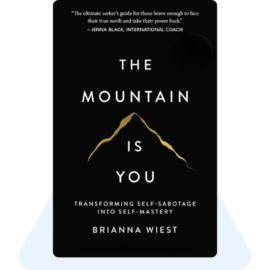
Have you ever promised yourself that you would finally change, only to repeat the same habit a few days later? Perhaps you delayed an important project even though success mattered deeply to you. Maybe you returned to a relationship that drained you, avoided an opportunity because it felt intimidating, or abandoned a healthy routine just when it started working. These moments can feel confusing because one part of you genuinely wants growth while another part quietly resists it. This inner conflict is the territory explored in The Mountain Is You by Brianna Wiest.
The book presents a powerful idea: the mountain standing between you and the life you want is often not a person, a circumstance or a lack of talent. It is the collection of emotional patterns, unprocessed experiences, hidden fears and protective behaviours operating within you. Self-sabotage is not proof that you are lazy, weak or incapable. It is usually a signal that two needs are competing inside you. One part seeks change; another part seeks safety, familiarity or emotional protection.
This book summary explains how to stop self-sabotage by understanding what your behaviour is trying to communicate. It explores emotional intelligence, resilience, self-trust, meditation, spirituality and the daily actions that turn awareness into transformation. In the practical style valued by Readers Books Club, the goal is not simply to know the ideas in a book. The goal is to apply them.
For readers who follow Amiett Kumar, personal development books, Law of Attraction teachings, coaching or the guidance of a life coach, The Mountain Is You offers an important bridge between intention and action. Positive thinking can give direction, but real transformation also requires us to face the patterns that keep pulling us backward. Your mountain is not a punishment. It is an invitation to become the person capable of living the life you keep imagining.
What Is The Mountain Is You About?
The Mountain Is You is a self-help and personal growth book about transforming self-sabotage into self-mastery. The mountain is used as a metaphor for the internal challenge that demands our growth. Every person has a different mountain. It may appear as fear of failure, fear of success, perfectionism, procrastination, emotional dependence, people-pleasing, avoidance, comparison or a constant need for external approval.
Wiest argues that these behaviours are rarely random. They often develop because they once served a purpose. Avoidance may have protected you from rejection. Perfectionism may have helped you earn appreciation. People-pleasing may have reduced conflict. Emotional detachment may have kept you from being hurt. The problem begins when an old survival response continues long after the original situation has ended.
The book therefore does not ask you to fight yourself with more force. It asks you to understand yourself with greater honesty. When you identify the need beneath the behaviour, you can meet that need in a healthier way. Instead of trying to destroy the part of you that resists change, you learn why it is afraid. That compassionate awareness creates the foundation for lasting growth.
The central journey has three stages. First, you recognise the patterns that are limiting you. Second, you process the emotions and beliefs that sustain those patterns. Third, you build new habits, a stronger identity and the emotional capacity to hold the life you want. This is why the book is not only about motivation. It is about becoming emotionally prepared for your own goals.
Why Do We Self-Sabotage?
Self-sabotage happens when our conscious desire and subconscious need move in opposite directions. Consciously, you may want a promotion. Subconsciously, you may associate greater responsibility with stress, criticism or the loss of freedom. You may want a loving relationship while also believing that closeness eventually leads to pain. You may want financial growth but feel guilty about becoming more successful than people around you. When the hidden fear is stronger than the visible goal, behaviour usually follows the fear.
This explains why willpower alone often fails. Willpower can temporarily suppress a behaviour, but it does not automatically resolve the emotional need underneath it. Someone who procrastinates may not need another productivity technique; they may need to separate their self-worth from the outcome of their work. Someone who repeatedly chooses unavailable partners may not need more dating advice; they may need to become comfortable with healthy intimacy.
Self-sabotage also thrives on familiarity. The nervous system often interprets what is familiar as safe, even when it is painful. A calm environment may feel uncomfortable to someone accustomed to chaos. Consistency may feel boring to someone who has learned to function through urgency. A respectful relationship may feel strangely uncertain to someone whose idea of love was formed around unpredictability. We may return to familiar discomfort because unfamiliar peace requires a new emotional identity.
The first step in learning how to stop self-sabotage is to replace judgement with curiosity. Instead of asking, “What is wrong with me?” ask, “What is this behaviour trying to protect me from?” That question changes the entire conversation. It moves you from shame to understanding, and understanding makes change possible.
Signs That You May Be Standing in Your Own Way
Self-sabotage is not always dramatic. It often hides inside ordinary choices that appear harmless in isolation. You may keep preparing but never publish, apply or launch. You may set unrealistic standards and then use your inability to meet them as evidence that you should stop. You may create conflict when a relationship becomes stable, spend impulsively when savings begin to grow, or abandon a routine after missing one day.
A useful exercise is to identify the repeating result in your life. What outcome keeps appearing despite your best intentions? Then trace the actions that usually lead to it. Finally, notice the feeling you are trying to avoid or create through those actions. This pattern map may reveal that procrastination helps you avoid evaluation, overworking helps you feel worthy, or people-pleasing helps you avoid abandonment.
Awareness is not the same as blame. You are not responsible for every wound or circumstance that shaped you, but you are responsible for what you do with the pattern now. The moment you can observe a behaviour without automatically obeying it, you create a gap. Inside that gap is choice.
Your Triggers Are Messengers, Not Enemies
One of the most useful ideas in The Mountain Is You is that emotional triggers contain information. A trigger is an intense reaction that seems larger than the present event. It may indicate that an old wound, unmet need, fear or belief has been activated. The goal is not to let every reaction control your behaviour, but neither is it wise to dismiss every reaction as irrational.
For example, criticism from a manager may trigger overwhelming shame because it connects with an older belief that mistakes make you unworthy. A friend’s success may create jealousy because it highlights a dream you have neglected. Someone setting a boundary may feel like rejection if you’ve learnt to equate love with constant access. The present event is real, but the intensity may be carrying the weight of the past.
When triggered, pause before creating a story. Name the feeling precisely: disappointment, embarrassment, fear, grief, envy, anger or powerlessness. Ask what the feeling seems to say about you, other people or the future. Then separate the fact from the interpretation. “They did not reply today” is a fact. “Nobody values me” is an interpretation. This separation reduces emotional confusion.
Meditation can support this process because it trains the ability to witness thoughts and feelings without instantly becoming them. In both psychology and spirituality, this observing awareness is deeply valuable. You learn that a thought can be present without being a command, and an emotion can be honoured without becoming your identity.
Emotional Intelligence: Feelings Need to Be Processed
Many people try to overcome self-sabotage by becoming less emotional. The book points in a different direction: growth requires emotional intelligence, not emotional numbness. Feelings carry information about needs, boundaries, losses, expectations and values. When ignored, they do not necessarily disappear. They may return as anxiety, irritability, compulsive behaviour, exhaustion or avoidance.
A simple emotional processing practice has four parts. First, identify the physical sensation: tight chest, heavy stomach, tense jaw or restless energy. Second, name the emotion without exaggerating it. Third, ask what need or belief is connected to it. Fourth, choose one grounded action. That action might be a conversation, rest, journaling, a boundary, an apology, a plan or professional support.
The more accurately you understand your emotions, the less they need to control you indirectly. This is a key principle of self-mastery. You do not become powerful by never feeling discomfort. You become powerful by knowing how to move through discomfort without abandoning yourself.
Stop Waiting to Feel Ready
A common form of self-sabotage is waiting for a future version of yourself to feel completely confident, motivated and certain. But confidence is usually the result of action, not its prerequisite. You learn that you can handle a situation by handling it. You build self-trust by keeping manageable promises, not by endlessly preparing for a perfect beginning.
The solution is to make the next step smaller. If writing a book feels overwhelming, write one page. If rebuilding your health feels impossible, walk for ten minutes. If meditation seems difficult, sit quietly for three minutes. If changing careers feels too risky, begin with one course, one portfolio project or one conversation. Small actions reduce the distance between intention and identity.
Readers Books Club often attracts people who love transformative books and big ideas. The Mountain Is You reminds us that one applied idea is worth more than dozens of ideas admired from a distance. Growth becomes real when wisdom enters your calendar, your conversations, your boundaries and your daily choices.
Microshifts: The Real Path to Transformation
People frequently imagine transformation as a dramatic breakthrough. Sometimes breakthroughs occur, but most lasting change is built through microshifts: small adjustments repeated until they become normal. A microshift may be pausing before sending an emotional message, sleeping at a consistent time, speaking honestly instead of people-pleasing, or completing a task before seeking more information.
The goal is consistency, not intensity. An extreme routine followed for four days may feel impressive but rarely transforms identity. A realistic routine followed for months changes your relationship with yourself. When you choose small promises that you can actually keep, your internal voice becomes more trustworthy.
This approach also reduces perfectionism. Missing one day no longer becomes a reason to abandon the entire plan. You simply return. Progress is not destroyed by an imperfect moment; it is destroyed when an imperfect moment becomes a permanent identity. The mature response is not “I failed.” It is “I interrupted the pattern, and now I will continue.”
Build Self-Trust Before Chasing Bigger Goals
Many ambitious people focus on setting bigger goals while ignoring the condition of their relationship with themselves. Yet a goal becomes difficult to sustain when you do not trust your own decisions, boundaries or commitments. Self-trust is the belief that you will listen to yourself, act with integrity and support yourself through consequences.
Self-trust does not mean believing that every decision will be perfect. It means believing that you can respond intelligently when a decision is imperfect. This distinction is liberating. It removes the impossible demand for certainty and replaces it with resilience.
A good life coach or coaching process can help a person identify contradictions between stated goals and repeated behaviour. However, no coach can build self-trust on your behalf. Guidance can reveal the path, but your repeated choices create the evidence. The most powerful commitment is not “I will never struggle again.” It is “When I struggle, I will not abandon myself.”
Let Go of the Past Without Denying It
Another major theme in The Mountain Is You is that the past must be processed rather than endlessly recreated. Letting go does not mean pretending that something did not matter. It means refusing to let an old experience continue making today’s decisions.
People often remain attached to the past because the mind is searching for a different ending. We replay conversations, imagine what should have happened and wait for someone else to give us closure. Yet closure is not always an answer received from another person. It can be the decision to accept what the experience revealed and stop negotiating with a reality that has already occurred.
Spirituality can be meaningful here when it encourages acceptance, compassion and a larger perspective. It becomes unhelpful when it is used to bypass pain or insist that every difficult emotion must immediately become positive. Genuine spiritual growth does not require denial. It allows truth, responsibility and hope to exist together.
The Future You Is Created Through Present Choices
The book encourages readers to develop a clear relationship with their future selves. Your future is not a mysterious destination waiting to be discovered; it is being built by repeated choices today. Every habit is a vote for a particular identity, and every boundary protects a particular future.
Imagine the version of you who has overcome the pattern you are facing. Do not focus only on possessions or achievements. Ask how that person thinks, communicates, rests, handles disappointment and responds to uncertainty. What does that person no longer negotiate with? What do they practise even when nobody is watching? What discomfort have they learned to tolerate?
Then look for the smallest behaviour that expresses that identity now. The future leader can prepare for tomorrow’s meeting. The future writer can complete today’s paragraph. The future financially disciplined person can review today’s spending. The future emotionally secure person can pause before chasing reassurance.
Visualisation, often discussed in law of attraction practices, becomes more effective when connected with behaviour. Visualising a desired future can strengthen emotional direction, but action provides the bridge. The question is not only “What do I want to attract?” It is also “What capacity, discipline and self-concept must I develop to receive and sustain it?”
Meditation, Spirituality and the Inner Mountain
Although The Mountain Is You is primarily a personal development book, its ideas connect naturally with meditation and spirituality. The mountain metaphor points inward. It asks us to observe the ego’s defences, the stories we repeat and the emotions we avoid. This inner work is similar to many contemplative practices that develop awareness without immediate reaction.
Meditation helps create space between stimulus and response. During a simple practice, thoughts may continue to appear, but you learn to notice them without following every one. That same skill can be used when the urge to procrastinate, seek approval or repeat an unhealthy pattern appears. You can notice the urge, breathe and choose a response that serves your values.
A practical meditation for self-sabotage can be brief. Sit comfortably and breathe slowly. Bring one repeating pattern to mind without judging yourself. Notice where the discomfort appears in the body. Ask gently, “What are you trying to protect me from?” Do not force an answer. Observe any words, memories or sensations. End by choosing one small action that communicates safety and progress.
For the Readers Books Club community and people who engage with Amiett Kumar’s work on meditation, manifestation and personal growth, this connection is especially relevant. Inner peace is not passive. A calmer mind allows you to recognise patterns earlier, regulate reactions and take more deliberate action. Spiritual awareness becomes practical when it improves the way you live.
The Law of Attraction Needs Self-Mastery
The law of attraction is often explained through focus, belief, emotion and expectation. The Mountain Is You adds an essential psychological layer: you may consciously desire a result while unconsciously resisting the identity, responsibility or vulnerability that comes with it. If those internal conflicts remain unexamined, affirmations can feel disconnected from behaviour.
This does not mean blaming yourself for every event or assuming that thoughts control all circumstances. Life includes external realities, other people’s choices, chance and structural limitations. A grounded approach uses the law of attraction as a framework for intentional focus while also respecting action, skill, timing and reality.
The deeper manifestation question is, “Who am I becoming through the way I respond today?” When your mindset, emotional patterns and actions begin moving in the same direction, you reduce internal resistance. You do not merely wish for a new life; you practise being the person who can participate in creating it.
A Practical Framework to Stop Self-Sabotage
Understanding is powerful, but a book summary becomes valuable only when it leads to action. Use the following framework whenever you notice a repeating pattern.
1. Define the pattern clearly. Avoid vague labels such as “I always ruin everything”. Describe the behaviour: “I delay submitting work until the last moment” or “I seek reassurance after every disagreement.” Specific language makes the pattern workable.
2. Identify the immediate reward. Every repeated behaviour offers some form of short-term benefit. Procrastination may offer temporary relief. People-pleasing may offer temporary approval. Overspending may offer temporary excitement. Recognising the reward explains why the habit survives.
3. Identify the deeper fear. Ask what might happen if you stopped the behaviour. Would you risk criticism, rejection, responsibility, boredom, intimacy or uncertainty? The feared consequence often reveals the conflicting need.
4. Create a safer replacement. Do not merely remove the old behaviour; replace its function. If avoidance gives relief, use a five-minute start and a planned break. If reassurance-seeking creates safety, practise self-soothing and direct communication. If perfectionism creates control, define a clear “good enough” standard.
5. Make the change small enough to repeat. Choose an action that can survive a difficult day. Consistency teaches the nervous system that the new behaviour is safe.
6. Track evidence, not just outcomes. Record moments when you responded differently, even if the final result was imperfect. These moments build a new identity.
7. Repair quickly after a setback. Do not transform one lapse into a story about who you are. Review the trigger, adjust the plan and return. Self-mastery is not flawless performance; it is the ability to come back consciously.
A Seven-Day Self-Mastery Practice
Day 1: Pattern awareness. Write down one behaviour that repeatedly blocks your progress. Describe when it happens, what you feel beforehand and what temporary benefit it gives you.
Day 2: Trigger mapping. List the situations, people, thoughts or physical states that activate the behaviour. Include hunger, fatigue, loneliness and overstimulation; patterns are not only psychological.
Day 3: Emotional honesty. Spend ten minutes journaling about the fear beneath the pattern. Complete the sentence: “If I truly change, I am afraid that…” Write without correcting yourself.
Day 4: Meditation and regulation. Practise five to ten minutes of slow breathing or mindful observation. The purpose is not to eliminate thoughts but to strengthen your ability to pause.
Day 5: One microshift. Choose a replacement action that takes less than fifteen minutes. Send the application, begin the workout, review the account, draft the message or set the boundary.
Day 6: Identity evidence. Write down three examples of times you acted with courage, discipline or self-respect. Your mind needs evidence that the desired identity already exists in small forms.
Day 7: Review and recommit. Ask what worked, what felt difficult and what needs to become easier. Plan one repeatable action for the next seven days. Progress grows through recommitment, not emotional intensity.
Key Lessons from The Mountain Is You
Self-sabotage is communication. A destructive pattern often represents an unmet need, old protection strategy or internal conflict. Understanding its purpose is more effective than attacking yourself.
Your triggers reveal unfinished work. Strong reactions can point toward beliefs, fears and wounds that need attention. They are information, not instructions.
Emotional intelligence is essential. Feelings become less disruptive when you can name, process and respond to them consciously.
Small changes create large identities. Microshifts repeated consistently are more powerful than dramatic plans that cannot be sustained.
Self-trust is built behaviourally. You trust yourself when your actions repeatedly show that you will listen, protect, guide and repair.
Healing includes grief. Letting go may require mourning the past, the expectation and the version of yourself that survived it.
The future is practised today. Your desired life requires present choices that develop the capacity to receive and sustain it.
Self-mastery is not self-control without compassion. It is the ability to understand your inner world and choose behaviour aligned with your deepest values.
Who Should Read This Book?
The Mountain Is You is suitable for readers who understand what they should do but struggle to do it consistently. It is especially relevant if you experience procrastination, perfectionism, repeated relationship patterns, fear of success, people-pleasing, emotional avoidance or difficulty trusting yourself.
It can also benefit readers interested in self-help books, psychology, meditation, spirituality, the law of attraction, manifestation, coaching and life coach guidance. The book helps connect inner awareness with practical responsibility. It does not offer a single productivity trick; it asks you to examine the identity and emotional patterns beneath your choices.
However, a book summary cannot replace mental-health treatment. If self-sabotaging behaviour is connected with trauma, addiction, severe anxiety, depression, self-harm or unsafe relationships, support from a qualified mental-health professional may be important. Books and coaching can contribute to growth, but different challenges require different forms of care.
Final Thoughts: You Do Not Conquer the Mountain by Hating Yourself
The most powerful message of The Mountain Is You is that the obstacle within you is not overcome through shame. You do not create self-mastery by declaring war on every fearful part of yourself. You create it by understanding why those parts exist, teaching them that new choices are safe and repeatedly acting in alignment with the life you value.
Your mountain may be procrastination, fear, emotional dependence, perfectionism or the belief that you are not ready. Whatever form it takes, it is showing you where your growth is waiting. The climb develops the strength, awareness and resilience that the next version of your life requires.
For Readers Books Club and the wider community inspired by books, podcasts, Amiett Kumar, meditation, spirituality, law of attraction and transformational coaching, this is the practical takeaway: insight must become action. Read the books, reflect deeply and seek guidance when needed—but also make the call, keep the promise, set the boundary and take the next step.
The mountain is not evidence that your dream is impossible. It is the training ground through which you become capable of living it. You do not need to transform everything today. Begin with one honest observation, one compassionate decision and one small action. Then repeat. That is how self-sabotage becomes self-awareness, self-awareness becomes self-trust, and self-trust becomes self-mastery.
Frequently Asked Questions
What is the main message of The Mountain Is You? The main message is that self-sabotaging behaviour often comes from conflicting internal needs. By understanding the emotional purpose of these patterns, processing unresolved feelings and building healthier responses, a person can move toward self-mastery.
How can I stop self-sabotaging my goals? Start by defining the exact behaviour, identifying its short-term reward, discovering the fear beneath it and replacing it with a smaller, safer action. Track consistent responses rather than demanding instant perfection.
Is The Mountain Is You a spirituality book? It is primarily a self-help and personal development book, but its focus on awareness, emotional healing, acceptance and inner transformation connects naturally with spirituality and meditation.
How does meditation help with self-sabotage? Meditation improves awareness of thoughts, emotions and impulses. It creates a pause in which you can observe an old pattern and choose a response aligned with your values instead of reacting automatically.
How is this book connected with the law of attraction? The book helps readers examine hidden fears and behaviours that may conflict with conscious intentions. A grounded law of attraction practice becomes stronger when visualisation and belief are supported by emotional growth, practical action and self-trust.
Can a life coach help with self-sabotage? A qualified life coach can help clarify goals, identify behavioural patterns and create accountability. When patterns involve significant trauma or mental-health concerns, a licensed mental-health professional may be more appropriate or may work alongside coaching.
Where can I discover more book summaries? Readers Books Club shares book summaries, suggestions, podcasts and videos focused on self-improvement, habits, motivation, personal finance, psychology and related subjects.
Contents