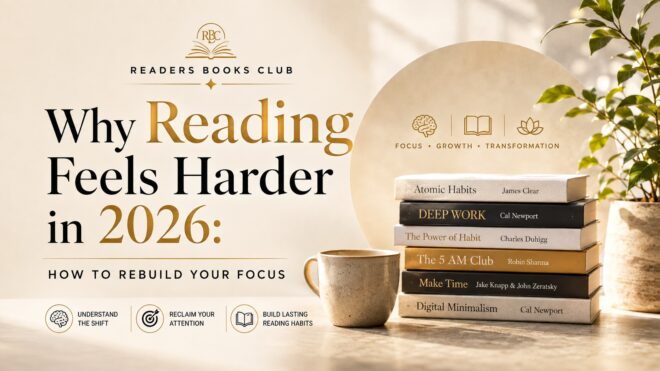
Why Reading Feels Harder in 2026: How to Rebuild Your Focus
Introduction: You Still Love Books – So Why Can’t You Focus?
You sit down with a book you genuinely wanted to read. The cover excited you. The topic matters to you. Maybe you even bought it after watching a Readers Books Club video, hearing a podcast recommendation, or saving it to your reading list months ago.
You read the first page. Then your hand reaches for your phone.
You return to the book, finish two paragraphs, and suddenly remember an email. You check one notification. That leads to a message, a reel, a headline, a short video, and ten minutes later you are no longer reading. When you finally come back, you have to reread the last page because you cannot remember what it said.
If this sounds familiar, you are not alone. One of the biggest reading problems in 2026 is not a shortage of books. It is not that people have stopped caring about stories, ideas, personal growth, psychology, spirituality, money, productivity, or self-improvement. In fact, books remain deeply relevant. What has changed is the environment in which we try to read them.
Our attention now lives inside a competition. A book asks you to stay with one voice, one argument, one story, and one train of thought. Your phone offers hundreds of possible rewards in seconds. A chapter develops an idea slowly. A feed refreshes instantly. A book may take twenty pages to deliver a breakthrough. A short-form video tries to deliver stimulation before your thumb can swipe again.
This is why reading can feel harder even when you still love books.
At Readers Books Club, the goal has always been bigger than collecting titles. Books matter because they can change the way we think, decide, work, love, communicate, build habits, manage money, understand spirituality, and shape our lives. But a book cannot help us if we never remain with it long enough to absorb its ideas. Watching a summary can introduce a concept. Listening to a podcast can deepen curiosity. A powerful quote can inspire us. Yet deep reading offers something different: sustained contact with an idea long enough for it to challenge, reorganise, and expand our thinking.
The good news is that your ability to read has probably not disappeared. Focus is not a personality trait that some people are born with and others permanently lose. It is influenced by habits, environment, energy, expectations, technology, and practice. If your reading attention has become fragmented, you can train it again.
This guide explains why reading feels harder in 2026, what current research says about digital distraction, short-form media, print versus screen reading, meditation and attention, and how to rebuild a reading habit that actually fits modern life. Whether you follow Readers Books Club for book summaries, Amiett Kumar for personal-growth ideas, meditation and spirituality, or you simply want to finish more books without forcing yourself, the aim is practical: help you become a reader who can stay.
Is Reading Really Dying in 2026? The Data Tells a More Interesting Story
It is easy to look at short videos, social media, AI summaries, podcasts, and streaming platforms and conclude that nobody reads anymore. The reality is more complicated – and more hopeful.
Pew Research Center reported in April 2026 that 75% of U.S. adults said they had read all or part of at least one book during the previous twelve months. Print remained more widely used than digital or audio formats. That matters because it shows that books have not been replaced by screens. People are still reading even inside one of the most digitally saturated periods in history.
Gen Z data is especially interesting. Research published by Cambridge in 2026, based on surveys conducted in 2020, 2022, and 2025, found that the share of Gen Z respondents identifying as readers rose substantially. The same research reported that 65.2% had read a print book in the previous year in 2025, compared with 50.5% in 2022. Physical library visits also increased. BookTok and Bookstagram continue to influence discovery, but many young readers are using those digital platforms to find physical books.
So the story is not simply, “Phones killed reading.” A better way to describe the moment is this: discovery has become digital, attention has become fragmented, but hunger for books remains.
That is exactly why Readers Books Club has a unique role. A YouTube video, podcast conversation, blog, or book summary can meet people where their attention already is and then guide them toward deeper reading. Digital media and books do not have to be enemies. The real question is whether we use fast media as a bridge to deeper thought or as a permanent replacement for it.
This distinction matters for SEO and for life. People increasingly search for phrases such as how to focus while reading, how to read more books, reading slump, how to improve concentration while reading, why can’t I focus on reading, and books vs social media because they still want to read. The desire is alive. The system around attention is what needs rebuilding.
Why Reading Feels Harder Now
1. Your Brain Is Practising Switching More Than Staying
Every time you move from a book to a message, from a message to Instagram, from Instagram to email, and from email back to the book, you are asking your attention to disengage, reorient, and reconstruct context.
This may feel effortless because digital switching is familiar, but familiarity is not the same as zero cognitive cost. A 2025 review of attention in the digital ecosystem describes media multitasking as a complex behaviour shaped by individual tendencies, task demands, device design, and environmental cues. The important practical lesson is simple: when switching becomes the default, sustained focus gets less practice.
Reading long-form text is almost the opposite skill. You need to hold earlier information in mind, connect it to what you are reading now, anticipate what comes next, notice structure, and resist unrelated impulses. If your day contains hundreds of small switches, the stillness of a book can initially feel uncomfortable.
That discomfort does not mean your brain is damaged. It often means your attention is accustomed to a different rhythm.
Think of it like physical conditioning. If you have spent months doing only short bursts of movement, a long walk may feel harder than expected. The solution is not to declare that you have permanently lost the ability to walk. You rebuild endurance gradually. Reading focus works in a similar way.
2. Short-Form Content Changes Your Expectation of Pace
A book asks for delayed reward. A strong nonfiction chapter may introduce a problem, give context, examine evidence, challenge an assumption, tell a story, and only then offer a useful framework. Fiction may spend pages building atmosphere or character before the plot changes direction.
Short-form content is designed around a different pace. The hook arrives immediately. Cuts happen quickly. Novelty is constant. If one piece of content becomes boring, another is available with a single movement.
A 2025 study of 745 social-media users found associations between more frequent short-form video use, deeper “scroll immersion”, and self-reported attention difficulties, working-memory disruption, and cognitive fatigue. Because the study was correlational, it cannot prove that short videos caused those outcomes. Still, it fits a common experience: habitual, unintentional scrolling can make slower activities feel less stimulating by comparison.
This is one reason people say, “I can watch reels for an hour but I cannot read ten pages.” The problem is not that ten pages are objectively harder than sixty minutes of video. They demand a different attentional tempo.
The first few minutes of reading may therefore feel unusually quiet. Your mind expects a new stimulus. Nothing changes. You expect another hook. The author is still developing the same idea. You feel an urge to leave.
That urge is a training moment.
3. Notifications Turn Reading Into a Semi-Interrupted Activity
Many people believe they are reading for thirty minutes when they are actually reading for three minutes, checking something, reading for five minutes, replying to someone, reading for two minutes, changing music, and then reading again.
The total clock time may be thirty minutes. The sustained attention time is not.
A phone beside you is not simply an object. It represents possible messages, social approval, work requests, news, entertainment, shopping, photos, and thousands of unanswered possibilities. Even when you resist checking it, part of your attention may remain alert to what it could deliver.
This is why one of the simplest ways to improve reading focus is physical separation. Not silent mode. Not turning the screen face-down. Put the phone far enough away that checking it requires standing up.
When friction increases, automatic behaviour decreases. This principle appears repeatedly in habit books such as Atomic Habits and Digital Minimalism, and it is extremely effective for reading.
4. We Often Read on Devices Built for Everything Except Reading
Digital reading itself is not automatically bad. A 2024 meta-analysis of 37 studies found no significant overall difference in reading comprehension between paper and digital reading, while also identifying important moderating factors. Other research has found advantages for print in some contexts, particularly when readers need deeper comprehension or factual recall or are under time pressure.
A 2025 study of university students found that participants spent more time with print texts and performed better on comprehension than when reading comparable multimodal material digitally. A 2024 cognitive review similarly concluded that screen reading can sometimes encourage shallower processing, especially for complex material.
But the lesson is not “screens are destroying reading.” Device context matters.
Reading a distraction-free Kindle is different from reading a PDF inside a laptop with Slack, WhatsApp Web, YouTube, email, and fifteen browser tabs open. Reading an ebook in aeroplane mode is different from reading inside a phone that receives notifications every few minutes.
The medium is only one part of the environment. The number of competing possibilities inside that medium may matter just as much.
Use the format strategically. Print can be excellent for deep nonfiction, studying, annotation, and reading before sleep. E-readers are convenient for travel and low-distraction digital reading. Audiobooks are powerful for commuting, walking, and increasing total exposure to books. A phone can work when it is the only option – but it is often the hardest environment for deep focus because the book is surrounded by alternatives.
5. Reading Has Become Another Productivity Test
Many people have accidentally turned reading into a performance.
They set a target: fifty books this year. They watch videos from people who claim to read a hundred. They download speed-reading apps. They feel guilty if a novel takes two weeks. They believe every book must be finished. They track pages, streaks, highlights, quotes, Goodreads numbers, and reading hours.
Then reading starts to feel like homework.
There is nothing wrong with goals. Readers Books Club itself is built around learning and implementation. But a reading goal should support your relationship with books, not replace it.
If your goal makes you rush through pages without remembering them, it is not improving your reading life. If you refuse to abandon a book you dislike because “a serious reader finishes,” you may train yourself to associate reading with obligation. If you choose only books that look impressive rather than books you genuinely need or enjoy, attention will become harder.
Sometimes the fastest way out of a reading slump is not stronger discipline. It is permission to read something easier, shorter, more entertaining, or more personally relevant.
6. You Are Trying to Read When Your Energy Is Gone
Attention is not independent of the body.
If you sleep poorly, work for ten hours, spend the evening solving problems, and then expect your brain to deeply process a complex psychology book at 11:45 p.m., difficulty focusing is not a moral failure.
Sleep, stress, hunger, physical discomfort, and mental workload all affect concentration. Reading requires working memory: you need to keep ideas active while integrating new information. When your cognitive resources are depleted, rereading and mind-wandering become more likely.
This means reading time should be designed around energy, not fantasy.
Some people focus best early in the morning. Others can read during lunch. Some prefer twenty minutes immediately after work before opening social media. Students may read effectively in a library afternoon block. Parents may have only a quiet window after children sleep.
The best reading schedule is not the most aesthetic one. It is the one you can repeat when your mind is actually capable of staying with a page.
7. You Expect Focus Before You Begin Instead of Building Focus by Beginning
A common mistake is waiting to “feel focused” before opening a book.
Focus often arrives after action, not before it.
The first two pages may feel restless. Page three becomes easier. By page six, you are inside the argument. Ten minutes later, the phone has stopped calling to you because the book has gained momentum.
This is why a small starting ritual is so powerful. Tell yourself you only need to read five pages. The goal is not to finish the chapter. The goal is to cross the transition from scattered attention into reading attention.
Once you are inside, you can continue if you want.
The hardest part is often not reading. It is switching from the world of infinite options into one chosen thing.
Deep Reading vs Fast Content: What Are You Actually Training?
Fast content is useful. It can teach, entertain, inspire curiosity, introduce a book, explain a concept, and help creators reach people who would never search for a 400-page text. Readers Books Club itself uses digital media because accessibility matters.
The problem begins when every form of information becomes fast.
Deep reading trains a different set of behaviours: staying with complexity, following extended reasoning, imagining scenes, tolerating ambiguity, remembering context, noticing contradictions, and allowing an idea to develop before judging it.
These are not only reading skills. They are thinking skills.
When you read a book about finance, you may need to connect one chapter on risk with another on behaviour. A relationship book may make more sense after three stories reveal the same emotional pattern. A spirituality book may use repetition deliberately because the goal is contemplation, not information density. A biography may require hundreds of pages before a life pattern becomes visible.
If we consume only summaries, we may know conclusions without experiencing the reasoning that produced them.
This does not make summaries bad. A good summary is a doorway. It helps you decide what deserves deeper attention. Readers Books Club can save you time by extracting key lessons, but the most powerful relationship with books is often a combination: discover through video, understand through a summary, read the full book when the subject matters deeply, and implement one idea in real life.
The goal is not to reject modern media. It is to protect the ability to use slow media when slow thinking is valuable.
Why Print Books Are Making a Comeback in a Hyper-Digital World
One of the most interesting reading trends of 2026 is that younger readers are not automatically abandoning print. Cambridge research on Gen Z reported increased print reading from 2022 to 2025, increased physical library visits, and continued use of social platforms such as BookTok for discovery.
That combination tells us something important: digital discovery and analog consumption can coexist.
A physical book has constraints that can become advantages. It does not receive notifications. It does not tempt you with another tab. It gives a visible sense of progress. You remember that an idea appeared near the bottom of a left-hand page. You can annotate without entering another app. The object itself becomes a cue: when you hold it, you are doing one thing.
For readers struggling with concentration, print can therefore function as environmental design.
You do not need to become anti-technology. Use technology to buy the book, discover the author, listen to the interview, watch the Readers Books Club summary, save the quote, and join the discussion. Then put the phone away and read twenty pages without it.
That is a healthy division of labour.
The 15-Minute Reading Focus Reset
If you currently struggle to read for even ten minutes, do not begin with an hour-long goal. Use this reset instead.
Minute 0-2: Remove competing options.
Put your phone outside reach. Close unnecessary tabs. Choose one book. Get water if you need it. Decide in advance that you will not research anything mentioned in the book until the session ends. If you see an unfamiliar word or interesting reference, mark it and continue.
Minutes 2-4: Settle your attention.
Take a few slow breaths. You can treat this as a tiny meditation. Notice sounds, body sensations, and the impulse to check something. Do not fight the impulse. Simply do not obey it.
Minute 4-14: Read one continuous block
Read for ten minutes without switching tasks. Do not measure speed. Do not worry about pages. When your mind wanders, return to the sentence where attention disappeared.
Minute 14-15: Recall
Close the book and answer one question: What was the most important idea I just read?
This final minute is powerful because it converts passive exposure into retrieval. You are not simply moving your eyes across text. You are asking your mind to keep something.
Do this daily for a week. Once fifteen minutes becomes normal, increase to twenty. Focus capacity grows through repeated successful sessions, not heroic attempts.
12 Practical Ways to Rebuild Your Reading Focus
1. Use the Ten-Page Rule
Commit to ten pages, not a chapter. Chapters vary in length and create unnecessary resistance. Ten pages feels concrete and small enough to begin.
On good days, ten pages may become thirty. On tired days, ten is still a win. If you read ten pages a day, a 300-page book takes about a month. That is twelve substantial books a year without speed reading.
Consistency beats intensity.
2. Put Your Phone in Another Room
This is the highest-return habit for many readers.
If you read on your phone, use airplane mode or a dedicated focus setting. If you own a physical book or e-reader, make that the default for focus sessions.
Do not build a reading system that requires constant willpower against the most powerful distraction device in your life.
3. Create a Reading Cue
Habits become easier when they have a reliable beginning.
Your cue could be morning tea, the metro ride, the first twenty minutes after lunch, the moment you get into bed, or sitting in a specific chair.
The more consistent the cue, the less negotiation your brain needs.
Instead of asking, “When will I find time to read?” decide, “After I make tea at 7:30, I read for fifteen minutes.”
4. Stop Scrolling Before You Read
If you move directly from fifteen minutes of reels into a slow nonfiction chapter, the book will feel unusually quiet.
Create a transition buffer. Even five minutes without fast media can help. Walk, stretch, make tea, breathe, or sit in silence before opening the book.
You are changing gears.
5. Choose the Right Difficulty
A reading slump is not the best time to prove your intelligence.
Choose a book with momentum: a strong story, short chapters, practical examples, or a subject you urgently care about. Once the reading habit returns, move toward more demanding books.
This is the reading equivalent of beginning exercise with a manageable weight.
6. Read With a Question
Passive reading makes distraction easier. A question gives your mind a job.
Before a chapter, ask: What problem is the author trying to solve? What do I want to learn? Which idea could I apply this week? Do I agree with the argument?
When reading becomes a search, attention becomes more active.
7. Mark, Don’t Interrupt
A book will trigger thoughts: “I should Google this.” “I need to message someone this quote.” “What year did that happen?” “I want to buy the author’s other book.”
Do not follow every branch.
Use a pencil, sticky note, or simple symbol. Research later. The ability to postpone curiosity is part of sustained reading.
8. Use Active Recall at the End of Every Session
After reading, close the book and explain the main idea in your own words.
You can write three bullets, record a thirty-second voice note, or tell someone what you learned. This transforms reading from consumption into learning.
Readers Books Club audiences already understand the power of summaries. Now create micro-summaries for yourself.
9. Combine Formats Instead of Choosing One
You do not need to be loyal to print, ebook, or audio.
Read the physical book at home. Listen to the audiobook while walking. Use the ebook when travelling. Some readers even listen at normal speed while following the printed text to rebuild focus.
The aim is engagement, not format purity.
10. Protect a “Book Before Feed” Window
Choose one daily window when books come before social media.
Morning works well because your attention has not yet been flooded with messages and novelty. But any protected window is useful.
The rule might be: ten pages before Instagram. Fifteen minutes before YouTube. One chapter before evening streaming.
This does not demonise entertainment. It simply prevents entertainment from automatically receiving your freshest attention.
11. Keep More Than One Book Available
Some readers lose momentum because they believe they must finish one book before touching another.
Try a small reading stack: one serious nonfiction book, one lighter book or novel, and one audiobook. Match the book to your energy.
You may want Deep Work in the morning, fiction at night, and a biography on a walk.
Multiple books can increase reading when they serve different contexts rather than becoming another form of avoidance.
12. Quit Books That Are Wrong for You
Life is too short to turn every disappointing book into a character test.
Some books are valuable but mistimed. Some repeat ideas you already understand. Some are not written for your current level. Some simply do not connect.
Give yourself permission to stop.
A reader is not someone who finishes every book. A reader is someone who keeps a meaningful relationship with books.
Meditation and Reading: Training the Skill of Returning
Meditation belongs in this conversation for a practical reason: it trains return.
During meditation, attention wanders. You notice. You return to the breath, sound, body, mantra, or chosen object. The success of meditation is not never becoming distracted. The practice is recognising distraction and returning without turning every wandering thought into a new activity.
Reading requires the same micro-skill.
You read a paragraph. Your mind remembers tomorrow’s meeting. You notice. You return. A notification urge appears. You notice. You return. You start imagining lunch. You notice. You return.
A 2024 meta-analysis of 111 randomised controlled trials found that mindfulness-based interventions produced small-to-moderate improvements in several cognitive domains, including executive attention and sustained attention accuracy. That does not mean five minutes of meditation will instantly turn you into a perfect reader. It means attention is trainable, and mindfulness can be one useful part of that training.
Try a five-minute meditation immediately before reading. Sit comfortably. Focus on natural breathing. When thoughts appear, label them lightly – thinking, planning, remembering – and return. After five minutes, open the book before touching your phone.
This creates a bridge from scattered awareness to chosen attention.
For Readers Books Club audiences interested in meditation and spirituality, reading itself can also become contemplative. Do not rush to collect quotes. Let one sentence sit. Ask what it means in your life. A spiritual book is often not asking you to consume more information. It is asking you to notice more deeply.
Reading, Spirituality, and the Quality of Attention
Spirituality is often described in terms of awareness, presence, purpose, inner growth, and the ability to observe life rather than constantly react to it.
From that perspective, reading can be a spiritual discipline even when the book is not “spiritual.”
When you choose to stay with one text instead of obeying every impulse, you practise patience. When you encounter an idea that challenges your beliefs, you practise openness. When fiction places you inside another person’s perspective, you practise empathy. When you read slowly enough to recognise your own reactions, you practise self-awareness.
A 2025 realist review of research on reading for wellbeing identified mechanisms such as space away from daily stressors, perspective taking, intellectual stimulation, self-understanding, and social connection through reading groups. These outcomes should not be exaggerated into claims that books cure every mental-health problem. But they remind us that reading can be more than information acquisition.
A book can create a quiet room inside a noisy day.
This is especially valuable in 2026 because the modern attention economy rarely rewards silence. It rewards reaction. Reading gives you the chance to choose a response instead.
Reading and the Law of Attraction: A Grounded Connection
Readers Books Club also serves people interested in the Law of Attraction, manifestation, affirmations, visualisation, meditation, and coaching. Reading fits naturally into this world when we keep the connection grounded.
If you believe attention influences the direction of your life, books are one of the most deliberate ways to choose what enters that attention.
A goal without knowledge can remain fantasy. You may want financial freedom, but a personal-finance book can teach you how money actually behaves. You may visualise becoming a better communicator, but a communication book can give you structures to practise. You may affirm that you are disciplined, while a habit book shows you how to design an environment that makes discipline easier.
In this practical sense, reading supports manifestation by improving the quality of thought and action available to you.
The Law of Attraction should not become a reason to avoid reality. Reading is useful precisely because it introduces reality: evidence, experience, mistakes, frameworks, stories, and strategies from people who have already explored the path.
An affirmation such as “I am becoming a focused reader” becomes more meaningful when you support it with action: phone outside the room, ten pages a day, one reading cue, and a weekly reflection.
Visualisation can help you imagine yourself calmly reading each morning. Meditation can help you notice distraction. Coaching can help you build accountability. But the book still has to be opened.
Alignment becomes practical when intention and behaviour point in the same direction.
How Coaching or a Life Coach Can Help With Focus
Not every reading problem requires coaching. But sometimes “I cannot focus on books” is connected to a larger pattern.
You may be overcommitted. Your goals may be unclear. You may consume huge amounts of information without implementation. You may buy books because they represent the person you want to become, then avoid reading because each unread title creates guilt. You may have no protected personal time at all.
A responsible life coach or performance coach can help clarify priorities, build routines, and create accountability. Coaching is particularly useful when you already know what to do but repeatedly fail to protect time for it.
The goal should not be to become a person who reads impressive numbers of books. It should be to create a learning system that serves your actual life.
For people who follow Amiett Kumar, the connection between books and coaching is especially relevant. Readers Books Club distils ideas from books, while coaching focuses on applying insight through decisions, routines, reflection, and action. Knowledge becomes useful when it changes behaviour.
If severe concentration problems appear across many areas of life – not only reading – and significantly interfere with work, study, relationships, or daily functioning, a qualified healthcare or mental-health professional may be more appropriate than a productivity system or life coach. Reading-focus advice is not a diagnosis.
The 7-Day Readers Books Club Focus Rebuild
If your attention feels broken, do not attempt a dramatic thirty-day detox. Start with seven days of simple evidence.
Day 1: Find Your Baseline
Choose a book you genuinely want to read. Put your phone away. Set a timer for ten minutes. Read normally.
When the timer ends, note how many times you felt an urge to switch tasks. Do not judge the number. You are collecting information.
Write one sentence about what you remember.
Day 2: Remove One Major Distraction
Repeat the ten-minute session, but remove the biggest cue from Day 1. If your phone pulled you, put it in another room. If browser tabs distracted you, use print. If noise interrupted you, change location.
Your focus problem may be less internal than you think.
Day 3: Add a Two-Minute Meditation
Before reading, sit quietly for two minutes and follow your breath.
Then read for twelve minutes.
Notice whether the transition into the book feels smoother.
Day 4: Read With a Question
Choose one question before you begin. For nonfiction: “What can I use?” For fiction: “What is changing in this character?” For biography: “What pattern explains this person’s decisions?”
Read for fifteen minutes.
Day 5: Book Before Feed
Do your reading session before recreational social media.
This is a powerful experiment. You may discover that reading was not inherently difficult; you were asking it to compete with a brain already adapted to faster stimulation.
Day 6: Explain What You Read
After fifteen or twenty minutes, close the book and explain the main idea aloud as though you were creating a mini Readers Books Club video.
If you cannot explain it, reopen the relevant page. This improves attention because your brain knows it will need to retrieve the idea.
Day 7: Design Your Permanent Rule
Review the week.
Which change mattered most? Phone separation? Morning reading? Meditation? Print instead of mobile? A better book? Active recall?
Choose one rule you can keep for the next month.
Do not keep all seven. Sustainable habits are simple.
Best Books to Help You Rebuild Focus and Reading Discipline
A blog about rebuilding reading focus should end with books that can help you understand the problem from different angles.
1. Deep Work by Cal Newport
Best for readers who struggle with concentration during work or study. The central idea is that distraction-free concentration is a valuable skill that can be deliberately trained.
2. Digital Minimalism by Cal Newport
Best for people whose phone use has become automatic. It encourages a values-based relationship with technology rather than simply deleting apps for a weekend.
3. Atomic Habits by James Clear
Best for turning reading into a repeatable routine. Its ideas about cues, environment, identity, and small actions map perfectly onto a reading habit.
4. Stolen Focus by Johann Hari
Best for readers interested in the wider environmental and social forces that shape attention. It moves beyond individual willpower and asks what modern systems do to concentration.
5. The Shallows by Nicholas Carr
Best for readers curious about how internet habits may influence the way we process long-form information. Its arguments have become even more relevant as digital media has expanded.
6. Dopamine Detox by Thibaut Meurisse
Best treated as a practical productivity framework rather than literal neuroscience. The useful idea is reducing unnecessary stimulation and making meaningful work easier to choose.
7. Make Time by Jake Knapp and John Zeratsky
Best for readers who say they are too busy. It offers practical ways to create a daily highlight and reduce reactive technology use.
Explore these titles through Readers Books Club summaries, videos, and podcasts, then choose one that deserves full reading based on your current problem.
How to Read More Books Without Speed Reading
People often search for how to read more books and assume the answer is faster eye movement.
The better answer is usually better systems.
Twenty focused minutes every day can produce more real reading than two distracted hours once a week. Carry a book. Use commuting time. Replace one scrolling window. Read while waiting. Keep a book beside the bed. Download an audiobook. Use a library. Create a weekend reading block.
More importantly, stop counting only completed books.
A chapter that changes how you manage money may be worth more than five forgotten books. A paragraph that changes your relationship may matter more than a yearly reading challenge. Reading is not valuable because it produces a number. It is valuable because it changes what you understand and what you can do.
Readers Books Club has always focused on extracting ideas that can be implemented. Keep that principle when reading the full book. Ask after every major section: What will I do differently because I read this?
If the answer is nothing, either the book is not relevant or you are reading too passively.
How to Use Book Summaries Without Destroying Deep Reading
Book summaries are extremely useful when used for the right job.
Use a summary to discover a book. Use it to review a book you already read. Use it to understand the core framework quickly. Use it to decide whether a 400-page commitment is worth your time. Use it to refresh lessons before applying them.
Do not use summaries as an automatic replacement for every full book.
Some books are idea-dense and can be summarised effectively. Others depend on stories, emotional progression, examples, nuance, or accumulated argument. A ten-minute summary can tell you what the author concluded. It may not give you the experience that makes the conclusion convincing.
A powerful Readers Books Club learning system is three layers:
- Discover – watch the video, listen to the podcast, or read the summary.
- Deepen – read the full book when the idea is important to your current life.
- Apply – choose one behaviour, conversation, experiment, or habit based on what you learned.
This prevents the modern self-improvement trap of endlessly consuming advice without changing anything.
What to Do When You Are in a Reading Slump
A reading slump often creates unnecessary identity panic.
“I used to read all the time. What happened to me?”
Nothing may be wrong. Your season changed.
Perhaps work became intense. You started a course. You have a new child. You are grieving. You moved. You are sleeping badly. The last three books disappointed you. You read too much heavy nonfiction. You spent more time online. Your interests changed.
Instead of demanding your old reading identity return immediately, reduce friction.
Reread a favourite. Choose a short novel. Try essays. Read a graphic novel. Listen to an audiobook. Visit a bookstore without a shopping list. Ask a friend for one irresistible recommendation. Read a book connected to a current problem rather than an abstract goal.
Most importantly, stop saying, “I am not a reader anymore.”
Identity follows evidence. Read five pages tonight. That is evidence.
The Reading Environment Audit
If focus is difficult, inspect the room before blaming your mind.
Ask these questions:
- Is my phone within arm’s reach?
- Can I see notifications?
- Is the television on?
- Is my chair uncomfortable?
- Is the light good enough?
- Am I trying to read where people constantly interrupt me?
- Do I have a pen or bookmark nearby?
- Is the book visible when I want to build the habit?
- Is my reading app surrounded by distracting apps?
- Am I reading at a time when I am already exhausted?
The environment is silent coaching. It keeps telling you what behaviour is easy.
Make reading the obvious option. Put the book on the pillow. Leave it open on the desk. Carry it in your bag. Put a reading chair near a lamp. Charge the phone somewhere else.
The easier it is to begin, the less motivation you need.
Reading for Wellbeing, Not Just Achievement
Reading is often sold as a productivity advantage: successful people read, CEOs read, leaders read, readers earn more, and reading makes you smarter.
There may be useful truth inside some of these claims, but if achievement is the only reason you read, you miss something important.
Reading for pleasure can create rest, perspective, emotional connection, curiosity, and a break from daily demands. A recent realist review of 43 papers on reading for wellbeing identified mechanisms such as escape from stressors, perspective taking, intellectual stimulation, memory, self-understanding, and social connection.
You are allowed to read because it feels good.
Not every book needs notes. Not every novel needs a lesson. Not every reading hour needs to become content, coaching material, or a productivity strategy.
Sometimes the deepest way to rebuild your reading habit is to remember why you loved books before you started measuring them.
Frequently Asked Questions
Why can’t I focus when I read anymore?
Your reading difficulty may be influenced by digital interruptions, frequent task switching, short-form media habits, stress, sleep, cognitive fatigue, reading on a highly distracting device, choosing a book that does not fit your current interests, or simply losing practice with sustained reading. Start by changing your environment and rebuilding focus in short daily blocks.
How can I improve my reading focus?
Begin with ten to fifteen distraction-free minutes. Keep your phone away, choose one book, read with a question, and briefly recall what you learned when the session ends. Increase duration gradually rather than forcing hour-long sessions.
Is social media ruining my attention span?
Research links heavy or habitual media multitasking and short-form video use with attention difficulties and cognitive fatigue, but individual studies do not prove that social media permanently damages attention. A more useful approach is to observe how your own media habits affect concentration and create boundaries around high-stimulation use.
Is reading a physical book better than reading on a screen?
Research is mixed. Some meta-analyses find little overall difference, while other studies find advantages for print in deeper comprehension or specific conditions. The best format depends on the task and environment. A distraction-free e-reader may be better than a phone full of notifications, while print can be excellent for deep study and annotation.
How long should I read every day?
There is no universal ideal. Start with a duration you can repeat. Fifteen to twenty focused minutes per day is more useful than an ambitious schedule you abandon. Once the habit feels automatic, extend it if you enjoy doing so.
Can meditation improve reading concentration?
Mindfulness and meditation can help train attention and the ability to notice distraction and return. Research on mindfulness-based interventions has found small-to-moderate benefits for several attention-related cognitive outcomes. Meditation is supportive training, not a guaranteed cure for concentration problems.
What should I read when I am in a reading slump?
Choose something highly engaging and relatively easy to enter: a favourite genre, short chapters, a practical book related to a current problem, a thriller, a memoir, a biography, a graphic novel, or audiobook. Rebuilding momentum matters more than choosing an impressive title.
Do audiobooks count as reading?
For most practical purposes, audiobooks are a legitimate way to engage with a book. The experience differs from visual reading, and some tasks such as detailed study or annotation may work better in print. But audiobooks can expand reading time and make books accessible during walking, commuting, exercise, or household tasks.
How can Readers Books Club help me read more?
Readers Books Club offers book summaries, videos, podcasts, curated suggestions, and personal-growth content across habits, psychology, productivity, finance, relationships, spirituality, Law of Attraction, and self-improvement. Use summaries to discover the right books, then build a reading system that helps you go deeper when a topic matters.
How do Amiett Kumar, meditation, coaching, and books fit together?
Books provide ideas and frameworks. Meditation can strengthen awareness and attention. Coaching or a life coach can help turn insight into goals and accountability. Amiett Kumar’s broader personal-growth content connects these areas through learning, self-reflection, spirituality, and practical action. The value comes from implementation rather than collecting information alone.
Final Thoughts: Your Attention Is Not Gone – It Is Being Trained
Reading feels harder in 2026 because books now compete with an environment designed around speed, novelty, alerts, endless choice, and immediate reward.
But the same year also gives us reasons for optimism. Print reading remains strong. Younger readers are returning to bookstores and libraries. BookTok can send old novels back onto bestseller lists. Podcasts can introduce authors to millions. YouTube can turn a single idea from a book into the beginning of a personal transformation.
The future of reading does not require rejecting technology. It requires learning when to turn technology off.
Your focus is shaped by what you repeatedly ask it to do. If you ask it to switch every thirty seconds, switching becomes easy. If you ask it to stay with a book for fifteen uninterrupted minutes every day, staying becomes more familiar.
Start smaller than your ambition.
Choose one book. Put the phone away. Read ten pages. Close the book and remember one idea. Repeat tomorrow.
Use meditation when you need help settling. Use spirituality to remember that attention is part of how you experience life. Use coaching when accountability would help. Use the Law of Attraction as a reminder that intention matters, but pair intention with action. Use Readers Books Club to discover books worth your time and Amiett Kumar’s personal-growth ecosystem when you want structured learning across books, mindset, meditation, and self-development.
Most of all, stop treating distraction as proof that you have lost something forever.
You are not trying to become the reader you were before smartphones, reels, notifications, and endless feeds. You are building a reader for the world that exists now – someone who can use technology without surrendering depth, discover quickly without thinking shallowly, and protect enough quiet to let a book change their mind.
The next chapter does not need more motivation.
It needs your attention
Contents