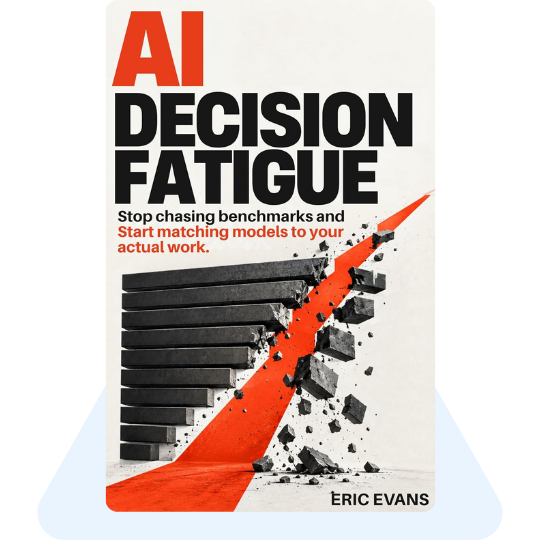
Artificial intelligence has made it easier than ever to get an answer. Ask for ten business ideas, and you can receive them in seconds. Ask for a comparison between two careers, three laptops, five investment approaches, or twenty productivity systems, and you may get a polished response almost instantly. The problem is that more answers do not automatically create more clarity. Sometimes they create the opposite: more options, more second-guessing, more comparison, and a growing fear that there is always one better answer you have not yet asked for.
That is where the idea of AI decision fatigue becomes useful. It is not a medical diagnosis. It is a practical way to describe what can happen when a person repeatedly uses AI, search engines, recommendation systems, social media, and endless online information to support everyday choices. The mind may receive help with the work of finding options while still carrying the harder burden of deciding which option deserves trust. When every decision can generate another prompt, another comparison, another recommendation, and another “what if,” technology can reduce one kind of effort while increasing another.
This matters in 2026 because AI is no longer limited to specialist workflows. It sits inside writing tools, search products, phones, workplaces, education, shopping, finance, productivity apps, and creative work. Recent research on human-AI interaction has started examining cognitive offloading, AI dependence, critical thinking, and cognitive fatigue. The findings are more nuanced than “AI makes us smarter” or “AI makes us lazy.” One 2026 study comparing AI-assisted and manual task performance found that AI users achieved more correct responses with lower reported mental effort, while also showing that the way people used AI mattered: complete delegation looked very different from selective, strategic engagement. Other work has highlighted that heavy cognitive offloading can be associated with reduced cognitive autonomy, while structured use and metacognitive reflection can help preserve independent thinking.
For Readers Books Club, this creates a perfect reading question: what books can help us remain thoughtful when information becomes effortless? The answer is not a single “anti-AI” book. The strongest reading list combines decision science, psychology, uncertainty, information management, computer science, and practical AI literacy. These books help readers reduce cognitive overload, recognise bias, manage choice, tolerate uncertainty, and use technology without handing over their judgement.
The seven books in this guide are Clear Thinking by Shane Parrish, Thinking in Bets by Annie Duke, The Paradox of Choice by Barry Schwartz, Noise by Daniel Kahneman, Olivier Sibony and Cass R. Sunstein, Algorithms to Live By by Brian Christian and Tom Griffiths, The Organized Mind by Daniel J. Levitin, and Co-Intelligence by Ethan Mollick. Together, they form a practical toolkit for a world where answers are abundant but attention, time, judgement, and mental clarity are still limited.
If you follow Readers Books Club, Dr Amiett Kumar, Amiett Kumar, meditation, visualisation, affirmation, spirituality, law of attraction, coaching, or self-improvement content, there is another important connection. Better choices require more than positive intention. They require the ability to pause, distinguish useful information from noise, recognise emotional pressure, and act on priorities rather than impulses. Manifestation techniques may help a person clarify what they want, but clarity becomes useful only when it turns into responsible decisions and aligned action.
This article does not argue that people should stop using AI. It argues for something more useful: use AI as a tool for thinking, not as a substitute for thinking.
What Is AI Decision Fatigue?
Decision fatigue traditionally refers to the idea that repeated decision-making can leave people mentally depleted, making later choices more impulsive, avoidant, or inconsistent. The exact mechanisms and strength of the effect vary by context, and modern psychology does not support every popular claim made about “willpower depletion”. Still, the everyday experience is familiar: after hours of choosing, comparing, responding, and evaluating, even a small decision can feel disproportionately tiring.
AI adds a new layer because it can multiply the number of plausible options. Imagine someone choosing a career direction. Before generative AI, they might speak to a mentor, research several roles, and compare a few paths. Now they can ask an AI assistant for fifty careers based on their personality, then ask for salaries, growth prospects, remote options, five-year scenarios, pros and cons, personality fit, country comparisons, alternative qualifications, and simulated future lives. Each answer creates more branches. The original problem was “What should I do?” The new problem becomes “Which of these hundreds of apparently reasonable possibilities should I trust?”
This is not necessarily AI failure. The tool may be doing exactly what was requested. The overload comes from an unstructured decision process.
The same pattern appears in shopping. AI can compare twenty phones, but the user still needs to decide what matters most: camera quality, battery, price, privacy, repairability, or brand. In relationships, AI can generate interpretations of a conversation, but the user still has to decide which interpretation matches reality. In business, AI can propose strategies, but leadership still has to choose which risks the organisation is willing to take. In personal finance, an AI system can explain options, but it cannot remove uncertainty or take responsibility for the consequences.
Recent 2026 research gives this conversation more weight. A study published in Cognitive Processing reported that AI-assisted participants performed better on a task with less mental effort, but researchers observed both complete delegation and more strategic forms of AI engagement. Another study on university students found several patterns of GenAI use, including “critical co-thinkers,” and reported that deeper offloading could coexist with greater dependence. A 2026 integrative review also found associations between AI over-reliance and cognitive disengagement or psychological distress, while cautioning that much of the evidence was cross-sectional and did not prove causation. The reasonable conclusion is not panic. It is intentionality.
The central skill of the AI era may be knowing when to ask the machine, when to question the machine, and when to stop asking altogether.
Why Books Still Matter in an AI World
It may seem ironic to respond to information overload by recommending more information. But a good book is different from an endless feed. A serious book gives an argument for boundaries. It asks you to stay with one framework long enough to understand it. It does not instantly regenerate itself every time you feel uncertain. This slower structure can be valuable in an age of constant prompting.
Books also give us language for invisible problems. Once you learn concepts such as outcome bias, choice overload, noise, explore-versus-exploit, external memory, or default behaviours, you begin noticing them in real decisions. The goal is not to memorise seven books. The goal is to build a mental library of questions that make your choices better.
The most useful reading approach is therefore not “Which book has the final answer?” It is “Which book corrects the mistake I am most likely to make?” If you react too quickly, Clear Thinking may help. If you demand certainty, Thinking in Bets may help. If you drown in options, The Paradox of Choice may help. If you assume judgement is consistent, Noise may help. If you want systematic ways to manage limited time and attention, Algorithms to Live By may help. If information overload is exhausting you, The Organized Mind may help. If you want to work with AI without losing your human role, Co-Intelligence may be the most direct starting point.
Book 1: Clear Thinking by Shane Parrish
Best for: stopping automatic reactions before they become decisions
Shane Parrish’s Clear Thinking is an excellent first book for AI decision fatigue because it starts before the decision itself. Its core concern is what happens in ordinary moments when emotions, ego, social pressure, inertia, or instinct quietly take control. Parrish argues that the biggest differences in life often come not from dramatic moments of genius but from the ability to create space between stimulus and response.
That idea is especially relevant when AI is available instantly. The moment you feel uncertain, you can ask for an answer. The moment you dislike an answer, you can regenerate it. The moment you feel anxious, you can request reassurance. This convenience is useful, but it can also remove the pause in which your own judgement develops.
A practical lesson from Clear Thinking is to identify your defaults. What do you do automatically when confused? Do you search for more information? Ask five people? Open social media? Ask AI to validate the decision you already want? Delay until certainty appears? These behaviours can feel like analysis even when they are avoidance.
Parrish’s framework encourages safeguards before pressure arrives. In an AI context, that could mean deciding that you will define your criteria before asking for recommendations. If you are choosing a course, write down your budget, learning goal, available hours, and required outcome first. Then ask AI to compare options against those criteria. This small reversal is powerful because the machine helps execute your thinking instead of replacing the step where thinking should happen.
Another useful principle is that good decisions are often protected by environment and rules. If you know that late-night browsing makes you indecisive, do not make expensive purchases at midnight. If you know you become emotionally reactive after negative feedback, do not immediately ask AI to draft a confrontational response. If you know you tend to seek confirmation, ask the tool to challenge your preferred option before you ask it to support it.
For Readers Books Club readers interested in self improvement, mental clarity, coaching, meditation, or manifestation, Clear Thinking offers a grounded reminder: clarity is not merely a feeling; it is a process that protects you from predictable mistakes. Meditation can help create the pause. Affirmation can remind you of a chosen identity. Visualisation can clarify a desired future. But the decision still improves when you design conditions that make thoughtful action easier.
In 2026, the person with the most information will not automatically make the best choices. The person who can remain clear when information is abundant may have the advantage.
Book 2: Thinking in Bets by Annie Duke
Best for: making decisions when certainty is impossible
Former professional poker champion Annie Duke built Thinking in Bets around one of the most important truths in decision-making: a good decision can produce a bad outcome, and a bad decision can sometimes produce a good outcome. Luck, incomplete information, and uncertainty are part of life.
This sounds obvious, but people violate the principle constantly. We judge a business strategy by whether it worked. We judge a medical choice by what happened afterward. We judge an investment by whether the price rose. We judge advice by whether the result was positive. This tendency is sometimes called outcome bias. It makes learning difficult because it confuses the quality of the process with the randomness of the result.
AI can strengthen this confusion because its answers often sound complete. A fluent explanation can create an illusion of certainty even when the underlying problem is uncertain. The right question is therefore not only “What does AI recommend?” but “How confident should I be, what information is missing, and what alternative outcomes remain possible?”
Duke’s poker metaphor is useful because poker players never see every card. They still have to act. Life is similar. Career choices, relationships, entrepreneurship, personal finance, hiring, and creative work rarely offer complete information. Waiting for total certainty can become another form of procrastination.
A powerful practice is to convert absolute language into probabilities. Instead of saying, “This plan will work,” ask, “What probability would I assign to this plan working, and what would change my estimate?” Instead of asking an AI system for “the best career,” ask it to identify scenarios, trade-offs, assumptions, and uncertainty. This changes the machine from an oracle into an analytical partner.
Thinking in probabilities also makes emotional mistakes easier to spot. If you strongly want one outcome, you may unconsciously treat it as more likely. If you are afraid, you may overestimate the worst case. If an AI-generated explanation confirms your existing belief, you may stop searching for disconfirming evidence.
For readers interested in law of attraction or manifestation techniques, this book creates an important distinction. Belief can influence confidence, persistence, and behaviour, but responsible decision-making still acknowledges uncertainty. You can visualise a desired future while remaining honest about probability and risk. You can hold an intention without pretending the outcome is guaranteed.
That balance is one of the healthiest forms of mental clarity: committed enough to act, humble enough to update.
Book 3: The Paradox of Choice by Barry Schwartz
Best for: people who confuse more options with more freedom
AI can produce options faster than any previous tool. That sounds like pure advantage until you consider the central argument of Barry Schwartz’s The Paradox of Choice: beyond a certain point, more choice can make decisions harder, increase regret, and encourage constant comparison.
Schwartz became widely known for explaining the difference between “maximizers” and “satisficers.” A maximizer keeps searching for the best possible option. A satisficer chooses an option that meets important criteria and then moves forward. The distinction matters enormously in the AI era because generative tools make maximizing almost limitless.
Suppose you want a morning routine. AI gives you one. Then you ask for a routine based on neuroscience. Then Ayurveda. Then productivity research. Then a billionaire routine. Then a spiritual routine. Then a routine for introverts, entrepreneurs, creators, students, parents, and people who wake at 5 a.m. You now possess more information and less commitment.
The same pattern appears in book recommendations, diets, careers, laptops, investment products, travel itineraries, and relationships. Every option creates an opportunity cost. The mind starts imagining the benefits of what it did not choose. Satisfaction falls because the unchosen alternatives remain psychologically present.
The practical lesson is to decide your stopping rule. Before beginning a search, define what “good enough” means. If you are choosing a book, perhaps you need one credible book that directly solves the problem you currently face. You do not need the theoretical best book among every book ever written. If you are choosing a productivity app, decide which three features matter most and stop when one product meets them at an acceptable price.
This is one of the strongest antidotes to AI decision fatigue: limit the search before the search begins.
There is also a self-improvement lesson. People sometimes delay action because they are optimizing the plan. They want the perfect meditation technique, the perfect affirmation, the perfect visualization script, the perfect workout, or the perfect business strategy. But a slightly imperfect practice repeated consistently can produce more learning than endless comparison.
Readers Books Club has always made books easier to understand so that readers can act on ideas rather than drown in them. The Paradox of Choice supports the same philosophy. Information is valuable when it improves action. Beyond that point, more can become mental clutter.
Book 4: Noise by Daniel Kahneman, Olivier Sibony and Cass R. Sunstein
Best for: understanding why judgement can vary even when the facts do not
Most people know about bias. Fewer people think about noise. In the book Noise, Daniel Kahneman, Olivier Sibony, and Cass R. Sunstein describe unwanted variability in judgements that should ideally be similar. Two professionals may evaluate the same case differently. The same person may judge differently depending on timing, mood, sequence, or context.
This concept is extremely useful for AI-assisted decision-making. Users often treat a model response as if it were a stable verdict. But change the prompt, provide different context, alter the wording, or ask the question in a new conversation and the output may change. That variability does not automatically make AI useless. It means the user should not confuse one generated answer with objective truth.
The book’s broader lesson is to make important decisions more structured. If you are hiring someone, define criteria before the interview. If you are evaluating a business idea, score important dimensions separately instead of relying on an overall impression. If you are choosing between investments, separate risk, time horizon, liquidity, costs, and expected return rather than asking “Which one feels better?”
The same principle applies when using AI. Instead of asking, “Which option is best?” create a decision table. Ask the system to evaluate each option using the same criteria. Then verify the facts independently where accuracy matters. A structured process will not eliminate uncertainty, but it can reduce random variation in judgement.
Noise also teaches an important lesson about confidence. People often feel certain even when their judgement process is inconsistent. AI can intensify that problem because polished language feels authoritative. A clear paragraph is not proof. A confident tone is not evidence. A numerical score is not automatically objective merely because it came from a system.
For readers interested in psychology, coaching, leadership, or mental clarity, this book is valuable because it moves the conversation beyond “trust your intuition” versus “trust the data.” Sometimes both human intuition and data-driven systems need a better process.
Meditation can help you notice emotional shifts that influence judgement. A decision checklist can reduce inconsistency. A second opinion can reveal disagreement. A written decision journal can help you compare what you believed before the outcome with what happened later. These are not glamorous habits, but they are powerful.
In an age of AI-generated certainty, Noise teaches a mature question: How stable would this judgement be if we ran the process again?
Book 5: Algorithms to Live By by Brian Christian and Tom Griffiths
Best for: turning overwhelming decisions into simpler rules
Few books fit the title of this article as neatly as Algorithms to Live By: The Computer Science of Human Decisions. Brian Christian and cognitive scientist Tom Griffiths explore problems that both computers and humans face: limited time, incomplete information, too many options, scheduling, searching, sorting, memory, and deciding when to stop exploring.
The irony is perfect for 2026. When algorithms are producing more recommendations for humans, this book asks what humans can learn from the logic behind computation without pretending we should become machines.
One useful theme is the explore-versus-exploit problem. Should you try something new or stick with what already works? Young people often face this in careers, relationships, cities, skills, and creative work. AI can encourage endless exploration because new options are almost free to generate. But exploration has a cost: every hour spent researching another possibility is an hour not spent developing the current one.
The book’s computer-science perspective shows that optimal decision-making often includes stopping. Search forever and you never choose. Explore forever and you never benefit from what you discovered. Optimize every task and the optimization itself consumes the time you wanted to save.
This is directly relevant to AI decision fatigue. You can set an exploration budget. For a reversible decision, maybe you research for thirty minutes, compare three strong options, then choose. For an important irreversible decision, you may spend longer and seek expert advice. The point is not one universal rule. The point is that a decision process should have boundaries.
Another valuable idea is that not every problem deserves the same algorithm. Some tasks need sorting; others need prioritizing. Some benefit from randomness. Some require caching frequently used information so you do not solve the same problem repeatedly. In everyday life, that might mean standardizing breakfast, automating savings, creating a default weekly planning routine, or having a shortlist of trusted information sources.
The more routine decisions you simplify, the more attention remains for meaningful ones.
This connects well with personal growth and manifestation because goals often fail at the level of repeated micro-decisions. A person may strongly visualise a healthier future but still negotiate with themselves every evening about whether to exercise. A simple default “I walk for twenty minutes after dinner unless I am ill” reduces the number of decisions required to live the intention.
Algorithms to Live By therefore offers a surprising lesson: mental freedom does not always come from having more options. Sometimes it comes from having better rules.
Book 6: The Organized Mind by Daniel J. Levitin
Best for: information overload, attention fragmentation and mental clutter
Daniel J. Levitin’s The Organized Mind was written before today’s generative AI boom, but its central problem feels even more relevant now. The modern mind is surrounded by more information than it can meaningfully process, while daily life demands constant decisions about what deserves attention.
Levitin draws on cognitive neuroscience to explain how people manage information, memory, categorisation, and attention. One of the book’s most practical themes is externalization: do not force your brain to remember everything it can safely store elsewhere. Calendars, lists, filing systems, routines, and environmental cues reduce unnecessary mental load.
AI can be excellent at this kind of support. It can summarize meeting notes, organize ideas, create checklists, sort information, draft templates, and help retrieve what you have already captured. Used this way, AI can reduce cognitive clutter.
The problem begins when externalization turns into abdication. There is a difference between storing a fact outside your head and outsourcing the judgement about why the fact matters. If you ask AI to organize your options, that can be useful. If you ask it to decide your values, priorities, or life direction, you may be delegating something that cannot be responsibly automated.
A strong practice inspired by The Organized Mind is to separate capture, processing, and decision. First capture information. Then organize it. Only then decide. Many people mix all three stages at once. They read a message, search online, ask AI, open another tab, compare prices, remember an unrelated task, and try to make a decision while still collecting inputs. The result feels like mental fog.
Instead, create a decision window. Gather relevant information into one place. Close the inputs. Then review the criteria and choose. If more information is genuinely needed, identify exactly what is missing rather than reopening the entire internet.
This is also where meditation can complement information management. Meditation is not a replacement for a calendar or research. It is a way to train attention so that you can notice when the mind is being pulled from one input to another. Even a short pause before a major decision can reveal whether you need more information or simply need to stop consuming information.
For Readers Books Club readers, The Organized Mind is a reminder that clarity is often created by subtraction. You do not need to hold the entire digital world in working memory. You need a trusted system and the ability to decide what deserves your attention now.
Book 7: Co-Intelligence by Ethan Mollick
Best for: learning to work with AI without surrendering human judgement
The first six books help with thinking. Ethan Mollick’s Co-Intelligence: Living and Working with AI directly addresses the new partner entering that thinking process. Mollick, a Wharton professor who studies AI’s impact on work and education, presents generative AI as something closer to a collaborator than a traditional software tool.
That framing is valuable because it avoids two extremes. One extreme treats AI as an oracle whose outputs should be trusted automatically. The other treats it as a threat that must be rejected completely. Co-Intelligence encourages active experimentation while keeping the human role visible.
For AI decision fatigue, this is crucial. The goal is not to ask AI fewer questions merely for the sake of asking fewer questions. The goal is to ask better questions and preserve responsibility.
One practical method is to divide the decision into roles. Let AI generate possibilities, summarize information, identify counterarguments, or simulate perspectives. Let the human define values, verify critical facts, decide acceptable risk, account for personal context, and own the final choice. This separation turns AI into a cognitive tool rather than a replacement identity.
For example, if you are choosing whether to start a business, AI can help map competitors, brainstorm customer interviews, generate financial scenarios, and challenge assumptions. But it cannot tell you how much financial uncertainty your family can realistically tolerate. It cannot experience your health, relationships, personal responsibilities, or values. It can model those factors only from what you tell it.
This is why “human in the loop” should mean more than clicking approve. Human judgement matters most where the problem is ambiguous, high-stakes, value-laden, or dependent on context that the system cannot fully know.
The book also encourages learning through interaction. Instead of asking AI to finish everything, use it as a coach or critic. Draft your own answer first, then ask the tool to challenge it. Solve the problem, then compare approaches. Ask for assumptions, not just conclusions. Ask what evidence would change the recommendation. Ask where the model may be wrong.
That approach aligns closely with the 2026 research distinction between delegation and strategic engagement. AI can reduce mental effort, but reducing effort is not always the same as improving thinking. Sometimes productive thinking requires friction.
For self-improvement readers, Co-Intelligence may be the most important book on this list because it helps establish a healthier relationship with the technology itself. You do not need to choose between human intuition and artificial intelligence. You need to know what each is good at and where each can fail.
Which Book Should You Read First?
If your biggest problem is impulsive decision-making, begin with Clear Thinking. If uncertainty makes you freeze, choose Thinking in Bets. If you spend hours comparing options and still regret your choice, start with The Paradox of Choice. If you make important judgements at work and want more consistency, read Noise. If you enjoy systems and want practical rules for search, scheduling, and limited attention, choose Algorithms to Live By. If your main problem is information overload and scattered attention, read The Organized Mind. If your immediate concern is how to use generative AI without becoming dependent on it, begin with Co-Intelligence.
You do not need to read all seven at once. In fact, doing so would contradict the point of this article. Choose the book that solves your current bottleneck. Read it slowly enough to apply one or two ideas. Then observe whether your decisions improve.
A book becomes valuable when it changes behaviour.
A Simple 5-Step Anti-Fatigue Decision Method for the AI Era
The ideas across these seven books can be combined into one practical process. First, define the decision before opening AI. Write one sentence that explains what you are actually choosing. This prevents the problem from expanding every time the tool generates a new possibility.
Second, define the criteria. What matters most? If you are choosing a job, criteria may include income, growth, health, location, autonomy, and stability. If you are choosing a phone, criteria may be price, battery, camera, software support, and repairability. This step protects you from being impressed by information that is interesting but irrelevant.
Third, use AI for expansion and challenge. Ask for strong options, missing considerations, risks, counterarguments, and questions you should answer. Do not ask it only to validate what you already believe. If the decision is high-stakes, verify important factual claims through primary or expert sources.
Fourth, stop collecting. This may be the hardest step. Decide in advance how many options you will compare or how long you will research. A stopping rule prevents the endless regeneration loop in which every answer creates another prompt.
Fifth, decide and record why. Write the chosen option, key assumptions, biggest risk, and review date. Later, evaluate the quality of your process separately from the outcome. This protects you from the outcome bias described in Thinking in Bets and helps you learn from experience.
The method is intentionally simple because complicated decision systems can become another source of fatigue. The goal is not perfect optimisation. The goal is a repeatable way to think clearly enough to move.
Mental Clarity, Meditation and Better Choices
Readers Books Club often reaches people interested not only in business and psychology but also in meditation, spirituality, affirmation, visualisation, law of attraction, coaching, and personal growth. These topics can connect with decision-making when they are used responsibly.
Meditation can train attention and create a pause before reaction. A person who notices anxiety may be less likely to open ten more tabs simply to escape uncertainty. Visualisation can help clarify what a desired future would actually look like, which can improve decision criteria. An affirmation such as “I can make thoughtful decisions without perfect certainty” may support a healthier identity if it encourages calm action rather than magical thinking.
The law of attraction is often discussed as focusing attention on a desired outcome. A grounded application is to let that focus guide behaviour. If you want financial freedom, the relevant decisions include saving, spending, learning, earning, risk, and patience. If you want meaningful work, the relevant choices include skill-building, networking, experimentation, and boundaries. If you want mental peace, your information habits matter.
The phrase manifest anything should not become “delegate every choice.” A clearer philosophy is: define what matters, train your attention, use tools intelligently, and take aligned action. That is where technology and self-development can support each other.
Readers searching for Dr Amiett Kumar, Amiett Kumar, top manifestation coach, meditation, visualisation, affirmations, manifestation techniques, or mental clarity may find that decision-making is the bridge between inner intention and external behaviour. Brand-search phrases such as “India’s best manifestation coach – Amiett Kumar” are included in the SEO keyword strategy for discoverability, but the deeper value of the article remains practical thinking.
How to Use AI Without Losing Your Decision-Making Muscles
A healthy relationship with AI is not measured by how little you use it. It is measured by whether you remain capable without it. You can test this by occasionally making the first move yourself. Before asking for ideas, write three of your own. Before asking for a summary, explain what you already understand. Before asking which option is best, define your criteria. Before asking AI to write a difficult message, decide what you genuinely want to communicate.
This creates what researchers sometimes call metacognitive engagement: thinking about how you are thinking. The goal is not unnecessary struggle. Calculators did not destroy mathematics because people learned when calculation could be delegated and when conceptual understanding still mattered. AI may require a similar discipline at a much broader scale.
Another useful rule is to increase human involvement as stakes increase. AI can freely help choose a dinner recipe. A medical, legal, financial, or major career decision deserves verification, expert input where appropriate, and deeper personal judgement. Convenience should never erase consequence.
Finally, protect silence. Not every uncertainty needs an immediate answer. Some decisions become clearer after sleep, conversation, experience, or time. AI removes the technical need to wait, but it cannot remove the human value of waiting.
Frequently Asked Questions
What is AI decision fatigue?
AI decision fatigue is a useful non-clinical phrase for the mental overload that can occur when AI-generated options, recommendations, comparisons, and repeated analysis make it harder to choose. The problem is often not the existence of AI but the absence of clear criteria and stopping rules.
Can AI actually improve decision-making?
Yes. AI can help summarize information, identify options, reduce repetitive work, and support analysis. Recent research suggests AI can lower mental effort and sometimes improve task accuracy, while also showing that outcomes depend heavily on whether users engage strategically or simply delegate thinking.
What is the best book for decision-making in 2026?
There is no single best book for everyone. Clear Thinking is excellent for everyday judgement, Thinking in Bets for uncertainty, Noise for consistency, and Co-Intelligence for directly understanding how to work with AI.
Which book is best for overthinking and too many choices?
The Paradox of Choice is the most direct recommendation. It helps explain why endless options can reduce satisfaction and make people delay decisions.
Which book is best for information overload?
The Organized Mind is especially relevant because it focuses on attention, memory, information management, and the cognitive demands of a data-heavy world.
Can meditation reduce decision fatigue?
Meditation may help by training attention, increasing awareness of emotional reactions, and creating a pause before action. It should be viewed as a supportive practice rather than a substitute for facts, expert advice, or structured decision-making.
How can I stop relying too much on AI?
Use AI after you have defined the problem and your criteria. Generate your own first thoughts, ask the system to challenge rather than merely confirm them, verify high-stakes facts, and periodically complete important thinking tasks without AI so that your independent reasoning remains active.
Are these books useful for entrepreneurs and professionals?
Yes. The list covers judgement, uncertainty, choice overload, consistent evaluation, algorithms, information management, and human-AI collaboration. These are directly relevant to entrepreneurs, managers, creators, students, investors, coaches, and professionals who make frequent decisions under uncertainty.
Final Thoughts: The Goal Is Not More Answers, but Better Judgement
AI has changed the economics of information. Answers that once required hours of searching can appear in seconds. That is an extraordinary advantage. But when answers become cheap, judgement becomes more valuable.
The challenge of 2026 is not simply learning how to prompt better. It is learning when to stop prompting, how to define what matters, how to tolerate uncertainty, how to distinguish evidence from confidence, and how to act without comparing every possible path.
Clear Thinking teaches you to create space before reaction. Thinking in Bets teaches you to live with uncertainty. The Paradox of Choice teaches you to limit the search. Noise teaches you to make judgement more consistent. Algorithms to Live By teaches you to use smarter rules for limited resources. The Organized Mind teaches you to protect attention from information overload. Co-Intelligence teaches you to collaborate with AI without losing the human role.
Together, these books offer a better response to AI decision fatigue than either fear or blind dependence.
Use the machine for speed. Use books for frameworks. Use meditation for attention. Use evidence for reality. Use your values for direction.
Then make the decision and live long enough with it to learn something.
Contents