Most people do not have a shortage of goals. They want to become healthier, earn more, manage money better, build stronger relationships, perform well at work, learn new skills, protect their mental health, and still have enough time to enjoy life. The problem is that all of these goals compete for the same limited resources: attention, energy, time and decision-making capacity.
That is why modern self-improvement can become exhausting. We download a habit tracker, start a morning routine, create a budget, promise to exercise five times a week, subscribe to productivity advice, try meditation, reorganise our calendar and decide that from Monday everything will finally be different. For a while, motivation carries the plan. Then work becomes busy, sleep gets disturbed, a family responsibility appears, travel breaks the routine or our enthusiasm simply fades. Soon we are back to depending on memory and willpower.
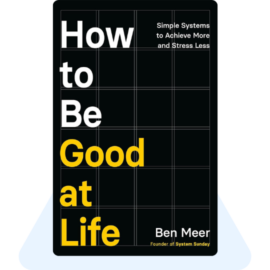
Ben Meer’s How to Be Good at Life: Simple Systems to Achieve More and Stress Less offers a different approach. Instead of asking you to become more disciplined every day, the book asks you to become a better designer of the systems around your life. Its central idea is simple: recurring problems deserve recurring solutions. If something matters repeatedly, it should not depend entirely on you remembering to do the right thing at the perfect moment.
For the Readers Books Club audience, this is a highly practical idea. The book connects productivity, personal growth, career, health, relationships, personal finance, time management, decision-making and environment design. It is not simply another list of better habits. Meer’s argument is that habits are useful building blocks, but a life becomes easier when those habits are organised into systems that work together.
This How to Be Good at Life summary explains ten powerful lessons from the book and shows how they can be applied without turning your life into a rigid productivity project. We will look at Meer’s DRIVE method, the Seven Life Engines, System Sunday, decision fatigue, environment design, practical technology and the deeper idea behind the book: the best systems are not meant to make you busier. They are meant to make important things easier and create more calm, freedom and mental clarity.
Readers who follow Readers Books Club, Dr Amiett Kumar, meditation, affirmation, visualisation, spirituality, law of attraction, coaching, manifestation techniques or the idea to manifest anything may also find an interesting bridge here. Inner work can clarify what you want, but outer systems determine whether those intentions survive ordinary life. A visualisation of a healthier future becomes more useful when sleep, food, movement and recovery have practical structures around them. An affirmation about financial confidence becomes more meaningful when saving, investing and spending decisions are supported by systems. Intention matters, but consistency becomes easier when the environment carries part of the load.
About How to Be Good at Life by Ben Meer
Ben Meer is the creator of System Sunday, a newsletter and online community built around practical systems for everyday life. He has described his work as helping people build systems that make health, wealth, career, relationships and attention easier to manage. How to Be Good at Life develops that philosophy into a book-length framework.
The Macmillan Business edition was published in October 2026. The official description presents the book as a guide to building systems across seven major areas of life, with more than forty adaptable systems, the DRIVE method and a weekly review ritual called System Sunday. Its promise is not that uncertainty disappears; it is that recurring friction can often be redesigned.
A goal tells you where you want to go, a habit is one repeated action, and a system connects actions, cues, tools, rules and reviews. That is why Meer emphasises feedback: life changes, so good systems must change with it.
Lesson 1: Stop Depending on Motivation and Start Designing Systems
The first lesson is the foundation of the entire book: motivation is useful, but it is unreliable infrastructure.
Most people begin change with emotion. A health scare makes them promise to exercise. A financial mistake inspires a budget. A stressful quarter leads to a new productivity app. A relationship conflict creates a plan to spend more quality time together. The motivation may be sincere, but sincerity does not guarantee repetition.
Systems thinking changes the question. Instead of asking, “How do I stay motivated?” ask, “How can I make the desired behaviour easier to repeat even when motivation is low?”
Suppose you want to read more. Motivation-based thinking says you should become the kind of disciplined person who reads every night. Systems thinking asks what repeatedly gets in the way. Is the book in another room? Does your phone sit beside the bed? Do you try to read when you are already exhausted? A better system might place a book on the pillow in the morning, charge the phone outside the bedroom and make ten pages the default rather than waiting for a perfect one-hour reading session.
The difference is not dramatic, but that is the point. Good systems often feel boring because they remove drama. They reduce the number of moments in which you must negotiate with yourself.
The same principle works in money and attention. Automatic transfers can make saving the default, while a waiting period can slow unnecessary purchases. If every morning begins with messages, social media and news, changing the first thirty minutes may work better than simply telling yourself to focus harder. Meditation can train attention, but the surrounding system still matters.
For Readers Books Club readers, the bigger takeaway is that self-improvement becomes kinder when it becomes less moralistic. Missing a routine does not automatically mean you are lazy. Repeated failure may be information about a badly designed system. Instead of blaming character, inspect structure.
Lesson 2: Define the Real Problem Before You Try to Fix It
The first step in Meer’s DRIVE method is Define. On the surface, this sounds obvious. In practice, many people rush to solutions before they have described the real problem.
“I need to be more productive” is vague. What exactly is failing? Are you taking too long to start difficult work? Are meetings consuming the day? Are priorities unclear? Are notifications interrupting concentration? Are you exhausted because sleep is poor? Each problem requires a different system.
“I need to get better with money” is equally vague. One person may earn enough but overspend. Another may have an income problem rather than a budgeting problem. A third may save regularly but avoid investing because financial decisions feel intimidating. Calling all three situations “money management” hides the mechanism.
Definition improves action because it turns emotional dissatisfaction into something observable. Instead of “My life feels chaotic,” you might define the problem as “I repeatedly forget personal commitments because work tasks and family tasks are stored in different places.” Now the solution is no longer “be more organised.” It may be one trusted calendar and a weekly review.
This is where mental clarity becomes practical. Clarity is not simply a peaceful feeling. It is the ability to name what is happening with enough precision that you can respond intelligently.
A useful way to define a problem is to separate outcome, friction and constraint. What outcome do you want? What keeps interfering? What constraints are real? If your goal is to exercise four times a week but you work late three evenings, that constraint should be part of the system design. Pretending it does not exist creates fragile routines.
Readers interested in manifestation can apply the same principle. “I want abundance” may be meaningful, but definition makes it actionable: a debt target, savings rate, new skill, service or income goal. Visualisation can make the future vivid; definition turns it into something you can design around.
Do not build a system for the label. Build it for the actual problem.
Lesson 3: Reverse Engineer the Result Instead of Collecting Random Habits
The second step in the official DRIVE framework is Reverse Engineer. Once the problem and desired outcome are clear, Meer’s approach is to work backward and identify what must happen for that outcome to become likely.
This protects you from one of the biggest traps in self-improvement: collecting habits because they sound impressive.
A person may wake at 5 a.m., journal, take a cold shower, meditate, read twenty pages, exercise, drink a green smoothie and still make no meaningful progress on the business they claim is their priority. The habits may be individually healthy, but they are not automatically a system for the stated result.
Reverse engineering starts with the destination. If you want to improve your career, what outcome matters over the next year? Maybe you want a promotion. What would make that more likely? Stronger results, visible ownership, better communication and one missing skill may matter more than adding another generic productivity routine.
If you want stronger relationships, reverse engineering may reveal that connection depends less on vague promises to “make more time” and more on a recurring date, protected no-phone meals, monthly planning and faster repair after conflict.
If you want better health, the system may need sleep consistency before advanced supplements. If you want financial stability, emergency savings and debt repayment may matter before complicated investment strategies. If you want to become a creator, a repeatable publishing process may matter more than constantly researching new platforms.
This is also a strong antidote to comparison. Social media shows visible behaviours but hides the system that makes them relevant. You see someone’s morning routine, content schedule or workout plan and copy it without knowing whether your desired result, constraints or resources are similar.
Reverse engineering brings self improvement back to first principles: identify the repeated actions and conditions that directly support the result, and remove what merely looks productive. In coaching, the useful question is not which habits look impressive, but which small set of behaviours would make the desired result more likely in this person’s real life.
Lesson 4: Implement the Simplest System That Can Actually Work
The third step in DRIVE is Implement. This is where plans become routines, tools, triggers and defaults.
The important word is not “complex.” It is “workable.”
People often overdesign new systems because planning itself feels productive. A budgeting spreadsheet grows to twelve tabs. A Notion dashboard becomes a project. A workout plan requires seven types of equipment. A morning routine has eleven steps. The system looks sophisticated, but maintaining the system becomes another task.
Meer repeatedly advocates practical systems, and the broader philosophy is to make them simple enough to survive normal life. If a system requires perfect attention, it has not reduced enough friction.
Implementation can involve automation, triggers and environment design. Bills can be scheduled, savings can move automatically, recurring appointments can live in the calendar and templates can reduce repetitive work. A trigger links behaviour to a reliable event, while the environment makes the desired action easier: keep workout clothes ready, remove distracting apps and put useful tools where they are visible.
None of these actions is impressive in isolation. Their power comes from reducing repeated decision-making.
This is where technology can be extremely useful. Calendar reminders, automation tools, digital banking, task managers, password managers and AI can support systems when they remove low-value friction. But technology should serve the system, not become the system. A new app cannot rescue an unclear priority.
The best implementation question is: “What is the simplest structure that makes the right action easier and the wrong action slightly harder?”
Lesson 5: Validate with Evidence, Not with Excitement
The fourth step in DRIVE is Validate. Once a system is running, you need to know whether it is producing the result it was designed to produce.
This sounds simple, but people often evaluate systems emotionally. A new routine feels exciting, so they assume it is working. A tool feels organised, so they keep using it. A habit looks impressive on a tracker, so they forget to ask whether the original problem improved.
Validation returns attention to outcomes.
If your sleep system is meant to improve energy, is daytime energy actually better? If your content system is meant to increase publishing consistency, are you publishing more consistently? If your budgeting system is meant to reduce financial stress, are bills covered and savings increasing? If your meditation system is meant to reduce reactivity, are you noticing more space between emotion and response?
Measurement does not have to become obsessive. In many areas, a simple weekly score or yes/no review is enough. The key is to choose evidence that relates to the purpose of the system.
A common mistake is measuring what is easy instead of what matters. Hours worked, videos watched or boxes ticked can look productive while the original result barely changes. Validation is equally useful for affirmations and visualisation: the grounded question is what changes in behaviour. If confidence practices lead to better preparation, clearer communication or more resilient action, they are supporting the system.
The deeper lesson is that self-improvement should include feedback. Without feedback, consistency can simply mean repeating the wrong process for longer.
Lesson 6: Evolve Your Systems as Your Life Changes
The fifth step in DRIVE is Evolve. This may be the part that separates systems thinking from rigid routine worship.
No system works forever because no life stays still.
A student has a different schedule from a parent. A new manager has different demands from an individual contributor. A freelancer’s money system may need to handle variable income, taxes and irregular payments. Someone recovering from illness needs a different fitness system from someone training for performance. A relationship changes after marriage, children, relocation or caregiving responsibilities.
When a system stops working, the immediate conclusion should not always be, “I need more discipline.” The better question is, “What changed?”
Evolving a system may mean simplifying it. Maybe a five-day workout schedule becomes three full-body sessions. Maybe a complicated meal-prep routine becomes a short list of default dinners. Maybe daily budgeting becomes a weekly review. Maybe a morning meditation shifts to lunchtime because the household schedule changed.
Evolution can also mean increasing sophistication when the basics are stable. A beginner saving system may start with an automatic emergency-fund transfer. Later, it can expand into investing, insurance reviews and goal-based accounts. A creator may begin with one weekly post and later add repurposing, email and analytics.
This makes the approach psychologically forgiving. The system serves the person; the person does not become a servant to the system.
People interested in spirituality can recognise a useful parallel: non-attachment can mean staying committed to the direction while remaining flexible about the method. Evolution is the opposite of perfectionism because systems thinking expects learning rather than instant perfection.
Lesson 7: Audit the Seven Life Engines Instead of Optimising One Area at the Expense of Everything Else
One of the book’s most useful frameworks is the Seven Life Engines. Meer’s current formulation covers Health, Emotions, Mind, People or Relationships, Career, Money and Environment.
The value of this framework is not that every area must be perfect. It is that life works as an interconnected system.
Career success can raise income but damage sleep. Financial stress can strain relationships. A cluttered environment can consume attention. Poor health can reduce career energy. Strong relationships can make difficult periods easier. Better emotional regulation can improve money decisions and leadership conversations.
Many high performers accidentally optimise one engine while allowing another to fail. Someone may build an impressive company while health deteriorates. Another may become physically fit but remain financially disorganised. Someone else may pursue personal development so intensely that relationships receive only leftover attention.
A life audit makes imbalance visible before it becomes a crisis.
For Health, you might look at sleep, movement, nutrition, medical care and recovery. For Emotions, notice stress, regulation, joy and unresolved tension. For Mind, consider learning, focus, creativity and mental inputs. For Relationships, ask whether the important people in your life receive enough attention and repair. Career includes skills, meaningful work, performance and opportunity. Money includes cash flow, savings, debt, investing and protection. Environment includes the physical and digital surroundings that shape behaviour.
The power is in asking system questions rather than identity questions. Instead of “Why am I bad with money?” ask which part of the money system is unreliable. Instead of “Why can’t I focus?” ask what in the environment repeatedly fragments attention. This is why the framework fits Readers Books Club: it connects finance, productivity, psychology, relationships and life lessons rather than treating them as separate worlds.
Lesson 8: Design Your Environment So Good Choices Require Less Willpower
Systems do not exist only in calendars and apps. Your physical and digital environment is part of the system.
People often imagine self-control as an internal battle. The disciplined person sees the temptation and resists it. Systems thinking asks whether the temptation needs to be constantly visible in the first place.
If your phone is beside you during deep work, every notification creates a decision. If unhealthy food is the easiest option when you are tired, nutrition requires more effort. If important documents are scattered, every financial task starts with searching. If exercise requires driving forty minutes to a specific gym, the routine may be fragile during busy weeks.
Environment design reduces the number of battles.
Environment design is about making cues and defaults support the behaviours you value. Keep useful objects visible, distracting devices away from focused work, recurring essentials on lists or automation, and important family time protected before the week fills up. Digital environment matters too: notification rules, app limits and intentional message windows can protect attention from systems designed to compete for it.
Meditation can strengthen awareness of distraction, but awareness becomes more powerful when the environment stops creating unnecessary distraction every thirty seconds.
The same is true of manifestation. If you repeatedly visualise a future self but your environment constantly cues the opposite behaviour, change becomes harder. The practical question is: what would the environment of that future self look like? What would be visible, automatic, scheduled, protected or removed?
You do not need to control everything around you. You need to notice which repeated environmental signals quietly shape your behaviour.
Lesson 9: Reduce Decision Fatigue with Constraints, Defaults and Better Rules
Modern life creates enormous numbers of small decisions. What should you eat? Which app should you use? Which product should you buy? When should you exercise? Which email deserves a response? What should you watch? Which course should you take? Which task comes first?
Individually, these decisions are small. Together, they consume attention.
One of the book’s practical themes is reducing unnecessary decision load. Meer has also written about putting limits on options and using simple scorecards when choosing products. The underlying principle is powerful: more choice does not always create more freedom. Sometimes it creates more search.
A system can replace repeated decisions with rules: a few default meals, a fixed savings percentage, a waiting period for large purchases, a protected focus block or a shortlist of trusted tools. Constraints are especially useful online, where choices are nearly infinite. Decide criteria before searching, limit the number of options and set a time boundary for research.
This is not about becoming less thoughtful. It is about reserving thought for decisions that deserve it.
Personal finance becomes easier when spending categories have boundaries. Career planning becomes easier when opportunities are judged against a few non-negotiables. Content creation becomes easier when formats, publishing days and review cycles are defined. Relationships become easier when important rituals do not need to be rediscovered every week.
The surprising result is that good constraints can create more freedom. When low-value decisions are simplified, mental space returns for creativity, relationships and difficult problems.
Lesson 10: Use System Sunday to Review Your Life Before Life Forces a Review
The final lesson brings many of the book’s ideas together: build a recurring review process.
Meer calls his weekly ritual System Sunday. The broader concept is a regular meeting with yourself to review what is working, what is creating friction and what needs adjustment across the major areas of life.
This matters because systems decay quietly. A calendar slowly fills. Subscriptions accumulate. Spending creeps up. A routine that once worked no longer fits. Important relationships get postponed. Digital clutter returns. Work expands into every open space.
Without review, people often notice these problems only when they become painful.
A weekly reset gives you a smaller feedback loop. You do not need a dramatic life overhaul. You might review the coming week, clear loose tasks, check finances, plan workouts, identify one important relationship action, simplify a recurring frustration and decide what should not receive attention.
The exact ritual can be adapted. The principle is that life needs maintenance just as businesses, machines and homes do.
System Sunday should not become an elaborate productivity ceremony. The point is to step out of reaction mode long enough to ask whether your systems still support the life you want. Review creates alignment between calendar and values, money and priorities, health and energy, and daily behaviour and long-term direction. A short reflective pause can be part of that process.
The deepest purpose of a system is not efficiency for its own sake. It is to reduce friction around what matters so you can spend more of life actually living.
Why Systems Can Reduce Stress Better Than Constant Self-Discipline
Stress is not caused only by having too much work. It is often intensified by open loops things that must be remembered, decided, tracked or repeatedly renegotiated.
A bill without a payment system remains in the mind. A health goal without a schedule becomes a daily debate. A recurring work task without a template requires reinvention. A relationship intention without protected time gets pushed behind urgent tasks. A financial goal without automation depends on leftover money and leftover attention.
Systems close some of those loops.
This is why a good system can create a feeling of lightness. You know where the information lives. You know when the review happens. You know what the default action is. Your brain no longer needs to keep the entire plan active at all times.
There is an important warning: systems can become a new form of anxiety if every part of life is quantified. Relationships require presence, creativity needs uncertainty and rest does not need to become a performance metric. The test is simple: does the system create support or pressure? If maintaining it has become the new problem, simplify it.
How the Book Connects with Personal Finance
For Readers Books Club, personal finance is one of the easiest places to see systems thinking in action.
Money problems are often treated as knowledge problems. People assume they need one more investing video, one more budgeting technique or one more book. Knowledge matters, but repeated money outcomes are usually influenced by repeated systems.
Income arrives through a system. Bills leave through a system. Spending is influenced by friction, payment methods, subscriptions, advertising and social comparison. Saving can be automatic or accidental. Investing can be scheduled or postponed indefinitely.
A simple financial system may include automatic savings on payday, a separate emergency account, a monthly spending review, a rule for non-essential purchases and a periodic review of insurance and investments. The details will differ by person, income and country, but the principle is stable: financial wellbeing should not depend entirely on remembering to make a responsible choice every single day.
This also changes how we think about abundance. Mindset can influence courage and attention, but financial systems determine what happens after money arrives. A higher income without spending boundaries may not create security. The grounded combination is healthier beliefs plus better systems.
How the Book Connects with Manifestation, Meditation and Visualisation
How to Be Good at Life is not a manifestation book, and it does not teach the law of attraction. It is a systems book. Still, readers interested in meditation, affirmation, visualisation and spirituality can connect the ideas in a practical way.
Manifestation practices often begin with intention. What kind of life do you want? Who do you want to become? What would greater health, wealth, peace, confidence or contribution look like?
Systems thinking asks the next question: what repeated structure would make that future more likely?
Visualising yourself as calm may inspire you, but a calm life may also need sleep boundaries, fewer notifications and protected recovery. Affirming that you are financially capable can support identity, but a capable financial system still needs saving, spending awareness and informed decisions. Meditating on focus can train attention, but focus is easier when the environment is not designed around interruption.
For followers of Dr Amiett Kumar, Amiett Kumar, coaching and manifestation content, the useful bridge is that inner change and outer design can support each other. Systems do not guarantee outcomes circumstances, other people and luck still matter but they can improve consistency and make aligned action easier. In that grounded sense, manifestation becomes not only imagining a future, but designing repeated actions compatible with it.
A Simple 30-Day Life Systems Experiment
You do not need to redesign all seven Life Engines at once. In fact, trying to do so may recreate the very overwhelm the book is trying to solve.
Choose one recurring frustration. Maybe bills are always late, mornings feel chaotic, workouts are inconsistent, important work gets interrupted, groceries become a last-minute problem or family plans are constantly improvised.
During week one, Define the problem and observe when it appears. In week two, Reverse Engineer the desired result and identify the few actions that matter most. In week three, Implement the simplest version using one trigger, default, automation or checklist. In week four, Validate and Evolve: keep what works, remove what does not and simplify the rest.
At the end of the month, review what you learned. The goal is not to prove that you are disciplined. The goal is to make one part of life easier to manage.
Repeat with another area only when the first system feels stable enough.
Who Should Read How to Be Good at Life?
This book is a strong fit for people who enjoy productivity and self improvement but are tired of collecting isolated habits. It is especially useful for entrepreneurs, managers, creators, students, professionals, parents and anyone managing many recurring responsibilities at the same time.
It may appeal to readers of Atomic Habits, Getting Things Done, Essentialism, The One Thing or other books about behaviour and productivity, but its emphasis is broader. Meer is interested in the architecture around habits the tools, environments, reviews and feedback loops that make them sustainable.
It is also useful for people who repeatedly restart. If every Monday feels like a new beginning, the same friction may be returning because the surrounding system never changed. Readers should still adapt rather than copy blindly; not every area of life needs optimisation, and DRIVE itself is built around testing and evolution.
Is How to Be Good at Life Worth Reading?
Yes, especially if your problem is not lack of information but lack of repeatability.
The book arrives at a useful moment. Modern life creates more tools, subscriptions, notifications, choices and administrative complexity than most people want to think about. We often respond by demanding more motivation from ourselves. Meer’s alternative is more practical: make the system carry more of the routine burden.
Its strongest idea is not that every goal needs a complicated operating system. It is that repeated problems should not repeatedly surprise you.
If something keeps happening, study it. If a solution must happen regularly, structure it. If the structure fails, learn from the failure. If life changes, evolve the structure.
That mindset can make personal growth less dramatic and more dependable.
10 Powerful Lessons from How to Be Good at Life – Quick Recap
The ten lessons can be remembered as one connected philosophy. First, stop expecting motivation to carry recurring responsibilities and design systems instead. Second, define the real problem before choosing a solution. Third, reverse engineer the result so that habits serve a purpose rather than becoming random self-improvement collectibles. Fourth, implement the simplest workable structure using routines, triggers, tools and defaults. Fifth, validate whether the system is producing the outcome it was meant to create. Sixth, evolve the system as your circumstances change rather than treating an old routine as a moral obligation.
The remaining lessons widen the lens. Audit the Seven Life Engines so success in one area does not quietly damage another. Design physical and digital environments that make useful behaviour easier. Reduce decision fatigue with constraints, defaults and better rules. Finally, create a recurring review such as System Sunday so that small problems can be adjusted before they become major breakdowns.
Together, these lessons move self improvement away from heroic willpower and toward thoughtful life design.
Frequently Asked Questions
What is How to Be Good at Life about?
How to Be Good at Life by Ben Meer is a practical book about using systems thinking to improve major areas of everyday life. It argues that goals and habits become more reliable when they are supported by repeatable systems, feedback and regular review.
What is the DRIVE method in How to Be Good at Life?
Ben Meer’s official DRIVE framework stands for Define, Reverse Engineer, Implement, Validate and Evolve. The process begins by clarifying the problem and desired outcome, then works backward to design a simple system, tests whether it works and improves it over time.
What are the Seven Life Engines?
The book organises life around seven interconnected areas: Health, Emotions, Mind, People or Relationships, Career, Money and Environment. The framework helps readers notice imbalances and build systems across life rather than optimising only one area.
What is System Sunday?
System Sunday is Meer’s recurring weekly review concept. It is a scheduled opportunity to step out of daily reaction mode, review the systems running your life and make small improvements. The exact routine can be adapted to individual needs.
Is How to Be Good at Life similar to Atomic Habits?
The books overlap in their interest in behaviour and systems, but Meer places more emphasis on designing broader life systems across multiple areas, using technology and tools, reviewing systems regularly and adapting them as life changes.
Can this book help with productivity?
Yes. Productivity is one of the clearest applications because systems can reduce repeated decisions, organise recurring work and protect attention. However, the book’s philosophy extends beyond productivity into health, money, relationships, emotions and environment.
Can How to Be Good at Life help with personal finance?
Its systems approach can be applied to budgeting, saving, spending rules, financial reviews and automation. The book is not primarily an investing manual, so readers should use appropriate financial sources for specific investment decisions.
Is the book related to manifestation or law of attraction?
Not directly. It is a systems and self-improvement book rather than a manifestation book. However, readers interested in visualisation, affirmations or manifestation can use the framework to turn intentions into repeatable action and supportive environments.
Who is Ben Meer?
Ben Meer is the creator of System Sunday and the author of How to Be Good at Life. His work focuses on systems thinking and practical systems for health, wealth, career, relationships and personal effectiveness.
What category should Readers Books Club use for this summary?
The best primary category is Self Improvement. Strong secondary categories are Productivity, Build Habits and Life Lessons.
Final Thoughts
How to Be Good at Life begins with a liberating possibility: maybe every repeated failure is not a character problem.
Maybe you do not need to become a completely different person. Maybe one part of your life simply needs a better structure.
That does not remove responsibility. In many ways, it creates a more useful form of responsibility. Instead of repeatedly promising to “try harder,” you become responsible for designing the conditions under which good actions are easier to repeat.
That shift can change how you look at almost everything.
If you keep overspending, inspect the money system. If you keep forgetting commitments, inspect the capture and calendar system. If you cannot focus, inspect the digital environment. If relationships only receive leftover time, inspect the scheduling system. If health habits collapse during busy weeks, inspect whether the routine was designed only for ideal weeks.
The goal is not to control life completely. That is impossible.
The goal is to remove unnecessary friction from the things that matter most.
A good system remembers what your tired brain forgets. It protects what urgency would otherwise crowd out. It reduces decisions that do not deserve fresh attention. It creates feedback before small problems become crises. And, importantly, it can be changed when your life changes.
For Readers Books Club readers, that is the most valuable idea in this How to Be Good at Life summary: progress does not always require more motivation, more pressure or more hustle. Sometimes it requires better architecture.
Build the system. Test it. Simplify it. Let it support the life you actually want to live.
Contents