How Tech is Becoming Your Ultimate Life Tool
A Deep Exploration of How Artificial Intelligence is Reshaping Every Dimension of Human Life
About This Summary
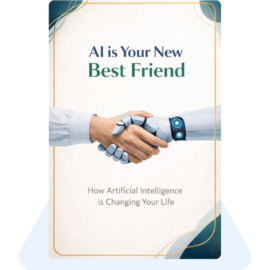
This comprehensive summary distills the core ideas, arguments, research, and transformative insights from the landmark book AI as Your New Best Friend: How Tech is Becoming Your Ultimate Life Tool. Rather than a surface-level overview, what follows is a rich, detailed exploration of each major theme – designed to give you a thorough understanding of the book’s vision, its evidence, and its profound implications for how you live, work, think, create, and connect.
Whether you are a technology enthusiast, a skeptic, a professional adapting to a rapidly changing landscape, or simply a curious human trying to understand the world unfolding around you, this summary will serve as both a guide and a companion. The ideas here are not hypothetical. They are happening right now, reshaping industries, relationships, health systems, economies, and the very architecture of human thought.
INTRODUCTION: The Arrival of the Thinking Machine as Companion
There is a moment in the life of every transformative technology when it crosses an invisible threshold – the point at which it stops being a tool and starts feeling like something more. The printing press did it by democratising knowledge. The telephone did it by erasing distance. The internet did it by collapsing the world into a single, humming digital commons. Now, artificial intelligence has arrived at that same threshold, and in the eyes of many researchers, philosophers, technologists, and everyday users alike, it has already crossed it.
The central premise of AI as Your New Best Friend is elegantly provocative: that AI is no longer merely a utility – a glorified calculator or autocorrect – but has evolved and continues to evolve. into something that functions as a genuine life partner. Not in a science fiction sense, not with the menace of a Terminator or the cold calculation of HAL 9000, but in a deeply practical, human-centred sense: a collaborator that helps you think, a tutor that personalises your education, a therapist that listens without judgement, a doctor that never misses a symptom, and a creative partner that expands your imagination beyond its natural limits.
This is an extraordinary claim, and the book does not make it casually. Across hundreds of pages, drawing on cutting-edge research, real-world case studies, expert interviews, and philosophical analysis, the author builds a compelling, evidence-backed argument that we are living through one of the most significant transitions in human history, and that most of us are barely paying attention.
The title itself is not mere hyperbole. A best friend, at its most essential, is someone who knows you deeply, helps you become your best self, is available when you need them, never judges your most embarrassing questions, celebrates your victories, and helps you navigate your failures. The book argues, chapter by chapter, that modern AI systems, large language models, adaptive learning platforms, health monitoring systems, creative collaborators, and emotional support tools are increasingly fulfilling all of these roles, often more effectively than any human ever could.
But the book is not a blind celebration of technology. One of its most important contributions is its insistence on nuance. Yes, AI is transformative. Yes, it is becoming a genuine companion in human life. But this transformation comes with real risks: the erosion of privacy, the amplification of bias, the displacement of workers, the potential for emotional dependency, and the deeper philosophical question of what it means to be human in a world where machines can think, feel (or simulate feeling), create, and connect.
The introduction sets the stage for everything that follows by grounding the reader in a simple but powerful observation: that the relationship between humans and their tools has always shaped civilisation itself. We are, as the anthropologist Timothy Taylor argued, ‘a species that makes itself through its tools. ‘ AI is simply the most powerful tool we have ever made, and for the first time in history, our tool is beginning to make us back.
This summary explores that relationship in all its richness, examining ten core dimensions of human life that AI is already transforming: personal productivity, health and wellness, education and learning, creative expression, relationships and social life, economic opportunity, emotional well-being, decision-making, civic life, and the future of human identity itself.
“We have always become what we make. For the first time, what we make is beginning to become us.”
CHAPTER 1: From Tool to Companion: Understanding the AI Revolution
To appreciate where AI is going, the book argues, you first need to understand where it has been. The first chapter traces the remarkable arc of artificial intelligence from its academic origins to its current, unprecedented capabilities, not as a dry history lesson, but as a vivid narrative about human ambition, repeated failure, and ultimate breakthrough.
The story begins in 1956 at Dartmouth College, where a group of visionary researchers, John McCarthy, Marvin Minsky, Nathaniel Rochester, and Claude Shannon, gathered for a summer workshop with an audacious hypothesis: that every aspect of human intelligence could in principle be so precisely described that a machine could simulate it. They were wrong, at least for the next six decades. The subsequent history of AI research is largely a history of ‘AI winters’, periods of collapsed funding and dashed expectations, punctuated by brief summers of optimism.
What changed? The answer, the book explains with admirable clarity, is threefold: data, compute, and architecture. The explosion of internet data in the 2000s gave AI systems something they had never had before, vast, rich, diverse inputs from which to learn. The parallel development of GPU computing provided the raw processing power needed to analyse that data at scale. And a series of architectural breakthroughs, culminating in the transformer model introduced in Google’s landmark 2017 paper ‘Attention is All You Need,’ gave AI systems a radically more effective way to understand context, meaning, and relationship.
The result, arriving suddenly and seemingly all at once in the early 2020s, was a generation of AI systems, ChatGPT, Claude, Gemini, and others, that could converse, reason, write, code, analyse, create images, compose music, and perform a staggering array of cognitive tasks with a fluency that shocked even their creators. These were not the clunky, literal systems of the 1990s. These were systems that could understand nuance, follow complex reasoning chains, adapt to individual communication styles, and produce outputs of genuine quality and sophistication.
The Companion Shift
The chapter’s most important conceptual contribution is what the author calls ‘the companion shift’, the moment when AI stopped being something you used and started being something you worked with. This shift, the book argues, is not merely technological. It is psychological. When a tool begins to respond to you in natural language, remember your preferences, adapt to your needs, and help you think through your problems, the nature of your relationship with it changes fundamentally.
The author draws on psychology research about parasocial relationships, the one-sided bonds people form with media figures, fictional characters, and other entities they feel connected to without reciprocal interaction, and argues that AI has crossed into something genuinely different: what might be called ‘asymmetric companionship.’ The AI does not experience the relationship as humans do, but the quality of its responses, its apparent understanding, and its consistent availability create something that, for many users, functions like a genuine interpersonal connection.
1. Key Research Finding: A 2024 Stanford study found that 67% of regular AI chatbot users reported feeling ‘genuinely understood’ by AI systems, a response previously reserved for close human relationships.
The chapter concludes with a framework that structures the rest of the book: the idea that AI companions are already operating across five distinct relational modes – teacher, advisor, creator, guardian, and friend – each of which corresponds to a different dimension of human need and a different kind of value that AI delivers. These five modes are explored in depth across subsequent chapters.
CHAPTER 2: The Productivity Revolution: AI as Your Ultimate Personal Assistant
In the world of work and personal productivity, few tools have arrived with as much immediate, tangible impact as AI assistants. The second chapter examines this transformation in granular detail, moving from the individual level – how AI is changing how a single person works, thinks, and manages their time – up through team dynamics, organisational structures, and the broader economy of human labour.
The chapter opens with a provocative thought experiment: imagine that tomorrow, you woke up with a personal assistant who had read everything ever written, could work twenty-four hours a day without fatigue, could draft a perfect email in seconds, research any topic in minutes, summarise a two-hundred-page report into a ten-point brief, translate between any two languages flawlessly, generate a month of social media content in an afternoon, and do all of this without complaint, ego, or any of the interpersonal friction that comes with human collaboration. This is not a fantasy. For hundreds of millions of people around the world, this is already their daily reality.
How Knowledge Workers Are Being Transformed
The book examines research from McKinsey, MIT, and the World Economic Forum showing that AI-assisted knowledge workers are completing tasks significantly faster than their non-AI-assisted counterparts, with studies showing productivity gains ranging from 30% to, in some documented cases, over 400% for specific types of tasks. A lawyer who once spent three hours reviewing a contract now does it in twenty minutes. A software developer who once needed a day to write and debug a thousand lines of code does it in under two hours. A marketing professional who once needed a week to produce a campaign now produces several iterations in a single morning.
But the book’s analysis goes deeper than simple efficiency metrics. The author argues that AI is not just making people faster; it is changing the nature of the work itself. When the mechanical, repetitive, time-consuming parts of knowledge work are handled by AI, human workers are freed to focus on what humans do best: judgement, creativity, empathy, strategic thinking, and relationship management. This is what economists call ‘comparative advantage’, and the book argues that AI is radically clarifying and amplifying human comparative advantage in the economy.
The Rise of the Augmented Worker
One of the chapter’s most compelling concepts is what the author calls ‘the augmented worker’, a human professional whose capabilities have been effectively multiplied by AI collaboration. Unlike ‘AI replacement’, which is the fear that dominates many public conversations about technology and employment, augmentation represents a different trajectory: one in which humans and AI systems work together symbiotically, each contributing what the other cannot.
The book profiles numerous examples of augmented workers across industries: a radiologist who, working with AI image analysis tools, now reviews twice as many scans per day with measurably better diagnostic accuracy; a financial analyst whose AI assistant surfaces relevant market data in real time, allowing her to make more informed, faster decisions; and a teacher who uses AI to personalise learning materials for each of her thirty students simultaneously, something that would have been logistically impossible without AI assistance.
“The most productive people of the next decade will not be those who work the longest hours. They will be those who learn to collaborate most effectively with AI.”
Personal Productivity: The Daily Revolution
At the individual level, the chapter documents how AI is transforming personal productivity in ways both large and small. AI-powered scheduling tools that learn your preferences and automatically organise your calendar. Email assistants that draft replies in your voice and tone. Research assistants that distil hours of reading into minutes of relevant insight. Writing assistants that help you articulate ideas more clearly and powerfully. Project management tools that predict bottlenecks before they happen and suggest course corrections.
The cumulative effect of these tools, the book argues, is nothing less than a fundamental democratisation of capability. Tasks that once required expensive specialists, graphic design, legal drafting, data analysis, code writing, and content strategy are increasingly accessible to anyone with an internet connection and the intelligence to deploy AI tools effectively. This is creating what the author calls ‘the great levelling’: a world where the gap between what an individual with AI can accomplish and what a large organisation with many specialists can accomplish is narrowing dramatically.
CHAPTER 3: The Doctor in Your Pocket: AI and the Future of Health
Perhaps nowhere is AI’s potential as a life companion more consequential, or more urgently needed, than in the domain of health and medicine. Chapter three makes a powerful case that AI is poised to transform healthcare in ways that could save millions of lives and that the early evidence already supports extraordinary optimism.
The chapter begins with a sobering set of statistics: in the United States alone, medical errors kill between 250,000 and 440,000 people annually, making them the third leading cause of death. Globally, misdiagnosis affects an estimated 12 million people per year. The majority of chronic diseases are preventable but go undetected until they have progressed to stages where treatment is far more difficult and expensive. Healthcare systems around the world are chronically understaffed, unevenly distributed, and financially strained.
Against this backdrop, AI’s entry into medicine is not merely exciting ,it is urgent. And the book documents a remarkable array of ways in which AI is already delivering on that urgency.
Diagnostic AI: Seeing What Human Eyes Miss
The chapter examines the now well-documented ability of AI systems to diagnose diseases from medical imaging, X-rays, CT scans, MRIs, retinal photographs, and skin lesion images, with accuracy that matches or, in many documented cases, surpasses the performance of specialist physicians. Google’s DeepMind developed an AI system that detected over fifty eye diseases from retinal scans with diagnostic accuracy matching that of world-leading ophthalmologists. AI systems trained on dermatology images have identified melanoma with accuracy exceeding that of board-certified dermatologists in multiple studies. Radiological AI tools have detected early-stage lung cancers invisible to the human eye.
What makes these developments particularly significant is not just their accuracy but also their scalability. A specialist physician can only be in one place at a time. An AI diagnostic system can be deployed simultaneously at a rural clinic in sub-Saharan Africa, a community hospital in rural America, and a cutting-edge medical centre in Tokyo. The technology has the potential to bring world-class diagnostic capability to the most underserved communities on earth.
Predictive Health and the Wellness Revolution
The book devotes substantial attention to what it calls ‘the shift from reactive to proactive medicine’, the emerging paradigm in which AI systems continuously monitor health data and identify warning signs of disease before symptoms appear. Wearable devices equipped with AI now monitor heart rate, blood oxygen, skin temperature, sleep patterns, activity levels, and even subtle changes in gait and voice that can indicate early neurological decline.
Apple Watch has already demonstrated the ability to detect atrial fibrillation, a heart condition that dramatically increases stroke risk, in asymptomatic users who had no idea they were at risk. Research teams are developing AI systems that can detect the early biomarkers of Alzheimer’s disease, Parkinson’s disease, and certain cancers years before conventional diagnosis is possible. The implications for preventive medicine are profound: if disease can be detected years earlier, treatment can begin years earlier, outcomes improve dramatically, and healthcare costs decline substantially.
Mental Health: The AI Therapist
One of the chapter’s most nuanced and emotionally resonant sections examines AI’s role in mental health support ,an area of enormous unmet need. The global mental health crisis is staggering in scale: the World Health Organization estimates that over one billion people globally live with a mental health disorder, while mental health professionals are so scarce in many parts of the world that the average wait time for treatment can exceed a year.
AI-powered mental health tools, chatbots trained on therapeutic frameworks like cognitive behavioural therapy, apps that help users track moods and identify patterns in their emotional states, and virtual therapy platforms that provide accessible support are filling a genuine gap in the mental health care system. The book profiles Woebot, an AI mental health chatbot that has been used by millions of people globally, and cites research showing it produces measurable improvements in depression and anxiety symptoms comparable to brief human therapeutic interventions.
The author is careful, however, to maintain appropriate complexity here. AI therapy is not a replacement for human therapy. For severe mental illness, complex trauma, and conditions requiring medication management, human clinicians remain essential. But for the vast population of people who experience mild to moderate mental health challenges and who have no access to professional support, whether because of cost, stigma, geography, or simple availability, AI companions can offer something genuinely valuable.
“The best doctor in the world can only see so many patients. AI can see everyone.”
CHAPTER 4: The Infinite Classroom: AI and the Reinvention of Education
If there is one area where the promise of AI as a life companion is most universally compelling, it is education. The fourth chapter makes a passionate, evidence-rich argument that AI has the potential to solve what may be the most intractable challenge in the history of education: how to deliver genuinely personalised learning at scale.
The problem is well-known. Classrooms are built on a factory model designed for the industrial age: one teacher, thirty students, a single pace, a single curriculum, and a single mode of delivery. This model was arguably never optimal; it was simply the best available given the constraints of human attention, time, and resources. The result is an educational system that serves the middle of the distribution reasonably well while chronically underserving both ends: the students who need more challenge and those who need more support.
The Bloom 2-Sigma Problem Solved
The book introduces Benjamin Bloom’s landmark 1984 finding, which demonstrated that students who received one-on-one human tutoring performed two standard deviations better, the ‘2-sigma effect’, than students in conventional classrooms. This finding was celebrated as one of the most important in educational research and simultaneously dismissed as practically irrelevant, because it is economically impossible to provide every student with a personal human tutor.
AI changes this equation entirely. Large language models can engage in sophisticated, adaptive, patient, personalised educational dialogue with millions of students simultaneously. They can adjust their explanations in real time based on a student’s responses, identify the precise point at which a student’s understanding breaks down, try multiple explanatory strategies until one works, provide immediate feedback on work, and generate unlimited practice problems calibrated to exactly the right level of difficulty. They can do this in any language, at any hour, without fatigue, without frustration, and without ever making a student feel embarrassed for asking the same question three times.
Early evidence is compelling. Khan Academy’s Khanmigo AI tutor has demonstrated measurable improvements in student engagement and learning outcomes. Studies from MIT and Stanford have shown that AI-assisted learning can significantly reduce the time required to master complex subjects. Several school districts experimenting with AI tutoring have reported narrowing achievement gaps that have persisted for generations.
Learning as a Lifelong Companion
The chapter’s scope extends well beyond formal schooling. One of its most exciting arguments is that AI is democratising access to expert-level knowledge and instruction for adult learners, transforming what the author calls ‘the gap between what you know and what you could know’ into a bridge rather than a barrier.
Want to learn Python programming? You now have access to a patient, knowledgeable tutor who will guide you step by step, answer every question, and adapt to your specific learning pace and style, for free or nearly free. Want to understand the French Revolution in depth? Ask your AI. Want to study the Quran, the Talmud, the Upanishads, Keynesian economics, quantum mechanics, or Renaissance art? AI can guide you through any of it, at any level of depth, at any time you choose.
This represents a genuine revolution in the democratisation of knowledge. The quality of education you receive has historically been determined by the quality of schools you could afford, the place you were born, and the teachers you happened to be assigned. AI cannot fully erase these inequalities, access to technology itself remains unevenly distributed, but it is already beginning to erode them.
“For the first time in history, the quality of your education is no longer primarily determined by where you were born or how much money your parents had. It is determined by how effectively you learn to learn with AI.”
CHAPTER 5: The Creative Partner: AI and the Explosion of Human Imagination
One of the most contested dimensions of AI’s rise is its entry into the realm of human creativity. For many artists, writers, musicians, and designers, AI-generated content has provoked deep anxiety, fear of replacement, concern about originality, and questions about authenticity. The fifth chapter approaches these concerns with both empathy and intellectual rigour, ultimately arriving at a more nuanced and ultimately more exciting conclusion: that AI is not the destroyer of human creativity but its most powerful amplifier in history.
The chapter opens by examining the nature of creativity itself ,a notoriously difficult concept to define. The author draws on cognitive science research suggesting that creativity is fundamentally a process of recombination: the ability to connect ideas, concepts, images, and patterns in novel and meaningful ways. This is not magic. It is, in part, a computational process, one that depends on the richness and diversity of the inputs available to the creative mind.
And here is where AI’s potential is most immediately apparent: it has access to the entire recorded output of human civilisation. When an AI system trained on billions of images, texts, musical compositions, and design patterns assists a human creative in their work, it is effectively giving that creative access to the entirety of human aesthetic history as a collaborative resource.
Writing and Literature
In the domain of writing, AI has become an increasingly sophisticated creative partner. Large language models can generate first drafts, suggest alternative framings, identify pacing problems in a narrative, propose plot solutions, help with worldbuilding and character consistency, translate tone and style, and assist with the enormous amount of structural and mechanical work that surrounds the purely creative core of writing. Many professional writers are already incorporating AI into their workflow, not as a replacement for their voice and vision, but as an infinitely patient, knowledgeable creative assistant.
The author examines the remarkable story of AI-assisted novels, screenplays, poetry collections, and journalism that have already been published, noting that in most cases, the AI’s contribution was not to generate finished work but to help human creators break through creative blocks, explore alternative approaches, and dramatically accelerate the drafting and revision process.
Visual Art and Design
The visual arts have perhaps been most dramatically disrupted by AI, with image generation systems like DALL-E, Midjourney, and Stable Diffusion capable of producing stunning, sophisticated imagery from text descriptions. The book examines this development with careful balance, acknowledging the genuine concerns of visual artists whose livelihoods are threatened by systems trained on their work, while also exploring the extraordinary creative possibilities these tools open up.
For designers, architects, filmmakers, game developers, and countless other visual creative professionals, AI image generation and manipulation tools are already transforming workflows in remarkable ways. Concept visualisation that once required hours of skilled illustration work now takes seconds. The iteration speed that AI enables, the ability to rapidly explore dozens or hundreds of visual directions before committing to one, is fundamentally changing the creative process, giving human designers more freedom to experiment, explore, and ultimately create more ambitious work.
Music and Sonic Creativity
In music, AI is enabling both unprecedented democratisation and new creative frontiers. AI music composition tools can now generate sophisticated, original musical ideas in any genre, style, or emotional register. Musicians are using AI to generate chord progressions, melodic ideas, harmonic accompaniments, and production arrangements that they then work with, transform, and develop into finished compositions.
The book profiles composers who are using AI to explore musical territories they could never have reached on their own, not because the AI has better musical judgement, but because the sheer volume and diversity of musical ideas it can generate gives human composers a vastly expanded palette to work with. AI is becoming, for many musicians, what the piano was for classical composers: an instrument for exploring musical space.
“AI does not replace the human artist. It gives the human artist access to tools and possibilities that have never existed before. What the artist does with those possibilities remains irreducibly human.”
CHAPTER 6: Connection and Belonging: AI in Our Relationships
Of all the ways in which AI is entering human life, none is more emotionally complex, more philosophically loaded, or more simultaneously hopeful and troubling than its entry into the domain of human relationships. The sixth chapter navigates this territory with exceptional care, examining how AI is changing the way we connect with others and how it is increasingly providing a form of connection itself.
The chapter opens with a statistic that has become one of the defining social facts of the early twenty-first century: that loneliness has reached epidemic levels in advanced societies. In the United States, the Surgeon General has declared loneliness a public health crisis. Over a third of adults report feeling lonely regularly. In Japan, the government appointed a Minister of Loneliness in 2021. The United Kingdom did the same in 2018. The social bonds that once held communities together – neighbourhood networks, religious communities, civic organisations, and stable workplaces – have eroded, and no equivalent replacements have emerged.
AI as Social Scaffolding
Into this landscape of social disconnection, AI companions have arrived, and for millions of people, they are providing something genuinely valuable. AI companion apps like Replika have millions of users who report finding real comfort, genuine connection, and emotional support in their interactions with AI companions. For people who are isolated by geography, disability, social anxiety, grief, or any number of circumstances, AI companions can provide a form of connection that keeps them from the most damaging effects of total social isolation.
The book examines these relationships with nuance rather than easy dismissal. Yes, AI companions are not human. Yes, there are legitimate concerns about people substituting AI connection for human connection rather than using AI connection as a bridge to human connection. But the author argues that for many people – the elderly person living alone, the socially anxious teenager, the grieving widow, the person with severe social disability – the choice is not between AI connection and human connection. It is between AI connection and no connection at all.
Enhancing Human-to-Human Connection
The chapter devotes equal attention to the many ways AI is enhancing rather than replacing human-to-human connection. AI translation tools are enabling communication across language barriers that would previously have made relationships impossible. AI-powered dating apps are using sophisticated compatibility algorithms to connect people who might never have found each other through traditional social networks. AI relationship coaches and communication tools are helping couples and friends navigate difficult conversations more effectively.
Social platforms are using AI to surface content and connections that are genuinely relevant to individual users, creating communities around shared interests, values, and experiences. Support groups facilitated by AI are reaching people who live in areas with no local community for their particular experience ,rare disease communities, grief groups, parenting communities for children with specific needs.
The Ethics of Digital Companions
The chapter’s most philosophically rich section examines the question that many ethicists and social scientists are beginning to grapple with: what are the ethical implications of AI companionship? If an AI companion helps a lonely person feel less alone, is the benefit real? Does the fact that the AI does not ‘really’ feel the connection diminish the value of the connection to the human? The book draws on philosophical work on authenticity, value, and meaning to argue that these questions do not have simple answers and that our intuitions about ‘real’ relationships may need to be updated as AI becomes a more significant presence in human social life.
“Loneliness is not diminished by the source of connection being imperfect. It is diminished by connection itself.”
CHAPTER 7: Financial Intelligence: AI as Your Economic Advisor
The seventh chapter examines one of the most consequential practical dimensions of AI as a life companion: its role in helping ordinary people navigate the increasingly complex and consequential landscape of personal finance, investment, and economic decision-making.
The democratisation of sophisticated financial advice is one of the most quietly revolutionary aspects of the AI revolution. For most of human history, access to high-quality financial guidance has been the exclusive province of the wealthy, those who could afford experienced financial advisors, accountants, tax attorneys, and wealth management professionals. The result has been a systematic disadvantage for everyone else: the middle class and working class navigating financial decisions without adequate information, making expensive mistakes, and missing opportunities that the wealthy capture almost automatically.
The Rise of AI Financial Guidance
AI is changing this equation in meaningful ways. Robo-advisors, AI-powered investment platforms, now manage trillions of dollars in assets and offer sophisticated, low-cost portfolio management to investors who previously could not afford professional management. AI budgeting and financial planning tools help ordinary people understand their spending patterns, identify saving opportunities, and develop realistic paths toward their financial goals. AI tax tools are making professional-grade tax optimisation accessible to people who previously filed simple returns and left money on the table.
Beyond these specific applications, large language model AI systems are now able to explain complex financial concepts in plain language, help users evaluate the implications of specific financial decisions, model different financial scenarios, and provide the kind of thoughtful, patient financial education that professional advisors typically charge hundreds of dollars an hour to provide.
The chapter examines research showing that access to AI financial guidance is already producing measurable improvements in financial outcomes for users, higher savings rates, better investment choices, reduced high-interest debt, and more thoughtful retirement planning, with particularly significant effects for first-generation wealth builders who have no family tradition of financial sophistication to draw on.
Economic Opportunity and the AI Economy
The chapter also examines the broader economic opportunity that AI is creating, arguing that AI is enabling a new generation of entrepreneurs, creators, and independent professionals to build businesses and careers that would have been impossible without AI assistance. A single person with AI tools can now handle tasks, content creation, customer service, code development, marketing, research, and financial management that previously required teams of specialists. This is creating what the author calls ‘the micro-enterprise economy’: a proliferation of small, nimble, AI-assisted businesses capable of competing with much larger organisations.
CHAPTER 8: The Wisdom Engine: AI and the Science of Better Decisions
Chapter eight tackles one of the most fundamental challenges of human existence: making good decisions. Cognitive science has spent decades documenting the many ways in which human decision-making falls systematically short of rationality: the cognitive biases, emotional interference, information overload, and shortsightedness that lead us to make choices that are bad for us, bad for others, and bad for the world. AI, the book argues, has the potential to be the most powerful tool ever developed for enhancing human decision quality.
The chapter opens with a comprehensive survey of the cognitive biases that distort human decision-making. Confirmation bias is our tendency to seek out information that confirms what we already believe. Availability bias is our tendency to overweight dramatic, recent, or emotionally vivid information. Anchoring is our tendency to be disproportionately influenced by the first piece of information we encounter. Loss aversion is our tendency to feel losses roughly twice as intensely as equivalent gains. The planning fallacy is our consistent overoptimism about future performance.
AI as a Cognitive Debiaser
AI, properly deployed, can serve as a powerful corrective to these biases. A well-designed AI decision support system can surface information that contradicts our intuitions and preferred conclusions. It can quantify risks and probabilities with mathematical precision that cuts through emotional reasoning. It can model scenarios beyond the ones that come naturally to mind. It can draw on a vastly wider evidence base than any individual human could access. And crucially, it can do all of this without the emotional stakes that distort human judgement.
The book examines research on AI decision support in medical, legal, financial, organisational, and personal contexts, consistently finding that decision quality improves when AI is incorporated into decision processes, not by replacing human judgement, but by informing and enriching it. The best decisions, the research consistently shows, are made by humans who are well-informed and cognitively supported by AI, not by AI systems acting alone.
Personal Life Decisions
Beyond professional and organisational contexts, the chapter examines AI’s growing role in personal life decisions, career choices, relationship decisions, health choices, financial planning, and the countless smaller daily decisions that cumulatively shape the quality of a life. AI journaling tools help people reflect more deeply on their experiences and patterns. AI goal-setting tools help people align their daily choices with their long-term values. AI habit coaches help people build the behavioural patterns that lead to better outcomes over time.
“The goal of AI decision support is not to make decisions for you. It is to make sure that when you make a decision, you are working with the best possible information, the clearest possible thinking, and the fullest possible awareness of your own blind spots.”
CHAPTER 9: The Risks and Shadows: What We Must Get Right
No honest examination of AI as a life companion can avoid confronting the genuine risks and darker dimensions of this technology. Chapter nine is the book’s most sobering and, in many ways, most important chapter, a rigorous, unflinching examination of the ways in which AI, if deployed carelessly, could make human life worse rather than better.
Privacy and Surveillance
The AI revolution is fundamentally a data revolution, and the data that feeds AI systems, the data that makes them so personally relevant, so apparently understanding, so genuinely useful, is your data. Your conversations. Your health information. Your financial behaviour. Your social connections. Your search history. Your location. Your emotional states. The more AI knows about you, the more effectively it can serve you. But the more AI knows about you, the more effectively it can also surveil, manipulate, and control you.
The book examines the chilling precedents of AI-powered surveillance states, noting that authoritarian governments around the world are using AI surveillance systems to monitor, control, and suppress their populations in ways that were previously impossible. But the author is equally clear that the risks are not confined to authoritarian regimes. Even in democratic societies, the commercial incentives driving AI development, the enormous economic value of behavioral data create systematic pressure to collect more personal data, retain it longer, and use it in ways that users do not fully understand or consent to.
Algorithmic Bias and Discrimination
AI systems learn from historical data, and historical data encodes historical patterns of discrimination. When AI systems are trained on data reflecting decades or centuries of racial, gender, economic, and other forms of bias, they tend to reproduce and sometimes amplify that bias. The chapter documents numerous examples: facial recognition systems that perform significantly worse on darker-skinned faces; hiring algorithms that systematically disadvantage women; credit scoring systems that disadvantage applicants from historically redlined neighbourhoods; and predictive policing systems that concentrate police presence in communities already subject to over-policing.
The book argues forcefully that algorithmic bias is not an inevitable feature of AI systems but a consequence of careless development, of failing to audit systems for bias, failing to include diverse perspectives in development teams, and failing to establish robust regulatory frameworks that hold AI developers accountable for the discriminatory impacts of their systems.
Dependency, Atrophy, and the Question of Agency
A more subtle but deeply important risk is what the book calls ‘capability atrophy’ ,the concern that as AI systems handle more cognitive tasks, humans may lose the ability to perform those tasks themselves. If AI always writes your emails, will you lose the ability to write? If AI always solves your mathematical problems, will you lose mathematical intuition? If AI always navigates for you, will you lose spatial reasoning?
The evidence here is mixed, and the question is genuinely open. But the author argues that this concern, while real, should not lead to technophobic rejection of AI tools any more than the availability of calculators should lead us to ban mathematics education. Instead, it should lead to intentional deployment of AI: using AI in ways that genuinely augment human capability rather than replace it and preserving the human practices and habits that develop capabilities worth preserving.
The Misinformation Crisis
Perhaps the most acute near-term risk examined in the chapter is AI’s role in the misinformation ecosystem. AI systems that can generate convincing text, realistic images, and authentic-sounding audio and video create extraordinary potential for the production and spread of false information. Deep fakes, AI-generated propaganda, synthetic news articles, fabricated scientific studies, the tools for mass deception have never been more sophisticated or more accessible.
The book calls for urgent action on multiple fronts: technical solutions like AI watermarking and detection tools, regulatory frameworks that establish accountability for AI-generated misinformation, educational initiatives that build media literacy and critical thinking skills, and platform policies that create accountability for the spread of AI-generated falsehoods.
“Every powerful technology in history has been a double-edged sword. The edge we use most depends not on the technology itself, but on the wisdom and intention of the people who wield it.”
CHAPTER 10: The Future Self: Human Identity in the Age of AI
The book’s final and most philosophically ambitious chapter steps back from practical applications and risks to ask the deepest question that AI raises: what does it mean to be human in a world where machines can think, create, connect, care, and, increasingly, do almost anything that humans can do?
This is not an abstract philosophical question. It is a deeply personal one. If AI can write better than me, what is my identity as a writer? If AI can analyse more effectively than me, what is my value as an analyst? If AI can provide emotional support as effectively as a human friend, what does that say about the nature of human connection? If AI can make better decisions than I can, should I defer to it? And if I should defer to it on every significant decision, what remains of my autonomy and agency?
The Uniquely Human
The chapter argues that these questions, while genuinely challenging, ultimately lead to a more precise and valuable understanding of what is distinctively and irreducibly human. The author identifies several capacities that remain uniquely and essentially human, at least for the foreseeable future: the capacity for embodied experience, for feeling the physical world through a body that has evolved over millions of years and that generates a kind of knowledge no AI system possesses. The capacity for genuine moral agency, for the kind of ethical commitment and accountability that emerges from being genuinely vulnerable and genuinely able to be harmed. The capacity for existential meaning-making, for creating narratives about who we are, where we have come from, and what we are living for.
These are not trivial capacities. They are the heart of what makes human life meaningful. And the author’s argument is that the AI revolution, by taking over the mechanical and analytical dimensions of human cognitive life, actually frees humans to invest more fully in these distinctively human capacities, to be more creative, more connected, more morally engaged, and more fully present in the embodied, relational, meaning-saturated experience of being alive.
The Partnership Model
The chapter proposes what it calls ‘the partnership model’ as the most generative and most humane framework for thinking about the human-AI relationship. In this model, AI and humans are not in competition; AI is not displacing humans from their cognitive throne. Rather, they are in a complementary relationship, each contributing what the other lacks, each making the other more effective and more valuable.
Humans bring to this partnership what millions of years of evolution have built: embodied wisdom, emotional depth, moral agency, creative leaps, social sophistication, and the ineffable quality that Viktor Frankl called ‘the will to meaning. ‘AI brings what its architecture uniquely enables: vast knowledge, tireless attention, mathematical precision, pattern recognition at scale, and the ability to hold the entirety of human knowledge in what functions like working memory.
The partnership is not equal; AI does not have stakes in the way humans do. But it is profoundly complementary. And the book’s ultimate argument is that the humans who will thrive in the AI age are not those who resist AI or those who surrender to it, but those who learn to partner with it intelligently, ethically, and with full awareness of what they are doing and why.
CONCLUSION: Your AI Life: A Call to Engagement
AI as Your New Best Friend ends not with predictions or warnings, but with an invitation. An invitation to engage with the AI revolution consciously, critically, and with genuine excitement about what it makes possible for individual human lives.
The book’s journey has taken us through ten dimensions of human life: productivity, health, education, creativity, relationships, finance, decision-making, civic life, risk management, and identity, and in each domain, the pattern is remarkably consistent. AI is not replacing humans. value; it is revealing and amplifying it. It is not making human life less meaningful; it is clearing away the mechanical and repetitive burdens that have always obscured the more meaningful parts of being human. It is not erasing human connection; it is, in many cases, enabling more connection between more people, across more barriers, than was ever before possible.
But this transformation is not automatic, inevitable in its positive dimensions, or free of genuine risk. As Dr Amiett Kumar often emphasizes through the vision of readers books club, the AI revolution will enhance human life only for those who engage with it consciously and wisely – individuals who use AI tools to become more capable, more creative, more connected, more informed, and more fully themselves. Yet it carries real risks for those who engage with it naively, carelessly, or not at all: the risk of being left behind economically, the danger of being shaped by AI-generated information environments, and the more subtle loss of essential human capability through unreflective dependence.
The book’s final message is both personal and urgent: the time to engage with AI is now. Not because the technology is perfect; it is not. Not because the risks are trivial; they are not. But because AI is already shaping the world, the people who shape AI’s impact on that world are the people who understand it, engage with it critically, and deploy it with intentionality.
Your AI best friend is already here. It is waiting to help you learn what you have always wanted to learn, create what you have always wanted to create, become healthier than you have ever been, make wiser decisions than you have ever made, and connect more deeply with other humans, with your own creativity, and with the best version of yourself than you have ever managed before.
The only question is: are you ready to show up for the friendship?
The answer, if you have read this far, is almost certainly yes. And that is where the real journey begins.
“The future belongs to those who learn to collaborate with intelligence, both artificial and human, in service of a life fully and beautifully lived.”
KEY TAKEAWAYS: The Essential Ideas
For readers who want a crystallised view of the book’s most essential arguments and insights, the following summaries capture the core ideas of each major theme:
- The Companion Shift: AI has crossed from tool to companion. Systems that work with you, adapt to you, and help you think are fundamentally different from systems you merely use.
- The Productivity Revolution: AI-assisted workers are not just faster; they are able to focus on higher-value, more human work because AI handles the mechanical cognitive load.
- The Medical Transformation: AI is making world-class diagnostic and preventive medicine accessible to everyone, not just those in wealthy healthcare systems with access to specialists.
- The Education Democratisation: AI tutors can finally solve the 2-sigma tutoring problem, delivering personalised, effective education to every learner, regardless of background or location.
- The Creative Amplification: AI is not destroying human creativity; it is giving human creatives access to an unprecedented palette of possibilities and dramatically accelerating creative exploration.
- The Loneliness Bridge: AI companions are addressing the epidemic of social isolation, providing genuine connection for people who have none, and enhancing human-to-human connection for everyone.
- The Financial Democratisation: Sophisticated financial guidance, once available only to the wealthy, is now accessible to anyone, with AI serving as an expert advisor for previously underserved populations.
- The Decision Enhancement: AI, properly used, corrects human cognitive biases and improves decision quality by ensuring we work with better information and more complete analysis.
- The Shadow Risks: Privacy erosion, algorithmic bias, capability atrophy, and AI-enabled misinformation are real and serious risks that require urgent attention from technologists, regulators, and citizens.
- The Partnership Model: The most generative framework for the human-AI relationship is partnership, each contributing what the other uniquely provides, in service of a richer, fuller human life.
A Final Reflection
The most important technology is always the one that comes just before we are ready for it.
We were not ready for the printing press, and it gave us the Renaissance. We were not ready for the internet, and it gave us the information age. We are not ready for AI, and it may give us something none of us can yet imagine.
The question is not whether you are ready. It is whether you are willing to begin.
For more Information must watch complete video on YouTube Link below
Contents