Is Social Media Changing Your Brain? Best Books & Key Summaries Explained
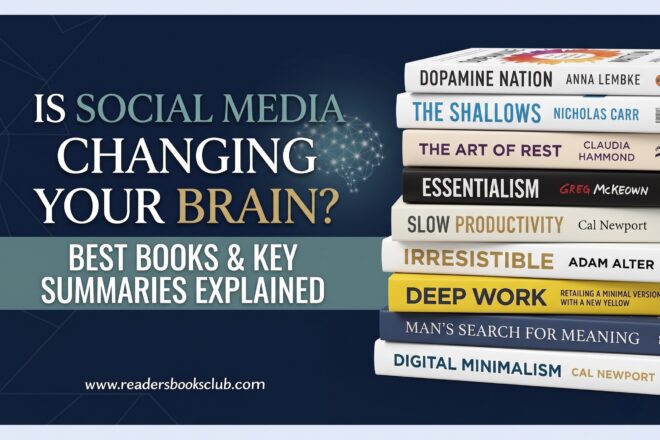
The Science of Digital Dopamine, Brain Rewiring Psychology, and How to Take Your Mind Back
You pick up your phone to check one notification. Fourteen minutes later, you look up, having passed through Instagram, YouTube, WhatsApp, Twitter, and back to Instagram with no memory of the journey and no idea what you actually wanted to see. You feel vaguely restless, vaguely dissatisfied, vaguely anxious. And somehow, inexplicably, you are already reaching for the phone again.
If this sounds familiar, you are not alone. And more importantly, you are not weak, or lazy, or without discipline. You are experiencing the predictable, engineered result of one of the most sophisticated behaviour-modification systems ever built: the social media ecosystem, designed by some of the most talented engineers and psychologists in the world, specifically to capture and hold your attention as completely and as continuously as possible.
The question is no longer whether social media is changing your brain. The neuroscience is clear: it is. The question that matters and the one that this blog from Readers Books Club addresses is what exactly is happening to your brain, what the best books on this subject reveal about the true cost of our digital addiction, and what you can do, starting today, to reclaim the extraordinary cognitive, creative, and spiritual potential that social media is quietly eroding.
At Readers Books Club, founded by Dr Amiett Kumar, India’s top manifestation coach, at www.readersbooksclub.com, we believe that understanding is the beginning of liberation. In this comprehensive blog, we explore the best books ever written on social media and the brain, the science of social media addiction, how social media affects the brain at the neurological level, the psychology of brain rewiring, and the digital dopamine trap that is keeping millions of intelligent people stuck in a cycle of compulsive scrolling. And we show exactly how the tools of manifestation, law of attraction, meditation, affirmation, and visualisation can help you break that cycle and rebuild a mind that is clear, focused, and genuinely free.
“The most dangerous prison in the modern world has no walls and no bars. It has a screen. And it fits in your pocket.” Dr Amiett Kumar
India’s Best Manifestation Coach: Dr Amiett Kumar and Readers Books Club
Dr Amiett Kumar, India’s top manifestation coach, author, spiritual educator, and the founder of Readers Books Club at www.readersbooksclub.com, has been exploring the intersection of technology, the human mind, and conscious living for years through his YouTube channel, podcast, and coaching programmes.
His perspective on social media and brain health is uniquely valuable because it brings together three dimensions that most conversations on this topic treat separately: the neuroscientific evidence for how social media affects the brain; the psychological understanding of social media addiction and its behavioural mechanics; and the spiritual and manifestation-focused insight into what this means for our capacity to attract, create, and live the lives we most deeply desire.
As India’s best manifestation coach, Dr Amiett Kumar understands something that most tech critics miss: the social media addiction crisis is not merely a mental health issue or a productivity problem. It is a manifestation crisis. When your attention is fragmented, your focus is depleted, your dopamine system is dysregulated, and your mind is constantly reactive, you lose the single most important faculty required for conscious manifestation: the ability to hold a clear, sustained, emotionally engaged vision of what you want to create in your life.
The law of attraction responds to sustained, clear, emotionally coherent intention. Social media is specifically engineered to make sustained, clear, emotionally coherent anything virtually impossible. This is the direct conflict between the digital age and the life of conscious creation, and it is why Readers Books Club has devoted this comprehensive blog to the best books on social media and the brain and to the tools of mind reclamation that make genuine manifestation possible in a world designed to hijack your attention.
“You cannot manifest your dream life with a fragmented mind. The most important digital hygiene practice is not which apps you delete t is what you replace them with. Replace scrolling with stillness. Replace reaction with intention. Replace digital dopamine with the real thing: purpose, connection, and meaning.” Dr Amiett Kumar
The Numbers That Should Alarm Every Thinking Person
Before we explore the books, let us look at the scale of what we are dealing with. The statistics on social media use and its effects are not merely concerning they represent one of the most significant public health phenomena of the twenty-first century.
6.37 hrs average daily screen time per person globally (Data Reportal, 2024)
2.5 hrs average time spent on social media per day per user worldwide
58% of people check their phone within 5 minutes of waking up
70% of people check their phone within 30 minutes of going to bed
47 number of times the average person checks their phone per day
23 min average time to regain deep focus after a single digital interruption
These numbers represent an extraordinary amount of human attention, the most precious, most finite, and most directly connected to wellbeing resource any person possesses being continuously extracted and redirected into a system designed to monetise it. Every minute spent in compulsive scrolling is a minute not spent in the focused, intentional, emotionally present state from which genuine creativity, meaningful relationships, and powerful manifestation flow.
This is not a moral judgement on social media users. It is a structural observation about the design of the systems within which we are all operating. Understanding this design, which the best books on social media and brain rewiring psychology reveal in extraordinary detail, is the first step toward reclaiming the mental freedom that genuine, conscious living requires.
“Your attention is your most valuable resource. It is also what your phone is designed to extract from you, every moment of every day. Knowing this changes everything.” Dr Amiett Kumar
How Social Media Affects the Brain: The Neuroscience Explained
Understanding how social media affects the brain at the neurological level is not just intellectually fascinating; it is practically essential for anyone who wants to take back conscious control of their attention, their emotions, and their capacity for the kind of clear, focused, intentional thinking that manifestation requires.
The Dopamine Hijack: Digital Dopamine and the Reward System
At the heart of social media addiction is dopamine, the neurotransmitter most commonly associated with reward, pleasure, and motivation. Your brain’s dopamine system evolved to reward behaviours that were essential for survival: eating, social bonding, learning, and exploration. It does this not primarily when you receive a reward, but when you anticipate one, which is why the possibility of a new notification, a new like, a new comment, or a new viral video creates a powerful dopamine-driven urge to check.
Social media platforms are engineered to maximise this anticipatory dopamine response. The variable reward schedule, in which sometimes there is something interesting when you scroll and sometimes there is not, is the same psychological mechanism that makes slot machines so addictive. The unpredictability is the feature, not a bug. It keeps the dopamine system permanently activated, permanently anticipating, permanently craving the next hit of digital stimulation.
The consequence of this chronic dopamine dysregulation, which the best books on social media addiction document in careful, alarming detail, is a brain that becomes progressively less responsive to the natural, sustainable sources of dopamine that genuinely fulfil human beings: deep work, meaningful conversation, creative accomplishment, physical movement, meditation, and the quiet satisfaction of a purposeful life well lived.
Brain Rewiring Psychology: Neuroplasticity and the Social Media Brain
The human brain is neuroplastic, meaning it literally rewires itself, at the structural level, in response to the experiences it is repeatedly exposed to. The pathways that are used most frequently become stronger and more automatic; those that are used rarely weaken and eventually atrophy. This is the fundamental principle of brain rewiring psychology, and it is precisely what makes the social media crisis so serious.
A brain that spends hours every day in the short-attention-span, high-stimulation, constant-context-switching environment of social media is literally rewiring itself for that environment: building stronger pathways for distraction, impulsivity, and reactive emotional response and allowing the pathways for sustained attention, deep thinking, delayed gratification, and genuine creativity to weaken from disuse.
This is not an exaggeration or a moral panic. It is what the neuroscience research consistently shows and what the best books on how social media affects the brain document with extraordinary clarity and concern. The good news, and this is where the tools of meditation, mindfulness, affirmation, and conscious practice become directly, practically relevant, is that neuroplasticity works in both directions. The same brain that has been rewired by social media can be rewired again, through consistent, intentional practices, into a brain that is focused, calm, creative, and genuinely capable of the sustained attention that manifestation requires.
The Attention Economy and the War for Your Mind
Every social media platform is built on an attention economy model: its revenue is directly proportional to the amount of your attention it captures and holds. This means that the entire design philosophy of every major social media platform, every algorithmic decision, every interface choice, and every notification system is optimised for one single goal: keeping you on the platform for as long as possible, as often as possible.
Understanding this is essential for breaking free from social media addiction. You are not failing to resist something neutral. You are being deliberately, scientifically, and continuously targeted by some of the most sophisticated behaviour-modification technologies ever built. Knowing this does not make you a victim, but it does explain why willpower alone is rarely sufficient and why the kind of conscious, intentional, system-level reclamation that Dr Amiett Kumar teaches through the Readers Books Club is necessary.
The Comparison Trap: Social Media and Mental Health
One of the most consistently documented ways that social media affects the brain is through the activation of social comparison mechanisms. The human brain is inherently social; it is wired to monitor our standing relative to others as a basic survival mechanism. Social media hijacks this mechanism by providing an endless, algorithmically curated stream of the highlight reels of other people’s lives, making the unconscious comparison not between your real life and someone else’s real life, but between your real life and an edited, filtered performance of someone else’s most impressive moments.
The psychological consequences of this chronic upward social comparison, including increased anxiety, depression, reduced self-esteem, and what researchers call ‘fear of missing out’, are among the most thoroughly documented effects of social media on mental and emotional wellbeing. And they are directly, powerfully relevant to manifestation: a mind locked in a state of comparative inadequacy and chronic dissatisfaction cannot generate the high-frequency emotional states of joy, gratitude, and positive expectation from which the law of attraction most powerfully and most generously responds.
“Social media shows you everyone else’s best day. Every day. And asks your nervous system to compare it to your ordinary Tuesday. That comparison is the slow-acting poison of the digital age.” Dr Amiett Kumar
The Best Books on Social Media and the Brain: Summaries by Readers Books Club
At Readers Books Club, Dr Amiett Kumar has curated and explored the most important, most rigorously researched, and most genuinely transformative books ever written on the intersection of social media, the brain, digital addiction, and the reclamation of attention and mental freedom. Here are the key summaries, each one a doorway into a dimension of this topic that every person living in the digital age needs to understand.
Deep Work: Rules for Focused Success in a Distracted World
by Cal Newport ★★★★★
Deep Work is perhaps the most important book ever written on the value of focused, distraction-free concentration and on why social media and the attention economy have made this rare, valuable capacity rarer and more endangered than ever before. Newport draws a compelling distinction between ‘deep work’ (cognitively demanding tasks requiring full, sustained concentration) and ‘shallow work’ (logistical, distraction-prone tasks that can be performed while distracted). He argues with compelling evidence from the world’s most accomplished thinkers, artists, and creators that deep work is not just more productive than shallow work. It is the source of virtually all meaningful, lasting contribution and achievement. And it is precisely the capacity that social media addiction most directly destroys.
Key Lesson: The ability to focus deeply for sustained periods is the single most valuable skill of the twenty-first century and the one that the digital age is most systematically destroying. Protect it with your life.
Stolen Focus: Why You Can’t Pay Attention and How to Think Deeply Again
by Johann Hari ★★★★★
Stolen Focus is the most thorough and most personally honest investigation of the attention crisis ever written. Hari spent three years travelling the world, interviewing the leading experts on attention, distraction, and the social media attention economy, and what he found was both deeply alarming and profoundly hopeful. The book documents twelve distinct forces that are currently degrading human attention, from social media and smartphone design to sleep deprivation, poor nutrition, and toxic childhood environments, and provides a comprehensive, evidence-based framework for understanding what is happening to our collective minds and what, both individually and collectively, we can do about it. It is essential reading for anyone who wants to understand the full scope of the social media and brain crisis.
Key Lesson: The attention crisis is not a personal failing. It is a systemic problem created by a system that profits from our distraction. Understanding this is the first step toward genuine liberation.
Indistractable: How to Control Your Attention and Choose Your Life
by Nir Eyal ★★★★☆
Written by a former tech industry insider who spent years studying and helping to create the psychological mechanisms of digital addiction, Indistractable is both a confession and a redemption. Eyal provides a complete, practical framework for understanding the internal and external triggers that drive compulsive social media use and for building the personal systems, environmental design choices, and inner skills that create genuine, lasting freedom from distraction. Unlike books that simply catalogue the problem, Indistractable is focused entirely on solutions: specific, tested, immediately implementable strategies for reclaiming your attention, your time, and your life from the digital systems that have been engineered to capture them.
Key Lesson: Distraction is not the problem. It is the symptom. The root cause is always an internal discomfort that you are using distraction to avoid. Address the root cause, and the distraction loses its power.
Digital Minimalism: Choosing a Focused Life in a Noisy World
by Cal Newport ★★★★★
Digital Minimalism makes the case compellingly and practically, with extensive evidence, for a fundamentally different relationship with technology: one based not on compulsive, habitual use but on deliberate, intentional choice about which digital tools genuinely serve your deepest values and which simply drain your time and attention without a commensurate return. Newport draws on the philosophy of Thoreau and the psychology of attention research to argue that digital minimalism – using technology with intention rather than compulsion – is not merely a productivity strategy. It is a philosophy of the good life and one that is urgently needed in an age of algorithmic manipulation and attention extraction.
Key Lesson: The question to ask about every digital tool is not whether it offers any benefit. It is whether the benefit is worth the full cost to your attention, your autonomy, and your capacity for the deep, meaningful engagement with life that genuine fulfilment requires.
The Shallows: What the Internet Is Doing to Our Brains
by Nicholas Carr ★★★★★
The Shallows is the groundbreaking, Pulitzer Prize-shortlisted work that first brought the neuroscientific evidence of internet-driven brain rewiring to mainstream attention. Carr documents, in extraordinary detail and with extensive scientific evidence, how the internet and social media in particular are reshaping the pathways of our brains in ways that reduce our capacity for deep reading, sustained attention, and linear, sequential thought while building pathways for the kind of rapid, superficial, context-switching information processing that characterises social media use. This is brain rewiring psychology at its most rigorously documented, and it is essential reading for anyone who wants to understand at the neurological level exactly how social media is affecting the brain.
Key Lesson: Every medium shapes the mind of those who use it. The internet shapes ours for breadth and speed at the cost of depth and wisdom. We are becoming, through our digital habits, shallower thinkers, and we can choose to reverse that.
⚡ Dopamine Nation: Finding Balance in the Age of Indulgence
by Dr Anna Lembke ★★★★★
Dopamine Nation is the most scientifically authoritative and most personally engaging account of the dopamine crisis, the epidemic of compulsive consumption, addiction, and pleasure-seeking that is driving not just social media addiction but the broader mental health crisis of the digital age. Dr Lembke is a Stanford psychiatrist and one of the world’s leading experts on addiction, and her account of how the dopamine system works, how it is exploited by social media platforms, and how it can be restored to healthy function is both deeply illuminating and immediately practically useful. The book introduces the concept of the ‘dopamine fast’ a structured period of abstinence from addictive stimuli, as a powerful tool for resetting the dopamine system and restoring the brain’s capacity for natural, sustainable pleasure.
Key Lesson: We are living in a world of unprecedented pleasure and unprecedented misery. The two are connected. The constant pursuit of high-dopamine stimulation destroys our capacity to enjoy the lower-dopamine pleasures that actually fulfil us: connection, meaning, creativity, and rest.
How to Break Up with Your Phone
by Catherine Price ★★★★☆
How to Break Up with Your Phone is the most practically actionable book on this list a day-by-day, step-by-step guide to fundamentally changing your relationship with your smartphone and, by extension, with social media. Drawing on the neuroscience of habit formation, the psychology of social media addiction, and a deep understanding of how smartphones are designed to exploit the brain’s vulnerabilities; Price provides a complete, compassionate, and highly effective protocol for building a healthier, more intentional relationship with the digital world. This is the ideal companion book for anyone who has understood the problem from the other books on this list and is ready to take concrete, structured action to solve it.
Key Lesson: Breaking up with your phone is not about deprivation. It is about rediscovering everything you have been missing while you were scrolling: the conversations, the experiences, the quiet, the depth, and the presence that make life genuinely worth living.
“Every book on this list is a gift to the human mind. Read them. Absorb them. Apply what they teach. And then watch what happens when you give your attention back to your own life.” Dr Amiett Kumar, Readers Books Club
Social Media Addiction and the Manifestation Crisis: The Connection Nobody Is Talking About
Most discussions of social media’s impact on the brain focus on productivity, mental health, and attention. These are enormously important. But at Readers Books Club, Dr Amiett Kumar raises a dimension of this crisis that almost nobody else is addressing: the direct, profound, and devastating impact of social media addiction on the capacity for conscious manifestation.
The law of attraction, as Dr Amiett Kumar consistently teaches, responds to sustained, clear, emotionally coherent intention. It responds to the quality of your dominant thoughts, the consistency of your emotional state, and the clarity and depth of your visualisation practice. It responds to the presence, the focus, and the inner stillness from which genuine, powerful creative intention emerges.
Social media addiction is the systematic destruction of every one of these capacities. Here is the precise mechanism:
Fragmented Attention Cannot Hold a Clear Vision
Effective visualisation, the practice of holding a vivid, emotionally engaged, multi-sensory inner image of your desired reality, requires sustained, focused attention. A mind that has been trained by hours of daily social media use to shift context every few seconds, to respond to every notification impulse, and to never sustain a single train of thought for more than a minute cannot visualise effectively. The vision dissolves before it can take root in the subconscious. The manifestation process is interrupted before it can begin.
Chronic Comparison Kills Gratitude and Abundance Consciousness
Gratitude and genuine abundance consciousness – the felt sense that life is already rich with blessings, that more goodness is always available, and that the universe is fundamentally generous and benevolent – are among the highest-frequency emotional states available to a human being and the ones to which the law of attraction responds most powerfully. Social media’s comparison trap, the constant, unconscious benchmarking of your real life against everyone else’s curated highlight reel, is the most effective possible destroyer of gratitude and abundance consciousness. It replaces them with lack, with envy, with the persistent sense that you are behind, that others have what you do not, that you are not enough.
Reactive Emotional States Cannot Generate Aligned Intention
Effective affirmation, the kind that actually reprograms the subconscious mind rather than merely repeating positive words over a background of unexamined negative emotion, requires a genuine inner alignment between the words being spoken and the emotional state from which they are spoken. A mind perpetually destabilised by social media’s emotional manipulation – the outrage, the anxiety, the FOMO, the inadequacy, and the restlessness – cannot generate the calm, clear, genuinely positive emotional state from which affirmations land at the subconscious level and create real inner change.
Digital Dopamine Replaces Inspired Action with Passive Consumption
The final and perhaps most devastating way that social media addiction sabotages manifestation is through the replacement of inspired action with passive consumption. Genuine manifestation is not passive. It requires inspired, aligned, consistent action in the direction of your desires. But a brain flooded with the cheap, easy, immediately available dopamine of social media stimulation loses its motivation for the harder, slower, more genuinely rewarding dopamine of deep work, creative effort, and meaningful contribution. The scrolling replaces the doing. The watching replaces the creating. And the manifestation that could have materialised through inspired action never arrives because the energy that would have powered it has been spent on content that added nothing to anyone’s life.
“Social media does not just steal your time. It steals the very mental and emotional capacities that are required for you to manifest the life you deserve. This is why reclaiming your attention is not a productivity decision. It is a manifestation decision.” Dr Amiett Kumar
Taking Your Brain Back: The Digital Detox and Mind Reclamation Protocol
Understanding the problem is essential. But understanding alone changes nothing. What changes everything is the consistent, intentional application of specific practices that rewire the brain away from social media addiction and toward the focused, calm, creatively powerful state from which genuine manifestation, genuine productivity, and genuine human flourishing are possible.
Drawing on the insights of the best books on this list and on his own deep expertise in the law of attraction, meditation, affirmation, and mindful living Dr Amiett Kumar recommends the following mind reclamation protocol:
1. The Morning Sacred Hour: No Phone Before Presence
The single most powerful thing you can do for your brain health, your mental clarity, and your manifestation practice is to reclaim the first hour of your morning from social media entirely. Before you check any notification, any feed, any message give yourself a full sixty minutes of phone-free presence. Use that hour for morning meditation, affirmation practice, visualisation, reading from one of the books on this list, journalling, or simply being quietly present with your own thoughts. This single habit, sustained consistently, will produce more positive change in your mental state than almost any other intervention available.
2. The Deliberate Digital Dopamine Fast
Following Dr Anna Lembke’s research on dopamine restoration, Dr Amiett Kumar recommends a structured period starting with just one day per week of complete abstinence from social media and other high-dopamine digital stimuli. This deliberate dopamine fast allows the brain’s dopamine system to reset, restoring its sensitivity to the natural, sustainable sources of pleasure and motivation: connection, creativity, nature, meaning, and the deep satisfaction of purposeful work that social media addiction has eroded. Begin with one day per week. Notice what happens to your mood, your creativity, your clarity, and your capacity for genuine presence.
3. Replace Scrolling with Reading
One of the most powerful and most reliably transformative digital hygiene practices is the direct substitution of social media scrolling with intentional reading. Every time you reach for your phone with the impulse to check a feed, reach instead for a book, one of the titles on this list, or any of the great books that Readers Books Club curates at www.readersbooksclub.com. The reading activates the deep attention networks that social media erodes. It slows the mind down from reactive to reflective. It delivers genuine insight rather than empty stimulation. And it builds the very cognitive and psychological capacities focused attention, sustained thinking, and genuine emotional depth that conscious manifestation requires.
4. Daily Meditation The Most Powerful Brain Rewiring Practice
Meditation is the single most evidence-based, most powerfully effective practice available for reversing the brain rewiring that social media causes. Regular meditation practice, even as little as ten to fifteen minutes per day has been shown to increase grey matter density in the prefrontal cortex (the brain region responsible for sustained attention, impulse control, and long-term thinking); reduce activity in the default mode network (the brain region responsible for mind-wandering and self-referential rumination); and strengthen the neural pathways associated with calm, focus, and emotional regulation. Dr Amiett Kumar’s guided meditations, available through his YouTube channel and Readers Books Club platform, are the perfect starting point for anyone ready to begin this most important practice.
5. Intentional Affirmation to Rebuild the Mind
Daily affirmation practice is one of the most effective tools for consciously rebuilding the self-concept and the dominant thought patterns that social media comparison has eroded. Affirmations such as ‘My attention is fully mine. I choose where I direct it and what I allow into my mind’ and ‘I am building a deep, focused, creatively powerful mind every day’ and ‘I am free from digital addiction. I choose presence, depth, and genuine connection, practised consistently with genuine emotional conviction are powerful instruments of the brain rewiring process. They do not simply change what you say to yourself. They literally change the neural pathways that determine how you think, how you feel, and how you act in every encounter with your digital devices.
6. Health Visualisation for the Digital-Free Mind
Use the powerful tool of visualisation not just for outer goals, but for the inner goal of a clear, focused, healthy, digitally sovereign mind. Spend five minutes each morning vividly imagining yourself as someone who uses technology with complete intention and freedom, someone who is never compulsively drawn to check a feed, who is fully present in every conversation, whose attention is their own to direct, and who creates, contributes, and connects with the full power of their undiminished mental capacities. This visualisation of mental freedom, practised consistently, rewires the brain toward the reality it imagines exactly as the best neuroscience and the deepest traditions of manifestation both predict.
7. Replace Digital Connection with Real Human Connection
One of the most important findings from the research on social media and mental health is that social media connection, however abundant, does not fulfil the brain’s need for genuine human belonging. Real conversation, real physical presence, real eye contact, and real shared experience these activate the brain’s social bonding systems in ways that social media interaction cannot replicate. Building a deliberate practice of real, in-person human connection whether through the Readers Books Club community, through family and friendships, or through community involvement is both a treatment for social media addiction and one of the most powerful wellbeing and manifestation practices available.
“The brain that has been reshaped by social media can be reshaped again by books, by meditation, by real connection, by purpose, and by the daily practice of showing up for your own life with complete, undivided presence.” Dr Amiett Kumar
Spirituality in the Digital Age: The Deep Connection Between Attention and Manifestation
From the perspective of the spiritual traditions that Dr Amiett Kumar draws on in his teaching through Readers Books Club, the social media and brain crisis is not merely a technological or psychological problem. It is a spiritual one.
Every great spiritual tradition teaches, in its own language and through its own imagery, that the quality of attention determines the quality of experience. Where attention rests, reality is created. What we consistently attend to, we become. The mind that is scattered, reactive, and perpetually stimulated cannot access the deep stillness in which genuine spiritual awareness and genuine manifestation are possible.
In the Vedic tradition, the cultivation of one-pointed attention (dharana) is the prerequisite of meditation (dhyana), which is in turn the prerequisite of the highest state of spiritual absorption (samadhi) the state in which the individual consciousness merges with universal consciousness and the full creative power of the universe flows through the individual soul without obstruction. Social media addiction, in this framework, is not a trivial distraction or a personal failing. It is a significant spiritual obstacle, one that blocks access to the deeper states of consciousness from which the most powerful manifestation, the most genuine creativity, and the most authentic human experience flow.
Dr Amiett Kumar’s teaching on reclaiming the mind from social media is, at its deepest level, a teaching on the recovery of spiritual sovereignty and the rediscovery of the extraordinary power that is available to a human being whose attention is genuinely, freely, and completely their own.
“Every notification is a request for your most precious resource: your attention. Every time you surrender it without intention, you give away a piece of your creative power. Guard it like the sacred gift it is.” Dr Amiett Kumar
Readers Books Club: Your Antidote to the Digital Age
Readers Books Club Dr Amiett Kumar’s beloved platform at www.readersbooksclub.com, is, in the most direct and deliberate sense, the antidote to everything that social media represents. It is a platform built on the conviction that books, the deepest, most demanding, most genuinely rewarding form of human communication ever devised, are the most powerful tool available for restoring the focused, contemplative, depth-orientated mind that the digital age is systematically eroding.
Where social media delivers fragments, Readers Books Club delivers wholes. Where social media rewards reaction, Readers Books Club rewards reflection. Where social media extracts your attention, Readers Books Club enriches it. Where social media leaves you feeling empty and restless, Readers Books Club leaves you feeling genuinely nourished, genuinely expanded, and genuinely more capable of the kind of sustained, intentional, deeply human engagement with life from which all meaningful creation flows.
Through his YouTube channel, his podcast, and the resources at www.readersbooksclub.com, Dr Amiett Kumar distils the wisdom of the world’s greatest books on social media and the brain, digital addiction, attention, manifestation, the law of attraction, meditation, affirmation, visualisation, and the full range of human excellence, making that wisdom accessible, engaging, and immediately applicable to the real lives of the millions of Indians who are ready to reclaim their minds and their creative power from the digital age.
The books on this list are available through Readers Books Club’s curated recommendations. The community that surrounds the platform, millions of conscious, growth-orientated Indians who share your commitment to depth, focus, and genuine human flourishing, is available to support and inspire your journey. And Dr Amiett Kumar’s teaching, consistent, generous, deeply knowledgeable, and genuinely transformative, is available every day through his free digital content.
“Books are the original deep work. They require and reward the very quality of sustained, focused attention that social media destroys. Every hour you spend with a great book is an hour of mental reclamation and an act of profound self-respect.” Dr Amiett Kumar
How to Begin Your Brain Reclamation Journey Starting Today
If this blog has awakened something in you, if you recognise yourself in the statistics, feel the urgency of the science, and sense the genuine possibility of a clearer, freer, more intentional relationship with your own mind, here is exactly how to begin:
- Visit www.readersbooksclub.com today. Explore Dr Amiett Kumar’s curated recommendations on the best books for digital wellbeing, brain health, and conscious living. Choose one book from this blog’s list and commit to reading it completely.
- Subscribe to the Readers Books Club YouTube channel. Begin with Dr Amiett Kumar’s content on attention, mindfulness, and the mind-body-digital connection. Replace one session of social media scrolling per day with one Readers Books Club video and notice the difference in how you feel afterward.
- Implement the Morning Sacred Hour immediately. Starting tomorrow morning, do not check your phone for the first sixty minutes of your day. Use that time for meditation, affirmation, visualisation, and reading. Do this for seven consecutive days and record what you notice.
- Begin a daily meditation practice. Even ten minutes of morning stillness guided by Dr Amiett Kumar’s free content on YouTube will begin the brain rewiring process that restores your capacity for deep focus, genuine emotional stability, and the sustained, intentional presence that manifestation requires.
- Choose three digital freedom affirmations and practise them daily. ‘My attention belongs to me. I direct it with complete intention and freedom. ”I am building a deep, clear, powerful mind every day. ”I choose books over scrolling, presence over performance, depth over distraction.’
- Join the Readers Books Club community. Connect with others who are making this journey. Allow yourself to be supported, inspired, and held accountable by a community of people who share your commitment to reclaiming the mind that the digital age is working so hard to take from you.
The mind you want clear, focused, creative, free, genuinely present, and powerfully aligned with the life you desire is not a distant possibility. It is what your mind looks like when it is not being continuously manipulated by systems designed to exploit its vulnerabilities. It is what your mind naturally becomes when you choose books over feeds, depth over breadth, silence over stimulation, and genuine human presence over digital performance.
That choice is available to you right now. Today. In this moment.
“The most radical act of self-care in the digital age is choosing, with full consciousness and complete conviction, to be the owner of your own attention. Everything else – your creativity, your relationships, your manifestations, and your happiness – follows from that single, courageous choice.” Dr Amiett Kumar
Conclusion: Your Brain Is Worth Fighting For
Yes, social media is changing your brain. The neuroscience is unambiguous, the psychology is clear, and the lived experience of hundreds of millions of people confirms it every day. The social media and brain rewiring psychology we have explored in this blog is not a moral panic or a Luddite complaint. It is the documented reality of what happens when the most sophisticated behaviour-modification technology in human history is aimed directly at the most precious and most vulnerable resource a human being possesses: their attention.
But this is not the end of the story. It is the beginning of a more important one: the story of what becomes possible when you understand what is happening, choose to reclaim your cognitive sovereignty, and begin the daily practices of meditation, affirmation, visualisation, intentional reading, and genuine human connection that restore the focused, free, deeply capable mind that is your birthright.
The books on this list explored through the lens of Dr Amiett Kumar’s extraordinary teaching at Readers Books Club offer the most complete, most practically useful, and most genuinely transformative map of that reclamation journey available anywhere. The community at www.readersbooksclub.com offers the support, the accountability, and the collective wisdom of millions of Indians who are making this journey alongside you. Your brain is worth fighting for. Your attention is worth protecting. Your capacity to manifest anything to use the extraordinary power of the law of attraction, meditation, affirmation, and visualisation to create the life you most deeply desire depends on it. And the tools to reclaim it are waiting for you, right now, at Readers Books Club.
Learn More from Dr Amiett Kumar:
- Beyond the Law of Attraction: The Real Connection Between Karma and Manifestation in Jainism
- IKIGAI The Japanese Secret to a Long and Happy Life
Contents