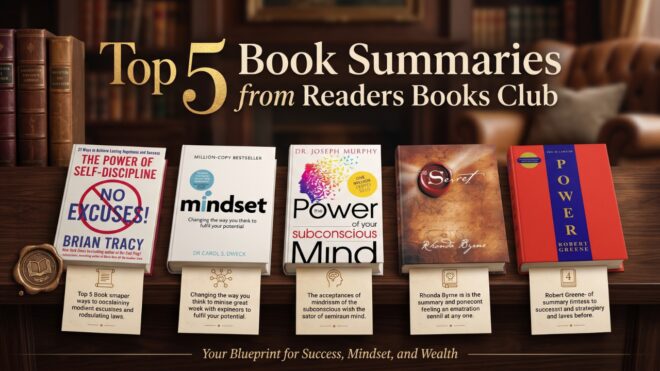
Top 5 Book Summaries from Readers Books Club
Your Ultimate Reading Guide from India’s Favourite Book Community
Welcome to Readers Books Club
At Readers Books Club, we believe that the right book at the right moment has the power to completely transform the way you think, live, and lead. We are a community of passionate readers, thinkers, and lifelong learners who gather every week on YouTube and our podcast to break down the world’s most impactful books chapter by chapter, idea by idea so that you can absorb the most important lessons in the time it takes to commute, work out, or cook dinner.
Our channel has become a go-to destination for anyone who wants to grow personally and professionally without having to wade through hundreds of pages alone. Whether you are a seasoned reader who wants a fresh perspective on a classic or a curious newcomer looking for your next favourite title, Readers Books Club is your home.
Over the past year, five books have stood out above the rest not just in terms of views and listener numbers but also in the depth of conversation they sparked in our community. These are books that our subscribers kept coming back to, sharing with friends and family, and crediting with genuine life changes. So we decided to bring them all together in one place.
In this blog, we present our Top 5 Book Summaries from Readers Books Club complete, thoughtful, and packed with the insights that matter most. Whether you have read these books before or are discovering them for the first time, we hope this guide serves as both an introduction and a reminder of just how much wisdom is waiting between the covers.
The Power of Your Subconscious Mind by Dr. Joseph Murph
About the Book
First published in 1963, The Power of Your Subconscious Mind by Dr. Joseph Murphy is one of the most enduring and widely read self-help books in history. More than six decades after its release, it continues to top bestseller lists, influence coaches and therapists, and find its way onto the bookshelves of entrepreneurs, athletes, artists, and everyday people looking to unlock a better version of themselves. The reason is simple: its core message is timeless, and its practical techniques genuinely work.
Dr. Joseph Murphy was a New Thought minister and prolific author who dedicated his life to studying the relationship between the conscious and subconscious mind. Drawing on psychology, spirituality, and his own pastoral experience working with thousands of people, he developed a framework for understanding how our internal beliefs, most of which we are not even aware of, determine the quality of our external lives.
The Core Idea
The foundation of Murphy’s teaching is this: you have two minds, not one. The conscious mind is the rational, analytical, decision-making part of you, the voice in your head that debates what to have for lunch or how to approach a difficult conversation. The subconscious mind, by contrast, operates below the surface. It is the storehouse of every belief, memory, habit, and emotional pattern you have ever accumulated. And unlike the conscious mind, it does not argue or judge. It simply accepts whatever it is consistently fed and then acts on it, automatically, without question.
This is both the most liberating and most terrifying truth Murphy presents. It means that if you have spent years telling yourself you are not good enough, not smart enough, or not deserving of love or wealth or success, your subconscious has taken that message on board and is actively working to confirm it attracting situations, sabotaging opportunities, and shaping your behaviour in ways that keep you exactly where your beliefs say you should be.
But it also means the reverse is true. By consciously, deliberately, and consistently feeding your subconscious with thoughts, images, and affirmations of abundance, health, love, and success, you can reprogram those deep-seated beliefs and begin to attract an entirely different quality of life.
How to Apply It
Murphy offers a range of practical techniques throughout the book. The most powerful, he argues, is the hypnagogic state the drowsy, half-awake period just before you fall asleep. During this window, the critical filter of the conscious mind relaxes, and the subconscious becomes unusually receptive to suggestion. Murphy recommends using this time to repeat affirmations, visualise desired outcomes, and impress positive beliefs deeply into the subconscious.
In our Readers Books Club video on this title, we focused particularly on the idea of identity-level belief change the understanding that real transformation happens not when you try harder, but when you genuinely begin to believe you are the kind of person who naturally achieves what you desire. That shift, Murphy would argue, starts in the subconscious.
Key Takeaway: Your subconscious mind cannot distinguish between what is real and what is vividly imagined. Feed it confidence, abundance, and peace consistently and it will work tirelessly to make those your reality. What you impress upon it, you will express in your life.
About the Book
When Rhonda Byrne released The Secret in 2006, it became a global phenomenon almost overnight. Within months, it had sold millions of copies, been translated into dozens of languages, and inspired a documentary film that spread its message even further. Nearly two decades later, it remains one of the best-selling self-help books of all time and one of the most debated.
Byrne, an Australian television writer and producer, describes the book’s origin story as a personal revelation during a period of profound crisis in her life. After discovering a century-old manuscript that referenced ‘the secret’, she began tracing the thread through the writings and teachings of history’s greatest minds from Plato and Shakespeare to Einstein, Carnegie, and Lincoln and found what she believed to be a common thread: the Law of Attraction.
The Core Idea
The Law of Attraction, as Byrne presents it, is a universal principle as fundamental as the law of gravity: like attracts like. Your thoughts are not passive; they are magnetic signals that go out into the universe and draw back experiences, people, and circumstances that match their frequency. Think thoughts of abundance, and abundance flows toward you. Dwell in thoughts of lack, fear, and limitation, and more of the same will find its way to your door.
The practical application of this principle, Byrne explains, comes down to three steps: Ask, Believe, and Receive. Asking means getting absolutely clear about what you want, not vaguely wishing, but declaring your desire with specificity and intention. Believing means operating as though your desire is already on its way or has already arrived, feeling the emotions of gratitude and fulfilment in advance. Receiving means being open and aligned with your desire, taking inspired action when it arises, and trusting the process.
One of the most powerful ideas in The Secret is the role of emotion. Byrne argues that your feelings are your feedback mechanism; they tell you whether you are in alignment with your desires or out of alignment. When you feel good, genuinely grateful, joyful, excited, or hopeful, you are on the right frequency. When you feel anxious, resentful, or fearful, you are pushing your desires away. The practice, then, is not just about thinking positive thoughts but about cultivating positive feelings as a daily discipline.
Why It Matters
Our podcast episode on The Secret was one of our most listened-to episodes of the year, and it generated more community debate than almost any other book we have covered. The central question our hosts explored was: Is the Law of Attraction a spiritual truth, a psychological tool, or a combination of both?
Our conclusion was that regardless of one’s metaphysical beliefs, the practical impact of living as though The Secret’s principles are true is undeniably positive. When you focus on what you want rather than what you fear, your attention, energy, and action naturally align in productive ways. When you practise gratitude daily, your baseline mood improves and your perception of opportunity expands. When you believe in the possibility of your goals, you pursue them with greater persistence and creativity.
The Secret is not a book that asks you to sit on your sofa and wait for a Lamborghini to appear. At its best, it is a book about the power of intentional living, about taking responsibility for your inner world as the first and most important step to changing your outer circumstances.
Key Takeaway: Your emotions are your compass. When you feel genuinely grateful, joyful, and expectant, you align yourself with the frequency of what you most desire. The Secret is not magic; it is the discipline of directing your mind, heart, and action toward the life you intend to live.
Mindset: The New Psychology of Successby Carol Dweck
About the Book
Carol Dweck is one of the most respected psychologists in the world. A professor at Stanford University, she has spent more than four decades studying motivation, achievement, and the beliefs that shape human potential. Her research, condensed in the landmark book Mindset: The New Psychology of Success, has influenced education systems, sports programmes, Fortune 500 companies, and millions of individual readers around the world.
The book’s central insight emerged from Dweck’s years of research into why some students thrived in the face of difficulty while others gave up. What she discovered was not about intelligence, background, or natural ability; it was about belief. Specifically, it was about what people believed about the nature of their own abilities.
The Two Mindsets Explained
Dweck identifies two fundamental mindsets that shape how we experience the world. The fixed mindset is the belief that your basic qualities – your intelligence, talent, personality, and character – are fixed traits. You either have them or you do not. People with a fixed mindset spend their lives trying to prove they are smart, talented, or worthy, and they avoid challenges that might expose their limitations. Failure, for the fixed-mindset person, is not an event; it is an identity. ‘I failed’ becomes ‘I am a failure.’
The growth mindset, by contrast, is the belief that your most basic abilities can be developed through dedication, effort, good strategy, and support from others. Intelligence and talent are not fixed endpoints; they are starting points. People with a growth mindset embrace challenges as opportunities to grow, persist in the face of setbacks, see the effort of others as inspiration rather than a threat, and learn from criticism rather than collapsing under it.
Crucially, Dweck shows that these mindsets operate in every domain of life, not just in academic settings. In sport, athletes with a growth mindset train harder and recover better from defeat. In business, leaders with a growth mindset build more innovative teams and are better equipped to navigate uncertainty. In relationships, people with a growth mindset approach conflict as a chance to understand rather than a threat to manage.
How to Develop a Growth Mindset
One of the most practically useful parts of Mindset is Dweck’s guidance on how to actually shift from a fixed to a growth orientation. She is careful to point out that nobody is purely one or the other; we all have a mix of both mindsets across different areas of our lives. The goal is not to achieve some perfect growth mindset state but to become aware of when the fixed mindset is running the show and to consciously challenge it.
Her recommended approach begins with awareness: noticing the internal voice that says, ‘You are not good enough for this’ or ‘Why bother trying?’ You will probably fail anyway.’ The next step is not to silence that voice, but to talk back to it. To say, ‘That is an old belief, not a fact.’ I may not be able to do this yet but I can learn.’ That single word, ‘yet’, is, for Dweck, one of the most powerful words in the English language.
In our Readers Books Club discussion, we spent a significant portion of our episode asking our audience to honestly examine which areas of their lives they were still approaching with a fixed mindset without even realising it. The responses we received were extraordinary: hundreds of comments from people recognising, often for the first time, that their self-limiting beliefs about money, creativity, fitness, and relationships were not facts about who they were, but stories they had been telling themselves for years.
Key Takeaway: The most successful people are not the most talented; they are the ones who believe that talent can be built. Replace ‘I can’t do this’ with ‘I can’t do this yet.’ That small shift in language reflects a profound shift in identity, and it changes everything.
The 48 Laws of Powerby Robert Greene
About the Book
Robert Greene’s The 48 Laws of Power, first published in 1998, is one of the most controversial and compulsively readable books of the modern era. It has been banned in some American prisons, championed by rappers and executives alike, and studied by diplomats, politicians, and strategists across the globe. More than 1.2 million copies are sold each year, making it a perennial phenomenon that shows no signs of slowing.
Greene spent years immersed in history, philosophy, literature, and biography to compile the 48 laws, a distillation of the principles of power as practised by history’s most formidable figures. From the Machiavellian courts of Renaissance Italy and the Sun King’s Versailles to the boardrooms of Silicon Valley and the battlefields of ancient China, Greene draws on an extraordinarily wide range of stories to illustrate each law in action.
What Are the 48 Laws?
The 48 laws cover a vast terrain of human behaviour and social dynamics. Some are intuitive and widely accepted: Law 1: Never Outshine the Master; Law 10: Infection: Avoid the Unhappy and Unlucky. Others are deeply provocative and deliberately uncomfortable. Law 15: Crush Your Enemy Totally; Law 3: Conceal Your Intentions. A few seem almost paradoxical. Law 17: Keep Others in Suspended Terror: Cultivate an Air of Unpredictability.
Each law is presented in a consistent format: a short statement of the law, an extended narrative example from history or mythology illustrating the law in action, a ‘Transgression of the Law’ showing what happens when it is violated, an ‘Observance of the Law’ demonstrating its successful application, an interpretation drawing out the deeper principle, and finally a ‘Reversal’, a nuanced consideration of when the law might not apply.
This structure is one of the book’s great strengths. Greene never presents the laws as absolute commandments; he presents them as tools, each with its appropriate context. The reader is trusted to judge for themselves which laws are morally acceptable, which are situationally useful, and which are simply illuminating as a window into how power has operated throughout human history.
Why Readers Books Club Covered This Title
When we decided to cover The 48 Laws of Power on our channel, we knew it would spark debate, and it did. Our hosts were honest about the fact that several of the laws describe behaviours they would not personally advocate. But we also argued passionately for something that we believe is deeply important: understanding how power works is not the same as endorsing its abuse.
In the world as it actually is, not as we might wish it to be, power dynamics are real. They operate in offices and families, in friendships and negotiations, in politics and art. People who understand those dynamics are better equipped to navigate them, to protect themselves from manipulation, and to use their own influence wisely and ethically. People who are unaware of them are, all too often, their unwitting victims.
The most important insight from our discussion was this: The 48 Laws of Power is ultimately a book about human nature. And while human nature at its worst can be manipulative, cunning, and self-serving, understanding that nature with clarity and without illusion is what allows us to bring out the best in it. Read with wisdom and moral discernment, this book is one of the most educational explorations of social dynamics ever written.
Key Takeaway: Power is neither good nor evil it is a tool. Understanding how it works is essential to protecting yourself, leading others effectively, and navigating the world with confidence. Read this book not to become Machiavellian, but to become wise.
No Excuses! The Power of Self-Discipline by Brian Tracy
About the Book
Brian Tracy is one of the most prolific and respected personal development authors of the last half century. Having written more than 80 books translated into dozens of languages, and having trained and coached more than five million people across 70 countries, Tracy has spent his career studying one question above all others: why do some people achieve so much more than others with the same hours in the day, the same access to information, and comparable levels of talent?
His answer, crystallised in No Excuses! The Power of self-discipline is both simple and demanding: it comes down to self-discipline. Not brilliance. Not luck. Not connections or circumstances or the right timing. Self-discipline the ability to make yourself do what you know you should do, when you should do it, whether you feel like it or not.
The Core Argument
Tracy opens the book with a statement that has become one of the most quoted lines in personal development literature: ‘Successful people do what unsuccessful people are not willing to do even when they don’t feel like it.’ That sentence encapsulates the entire philosophy of the book. It removes every excuse, every justification, every story we tell ourselves about why we haven’t yet achieved what we set out to achieve and replaces it with a single, inescapable conclusion: the gap between where you are and where you want to be is a discipline gap.
The book is structured around 21 areas of life where self-discipline is the critical differentiator from goal-setting and time management to health, finances, relationships, courage, and personal leadership. In each area, Tracy provides both the philosophy and the practice: not just why discipline matters, but exactly how to build it, one day and one decision at a time.
A central concept throughout the book is what Tracy calls the ‘long-term thinking’ principle. He argues that the primary difference between high achievers and average performers is their time horizon. High achievers think years and decades into the future and make present decisions in light of their long-term goals. Average performers make decisions based on what feels good right now and consistently sacrifice their future for temporary comfort. Self-discipline, in Tracy’s framework, is simply the practice of choosing long-term results over short-term pleasure.
Building the Discipline Habit
One of the most practically useful sections of the book is Tracy’s framework for building discipline as a habit. He argues that self-discipline is not a personality trait you either have or lack it is a skill that can be developed through consistent practice, just like any other. Every time you make yourself do something difficult, uncomfortable, or inconvenient in service of your goals, you are exercising and strengthening your discipline muscle. Every time you give in to distraction or delay, you weaken it.
Tracy recommends starting with small, manageable disciplines getting up on time, completing one key task before checking your phone, exercising for just twenty minutes and building from there. The early wins matter not just for their direct results, but for the self-image they create. Each disciplined action sends a message to your subconscious: I am the kind of person who follows through. Over time, that identity becomes self-reinforcing, and discipline becomes less of a struggle and more of a natural expression of who you are.
Why This Book Resonated with Our Community
Our YouTube video on No Excuses! became one of our most-shared pieces of content and the feedback from our community told us exactly why. In a world saturated with motivational content that tells you to dream bigger, visualise harder, and believe in yourself more, Tracy’s book stands out because it tells you something different: none of that matters without the daily, unglamorous, consistent practice of doing the work.
That message landed hard for a lot of our viewers. It cut through the noise and spoke to something many of them already knew but had been avoiding: that the life they wanted was not being withheld from them by circumstances or luck, but was waiting on the other side of a discipline they had not yet fully committed to building.
Key Takeaway: Self-discipline is not a personality trait it is a daily practice. Every act of discipline strengthens your identity as a person who follows through. Start small, stay consistent, refuse to make excuses, and compound your results over time. That is the entire formula for success.
Final Thoughts: Why These Five Books?
Looking across these five titles – The Power of Your Subconscious Mind, The Secret, Mindset, The 48 Laws of Power, and No Excuses! – a powerful thread emerges. Each book, in its own way, is saying the same fundamental thing: your life is shaped primarily from the inside out. Your beliefs, your mindset, your thoughts, and your daily disciplines are not responses to your circumstances; they are the creators of your circumstances.
Dr. Murphy shows us that the programming running in our subconscious mind is determining our reality and that we can change that programming. Rhonda Byrne reminds us that the frequency we broadcast through our thoughts and feelings is attracting our experiences and that gratitude and joy are the most powerful signals we can send. Carol Dweck demonstrates that the beliefs we hold about the nature of our abilities determine whether we grow or stagnate and that those beliefs are always within our power to change.
Robert Greene strips away illusion and shows us the world of power and influence as it really operates, not as we wish it would, and in doing so, equips us to navigate it with greater wisdom, awareness, and strategic intelligence. And Brian Tracy brings it all home with the most grounded message of all: none of the above matters without the daily, consistent, excuse-free discipline to act.
We hope this blog has given you not just a summary of each title but also a genuine sense of why each one matters and what it could mean for your life. If you have not read all five, we encourage you to start with whichever resonates most strongly and then come join us on YouTube or the podcast to discuss it with our community.
Join the Readers Books Club community.
Every week on our YouTube channel and podcast, we break down a new book exploring its core ideas, debating its merits, and drawing out the lessons most relevant to our listeners’ lives. We cover self-help, psychology, business, philosophy, history, and fiction, with the same commitment to depth, honesty, and genuine intellectual engagement.
Our community includes readers from across India and around the world: students, entrepreneurs, professionals, parents, and lifelong learners all united by the belief that reading is one of the most powerful investments you can make in yourself. If you share that belief, we would love to have you join us.
Website: www.readersbooksclub.com
YouTube: Readers Books Club
Contents