Introduction: The Illusion of Busyness
Modern life has turned “being busy” into a badge of honour. People wear exhaustion as though it proves ambition, and overloaded calendars as if they show commitment. But beneath this cultural obsession lies a painful truth: most of the busyness we glorify is not productivity, it is avoidance, anxiety, and lack of direction disguised as work.
The brain is naturally attracted to activity because activity produces dopamine. Every small email checked, every notification responded to, every minor task completed gives us a micro-hit of satisfaction. The feeling of “I’m doing something” becomes addictive, even when that something moves us nowhere. In a world of constant stimuli and infinite choices, busyness becomes an emotional shield: a way to avoid deep decisions, uncomfortable priorities, and meaningful progress.
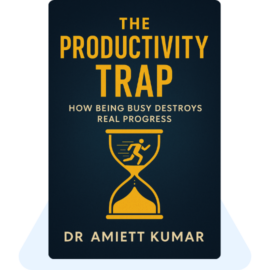
This book explores this illusion. It reveals how busyness hijacks our clarity, drains our cognition, and ultimately prevents us from doing the work that actually changes life. True productivity is deliberate, slow, and calm, not frantic. And reclaiming it requires unlearning everything the modern world has taught us about effort.
Chapter 1: The Busyness Bias: Why Motion Feels Like Progress
Humans are wired to prefer action over stillness because action historically meant survival. Our ancestors moved to find food, safety, shelter, motion equaled security. That ancient instinct still lives in our neural circuitry. When life feels uncertain or overwhelming, the mind pushes us toward any activity, because inactivity feels like danger.
This creates the Busyness Bias, the cognitive tendency to confuse movement with improvement. You answer emails, clean your desk, join meetings, scroll through information, and feel productive simply because you are occupied. But real progress requires direction, not motion. The tragedy is that many people spend their whole lives sprinting on cognitive treadmills, sweating, burning energy, but staying in the exact same place.
Busyness becomes a psychological escape from the discomfort of deep work. The tasks that truly matter, strategy, creativity, long-term thinking, demand presence, courage, and uncertainty. They are harder. They trigger resistance. So the brain chooses easier tasks that create the illusion of achievement. This cycle keeps people stuck in shallow productivity while their most meaningful goals remain untouched.
Chapter 2 – Cognitive Overload: The Hidden Cost of Too Many Tasks
Our brains are not built to juggle endless tasks. The prefrontal cortex, the part responsible for focus, planning, and decision-making, has a limited bandwidth. Every time we switch tasks, we activate a mechanism called context switching, which forces the brain to stop, reset, and re-engage. Each switch drains mental energy and disrupts clarity.
In today’s multitasking culture, people make hundreds of these switches daily. Notifications, calls, messages, tabs, meetings, each interruption fragments the mind. Cognitive overload accumulates quietly until it becomes mental fog, exhaustion, irritability, and emotional fatigue. You feel tired not because you worked deeply, but because your mind was forced into constant micro-reboots.
Real productivity requires continuity. Deep thinking requires uninterrupted focus. But overload steals both. It scatters attention into small fragments, leaving no cognitive space for insight. You might be working all day, yet end the day feeling like nothing important was accomplished. That emotional frustration is not failure, it is biology working against you.
Chapter 3: The Metrics Problem: Why We Track the Wrong Things
Most productivity systems reward the wrong metrics. They track tasks completed instead of problems solved, hours worked instead of quality created, meetings attended instead of impact generated. Humans naturally pay attention to what gets measured. So when systems measure activity, people optimize for activity, not results.
This is why to-do lists feel satisfying but often meaningless. The moment you cross off a task, you feel a surge of dopamine, regardless of whether the task mattered at all. You become addicted to the sensation of completion rather than the value of completion. As a result, the easy, shallow, low-impact tasks dominate your day, while the complex, high-value tasks remain perpetually postponed.
Progress is not the number of things you do; it is the number of things that matter that you finish. Until you shift from activity-based thinking to impact-based thinking, your productivity will remain shallow. You will keep chasing checkmarks rather than creating outcomes.
Chapter 4 – The Priority Paradox: When Everything Feels Urgent
Urgency is one of the most dangerous psychological traps in modern life. When everything feels urgent, nothing is truly important. The nervous system becomes addicted to stress-driven action: answering messages instantly, reacting to requests immediately, attending every alert as if it’s life-or-death.
The brain misinterprets urgency as importance because urgency activates the fight-or-flight response. This emotional surge creates a false sense of significance around trivial tasks. You become reactive instead of proactive, responding to noise instead of directing your focus toward genuine priorities.
Living in constant urgency prevents strategic thinking. You become a firefighter, not a builder. Your day is spent solving small flames while the architecture of your life remains untouched. Productivity collapses because urgency steals the cognitive space required for long-term progress.
Chapter 5 – The Myth of Hard Work: Why Effort Alone Doesn’t Scale
Hard work is important, but it has been over-glorified. Society romanticizes hustle; we worship exhaustion as proof of commitment. But effort without direction is waste. Working harder does not compensate for poor clarity. Working longer does not create proportionate results. Beyond a certain point, more effort actually reduces output, a phenomenon known as the diminishing returns curve.
The brain fatigues. Willpower declines. Creativity collapses. When people keep pushing past their cognitive limits, they produce errors, lower-quality work, and emotional burnout. True productivity is not about squeezing more hours out of the day; it is about designing systems that reduce friction and improve flow. Hard work matters. Smart work matters more. Aligned work matters the most.
Chapter 6 – Deep Work Deficit: Avoiding the Work That Actually Matters
Deep work: cognitively demanding, meaningful, strategic work, creates disproportionate results. Yet it’s the type of work people avoid the most. Why? Because deep work exposes you. It confronts you with uncertainty, self-doubt, fear of failure, fear of success, and the emotional discomfort of concentration.
Shallow tasks are easy. They provide quick rewards. Deep work is silent, slow, and psychologically intense. It requires long periods of solitude, focus, and presence. That’s why the modern world, with its infinite distractions, has made deep work rare. But rarity is exactly why it holds value. A person who can consistently engage in deep work gains an edge that busyness can never match.
Deep work is not simply a skill; it is a lifestyle decision. You choose to withdraw from noise. You choose clarity over stimulation. You choose depth over dopamine.
Chapter 7 – The System Gap: Productivity Without Structure Fails
Motivation alone cannot sustain productivity. Dopamine fades. Feelings fluctuate. Energy varies. Without systems – routines, environment designs, tools, constraints – productivity collapses under emotional pressure. The mind will always drift toward easier tasks unless structure guides it.
Systems reduce the mental load of decision-making. They automate discipline. They protect your limited cognitive bandwidth and allow you to perform well even on unfocused days. A well-designed system removes friction, sets boundaries, and transforms intention into consistent action. Productivity becomes predictable because behavior becomes predictable.
Most people don’t fail due to lack of ability. They fail due to lack of systems.
Chapter 8 – The Slow Thinking Advantage: Why Calmness Outperforms Speed
Slow thinking is not laziness; it is depth. It is accuracy. It is long-term wisdom. The modern world pressures people to respond quickly, act instantly, and move rapidly – but speed often leads to shallow thinking, emotional decision-making, and reactive behaviour.
Slow thinking activates the brain’s long-term reasoning networks. It improves judgment, reduces impulsiveness, and increases creativity. When you slow down, you see more. You think clearer. You separate signal from noise. Calmness becomes a competitive advantage because it allows you to choose deliberately rather than react Automatically.
Slowness is not the opposite of progress, it is the foundation of meaningful progress.
Chapter 9 – Redefining Productivity: Doing Less to Achieve More
Real productivity is not about doing everything. It is about doing the right things. It means reducing, simplifying, and focusing. It means eliminating the unnecessary so you can devote energy to the essential.
A productive life is a designed life: one where your actions align with your values, your systems align with your goals, and your time aligns with your future. When you remove friction, distractions, and shallow work, progress becomes natural. You don’t chase productivity anymore; you embody it.
Doing less is not laziness – it is precision. It is clarity. It is choosing excellence over chaos.
Conclusion – A Life That Moves With Purpose, Not Panic
The world will always reward busyness. It will always demand more. It will always distract you with noise, urgency, and shallow validation. But your life is measured not by how much you do, but by what you do and why you do it.
Busyness destroys progress because it steals your clarity. Productivity begins the moment you reclaim that clarity.
Real progress is deliberate. It is thoughtful. It is calm. It is intentional. When you stop chasing motion and start choosing direction, your life shifts from frantic activity to meaningful achievement. You don’t become busier – you become effective.
And effectiveness is the true definition of progress.
Learn More from Dr Amiett Kumar:
- The Science of Surrender: Why Letting Go Activates Instant Manifestation
- The Behavior of Money: Why Smart People Make Stupid Financial Choices
Contents