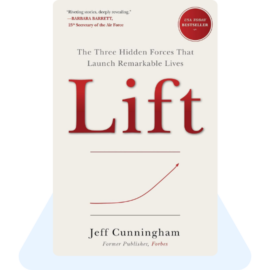
Almost every success story we are told has the same hero: a lone, driven individual who worked harder, thought bigger and refused to quit until the world gave in. It is a flattering story, because it suggests that your results sit entirely in your own hands. It is also, according to former Forbes publisher Jeff Cunningham, a myth. In his new book Lift, Cunningham argues that there is no such thing as a self-made success story. Behind every remarkable life, he says, are forces that most people never notice, and those forces have far more to do with the people and places around you than with raw talent or hustle.
That idea is exactly why this book has been landing on lists of the best books 2026 and why it deserves a place on any serious reading list of self improvement books. Whether you follow personal growth content, study leadership, or simply want to understand why some people rise while equally gifted people stall, Lift gives you a new lens. It asks you to stop staring only at your own willpower and start looking honestly at your circle, your mentors and your environment. In this Jeff Cunningham book summary, we will walk through the three big ideas, unpack ten powerful lessons, and show you how to apply them in your own life, starting this week.
At Readers Books Club, we love books that change how you see an ordinary question, and Lift does exactly that. Instead of asking “How do I become more successful?”, it asks “Where am I standing, who is standing with me, and what are the unwritten rules of that space?” It is a quieter question than the usual hustle advice, but it may be a far more useful one. Let us begin with the basics.
Lift at a Glance: Book Details and Who Wrote It
The book appears under a few slightly different titles depending on where you look. The main edition is Lift: How Small Worlds Create Big Lives and How to Find Yours, while several retailers list it as Lift: The Three Hidden Forces That Launch Remarkable Lives, and some searchers know it as Lift: How Small Worlds Make Big Lives. All of them refer to the same 288-page book from Skyhorse Publishing. The ebook was released in October 2026, with the hardcover following in November 2026 according to retailer listings. The publisher describes it as a USA Today bestseller and an October 2026 selection of the Next Big Idea Club, a group curated by Malcolm Gladwell, Adam Grant, Susan Cain and Daniel Pink.
Jeff Cunningham brings an unusual set of credentials to the subject. He is a former publisher of Forbes, where he helped create the Forbes 400, and he is a leadership professor at Arizona State University’s Cronkite School. According to the publisher, he also ran Zip2, the first company founded by Elon Musk. Over roughly twenty years he interviewed some of the world’s most accomplished people, including Warren Buffett, Michael Phelps, John McCain, Nikki Haley, David Petraeus, Lloyd Blankfein, the NASA chemist and ExxonMobil director Reatha Clark King, and the improbable partnership of F. W. de Klerk and Nelson Mandela. One endorsement describes the book as built on fourteen profiles, each with a hidden lesson attached.
The genre blend is part of the appeal. The publisher calls it part biography, part social science and part practical roadmap, and compares its storytelling to Malcolm Gladwell’s. It is pitched at readers of Outliers, Range, Think Again and The Psychology of Money. In other words, it is not a dry academic study, and it is not a pile of motivational slogans either. It is a story-driven book with a clear argument, which makes it ideal for the kind of success mindset reading that Readers Books Club viewers enjoy.
The Big Idea: Why the Self-Made Myth Falls Apart
The central claim of Lift is simple to state and surprisingly hard to live by: nobody rises alone. After decades of conversations with famous achievers, Cunningham says he kept hearing variations of the same story. The people we celebrate as self-made were, in fact, lifted by someone who noticed them early, by a small group that stood by them in difficult seasons, and by an environment whose unwritten rules rewarded the right behaviour. The talent was real, but it was never the whole explanation.
This matters because the self-made myth is not harmless. If you believe success is purely individual, then every setback feels like a personal verdict. You assume you are not disciplined enough, not smart enough, not confident enough. Meanwhile you ignore the possibility that you may simply be standing in the wrong room, surrounded by people who cannot see your potential, and playing by rules that were never designed to help you win. Lift gently shifts the question from “What is wrong with me?” to “What is wrong with this environment, and where could I find a better one?”
The flip side is just as important. If environments create success, then environments can also be built. Parents, teachers, managers, founders and community leaders all have the power to create small worlds in which ordinary people become extraordinary. That is the hopeful heart of the book, and it is why endorsers from business, academia and public service have praised it so warmly. The book is not only about how to find a lift. It is about how to become one for someone else.
The Three Hidden Forces Behind Remarkable Lives
Cunningham organises his argument around three patterns that, according to the publisher, appeared again and again in his interviews. The first he calls the Law of the First. This is the mentor, coach, parent or teacher who recognises your potential before you can see it yourself. The second is the Power of Tight Circles, which describes the small group of people who keep believing in you after everyone else has stopped. The third is the Rules of the Room, meaning the unwritten values, habits and codes that decide who rises in a company, community or culture.
Notice how these three forces work together. The first person to believe in you gives you a spark. The tight circle keeps that spark alive through doubt and failure. And the rules of the room determine whether your spark ever turns into a fire, because even a believed-in person will stall in a place that rewards the wrong things. Remove any one of the three, and the whole structure weakens. That is why talent alone, however dazzling, rarely explains a life.
The ten lessons below follow the logic of these three forces. We begin with the myth itself, move through each force in turn, and then look at what it means to choose, build and become a small world for others. Each lesson ends with an “In practice” note, which is our own commentary on how you might apply the idea in everyday life.
Lesson 1: No One Climbs Alone
The first lesson is the foundation for everything else: the lone-genius story is incomplete. When you look closely at any impressive career, you will find a supporting cast of teachers, relatives, colleagues, rivals and friends. Cunningham’s twenty years of interviews led him to a conclusion that sounds almost too simple, yet it quietly overturns a great deal of popular advice. If success were mostly about individual grit, the most determined people would always win. Real life, as most of us know, is messier than that.
Accepting this lesson requires humility, and humility is not a popular trait in the age of personal branding. But it is also deeply freeing. When you stop pretending that you must do everything alone, you become willing to ask for help, to accept mentorship and to invest in relationships without feeling that you are cheating. You also become more generous with credit, which tends to make you the kind of person others want to support.
In practice: Write down three people who helped you reach where you are today, including some whose contribution you rarely mention. Then send one of them a sincere message of thanks this week. This small act reminds you that your story is shared, and it often reopens a door you did not realise was still open.
Lesson 2: The Law of the First: Someone Must See You Before You See Yourself
The Law of the First is perhaps the most emotionally powerful idea in the book. It says that behind many remarkable lives stands a single person, whether a mentor, coach, parent or teacher, who recognised potential before the person could see it. That first believer does not need to be famous or wealthy. They only need to look at you and see a larger possibility than you currently see in yourself.
One endorsement captures this beautifully. Barbara Barrett, who later served as US Ambassador and Secretary of the Air Force, recalls that as a young girl she assumed her options were limited to a few traditional careers. Then her father casually asked why she should not become a doctor. In her telling, that one question widened her whole sense of what was possible, and it carried her far beyond what she had imagined. The lesson is that a single sentence, spoken at the right moment by the right person, can change a trajectory.
This law also has a quiet implication for how we think about self-belief. Many of us treat confidence as something we must manufacture alone, through affirmation, visualisation or sheer force of will. Lift suggests that confidence is often lent to us first. Someone believes in us, and we slowly borrow their belief until it becomes our own.
In practice: Think about who your “first” was. If you cannot name one, look for one. Seek a teacher, a coach, a senior colleague or an experienced life coach who has walked the path you want to walk, and ask them for honest feedback on your potential.
Lesson 3: Potential Is Invisible Until Someone Names It
A subtle but important extension of the Law of the First is that potential is not self-evident. We often imagine that talent announces itself, that gifted people are obviously gifted from the start. Cunningham’s research points in a different direction: extraordinary achievement begins long before it becomes visible, as one endorser puts it, and the early signs are often fragile and easy to miss without a perceptive observer.
This has uncomfortable implications for how organisations hire and promote. If potential needs to be seen and named, then workplaces that only reward obvious, already-polished talent will miss countless people who simply have not yet been noticed by the right person. A leader who learns to spot unfinished potential, in a quiet junior employee or an unconventional student, may be creating the next generation of high performers without even realising it.
It also has implications for you personally. If you are still waiting to feel “ready” before sharing your ideas, remember that the people who could name your potential cannot see it if you keep it hidden. Showing your work, asking questions and being visible in the right spaces are not acts of vanity. They are how potential gets seen.
In practice: Choose one project this month and share it with someone you respect, even if it is not perfect. Ask them one question: “What strengths do you notice in this that I might be overlooking?” Their answer may be your first clue about what others already see.
Lesson 4: The Power of Tight Circles: Keep the Believers Close
The second hidden force is the tight circle, defined as the small group of people who keep believing in you when everyone else stops. Notice the word small. This is not about collecting thousands of followers or attending every networking event. It is about a handful of relationships deep enough to survive your worst seasons. When the first believer gives you the spark, the tight circle protects it through failure, rejection and doubt.
This lesson deserves attention in an era when social networks have made connection feel cheap and abundant. One of the book’s endorsers, communications expert Richard Torrenzano, warns that if we neglect meaningful human bonds, the emptiness of the online world will rush in to fill the void. Hundreds of loose online contacts cannot replace a few people who know your story, challenge your excuses and show up when things fall apart.
It is also a useful correction for anyone obsessed with networking for success. Networking is often taught as a numbers game, but Lift suggests that depth matters far more than breadth. A tight circle shares your values, tells you the truth, celebrates your wins without envy and reminds you of who you are becoming. Few assets in life are more valuable, and few are harder to build quickly.
In practice: Audit your inner circle honestly. Who are the five people you speak to most? Do they stretch you or shrink you? Invest this month in deepening one relationship that makes you braver, and gently reduce the time you spend on those that leave you smaller.
Lesson 5: Small Worlds Beat Big Worlds
The book’s subtitle points to its most memorable image: small worlds that produce big lives. The publisher describes these as scrappy hideouts where the big world’s rules do not apply, and one listing mentions an Omaha cul-de-sac where a teacher plays an important role. The point is that remarkable people often emerge not from vast, impersonal systems but from small, close-knit environments such as a street, a classroom, a team, a family or a workshop, where everyone knows everyone and attention is personal.
There is a practical reason this works. In a small world, you are seen. Your effort is noticed, your mistakes are corrected quickly, and the standards are visible to everyone. In a giant, anonymous environment, you can drift for years without a single meaningful conversation about your growth. Size is not the enemy, but intimacy is the ingredient, and small worlds supply it naturally.
This lesson will feel familiar to anyone who has ever flourished in a tiny study group, a small startup or a close community, and struggled in a much larger setting with more resources. It suggests that when you choose a school, a job, a city or a community, you should ask not only how impressive it looks from the outside but how well it will actually know you.
In practice: If you work in a large organisation, create a small world inside it. Form a monthly group of four or five people who share goals, swap honest feedback and hold each other accountable. Small, structured circles can give you the feeling of a close community even inside a large institution.
Lesson 6: The Rules of the Room Decide Who Rises
The third hidden force is the most invisible: the unwritten values, habits and codes that determine who rises in any company, community or culture. Every room has rules that no one prints on the wall. Who speaks first? Who gets credit? Is it safe to admit a mistake? Is hard work admired or quietly mocked? Is curiosity rewarded or punished? These unspoken rules shape behaviour far more powerfully than any official policy.
Cunningham’s argument is that two equally talented people placed in different rooms can have completely different outcomes, simply because one room rewards growth and the other rewards conformity. This is not an excuse for passivity. It is a call for awareness. If you can read the rules of your current room, you can decide whether to play by them, change them or leave.
The rules are also deeply shaped by values learned early. One endorser, the business leader Richard Adkerson, describes how his sense of responsibility to the communities his company served came from a family of hardworking Mississippi farmers who helped each other through every hardship. His point is that character formed in a small world travels with a person into every boardroom they later enter. The rules of the first room become the habits of the later ones.
In practice: Spend a week observing your workplace or community as an anthropologist would. Note who gets promoted, what behaviours earn respect and what gets quietly punished. Then ask yourself honestly: do these rules push me toward the person I want to become?
Lesson 7: Your Environment Shapes You More Than You Think
This is where the book connects most directly to the broader theme of the power of environment. The publisher notes that some neighborhoods, teams and cultures elevate ordinary people to extraordinary heights, while others hold people down through the wrong choices and the wrong zip code. That sentence is both a diagnosis and a challenge. It admits that circumstances matter, yet it also insists that circumstances can be chosen and changed.
It helps to remember how how environment shapes success in quiet, daily ways. The people around you set your standards for what is normal. If everyone nearby reads, builds and learns, then reading, building and learning feel ordinary. If everyone nearby complains, procrastinates and cuts corners, those habits start to look normal too. Over months and years, your successful people habits, or your lack of them, are strongly influenced by what the room around you treats as acceptable.
This is why so many people who try to change their lives in isolation struggle. They return every evening to the same environment that formed the old habits, then blame themselves for a lack of discipline. Lift offers a kinder and more strategic explanation. Change your environment, and many habits change with it, almost without effort.
In practice: Redesign one environment this month. It might be your workspace, your friend group, your online feed or the hours you spend at home. Remove one influence that pulls you down and add one that quietly pulls you up.
Lesson 8: Talent Alone Is Not Enough
One of the most refreshing questions the book tackles, according to the publisher, is why some gifted people stall while others rise from nowhere. If talent were the main ingredient, the answer would be obvious. The three hidden forces suggest a different story: gifted people stall when they lack a first believer, a tight circle or a room whose rules reward their growth, and ordinary people rise when they find all three.
This lesson is both humbling and encouraging. It is humbling for people who have always attributed their success purely to ability, because it invites them to acknowledge the invisible support behind them. It is encouraging for those who feel stuck despite working hard, because it suggests that the problem may not be a lack of ability at all. It may be a missing ingredient that can be found.
Michael Crow, president of Arizona State University, makes a related point in his endorsement. He argues that institutions do not merely discover talent; they determine how much talent a society produces. In other words, opportunity is not just found, it is manufactured by the organisations we build. That perspective turns this lesson into a challenge for leaders as much as for individuals.
In practice: If you feel stuck, run a simple diagnosis. Ask whether you lack a believer, a circle or a supportive room. Whichever is missing is where you should invest your energy first, rather than simply working harder at the same approach.
Lesson 9: Become a Lift for Someone Else
A book about being lifted would be incomplete without a call to lift others, and Lift delivers one. Barbara Barrett’s endorsement ends by suggesting that every reader will finish the book remembering the person who first saw who they could be, and wondering whose life they might yet help lift. That is a powerful way to turn a reading experience into a lifelong practice.
This lesson matters for leadership and influence in a particular way. The most respected leaders are rarely those who collect the most followers. They are the ones who leave behind more capable people than they found. A leader who spots potential early, offers honest belief and builds a room with healthy rules is quietly multiplying their impact for decades.
It also changes how we think about mentoring and coaching. Mentorship is often treated as a favour or a career tactic, but the book frames it as one of the main engines of human achievement. A single conversation, a single recommendation or a single encouraging question can ripple outward across a whole life, and the person who offered it may never know how far it travelled.
In practice: Identify one younger or less experienced person in your world and offer them something concrete this month: an introduction, an hour of your time, or a specific, honest compliment about a strength they have not yet noticed in themselves.
Lesson 10: Choose, Build and Deliberately Find Your Small World
The final lesson is the practical one. According to the publisher’s description, the book shows readers how to find the environment where the rules crown them a champion, whether they are choosing where to live, building a company culture or looking for spaces that spark greatness. The promise is that small worlds are not purely accidents of birth. They can be identified, understood and deliberately built.
This means treating your life choices as environmental choices. When you accept a job, you are choosing a room. When you pick a city, you are choosing neighbours and rules. When you join a community, a class or a mastermind, you are choosing the people who will quietly shape your standards. Seen this way, many decisions that once felt like matters of convenience become matters of destiny.
It also means being patient. Finding the right small world often takes experimentation, and you may need to try a few rooms before one fits. Each attempt teaches you what you value, what you tolerate and which rules help you grow. The goal is not to find a perfect place but to keep moving toward environments that lift you, and to leave those that consistently lower you.
In practice: Write a short description of your ideal small world: the kind of people in it, the values it rewards and the habits it makes easy. Compare it honestly with your current reality, and identify the single change that would close the biggest gap.
Lift Versus Other Self Improvement Books
If you have read Outliers, you will recognise the idea that success depends on context as much as talent, but Lift focuses on the personal relationships and small communities inside that context. If you have read Range or Think Again, you will appreciate the evidence-informed storytelling, although this book is more concerned with people than with thinking styles. And if you have read The Psychology of Money, you will notice a similar spirit: clear, humane stories that explain why outcomes are less purely rational than we like to believe.
Compared with classic habit and productivity books, Lift has a different centre of gravity. Those books mostly ask what you should do each morning. This one asks who you do it with, and where. The two approaches work best together. Strong personal habits are far easier to sustain inside an environment that supports them, and a good environment is wasted without the discipline to use it.
The book is best suited to anyone building a career, raising children, leading a team or mentoring someone younger, and to those who want to understand why their own path turned when it did. If you prefer step-by-step checklists, you may wish to pair it with a practical habits book. If you enjoy stories, ideas and perspective, you will likely find it deeply rewarding.
A 30-Day Plan to Apply the Lessons of Lift
In the first week, focus on awareness. Write down your “first” believers, honestly review your inner circle and observe the unwritten rules of your main environment. Do not try to change anything yet. Simply gather information about where you stand, because clarity is the cheapest and most powerful starting point.
In the second week, strengthen what already works. Thank a mentor, reconnect with someone who genuinely believes in you and arrange one meaningful conversation with a person you admire. Treat these not as networking tasks but as investments in your tight circle. You are rebuilding the second hidden force with intention.
In the third week, adjust your environment. Make one change to your physical space, your digital habits or your social calendar so that the rules around you reward the person you want to become. Small changes, such as joining a different group or leaving a draining one, can have surprisingly large effects over time.
In the final week, give back. Offer your time, your belief or your introduction to someone else, and begin building a small world of your own, however modest. By the end of the month, you will have touched all three hidden forces, and you will likely see your own life through a clearer and kinder lens.
Lift, Visualisation and Manifestation: A Useful Connection
Many of our viewers love manifestation techniques, visualisation, affirmation and meditation, and they often ask whether a book about environment and relationships fits into that world. It is important to be clear that Lift is not a manifestation book, and Jeff Cunningham does not present it as one. But there is a thoughtful connection worth exploring, and it is our own interpretation rather than the author’s claim.
Spiritual and law of attraction teachers often say you can manifest anything by shifting your thoughts and beliefs. Lift adds a grounding insight: beliefs are rarely formed alone. The things you imagine for yourself are shaped by the people who believe in you, the circle that reinforces your self-image and the rules of the room that tell you what is possible. If you practise daily visualisation and affirmations while living in an environment that mocks your dreams, you are swimming against a strong current. If you pair those same practices with supportive mentors and a believing circle, your inner work and outer world begin to point in the same direction.
In that sense, the book is a wonderful companion to spirituality, meditation and coaching content. It reminds us that inner alignment and outer environment are partners, not rivals. For deeper guidance on the inner side, you can explore the manifestation, meditation and affirmation talks from Dr Amiett Kumar, known to many in the community as one of India’s top manifestation coaches, on the Amiett Kumar channel and at amiettkumar.com. Used together, inner practice and a lifting environment can make your personal growth journey far more sustainable.
Frequently Asked Questions About the Lift Book
Who wrote Lift?
Lift was written by Jeff Cunningham, a former publisher of Forbes and a leadership professor at Arizona State University’s Cronkite School. He draws on roughly twenty years of interviews with leading figures from business, sport, politics and public life.
What are the three hidden forces in Lift?
They are the Law of the First (the mentor, coach, parent or teacher who sees your potential early), the Power of Tight Circles (the small group that keeps believing in you) and the Rules of the Room (the unwritten values and habits that decide who rises).
Is Lift worth reading?
If you enjoy narrative non-fiction that blends stories with practical insight, it is a strong choice, especially for readers interested in mentors, leadership, environment and personal growth. It has been described by the publisher as a USA Today bestseller and a Next Big Idea Club selection.
Is Lift a manifestation or law of attraction book?
No. It is a book about people, relationships and environments. However, its ideas pair well with visualisation and affirmation practices, because supportive surroundings make inner change easier to sustain.
How is Lift different from Outliers?
Both explore how context shapes success. Lift focuses more on the personal relationships and small communities that quietly launch remarkable lives, and it offers more direct guidance on finding or building such environments.
Final Thoughts: Who Is Lifting You, and Who Are You Lifting?
The lasting gift of Lift is a better question. Instead of asking only how hard you are working, it invites you to ask who first believed in you, who still does, and what kind of room you are standing in. Those three questions can explain a surprising amount about where you are today, and they can guide you toward where you want to go next.
The message is ultimately hopeful. If the self-made story is a myth, then you are released from the exhausting belief that you must do everything alone. You are free to seek mentors, deepen your circle, change your environment and, in time, become the first believer in someone else’s story. That is how small worlds make big lives, and it is how one person’s quiet belief can travel much further than they ever imagine.
If you enjoyed this summary, subscribe to Readers Books Club on YouTube for more book summaries, self improvement books, finance reads and visualisation ideas, and visit readersbooksclub.com for new recommendations. Share this post with the person who first believed in you, and tell us in the comments: who was your “first”?
Contents