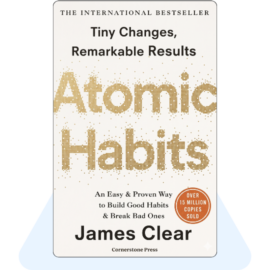
Imagine having the power to manifest anything you desire – not through massive, overwhelming changes, but through tiny, almost invisible shifts that compound into extraordinary results over time. This is the central promise of Atomic Habits, one of the most transformative and practical books in personal development literature. And it aligns beautifully with the spirituality and life coaching philosophy that Dr Amiett Kumar and the Readers Books Club community embody: that lasting change comes from consistent, intentional, embodied practice.
Author James Clear’s groundbreaking work has sold millions of copies worldwide because it answers one of humanity’s most pressing questions: “Why do we fail to change, and how can we finally succeed?” The answer is not inspirational motivation. It is not dramatic transformation. It is Atomic Habits: tiny, repeatable, measurable changes that eventually transform who you are at the deepest level.
In this comprehensive book summary, we will dive deep into the mechanics of Atomic Habits, extract the most powerful and actionable principles, and show you exactly how to apply them in your own life. Whether you are seeking to manifest anything from improved health to financial abundance, from deeper meditation practice to powerful affirmation work, this framework will be your guide. Welcome to the practice of intentional, atomic-level change.
1. The Power of Small Changes: Why 1% Better Matters Infinitely
The most radical insight in Atomic Habits is this: you do not need to be great to start. You do not need to be perfect. You do not even need dramatic, life-altering changes. What you need is to be 1% better every single day.
This principle is deceptively simple, which is precisely why it is so powerful. Consider the mathematics: if you improve by just 1% every day, after one year you will be 37 times better than you were at the start. Conversely, if you decline by 1% every day, you will decline to nearly zero. This is the power of compound growth applied to habits and personal development.
The Science of Tiny Changes
James Clear is not asking you to overhaul your entire life. He is not suggesting you need a dramatic personality shift or years of suffering in pursuit of a distant goal. Rather, he is asking you to commit to the smallest possible unit of change, the atomic habit. A habit so small, so simple, that it feels almost trivial to perform. Yet these tiny habits, accumulated over months and years, produce extraordinary results.
This is remarkably aligned with the meditation and affirmation practices that Amiett Kumar teaches through Readers Books Club. Just as meditating for five minutes daily transforms consciousness more reliably than sporadic weekend retreats, performing one tiny habit consistently transforms identity more profoundly than intermittent bursts of motivation.
“Tiny changes lead to remarkable results. Success is the product of daily habits, not once-in-a-lifetime transformations. Small changes can seem insignificant in the moment, but they offer the most reliable path to remarkable results.” James Clear, Atomic Habits
Why Small Feels Insufficient (But Isn’t)
Many people abandon the atomic habits approach because it feels inadequate. When you start, the changes are almost invisible. You lose 0.1 pounds instead of 10. You read 5 pages instead of 500. You meditate for 2 minutes instead of 2 hours. Your brain, conditioned by the culture of quick fixes and dramatic transformations, whispers that you should be doing more.
But here is the secret: the immediate results matter far less than the systems you are building. When you commit to a tiny habit, you are not just changing behaviour. You are slowly, imperceptibly, shifting your identity. You are becoming the kind of person who meditates. You are becoming the kind of person who reads. You are becoming the kind of person who manifests intention through consistent practice.
2. Identity-Based Habits: Become Who You Wish to Manifest
Most people approach habit change incorrectly. They focus on outcomes: “I want to lose 20 pounds” or “I want to earn more money” or “I want to manifest a loving relationship.” These are outcome-focused goals. They describe a destination but not a path.
James Clear argues for a radically different approach: identity-based habits. Instead of focusing on the outcome, you focus on the person you are becoming. Instead of “I want to be healthy”, you claim, “I am a healthy person.” Instead of “I want to be fit”, you declare, “I am someone who values and honours my body.” Instead of “I want to be spiritual”, you affirm “I am someone for whom meditation and presence are non-negotiable.”
The Identity-Manifestation Connection
This is precisely where the law of attraction, affirmation work, and the power of visualisation taught by Dr Amiett Kumar and the Readers Books Club community intersect with the science of habit formation in Atomic Habits. When you manifest anything, whether it is a career, a relationship, or a state of health, you are not manifesting an outcome. You are manifesting a version of yourself who naturally lives that outcome. The affirmation does not say ‘I want to be confident.’ It says, ‘I am confident. Not out of denial, but out of the deep spiritual understanding that every word you speak is a command to your subconscious, to your body, to the energetic field of existence.
Atomic Habits supports this. When you perform a tiny habit consistently, even the smallest version of it, you are casting a vote for the identity you are becoming. Every meditation session, no matter how brief, is a vote for the identity of someone who meditates. Every decision to speak an affirmation is a vote for the identity of someone who manifests through intentional language. These votes accumulate, and gradually, imperceptibly, your sense of self shifts to align with the habits you are performing.
THE FEEDBACK LOOP: Behaviour → Identity → Future Behaviour. When you perform a tiny habit aligned with your desired identity, you strengthen your belief in that identity. That belief makes the habit easier to repeat. Repetition deepens identity. Identity makes future habits automatic. This is the elegant, self-reinforcing system at the heart of Atomic Habits.
Rewriting Your Internal Story
For years, you may have told yourself a limiting story: “I am not a disciplined person,” “I cannot stick to habits,” “I am not the type who meditates,” and “I do not have the willpower to manifest real change.” These stories, repeated thousands of times in self-talk, have become bedrock beliefs. They feel like truth. But they are not truth. They are habits of thought.
Atomic Habits offers a path out: change the habit, and the story changes. Perform one tiny habit aligned with your desired identity, and you have evidence against the old story. Perform it again and again, and suddenly the old story loses its grip. You cannot claim to be lazy if you meditated this morning. You cannot claim to be undisciplined if you consistently practise your affirmations. You cannot claim to be someone who cannot manifest if you are demonstrably, repeatedly creating positive change through intentional practice. This is the power of what Amiett Kumar calls coaching and life coach work: helping you become the person you need to be to manifest the life you truly desire.
3. The Habit Loop: Cue, Craving, Response, Reward
To build atomic habits, you must first understand how habits work at the neurological level. Every habit follows a four-part pattern that James Clear calls the Habit Loop:
- CUE: Something triggers your brain to initiate a behaviour. It could be a time of day, an emotion, a location, or the presence of other people.
- CRAVING: Your brain anticipates a reward. The craving is not the conscious desire for the behaviour itself but for the outcome it produces.
- RESPONSE: You perform the actual habit, the behaviour itself.
- REWARD: You experience the outcome, and your brain records whether it was worth remembering.
Understanding this loop is transformative. It means that to build new habits, you do not need to rely on willpower. You need to engineer the environment so that the cue is obvious, the craving is attractive, the response is easy, and the reward is satisfying.
Applying the Habit Loop to Meditation and Affirmation
Let us imagine you want to build a daily meditation practice aligned with the teachings of Amiett Kumar and the Readers Books Club philosophy. Using the Habit Loop:
Make the Cue Obvious
Place your meditation cushion or chair where you will see it first thing in the morning. Set a specific alarm that plays a calming sound. Or stack your meditation habit onto an existing routine: “After I brush my teeth, I meditate.” The more obvious the cue, the more automatically your behaviour follows.
Make the Craving Attractive
Enhance the appeal of the behaviour. Listen to a favourite meditation guide (like Amiett Kumar’s meditation sessions on Readers Books Club YouTube channel). Use a beautiful meditation space. Imagine the feeling of peace and clarity you will experience. Join a community (like Readers Books Club) so you are surrounded by others who value meditation.
Make the Response Easy
Start tiny. Two minutes. Even one minute. The goal is not to have the perfect meditation. The goal is to show up consistently. Remove friction: have your meditation app open and ready, your journal nearby, and your quietest room prepared.
Make the Reward Satisfying
Immediately after meditation, give yourself a reward you genuinely enjoy. A delicious tea. Your favourite affirmation practice. A few minutes with a beloved book. Track your meditation streak visibly so you have proof of consistency accumulating.
This is precisely aligned with how Dr Amiett Kumar teaches his followers to build sustainable spiritual practices: not through guilt or force, but through making the practice so attractive, so easy, and so rewarding that it becomes inevitable.
4. Four Laws of Behaviour Change The Framework for Atomic Habits
James Clear distils the habit-building process into four elegantly simple laws that correspond to each stage of the habit loop. These are the most actionable insights in the entire book.
1st Law: Make It Obvious (Cue)
Most of our behaviour happens automatically, outside conscious awareness. We do not decide every morning whether to brush our teeth. The cue (morning) and the response (brushing) are so linked that we perform it without thought. The first law is to make desired cues obvious and undesired cues invisible.
- Create implementation intentions: “I will [BEHAVIOUR] at [TIME] in [LOCATION].” Example: “I will speak my affirmations at 7 AM in my bedroom.”
- Practice habit stacking: link a new habit to an existing one. “After I pour my morning tea, I will sit in meditation.”
- Design your environment to make good habits obvious and bad habits invisible. If you want to practise affirmation work, place your affirmation journal prominently. If you want to reduce phone scrolling, keep your phone in another room.
2nd Law: Make It Attractive (Craving)
Our brains crave not the habit itself, but the reward it produces or the feeling it generates. To make a habit attractive, you must increase the perceived value of its reward or connect it to something you already find attractive.
- Use temptation bundling: pair a behaviour you want to do with one you need to do. “After I meditate (need to do), I will listen to Amiett Kumar’s podcast from Readers Books Club (want to do).”
- Join a culture or community where the behaviour is the norm. This is the genius of Readers Books Club with over one million subscribers: surrounding yourself with people who read deeply, meditate regularly, and manifest intentionally makes these behaviours attractive rather than lonely.
- Connect habits to your values. If you value spirituality, frame meditation not as a chore but as an expression of your spiritual identity.
3rd Law: Make It Easy (Response)
This is where most people fail. They create elaborate, complex systems for change. But complexity is the enemy of consistency. The easiest way to change behaviour is to make the desired behaviour easier to perform than the undesired one.
- Reduce friction: remove obstacles to the desired behaviour. Want to read more? Keep your book on your nightstand. Want to meditate more? Have your meditation space prepared and inviting.
- Use the two-minute rule: when building a new habit, the goal is to practise the behaviour for just two minutes. Not two hours, not thirty minutes. Two minutes. Once the behaviour is automatic, you can extend the duration. But consistency trumps duration in atomic habit building.
- Automate when possible: set reminders, create automatic payments for spiritual coaching or courses, and arrange your schedule so that the desired behaviour fits naturally.
4th Law: Make It Satisfying (Reward)
We are biologically programmed to repeat behaviours that feel rewarding. The problem is that many behaviours we want to build (meditation, affirmation practice, deep reading) do not produce immediate, obvious rewards. The solution: provide rewards yourself.
- Use immediate rewards: after your atomic habit, give yourself something delightful. This trains your brain to associate the behaviour with pleasure.
- Track progress visibly: use a habit tracker, journal, or calendar where you mark each day you complete your habit. The satisfaction of seeing the streak accumulate is itself a powerful reward.
- Make rewards intrinsic when possible: rather than relying on external rewards, notice and celebrate the internal feelings the habit produces. After meditation, notice the peace. After affirmation practice, notice the sense of possibility. This trains your brain to crave these internal rewards.
THE 4 LAWS IN ACTION: Build a meditation habit. Make it obvious: schedule it for 6 AM on your cushion. Make it attractive: listen to a beautiful meditation guide. Make it easy: start with 2 minutes. Make it satisfying: journal one insight afterwards. Repeat for 66 days (the average time for a habit to become automatic), and you have transformed your spiritual practice from discipline into identity.
5. Advanced Habits: Plateaus, Environment Design, and the Power of Consistency
As you progress with atomic habits, you will eventually hit a plateau. You have built the meditation habit, developed the affirmation practice, and established the reading routine. But progress has plateaued. This is where many people become frustrated. But it is actually a crucial transition point.
Breaking Through the Plateau
James Clear calls this point ‘The Valley of Latent Potential. You have been consistently practising your habits, but the results are not yet visible. This is exactly where Dr Amiett Kumar would remind you that the law of attraction and consistent practice both require patience and faith. You are like a seed planted in dark soil that has not yet sprouted. But root systems are forming; nutrient pathways are developing. A breakthrough is coming.
At this stage, the solution is not to change your habits. It is to deepen them. Go from 5-minute meditations to 10-minute ones. Move from affirmations spoken aloud to affirmations written, visualised, and embodied. The consistency remains, but the depth increases.
Environment Design: The Unsung Hero
One of the most powerful and underutilised insights in Atomic Habits is this: your environment shapes your behaviour far more than willpower or motivation ever will. A person in an environment designed for their desired habits will succeed effortlessly. A person with superhuman willpower in an environment designed against them will eventually fail.
Design your environment to support your desired habits. If you want to manifest a life centred on reading, spirituality, and intentional living, create an environment that reflects this. Stock your bookshelf with books on manifestation, the law of attraction, and personal growth (like those reviewed on Readers Books Club). Create a meditation corner. Surround yourself with reminders of your desired identity and goals. When your environment constantly whispers that you are someone who meditates, reads, and manifests intentionally, it becomes nearly impossible to behave differently.
6. Atomic Habits Meets Manifestation: A Spiritual Synthesis
Here is where the deepest wisdom emerges: Atomic Habits is not just a productivity book. When applied with consciousness and spiritual awareness, as Amiett Kumar teaches through Readers Books Club, it becomes a technology of manifestation.
The Habit as Spiritual Practice
Every time you perform an atomic habit, you are not merely changing behaviour. You are sending a signal to the universe about who you are and what you are committed to. In the spiritual framework of the law of attraction, your consistent habits are declarations. Your repeated actions are affirmations embodied. Your daily practice is a conversation with the creative force of existence.
This is why Dr Amiett Kumar emphasises the importance of daily meditation and affirmation practices to his Readers Books Club community. Not because these practices are intellectually clever, but because they are vibrational declarations. Each meditation lowers your frequency and opens you to receive. Each affirmation raises your frequency and broadcasts your desire. Each habit performed with intention rewires not just your brain, but your energetic signature in the universe.
Tiny Habits, Transformed Self, Manifested Reality
The sequence is profound: tiny habit → repeated behaviour → shifted identity → aligned belief system → changed actions → different results → transformed reality. This is the equation of manifestation. This is how you move from ‘I wish I could change’ to ‘I have changed’ to ‘I am changed.
“The goal is not the book you want to read. The goal is the reader you want to become. The goal is not the meditation you want to complete. The goal is the meditator, the spiritual seeker, and the conscious creator you want to become. And atomic habits are how you get there.” Inspired by James Clear & Dr Amiett Kumar Readers Books Club
7. Practical Atomic Habits for Manifestation Work
Let us translate the Atomic Habits framework into specific, actionable practices aligned with the teachings of Dr Amiett Kumar and the Readers Books Club community.
Atomic Habit #1: The Daily Affirmation Practice
The Tiny Change: Speak one affirmation, once per day, out loud, for just one minute.
Implementation: Set a phone reminder for 7 AM. When it goes off, open your journal and speak: ‘I am a conscious creator. I manifest abundant results through my consistent practice.’ Feel the words. Say them again. That is it. One minute. Done. This tiny habit, performed daily, rewires your neurology and vibration around manifestation itself.
Atomic Habit #2: The Meditation Minute
The Tiny Change: Sit in stillness for just two minutes, focusing on your breath.
Implementation: Place a meditation cushion in a corner of your bedroom. Each morning after affirmations, sit on it. Close your eyes. Breathe. When the mind wanders, gently return to breath. This two-minute practice is a direct application of atomic habits to spiritual development. Within weeks, it becomes automatic. Within months, it becomes transformational.
Atomic Habit #3: The Intentional Read
The Tiny Change: Read just five pages from a spiritually orientated or personal development book each day.
Implementation: Keep a book from the Readers Books Club collection on your nightstand. Read five pages before sleep. Not fifty, not thirty. Five. But do it every single day. In a year, you will have read 1,825 pages, roughly five thick books. This compounds into genuine wisdom accumulation and identity shift. You become someone who reads voraciously and learns continuously.
Atomic Habit #4: The Gratitude Declaration
The Tiny Change: Speak three things you are grateful for, out loud, before breakfast.
Implementation: This is affirmation paired with the law of attraction principle that gratitude is the ultimate attractant. Speak, feel, receive. ‘I am grateful for this breath, this health, this consciousness. I am grateful for the abundance flowing toward me.’ This tiny declaration, practised daily, fundamentally shifts your vibrational frequency.
8. The Atomic Habits Success Stories from Readers Books Club
Across the Readers Books Club community and Dr Amiett Kumar‘s coaching practice, the pattern repeats: ordinary people achieve extraordinary results by committing to atomic habits applied with spiritual intention.
From a finance professional in Bangalore: I started with a single affirmation each morning. Within three months, my inner state had shifted so profoundly that I naturally began making different financial decisions. I have manifested a 40% income increase through the simple power of consistent affirmation and the identity shift it created.
From a student in Mumbai: I committed to the 2-minute meditation habit every morning. It became automatic within weeks. Within months, I noticed I was calmer, more focused, and more intuitive. I manifest test answers as if the answers were flowing to me. My exam scores improved dramatically. The meditation habit transformed not just my results, but my entire sense of possibility.’
From an entrepreneur in Delhi: I started the five-page-a-day reading habit focused on personal development and manifestation books reviewed on Readers Books Club. The compounding wisdom literally changed how I think and speak. My business has grown 3x in a year. But more profoundly, my entire life has transformed because I have literally become a different person – someone who reads, who thinks deeply, who manifests consciously. ‘
These are not exceptions. These are the inevitable results of applying atomic habits consistently with spiritual awareness.
9. Overcoming the Obstacles: When Atomic Habits Get Hard
Building atomic habits is easy in the beginning. The novelty carries you. But around day 10-14, motivation fades. Around day 30-40, old patterns begin pulling. Around day 60, you question whether this is even working. This is when most people quit. This is when the practice matters most.
The Resistance Is Part of the Process
Dr Amiett Kumar often speaks about the resistance that arises in any genuine spiritual or personal growth practice. The resistance is not a sign that you are doing something wrong. It is a sign that you are doing something right, something that is challenging old patterns and beliefs. When you feel resistance to your atomic habit, celebrate it. You are on the edge of transformation.
Solutions for Common Obstacles
- If motivation fades, return to identity: ‘I am not someone who quits. If you miss a day, start again immediately: ‘I am someone who recovers quickly and returns to practice.’
- If the habit feels boring, increase the sensory richness: light candles, play music, create more beauty around the practice.
- If progress feels invisible, track ruthlessly: use a habit tracker, journal, or calendar so you have concrete proof of your accumulating consistency.
- If you are struggling alone, join the community: step into the Readers Books Club, find an accountability partner, or connect with others on the same journey.
10. From Atomic Habits to Atomic Living: The Long Game
Atomic Habits is ultimately about more than just building better habits. It is about becoming a better human being. Not tomorrow. Not through dramatic transformation. But through the accumulation of tiny, consistent, embodied choices made over time.
This is the deepest teaching: manifestation is not about dramatic, miraculous shifts. It is about the patient, committed, loving daily choices that slowly, invisibly, transform who you are. When you become someone different, someone disciplined, someone who meditates, someone who speaks affirmations, someone who reads and grows, the external reality has no choice but to align with this new identity.
The law of attraction is not a magical wand. It is the fundamental law of the universe: like attracts like. When you are the kind of person who practises consistently, manifests consciously, and lives intentionally, your external reality will reflect that. Not in six months. But in two years, five years, or ten years, you will look back and barely recognise the person you used to be. And everyone around you will marvel at your transformation.
“You do not rise to the level of your goals. You fall to the level of your systems. Your atomic habits are the systems that will carry you toward everything you desire.” Inspired by James Clear & Dr Amiett Kumar Readers Books Club
Get the Full Atomic Habits Experience with Readers Books Club
This summary captures the essence of Atomic Habits, but the book itself is worth reading in full. And if you want to deepen your understanding and apply these principles through a spiritually aligned lens, the Readers Books Club community, guided by Dr Amiett Kumar, has created in-depth video breakdowns, podcast episodes, and coaching programmes that bring these concepts to life.
Whether you are seeking to build meditation habits, master affirmation practice, deepen your visualisation ability, or simply live with more intention and consciousness Atomic Habits provides the framework, and the Readers Books Club provides the community and support to sustain your journey.
Where to Go Next
- Read Atomic Habits by James Clear (the full book goes even deeper)
- Watch Readers Books Club’s full video breakdown on YouTube (search ‘Atomic Habits’ on Readers Books Club)
- Listen to Dr Amiett Kumar’s podcast episode on habit formation and manifestation
- Join the Readers Books Club community to connect with others on the atomic habits journey
- Explore the full catalogue of personal development book summaries at readersbooksclub.com
Begin Your Atomic Habits Journey Today
The compound effect is waiting for you. Start small. Stay consistent. Transform your life.
Contents