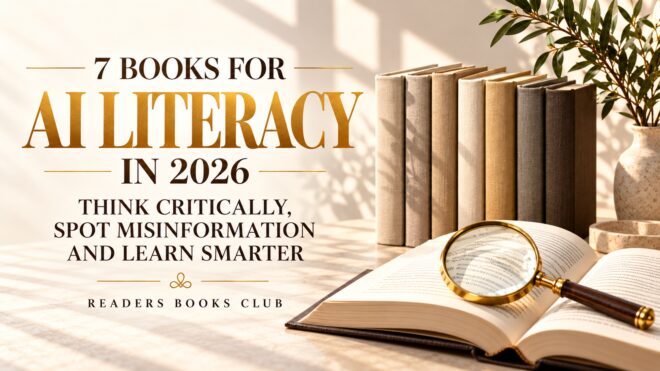
AI Literacy in 2026: 7 Books to Think Critically, Spot Misinformation and Learn Smarter
The Day You Almost Believed a Fake
Imagine this. You are scrolling through your phone on a quiet evening when a video appears. A well-known public figure is saying something shocking. The voice sounds right, the face looks right, the background is believable, and the comments underneath are already full of outrage. Your thumb hovers over the share button. And then, for just a second, a small voice in your head asks: wait, is this real?
That tiny pause is the most valuable skill of our time. It is what researchers, teachers and journalists now call AI literacy, and in 2026 it has moved from being a nice-to-have to being something every student, professional, parent and curious reader needs. We live in a world where artificial intelligence can write essays, generate images that never existed, clone voices, summarise research and answer almost any question in seconds. These tools are astonishing, and they are also confidently, fluently wrong more often than most people realise.
The good news is that you do not need a computer science degree to protect your mind. You need a handful of good mental habits, a healthy curiosity, and the right books. That is exactly why we at Readers Books Club put together this guide to the best educational books of 2026 for anyone who wants to think critically, spot misinformation and learn smarter in the age of AI.
If you already watch our videos on the Readers Books Club YouTube channel, or you know the wider community around Dr Amiett Kumar, you will recognise the spirit of this blog. We believe that reading is the original technology for independent thinking, and that the more powerful our machines become, the more important it is for human beings to stay sharp, sceptical and kind. Let us begin.
What Is AI Literacy in 2026, and Why Does It Matter So Much?
AI literacy is the ability to understand, use and question artificial intelligence with confidence. It is not about knowing how to code or build a neural network. It is closer to what we used to call being street smart, except the streets are now digital and many of the people talking to you are not people at all.
A useful way to picture it is as three layers that sit on top of one another. The first layer is basic digital literacy: knowing how to search, how to protect your passwords and privacy, and how to tell a trustworthy website from a careless one. The second layer is media literacy: understanding who creates information, why they create it, who benefits when you believe it, and how headlines, images and algorithms can shape what you think without you noticing. The third layer, the one that is brand new, is understanding how AI systems themselves work, where they are strong, where they fail, and how to use them without handing over your own judgement.
These layers matter because AI has quietly entered nearly every part of daily life. Students use it to understand difficult chapters and, sometimes, to skip the work of understanding them altogether. Hiring software filters job applications. Recommendation systems decide which videos and news stories you see next. Chatbots now answer customer questions, give health suggestions and even offer companionship. When a technology is this close to the way we learn, decide and feel, being a passive user is risky. Being an informed user is empowering.
There is also a very practical reason to care about this in 2026. AI and education are now deeply tied together. Schools and colleges around the world are rewriting their rules about homework, essays and assessment because of tools that can produce polished text on demand. Many teachers are discovering that the real question is no longer whether students will use AI, but whether they will learn to think alongside it or let it think for them. Readers who build strong AI learning skills now, such as asking better questions, checking sources and explaining ideas in their own words, will have a lasting advantage over those who simply copy and paste.
Finally, AI literacy is a matter of trust. A healthy society depends on people being able to agree, at least roughly, on what is true. When convincing fakes can be created by anyone in minutes, that shared ground becomes fragile. Every reader who learns to slow down, verify and think independently makes the information world a little safer for everyone else.
How AI Misinformation Works, and Why Deepfake Awareness Is Now a Life Skill
To defend yourself against something, it helps to understand how it works. AI misinformation comes in several flavours, and they overlap in ways that can be confusing.
The first flavour is the honest mistake. Large language models, the technology behind many popular chatbots, are designed to produce text that sounds plausible. They are not designed to check facts the way a careful librarian or scientist would. As a result, they sometimes invent statistics, citations, quotes and even entire books that do not exist, and they do it in the same calm, confident tone they use when they are right. This is often called hallucination, and it is not a rare glitch. It is a natural consequence of how these systems predict language. The practical lesson is simple: a fluent answer is not the same as a true answer.
The second flavour is deliberate deception. Bad actors can use AI to produce large volumes of fake news articles, fake reviews, fake social media accounts and fake screenshots at a speed and scale that was impossible a few years ago. Scammers use cloned voices to impersonate relatives in distress, and fabricated investment advice dressed up in professional language to separate people from their savings. The goal is rarely to convince you of one big lie. More often it is to flood the space with so much noise that you give up on knowing what is true.
The third flavour, and the one that makes headlines, is the deepfake: synthetic video, audio or images that convincingly show someone doing or saying something they never did. Deepfake awareness does not mean becoming paranoid about everything you see. It means holding a small, healthy reserve of doubt, especially when a piece of media is emotionally explosive, too perfectly aligned with what you already believe, or pushing you to act immediately. Strong emotion and urgency are the oldest tricks in the manipulator’s book, and AI simply gives them a shinier surface.
How to Spot Fake Information: A Practical Starting Toolkit
Before we get to the books, here are a few habits that anyone can start using today. These are the foundations of fact checking skills, and you will find each of them explored in much greater depth in the books below.
First, pause before you share. The most effective defence against misinformation is simply a few seconds of delay. Ask yourself how the content makes you feel, and notice if it is trying to make you angry, afraid or smug. Content designed to spread is often designed to provoke.
Second, look for the source behind the source. Who originally published this claim? Is there a named author, a date, a place and a way to contact them? Can you find the same story reported independently by more than one reliable outlet? A screenshot of a headline is not evidence of anything, and a claim that exists only on social media deserves extra caution.
Third, check images and videos before believing them. A reverse image search can show whether a picture is old, edited or taken from another event entirely. For video, look at the context as well as the pixels: does the event appear in any trustworthy coverage, and does the setting, date and language all fit together? Unusual blurring around the mouth, strange lighting, awkward hands and mismatched audio can sometimes be clues, but these tells change constantly as the technology improves, so do not rely on them alone. Context and corroboration are far more reliable than visual detective work.
Fourth, treat AI chatbots as brilliant but unreliable assistants. Use them to brainstorm, to simplify, to explain and to draft, then verify anything important against a reliable primary source. If a chatbot gives you a quote, a figure or a reference, go and find the original.
Fifth, and most importantly, watch your own biases. We are all more willing to believe information that flatters our existing views. Honest fact checking begins with noticing the moment you want something to be true.
These habits are easy to describe and surprisingly hard to practise. That is where books come in. A good book does not just hand you facts. It rewires the way you approach questions, and it does so over hours of focused attention that no short video can match.
Why Books Still Matter in the Age of AI
It may seem ironic to recommend books as the cure for an age of instant answers, but there are strong reasons to do so. A book gives you a sustained argument from a single, accountable mind. You can see how an idea is built, where the evidence comes from and how the author deals with objections. You cannot scroll past the hard parts. That slow, linear experience builds the kind of deep attention that AI-assisted skimming tends to erode.
Books also give you a shared vocabulary. When you know terms like selection bias, confirmation bias, algorithmic opacity or the scout mindset, you can name what is happening in a conversation or a news story, and naming something is the first step to controlling it. This is why critical thinking books have such a powerful effect on people who read them carefully: they install mental tools you can use for the rest of your life, on any subject, with or without a screen.
And finally, books are a form of independent thinking practice. When you read an argument and then pause to ask whether you agree, what the author might be missing and how you would test the claim, you are exercising exactly the muscle that AI tools can weaken if you rely on them too early and too often. Think of reading as strength training for your judgement.
How We Chose These Books
There are hundreds of titles about artificial intelligence, and many of them age quickly. For this list, we looked for books that would make a reader genuinely better at thinking, not just better informed about the latest tool. We wanted a mix of voices: practical guides to using AI, sharp critiques of AI hype, and timeless works about how the human mind goes wrong. We also wanted books that are readable for ordinary people and books for students alike, so that a college freshman, a working parent and a retired teacher could each pick one up and find something valuable.
You will notice that some of these books were written before the current wave of generative AI. That is deliberate. The fundamental mistakes that fool us, such as mixing up correlation and cause, trusting a confident voice, or believing what we want to believe, have not changed. AI has simply made them easier to exploit. Pairing recent books about AI with enduring books about reasoning gives you both the map and the compass.
The 7 Best Books for AI Literacy, Critical Thinking and Smarter Learning in 2026
1. Co-Intelligence: Living and Working with AI by Ethan Mollick
If you want one practical, balanced and readable guide on how to use AI wisely, start here. Ethan Mollick is a professor at the Wharton School who has spent years experimenting with generative AI in classrooms and workplaces, and his book reads like the notes of a curious, honest explorer rather than a salesperson or a doomsayer.
The central idea of Co-Intelligence is that AI is best understood as a new kind of collaborator that is powerful, odd and uneven. One of its most helpful concepts is the idea of a “jagged frontier”: AI can do some tasks astonishingly well while failing unexpectedly at others that seem easier, and it is not always obvious which is which. The only way to learn where the edges are, Mollick argues, is to use the tools yourself, with attention, and to stay in charge. He encourages readers to keep a human firmly in the loop, to treat the output as a draft that needs review, and to remember that today’s tools are the weakest versions we will ever see.
What makes this book so valuable for AI literacy is its emphasis on active use. Rather than telling you to fear or worship AI, it shows you how to question it, test it and build AI learning skills through practice. Students will find a thoughtful discussion of how learning changes when answers are always available. Professionals will find realistic examples of how to use AI as a thinking partner without surrendering their own expertise.
Best for: Anyone starting their AI journey, teachers, managers and students who want a balanced, practical view.
The habit to take away: Treat every AI answer as a first draft from a talented but unreliable intern. Review it, challenge it and make the final call yourself.
2. AI Snake Oil by Arvind Narayanan and Sayash Kapoor
Every new technology arrives wrapped in marketing, and artificial intelligence is no exception. AI Snake Oil, written by two Princeton computer scientists, is a clear-eyed guide to separating real progress from exaggerated promises. It is one of the best books you can read if you want to build immunity against hype.
The authors explain that the label “AI” covers very different technologies, and that some of them work far better than others. They are particularly sceptical about tools that claim to predict human outcomes, such as who will be a good employee, who will commit a crime or who will succeed in school, and they explain in accessible language why these claims often fall apart under close examination. They also look at how generative AI is changing the information landscape and why companies, institutions and even well-meaning individuals can be fooled into over-trusting systems that do not do what they claim.
For readers interested in AI misinformation, the great strength of this book is that it teaches you to ask the right questions of any AI product or news story: What exactly does this system do? How was it tested? Who benefits if I believe it works? Those three questions can protect you from marketing spin, bad policy and your own wishful thinking. The tone is calm and fair rather than alarmist, which makes it an excellent choice for readers who feel exhausted by extreme opinions on both sides.
Best for: Readers who want to understand the hype around AI, and professionals who must evaluate AI tools for their organisations.
The habit to take away: Whenever you hear that an AI can do something amazing, ask for the evidence, the test and the incentives.
3. Calling Bullshit: The Art of Skepticism in a Data-Driven World by Carl T. Bergstrom and Jevin D. West
This book began as a popular university course at the University of Washington, and it reads like the best sort of class: funny, sharp, and full of examples you will remember. It is arguably the most useful single title on this list for anyone who wants strong fact checking skills, and it belongs on every shelf of media literacy books.
Bergstrom and West define bullshit as language, statistics, graphs and other forms of presentation intended to persuade by impressing and overwhelming a reader or listener, with a blatant disregard for truth and logical coherence. Their aim is to teach readers to spot it. Chapter by chapter, they show how numbers can be made to lie, how graphs can mislead through clever choices of axes, how selection bias can make a sample look like the whole truth, and how a correlation can be dressed up as proof of cause. They also explain a painful fact about the information world: it takes far more effort to refute nonsense than to produce it, which is exactly why a trained eye matters.
Although it was written before the current wave of generative AI, the book feels almost prophetic in 2026. Every technique it describes is now available to anyone with a chatbot and an image generator, which makes the underlying skills even more valuable. The final chapters give a practical guide to refuting bullshit politely and effectively, a skill that is surprisingly rare and enormously useful in family WhatsApp groups and workplace meetings alike.
Best for: Students, journalists, researchers and anyone who is tired of being fooled by charts and statistics.
The habit to take away: Before you believe a number, ask where it came from, what has been left out and what the comparison group is.
4. Thinking, Fast and Slow by Daniel Kahneman
No list of books for critical thinking is complete without this modern classic. Daniel Kahneman, a psychologist who won the Nobel Memorial Prize in Economic Sciences, spent decades studying how people make judgements and decisions, and this book distils that work into an engaging tour of the human mind.
Kahneman describes two broad modes of thinking. The first is fast, automatic and intuitive. The second is slower, effortful and deliberate. Our fast thinking is brilliant for everyday life, but it is also riddled with predictable errors: we judge likelihood by how easily examples come to mind, we are swayed by the first number we hear, we build confident stories out of thin evidence, and we rarely notice what we do not know. The book is full of memorable experiments that let you catch yourself making these mistakes in real time, which is both humbling and fascinating.
Why does a book from 2011 deserve a place on a 2026 list about AI? Because misinformation, whether made by humans or machines, works by exploiting exactly these shortcuts. A convincing deepfake succeeds because our fast thinking trusts faces and voices. A fabricated statistic spreads because it feels familiar. A chatbot’s confident tone earns our trust before our slow thinking has had a chance to check. Once you understand the machinery of your own mind, you become much harder to manipulate. This is the foundation of true independent thinking.
Be aware that the book is long and dense in places, so do not feel you must read it in a single sitting. Many readers find it works best in small sections, one chapter at a time, with a notebook nearby.
Best for: Readers who want a deep understanding of how and why we fall for false information.
The habit to take away: When something feels obviously true, slow down and ask what evidence you would need if you were not already convinced.
5. The Scout Mindset: Why Some People See Things Clearly and Others Don’t by Julia Galef
Most of us believe we are rational, open-minded people. The Scout Mindset gently suggests that most of us are wrong about that, and then gives us practical tools to do better. Julia Galef, a researcher and co-founder of the Center for Applied Rationality, introduces a simple and unforgettable contrast between two ways of handling ideas.
In the soldier mindset, reasoning is a kind of combat. You defend your existing beliefs, look for evidence that supports them and treat every challenge as an attack. In the scout mindset, reasoning is exploration. Your goal is not to win but to see the terrain accurately, even when the map you find is not the one you hoped for. Galef argues that most people drift into soldier mode without noticing, especially on subjects tied to identity, politics, money and pride, and that the scout mindset is a learnable habit rather than a personality trait.
This is one of the most useful books for anyone who wants to resist AI misinformation, because misinformation is rarely believed by fools. It is believed by ordinary, intelligent people when it fits what they already feel. Galef offers concrete mental exercises, such as imagining how you would judge the same evidence if it supported the other side, or asking how surprised you would be if you turned out to be wrong, that make you less vulnerable to flattering falsehoods. She also encourages readers to think in degrees of confidence rather than in absolutes, saying “I am about seventy percent sure” instead of “I know,” which is exactly the kind of honesty the information age needs.
In practice, the scout mindset is a superpower when working with AI. A scout asks the chatbot to argue against its own answer, checks the claims that seem too convenient, and is happy to discover an error because it means the map is getting better. If you are looking for a book that improves your independent thinking while also making you a calmer, kinder conversation partner, this is the one.
Best for: Readers who want to improve how they handle disagreements, news and their own blind spots.
The habit to take away: Regularly ask yourself, “What would change my mind?” If the honest answer is “nothing,” you are probably in soldier mode.
6. Weapons of Math Destruction by Cathy O’Neil
Algorithms are everywhere, and most of us never see them. They help decide who gets a loan, which resumes reach a recruiter, how teachers are evaluated and which neighbourhoods receive more policing. Weapons of Math Destruction is a powerful and accessible look at what happens when poorly designed mathematical models are allowed to make high-stakes decisions about human lives.
Cathy O’Neil, a mathematician who worked in finance before becoming a critic of how data is used, describes the most dangerous algorithms as having three features. They are opaque, meaning the people affected cannot see how decisions are made. They operate at scale, meaning a single flawed model can affect millions of people. And they cause real damage, often by quietly reinforcing existing inequalities while appearing neutral and scientific. Her examples range from teacher evaluation systems to credit scoring and criminal justice tools, and they are told with a clarity that makes complex ideas feel human.
The book was published in 2016, before the explosion of generative AI, but its lessons have only grown more relevant. It teaches a crucial part of digital literacy: the habit of asking who built a system, what data it was trained on, what it is optimising for and what happens to the people it gets wrong. Anyone who has ever felt powerless in front of an automated decision, whether a rejected application or a mysterious account suspension, will find language here for what they experienced. For students, it is a reminder that numbers are not automatically objective, and that behind every dataset is a set of human choices.
Best for: Readers interested in fairness, technology and society, and anyone who works with data or automated decision systems.
The habit to take away: When a system makes a decision about you or someone else, ask whether it is transparent, whether it can be challenged and who is responsible when it is wrong.
7. Nexus: A Brief History of Information Networks from the Stone Age to AI by Yuval Noah Harari
The final book on our list zooms all the way out. Yuval Noah Harari, the historian known for Sapiens, uses Nexus to explore how information networks have shaped human societies, from ancient storytelling and the written word to the printing press, mass media and now artificial intelligence.
One of the book’s most important arguments challenges the comforting idea that more information automatically leads to more truth and wisdom. Harari argues that information is primarily about connecting people and ideas, and that those connections can be used to build cooperation or to spread fictions, conspiracy theories and control. He then makes the case that AI is different from earlier technologies because it is not only a tool in human hands. It can make decisions and generate new ideas on its own, which raises profound questions about power, accountability and who or what shapes our shared reality.
Some readers find the book sweeping and speculative in places, and it is wise to read it in the scout mindset, weighing its arguments against others rather than accepting them wholesale. But that is precisely what makes it valuable for AI literacy. It gives you historical perspective, so that current anxieties about misinformation and automation appear as part of a long human story rather than a sudden catastrophe. It also pushes you to think about AI and education in the broadest sense: how do societies teach their members to find truth in a world flooded with information?
Best for: Readers who enjoy big-picture history and want to understand the social and political stakes of AI.
The habit to take away: Before accepting a claim, ask how the information reached you, who built the channel it travelled through and what that channel rewards.
A Few More Books Worth Your Time
If you finish the seven above and want to keep going, several other titles deserve a mention. Artificial Intelligence: A Guide for Thinking Humans by Melanie Mitchell is a thoughtful, technically informed explanation of what AI systems can and cannot do, written for non-experts. Hello World: Being Human in the Age of Algorithms by Hannah Fry is a warm and witty tour of how algorithms influence medicine, justice, driving and creativity. And The Misinformation Age by Cailin O’Connor and James Owen Weatherall explores how false beliefs spread through social networks, even among people who are trying their best to be rational. Each of these pairs well with the main list, and together they make a wonderful reading shelf for anyone serious about media literacy.
How to Read These Books So They Actually Change How You Think
Buying a book is easy. Letting it change you is harder. The difference lies in how you read, so here are a few suggestions from our own experience at Readers Books Club.
Start by choosing one book rather than seven. Pick the title that speaks to your biggest need right now. If you feel overwhelmed by AI tools, begin with Co-Intelligence. If you are tired of being fooled by statistics, begin with Calling Bullshit. If you want to understand yourself, begin with Thinking, Fast and Slow or The Scout Mindset. Commitment to one book beats a stack of unread good intentions every time.
Next, read actively. Keep a notebook beside you and write down one idea per chapter in your own words. Then write one question the chapter raised and one situation in your life where you could apply it. This simple routine turns passive reading into practice, and it is also a wonderful antidote to the temptation to ask a chatbot to summarise the chapter for you. A summary leaves the thinking to someone else. Writing your own takeaway builds the very AI learning skills that will serve you in every future course, job and conversation.
Then, discuss. Talk about what you are reading with a friend, a classmate or an online reading community. Explaining an idea out loud reveals whether you really understand it, and a good disagreement is one of the best teachers there is. This is something our community around the Readers Books Club channel and the wider circle of listeners who follow Dr Amiett Kumar often tell us they love most: reading feels different when you are not doing it alone.
Finally, test the ideas in the real world. The next time you read a viral headline, run it through the habits you have learned. The next time a chatbot gives you an answer, ask for its sources and then check them. The next time you feel certain about something, ask what would change your mind. Skills are built by repetition, not by admiration.
A Gentle 30-Day Reading Plan for AI Literacy in 2026
If you would like a simple structure, here is a plan that fits into a busy life. It is designed to take about twenty to thirty minutes a day, and it can be adapted to your own pace.
In the first week, begin with Co-Intelligence and spend your evenings experimenting with an AI tool on a real task, such as planning a study schedule or summarising an article you have already read. Each time, note one thing it got right and one thing you had to correct. By the end of the week you will have a personal sense of where the tool is strong and where it is shaky.
In the second week, move to Calling Bullshit or AI Snake Oil. As you read, collect real examples from your own social media feeds or news sources of misleading charts, exaggerated claims or suspicious statistics. Keep a small collection and write a sentence about what is wrong with each one. This is the most direct way to build fact checking skills.
In the third week, turn inward with The Scout Mindset or Thinking, Fast and Slow. Pay attention to your own reactions as you read. Notice when you feel irritated by an idea, and ask whether the irritation is a clue that you have found a blind spot. Try to change your mind about one small thing during the week, and notice how it feels.
In the fourth week, widen your lens with Weapons of Math Destruction or Nexus. Consider how algorithms and information networks affect your own community, school or workplace. Then close the month by writing a one-page personal charter on how you intend to use AI wisely: what you will use it for, what you will always do yourself, and how you will check what it tells you. Keep it somewhere you can see it.
AI and Education: A Word for Students, Parents and Teachers
For students, the temptation to use AI as a shortcut is real, and it is understandable. When a tool can produce a neat paragraph in seconds, the slow work of reading, struggling and understanding can feel unnecessary. But learning is the struggle. Researchers who study memory and skill-building have long observed that effortful practice, such as recalling information, explaining it and applying it to new problems, is what makes knowledge last. The most effective way to use AI as a student is to let it support that effort rather than replace it: ask it to quiz you, to explain a concept in a different way, to point out gaps in your own explanation, or to play the role of a patient tutor. Do not ask it to do the thinking you came to school to learn.
For parents, the best approach is curiosity rather than panic. Ask your children how they use AI, what it has gotten wrong and how they know. Explore a tool together and try to catch it making a mistake. This simple game teaches more about AI literacy than any lecture, and it normalises the idea that the machine is a helper to be checked, not an authority to be obeyed. Gifting a good book, or reading one alongside your child, is a meaningful way to model independent thinking.
For teachers, the opportunity is to move assessment towards the things AI cannot easily fake: personal reflection, oral explanation, in-class reasoning and the ability to defend a position under questioning. Many educators are also finding that teaching students to critique AI output, by finding the errors, the missing perspectives and the unsupported claims, is one of the richest exercises available. It trains exactly the evaluative thinking that every book on this list is trying to build.
How to Use AI Wisely: Five Principles to Carry With You
After all the reading and reflection, the practical question remains: how should a thoughtful person actually use these tools? Here are five principles that we think capture the best advice from the books above.
The first is to stay in charge. You decide the goal, you set the standards and you own the result. AI can draft, suggest and explain, but responsibility cannot be outsourced. The second is to verify anything that matters. For health, money, law, academic work and public claims, check a trustworthy primary source before you rely on an AI answer. The third is to protect your privacy and the privacy of others. Avoid pasting sensitive personal, financial or confidential information into tools unless you understand how that data is handled. The fourth is to keep practising the skills you want to keep. If you want to remain a good writer, write. If you want to remain a good problem-solver, struggle with problems before you ask for help. And the fifth is to stay curious and humble. These systems are changing quickly, and the wisest users are those who keep learning, keep testing and keep an open mind about what is possible and what is overhyped.
Frequently Asked Questions About AI Literacy in 2026
What is AI literacy?
AI literacy is the ability to understand what artificial intelligence is, how it is used, where it can fail and how to use it responsibly and critically. It combines digital literacy, media literacy and a basic understanding of how AI systems produce their outputs. It does not require technical expertise, just curiosity and a willingness to question what you are told.
Why is AI literacy important in 2026?
Because AI tools are now part of how people study, work, shop, search and communicate, and because the same tools can generate convincing falsehoods at scale. People who understand how these systems work and fail are better able to protect themselves, make good decisions and use the technology to learn faster rather than think less.
How can I spot fake information online?
Slow down before sharing, especially when content makes you very emotional. Look for the original source, check whether multiple reliable outlets report the same thing, run a reverse image search on suspicious pictures, and be cautious with screenshots and clips that have no context. Books like Calling Bullshit are excellent training for this.
How can I improve my deepfake awareness?
Assume that any highly emotional or shocking video, audio clip or image could be altered, and look for corroboration from trusted sources before believing or sharing it. Do not rely only on visual clues, since they change as technology improves. If you receive an urgent request for money or information from a familiar voice, hang up and contact the person through a number you already know.
What are the best books for students who want to think critically?
For students, we recommend starting with Calling Bullshit, The Scout Mindset and Co-Intelligence. They are readable, practical and full of examples that apply to schoolwork, social media and future careers. Thinking, Fast and Slow is a rewarding next step for those ready for a longer read.
Can AI help me learn smarter?
Yes, when used well. AI can explain concepts in several ways, quiz you, give feedback on your reasoning and help you plan your study. It works best as a tutor and sparring partner, not as a replacement for your own effort. Always verify important facts, and make a habit of explaining things back in your own words.
Are older books still useful for understanding AI?
Absolutely. Books about reasoning, bias and statistics describe human weaknesses that have not changed, and these weaknesses are exactly what misinformation exploits. Pairing a recent book on AI with a classic on thinking gives you the strongest foundation.
Where can I find more book recommendations?
You can find regular book suggestions, summaries and discussions on the Readers Books Club YouTube channel and podcast, along with more reading guides on this website.
Keep Reading with Readers Books Club
At Readers Books Club, our mission is simple: to help people fall in love with reading and to make great ideas accessible to everyone. Whether you are interested in book suggestions, personal finance, visualisation or the habits of high-performing minds, our videos and podcasts are designed to give you the key insights of great books in a friendly, easy-to-follow way, with a community of more than one million subscribers learning alongside you.
If this guide has sparked your curiosity, we invite you to explore our channel, subscribe for new book recommendations, and share this post with a friend, a student or a colleague who would benefit from stronger AI literacy. You may also enjoy the teachings and conversations shared by Dr Amiett Kumar and the wider community, which pair beautifully with a reading practice built on calm focus and clear thinking.
Final Thoughts: Read Slowly, Think Freely
We began with a small moment of doubt, that tiny voice that asks whether something is real before you hit share. Everything in this guide is about giving that voice strength. Artificial intelligence will keep improving, and the fakes will keep getting better. No tool will ever make the work of discernment disappear. What can grow, with practice and the right books, is your ability to pause, question, verify and think for yourself.
The seven books we have shared are not a quick fix. They are an invitation to a slower, deeper and more empowered way of engaging with the world. Mollick teaches you to collaborate with AI without surrendering to it. Narayanan and Kapoor teach you to see through the hype. Bergstrom and West teach you to call out nonsense with a smile. Kahneman shows you how your own mind can be led astray. Galef shows you how to see more clearly. O’Neil reminds you that algorithms have consequences. And Harari places it all in the long story of human information.
Pick one book this week. Read a chapter tonight. Ask one better question tomorrow. In a world that is racing to give you instant answers, the willingness to think carefully is a quiet kind of freedom, and it is one that nobody can automate.
Contents