Neuroplasticity and Visualization: Transform Your Mind and Life
Introduction
There is a moment that happens in almost every reader’s life. You finish a book maybe on meditation, maybe on the law of attraction, maybe on the subconscious mind, and you close it thinking, “I finally understand why my life looks the way it does.” That moment is not an accident. It is neurology. It is the science of how your brain quietly programs itself, day after day, based on the thoughts, images, and beliefs you feed it.
At Readers Books Club, this is the exact territory we live in. We are a community built on books, book suggestions, and trending book summaries, but more than that, we are a community built on transformation. Through our YouTube channel, our podcast, and the platform at readersbooksclub.com, we have spent years distilling the wisdom of thousands of books into ideas people can actually use. Few subjects have captivated our audience more than this one: the neurology of subconscious programming and how visualisation, brain rewiring, and spiritual growth intersect to completely change the shape of a human life.
This blog is our deep dive into that subject. We will talk about what the subconscious mind actually is, what neuroscience tells us about visualisation, how spirituality and meditation fit into this picture, and how coaching, including the work we do at Readers Books Club under Dr Amiett Kumar, helps people apply all of this in real, practical ways. If you are someone who loves books, who is curious about meditation and the law of attraction, or who is simply trying to understand why your mind behaves the way it does, this one is for you.
What Is the Subconscious Mind, Really?
Before we talk about programming the subconscious, we need to be honest about what the subconscious actually is. It is not mystical in the way pop culture sometimes makes it sound, and it is not “fake” in the way sceptics sometimes dismiss it either. The subconscious mind is the vast portion of your mental processing that happens below the threshold of conscious awareness: the habits, the automatic reactions, the beliefs you never chose but somehow absorbed, and the patterns that run your behaviour on autopilot.
Books on the subconscious mind have existed for nearly a century. Classics like Joseph Murphy’s The Power of Your Subconscious Mind and Maxwell Maltz’s Psycho-Cybernetics were some of the first to popularise the idea that the subconscious operates like a kind of internal programming system one that takes in repeated thoughts, images, and emotional experiences and converts them into automatic behaviour. Decades later, neuroscience began to catch up with what these authors intuited.
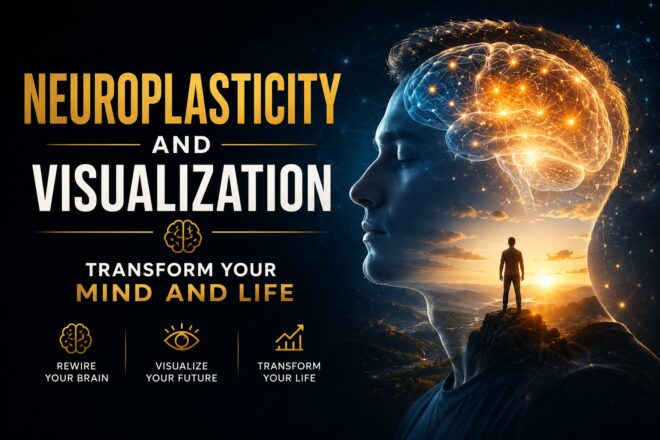
This is where the “neurology” part of the conversation becomes so fascinating. Your brain is not a fixed, unchangeable organ. It is constantly reorganising itself based on your experiences, your repeated thoughts, and yes, your visualisations. This capacity is called neuroplasticity, and it is the biological foundation for everything we are about to discuss.
The Neuroscience of Visualization: How the Brain Rewires Itself
Here is a fact that surprises most people the first time they hear it: your brain does not fully distinguish between a vividly imagined experience and a real one. When you close your eyes and visualise yourself giving a confident speech, walking into the home you have always wanted, or having the difficult conversation you have been avoiding, the same neural networks activate as if you were actually doing it.
This is not new-age speculation; it is well-documented in neuroscience and sports psychology. Athletes have used visualisation for decades because mental rehearsal activates the motor cortex in patterns similar to physical practice. Musicians visualise their performances. Surgeons visualise complex procedures before they ever touch a scalpel. The brain, in a very real sense, treats vivid, emotionally charged imagination as data worth encoding.
This is the mechanism behind subconscious programming. Every time you visualise a scenario with focus and emotional intensity, you are strengthening certain neural pathways and weakening others. Repeat that visualisation daily, and the brain begins to treat the imagined identity – the confident version of you, the abundant version of you, the calm version of you – as familiar territory rather than foreign territory. Over time, your automatic, subconscious responses start to shift to match the inner picture you have been rehearsing.
This is why so many trending book summaries on our channel, whether we are discussing the law of attraction, manifestation, or the psychology of habit change, circle back to the same core idea again and again: change your inner imagery, consistently and emotionally, and your outer behaviour eventually follows.
Why Repetition and Emotion Matter So Much
Two ingredients matter more than anything else when it comes to rewiring the brain through visualisation: repetition and emotional charge.
Repetition matters because neural pathways strengthen through use. The often-cited neuroscience principle “neurones that fire together, wire together” describes how repeated patterns of thought become physically embedded as stronger, faster neural connections. A visualisation practised once will fade. A visualisation practised daily, for weeks or months, becomes structurally part of how your brain operates.
Emotion matters because the brain treats emotionally charged experiences as more important than neutral ones. This is partly why traumatic memories can form instantly and last a lifetime, while an ordinary Tuesday afternoon is forgotten within hours. The same biological mechanism that “supercharges” trauma can be intentionally directed toward positive transformation. When you visualise your desired future with genuine feeling – not just picturing it, but feeling the gratitude, the relief, and the joy of it being real – you are giving your subconscious mind a much stronger signal to encode and act upon.
This is precisely why meditation, breathwork, and emotional regulation are not separate from visualisation practice; they are the foundation that makes visualization actually work. A scattered, anxious mind cannot visualise with the clarity or emotional depth required to create real neurological change. A calm, centred mind can.
Where Spirituality Enters the Picture
It would be easy to stop the conversation at neuroscience and call it a day. But anyone who has spent real time studying the subconscious mind through books, through meditation, through coaching, or through their own life experience knows that something deeper is also at play. This is where spirituality enters, not as a contradiction to science, but as its natural companion.
Spirituality, in the way we approach it at Readers Books Club, is not about a specific religion or dogma. It is about a relationship with something larger than the day-to-day chatter of the conscious mind – call it consciousness, the universe, the higher self, source energy, or simply stillness. Across centuries of spiritual traditions, from contemplative prayer to Eastern meditation practices, one consistent teaching keeps appearing: the mind that quiets itself gains access to clarity, intuition, and a sense of connection that the noisy, anxious mind cannot reach.
This matters enormously for subconscious programming because the subconscious mind is most receptive precisely in those quiet, slowed-down states – the same states that meditation, prayer, and contemplative spiritual practice are designed to produce. This is not coincidence. It is why so many of the most effective visualisation and manifestation practices are explicitly built on a foundation of meditation. You quiet the conscious mind first. Then you plant the seed of the visualisation. Then the subconscious, now receptive, now undistracted, receives that seed and begins working with it.
This blending of neurology and spirituality is one of the reasons subconscious programming has become such a rich, trending topic in book summaries across the personal growth space. It honours both the measurable biology of the brain and the felt, lived experience of spiritual transformation that millions of people describe when they commit to a consistent meditation and visualisation practice.
The Law of Attraction, Reframed Through Neuroscience
No conversation about subconscious programming, visualisation, and spirituality would be complete without addressing the law of attraction directly, because it is one of the most searched, most discussed, and most misunderstood ideas in this entire space.
Critics often dismiss the law of attraction as wishful thinking – the idea that simply wanting something hard enough will make it appear, with no action required. That is a misunderstanding of what the most serious teachers of manifestation actually teach. The law of attraction, properly understood through the lens of subconscious programming, is not about ignoring action. It is about ensuring that your subconscious beliefs, your emotional state, and your visualised identity are aligned with the action you take so that you are not unconsciously sabotaging your own efforts.
Here is a simple, common example. Someone consciously wants financial abundance. They say it, they write it down, they may even repeat affirmations about it. But underneath, their subconscious mind, shaped by years of childhood conditioning, financial fear, or scarcity-based belief, is quietly running a different program: “Money is dangerous.” “People like us don’t get rich,” and “Wanting more is greedy.” This mismatch between the conscious desire and the subconscious programme is precisely why so many people feel stuck despite genuinely trying to change their circumstances.
This is where visualisation combined with subconscious reprogramming becomes so powerful. Instead of layering a conscious wish on top of an unchanged subconscious belief, the practice works to actually rewire the underlying belief itself through repeated, emotionally charged visualisation, often supported by meditation, journaling, and the kind of coaching that helps a person identify exactly which subconscious programs are working against them.
This reframe of the law of attraction not as magic but as applied neuroscience and psychology is one of the central themes we return to again and again in our book suggestions and trending book summaries on Readers Books Club.
Meditation as the Gateway to Subconscious Access
If visualisation is the tool that reshapes the subconscious, meditation is the doorway that gives you access to it in the first place.
Most people spend their entire day operating from beta brainwave states: alert, analytical, and often anxious. These states are excellent for solving a spreadsheet problem or navigating traffic, but they are not particularly receptive to deep subconscious reprogramming. Meditation guides the brain into slower wave states, alpha and theta, which are associated with relaxed focus, creativity, and heightened suggestibility. This is the same brainwave territory associated with the hypnagogic state just before sleep, which is precisely why many subconscious reprogramming techniques recommend visualising right before bed or right after waking, when the boundary between conscious and subconscious is naturally thinner.
A consistent meditation practice does more than create a temporary calm state, though. Over months and years, it changes the baseline structure of the brain itself. Long-term meditators show measurable differences in regions associated with emotional regulation, self-awareness, and stress response. In other words, meditation is not just a tool you use right before visualisation; it is itself a long-term subconscious reprogramming practice, gradually shifting your default emotional and mental patterns toward calm, clarity, and presence.
This is why, across the hundreds of book suggestions and trending book summaries we have covered on our YouTube channel and podcast, meditation rarely appears as an isolated topic. It threads through nearly every conversation about manifestation, the law of attraction, healing, and personal transformation because it is the practical, repeatable mechanism that makes everything else possible.
Why Most People Fail to Reprogram Their Subconscious And What Actually Works
If subconscious reprogramming is so well understood, why do so many people read the books, watch the videos, try the affirmations, and still feel stuck?
The honest answer is that subconscious change requires more than information. It requires structure, consistency, and very often outside support to see your own blind spots. This is one of the most important and most overlooked truths in this entire field.
Information alone rarely changes behaviour. You can understand intellectually that visualisation rewires neural pathways. You can know, in theory, that limiting beliefs sabotage your goals. But knowing this consciously does not automatically dissolve the subconscious program itself. This is the gap between knowing and transforming, and it is precisely the gap that coaching is designed to close.
Subconscious patterns are, by definition, hard to see on your own. If a belief is operating below conscious awareness, you cannot simply think your way to noticing it. This is why an outside perspective, a life coach, a mentor, or a structured programme is often the difference between years of frustrated effort and a genuine breakthrough. A skilled life coach or manifestation coach knows the right questions to ask, the right practices to assign, and how to hold a person accountable to the consistency that subconscious rewiring actually requires.
Consistency beats intensity. A single, dramatic visualisation session will not rewire a belief that took twenty years to form. But ten focused minutes of visualisation, meditation, and reflection practised daily for ninety days absolutely can. This is the unglamorous truth behind almost every real transformation story: not a single breakthrough moment, but quiet, repeated, daily practice.
This is exactly the gap that real coaching exists to close, and it is the foundation of the work we do at Readers Books Club.
How Readers Books Club Brings This to Life
Readers Books Club exists because books alone, as powerful as they are, are not always enough. Reading a brilliant book on the subconscious mind, visualisation, or the law of attraction can spark real insight, but insight without structure and community often fades within weeks.
That is the gap Dr Amiett Kumar, founder of Readers Books Club, has spent years working to close. As a Law of Attraction and manifestation coach with nearly two decades of experience in the training field, Dr Amiett Kumar has built Readers Books Club into one of India’s most-followed homes for book suggestions, trending book summaries, meditation guidance, and applied personal transformation, reaching millions of people through the Readers Books Club YouTube channel, podcast, and coaching programmes.
What makes this approach distinct is the bridge it builds between reading and doing. On our YouTube channel and podcast, we do not just summarise books; we connect them to neuroscience, to meditation practice, to spirituality, and to the lived, everyday struggles people actually face: stuck careers, strained relationships, financial fear, low self-worth, and the quiet feeling of being capable of so much more than current circumstances reflect.
Through book summaries, podcast conversations, guided meditation content, and structured coaching, Dr Amiett Kumar and the Readers Books Club community help people move from simply consuming information about subconscious programming to actually practising it consistently, with support, and with a community of fellow readers walking the same path.
If the ideas in this blog resonated with you – the neuroscience of visualisation, the role of meditation, the deeper layer of spirituality, and the practical reframe of the law of attraction – we would genuinely encourage you to explore the Readers Books Club YouTube channel and podcast, where these themes are unpacked further through book suggestions, trending summaries, and real coaching conversations.
A Simple Starting Practice You Can Try Today
We believe in making this practical, not just theoretical. Here is a simple way to begin applying subconscious programming through visualisation, grounded in everything discussed above:
Step one: Quiet the mind. Spend three to five minutes in simple, breath-focused meditation. You are not trying to “achieve” anything here; you are simply slowing your brainwave state enough to make the subconscious more receptive.
Step two: Choose one specific scene. Not a vague wish like “I want to be successful”, but a specific, sensory scene: what are you doing, what do you see around you, who is with you, and what does the moment feel like in your body?
Step three: Add genuine emotion. This is the step most people skip, and it is the most important one. Do not just picture the scene; feel the gratitude, relief, joy, or peace of it being real, right now, in your body.
Step four: Repeat daily. Five to ten minutes, ideally at the same time each day. Many people find early morning or just before sleep most effective, given how those windows naturally align with more receptive brain states.
Step five: Track and reflect. Notice, over weeks, which beliefs or resistances come up during this practice. These are often the exact subconscious programs that have been quietly running your life, and noticing them is the first step to changing them.
This is a small practice, but small, consistent practices are exactly how subconscious reprogramming actually works. Not through one dramatic moment, but through the quiet accumulation of repeated, emotionally charged, focused attention over time.
Common Myths About Subconscious Programming, Visualization, and the Law of Attraction
Because this topic sits at the crossroads of neuroscience, psychology, and spirituality, it tends to attract a lot of confusion online. Before wrapping up, it is worth clearing away a few of the most common myths we hear in our community at Readers Books Club through comments on our YouTube channel, questions during our podcast episodes, and conversations inside our coaching programmes.
Myth one: “Visualisation alone will manifest anything, with no action required.” This is the most damaging misunderstanding of the law of attraction, and it is not what serious teachers or serious books on the subject actually teach. Visualisation changes your subconscious beliefs, your emotional state, and your felt sense of identity. It does not bypass the need for aligned action in the real world. What it does is make that action far more likely to actually happen, because you are no longer subconsciously sabotaging yourself while consciously trying to move forward. Visualisation and action work together, not as substitutes for each other.
Myth two: “If it isn’t working, you’re just not believing hard enough.” This idea can be genuinely harmful because it places all the blame on the individual without acknowledging how deep some subconscious programmes run. Beliefs formed in early childhood, beliefs absorbed from family trauma, and beliefs reinforced over decades do not dissolve simply because someone tries to “believe harder” for a few weeks. This is precisely why structured practice, consistency, and often outside coaching support matter so much. Subconscious reprogramming is a skill and a process, not a single act of willpower.
Myth three: “Meditation and visualisation are purely spiritual and have nothing to do with science.” As we explored earlier in this blog, the opposite is closer to the truth. Neuroscience has spent decades documenting how visualisation activates real neural pathways, how meditation changes measurable brain structure over time, and how repeated mental rehearsal influences actual behaviour. Spirituality and neurology are not competing explanations here; they are two different languages describing overlapping aspects of the same underlying process.
Myth four: “This only works for big, dramatic life goals.” Many people assume subconscious programming is reserved for huge, sweeping transformations: becoming wealthy, finding a soulmate, and achieving fame. In reality, the same mechanisms apply just as powerfully to small, daily shifts: speaking up more calmly in a difficult conversation, breaking a habit of procrastination, feeling less anxious in social situations, or simply waking up with a steadier, more peaceful mind. Subconscious programming is not just for the dramatic moments of life. It is for the ordinary Tuesday afternoons too, which, over time, are what actually make up a life.
Why This Topic Keeps Trending in Book Summaries
If you spend any time browsing book suggestions or trending book summaries online, you will notice that subconscious mind books, visualisation guides, meditation literature, and law of attraction classics never seem to go out of style. New books on these themes are published every year, and older classics continue to sell strongly decades after their first printing. Why does this particular corner of personal growth literature stay so consistently popular?
Part of the answer is simply that the problem these books address is timeless. Every generation produces people who feel capable of more than their current circumstances reflect, people who sense an internal ceiling they cannot quite explain, who feel that something beneath the surface of their conscious mind is quietly limiting them. The language changes from decade to decade; sometimes it is framed as “the subconscious”, sometimes as “limiting beliefs”, sometimes as “neural pathways”, sometimes as “karma” or “alignment”, but the underlying human experience being described is remarkably consistent across cultures and centuries.
The other part of the answer is that this is one of the rare areas of personal growth where ancient spiritual wisdom and modern neuroscience increasingly point in the same direction. A reader today does not have to choose between a scientific worldview and a spiritual one to find this material credible. Brain imaging studies on meditation, behavioural research on visualisation and mental rehearsal, and clinical work on belief change all support what spiritual traditions have taught for centuries through different languages. This convergence is part of why trending book summaries in this space resonate so widely they offer readers permission to take both science and spirituality seriously at the same time, rather than forcing an either-or choice.
This is exactly the territory Readers Books Club lives in. Our book suggestions, our trending book summaries, and our YouTube and podcast conversations consistently return to this intersection, because it is where so much of our community’s real transformation happens – not in choosing science over spirituality, or vice versa, but in understanding how they describe the same human mind from two different angles.
Building a Personal Library Around Subconscious Transformation
If this blog has sparked your curiosity, one of the most valuable things you can do next is begin building a small, intentional personal library around these themes. You do not need to read fifty books before you start practising; in fact, we would strongly encourage the opposite. Read one foundational book deeply, apply its ideas for a few weeks through real practice, and only then move to the next.
A thoughtful starting library on subconscious programming, visualisation, and spiritual transformation typically blends a few different categories: a classic on the subconscious mind itself, a modern neuroscience-informed book on belief change and meditation, something grounding from a spiritual or contemplative tradition, and a practical, exercise-driven guide on visualisation or manifestation that gives you concrete daily practices rather than just theory.
This is precisely the kind of curated guidance we aim to provide through our book suggestions and trending book summaries at Readers Books Club. Rather than leaving you to sort through hundreds of options alone, our YouTube channel, podcast, and coaching programmes are built to help you identify which books, in which order, will serve your specific stage of growth, whether you are just beginning to explore meditation and the subconscious mind or you are already deep into a law of attraction and manifestation practice and looking for the next layer of depth.
Final Thoughts
The neurology of subconscious programming is one of the most fascinating intersections in all of personal growth literature: the place where hard neuroscience meets visualisation, where meditation meets spirituality, and where ancient wisdom about the mind finally has modern science to explain why it works. Your brain is not static. It is constantly being shaped by what you repeatedly think, imagine, and feel, which means you have far more influence over your own subconscious programming than you may have ever realised.
This is exactly the kind of conversation we love having on Readers Books Club connecting books, science, spirituality, and real coaching into something people can actually use to change their lives. If this topic resonated with you, explore more book suggestions and trending book summaries on our YouTube channel and podcast, where Dr Amiett Kumar and the Readers Books Club community continue exploring meditation, the law of attraction, spirituality, and applied personal transformation, one book and one conversation at a time.
Your subconscious mind has been listening to you your whole life. It might be time to start giving it something new to hear.
Contents