What Is Wabi-Sabi? The Japanese Philosophy of Imperfect, Impermanent Beauty
Introduction: The Philosophy the World Needs Right Now
We live in a world obsessed with perfection. Social media feeds are curated to show only the best moments. Advertisements promise the ideal body, the ideal home, the ideal life. Every product, every person, every experience is presented through a filter of flawlessness. And yet, beneath all of this carefully constructed perfection, millions of people feel quietly, persistently dissatisfied, like they are always one upgrade, one achievement, or one transformation away from finally being enough.
Into this world of relentless perfectionism comes an ancient Japanese philosophy with a very different message. It does not tell you to try harder, earn more, or achieve greater things. It tells you something far more radical and far more liberating: that beauty already exists in your imperfect, incomplete, and fleeting life; you simply have not learned to see it yet. This philosophy is called Wabi-Sabi, and it may be the most important idea you encounter this year.
Here at Readers Books Club, India’s fastest-growing community for book lovers and lifelong learners, we have spent a great deal of time exploring the world’s most transformative ideas through books, conversations, and our YouTube channel. And when it comes to how to live a genuinely simple, peaceful, and meaningful life, no philosophy has spoken to us more powerfully than Wabi-Sabi.
In this full book summary and deep dive, we explore everything Wabi-Sabi means: its origins, its three core truths, how to apply it to your daily life, and how it connects to your relationships, your work, your mental health, and your spiritual journey. We also explore how this ancient wisdom connects in a surprising and profound way to the teachings of India’s top personal development coaches and the world’s greatest books on success and transformation.
By the end of this article, you will see your own life, your flaws, your unfinished chapters, and your ordinary Tuesday morning with completely new eyes. And that shift in perception may be the beginning of the most peaceful and purposeful chapter of your life.
Wabi-Sabi teaches us this: what is broken is still beautiful. What is unfinished is still whole. What is passing is still precious. The life you have right now, exactly as it is, is worthy of your full and grateful attention.
The Origins of Wabi-Sabi: Where Did This Japanese Philosophy Come From?
Wabi-Sabi is a compound of two Japanese words, each of which carries its own layered and nuanced meaning. Understanding these two words separately is the first step toward understanding the philosophy they create together.
What Does ‘Wabi’ Mean?
Wabi originally referred to the loneliness and hardship of living in nature, away from society. In its earliest usage, it carried connotations of poverty, desolation, and melancholy – qualities that were considered entirely negative. But over centuries, particularly through the influence of Zen Buddhism, the meaning of wabi underwent a profound and beautiful transformation. It came to describe a kind of contentment found in simplicity, the quiet satisfaction of a life lived close to nature, free from the noise and vanity of the social world. Wabi became associated with the beauty of restraint, of empty space, of the simple and the understated.
What Does ‘Sabi’ Mean?
Sabi refers to the beauty that comes with the passage of time: the patina on an old wooden table, the rust on an ancient iron gate, the wrinkles on a grandmother’s hands, the worn spine of a much-loved book. Where wabi speaks to a spatial kind of simplicity, sabi speaks to a temporal one. It is the recognition that age, wear, and impermanence do not diminish beauty; they deepen it. Sabi celebrates the marks that time leaves on things and people as evidence of a life genuinely lived.
How Wabi-Sabi Became a Complete Philosophy
When these two ideas come together as Wabi-Sabi, they form a complete philosophy of life, one that sees beauty in imperfection, finds peace in impermanence, and locates wholeness in incompleteness. This philosophy emerged most powerfully in Japan during the 15th and 16th centuries, particularly through the tea ceremony tradition pioneered by the great tea master Sen no Rikyu. At a time when Japan’s ruling classes were indulging in lavish displays of wealth and elaborate Chinese aesthetics, Rikyu chose the opposite direction. He served tea in rough, handmade clay bowls. He decorated tea rooms with a single, wild flower. He chose beauty that was quiet, irregular, and close to the earth.
This was not poverty or resignation. It was a deliberate, sophisticated aesthetic and philosophical choice – a statement that the most profound beauty is found not in the grand and the perfect, but in the small, the imperfect, and the transient. This counterintuitive wisdom became the foundation of Wabi-Sabi, and it has been quietly influencing Japanese art, architecture, literature, and daily life ever since.
Today, in an age of digital excess and manufactured perfection, the ancient wisdom of Wabi-Sabi feels more urgent and more relevant than ever. It offers a genuine alternative to the anxiety of perfectionism, not a passive settling for less, but an active, conscious, and sophisticated appreciation of what already is.
The Three Core Truths of Wabi-Sabi Philosophy
At its philosophical heart, Wabi-Sabi rests on three interconnected truths about the nature of existence. These are not merely poetic ideas; they are deep observations about reality that, when genuinely understood and accepted, have the power to transform the way you experience every single day of your life.
Truth 1: Nothing Lasts – The Wisdom of Impermanence
The first and most foundational truth of Wabi-Sabi is impermanence, the recognition that absolutely nothing in the physical world is permanent. Relationships change. Bodies age. Seasons shift. The warmth of this morning’s sunlight will be gone by evening. The phase of life you are in right now, whether you are suffering through it or treasuring it, will eventually give way to something different.
Most of us intellectually understand impermanence, but we spend enormous amounts of emotional energy resisting it. We try to hold on to good moments, good feelings and good relationships and we suffer when they change or end. We resist the natural process of ageing, of letting go, of moving through life’s phases. This resistance, Wabi-Sabi teaches, is the root of a great deal of unnecessary suffering.
The Wabi-Sabi perspective on impermanence is not resigned or sad. It is actually deeply liberating. When you truly accept that nothing lasts, something remarkable happens: you begin to pay exquisite attention to what is here right now. The conversation you are having. The meal on your table. The face of someone you love. These ordinary moments, seen through the lens of impermanence, become luminous not despite the fact that they will pass, but precisely because they will.
There is also a profound consolation in this truth for anyone who is suffering. If nothing lasts, then no pain lasts either. No difficulty, no failure, and no period of darkness is permanent. Everything passes. And understanding this, really understanding it in your bones, not just your head, creates a quality of patience and trust that no amount of positive thinking can manufacture.
Truth 2: Nothing Is Perfect – The Beauty of Imperfection
The second core truth of Wabi-Sabi is the imperfection of all things. Not a single person, object, relationship, or achievement in the world is without flaw. Every human being carries contradictions, inconsistencies, wounds, and limitations. Every beautiful thing in the world has its cracks, its rough edges, its shadow side. And Wabi-Sabi says this is not a problem to be solved. This is the texture of reality itself, and it is beautiful.
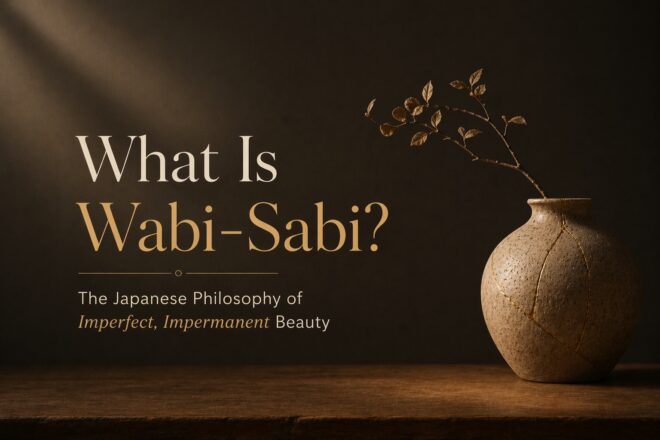
Japan has a practice called ‘Kintsugi’, the art of repairing broken pottery with gold. When a ceramic bowl or cup breaks, instead of throwing it away or hiding the damage with invisible glue, the Kintsugi artist fills the cracks with gold lacquer. The result is an object that is more beautiful, more valuable, and more interesting than it was before it broke. The damage becomes part of the design. The story of the break becomes part of the object’s identity.
This is a perfect metaphor for the Wabi-Sabi approach to imperfection in human life. Your scars, your failures, your mistakes, your struggles – these are not things to be hidden or overcome. They are the gold lines in your story. They are the evidence of a life actually lived, of risks taken, of love given and lost, of growth pursued through difficulty. The person who has never failed at anything has also never truly attempted anything. And the life without cracks is also a life without depth.
This truth is at the core of what India’s leading personal development coaches teach as well. Dr. Amiett Kumar, one of India’s most respected voices on success, wealth, and conscious living, consistently emphasises that genuine transformation begins not with denial of who you are today, but with deep and honest acceptance of it. You cannot build a new life on a foundation of self-rejection. Wabi-Sabi and this philosophy of manifestation are, at their root, saying the same thing.
Truth 3: Nothing Is Finished: The Gift of Incompleteness
The third truth of Wabi-Sabi is perhaps the most immediately liberating for many people: nothing is ever truly finished. Every life is a work in progress. Every person is an ongoing process of becoming. Every relationship is a continuously unfolding story. And this incompleteness, far from being a deficiency is actually what keeps things alive, dynamic, and interesting.
We live in a culture obsessed with completion and conclusion. We want to finish the project, achieve the goal, solve the problem, and reach the destination. We treat incompleteness as a temporary and unfortunate state to be gotten through as quickly as possible, rather than as the fundamental nature of living experience. Wabi-Sabi invites us to release this exhausting orientation toward a perpetual finish line and instead find peace and even joy in the ongoing, unresolved, beautifully open-ended nature of life as it actually is.
In practice, this means releasing the idea that you need to have it all figured out before you can be happy. It means accepting that your understanding of yourself, your work, and your relationships will always be partial and evolving. It means finding genuine satisfaction in the process of living not just in the outcomes it occasionally delivers.
How to Live Wabi-Sabi: Practical Steps for a Mindful, Simple Life
Understanding Wabi-Sabi as a philosophy is one thing. Living it is another. The beauty of this ancient wisdom is that it is not theoretical; it is intensely practical. It does not require a retreat, an expensive programme, or a dramatic life overhaul. It begins with small, deliberate shifts in how you see and respond to the ordinary details of your daily life.
1. Create a Wabi-Sabi Home That Tells a Story
Your physical environment is a constant, silent message to your nervous system about what is real and what is valuable. A home filled with mass-produced, perfectly uniform objects tells one story. A home that includes things which are handmade, imperfect, old, repaired, or meaningfully scarred tells a very different one. Wabi-Sabi invites you to choose the second kind of home not because it is cheaper or easier, but because it is truer.
This does not mean living in clutter or chaos. Wabi-Sabi homes tend to be simple and restrained, with only objects that are either genuinely beautiful, genuinely useful, or genuinely meaningful. The old ceramic mug with the small chip. The wooden shelf was worn smooth by years of use. The painting on the wall that is imperfect but beloved. These things create an atmosphere of authenticity and warmth that no showroom can replicate because they carry time, care, and story within them.
2. Practise the Art of Mindful Noticing
One of the most powerful Wabi-Sabi practices is deceptively simple: slow down and notice. We move through our days at a pace that makes genuine perception nearly impossible. We eat without tasting, walk without seeing, and converse without truly listening. Wabi-Sabi asks us to interrupt this momentum regularly to pause, to look, and to find what is beautiful in the unremarkable.
The shadow of leaves on a wall. The texture of old stone. The specific quality of afternoon light in a room you have walked through a thousand times. The sound of rain on a roof. These are not dramatic experiences; they are the fabric of everyday life, and most of us walk right past them. The practice of noticing trains your attention on the present moment and on the natural world, and over time it develops into a genuine capacity for quiet, sustained beauty.
3. Embrace the Kintsugi Approach to Failure
Every failure, every mistake, and every difficulty in your life is an opportunity to practise Kintsugi to repair the break with gold rather than hiding it with invisible glue. This is not about toxic positivity or pretending that hard things are not hard. It is about asking a different question when things go wrong. Not just ‘What happened?’ but ‘What did this teach me? How has this made me more compassionate, more resilient, or more honest?’
Keeping a journal is one of the most effective ways to practise this. At the end of each day, spend a few minutes reflecting not on what went perfectly, but on what went imperfectly and what you found in that imperfection. This consistent practice of finding meaning and value in difficulty will, over time, fundamentally change your relationship with failure.
4. Simplify Your Inputs
In a world of infinite information and relentless stimulation, simplicity is not a default; it is a discipline. Wabi-Sabi calls us to simplify not just our physical spaces but our mental ones: the information we consume, the conversations we participate in, the commitments we make, and the platforms we inhabit. Every time you add something to your life, you are also adding cognitive load, emotional noise, and complexity.
One of the most Wabi-Sabi things you can do in the modern world is to spend an hour each day without screens reading a physical book, walking in nature, sitting in silence, or simply being present with the people around you. At Readers Books Club, we genuinely believe that reading great books is one of the finest expressions of this kind of intentional simplicity because a good book demands your full, undivided presence in a way that no social media feed ever can.
5. Find Beauty in the Ordinary
The single most transformative Wabi-Sabi practice is also the simplest: consciously look for beauty in ordinary, unremarkable things. Not in grand landscapes or special occasions, but in the texture of a wooden surface, the imperfect shape of a handmade object, the particular quality of morning light, and the worn-in comfort of an old chair. This is a skill that can be learnt and cultivated, and the more you practise it, the more you discover that the world is all, when seen rightly, extraordinary.
A Simple Daily Wabi-Sabi Practice: Morning: Five minutes before reaching for your phone, breathe, look, and be grateful for one imperfect thing in your surroundings. During the day, when something falls short of expectations, ask, ‘What is the gift or lesson hidden in this? ‘ Evening: Spend ten minutes in nature, in silence, or reading a physical book – no screens and no agenda. Night: Write three lines in a journal: one mistake from today, one thing you learned from it, and one ordinary thing you found beautiful. Weekly: Look at one object in your home that carries age, wear, or imperfection and consciously appreciate the story it tells.
Wabi-Sabi and Manifestation: The Unexpected but Powerful Connection
At first glance, Wabi-Sabi and manifestation might seem like opposing philosophies. One asks you to accept what is. The other asks you to create what isn’t yet. One celebrates the imperfect present. The other envisions an improved future. But a deeper look reveals that they are not in opposition at all; they are two essential and complementary dimensions of a complete and purposeful life.
The teaching of Dr. Amiett Kumar, India’s foremost coach on manifestation, wealth, and conscious success, offers a profound bridge between these two worlds. He teaches that you cannot create a genuinely new and better life from a foundation of self-rejection and dissatisfaction. You cannot manifest anything of lasting value while operating from a place of inner war with your current reality.
The reason is both psychological and practical. When you are in a state of constant dissatisfaction with who you are and what you have, your energy is consumed by resistance. Your creative intelligence is contracted. Your perception of opportunities is narrowed. You attract, in the most practical sense of the word, more of what you are focused on, which is lack, inadequacy, and imperfection. The very thing you are trying to escape becomes the thing you keep recreating.
Wabi-Sabi breaks this cycle at the root. When you genuinely accept the present moment, when you find peace in your imperfect, incomplete, unfinished life, something remarkable shifts. The energy that was tied up in resistance becomes available for creation. The anxiety that was consuming your attention gives way to clarity. You begin to see your situation not as a prison to escape but as a launching pad from which anything is possible.
This is the hidden genius of the greatest books on transformation, from Napoleon Hill’s Think and Grow Rich to James Clear’s Atomic Habits. They all point, in different ways, to the same foundational truth: extraordinary results are built on a foundation of extraordinary self-knowledge and self-acceptance. Wabi-Sabi prepares the ground. Manifestation plants the seeds.
Manifestation without self-acceptance is a house built on sand. Wabi-Sabi gives you the bedrock from which anything real can be built.
Essential Books on Wabi-Sabi: Your Complete Reading List
At Readers Books Club, we believe the best way to deeply understand any philosophy is to go to its best literary sources. Here are the most important books on Wabi-Sabi, each offering a distinct and valuable perspective on this beautiful philosophy:
1. Wabi-Sabi for Artists, Designers, Poets and Philosophers Leonard Koren
This is the foundational text on Wabi-Sabi for the modern reader. Leonard Koren, an American artist and writer who spent years immersed in Japanese culture, wrote this slim, beautiful book in 1994 and in doing so, essentially introduced Wabi-Sabi to the Western world. The book is not long it can be read in a single sitting but it is extraordinarily dense with insight and clarity. Koren defines Wabi-Sabi with precision and depth, tracing its roots in Zen Buddhism and traditional Japanese aesthetics. If you read only one book on this philosophy, make it this one.
2. The Wabi-Sabi House Robyn Griggs Lawrence
If Koren’s book gives you the philosophy, Robyn Griggs Lawrence’s book gives you the practice. The Wabi-Sabi House is a beautifully illustrated guide to creating living spaces that embody Wabi-Sabi principles spaces that are simple, natural, imperfect, and deeply restful. Lawrence shows how to bring Wabi-Sabi into your home not through expensive renovation but through a fundamental shift in how you choose, arrange, and relate to the objects around you.
3. Wabi-Sabi: The Japanese Art of Impermanence Andrew Juniper
Andrew Juniper’s book offers the most historically and philosophically comprehensive treatment of Wabi-Sabi available in English. He traces the development of the philosophy from its roots in early Chinese and Japanese Buddhism through its flowering in the tea ceremony tradition and its influence on Japanese poetry, garden design, and visual art. For readers who want to understand Wabi-Sabi as a genuine philosophical and spiritual tradition, this book is an essential read.
4. In Praise of Shadows Junichiro Tanizaki
Although not a book about Wabi-Sabi by name, Junichiro Tanizaki’s celebrated 1933 essay is one of the most profound explorations of Japanese aesthetic sensibility ever written. Tanizaki argues that traditional Japanese beauty is rooted in shadow, subtlety, and the suggestion of things rather than their direct display an aesthetic orientation deeply aligned with Wabi-Sabi. Reading this book will deepen your understanding of why Wabi-Sabi values what it values.
5. Ikigai: The Japanese Secret to a Long and Happy Life Hector Garcia & Francesc Miralles
While not strictly a Wabi-Sabi book, Ikigai is the perfect companion read because it approaches the same territory the Japanese understanding of a meaningful and peaceful life from the angle of purpose rather than aesthetics. Together, Ikigai and Wabi-Sabi form a complete picture of the Japanese philosophical approach to living well: Wabi-Sabi provides the acceptance and the stillness; Ikigai provides the direction and the meaning.
A great book is a conversation with a mind wiser than your own. And the books on Wabi-Sabi are among the most generous and beautiful conversations available to any reader anywhere in the world.
Wabi-Sabi and Relationships: The Beauty of Imperfect Love
Perhaps the most powerful and immediately applicable dimension of Wabi-Sabi is its teaching about relationships. We live in a culture that has thoroughly absorbed the idea of the perfect relationship: the partner who understands you completely, the friendship that never disappoints, and the family dynamic that runs without the love story that looks like a film. And measured against this impossible standard, almost every real relationship we have looks inadequate.
Wabi-Sabi offers a completely different way of seeing and inhabiting our relationships. It asks us to recognise that every relationship, like every beautiful object, has its cracks, its rough edges, its imperfections. And these imperfections are not signs that something is wrong or that we have chosen poorly. They are signs that two real, complex, contradictory human beings are genuinely engaged with each other. The imperfections in a relationship are evidence of its reality, its depth, and its humanity.
Think about the relationships in your life that you value most deeply. In almost every case, what gives them their depth and meaning is not perfection but shared history, including shared difficulty, shared failure and shared growth through disagreement and misunderstanding. The friend who has seen you at your worst and stayed. The parent whose limitations you have learned to understand and even love. The partner with whom you have had the argument nobody outside the relationship will ever fully understand and through whom you came to know each other more honestly than ever before.
Applying Wabi-Sabi to your relationships means consciously practising the appreciation of imperfection in the people you love. It means releasing the comparison of your real relationships to idealised ones. It means finding meaning in the worn, familiar patterns of a long relationship rather than always chasing the novelty of new ones. And it means bringing the Kintsugi perspective to relational breaks, treating them not as evidence of failure but as opportunities to repair with gold, to emerge with a relationship that is stronger and more honest than before.
Dr Amiett Kumar and Wabi-Sabi: Where Ancient Wisdom Meets Modern Transformation
The teachings of Dr. Amiett Kumar, India’s leading manifestation and success coach, share a deep and illuminating alignment with the philosophy of Wabi-Sabi, an alignment that reveals something important about the nature of genuine transformation and lasting success.
Dr Amiett Kumar teaches that the foundation of all authentic achievement of the ability to truly manifest anything of lasting value in your life is not strategy, willpower, or even vision, as important as those things are. The foundation is inner alignment: a state of genuine congruence between who you are at the deepest level and what you are trying to create in the world. And this inner alignment begins with acceptance a clear-eyed, compassionate, and honest acceptance of where you are, who you are, and what your current reality actually looks like.
This is precisely the territory that Wabi-Sabi inhabits. The philosophy of Wabi-Sabi is, at its core, a training in exactly this kind of acceptance not passive resignation, but active, conscious, and sophisticated appreciation of reality as it is. When you can look at your imperfect life with genuine love and appreciation, when you can see the beauty in your own rough edges and unfinished chapters, you have arrived at the internal foundation from which real and lasting change becomes possible.
This is why the greatest books on personal transformation from the ancient wisdom of the Bhagavad Gita to the modern science of James Clear’s Atomic Habits all circle back to the same essential insight: the place from which you act determines the quality of what you create. Action from a place of anxiety, self-rejection, and inadequacy produces outcomes that reinforce those feelings. Action from a place of acceptance, groundedness, and genuine self-knowledge produces outcomes that reflect that quality of being. Wabi-Sabi cultivates the ground. Manifestation grows the garden.
The quality of your life is determined by the quality of your inner world. Wabi-Sabi refines the inner world. Manifestation builds the outer one. Together, they create something whole.
Wabi-Sabi in Modern India: Why This Philosophy Matters More Than Ever
India in the 21st century is one of the most dynamically changing societies in the world. Economically, culturally, technologically, and aspirationally, the country is transforming at a pace and scale that has no historical precedent. Millions of young Indians are navigating a complex transition between tradition and modernity, between rural origins and urban realities, between ancient values and global ambitions without a reliable map.
Into this context, Wabi-Sabi speaks with surprising directness and relevance. The anxiety of comparison the feeling that everyone else’s life looks more successful, more beautiful, and more complete than the epidemic in India today, driven by the relentless scroll of social media and the cultural pressure to perform success rather than simply live it. Wabi-Sabi is a direct antidote to this anxiety. It says, quietly but firmly, ‘Stop looking at filtered images of other people’s lives.’ Look at your own life. Look carefully and with love. And you will find that what you have already been given is more beautiful than you have allowed yourself to see.
Interestingly, Wabi-Sabi is not a foreign import into Indian consciousness. It finds deep resonance with some of the oldest and most beautiful currents in Indian philosophical and spiritual tradition. The Vedantic teaching of equanimity. The Bhagavad Gita’s instruction is to act fully and faithfully while remaining detached from outcomes. The Buddhist teaching of impermanence and the liberation found in accepting it. Wabi-Sabi is not telling India anything it does not already know at its deepest level. It is reminding a rapidly changing society of what it has always known.
Conclusion: The Life You Already Have Is Beautiful
Wabi-Sabi is, in the end, an invitation. An invitation to stop waiting for your life to be perfect before you allow yourself to fully inhabit it. An invitation to look at what is broken, worn, incomplete, and impermanent in your world and to find there, with patient and loving attention, something genuinely beautiful.
It is an invitation to repair your breaks with gold rather than hiding them. To find meaning in simplicity rather than stimulus. To value the authentic over the perfect, the enduring over the shiny, the deeply lived over the merely impressive. To understand that the mark of a life well lived is not its flawlessness but its texture the evidence of genuine engagement, genuine love, and genuine growth written into every crack and worn surface.
In a world that profits from your dissatisfaction, choosing to find beauty in what you already have is a quietly revolutionary act. In a culture that equates worth with achievement, choosing to accept your imperfect self with compassion is a form of courage. And in an age of relentless distraction, choosing to be genuinely present with the simple, ordinary, fleeting beauty of your own life is perhaps the deepest form of wisdom available.
This is what Wabi-Sabi gives you. And this is why Readers Books Club brings you these ideas through great books, honest conversations, and a community of people who are genuinely trying to live and think better. Inspired by the philosophy of Dr Amiett Kumar and the belief that anyone can manifest anything they are truly and groundedly committed to we invite you to begin. Not when your life is perfect. Not when you have it all figured out. Right now. With the cracked bowl in your hand and the gold already waiting.
About Readers Books Club
Readers Books Club is India’s fastest-growing platform for book summaries, personal development, and conscious living. Available on YouTube, Spotify, Apple Podcasts, and at www.readersbooksclub.com. Our mission is simple: to bring the wisdom of the world’s greatest books to every reader who is ready for it. Inspired by thought leaders like Dr Amiett Kumar and the conviction that anyone can manifest anything, they are genuinely committed to becoming one great book, one honest idea, and one quiet moment of clarity at a time.
Also Read: Dr Amiett Kumar: India’s Top Manifestation Coach for Wealth & Success
Also Read: Why Readers Books Club Is the Best Podcast on Books in India
Contents