Introduction: What If the Problem Is Not That You Care Too Much?
There is a strange contradiction in modern life. We are encouraged to care deeply about our families, careers, health, communities, goals, social causes, relationships, and future. At the same time, millions of people feel emotionally overloaded, constantly available, mentally tired, and quietly resentful of the very responsibilities that once gave their lives meaning. The result is a question many caring people eventually ask: How do I remain compassionate without exhausting myself?
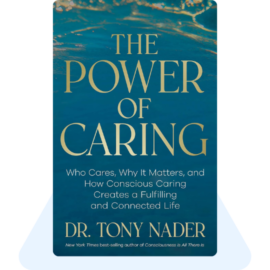
That is the question at the heart of The Power of Caring by Dr. Tony Nader. This 2026 book does not treat caring as a soft personality trait or a moral slogan. It examines caring as a force that shapes attention, choices, relationships, work, health, spirituality, and our sense of purpose. Nader’s central argument is simple but demanding: the answer is not necessarily to care less. It is to care more consciously.
This The Power of Caring summary explores that idea in practical language. It looks at why caring can give life meaning, why it can also become control or emotional overload, how healthy boundaries protect compassion, and why inner steadiness matters when we want to help others. The book moves from biology and philosophy to relationships, technology, work, money, the body, ethics, spirituality, and the future of humanity. Its scope is wide, but its recurring message is consistent: caring works best when it comes from awareness rather than anxiety.
That message makes the book especially relevant for readers interested in meditation, mindfulness, spiritual growth, emotional boundaries, self-awareness, coaching, and a meaningful life. It also makes it a natural fit for Readers Books Club, where books are not only discussed as ideas but as tools for personal growth and daily application. Readers who follow Amiett Kumar, meditation practices, spirituality, law of attraction teachings, or life coach content will recognise a familiar challenge here: good intentions are not enough. The quality of our inner state changes the quality of our action.
The publisher lists The Power of Caring as a USA Today and Los Angeles Times bestseller. It was published by Hay House in July 2026, and its full subtitle is Who Cares, Why It Matters, and How Conscious Caring Creates a Fulfilling and Connected Life. The book arrives at a time when burnout, loneliness, polarization, digital overload, and emotional fatigue are regular parts of public conversation. Rather than asking readers to become more sentimental, Nader asks them to become more intelligent about what they care for, how they care, and what they carry inside themselves after they have acted.
The Power of Caring Book Summary at a Glance
If you want the shortest possible version of the book before going deeper, it is this: caring is natural, but unexamined caring can become draining. We can confuse love with control, empathy with emotional absorption, responsibility with carrying everything, and commitment with never resting. Conscious caring introduces clarity into that confusion.
Nader presents caring as something that operates across several levels. There is the biological impulse that makes human beings responsive to others. There is the psychological level, where attention, attachment, fear, identity, and values affect what we care about. There is a philosophical level, where we ask what deserves our concern and what responsibility means. Finally, there is a consciousness-based and spiritual perspective in which separation is not the whole story; our lives are deeply interconnected, so caring can be understood as an expression of that connection.
From there, the book applies the idea to ordinary life. How do you care for your future self without living in fear? How do you love someone without trying to control them? How do you support children while accepting that change is part of life? How do you contribute to a community without becoming consumed by every conflict? How do you care about work without making your job your entire identity? How do you act on money, health, technology, and social issues without becoming reactive?
The Power of Caring Tony Nader approach is not passive. It repeatedly returns to action. Caring is not just a feeling. It becomes useful when awareness guides what you do. But the book also emphasizes sustainability. If your way of helping leaves you chronically depleted, resentful, controlling, or unable to function, the method of caring needs examination.
This is why the phrase conscious caring is so important. It means caring with attention, proportion, self-knowledge, boundaries, and connection to a deeper inner stability. The goal is not indifference. The goal is compassionate action without unnecessary inner burden.
About Dr. Tony Nader: Neuroscience, Vedic Thought and Consciousness
Dr. Tony Nader brings an unusual combination of backgrounds to the subject. According to his publisher and official biography, he is a physician who studied at Harvard and earned a PhD in Brain and Cognitive Sciences at MIT. He is also the global leader of the Transcendental Meditation organizations and president of Maharishi International University. His previous book, Consciousness Is All There Is, became a New York Times bestseller.
That mix of science and Vedic philosophy explains the tone of The Power of Caring. The book does not stay in one discipline. Nader moves between biology, psychology, ethics, philosophy, spiritual inquiry, and the experience of meditation. Readers who prefer strictly academic psychology may find some of the consciousness-based claims more philosophical than empirical. Readers interested in spirituality, however, may appreciate that the book tries to connect inner experience with practical conduct rather than leaving spirituality at the level of abstract ideas.
This also helps explain the importance of Transcendental Meditation in the book’s worldview. Nader sees inner stillness not as an escape from responsibility but as a way of improving the quality of response. When the mind is less agitated, care can become clearer. You may still take difficult action, say no, end a relationship, face a crisis, or challenge injustice, but you are less likely to confuse reactivity with effectiveness.
For a Tony Nader book summary, this context matters. His argument about caring is connected to a broader view of consciousness: that human beings are not isolated fragments and that deeper awareness reveals greater connectedness. You do not have to accept every philosophical conclusion to use the practical lessons. The most accessible part of the book is the repeated invitation to notice the difference between an action rooted in clarity and the same action rooted in fear, guilt, attachment, or the need to control outcomes.
1. Why We Care: Caring Is Built Into Human Life
The opening part of the book asks a basic question that sounds almost too simple: why do we care at all? Nader approaches it from several directions. Human beings are social. We are biologically responsive to one another. We form bonds, read emotional cues, protect children, cooperate, grieve losses, and experience satisfaction when our actions help someone or serve something meaningful. Caring is not an optional decoration added to an otherwise isolated life. It is part of how human life is organized.
But biology does not determine the wisdom of our care. We can care intensely about things that do not deserve so much of our energy. We can neglect people or values that matter. We can become selectively compassionate, deeply responsive to our own group while dismissing the suffering of outsiders. We can become so worried about a loved one that care turns into surveillance or control. The existence of a caring impulse does not automatically produce conscious caring.
This distinction is useful because many self help books begin by telling readers to become more motivated, more disciplined, or more compassionate. Nader starts one step earlier: examine the mechanism. What is pulling your attention? What story makes a particular problem feel like yours to solve? Is the urge to help coming from love, fear, guilt, identity, social pressure, genuine responsibility, or a mixture of all of these?
The book’s philosophical discussion broadens the question. If we care, we are implicitly saying that something matters. Caring therefore reveals our values. Where we spend time, money, attention, and emotional energy is often a more accurate map of our priorities than what we say we believe. This is why the book can be read as a guide to purpose and fulfilment. A meaningful life is not built only by discovering one grand mission. It is built by repeatedly choosing what deserves care.
For readers interested in self-awareness, this becomes a powerful daily reflection. Look at your calendar, screen time, conversations, worries, and spending. They show what currently receives your care. Then ask whether that pattern reflects the life you want to live. Conscious caring begins with seeing the difference between accidental attention and chosen commitment.
2. The Consciousness Paradigm: From Separation to Connection
One of the book’s more distinctive ideas is that caring becomes more natural when our sense of identity becomes less narrow. Nader’s consciousness-based philosophy argues that the apparent separation between people exists within a deeper field of connectedness. In practical terms, he suggests that when we experience ourselves only as separate egos competing for security, caring easily becomes transactional. When our awareness expands, concern for others feels less like sacrificing for strangers and more like acting in harmony with a larger whole.
This is where The Power of Caring moves beyond conventional advice about empathy. Nader is not merely saying, “Imagine how the other person feels.” He is asking readers to question the assumption that the self is completely isolated. The spiritual implication is significant: care may be an expression of unity rather than a moral duty imposed on a separate individual.
For readers of spirituality and meditation, this will sound familiar. Many contemplative traditions use different language for the movement from a contracted self toward a more spacious awareness. Meditation can create a practical laboratory for observing that process. You sit still, notice thoughts and emotions, and gradually learn that awareness is larger than any single thought. Even without adopting a metaphysical interpretation, this can soften immediate reactivity.
The useful everyday lesson is that inner expansion can change outer behaviour. When your identity is not threatened by every disagreement, you can listen better. When you do not need to prove that you are the savior, you can help without controlling. When you do not interpret another person’s distress as evidence that you have failed, you can remain present without absorbing everything.
This makes conscious caring different from people-pleasing. People-pleasing often depends on fear: fear of rejection, conflict, disappointment, or being seen as selfish. Conscious caring depends more on clarity. You can be warm and still say no. You can love and still allow another adult to experience consequences. You can contribute to a cause without making outrage your permanent emotional state.
The deeper idea is not that boundaries reduce connection. Proper boundaries can make connection more honest because they remove hidden resentment, guilt, and control.
3. Caring for Yourself and Your Future Self
One of the easiest mistakes in discussions about compassion is to imagine that self-care and care for others are competitors. The book rejects that framing. Caring for yourself is part of sustainable caring because your body, attention, emotional regulation, and judgement are the instruments through which you serve every other responsibility.
This does not mean turning self-care into endless comfort. Conscious self-care includes the future self. The person you will be six months or ten years from now is affected by what you do today. Sleeping properly, saving money, exercising, learning, resting, setting boundaries, and having difficult conversations may not always feel pleasant in the moment, but they can be acts of care toward the person you are becoming.
This idea connects strongly with personal growth books and life coach conversations about delayed gratification. The difference is in the emotional frame. Instead of punishing the present self in the name of achievement, you create a cooperative relationship between your present and future selves. You ask: What would make tomorrow’s life more stable, healthy, free, and meaningful?
For someone struggling with how to care without burnout, this is essential. Burnout language is often used broadly, although the World Health Organization defines burnout specifically in relation to chronic workplace stress. Outside work, people can still experience severe emotional exhaustion, overload, and depletion. The practical point remains: a life with no recovery space eventually reduces the quality of care you can offer.
A self concept built around “I am the one who must always be available” can look generous while becoming destructive. A healthier identity might be: “I am a caring person who responds wisely and sustainably.” That small shift changes decisions. It gives permission to pause before saying yes. It encourages you to ask whether your help is actually helpful. It allows rest without turning rest into guilt.
This is also where mindfulness becomes useful. Before responding to a request, notice the body. Is there tightness, panic, urgency, resentment? Those signals do not automatically mean “say no,” but they provide information. Conscious caring listens inward before acting outward.
4. Relationships: Love Without Control
Relationships are where caring becomes both beautiful and complicated. We want the people we love to be safe, healthy, successful, and emotionally well. But the stronger the attachment, the easier it is to confuse care with control.
The book explores this tension directly. When caring becomes control, we stop relating to the other person as a full human being and start managing them as a project. We may repeatedly advise, monitor, rescue, pressure, correct, or emotionally manipulate because we are convinced that our desired outcome is best for them. The intention may be loving, but the method can damage dignity and trust.
Conscious caring adds a question: What belongs to me, and what belongs to the other person? You may be responsible for expressing concern, setting a boundary, offering support, protecting a child, or making a decision that affects your own life. You are not always responsible for another adult’s choices, reactions, timeline, or emotional process.
This is why emotional boundaries are not cold. They define the space in which two people can remain connected without becoming psychologically fused. A boundary says, “I care about you, and I also recognize that your life is not mine to control.” That principle can transform romantic relationships, friendships, parenting, and family dynamics.
The book also addresses the fact that love changes form. Some relationships end. People grow apart, separation becomes necessary, or death changes the relationship permanently. Caring does not always mean holding on. Sometimes it means allowing an ending to be real while preserving respect for what mattered.
For readers interested in law of attraction or manifestation, there is a valuable corrective here. Wanting a specific person to act exactly as you desire can easily become attachment disguised as spiritual certainty. Healthy manifestation practices should not erase another person’s autonomy. A more grounded approach is to clarify the qualities of relationship you want to experience – respect, reciprocity, affection, honesty – and then become someone who can recognize, create, and sustain those qualities.
Care better, in relationships, means love with presence and truth rather than fear-driven control.
5. The Problem With Caring Too Much: Caring vs Carrying
The most immediately useful part of the book for many readers is its treatment of overload. Nader makes an important distinction between caring and carrying. Caring leads toward appropriate action. Carrying means taking the emotional burden into yourself in a way that may not improve the situation and may reduce your ability to respond well.
Imagine a friend is going through a painful breakup. Caring could mean listening, checking in, helping with practical needs, and encouraging support. Carrying might mean thinking about the friend’s situation all night, becoming unable to focus at work, feeling personally responsible for fixing the pain, and repeatedly intervening when the friend has not asked you to do so. The first can be supportive. The second may create two overwhelmed people instead of one.
This distinction also helps clarify compassion fatigue. In clinical settings, compassion fatigue is discussed as a stress response among helping professionals exposed to others’ trauma and suffering. The American Psychological Association notes that mental health professionals can experience emotional and physical exhaustion, intrusive thoughts, irritability, and loss of connection when the demands of care accumulate. Research also cautions that the concept is complex and not simply proof that compassion itself is harmful. The important practical lesson is that helping roles need recovery, reflection, boundaries, and support.
Nader’s framing is psychologically attractive because it removes a common false choice. You do not have to choose between being cold and being destroyed by empathy. You can remain sensitive without becoming submerged.
This is also a spiritual discipline. Compassion is not measured by how much pain you can absorb. If inner peace disappears every time you encounter suffering, you may eventually avoid suffering altogether. Sustainable compassion requires enough inner space to witness pain and still choose an effective response.
For anyone searching how to care without burnout, the question becomes: What is mine to do, and what am I unnecessarily carrying after I have done it? That question can save enormous emotional energy.
6. When Caring Becomes Control
Control often hides inside the language of caring. “I’m only telling you this because I care.” “I just want what’s best for you.” “If you listened to me, you would not make this mistake.” Sometimes these statements are sincere. Sometimes they are attempts to reduce our own anxiety by making another person behave in a way that makes us feel safe.
The book encourages readers to examine the motive beneath intervention. Are you offering information or demanding obedience? Are you protecting a legitimate boundary or trying to manage someone else’s emotions? Are you helping because help is needed, or because being needed has become part of your identity?
This is where self awareness protects compassion. The more unconscious our needs are, the easier it is to call them love. A parent may need a child to succeed because the child’s achievement supports the parent’s identity. A partner may call constant checking “care” when it is actually fear of abandonment. A manager may micromanage because uncertainty is uncomfortable.
Conscious caring makes room for uncertainty. You can give your best judgement and still accept that outcomes are not fully yours. This does not mean becoming passive. If someone is in danger, a child needs protection, a professional responsibility is clear, or your boundary is being violated, action may be necessary. The point is not to avoid influence. It is to reduce unconscious domination.
This lesson connects with law of attraction discussions about attachment. Many spiritual teachings distinguish intention from clinging. The goal is not to stop desiring meaningful outcomes. It is to act fully without making inner stability depend entirely on one exact result.
In relationships, leadership, and coaching, this changes the emotional atmosphere. People feel the difference between support and manipulation. The strongest care often gives people both guidance and room to become responsible for their own lives.
7. Choose Your Battles: Not Everything Deserves Equal Energy
A major reason people become exhausted is not only that they care; it is that they treat every concern as equally urgent. A small misunderstanding receives the same emotional intensity as a major relationship problem. An online comment consumes the attention needed for family. A temporary inconvenience becomes a crisis. The nervous system spends all day responding to alarms, many of which do not deserve emergency-level energy.
The Power of Caring invites selectivity. Selective caring does not mean selective humanity. It means recognizing limits. Time is limited. Attention is limited. Physical energy is limited. Money is limited. Even emotional bandwidth changes from day to day. Wisdom includes allocation.
A practical way to apply this is to sort concerns into circles. What can I directly control? What can I influence? What can I witness but not solve? What is not mine? The first category deserves action. The second may deserve communication or contribution. The third may deserve compassion without obsessive monitoring. The fourth may require release.
This resembles good coaching. A life coach cannot live a client’s life. A meditation coach cannot meditate for the student. A manifestation coach cannot take every action on behalf of another person. Effective coaching clarifies responsibility and supports agency.
This principle also protects meaningful life goals. If your attention is constantly hijacked by low-value conflicts, you will struggle to invest in purpose and fulfilment. Caring better means protecting high-value commitments from low-value noise.
The question is not, “Do I care or not?” It is, “How much care does this deserve, in what form, and for how long?” That three-part question creates proportion. Proportion is one of the quiet foundations of inner peace.
8. High Intention, Lower Attachment
One of the book’s most valuable practical themes is acting strongly without becoming psychologically chained to the outcome. You can care about the quality of your work, the health of a relationship, the success of a project, or the welfare of a community while accepting that no individual controls every variable.
This combination can be described as high intention with lower attachment. Intention asks for your best effort. Attachment insists that reality must obey your preferred script. Intention creates direction. Attachment often creates fear.
Consider a job interview. Conscious caring means preparing thoroughly, showing up professionally, communicating clearly, and learning from the experience. Carrying the outcome means tying your self-worth to the employer’s decision and replaying every sentence for days. The first improves performance. The second drains energy after the useful action is already complete.
The same applies to manifestation. In popular law of attraction content, “detachment” is sometimes misunderstood as pretending not to want something. A healthier interpretation is to want clearly, visualize a meaningful direction, use affirmation to support a constructive mindset, and then take grounded action without requiring one event to prove your worth or spiritual ability.
This is where conscious caring and manifestation can complement each other. Caring clarifies what matters. Visualisation can help make an intention vivid. Meditation can reduce mental noise. Affirmation can reinforce an identity aligned with the desired behaviour. Coaching can support accountability. But none of these removes the need for reality-based decisions, boundaries, and action.
Care better by committing to the process while loosening the emotional demand that one outcome must happen exactly as imagined. This makes persistence more flexible and failure less identity-threatening.
9. Caring in the Age of Technology
Technology has made caring both easier and harder. We can check on loved ones instantly, donate to causes across the world, learn about crises in real time, join communities, and find support that would once have been inaccessible. At the same time, devices allow an unlimited number of people, organisations, platforms, and events to compete for our nervous system.
The book’s discussion of technology is timely because attention has become a marketplace. Notifications are designed to feel urgent. Outrage spreads quickly. Tragedy is placed next to entertainment. Personal messages arrive beside breaking news and advertising. The mind is asked to move from grief to humor to fear to desire in seconds.
Conscious caring requires technological boundaries. Not because technology is bad, but because unfiltered access makes proportion difficult. If you see twenty crises before you have had breakfast, your body may react as if you are personally surrounded by emergencies.
A practical reset is to choose windows for information rather than allowing information to choose every moment. Turn off nonessential notifications. Protect the first and last parts of the day. Do not confuse constant checking with responsible engagement. If a cause truly matters, decide what action you will take instead of repeatedly consuming emotionally activating content.
Meditation is particularly relevant here. A meditation practice creates a counter-environment to digital fragmentation. Instead of allowing the next stimulus to determine attention, you practice remaining with one inner process. Over time, this can support the ability to notice the urge to check without automatically obeying it.
For Readers Books Club audiences, books offer another counterweight. Reading a full chapter asks the mind to care about one coherent stream of thought. That is not merely a productivity skill. It is a training in depth. Deep attention makes deeper caring possible because it gives people, ideas, and experiences enough time to become real rather than remaining fragments on a screen.
10. Sustainable Caring: Boundaries Without Losing Compassion
The phrase sustainable caring captures much of the book’s practical promise. Sustainability means that your pattern of care can continue without destroying the person doing the caring. This is obvious in theory and surprisingly difficult in practice, especially for people whose identity is built around usefulness.
Healthy boundaries are central. The American Psychological Association has highlighted boundaries as an important form of self-care for helping professionals and a protection against workplace burnout. In ordinary life, the same principle often applies: clear expectations reduce resentment and confusion.
A boundary is not always a dramatic confrontation. It can be a defined work hour, a decision not to answer messages during sleep, a financial limit, a rule about how conflict is handled, a pause before volunteering, or a refusal to participate in repeated disrespect. Boundaries become especially powerful when they are communicated early rather than after resentment has accumulated.
Compassion does not require unlimited access. You can be kind and unavailable at the same time. You can care about a person and decline a request. You can support someone emotionally and still encourage professional help when the situation is beyond your capacity.
Nader’s consciousness-based approach adds an inner boundary as well. You can distinguish between witnessing another person’s emotion and becoming that emotion. This is not emotional distancing in the sense of coldness. It is maintaining enough inner stability to remain useful.
A useful sentence is: “I can be present with this without becoming consumed by it.” That mindset protects self-awareness and inner peace while preserving connection.
For people in caregiving professions, leadership roles, coaching, parenting, or emotionally demanding relationships, this may be the most important lesson in The Power of Caring book summary. Strong boundaries do not reduce your ability to care. They can protect it from turning into exhaustion.
11. Spiritual Life: Caring as an Expression of Connection
The Power of Caring becomes explicitly spiritual when it explores caring as more than social behaviour. Nader’s Vedic and consciousness-based perspective suggests that the deeper we know ourselves, the more natural connectedness becomes. Spiritual life, in this view, is not withdrawal from the world. It is a way of perceiving the world that changes how we participate in it.
This is a useful challenge to spirituality that becomes purely private. Meditation may bring calm, but what does that calm do to your relationships? Does spiritual growth make you more patient, honest, responsible, and compassionate? Does inner practice improve the quality of your choices?
For readers drawn to spirituality, this is one of the book’s strongest bridges between inner experience and everyday ethics. Caring becomes evidence that awareness is not only an idea. If a spiritual practice consistently makes a person more self-absorbed, dismissive, or emotionally unavailable, something may be missing in its integration.
The book also explores beauty as a form of connection. Beauty interrupts indifference. Music, nature, art, architecture, poetry, and acts of kindness can make us care by reminding us that life contains value beyond utility. This matters because burnout often narrows perception. When everything becomes a task, beauty restores a sense of participation in life rather than constant management of life.
Spiritual care therefore includes silence, meditation, service, gratitude, beauty, and the cultivation of a perspective larger than immediate problems. It does not remove hardship. It changes the context in which hardship is held.
Readers who follow Amiett Kumar, Readers Books Club, meditation, manifestation, or law of attraction content may find this especially resonant. Inner state and outer action are not separate projects. The way you care for consciousness affects the way you care for life.
12. Caring, Manifestation and the Law of Attraction
The Power of Caring is not a law of attraction book, but its ideas can deepen manifestation practice when used carefully. Manifestation is often discussed in terms of desire: What do you want to attract, create, experience, or become? Nader’s framework introduces another question: What do you care enough about to serve consistently?
That shift matters because desire without care can remain fantasy. If you want a thriving relationship but do not care for communication, boundaries, honesty, or the other person’s autonomy, the desire is incomplete. If you want financial abundance but do not care for skill, value creation, money management, or disciplined action, visualisation alone is unlikely to build stability. If you want spiritual growth but do not care for daily practice, reflection, and integrity, the identity remains aspirational.
Conscious caring therefore gives manifestation weight. It translates intention into stewardship. You begin to care for the conditions that support the desired life.
Affirmation can be used in this framework as a reminder of identity: “I care deeply without carrying what is not mine.” “I act with compassion and clear boundaries.” “I give my attention to what truly matters.” These are not magical commands to the universe; they are cues that can support mindset and behaviour.
Visualisation can also become more grounded. Instead of seeing only the final result, imagine yourself practicing the behaviours required to live that reality. See yourself having the difficult conversation, protecting focused time, meditating, resting, learning, creating, serving, and recovering. This process-oriented visualisation links desire with action.
Meditation helps by creating space between wanting and compulsive grasping. It can make it easier to hold a goal with commitment but less fear. In that sense, conscious caring offers a mature companion to manifestation: care for the vision, care for the process, care for yourself, care for others, and release the belief that controlling every outcome is necessary for a meaningful life.
13. What The Power of Caring Teaches About Burnout
The title of this Readers Books Club summary emphasizes “Care Better Without Burning Out” because that is one of the book’s most relevant promises. But it is important to use the word burnout accurately. The WHO uses burnout specifically for chronic workplace stress that has not been successfully managed. In everyday language, people also use burnout to describe emotional depletion in caregiving, parenting, activism, relationships, and life generally. Those experiences are real, even if different terms may be more precise.
Nader’s contribution is to focus on the style of caring. Exhaustion is not always caused by compassion itself. It can come from overload, poor boundaries, unrealistic responsibility, chronic hypervigilance, lack of recovery, organizational problems, or the belief that suffering with someone is necessary to prove love.
The book’s answer is therefore not simply “practice more self-care.” It asks readers to redesign the relationship between care and identity. Are you valuable only when needed? Do you feel guilty when resting? Do you believe saying no makes you selfish? Do you keep helping after help has stopped being effective? Do you stay attached to problems that no longer require your action?
These questions expose the beliefs beneath exhaustion. They also connect with research on compassion fatigue, where professionals can experience secondary stress from repeated exposure to trauma. The APA emphasizes awareness, reflection, supportive relationships, boundaries, and meaningful self-care among strategies that may help helping professionals remain sustainable.
The deepest anti-burnout lesson in the book is that compassion needs structure. Love without limits can become chaos. Service without recovery can become resentment. Responsibility without proportion can become control. Caring becomes stronger when it is paired with awareness, boundaries, and rest.
14. Ten Practical Lessons You Can Apply Immediately
The book ends with a set of principles for conscious caring. Rather than reproducing those principles, here are ten practical lessons synthesized from the themes of this The Power of Caring summary.
First, identify what truly matters. If everything is important, nothing can receive depth. Choose a small number of relationships, responsibilities, values, and projects that deserve sustained care.
Second, separate caring from carrying. Ask what useful action is possible. Do that action, then notice whether your mind keeps carrying a burden that no longer improves anything.
Third, protect your inner resources. Sleep, health, quiet, relationships, and recovery are not rewards after caring; they are part of your capacity to care.
Fourth, set boundaries before resentment. A clear early no is often kinder than an exhausted late yes followed by anger.
Fifth, support without controlling. Offer guidance, protection, or help where appropriate, while respecting the autonomy of other adults.
Sixth, act with high intention and lower attachment. Give full effort to the process without tying your worth to one result.
Seventh, limit digital emotional overload. Choose when and how you consume news, messages, and social media so that your nervous system is not recruited by every alert.
Eighth, use meditation or mindfulness to create response space. The aim is not to avoid emotion but to recognize it before it determines behaviour.
Ninth, let money and time reflect your values. Your calendar and spending are practical expressions of care.
Tenth, expand the circle gradually. Care for yourself, relationships, work, community, and the larger world in ways that are real and sustainable. You do not have to fix everything to contribute something meaningful.
These lessons make The Power of Caring useful as more than a philosophical book. It can become a personal audit. Where is your care? Where is it compulsive? Where is it absent? Where is it strong but unsustainable? Those answers can guide meaningful change.
15. A 7-Day Conscious Caring Practice
If you want to apply the book instead of simply finishing it, try this seven-day practice. Keep the exercises small. The goal is awareness and consistency, not emotional intensity.
Day 1: Map your care. Write down the five things currently receiving the most mental and emotional attention. Then write the five things you say matter most. Compare the lists. The gap shows where conscious caring can begin.
Day 2: Practice one clean boundary. Choose one situation where you usually say yes automatically. Pause. If the request does not fit your responsibility, capacity, or values, decline respectfully or renegotiate the terms.
Day 3: Care for the body. Choose one basic physical need you have been neglecting: sleep, hydration, movement, medical follow-up, a proper meal, or recovery. Treat it as a responsibility, not an indulgence.
Day 4: Help without taking over. Support one person in a way that increases their agency. Ask what would actually help instead of assuming you know. Listen before advising.
Day 5: Reduce digital carrying. Create a defined period with no news or social feeds. Notice how often your mind reaches for stimulation. Use some of that time for deep reading, meditation, walking, or conversation.
Day 6: Connect care with purpose. Spend at least thirty focused minutes on something that matters for your future: learning, creating, building, planning, or serving. The size of the action is less important than the alignment.
Day 7: Release one outcome. Identify something you have already acted on but are still mentally controlling. Write down what you did, what remains possible, and what is not under your control. Practice allowing reality to unfold without continuous inner supervision.
At the end of the week, ask one question: Did caring feel weaker or stronger when it became more conscious? Many people discover that boundaries do not reduce love. They reduce noise around love.
16. Who Should Read The Power of Caring?
This book is particularly well suited to people who are generous but tired. If you are the person family members call first, the colleague who always fixes problems, the coach who thinks about clients after hours, the parent who worries constantly, or the friend who absorbs everyone’s emotions, the book gives language to a pattern you may already feel.
It is also valuable for people on the opposite side: those who have responded to overload by shutting down. Cynicism can be a defence against caring when caring has repeatedly felt painful or ineffective. The book does not shame that response. It offers a way to re-enter concern with greater intelligence.
Readers interested in meditation, Transcendental Meditation, consciousness, mindfulness, spirituality, and self-awareness will find the philosophical sections especially relevant. Readers who prefer practical psychology may be most drawn to the discussions of boundaries, control, compassion fatigue, technology, work, and sustainable care.
The book can also be useful for leaders, educators, healthcare professionals, therapists, carers, entrepreneurs, coaches, and anyone working in a role where other people’s needs are constantly present.
For Readers Books Club followers, it belongs comfortably beside personal growth books and self help books about purpose, relationships, emotional intelligence, and inner peace. It is less about optimizing performance and more about improving the quality of the attention and responsibility from which performance emerges.
If your life feels empty because you have stopped caring, this book asks how to reconnect. If your life feels heavy because you care about everything, it asks how to create proportion. Both problems point toward the same skill: conscious caring.
17. Final Takeaway: Care Better, Not Just More
The Power of Caring begins with a question that can sound casual: Who cares? By the end, the question becomes a way of examining an entire life.
What do you care about? How do you know? Does your calendar show it? Does your spending show it? Do your relationships feel it? Does your body receive it? Does your future self benefit from it? Does your care create clarity and contribution, or does it create control, exhaustion, and resentment?
Dr. Tony Nader’s answer is not to withdraw. It is to make caring more conscious. The deeper your awareness, the more carefully you can choose where attention goes. The clearer your boundaries, the longer compassion can remain available. The more stable your inner state, the less likely you are to confuse another person’s pain with a demand that you suffer in exactly the same way.
For readers interested in personal growth, spiritual growth, mindfulness, meditation, purpose and fulfilment, emotional boundaries, and a meaningful life, this is the central value of the book. Caring is not merely something you feel. It is a way of directing life energy.
For Readers Books Club, the lesson fits a broader philosophy of reading for transformation. A useful book should change not only what you know but also what you notice and what you do. The next time you feel overwhelmed by a responsibility, relationship, goal, or global problem, ask three questions: What truly matters here? What is mine to do? What can I release after I have done it?
That is conscious caring in practice.
You do not need a smaller heart. You may need a clearer relationship with your heart.
Contents