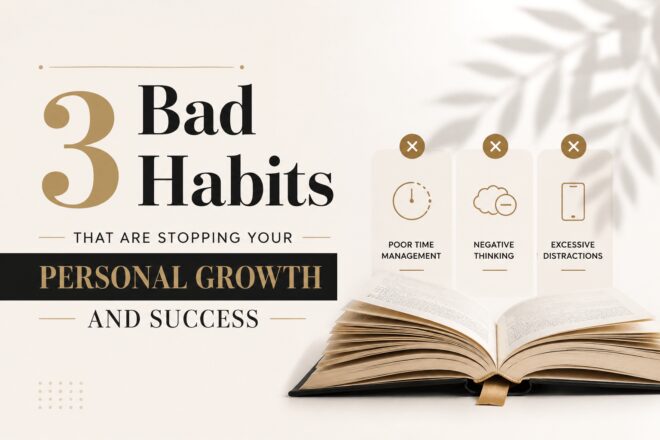
3 Bad Habits That Are Stopping Your Personal Growth and Success
Have you ever felt stuck like no matter how hard you try, success keeps slipping through your fingers? You set the goals, you make the plans, you tell yourself, “This time will be different,” and then, somehow, you end up exactly where you started. If this sounds familiar, you are not alone. Millions of people across the world struggle with the same invisible barriers to their growth. And the frustrating truth? Most of those barriers are not external. They live inside us in the form of bad habits.
At Readers Books Club, we spend a lot of time exploring ideas across books, podcasts, and YouTube conversations that dig deep into what makes people grow and what holds them back. And over and over again, the same patterns emerge. Whether we are reading the latest bestseller on productivity or talking to a guest on our podcast about their journey to success, the story is often the same: it was not a lack of talent or opportunity that slowed them down. It was their habits.
The good news? Habits can be changed. Unlike your IQ, your background, or the economy, habits are entirely within your control. But before you can change them, you need to see them clearly. In this blog, we are breaking down 3 bad habits that are silently stopping your personal growth and success and exactly what you can do to replace them with something better. Consider this your reading guide, your episode companion, and your honest mirror.
Habit #1: Living in Passive Consumption Mode
The Habit That Feels Like Growth But Is Not
Let us start with one of the sneakiest bad habits stopping success in the modern world: passive consumption. This is when you spend hours watching motivational videos, reading self-help books, listening to podcasts, scrolling through inspirational quotes on Instagram and then doing absolutely nothing with any of it.
Sound familiar? Here is the uncomfortable truth: consuming content about growth is not the same as growing. There is a critical difference between learning and doing. And for many people, the act of consuming becomes a way to feel productive without actually being productive. It is comfortable. It is safe. And it is one of the most common negative habits ruining success today.
Psychologists call this “pseudo-productivity” the sensation of being busy and engaged without any real output or change. You finish a book and think, “Wow, that was amazing.” You listen to an episode of a podcast and feel fired up. But by the next morning, the insight has faded, the motivation is gone, and you are back to your old patterns. The book is on your shelf. The podcast is in your history. Nothing has changed.
Why This Habit Holds You Back
The real danger of this toxic habit to quit is that it masquerades as personal development. It feeds your ego just enough to feel like you are making progress, while your actual life stays frozen. Meanwhile, weeks and months pass. You have consumed hundreds of hours of content, but your goals are still the same ones you wrote down years ago.
Books like “Atomic Habits” by James Clear and “Deep Work” by Cal Newport both address this phenomenon directly. Clear argues that the purpose of knowledge is to drive action and that identity-level change only happens when you act consistently, not when you consume consistently. Newport, on the other hand, warns about the seductive distraction of the shallow work loop constant input with no deep output.
How to Break It
Breaking this habit begins with one rule: for every hour you spend consuming, commit to at least thirty minutes of applying. Read a chapter? Write down three ways you will use what you learned before the week is out. Watch a YouTube video on a skill? Practice that skill for even fifteen minutes. Listen to a podcast on mindset? Journal one specific change you are committing to.
This is one of the most powerful personal growth habits you can build: the habit of implementation. It transforms your bookshelf from a trophy case into a genuine toolkit. At Readers Books Club, this is why we always encourage our community not just to read, but to discuss, reflect, and act. Our podcast episodes are designed to push you past the “that was interesting” stage into the “here is what I am doing differently” stage.
- Set an implementation rule: one action per piece of content consumed.
- Keep a “lessons into life” journal where you write how you will use each insight.
- Join discussions; our YouTube comments section and community are great for accountability.
- Choose fewer books, but go deeper. One book fully applied beats ten books half-remembered.
“Knowledge without application is just information. Wisdom is applied knowledge.” This is the philosophy that drives every episode we record and every book we recommend.
Habit #2: Avoiding Discomfort and Choosing the Path of Least Resistance
The Comfort Zone Trap
The second of the habits that stop personal growth is one of the oldest and most deeply wired in human psychology: the avoidance of discomfort. We are biologically programmed to seek safety and avoid pain. For our ancestors, this was survival. For us, in the modern world, it has become one of the most stubborn habits holding us back from everything we say we want.
Here is what this looks like in real life. You want to start a business, but you never make the call because rejection might sting. You want to get fit, but the workout feels hard, so you skip it “just this once”. You want to speak up in meetings, but you stay quiet to avoid the discomfort of being wrong. You want to write that book, launch that idea, and have that honest conversation, but every time you get close, you find a reason to pull back.
This is not laziness. This is comfort addiction a deeply ingrained negative habit that ruins success more reliably than any external obstacle ever could. The more we give in to comfort, the more our tolerance for discomfort shrinks, and the smaller our life becomes.
What the Research and the Books Tell Us
In “The Comfort Crisis” by Michael Easter, the author argues that the modern obsession with ease and comfort has created a generation of people who are physically, mentally, and emotionally soft not because they are weak, but because they are never challenged. We have designed difficulty out of our lives, and in doing so, we have also designed out growth.
Similarly, “Mindset” by Carol Dweck one of the most influential books on growth mindset habits ever written shows clearly that people with a fixed mindset avoid challenges because failure feels like a verdict on their identity. People with a growth mindset, however, seek challenges because they understand that struggle is the very mechanism through which growth happens.
The willingness to be uncomfortable is not just a personality trait; it is a self-improvement habit that can be deliberately cultivated. And it might be the single most important one.
The Real Cost of Playing It Safe
Every time you choose comfort over growth, you are making a trade. You trade a short-term feeling of safety for a long-term feeling of stagnation. You trade the discomfort of failure for the quiet, grinding discomfort of never trying. The problem is, the cost of playing it safe is invisible in the short term. It only becomes clear years later, when you look back and realise that the life you are living is the one you settled for rather than the one you built.
Habits that stop personal growth often do not feel like bad habits in the moment. Choosing the easier road feels sensible. Avoiding a difficult conversation feels diplomatic. Putting off the scary project feels strategic. But these small, daily decisions compound over time and they add up to a life shaped by fear rather than intention.
How to Build the Discomfort Muscle
The antidote to comfort addiction is not forcing yourself into overwhelming situations. That is not courage that is recklessness. The real growth mindset habit here is gradually and intentionally expanding your comfort zone, a little at a time.
- Do one uncomfortable thing every day, even if it is small. Cold shower. Hard conversation. New skill. The habit of tolerating discomfort compounds just like any other habit.
- Name the fear. Write it down. Often, discomfort becomes easier when you drag it into the light and examine it clearly.
- Reframe failure. Every time you try and fail, you have gathered data. Every time you do not try, you have gathered nothing.
- Use books as practice grounds. We often recommend at Readers Books Club that you read books that challenge your worldview, not just books that confirm it. Intellectual discomfort is the gateway to intellectual growth.
- Set stretch goals alongside your comfort goals. One should feel achievable. One should scare you a little.
On our podcast, we frequently revisit this theme: the people who grow the most are not the most talented; they are the ones most willing to be bad at something before they become good at it. That willingness is a habit. And like all habits, it starts small and builds over time.
Habit #3: Surrounding Yourself With the Wrong Energy
You Are the Average of Your Environment
You have likely heard the famous saying attributed to motivational speaker Jim Rohn: “You are the average of the five people you spend the most time with.” Whether the exact math checks out or not, the core insight is undeniable: your environment shapes you more than you realise. And one of the most overlooked habits holding you back from success may be the people, the conversations, and the digital environments you are immersed in every day.
This is not about cutting people out callously or becoming elitist about who deserves your time. It is about recognising that energy is contagious. Negativity spreads. Limiting beliefs are shared. Cynicism is infectious. And if the people around you, whether physically or digitally, are consistently pulling your ambitions down, doubting your dreams, or reinforcing your worst self-talk, they are part of your bad habits ecosystem.
How Your Social Environment Becomes a Toxic Habit
Most people do not think of their social circle as a habit but it is. The people you choose to spend time with, the communities you belong to, the social media accounts you follow, and the conversations you have at dinner – all of these are habitual choices that either feed your growth or slowly starve it.
In “The 48 Laws of Power” by Robert Greene and even in more compassionate reads like “Boundaries” by Dr. Henry Cloud and Dr. John Townsend, a common thread emerges: your time and energy are finite, and where you direct them determines your trajectory. People who drain your confidence, dismiss your goals, or create constant chaos are not just unpleasant; they are obstacles to your personal growth.
Social media compounds this problem significantly. If your feed is full of content designed to make you feel inadequate, envious, or distracted, you are voluntarily immersing yourself in a toxic habit every single day. Studies consistently show that passive social media consumption is linked to lower self-esteem, reduced motivation, and a distorted sense of what success looks like for other people.
The Power of Curating Your Inputs
Here is where the self-improvement habits framework gets really exciting because this is an area where intentional change creates almost immediate results. When people deliberately shift their environment, even slightly, they often report dramatic changes in their energy, focus, and optimism within just a few weeks.
This might look like joining a book club (like our own community at Readers Books Club) where conversations are centred on growth rather than gossip. It might look like unfollowing accounts that trigger comparison and following creators and communities that inspire action. It might look like having an honest conversation with someone close to you about the kind of support you need.
It might also look like reading more. Books are one of the most powerful environmental inputs available to us. They place our minds in the company of the world’s greatest thinkers, strategists, creators, and visionaries on demand, for the price of a paperback. Every book you read is, in a sense, an upgrade to your social circle. You are spending time in the mental world of someone who has spent decades building expertise in something that matters to you.
Practical Steps to Shift Your Environment
- Audit your five: Think about the five people you spend the most time with. Are they growth-orientated? Do they challenge and support you? What qualities do you want more of in your circle?
- Curate your digital environment ruthlessly. Unfollow, mute, and limit. Follow thinkers, authors, educators, and communities that expand your thinking.
- Seek out communities of growth. Our Readers Books Club community on YouTube, in our podcast comments, and across our social channels is full of people who are reading, growing, and pushing each other forward. That is the kind of energy that changes lives.
- Read biographies and memoirs. One of the best ways to upgrade your environment when you cannot change your physical surroundings is to spend time in the life stories of people who achieved what you want to achieve.
- Notice how you feel after every interaction. Do you feel energised or deflated? Inspired or small? Your body knows the difference between a nourishing environment and a draining one.
At Readers Books Club, we believe that a good book is one of the most powerful environmental upgrades you can make. And a community of readers? That is a multiplier. Every conversation in our YouTube comments, every discussion sparked by a podcast episode, is a small act of choosing a better environment – one that habits for change in your life are built inside.
Putting It All Together: Your Habit Audit
Let us bring this home. We have walked through three of the most common and most damaging bad habits stopping success:
- Passive consumption: consuming without applying.
- Comfort addiction, avoiding the discomfort that is required for growth.
- Toxic environments: surrounding yourself with energy that limits rather than expands you.
None of these habits are dramatic or obvious. They do not feel like self-destruction. They feel like comfort, caution, and convenience. And that is precisely what makes them so dangerous. The habits holding you back are often the ones you have never thought to question.
So here is your challenge: this week, pick just one. Choose the habit that feels most relevant to you right now, the one that you quietly recognise as your own, and make one small change in that area. Not a total life overhaul. Not a 30-day challenge. Just one small, honest shift.
Because here is what the best books on self-improvement habits tell us again and again: transformation is not a single dramatic moment. It is the accumulation of small, deliberate choices, made consistently over time. It is choosing action over consumption. It is choosing the hard path over the comfortable one. It is choosing to be around people who believe in the version of you that is still becoming.
That is what personal growth actually looks like. Not the highlight reel. The quiet, daily work of becoming.
Books We Recommend for Breaking These Habits
If you want to go deeper on any of these ideas, here are some of our favourite reads at Readers Books Club that speak directly to these habits:
- “Atomic Habits” by James Clear The definitive guide to building good habits and breaking bad ones. Practical, research-backed, and endlessly re-readable.
- “Mindset: The New Psychology of Success” by Carol Dweck The foundational text on growth mindset habits and why the belief that you can grow is the first step to actually growing.
- “Deep Work” by Cal Newport: A compelling case for the power of focused effort over distracted consumption and how to build that capacity in your life.
- “The Comfort Crisis” by Michael Easter: A fascinating exploration of why we have engineered challenge out of our lives and what we lose when we do.
- “The 5 Second Rule” by Mel Robbins: A deceptively simple tool for overcoming the hesitation and avoidance that feeds toxic habits.
- “The Power of Now” by Eckhart Tolle: For those who want to go deeper into the psychological roots of why we cling to comfort and self-limiting patterns.
We have covered several of these on our podcast and YouTube channel, so if reading feels like a lot right now, start there. Search for them on our channel and listen in while you commute, cook, or exercise. And when you are ready to go deeper, pick up the book.
Final Thoughts: The Most Important Habit of All
If there is one meta-habit that underlies all the others, the habit that makes every other self-improvement habit possible, it is this: the habit of honest self-reflection.
You cannot change what you cannot see. And most of us are far too skilled at not seeing ourselves clearly. We defend our habits. We rationalise our avoidance. We blame circumstances. But deep down, if you sit with yourself honestly, you already know which habits are holding you back. You have known for a while.
This blog is your invitation to stop knowing and start doing. To move from awareness to action. To take the insights from books and podcasts, including ours, and turn them into the daily choices that, strung together, become the life you actually want.
At Readers Books Club, our mission has always been simple: to connect great ideas to great people and to make the wisdom in books accessible, engaging, and genuinely useful. Whether you found us through YouTube, our podcast, or stumbled across this blog, we are glad you are here. And we hope this conversation has given you at least one thing to take forward.
Now go close a tab. Open a book. Take one small action. And come back and tell us how it goes.
Learn More from Dr Amiett Kumar: