Introduction: What If Your Biggest Limit Is Not Your Ability?
Most people assume that progress is blocked by a lack of effort. If the career is not growing, work harder. If the relationship is struggling, communicate more. If confidence is low, become more disciplined. If health habits keep collapsing, try another routine. Effort matters, of course. But Beyond Belief asks a more uncomfortable question: what if the hidden obstacle appears before effort even begins?
Imagine two people walking into the same room. One believes, “People like me are not taken seriously.” The other believes, “I can learn how to contribute here.” They may see the same faces and hear the same words, but they do not experience the same room. One notices every sign of rejection. The other notices openings, questions and people who might help. Their beliefs do not magically rewrite reality, yet those beliefs influence attention, interpretation and behaviour. Over time, different behaviour can produce different results.
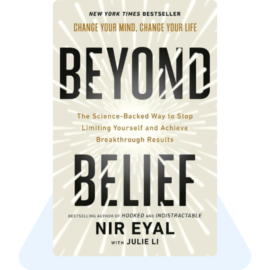
That is the doorway into Nir Eyal and Julie Li’s Beyond Belief. Eyal is already known for Hooked and Indistractable, books about habits, attention and behaviour design. In this 2026 book, he turns toward the assumptions underneath behaviour. The official description frames the problem simply: many limits are psychological rather than physical, and people often carry beliefs they have never deliberately chosen.
The book’s most important sentence can be paraphrased as follows: a belief is not automatically a fact; it can be a tool. That distinction changes the conversation. Instead of asking, “Is this belief absolutely true forever?” you can ask, “What does this belief make me notice? What does it make me expect? What does it make me do? Does it help me move toward the life I value?”
This Readers Books Club summary turns that framework into practical lessons. It also explains where the book overlaps with familiar personal-growth themes such as self concept, identity, the subconscious mind, meditation, spirituality and coaching. For readers who follow Amiett Kumar, the connection may feel immediate: manifestation conversations often emphasize inner beliefs. But this summary will keep the distinction clear. Beyond Belief is not a Law of Attraction manual. Its value lies in a more grounded proposition: beliefs influence perception, expectation and action, so changing an unhelpful belief can change the choices available to you.
What Beyond Belief Is Really About
The public table of contents reveals the architecture of the book. It begins with “Beliefs Are Tools, Not Truths,” then organizes the middle around three broad powers. The first is Attention: beliefs influence what you notice. The second is Anticipation: beliefs influence what you expect and therefore how experiences can feel. The third is Agency: beliefs influence whether you perceive yourself as capable of meaningful action.
This structure is useful because it avoids treating belief as a vague motivational concept. A belief has consequences. If you believe a colleague dislikes you, your attention may search for evidence of coldness. If you expect a meeting to go badly, your body may enter it tense and defensive. If you believe you have no control over your career, you may stop asking, applying, learning or negotiating. The belief becomes part of the system that produces your next behaviour.
The book also pushes against a common self-help mistake: replacing every negative belief with a grandiose positive one. Telling yourself “I am unstoppable” is not automatically useful if your mind rejects it and your behaviour does not change. Eyal’s framework is more pragmatic. A good belief should help you see more accurately, act more effectively and remain open to revision.
This makes Beyond Belief especially relevant in a time when social media constantly hands people identities. “I am an introvert.” “I am anxious.” “I am bad at math.” “I have no discipline.” “I am a procrastinator.” Labels can describe patterns, but when description hardens into destiny, it becomes a limit. A diagnosis, personality trait, past failure or social category may contain useful information; it should not automatically become a prison sentence about what you can never learn or become.
The following 12 lessons are a Readers Books Club distillation of the book’s published chapter themes. They are not the book’s official numbered lessons. Think of them as a practical map for applying the framework.
Lesson 1: Beliefs Are Tools, Not Truths
The first lesson is the foundation for everything else. Most people experience beliefs as facts. “I am not creative.” “People cannot be trusted.” “Success requires suffering.” “Money always creates problems.” “I cannot meditate.” “I have tried before, so I know how this ends.” Because the belief feels familiar, the mind stops examining it.
Beyond Belief invites you to create distance between yourself and the thought. Instead of saying “I am bad at public speaking,” try “I currently believe I am bad at public speaking.” That tiny change matters. The first sentence sounds like identity. The second sounds like information that can be investigated.
A belief is useful when it helps you navigate reality. You believe the floor will support you, so you walk across it without testing every step. You believe practice improves skill, so you are willing to repeat something before you become good at it. Problems arise when a belief is outdated, overly broad or self-defeating but continues to operate as if it were objective truth.
Consider someone who was laughed at during a school presentation. The event was real. The later belief “I am terrible in front of people” is an interpretation. For years, that interpretation may guide behaviour: avoiding presentations, declining leadership, speaking quietly, refusing video opportunities. The original event lasted minutes; the belief can shape decades.
A practical exercise is to write one sentence you regularly treat as a fact. Then add three questions: What evidence supports this? What evidence does not fit? What would I attempt if I held a more useful belief? The goal is not denial. If you genuinely lack a skill, the useful belief might be “I can train this,” not “I am already world-class.”
This distinction is also important for self concept. A healthy self concept is not a fantasy biography. It is a flexible working model of who you are becoming. When people ask how to change your self concept, the first step is not repeating hundreds of affirmations. It is recognizing that identity statements are beliefs, and beliefs can be updated through evidence, practice and experience.
Lesson 2: Attention Makes Belief Feel Like Reality
The first power of belief is attention. Human beings cannot consciously process everything around them. Attention selects. Once a belief is active, it helps decide what gets selected.
Suppose you believe your manager does not respect you. You may notice the email without a greeting, the meeting where your suggestion was not used, or the day they did not smile. You may overlook the detailed feedback they gave you, the project they trusted you to lead, or the fact that their communication style is equally brief with everyone. The belief does not invent every event, but it influences which events become psychologically loud.
This is why limiting beliefs can become self-confirming. You collect evidence that matches them. Contradictory evidence gets dismissed as luck, an exception or something that “doesn’t count.” Over time, the belief appears more certain because attention has built a biased archive around it.
The same mechanism can work in a constructive direction. If you adopt the belief “There are people I can learn from,” you start noticing mentors, books, podcasts, courses and conversations that previously looked irrelevant. If you believe “I can improve my relationship through small acts of curiosity,” you notice moments where a question might work better than an accusation.
Try a 24-hour attention audit. Choose one limiting belief and record every piece of evidence you notice for it. Then deliberately record evidence against it. Do not force balance; simply collect data. Many people discover that their belief was functioning less like a camera and more like a search engine with a preloaded query.
Meditation can support this lesson because meditation trains noticing. You learn to observe a thought as an event rather than immediately treating it as reality. That pause creates room to ask whether attention is showing you the whole picture.
Lesson 3: Your Expectations Shape Relationships
One of the book’s chapter themes concerns relationships. This is a powerful area because beliefs about other people can change the way we behave toward them before they have a chance to respond.
Imagine entering a conversation with the belief “They never listen.” Your voice may become sharper. You may interrupt because you expect interruption. You may explain defensively because you expect misunderstanding. The other person experiences your tension and becomes guarded. Their guarded response then confirms your original belief: “See? They never listen.”
This loop is common in marriages, friendships, teams and families. A belief about another person shapes attention, tone and interpretation. That does not mean every relationship problem exists only in your mind. Some people are unreliable, disrespectful or unsafe. The lesson is not to ignore evidence. The lesson is to notice when an expectation is helping create the interaction you fear.
A more useful belief might be specific and testable: “This conversation may go better if I ask one question before defending my position.” That belief changes behaviour immediately. It does not require pretending the relationship is perfect.
For readers interested in manifestation self concept, this section offers a grounded insight. The way you see yourself in relationships affects what you tolerate, request and communicate. If your self concept is “I must earn love,” you may overgive. If it is “My needs always cause conflict,” you may stay silent. If it becomes “I can be caring and still have boundaries,” your behaviour begins to shift.
A useful relationship exercise is to finish these sentences: “I believe this person always…,” “I believe this person never…,” and “Because I believe that, I usually….” Then ask what would happen if you approached the next interaction with curiosity instead of prediction.
Coaching can be valuable here because an outside perspective can reveal assumptions that feel invisible from inside the relationship. A responsible life coach can help with communication goals and behaviour patterns, while serious abuse, trauma or mental-health concerns require appropriately qualified professional support.
Lesson 4: Useful Beliefs Help You See Opportunities Others Miss
Another chapter asks how some people appear to notice opportunities others miss. The tempting explanation is luck. The deeper explanation is often attention plus expectation.
If you believe opportunities are only formal – a job advertisement, an invitation, a perfect business idea – you ignore informal openings. A conversation after an event, a problem a customer keeps mentioning, a skill your team lacks, or a small audience asking the same question may not look like an “opportunity” until a belief tells your attention that it could be one.
This does not mean believing in opportunity guarantees opportunity. Economic conditions, privilege, geography, health and timing matter. Beyond Belief is most useful when it expands agency without erasing reality. A constructive belief changes the probability of action because it changes what you look for and what you are willing to test.
For example, compare “Nobody will hire me because I changed careers” with “My unusual combination of skills may be valuable somewhere; I need to find where.” The second belief does not promise employment. It creates a search strategy. You may rewrite your story, contact different companies, build a portfolio or ask better questions.
Try an opportunity scan. Write down three problems you repeatedly notice in work, relationships or daily life. Then ask: What skill, service, conversation or experiment could this problem be inviting? The goal is not to turn every inconvenience into a business. It is to train attention to see openings alongside obstacles.
This is also where “manifest anything” language should be used responsibly. You cannot command every external result. But you can become more available to possibility by changing what you notice and what you attempt. A belief that increases useful action is already doing meaningful work.
Lesson 5: Anticipation Changes the Experience Before It Happens
The second power of belief is anticipation. Expectations can influence how an upcoming experience feels. Anyone who has dreaded a dental appointment, interview, difficult conversation or presentation understands this. The event begins psychologically long before it begins physically.
The brain constantly predicts. It uses past experience and current beliefs to prepare the body and interpret incoming information. When you expect disaster, ordinary uncertainty can feel like evidence that disaster has started. When you expect that discomfort is manageable, the same sensations may be interpreted differently.
This is not an invitation to ignore danger. Accurate anticipation protects us. The problem is when prediction becomes automatic catastrophe. “I will definitely embarrass myself.” “This pain means something terrible.” “If they say no, my career is finished.” Those predictions create emotional load before facts arrive.
A more useful belief is often not “Everything will be amazing.” It is “I can handle multiple possible outcomes.” That sentence protects agency. It reduces the need to control the future by pretending certainty.
This lesson connects with visualisation. Visualisation for manifestation is often taught as imagining the perfect outcome. A more psychologically robust practice is process visualisation: see yourself taking the next step, responding to difficulty, staying grounded and adapting. The aim is not to force reality to match a mental movie. It is to rehearse a more capable response.
Try a two-scene visualisation. First, imagine the desired outcome for thirty seconds. Then spend two minutes imagining the process: preparing, asking, practising, receiving feedback, adjusting, and trying again. Notice which version creates more useful energy.
For people who practise self concept meditation, anticipation can become a training ground. Instead of meditating on “nothing bad will happen”, practise the identity “I can meet uncertainty with steadiness.” That belief is useful whether the day goes exactly as planned or not.
Lesson 6: Beliefs Can Influence How We Experience Symptoms – But They Do Not Replace Medicine
One of the book’s most provocative chapter titles distinguishes sickness in the body from illness in the mind. This theme requires careful reading. Expectations can influence symptom perception, pain and the meaning we assign to bodily experiences. Placebo and nocebo research shows that expectation can have real effects on subjective experience and some physiological responses.
But this does not mean serious disease is imaginary, that patients caused their conditions by thinking badly, or that belief should replace diagnosis and treatment. That interpretation would be both inaccurate and harmful.
The practical lesson is about reducing unnecessary suffering layered on top of a real problem. A headache may be real; the thought “This proves my body is failing and my entire week is ruined” adds another layer. A diagnosis may require medical treatment; the belief “I am nothing but this diagnosis now” can shrink identity far beyond what the condition itself demands.
This is especially important in spirituality and Law of Attraction communities, where people can sometimes feel blamed for illness. A responsible Readers Books Club interpretation rejects that blame. Meditation, prayer, affirmations or belief practices may support coping for some people, but they should not be used to shame someone or replace qualified medical care.
A useful practice is to separate three columns: fact, interpretation, and helpful action. Fact: “My doctor diagnosed X.” Interpretation: “My future is over.” Helpful action: “I will follow medical advice, ask questions, protect sleep, seek support and avoid turning one diagnosis into my entire identity.”
Beliefs are powerful partly because they shape behaviour. A belief that treatment is worth following can support adherence. A belief that improvement is possible may encourage rehabilitation. The power is not mystical immunity; it is the way expectation and meaning interact with action.
Lesson 7: Beliefs About Aging, Strength and Capacity Affect What You Practise
Another chapter explores living longer, stronger and smarter. Again, the useful takeaway is not that belief defeats biology. Aging, genetics, disease and environment are real. The lesson is that beliefs about capacity can influence behaviour, and behaviour influences health over time.
If a person believes “At my age, exercise is dangerous,” they may avoid movement entirely. If they believe “I can build strength safely with appropriate guidance,” they may walk, train, sleep better and maintain social activity. The second belief creates behaviours that support function.
The same applies to learning. “My brain is too old to learn technology” becomes an excuse not to practise. “I may learn more slowly than a teenager, but I can still improve” produces a different relationship with effort.
This is a central pattern in Beyond Belief: good beliefs often create participation. They invite you into the behaviours through which change becomes possible. Bad beliefs create premature withdrawal.
For personal growth, ask where you have confused current capacity with permanent capacity. Maybe you cannot run five kilometres today. That is different from “I am not a runner.” Maybe you do not understand investing today. That is different from “I am terrible with money.” Maybe meditation feels restless today. That is different from “Meditation does not work for me.”
Lesson 8: Agency Grows When You Focus on What You Can Influence
The third power of belief is agency – the sense that your actions matter. This may be the most practical section of the book because helplessness changes behaviour quickly. When people conclude that nothing they do matters, they stop experimenting.
Agency does not mean total control. You cannot control markets, other people, weather, algorithms, illness, traffic, layoffs or every outcome. Agency means locating the part of the situation where choice remains.
Imagine being rejected for a role. Low-agency belief: “The industry is impossible; there is no point.” High-agency belief: “I cannot control this decision, but I can request feedback, improve the portfolio, contact three more companies and practise the interview.” The second belief does not guarantee success. It preserves movement.
This is also a useful correction to manifestation culture. If Law of Attraction becomes a reason to wait for signs instead of acting, it reduces agency. A healthier manifestation self concept is “I am someone who notices possibilities and takes aligned action.” In this framing, belief supports behaviour rather than replacing it.
A simple exercise is the three-circle method. Draw three circles: Control, Influence, and Accept. Put each part of the problem into one circle. Then spend most of your energy on the first two. Acceptance is not surrendering ambition; it is stopping the wasteful attempt to control what is not yours.
A life coach or performance coach can be useful when someone knows what they want but repeatedly loses agency through avoidance or confusion. Good coaching helps define choices, experiments and accountability. It should not promise supernatural control over outcomes.
Lesson 9: Ritual Can Bridge Belief and behaviour
The book includes a chapter about prayer and ritual. The fascinating idea is that ritual can matter even when people interpret its meaning differently. Ritual creates structure. It marks a transition from intention to action.
Athletes have pre-performance routines. Writers make coffee and open the same document. Families repeat traditions. Spiritual practitioners pray, chant or meditate. The ritual itself may not control the external event, but it can organize attention, emotion and behaviour.
This helps explain why some affirmations, meditations and visualisation practices feel powerful. The words are not necessarily magical commands. The practice can become a cue: “This is the moment I return to the identity and behaviour I have chosen.”
For example, a self concept meditation could be five minutes each morning. Sit, breathe, remember the identity you are building, choose one behaviour that would express it today, and then act. The meditation becomes a bridge to the day rather than an escape from it.
The danger is ritual without function. Repeating an affirmation 500 times while avoiding the phone call you need to make can become procrastination with spiritual language. The question is always: What behaviour does this ritual prepare me to do?
Readers Books Club readers can build a simple three-minute belief ritual:
1. Name one limiting belief that appeared yesterday.
2. Replace it with a believable, useful belief.
3. Choose one action that would provide evidence for the new belief.
4. Visualise doing that action calmly.
5. Do the action as early as practical.
This gives affirmation, meditation and identity work a behavioural anchor.
Lesson 10: Labels Can Become Limits
“Your Labels Are Your Limits” is one of the book’s most memorable chapter themes. Labels are useful shortcuts. They help us communicate. “Introvert,” “ADHD,” “creative,” “engineer,” “parent,” “anxious,” “bad with money,” “spiritual,” “not academic.” Problems arise when a label becomes a complete explanation of what we can or cannot do.
A label can turn a pattern into destiny. “I procrastinate sometimes” becomes “I am a procrastinator.” The second statement makes change feel like a betrayal of identity. “I experience anxiety” becomes “I am an anxious person,” which may cause someone to interpret every normal stress response as confirmation of a permanent self.
This does not mean diagnostic labels are useless. Diagnoses can provide treatment, language, accommodation and relief. The key is to use a label for information without allowing it to define the entire horizon of possibility.
This lesson maps directly onto identity shift manifestation. In manifestation communities, people often ask how to become the “desired self.” A grounded answer begins by loosening the old labels. Not by pretending the past never happened, but by refusing to use the past as the only definition of the future.
Try replacing noun identities with process language. Instead of “I am lazy,” say “I have built a pattern of avoiding tasks when they feel unclear.” Now the problem contains a mechanism that can be changed. Instead of “I am bad with money,” say “I have not yet built a consistent budgeting system.”
Affirmations for self concept work better when they are credible enough to guide behaviour. “I am becoming someone who handles money weekly” may be more effective than “I am a billionaire” if the latter creates immediate internal rejection.
Lesson 11: Good Beliefs Should Be Tested, Not Worshipped
The conclusion of Beyond Belief asks readers to distinguish good beliefs from bad ones. This is crucial because the book is not arguing that all empowering beliefs are automatically true or useful.
A belief can feel motivating and still be dangerous. “I never need help” may create confidence until it becomes isolation. “Everything happens for a reason” may comfort one person but silence another person’s grief. “If I want it enough, I can achieve anything” may encourage persistence while ignoring constraints or leading to self-blame when outcomes depend on factors outside control.
A useful belief should survive questions. Does it help me see reality more clearly? Does it increase agency? Does it encourage constructive behaviour? Does it remain open to evidence? Does it respect other people’s autonomy? Does it create resilience when the outcome is uncertain?
This provides a valuable filter for Law of Assumption and Law of Attraction ideas. If a belief encourages you to communicate, practise, save, learn, set boundaries and persist, it may be useful. If it encourages obsession, magical certainty, blaming yourself for every setback or trying to control another person’s choices, it is not serving you well.
Spirituality is healthiest when it increases humility rather than certainty. Meditation is healthiest when it makes you more present rather than more avoidant. Coaching is healthiest when it strengthens agency rather than dependency on the coach.
Use the Belief Test:
• Is this belief supported by at least some evidence or reasonable possibility?
• Does it help me take useful action?
• Does it reduce unnecessary helplessness without denying reality?
• Can I update it if new evidence appears?
• Does it respect health, safety and other people’s autonomy?
If a belief fails repeatedly, you do not need to defend it just because it once motivated you.
Lesson 12: Stop Waiting to Feel Certain – Build Evidence Through Action
The final practical lesson brings the whole book together. Beliefs influence attention, anticipation and agency, but beliefs also change through experience. If you want a new belief to become credible, create evidence.
Suppose the old belief is “I cannot speak confidently.” The replacement belief is “Confidence can be trained.” Evidence comes from recording a one-minute video, joining a speaking group, asking one question in a meeting, getting feedback, improving, and repeating. Every action adds data.
This is why identity change often fails when it stays only in the mind. People repeat “I am disciplined” but never design a disciplined day. They say “I am worthy” but keep accepting disrespect. They say “I am abundant” but avoid looking at their bank statement. The words and the behaviour contradict each other.
A stronger identity shift uses a loop:
Belief -> Action -> Evidence -> Stronger Belief -> Larger Action.
The first belief does not need to be perfect. It only needs to be strong enough to produce the next useful behaviour.
For anyone asking how to manifest faster, this is a better question: how can I reduce the delay between intention and aligned action? Sometimes the fastest “manifestation” is not another technique. It is the email you have postponed, the boundary you have avoided, the application you have not submitted, the daily meditation you keep restarting, or the skill you have not practised long enough.
The Three Powers of Belief: A Simple Readers Books Club Model
The entire book can be remembered through three words.
1. Attention – What do I notice?
Beliefs filter information. If you believe you are unwanted, you notice rejection. If you believe you can learn, you notice teachers. If you believe there are options, you notice openings.
Ask: What is my current belief training me to notice?
2. Anticipation – What do I expect?
Beliefs shape predictions. Predictions influence emotion and preparation. Catastrophic beliefs can make uncertainty feel unbearable; flexible beliefs can make discomfort manageable.
Ask: What am I expecting, and is that expectation helping me respond well?
3. Agency – What do I believe I can do?
Beliefs influence action. When agency collapses, experimentation stops. When agency grows, people search for choices even inside difficult circumstances.
Ask: What part of this situation can I influence next?
Use these three questions whenever you feel stuck. They turn “mindset” from an abstract concept into a practical diagnosis.
A 7-Day Beyond Belief Reset
Day 1: Name the Belief
Write one sentence you regularly treat as fact: “I always…,” “I never…,” “People like me…,” “At my age…,” “In relationships…,” or “Money is….” Do not fix it yet. See it clearly.
Day 2: Audit Attention
Notice what evidence you automatically collect for the belief. Then record evidence that does not fit. Your job is not to prove the opposite; it is to see the filter.
Day 3: Replace the Belief With a Useful Version
Choose something believable and actionable. “I am fearless” may be too large. “I can act while nervous” is stronger because it works on difficult days.
Day 4: Create Evidence
Take one small action that the old belief would avoid. Make the new belief earn credibility.
Day 5: Build a Ritual
Create a three- to five-minute meditation, affirmation or journaling ritual that reminds you of the new belief and ends with one action.
Day 6: Remove a Limiting Label
Find one identity label that has become too rigid. Rewrite it as a behaviour pattern you can influence.
Day 7: Review Agency
Ask what changed in what you noticed, expected and attempted. Keep the belief only if it makes you more accurate, capable and constructive.
Beyond Belief and Meditation: Observe the Belief Before Obeying It
Meditation is a natural companion to the book because belief often operates below deliberate awareness. A thought appears – “This will fail” – and behaviour changes before you consciously examine the statement.
A simple meditation practice can create space. Sit for five to ten minutes. When a thought appears, label it gently: “prediction,” “memory,” “identity,” or “belief.” Return to breathing. You are not trying to suppress thoughts. You are learning that a thought can be present without automatically becoming a command.
This practice connects with mindfulness research, but it should remain modest in its claims. Meditation may support attention, emotional regulation and stress management for some people. It is not a guarantee of success and not a replacement for mental-health or medical care when those are needed.
For Readers Books Club audiences interested in spirituality, the deeper question is: Which beliefs am I carrying unconsciously? Spiritual practice can be a way of examining attachment to identity. But spirituality should make you more honest, not less. If evidence contradicts a belief, growth may require updating it.
Beyond Belief and the Law of Attraction: A Grounded Connection
Readers searching for self concept law of assumption, manifestation self concept, Law of Attraction or identity shift manifestation will naturally see similarities. Both conversations ask how inner beliefs shape experience.
The difference is important. Beyond Belief focuses on psychological mechanisms – attention, expectation, perception and agency. It does not establish that thoughts create external events through a universal law.
A grounded bridge is this: your beliefs influence what you notice, how you interpret situations and what actions you take. Those actions can change outcomes. If an affirmation changes your behaviour, it can matter. If visualisation helps you rehearse a difficult conversation, it can matter. If self concept meditation helps you set boundaries or persist through discomfort, it can matter.
The useful version of Law of Assumption is not “Assume another person must behave exactly as I want.” It is “Assume I can become someone who communicates clearly, chooses wisely and acts consistently with my values.” That protects both agency and other people’s autonomy.
For people who want to manifest your dream life, define the dream in behaviours as well as outcomes. What does that version of you practise every week? What do they stop tolerating? What skill do they build? What do they do when motivation falls? This is where manifestation becomes implementation.
How to Change Your Self Concept Using the Beyond Belief Framework
A self concept is the collection of beliefs you hold about who you are. Some are descriptive. Some are inherited. Some were formed from childhood experiences, labels, failures or repeated feedback. They can feel permanent because the mind keeps collecting confirming evidence.
Use four steps:
Step 1: Identify the old identity statement. “I am terrible at relationships.”
Step 2: Find the behaviour hidden inside it. “I avoid difficult conversations and then feel disconnected.”
Step 3: Choose a useful new belief. “I can learn to communicate before resentment builds.”
Step 4: Create proof. Have one respectful conversation. Read one book about communication. Practise one boundary. Repeat.
This is identity shift manifestation without pretending identity changes instantly. You build the new self concept through repeated evidence.
Affirmations for self concept can support the process when they are specific. Try statements such as:
• I can learn behaviours I was never taught.
• I am allowed to update old beliefs.
• I can act before I feel completely confident.
• My past is information, not a prophecy.
• I can choose beliefs that increase responsibility and possibility.
• I notice opportunities I once ignored.
• I can be spiritual and still question my assumptions.
• I build self-trust by keeping small promises.
What Beyond Belief Gets Right About the Subconscious Mind
The word “subconscious” is used loosely in popular self-help. The book’s framework is more useful when you think in terms of automatic assumptions. Many beliefs operate without a daily conscious decision. You do not wake up and deliberately choose “I am not enough.” The pattern is simply there, influencing attention and action.
Changing automatic patterns usually requires repetition and evidence. One meditation may create insight, but a new behaviour practised repeatedly makes the new belief more believable. This is why environment and systems matter. If you want the belief “I am a reader,” keep a book visible and read daily. If you want “I handle money responsibly,” schedule a weekly money review. If you want “I can focus,” protect a distraction-free block.
The subconscious mind should not become a magical explanation for every problem. Sometimes the obstacle is practical: lack of skill, money, time, sleep, support, information or opportunity. Belief work is strongest when combined with problem-solving.
Common Limiting-Belief Mistakes
Mistake 1: Replacing Reality With Positive Thinking
Positive thinking is not the same as useful belief. “Everything is perfect” can become denial. A better belief is often “This is difficult, and I can choose my next response.”
Mistake 2: Choosing an Affirmation Your Mind Immediately Rejects
If “I am completely confident” feels absurd, use a bridge belief: “I am learning to speak even when I feel nervous.”
Mistake 3: Treating Labels as Destiny
Labels may explain patterns; they should not automatically define your maximum capacity.
Mistake 4: Ignoring Structural Reality
Beliefs matter, but so do economics, discrimination, disability, health, family responsibilities and opportunity. Agency is not the same as pretending everyone has identical circumstances.
Mistake 5: Waiting for Belief Before Acting
Sometimes action comes first. You may not believe you are fit until you have walked for two weeks. Evidence can create belief.
Mistake 6: Using Manifestation to Avoid Difficult Action
Visualisation without implementation can become entertainment. Connect every practice with a behaviour.
Mistake 7: Believing Every Setback Is Your Fault
You do not control every outcome. A useful belief preserves responsibility for your actions without creating responsibility for the entire universe.
Mistake 8: Refusing to Update a “Positive” Belief
If evidence repeatedly shows a strategy is not working, change the strategy. Flexibility is part of good belief.
Beyond Belief, Coaching and the Role of a Life Coach
Coaching is often a belief conversation disguised as a goal conversation. “I want to start a business” quickly becomes “I am not the kind of person who sells.” “I want a relationship” becomes “Nobody trustworthy will choose me.” “I want to speak publicly” becomes “People will judge me.”
A skilled coach helps make assumptions visible, define experiments and create accountability. A life coach should not decide what you must believe. The useful role is to ask questions: What evidence supports this? What does the belief cost? What would a more useful belief make possible? What action could test it this week?
For Readers Books Club readers who follow Amiett Kumar, coaching can become the bridge between inspiration and implementation. Books supply frameworks. Meditation supplies awareness. Coaching can supply structure and accountability. The combination is most useful when it increases independence rather than making someone dependent on a teacher.
Beyond Belief and Readers Books Club: Why This Book Fits the Platform
Readers Books Club is built around turning ideas from books into practical growth. Beyond Belief fits naturally beside books on habits, focus, psychology, mindset, mindfulness and self-mastery.
It also complements existing Readers Books Club content such as Designing the Mind, Atomic Habits, The Let Them Theory, self-sabotage themes and articles about mindset change. The internal-link opportunity is strong because belief sits underneath many other topics. Habits require beliefs about identity. Deep work requires beliefs about attention. Relationships require beliefs about self and others. Money books uncover beliefs about risk, worth and scarcity.
The important SEO principle is topical relevance. Keywords such as self improvement books, personal growth books, psychology books, limiting beliefs, mindset change and Nir Eyal book summary belong naturally throughout this article. Terms such as Law of Attraction, meditation, spirituality, Amiett Kumar, coaching and life coach fit best in application sections rather than being repeated in every paragraph.
Related Reading: Where the Manifestation Keywords Fit
Readers interested in self concept law of assumption, identity shift manifestation, manifestation self concept, how to change your self concept, subconscious mind, affirmations for self concept, self concept meditation, how to manifest faster and manifest anything may also benefit from Readers Books Club and Amiett Kumar content specifically focused on manifestation and identity work.
Use internal links from this article to relevant pages rather than forcing every manifestation phrase into the book summary. This protects SEO relevance while still serving readers who want to explore the spiritual or manifestation interpretation of belief change.
A helpful reading sequence could be:
1. Beyond Belief – learn how beliefs shape attention, anticipation and agency.
2. Designing the Mind – explore mental self-direction and self-mastery.
3. Atomic Habits – turn useful beliefs into repeatable systems.
4. Mindfulness or meditation books – learn to observe thoughts before reacting.
5. Amiett Kumar manifestation content – explore self concept, affirmations, visualisation and spirituality through a clearly labeled manifestation lens.
A 30-Day Belief Change System
A seven-day reset creates awareness. Thirty days creates enough repetition to begin gathering evidence.
Week 1: Observe
Track one limiting belief. Note triggers, attention patterns, emotions and behaviours. Do not try to fix ten beliefs at once.
Week 2: Replace
Create one useful bridge belief. Test it through small actions. Record evidence, especially evidence your old belief would have ignored.
Week 3: Build Agency
Increase the size of the action. If the new belief is “I can speak while nervous,” move from recording yourself to speaking in a meeting or small group.
Week 4: Integrate
Create a ritual and environment that keep the belief alive. Schedule practice. Remove obvious friction. Review whether the belief remains useful and evidence-sensitive.
At Day 30, ask three questions: What do I notice now that I did not notice before? What do I expect differently? What action am I taking now that I previously avoided? Those three answers reveal whether the belief change is real.
Contents