10 Powerful Lessons for Building Stronger Relationships
Introduction: Why Vibe Matters in a Lonely World
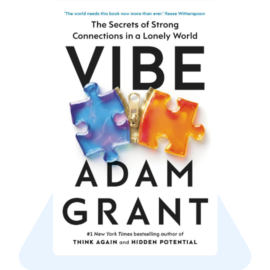
We spend more time connected than any generation before us, yet many people feel strangely disconnected. Our phones are full of contacts, our feeds are full of updates, and our calendars are full of meetings, but meaningful human connection can still feel rare. We can talk to dozens of people in a day and still go to bed feeling unseen. That tension sits at the heart of Vibe: The Secrets of Strong Connections in a Lonely World by Adam Grant.
In Vibe, organizational psychologist Adam Grant turns his attention to a question that affects almost every part of life: why do we click with some people, struggle with others, and sometimes become close to people we never expected to like? More importantly, can connection be improved deliberately, or is chemistry something mysterious that either appears or does not?
Grant’s answer is hopeful. Strong relationships are not simply gifts of luck. They are shaped by the way we communicate, the goals we share, the care we show, the conflict we survive, and the environments we create around one another. The book challenges the popular belief that good relationships require instant chemistry, constant contact, identical personalities, or endless harmony. Instead, it suggests that connection is a skill and a process.
That makes Vibe especially relevant now. Digital communication is convenient, artificial intelligence can draft our messages, and social platforms can keep us updated about people we rarely meet in person. But information about someone is not the same as intimacy with them. Knowing what a person posted today does not necessarily mean knowing what they are worried about, what they value, what they are becoming, or what kind of support they need.
This Vibe by Adam Grant Summary explores ten of the book’s most useful ideas in a simple, practical way. Rather than treating the book as a collection of networking tricks, we will look at the deeper message behind it: how to build stronger relationships without pretending, people-pleasing, forcing similarity, or avoiding every uncomfortable conversation.
If you have been searching for a Vibe book summary, Adam Grant Vibe summary, Vibe book key lessons, advice on how to build strong relationships, or a practical explanation of human connection and relationship psychology, this guide is designed to give you the core ideas and show you how to apply them in everyday life.
Vibe at a Glance
Vibe: The Secrets of Strong Connections in a Lonely World was published in October 2026 by Viking. Adam Grant is an organizational psychologist at the Wharton School and the bestselling author of books including Think Again, Hidden Potential, Give and Take, and Originals. His work usually takes a familiar belief about people or performance and asks whether the evidence actually supports it. Vibe applies that same approach to relationships.
The central subject is not romance alone and not friendship alone. Grant looks at connection across friendships, families, workplaces, teams, communities, and encounters with people who may initially seem very different from us. The book asks how bonds begin, how they become stronger, how they survive friction, and how groups can create a deeper sense of belonging.
One of the most useful features of the book is that it does not reduce every relationship to one standard. Some people help us accomplish a goal. Some make life more fun. Some become the people we trust with our fears and values. Some relationships remain light and useful, while others deepen over time. Grant gives readers a framework for understanding those differences without assuming that every casual connection is a failed friendship.
The result is a book that sits comfortably across psychology, communication, self-improvement, workplace culture, and relationship categories. It is practical enough to change how you handle conversations this week, but broad enough to make you rethink what “having good people in your life” actually means.
The Big Idea: Connection Is a Skill, Not Just a Spark
The big idea of Vibe is simple: meaningful connection is built more often than it is discovered.
Popular culture teaches us to wait for a spark. We are told that we will “just know” when we meet the right friend, partner, colleague, mentor, or collaborator. That idea is attractive because it makes relationships feel effortless. If the vibe is right, everything should flow. If the vibe is wrong, perhaps the person is simply not for us.
Grant pushes against that assumption. Chemistry can grow. Trust can be built between people who begin with little in common. A relationship can improve when people find a shared goal, reveal something real, spend time in the right context, or learn how to disagree without attacking each other. On the other hand, instant excitement does not guarantee lasting compatibility.
This changes the question we ask about people. Instead of asking only, “Do I like this person?” we can ask, “What kind of connection is possible here?” Instead of deciding that a colleague is difficult after one meeting, we can become curious about the setting in which that person behaves differently. Instead of assuming that a friendship is fading because we do not talk every day, we can examine whether the conversations we do have still contain depth, trust, and mutual care.
The book is therefore not about becoming universally charming. It is about becoming more intentional. You do not need to connect deeply with everyone. You do need to understand that the quality of your relationships is influenced by choices: what you ask, what you share, what you notice, what you tolerate, what you repair, and what you repeatedly practice.
Lesson 1: Do Not Let the First Vibe Become the Final Verdict
Many people treat chemistry like a verdict delivered in the first few minutes. A conversation feels smooth, so we assume we have found “our kind of person.” Another interaction feels awkward, so we mentally close the door. Vibe asks us to be more patient.
First meetings are unusually noisy sources of information. People may be nervous, distracted, tired, guarded, overly enthusiastic, or trying too hard to make a good impression. The context may be wrong. A formal meeting can make a playful person appear stiff. A loud event can make a thoughtful introvert seem distant. A stressful deadline can turn an otherwise generous colleague into someone who looks impatient.
Grant’s broader point is that compatibility is not merely discovered; it often develops through interaction. People learn one another’s timing. They discover shared references. They understand what the other person means when they are being brief, sarcastic, quiet, intense, or cautious. With repeated exposure, what initially felt awkward can become natural.
This idea is useful in friendships and work. Imagine joining a new team and immediately deciding that one colleague is “not your vibe.” If you avoid that person, your first impression becomes a self-fulfilling prophecy. You never gather better information because you never create another context. But if you work together on a meaningful task, have lunch, exchange ideas informally, or solve a problem under pressure, you may discover qualities that were invisible in the first meeting.
The same principle applies in personal life. A person does not need to impress you instantly to become important later. Some of the safest relationships are slow-growing relationships. They become valuable because two people repeatedly show up, respond reliably, and learn how to understand each other.
A practical way to use this lesson is to replace instant judgment with a second look. When a new person leaves you uncertain, do not force a friendship, but do not rush to label them either. Try one different context. If the first interaction was formal, try something informal. If it was a group setting, try a one-to-one conversation. If you only discussed work, ask about something they genuinely enjoy.
The goal is not to convince yourself to like everyone. The goal is to stop treating incomplete evidence as a final answer. Human beings are more situational than our first impressions allow.
Lesson 2: Similarity Is Helpful, but Shared Purpose Can Be Stronger
We often assume that the easiest way to connect is to find people who are similar to us. Same background, same interests, same age, same industry, same opinions. Similarity can certainly make conversation easier, but Vibe argues that sameness is not the only road to solidarity.
A powerful relationship can begin with a shared purpose rather than a shared personality. Two people may disagree about many things and still become excellent allies if they care deeply about solving the same problem. A team does not need to become a friendship circle in order to work well. What it needs is clarity about the mission, trust in each person’s contribution, and confidence that everyone is moving toward the same outcome.
This matters because modern life often encourages us to sort people too quickly. Online platforms make it easy to follow people who sound like us and unfollow people who irritate us. At work, departments become tribes. In families, differences in lifestyle or politics can become shortcuts for judging character. The more we filter for sameness, the less practice we get at building connection across difference.
Grant’s idea is not that every difference should be ignored. Values matter. Safety matters. Respect matters. There are beliefs and behaviors that genuinely make closeness difficult or inappropriate. But we should distinguish between a difference that threatens a relationship and a difference that simply makes it less familiar.
One of the healthiest questions in relationship psychology is: “What do we share that is more important than what separates us?” Sometimes the answer is a goal. Two parents may disagree on many preferences but share a commitment to their child’s well-being. Two colleagues may have opposite communication styles but care about delivering excellent work. Two friends may enjoy very different lifestyles but share loyalty, curiosity, and honesty.
When a relationship feels stuck, search for a point of alignment before trying to manufacture affection. Shared action often creates understanding faster than abstract debate. Work on something together. Help someone solve a real problem. Build a small tradition. Volunteer. Plan a project. Learn a skill. Connection grows when people have repeated evidence that they can rely on each other.
The lesson is liberating because it removes the pressure to find perfect matches. You do not need a clone. You need enough common ground to build something real.
Lesson 3: Different Relationships Serve Different Purposes
One of the most interesting ideas in Vibe is that relationships become easier to understand when we stop using the single word “friend” for every kind of meaningful bond. Grant describes different wavelengths of connection. At the lightest end are associates, people connected through compatible needs. Then there are allies, connected by shared goals; pals, connected through shared interests and enjoyment; and companions, connected by care and compatible values.
The value of this framework is not the labels themselves. The value is that it reduces unnecessary disappointment.
Many relationship problems begin with mismatched expectations. You think a colleague is becoming a close friend; the colleague sees the relationship mainly as a productive alliance. You expect an old school friend to support your career decisions, while the friendship has always been built mostly around humor and shared memories. You feel hurt when a fun social friend is not the person you can call during a crisis, even though that relationship was never built around emotional support.
When we expect every relationship to provide everything, people are almost guaranteed to disappoint us.
A more mature approach is to appreciate different people for different roles. An ally can be extremely valuable without becoming a companion. A pal can add joy to your life even if you would not ask them for major life advice. An associate can make your daily life easier through fairness and reliability. A companion may know you deeply even if you share few hobbies.
This also improves how you invest in relationships. If you want to deepen a connection, ask what dimension is missing. An ally can become more like a pal when you spend time together with no task to complete. A pal can become more companion-like when conversation moves from entertainment to values, fears, hopes, or care. An associate can become an ally when you discover a meaningful goal you both want to achieve.
The framework is especially useful for people who feel lonely even though they “know a lot of people.” The issue may not be the number of relationships. It may be that the current network is concentrated in one wavelength. You might have many professional allies but almost no companions. Or you may have loving companions but very few pals who bring play and novelty into life.
Instead of asking, “Do I have enough friends?” try asking, “Do I have the kinds of connection I need?” That question is more specific, more compassionate, and much easier to act on.
Lesson 4: Depth Matters More Than Constant Contact
When people want stronger relationships, the most common advice is to spend more time together. Time does matter, but Vibe makes an important distinction: frequency and depth are not the same thing.
You can speak to someone every day and remain emotionally distant. Many workplace conversations are frequent but shallow. Many family members exchange daily logistics without discussing anything that reveals their inner life. On the other hand, there are friends who speak less often but reconnect with remarkable depth because the relationship contains trust, attention, and a willingness to go beyond updates.
This lesson is particularly important in the era of constant messaging. A stream of reactions, memes, likes, and “what’s up?” messages can create the feeling of contact without the substance of connection. Digital communication is not bad, but it can trick us into measuring relationships by activity rather than quality.
Depth begins with attention. When someone tells you something important, do you stay with the subject or immediately compare it to your own experience? Do you ask the second question? Do you remember what mattered to them last time? Do you create space for an answer that is longer than a sentence?
Better conversation also requires moving beyond standard scripts. “What do you do?” often produces a job title. “What are you excited about these days?” produces a person. “How was your week?” may produce “fine.” “What took most of your energy this week?” is more likely to reveal something meaningful.
This does not mean turning every conversation into therapy. Depth can include laughter, creativity, shared curiosity, and focused play. The point is to have moments in which both people are genuinely present rather than simply exchanging information.
If you want to improve human connection without adding more hours to your calendar, improve the quality of the time already available. Put the phone away for twenty minutes. Ask one real question. Follow the answer instead of rushing to the next topic. Share something slightly more honest than your usual update. Notice whether the other person seems energized, relieved, thoughtful, or uncomfortable, and adjust.
A useful relationship is not measured only by how often two names appear in each other’s notifications. It is measured by whether the interaction leaves both people feeling more known.
Lesson 5: Small Signals of Attention Create Big Feelings of Care
One of the quiet relationship skills running through Vibe is the ability to show people that you notice them. Big gestures are memorable, but strong bonds are often maintained by very small signals of attention.
Think about how meaningful it feels when someone sends you an article because they remembered a conversation from weeks ago. Or when a colleague brings up a goal you mentioned casually and asks how it is progressing. Or when a friend remembers the name of the person you were worried about. These actions are small, but they communicate something larger: “You were still in my mind after the conversation ended.”
Grant discusses the idea of sending personalized little tokens of attention—links, ideas, recommendations, or other small items that fit the person. The important part is not the object. It is the specificity. A generic motivational quote sent to fifty people does not create the same feeling as a message that says, “This made me think of the question you asked last week.”
This is a useful antidote to performative networking. Many networking strategies focus on visibility: post often, introduce yourself, collect contacts, remain top of mind. Vibe points us toward a different kind of visibility: make other people feel seen.
That requires curiosity. You cannot personalize attention if you never learn what matters to the person. Listen for the projects they care about, the books they love, the problems they are trying to solve, the skills they want to build, the challenges their family is facing, or the ideas they keep returning to. Then respond occasionally when something genuinely relevant appears.
The practice should be light, not intrusive. Strong connection is not constant monitoring. It is thoughtful recognition.
For Readers Books Club readers, this principle has an obvious application. If someone tells you they are struggling with focus, sending them a relevant book summary a week later can be more meaningful than simply saying, “You should read more.” If a colleague wants to understand money better, sharing a useful finance episode that matches their exact concern signals real listening.
The easiest way to become better at relationships is not to become more impressive. Become more observant.
Lesson 6: Strong Relationships Need Healthy Friction
Many of us believe that strong relationships should feel peaceful. We use the absence of disagreement as proof that a team, friendship, or partnership is healthy. Vibe challenges this idea by showing that friction can be part of closeness.
The key is to separate conflict about a problem from conflict about a person.
Healthy friction says, “I think this idea will fail because…” Unhealthy friction says, “You always ruin things.” Healthy friction keeps the subject visible. Unhealthy friction turns the other person into the subject. One invites examination; the other triggers defense.
Grant uses examples of groups that became stronger by learning to handle disagreement more openly. The broader lesson is that a relationship that cannot survive honest differences becomes fragile. People begin editing themselves. Resentment grows outside the conversation. Politeness replaces trust.
This is relevant in creative work. The best idea rarely appears because everyone immediately agrees. A strong team needs people who can question assumptions without humiliating each other. It is relevant in families, where avoiding every difficult topic may preserve temporary calm but prevent real understanding. It is relevant in friendship, where one honest conversation can stop a small irritation from becoming a permanent distance.
A useful technique is to describe your interpretation as an interpretation rather than a fact. Instead of saying, “You ignored me,” say, “When I did not hear back, I interpreted it as a sign that this was not important to you.” The second sentence leaves room for correction. Perhaps the other person was overwhelmed, confused, or waiting for information. The facts may be the same, but the conversation becomes less accusatory.
Another useful habit is to identify the shared goal before discussing the disagreement. “We both want this project to succeed, and I think we are seeing the risk differently.” That sentence turns the other person from an opponent into a collaborator who has a different model of the problem.
Healthy conflict does not mean raising your voice, winning arguments, or saying every thought immediately. It means building enough trust that truth can enter the room.
If a relationship is important, do not judge it by whether you ever fight. Judge it by what happens when you do.
Lesson 7: Space Does Not Always Weaken a Bond
Closeness can become weaker when people assume that maintaining a relationship requires constant access. Vibe offers a more flexible picture. Some relationships can remain strong through periods of lower contact followed by intense, meaningful reconnection.
This pattern is useful for adult life because adulthood is rarely synchronized. One friend has a newborn. Another moves cities. Someone starts a company. Someone cares for an aging parent. Work becomes demanding. Time zones change. If closeness is measured only by weekly frequency, many valuable relationships will appear to be failing when they are simply moving through different seasons.
The healthier question is whether the relationship still has responsiveness and depth when people return to one another.
This does not excuse neglect. If only one person ever initiates, cares, remembers, or repairs, the relationship may genuinely be unbalanced. But there is a difference between low frequency and low commitment.
Grant’s discussion of creative groups that benefited from time apart points toward another advantage of space: separation gives people new experiences to bring back. Constant togetherness can make relationships repetitive. Time apart can create new stories, insights, skills, and perspectives. Reconnection becomes richer because each person has changed.
This can be applied intentionally. Instead of sending guilty messages such as “Sorry we haven’t spoken in forever,” try reconnecting with substance. “I was thinking about our conversation on changing careers. A lot has happened since then—can we catch up properly this weekend?” The goal is not to erase the gap but to make the next contact meaningful.
In teams, this also suggests that collaboration does not require nonstop meetings. People need periods of independent thinking followed by bursts of focused exchange. Too much communication can reduce the very originality the group needs.
Relationships breathe. Some inhale through togetherness and exhale through space. When we stop treating every gap as rejection, we can preserve more relationships through the natural rhythms of life.
Lesson 8: Belonging Is Often a Design Problem
Loneliness is often described as a personal problem: you should go out more, be more confident, make friends, join a club. Vibe widens the lens. Connection is not only created by individuals; it is also shaped by environments.
Think about two events. At the first, one hundred people enter a room, receive drinks, and are told to “network.” Most people move toward someone they already know or speak to the safest-looking stranger. At the second event, people are placed into small groups around a meaningful prompt, given a shared challenge, and rotated once. The same people may leave the second event with far more connection, not because their personalities changed but because the structure changed.
This is an important lesson for leaders, teachers, podcast hosts, community builders, event organizers, and anyone responsible for bringing people together. You cannot demand belonging. You can design conditions that make belonging easier.
Good structures reduce social risk. They give people a reason to speak, something specific to do, and a clear way to enter the conversation. They prevent the most confident people from dominating every interaction. They create smaller units where individuals can be recognized.
Grant also explores the value of giving people both belonging and distinctiveness. Humans want to be part of something, but they also want to feel that their individual identity matters. A well-designed group gives members a shared “we” without turning them into interchangeable pieces.
You can use this idea in very ordinary settings. In a team meeting, ask everyone to share one obstacle before discussing solutions. At a family gathering, use a question that invites stories rather than forcing small talk. In an online community, create smaller interest groups so people can repeatedly meet familiar names. In a classroom, rotate collaborative partners instead of allowing the same clusters to form every time.
Even a podcast can create connection beyond the host and guest. The questions chosen, the stories highlighted, and the community prompts after the episode can make viewers feel that they are participating in a shared exploration rather than simply consuming content.
When connection is weak, do not always blame the people. Sometimes the room needs redesigning.
Lesson 9: Understand the Person in Context, Not Just the Label
One of the most valuable ideas in Vibe is that we behave differently in different situations. A person who seems quiet at a party may become energetic in a small group. A confident manager may become hesitant around senior leadership. A warm friend may look cold during conflict. Personality is real, but context influences which part of a person appears.
This matters because relationship problems often come from turning situational behavior into a permanent identity. Someone misses a deadline and becomes “unreliable.” Someone gets defensive once and becomes “insecure.” Someone speaks little in a meeting and becomes “uninterested.”
Labels feel efficient, but they reduce curiosity.
A better approach is to look for patterns: when does this behavior appear? What happens immediately before it? In what settings does the person behave differently? What conditions bring out their best?
This does not mean excusing repeated harmful behavior. Patterns still matter. If someone lies repeatedly, violates boundaries, or treats people badly across contexts, that evidence should be taken seriously. The lesson is simply to avoid confusing one version of a person with the whole person.
The same principle helps us understand ourselves. You may call yourself an introvert because large social events exhaust you, while ignoring the fact that you become highly expressive with people you trust. You may think you are bad at relationships because you dislike surface-level networking, while being excellent at one-to-one conversation. A more precise self-description gives you more options.
In practical terms, when a connection is not working, change the conditions before changing the conclusion. If conversations fail over text, try a call. If a colleague becomes defensive in public meetings, give feedback privately. If a family member shuts down during heated discussions, choose a calmer time. If you struggle to meet people at large events, join an activity where the shared task creates natural conversation.
Relationship psychology becomes more useful when it moves from “What kind of person are they?” to “What kind of situation are we creating together?”
Sometimes the vibe changes because the people changed. Sometimes it changes because the context finally allowed different parts of them to appear.
Lesson 10: Use Technology to Support, Not Replace, Human Connection
The final theme of Vibe becomes especially important as artificial intelligence becomes part of everyday communication. Technology can support relationships. It can help people translate, brainstorm a thoughtful message, remember important dates, find communities, and stay in contact across distance. But there is a risk in outsourcing too much of the human work.
Real relationships contain uncertainty. People misunderstand us. They do not always reply the way we hope. They have needs that compete with ours. They disagree, change, disappoint, surprise, and require repair. Those difficulties are not bugs in connection; they are part of what makes connection meaningful.
If every uncomfortable message is delegated to a machine, we may become more polished while becoming less practiced. If every lonely moment is filled by an endlessly agreeable digital companion, we may lose patience for relationships in which another person has boundaries, moods, and independent desires.
The point is not to reject AI. The better principle is to use technology as scaffolding rather than substitution.
For example, you can use a tool to help organize your thoughts before a difficult conversation, but you should still have the conversation. You can use AI to suggest questions for a podcast guest, but the connection comes from listening closely enough to follow an unexpected answer. You can ask for help drafting an apology, but the apology matters only if you understand what you are taking responsibility for.
This distinction is highly relevant to creators and communities like Readers Books Club. Technology can help summarize information, generate ideas, translate content, and make knowledge more accessible. But the reason an audience stays is not information alone. It is trust, perspective, consistency, and the feeling that real people are thinking with them.
The future may contain more automated communication, not less. That makes human skills more valuable: attention, listening, empathy, courage, disagreement, forgiveness, humor, and care.
The strongest lesson of Vibe may be that connection cannot be reduced to efficiency. Some of the most valuable parts of a relationship are precisely the parts that take effort.
A Practical Vibe Audit: How to Strengthen Your Relationships
The easiest way to apply Vibe is to stop thinking about relationships as one large category and start examining your actual connection map.
Begin with the people you interact with most. Instead of rating them as good friends or bad friends, ask what kind of connection exists. Who are your allies—the people you can build something with? Who are your pals—the people who make life lighter and more enjoyable? Who are your companions—the people with whom you can be honest about values, fears, and important decisions? Who are useful associates with whom fairness and reliability matter more than intimacy?
Then look for imbalance. A person can be socially busy and still lonely if almost every relationship is transactional or goal-based. A founder may have dozens of allies and almost no companions. A remote worker may have loving family relationships but very few pals nearby. A student may have many casual pals but no trusted ally for an ambitious project.
Next, identify one relationship you would like to strengthen. Do not begin with a dramatic emotional conversation. Choose the smallest useful move. If the relationship is too transactional, discover a shared interest. If it is fun but shallow, ask one deeper question. If there is affection but little collaboration, work toward a shared goal. If there is unresolved tension, name the issue without attacking the person.
Finally, audit the environments you create. When you host meetings, family gatherings, community sessions, or content conversations, are people given a real way to connect? Or are they simply placed near one another and expected to figure it out?
Vibe becomes powerful when it moves from theory to tiny repeated actions. Stronger relationships rarely come from one grand gesture. They come from accumulated evidence: I notice you. I can rely on you. I can disagree with you. I remember what matters to you. I can give you space. I can tell you the truth. I will repair what I damage.
That evidence is what eventually becomes trust.
A 30-Day Plan to Build Stronger Connections
For the first week, focus on noticing. Pay attention to which interactions leave you energized and which leave you depleted. Notice the people with whom you can be playful, productive, honest, or vulnerable. Also notice which relationships are built almost entirely around logistics. Do not judge anything yet. The goal is simply to see your social world more clearly.
During the second week, practice depth. Choose three conversations and ask a better question than you normally would. Instead of “How are you?” ask, “What has been taking most of your attention lately?” Instead of “How is work?” ask, “What part of work feels most meaningful right now?” Listen long enough for the first easy answer to pass.
In the third week, practice thoughtful signals of attention. Send one article, book recommendation, podcast episode, note, or idea to someone because it genuinely fits something they care about. Keep it specific. Avoid mass-forwarding. The message should make sense only because you know that person.
In the fourth week, practice repair and structure. Have one conversation you have been postponing, using the shared goal as the starting point. Then improve one environment you control. If you lead a meeting, make it easier for quieter people to participate. If you host a gathering, create a prompt or activity that moves people beyond small talk. If you manage an online community, create a smaller recurring space where members can recognize one another.
At the end of thirty days, do not ask whether you have become more popular. Ask whether your interactions contain more attention, clarity, trust, and courage. That is a more meaningful measure of connection.
Related Reading on Readers Books Club
A natural Readers Books Club internal link for this article is The Art of Fighting summary. Both books challenge the idea that strong relationships are defined by the absence of tension: The Art of Fighting focuses directly on conflict, while Vibe places conflict inside the wider psychology of chemistry, closeness, belonging, and relationship maintenance.
For SEO, “The Art of Fighting summary” should work as an internal-link anchor rather than the primary keyword of this page. The page itself is about Vibe, so “Vibe by Adam Grant Summary” should remain the focus phrase in the title, URL, introduction, headings, and meta fields. This keeps the article aligned with the searcher’s actual intent and avoids keyword mismatch.
Final Thoughts: Better Relationships Are Built One Interaction at a Time
Vibe arrives at an interesting moment. We have more tools for communication than ever before, but communication is not the same as connection. We can send faster messages, attend more virtual meetings, collect more followers, and receive more notifications without necessarily building the kind of relationships that make life feel supported and meaningful.
Adam Grant’s central contribution is to make connection feel less mysterious. A vibe is not always instant. It is not always based on similarity. It is not preserved only through constant contact. And it is not protected by avoiding every disagreement.
Strong relationships grow when people discover the right kind of common ground, show specific attention, create deeper moments, survive useful friction, and design environments where individuals can belong without disappearing into the group.
Perhaps the most useful shift is this: stop asking only whether you naturally click with someone. Ask what you can build together.
Some people will remain associates, and that is fine. Some will become reliable allies. Some will be the pals who make ordinary life fun. A smaller number will become companions who know what you value and remain present when life becomes complicated. The goal is not to turn every person into a best friend. The goal is to become wiser about the relationships already around you and more skillful at growing the ones that matter.
If there is one action to take after reading this Vibe by Adam Grant Summary, choose one person and make the next interaction one level more intentional. Ask the better question. Send the thoughtful message. Name the shared goal. Have the honest conversation. Create the gathering. Repair the tension.
A stronger social life is not built in one dramatic moment. It is built one better interaction at a time.
Frequently Asked Questions About Vibe by Adam Grant
What is Vibe by Adam Grant about?
Vibe is about the science and psychology of human connection. Adam Grant explores how relationships begin, how people develop chemistry, how different kinds of bonds serve different purposes, how conflict can strengthen or weaken relationships, and how groups can create stronger belonging. The book covers friendships, teams, families, colleagues, communities, and the growing challenge of connection in a digitally saturated world.
What is the main lesson of Vibe?
The main lesson is that strong connection is not simply something you find. It is something you can build. Initial chemistry matters less than many people assume, and relationships can deepen through shared goals, thoughtful attention, meaningful conversation, healthy disagreement, and repeated evidence of care and reliability.
What are the key relationship types discussed in Vibe?
Grant describes connections in terms of associates, allies, pals, and companions. Associates are linked by compatible needs, allies by shared goals, pals by shared interests and enjoyment, and companions by deeper care and values. The framework helps readers understand why different relationships feel different and why one person does not need to fulfill every social need.
Does Vibe say that first impressions are wrong?
Not exactly. First impressions can contain useful information, but they are incomplete. People behave differently across contexts, and chemistry can grow over time. The book encourages readers not to turn one interaction into a permanent judgment before seeing the person in other situations.
How can I build stronger relationships according to Vibe?
Start by improving the quality of attention you give people. Ask better questions, remember what matters to them, identify shared goals, create time for deeper conversation, and handle disagreements without turning them into personal attacks. Strong relationships are built through many small signals of reliability and care rather than one dramatic gesture.
Is constant communication necessary for closeness?
No. One of the useful ideas in Vibe is that frequency is not the same as depth. Some relationships stay strong even when people do not speak every day, provided the connection remains responsive, trusting, and meaningful when they reconnect.
What does Vibe say about conflict?
The book treats healthy friction as an important part of strong relationships. Avoiding every disagreement can make a relationship fragile because people stop saying what they really think. The goal is not to fight more aggressively; it is to disagree about ideas and problems without attacking the identity or worth of the other person.
Is Vibe useful for workplace relationships?
Yes. Many of the ideas apply directly to teams: shared goals, trust, group structure, constructive disagreement, and understanding that colleagues do not need to become close friends in order to collaborate effectively. Leaders can also use the book’s ideas to design meetings and teams that make belonging easier.
Contents