Introduction: Why This Book Feels So Necessary Right Now
A message goes unanswered for an hour and your mind writes a whole story. Someone looks distracted in a meeting and you assume you did something wrong. A friend makes one careless comment and it stays with you for the rest of the day. You replay a conversation while brushing your teeth, carry yesterday’s tension into today’s work, and spend energy trying to understand people who may not even be thinking about the situation anymore. If this sounds familiar, Stop Letting Everything Affect You by Daniel Chidiac speaks directly to that exhausting pattern.
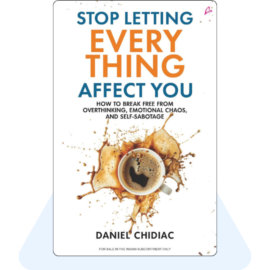
The full title is Stop Letting Everything Affect You: How to Break Free from Overthinking, Emotional Chaos, and Self-Sabotage. Daniel Chidiac’s official book page describes it as a 2025 self-development guide for people who overthink, absorb other people’s energy, struggle with emotional reactivity, get pulled into unhealthy relationship patterns, or feel that small events can ruin an entire day. The promise is not that you should stop caring. It is that you can care without allowing every opinion, delay, rejection, mood, message, mistake, and misunderstanding to control your inner state.
That difference is the heart of this Readers Books Club summary. Emotional strength is not becoming cold. Peace is not pretending nothing hurts. Detachment is not indifference. The book’s central direction is toward self-respect, clearer boundaries, healthier thinking, and a stronger sense of personal responsibility. Instead of asking, ‘How do I make everyone behave in a way that keeps me calm?’ it encourages a more powerful question: ‘How do I become less easily controlled by what I cannot control?’
For readers who follow books on mindset, psychology, relationships, spirituality, meditation, Law of Attraction, coaching, and personal growth, this topic is especially relevant. Readers Books Club has always focused on turning useful ideas from books into actions that ordinary people can apply. The aim here is the same. You will not only understand the major ideas associated with Daniel Chidiac’s book; you will also get practical reflection exercises, a seven-day emotional reset, a simple meditation practice, a grounded spirituality section, and ways a life coach or coach may help when insight alone is not enough.
One important editorial note: the twelve lessons below are an independent Readers Books Club synthesis of the themes publicly described by the author and major book listings. They are not presented as the book’s official chapter titles, and this summary does not reproduce the book. The goal is to preserve the book’s core message while making it easy to understand, remember, and use.
Book at a Glance: What Stop Letting Everything Affect You Is About
Daniel Chidiac’s book is built around a familiar modern problem: too much of our emotional life is outsourced. Our mood depends on the reply. Our confidence depends on praise. Our peace depends on whether a difficult person is behaving well. Our self-image changes after one criticism. We may intellectually know that other people have their own fears, habits, wounds, agendas, and bad days, yet emotionally we still interpret their behaviour as a verdict on us.
The official description highlights several practical goals: stop letting little things ruin the day, stop self-sabotaging, set healthy boundaries without guilt, recognise the difference between genuine guilt and manipulation, interrupt overthinking, stop taking everything so personally, identify toxic relationship patterns, move from victimhood toward self-empowerment, practise emotional detachment without becoming cold, and move forward without feeling required to explain every stage of growth.
These themes place the book naturally in self-improvement, emotional wellness, relationships, boundaries, mindset, and stress-management categories. It is also useful for people who consume books about self-esteem, overthinking, letting go, personal development, and emotional intelligence. Readers who enjoyed books such as The Let Them Theory, The Mountain Is You, The Courage to Be Disliked, or titles about boundaries and self-sabotage will recognise the territory, but Chidiac’s framing is direct: protect your peace by becoming more responsible for what you give power to.
| Featured Snippet AnswerStop Letting Everything Affect You by Daniel Chidiac is a 2025 self-development book about breaking cycles of overthinking, emotional reactivity and self-sabotage. Its core message is to stop taking everything personally, set healthier boundaries, recognise manipulation, detach without becoming cold, and shift from victimhood to self-empowerment so that other people and small events no longer control your peace. |
Lesson 1: Not Every Small Thing Deserves Your Whole Day
A five-minute event can take five minutes or five hours depending on what happens next in your mind. The event itself may be small: a rude cashier, a delayed email, a comment on social media, a colleague’s tone, traffic, a plan that changes, a friend who forgets to call. The emotional cost becomes large when the mind keeps carrying the event long after the event has ended.
This does not mean your feelings are irrational. A small event can touch an old wound, trigger insecurity, or remind you of a larger pattern. But there is a useful distinction between feeling something and feeding it. Feeling happens. Feeding is what we do when we rehearse the insult, imagine new arguments, tell the story repeatedly, search for hidden meaning, and keep checking whether we are still upset. One creates an emotion; the other can turn it into an atmosphere.
The practical lesson is to become more selective with emotional attention. Ask: will this matter next week? Is there an action I need to take? Is this a pattern or a one-time irritation? If it is a pattern, address it. If it is a passing annoyance, let it be small. You do not need to build a permanent home for a temporary problem.
A useful technique is the ‘size test.’ Give the event a score from one to ten based on its real consequences, then score the amount of mental space you are giving it. If the event is a three and your attention is a nine, the imbalance tells you something. You may still be upset, but you can choose not to organise the rest of the day around it.
For Readers Books Club readers, this lesson is bigger than mood management. Attention is one of your most valuable resources. The same hour spent replaying a stranger’s comment could have gone into reading ten pages, working on a project, walking, calling someone you love, meditating, or simply resting. Protecting peace is also protecting time.
| Readers Books Club TakeawayAsk yourself: Is this problem still happening, or is my mind keeping it alive? Feel what you feel, take any necessary action, and then stop giving a small event a larger role than it deserves. |
Lesson 2: Overthinking Is Not the Same as Solving
Overthinking often feels responsible. You tell yourself that if you analyse the conversation one more time, you will discover the answer. If you imagine every possible future, you will avoid being surprised. If you revisit every mistake, you will prevent another one. The mind presents repetition as preparation.
But problem-solving and overthinking have different outcomes. Problem-solving becomes more specific. It moves toward a decision, an experiment, a conversation, a boundary, or an action. Overthinking becomes more circular. It produces new versions of the same uncertainty without giving you more control. You end up mentally exhausted but practically unchanged.
One way to interrupt the loop is to ask three questions. First: What do I actually know? Second: What am I assuming? Third: What can I do next? Suppose a person has not replied. You know the message was sent. You may assume they are angry, losing interest, disrespecting you, or intentionally ignoring you. Your next action might simply be to wait, send one clear follow-up later, or continue with your day. The questions separate facts from stories.
Another useful rule is ‘think once, decide once, review later.’ If a problem needs thought, schedule ten or twenty minutes to think deliberately. Write your options. Choose the best available next step. Then set a time to review the result. This stops the mind from reopening the case every ten minutes as if constant anxiety were improving the decision.
Meditation supports this lesson because it trains the ability to notice a thought without automatically entering it. During meditation, a thought appears and you return to the breath or chosen focus. The thought is not defeated; it simply does not receive unlimited attention. That same skill can be practised outside meditation: ‘I notice the mind is replaying this again. I have already decided what I will do.’
Lesson 3: Create a Pause Between Trigger and Response
Many emotional regrets happen quickly. A message arrives and we reply while angry. A criticism lands and we become defensive. A family member uses the same old tone and we instantly return to the same old argument. The trigger may be new, but the response is often rehearsed.
Emotional control does not require that you never react internally. It means creating enough space so the first impulse is not always the final behaviour. The pause can be ten seconds, ten minutes, or overnight. The important thing is that your nervous system is not the only person making the decision.
Try the STOP practice: Stop. Take one slow breath. Observe what is happening in the body and mind. Proceed with intention. You may notice a tight chest, an urge to prove yourself, fear of rejection, embarrassment, or anger. Naming the experience can reduce the feeling that you must immediately act it out.
The pause is especially important in digital communication. Text strips away tone and adds speed. You can receive a message while tired, interpret it through your current mood, type something you would never say calmly, and send it before the other person even knows there is a problem. A simple rule no major emotional replies while highly activated can protect relationships and self-respect.
This is where emotional detachment begins. Detachment is not avoiding the issue. It is refusing to let urgency choose the quality of your response. Sometimes the strongest answer is calm. Sometimes it is a boundary. Sometimes it is silence. Sometimes it is a question. The pause gives you access to more than one option.
Lesson 4: Stop Taking Everything Personally
Personalisation is the habit of interpreting other people’s behaviour as primarily about you. Someone is quiet, so you assume you have upset them. A colleague is short, so you believe they dislike you. A post gets fewer likes, so you question your value. A friend cancels, and the mind translates scheduling into rejection.
The truth is that other people are carrying invisible worlds. They may be tired, distracted, grieving, worried about money, dealing with family, uncomfortable in their own skin, or simply behaving according to habits that existed long before they met you. Their behaviour can affect you without being a definition of you.
Not taking things personally does not mean tolerating disrespect. If someone repeatedly breaks agreements, insults you, manipulates you, or ignores reasonable boundaries, you should pay attention to the pattern. The goal is not to invent excuses for harmful behaviour. The goal is to respond to the behaviour itself rather than adding a second wound: ‘This proves I am unworthy.’
A strong question is: What else could this mean? You do not need to choose the most comforting interpretation. You simply remind the mind that its first explanation is not automatically fact. This creates psychological flexibility and makes you less dependent on reading minds.
For people interested in Law of Attraction and manifestation, this lesson also protects intention. If your mood changes every time another person changes, your focus is being controlled externally. A grounded manifestation practice asks you to return to the qualities you want to embody self-respect, clarity, courage, love, abundance, patience without demanding that everyone around you first create the perfect conditions.
Lesson 5: Healthy Boundaries Protect Peace Without Needing Guilt
A boundary is a statement about what you will participate in, what you will accept, and what you will do when a limit is crossed. It is not a punishment, a threat, or a strategy to control another person. That distinction matters because many people avoid boundaries until resentment becomes unbearable, then communicate them as anger.
Healthy boundaries can sound ordinary: ‘I cannot take calls during work hours.’ ‘I am not comfortable discussing that.’ ‘If the conversation becomes insulting, I will leave and we can talk later.’ ‘I cannot lend money right now.’ ‘I need more notice before committing.’ These statements do not require a courtroom argument. They communicate your limit and, when necessary, your action.
Guilt often appears because a boundary changes a familiar system. Perhaps you have always been available. Perhaps you learned that being a good person means keeping everyone happy. Perhaps one family member reacts strongly whenever you say no. The presence of guilt does not automatically mean the boundary is wrong. Sometimes guilt is simply the emotional cost of behaving differently from your old pattern.
It also helps to remember that boundaries reveal information. A healthy person may feel disappointed by your no, but can still respect it. A manipulative person may treat your boundary as betrayal, selfishness, or proof that you do not love them. Their reaction does not by itself determine whether the boundary is fair.
Life coaching and relationship coaching can be useful when someone understands boundaries intellectually but repeatedly abandons them under pressure. A coach can help turn vague intentions into scripts, rules, and accountability. But serious abuse, coercive control, or safety concerns may require qualified professional or specialist support beyond coaching.
| Boundary ReminderYou are allowed to disappoint someone without disrespecting them. A healthy boundary is not about making another person agree; it is about being clear about your participation and following through consistently. |
Lesson 6: Learn the Difference Between Real Guilt and Manipulation
Guilt can be useful when it points to a genuine violation of your values. You lied, broke an agreement, acted carelessly, or hurt someone, and your discomfort motivates repair. In that case, the healthy response is responsibility: acknowledge the behaviour, apologise when appropriate, make amends, and change the pattern.
But guilt can also be activated by someone who wants access, compliance, attention, money, secrecy, or emotional labour. The message may be direct ‘If you really cared, you would do this’ or subtle. You may be reminded of everything they have done for you, accused of becoming selfish, or made responsible for their mood whenever you make an independent choice.
A useful test is to separate wrongdoing from disappointment. Did you violate a reasonable commitment, or did someone simply dislike your decision? Those are not the same. Another person’s disappointment may be real and still not create an obligation for you to abandon your needs.
Manipulation becomes easier to recognise when you slow down. You do not have to answer every request immediately. Say, ‘Let me think about it.’ Then ask: Would I still choose this if guilt were removed from the decision? What am I afraid will happen if I say no? Is the request reciprocal and reasonable? Does this person respect my no in other situations?
This lesson is deeply connected to self-trust. If every strong reaction from another person causes you to doubt your own judgment, you become easy to control. Self-trust does not mean you are always right. It means you can examine feedback without automatically surrendering your decision-making authority.
Lesson 7: Self-Sabotage Often Looks Like Protection
Self-sabotage is rarely experienced as a conscious decision to destroy your own life. It often feels like protection. You procrastinate because beginning could expose your ability. You avoid the conversation because honesty could create conflict. You choose an unavailable partner because true intimacy feels risky. You abandon a goal as soon as progress becomes visible because success would require a new identity, more responsibility, or greater visibility.
This is why self-criticism alone usually fails. Calling yourself lazy, weak, or undisciplined may create shame without identifying the function of the behaviour. A better question is: What is this pattern helping me avoid? The answer might be rejection, uncertainty, failure, judgment, commitment, disappointment, loneliness, or the possibility of outgrowing a familiar environment.
Once you identify the protection, you can find a healthier strategy. If procrastination protects you from perfectionism, reduce the task and allow an imperfect first version. If people-pleasing protects you from conflict, practise one low-stakes no. If avoiding applications protects you from rejection, set a target based on applications sent rather than offers received.
The Readers Books Club approach to self-improvement is implementation. Books become useful when they change behaviour. So choose one sabotage loop and make it visible: Trigger -> Feeling -> Automatic Action -> Short-Term Reward -> Long-Term Cost. Then redesign one part of the chain. You do not have to transform your whole personality at once. You need one interruption repeated often enough to become believable.
This also connects with coaching. A life coach can help identify where stated goals and repeated behaviour do not match. The value is not being told what to do; it is having a structured space to notice patterns, clarify choices, and create accountability for the action you already know matters.
Lesson 8: Toxic Patterns Matter More Than Isolated Promises
Relationships can become confusing when words and patterns disagree. A person apologises beautifully but repeats the behaviour. They promise change after every crisis. They are affectionate after disrespect, attentive after withdrawal, or generous after crossing a boundary. The good moments make you question whether the difficult pattern is really serious.
Chidiac’s official book description explicitly includes identifying toxic patterns and walking away without regret. The key word is pattern. A pattern is repeated behaviour over time, especially after the issue has been clearly communicated. One mistake may require grace. A repeated cycle requires information.
Look at consistency rather than intensity. Does the person take responsibility without turning the conversation against you? Do they respect boundaries when there is no immediate risk of losing you? Do apologies produce changed behaviour? Can disagreement happen without punishment, threats, humiliation, prolonged silent treatment, or manipulation? Do you feel increasingly free to be yourself or increasingly careful about preventing their reactions?
Leaving an unhealthy dynamic can still be painful. Emotional clarity does not erase attachment. You may miss the person, question yourself, remember the good moments, or hope that one more conversation would finally produce closure. Detachment here means accepting that longing is not always evidence that returning is wise.
For serious abuse, stalking, coercion, threats, or danger, the priority is safety rather than self-help analysis. A book summary, meditation practice, or coaching session is not a substitute for appropriate professional, legal, medical, or emergency support.
Lesson 9: Emotional Detachment Is Not Becoming Cold
The word detachment can sound harsh. People imagine becoming indifferent, emotionally unavailable, or disconnected from love. But healthy detachment is closer to letting people have their thoughts, moods, and choices without making those things the manager of your nervous system.
You can love someone and still let them experience the consequences of their decisions. You can care about a colleague and still refuse to carry their workload. You can listen to a family member without accepting responsibility for fixing every emotion. You can receive criticism without either collapsing or attacking. Detachment preserves compassion by removing the belief that compassion requires self-abandonment.
A simple sentence is: ‘This belongs to them; this part belongs to me.’ Their anger belongs to them. Your tone belongs to you. Their opinion belongs to them. Your decision about whether the feedback is useful belongs to you. Their choice belongs to them. Your boundary and next action belong to you.
Meditation is especially compatible with this lesson. In meditation, sounds appear, thoughts appear, sensations appear, and emotions appear. You practise noticing without grabbing every experience. Spiritual traditions often describe some form of witnessing awareness: the ability to observe what passes through consciousness without assuming every passing event is the whole self.
Used carefully, that perspective can help with everyday reactivity. ‘Anger is present’ can create more room than ‘I am anger.’ ‘There is a fear that I will be rejected’ is different from ‘I know rejection is coming.’ Detachment does not remove emotion; it changes your relationship with emotion.
Lesson 10: Move From Victimhood to Self-Empowerment
There are times when people genuinely harm us, systems are unfair, circumstances are painful, and outcomes are outside our control. Self-empowerment should never be used to erase that reality or blame someone for what happened to them. The useful shift is about what happens next: where does your available power live now?
Victimhood as a mindset begins when the story of what happened becomes the complete definition of what is possible. Every decision is organised around the wound. Responsibility for the future is handed to the person who caused the past. Self-empowerment says: I may not have chosen what happened, but I want to participate in what I build from here.
This can begin with very small choices. Who do I talk to? What boundary do I set? What skill do I learn? What appointment do I make? What expense do I review? What environment do I leave? What routine supports me? What truth do I stop hiding from myself? Empowerment becomes real through behaviour, not slogans.
This lesson also creates a grounded bridge to the Law of Attraction. Manifestation is most constructive when it increases agency rather than magical helplessness. If a spiritual practice leaves you waiting passively for signs while avoiding necessary action, it is not increasing your power. If it helps you clarify what you want, regulate emotion, notice opportunities, and act with intention, it is serving a useful role.
Readers Books Club audiences who follow Amiett Kumar‘s work around meditation, spirituality, coaching, and manifestation can use this distinction: inner work and outer action are partners. Your beliefs influence behaviour, but behaviour also gives beliefs evidence. Self-empowerment grows when both move in the same direction.
Lesson 11: Stop Explaining Every Stage of Your Growth
Growth changes relationships because patterns are relational. If you were always available and become selective, someone may call you distant. If you used to tolerate jokes at your expense and now object, someone may say you have changed. If you stop rescuing people, the people who benefited from rescuing may not celebrate your progress.
The temptation is to over-explain. You write long messages defending a simple boundary. You search for the perfect wording that will make everyone approve. You reveal private reasons so the other person cannot accuse you of being unfair. But explanation has limits. A person who is committed to misunderstanding you can turn every new detail into another argument.
This does not mean communication is unimportant. In healthy relationships, context, empathy, and conversation matter. The lesson is to notice when communication becomes a trial in which you are trying to prove your right to grow. You can explain once, answer reasonable questions, and still allow someone to dislike your choice.
A mature sentence is: ‘I understand that this is different from what you are used to, but this is what I need now.’ Another is: ‘I have explained my decision, and I do not want to keep debating it.’ Calm repetition often protects a boundary better than increasingly elaborate justification.
There is a spiritual dimension here too. Much of spirituality is about moving from external approval toward a more stable inner reference point. That does not mean ignoring wisdom or feedback. It means your life cannot be a continuous referendum in which every person gets a vote on whether you are allowed to become more honest.
Lesson 12: Protect Your Peace by Choosing What Gets Access to You
The final lesson gathers the others into one idea: access is powerful. What gets access to your attention, time, body, home, phone, calendar, money, private thoughts, and emotional energy will shape your life. Protecting peace therefore requires more than positive thinking. It requires selection.
Digital access matters. If the first thirty minutes of every morning are filled with other people’s opinions, news, arguments, comparison, and messages, your nervous system begins the day in reaction mode. Relationship access matters. If someone repeatedly humiliates you and still receives unlimited access to your time, the boundary is only theoretical. Mental access matters. If an old criticism is replayed every night, a person from the past may still occupy valuable space without being physically present.
Create an access audit. List five things that currently receive too much access and five things that deserve more. Too much might include one social account, a draining group chat, a habit of checking an ex-partner’s page, constant work notifications, or a relative who calls only to criticise. More might include books, sleep, exercise, a supportive friend, creative work, meditation, nature, or uninterrupted family time.
Peace is not something you find once and permanently keep. It is maintained by small decisions. What do I answer? What do I ignore? What do I schedule? What do I stop following? Who gets another conversation? Which promise do I keep to myself today? When these decisions become consistent, peace stops being dependent on ideal circumstances.
The most empowering reading of Stop Letting Everything Affect You is therefore not ‘nothing should affect me.’ Human beings are affected by life. The better message is: not everything deserves the same depth of access, the same duration of attention, or the same authority over my next choice.
| The Core IdeaEmotional freedom is not feeling nothing. It is being able to feel something without automatically giving it control over your identity, your entire day, or your next decision. |
A Practical 7-Day “Protect Your Peace” Reset
Reading about emotional strength can create a temporary feeling of clarity. The real test is what happens during the next difficult message, awkward silence, criticism, request, or delay. Use this seven-day reset to turn the ideas into observable behaviour. Keep the challenge simple; you are not trying to create a perfect personality in one week.
1. Day 1 – Notice the trigger. Keep a short note on your phone or paper. Each time your mood shifts strongly, write what happened, what you immediately thought it meant, and what you wanted to do. Do not fix anything yet; collect data.
2. Day 2 – Separate facts from stories. Choose one trigger and make two columns: What I know / What I am assuming. This is especially useful for unanswered messages, social situations, and work feedback.
3. Day 3 – Practise one pause. Do not send an emotional reply immediately. Take ten slow breaths, walk, or wait twenty minutes. Then decide whether the response needs to be different from your first impulse.
4. Day 4 – Set one small boundary. Say no to one request you genuinely cannot or do not want to accept, or state one reasonable limit clearly. Avoid a long apology for having a limit.
5. Day 5 – Reduce one source of emotional noise. Mute a draining account, leave a pointless group chat, switch off non-essential notifications, or stop checking something that repeatedly disturbs your peace without giving useful information.
6. Day 6 – Choose one self-empowering action. Complete a task you have been avoiding because of fear, uncertainty, or perfectionism. Keep it small enough to finish today.
7. Day 7 – Review your access. Ask which people, apps, habits, and thoughts received too much attention this week. Choose two permanent rules for the next thirty days.
The purpose of the reset is not to prove you can remain calm all week. The purpose is to discover where you have more choice than you thought. Even one pause, one boundary, or one decision not to reopen an old argument can be evidence that emotional habits are trainable.
Meditation and Stop Letting Everything Affect You
Meditation fits naturally beside the book’s message because emotional reactivity often begins before conscious thought catches up. The body tightens, the mind predicts, and attention narrows. A brief meditation gives you practice noticing those changes earlier.
Try a five-minute ‘protect your peace’ meditation. Sit comfortably and breathe naturally. For the first minute, notice physical contact with the chair or floor. For the next two minutes, place attention on breathing. When thoughts appear, label them gently: planning, remembering, worrying, judging. Do not argue with them. For the final two minutes, repeat a simple intention such as, ‘I can choose my response,’ or, ‘Not every thought needs my participation.’
The value is not that meditation makes you impossible to upset. It gives you repetitions of the same basic skill required in real life: notice, pause, return. During a conflict, the focus is not the breath; it may be your values, your boundary, or the facts. But the mental movement is similar. You notice the impulse and return to what you want to stand for.
Readers Books Club readers interested in meditation can also use the practice before difficult conversations. Five quiet minutes may help you enter with a slower pace and clearer intention. It is easier to protect peace when you are not trying to invent peace in the middle of maximum activation.
Spirituality, Detachment and Inner Peace
Spirituality appears in many forms, but a recurring theme across traditions is the difference between the observing self and the changing contents of experience. Thoughts change. Emotions change. Praise and criticism change. Success and disappointment change. If identity is attached to every movement, inner life becomes unstable.
Healthy spiritual detachment does not ask you to reject the world. It asks whether you can participate without being completely possessed by every outcome. You can care deeply about your work without allowing one bad result to define your worth. You can love someone without trying to control their inner world. You can have ambition without making achievement the price of self-respect.
This is also where the phrase ‘protect your energy’ can be made more practical. You do not need to imagine that every difficult person is literally transferring a mysterious substance into you. Protecting energy can mean limiting exposure, changing the topic, leaving a hostile environment, reducing comparison, sleeping properly, meditating, and refusing conversations that repeatedly become disrespectful.
For spiritual readers, the most useful question may be: What am I giving sacred attention to? Attention is limited. If most of it is consumed by resentment, comparison, gossip, fear of opinions, and imaginary arguments, there is less available for prayer, meditation, creativity, service, family, learning, or meaningful work. Protecting peace becomes an act of devotion to what matters.
Stop Letting Everything Affect You and the Law of Attraction
Stop Letting Everything Affect You is not primarily a Law of Attraction book, so it is important not to rewrite Daniel Chidiac’s message into something it is not. However, Readers Books Club audiences who follow Law of Attraction content can make a grounded connection through attention, emotional regulation, and self-empowerment.
Manifestation practices often ask: What are you focusing on repeatedly? What do you believe is possible? What identity are you rehearsing? The book asks a complementary question: Who and what are you allowing to control those inner states? If your confidence collapses after one comment, or your intention disappears every time someone doubts you, your emotional direction is externally managed.
A practical Law of Attraction approach is not to deny reality but to choose a response that supports the life you want to create. If you want healthier relationships, practise boundaries and reciprocal communication. If you want a calmer life, reduce unnecessary emotional noise. If you want a new career, stop allowing fear of opinions to prevent applications, learning, or visibility. Visualisation and affirmation can support those intentions, but real-world behaviour gives the intention structure.
A grounded affirmation inspired by the book might be: ‘I protect my peace and respond from self-respect.’ Another could be: ‘Other people’s opinions can inform me, but they do not define me.’ These statements are more useful when followed by evidence a calm reply, a completed task, a boundary, or a choice to stop checking for validation.
This is also consistent with a broader message often found in Amiett Kumar’s manifestation and coaching ecosystem: inner practice is most powerful when it improves outer choices. Readers Books Club brings books, spirituality, meditation, manifestation, and self-improvement together around implementation rather than passive consumption.
How Coaching or a Life Coach Can Help You Apply These Lessons
Some people read a book about boundaries and immediately know what to change. Others understand every concept but freeze when the real situation appears. Insight and behaviour are different skills. Coaching can help bridge that gap when the issue fits within coaching rather than clinical care.
A life coach may help you define the situations that repeatedly disturb your peace, identify the beliefs that keep the pattern alive, rehearse difficult conversations, create boundaries, and set accountability around specific actions. A relationship coach may focus more on communication, standards, reciprocity, and patterns of choosing or staying in relationships. A manifestation coach may combine goals, beliefs, visualisation, meditation, and aligned action.
Good coaching should increase your ability to think and choose, not create dependence on the coach. It should also respect scope. Persistent anxiety, depression, trauma symptoms, compulsive behaviour, abuse, or serious mental-health concerns may be better addressed by appropriately qualified health or mental-health professionals. Coaching and therapy can sometimes complement each other, but they are not interchangeable.
For Readers Books Club readers who know Amiett Kumar through books, YouTube, podcasts, meditation, spirituality, Law of Attraction, and coaching content, the useful principle is simple: a lesson becomes transformation only when it enters your calendar, conversations, habits, and decisions.
Common Mistakes When Trying to “Stop Letting Everything Affect You”
The title is memorable, but it can be misunderstood if taken too literally. Emotional strength is not a competition to become unaffected. The goal is healthier influence and faster recovery, not numbness.
- Mistake 1: Suppressing emotion. Saying ‘I do not care’ while resentment grows underneath is not detachment. Name the feeling, understand the need, and choose the response.
- Mistake 2: Using boundaries to control people. A boundary describes your participation. ‘You are not allowed to speak to anyone I dislike’ is control; ‘I will leave conversations where I am insulted’ is a boundary.
- Mistake 3: Calling every uncomfortable person toxic. Conflict, disagreement, bad moods, and imperfect communication are part of relationships. Look for repeated harmful patterns, not a label after one difficult moment.
- Mistake 4: Turning self-empowerment into self-blame. You are not responsible for everything that happened to you. Empowerment is about the choices available now.
- Mistake 5: Refusing feedback. Not taking things personally does not mean becoming unteachable. Ask whether the feedback is specific, credible, and useful.
- Mistake 6: Expecting instant peace. Old emotional habits may return under stress. Progress can look like recovering in twenty minutes instead of two days.
- Mistake 7: Confusing detachment with avoidance. Sometimes peace requires a conversation, apology, decision, or boundary. Ignoring every issue is not emotional maturity.
- Mistake 8: Using spirituality to bypass practical action. Meditation, affirmation, and Law of Attraction practices should not replace necessary communication, financial decisions, medical care, or safety planning.
12 One-Line Reminders From This Readers Books Club Summary
1. A small event does not automatically deserve a large emotional budget.
2. If thinking is not moving toward action or clarity, it may be rumination rather than problem-solving.
3. Pause long enough for values to have a vote before impulse sends the reply.
4. Other people’s behaviour can be information without becoming your identity.
5. A boundary can be kind and still be firm.
6. Disappointing someone is not the same as doing something wrong.
7. Ask what your self-sabotaging habit is trying to protect you from.
8. Repeated patterns are more informative than intense promises.
9. Detachment means caring without handing over control of your inner state.
10. Empowerment begins with the next choice that is genuinely yours to make.
11. You do not need universal approval before you are allowed to grow.
12. Protecting your peace means choosing what gets access to your attention, time, and energy.
How This Book Compares With Other Popular Self-Improvement Books
Stop Letting Everything Affect You sits at the intersection of several popular self-improvement themes. If The Let Them Theory appeals because it encourages you to stop trying to control other people’s choices, Chidiac’s book is a natural companion because it asks how you stop those choices from controlling your emotional life. Both direct attention away from managing everyone else and back toward your own response.
The Mountain Is You is strongly associated with self-sabotage and the inner patterns that keep people stuck. Chidiac also addresses self-sabotage, but places it beside boundaries, overthinking, toxic relationship dynamics, guilt, and detachment. Readers interested in emotional triggers may therefore find the two books complementary.
The Courage to Be Disliked explores freedom from excessive approval-seeking through Adlerian ideas. Stop Letting Everything Affect You reaches a similar everyday pain point in a more direct self-help voice: taking things personally, fearing judgment, and needing to explain your growth. Boundary-focused books can provide deeper frameworks for saying no and defining responsibility, while Chidiac’s book ties those skills to protecting peace.
For Readers Books Club, these comparisons are useful because no single book needs to solve every dimension of a problem. One book may help you understand self-sabotage, another boundaries, another deep work, another spirituality. The value of books is cumulative when you turn overlapping ideas into a personal system.
Frequently Asked Questions
What is Stop Letting Everything Affect You about? It is a self-development book by Daniel Chidiac about reducing overthinking, emotional reactivity and self-sabotage, setting boundaries, recognising manipulation and toxic patterns, practising healthy detachment, and shifting toward self-empowerment.
Who wrote Stop Letting Everything Affect You? The author is Daniel Chidiac, also known for Who Says You Can’t? You Do and The Modern Break-Up. The official book page lists the title as a 2025 release available in paperback, ebook, and audiobook formats.
How many pages is Stop Letting Everything Affect You? Daniel Chidiac’s official page lists the book at 244 pages. Page counts may vary across specific editions or formats, so readers should check the edition they plan to buy.
Is this a book about overthinking? Overthinking is one of its major themes, alongside emotional chaos, self-sabotage, boundaries, guilt, personalisation, toxic relationship patterns, detachment, and empowerment.
Does the book teach you to stop caring? No. The useful interpretation is not emotional numbness. The book’s public description specifically frames detachment as becoming less bothered without becoming cold. The goal is greater control over your response, not the elimination of empathy.
Can meditation help with overthinking? Meditation can be used as a practice for noticing thoughts and returning attention rather than automatically following every mental loop. It is a supportive practice, not a guarantee that all overthinking or anxiety will disappear.
How does this connect with spirituality? Spirituality can support the idea of observing thoughts and emotions without treating every passing experience as identity. It can also encourage reflection on where attention and energy are being invested.
Is Stop Letting Everything Affect You a Law of Attraction book? It is primarily presented as a self-development book about overthinking, emotional reactivity, boundaries and self-sabotage. The Law of Attraction connections in this Readers Books Club summary are editorial applications for readers interested in manifestation, not claims that the book itself is a manifestation manual.
Can a life coach help me stop overthinking? Coaching may help when overthinking is connected with unclear decisions, goals, boundaries or accountability. Persistent or severe anxiety, trauma, depression, compulsive behaviour, or other mental-health concerns may require qualified clinical support rather than coaching alone.
Should I read the full book after this summary? If the themes of boundaries, self-sabotage, emotional detachment and overthinking feel highly relevant, the full book gives you Daniel Chidiac’s complete presentation rather than an editorial summary. A good book summary helps you decide what deserves deeper reading; it does not replace the author’s full work.
Final Thoughts: Protecting Your Peace Is a Practice, Not a Personality
The reason Stop Letting Everything Affect You resonates is simple: many people are tired of living emotionally on call. A notification can change the mood. One person’s opinion can rewrite self-esteem. A difficult interaction can occupy the whole evening. The mind becomes a room where everyone else seems to have a key.
Daniel Chidiac’s message, as publicly described, is about taking some of those keys back. Stop letting small things consume entire days. Question overthinking. Set boundaries without automatically interpreting guilt as proof you are wrong. Recognise manipulation and repeated toxic patterns. Stop turning every person’s behaviour into a statement about your worth. Practise detachment without losing warmth. Move from helplessness toward the choices that are actually available.
The deepest lesson is not that life should stop affecting you. Love will affect you. Loss will affect you. Good books will affect you. Meaningful work, meditation, spirituality, relationships, mistakes, and growth will affect you. The goal is discernment: what deserves to enter deeply, what deserves a boundary, what deserves action, and what deserves to pass.
That is also why this book belongs naturally on Readers Books Club. Books are not only for collecting ideas. They can become mirrors that show you where your attention has been going and tools that help you practise a different response. Whether you know Readers Books Club through its book summaries, YouTube videos, podcasts, Amiett Kumar’s personal-growth work, meditation, Law of Attraction, coaching, or spirituality content, the question at the end is the same: what will you do differently after reading?
Start with one thing. One message you do not need to answer immediately. One boundary you can communicate without a twenty-line apology. One assumption you can separate from fact. One person whose opinion no longer gets to define your day. One ten-minute meditation instead of another round of checking. Protecting peace is not a dramatic escape from life. It is a series of small decisions about what gets access to you and what does not.
Contents