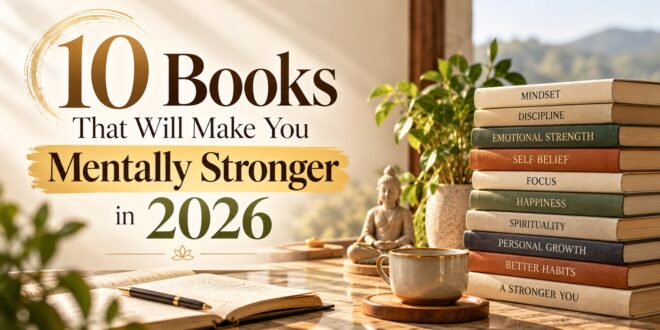
10 Books That Will Make You Mentally Stronger in 2026
A Readers Books Club guide to resilience, focus, self-belief, discipline, and emotional clarity
There are moments when life does not ask whether you are ready. A difficult conversation arrives before you have found the right words. A plan fails after months of effort. Someone misunderstands you. Work becomes uncertain. Motivation disappears. Your phone keeps demanding your attention, while your own thoughts become louder. In those moments, mental strength is not about pretending that nothing hurts. It is about staying clear enough to choose your next response.
That is why books about mindset, resilience, habits, and emotional clarity continue to matter in 2026. We have more information than ever, but information alone does not make us stronger. What helps is learning how to think under pressure, how to recover from setbacks, how to stop wasting energy on what we cannot control, and how to build daily systems that support the person we want to become.
At Readers Books Club, we see books as more than entertainment or information. A good book can become a conversation with yourself. It can make you notice a pattern you have repeated for years. It can give you language for an emotion you never knew how to explain. It can challenge your comfort zone, sharpen your mindset and help you respond to life with more self-awareness.
This reading list brings together ten books that can help you become mentally stronger in different ways. Some are current bestsellers. Some are modern classics that remain highly relevant in 2026. Together, they cover boundaries, purpose, habits, focus, self-belief, emotional regulation, discomfort, discipline and continuous growth.
The list is also designed for the wider Readers Books Club community that follows Amiett Kumar for books, meditation, spirituality, mindset, and personal growth. Not every book here teaches manifestation, the law of attraction, or spiritual practice. Where those themes appear later in this article, they are Readers Books Club editorial connections rather than claims about what every author teaches.
If you have been searching for the best self help books 2026, personal growth books, self-improvement books, books for mindset, motivation books, habit formation books, books for mental clarity, or life changing books, start here.
What Does “Mentally Stronger” Actually Mean?
Mental strength is often confused with emotional suppression. People imagine a mentally strong person as someone who never cries, never doubts, never needs rest and never asks for help. That picture is not strength. It is often avoidance.
A more useful definition is the ability to stay connected to reality while choosing a constructive response. Mental strength can look like saying no without creating a twenty-minute explanation. It can look like admitting that a plan failed and trying again with better information. It can mean walking away from an argument you do not need to win. It can mean taking one small action when motivation is low. It can also mean recognizing when a problem is bigger than self-help and seeking qualified support.
The ten books below develop different parts of this capacity. One book may help you stop trying to control other people. Another may help you build habits that survive low motivation. Another may teach you to tolerate discomfort. Another may show you how to protect deep focus in a distracted world. Mental strength is not one skill; it is a collection of skills that reinforce one another.
It is also important to separate mental strength from mental health treatment. Books can teach useful concepts and practices, but they are not a substitute for professional care when someone is dealing with severe or persistent mental health symptoms. Think of these recommendations as tools for self-awareness, growth and everyday resilience.
Why These Books Stand Out in 2026
The self-help category is crowded. New books appear constantly, and older titles are rediscovered through podcasts, Instagram, YouTube and short-form video. For this list, we used three filters.
First, the book needed a clear connection to resilience, focus, habits, self-belief, emotional regulation or purposeful growth. Second, it needed enough practical value that a reader could apply at least one idea immediately. Third, we looked for a balance between current 2026 relevance and proven staying power.
That balance matters. Current bestseller lists show strong demand for personal development books focused on habits, meaning and mindset, while publishers in India are also highlighting books around calm, focus, growth and wellbeing for 2026 readers. At the same time, books such as Atomic Habits, Deep Work and The Courage to Be Disliked continue to sell because their ideas address problems that have not disappeared.
So this is not a list of ten books that were all published in 2026. It is a list of ten books worth reading in 2026 if you want a stronger mind, better habits and a more deliberate life.
1. The Let Them Theory Mel Robbins
The first kind of mental strength is knowing what is not yours to control.
Mel Robbins’s The Let Them Theory became a major bestseller by turning that idea into a simple phrase: let other people be who they are, and stop spending so much energy trying to manage their reactions, opinions, choices and expectations. The publisher describes it as a life-changing tool centered on two words, and the book has sold millions of copies.
This sounds almost too simple until you notice how much mental energy disappears into control. We replay conversations because someone did not respond the way we hoped. We over-explain because we are afraid of being misunderstood. We try to persuade people who are committed to seeing us differently. We worry about whether someone approves of our career, relationship, boundaries, appearance or decisions.
The power of the “let them” idea is that it creates separation between another person’s behaviour and your own responsibility. Mental strength grows when you stop treating every external reaction as an emergency.
What this book can teach you
The book can help you practice emotional boundaries. If someone chooses not to invite you, let them. If a colleague does not recognize your contribution, let them show you who they are, then decide what you will do next. If someone disagrees with your life choice, let them disagree. The important second half is not passivity. It is returning attention to your own decisions.
That distinction matters. “Let them” does not mean tolerating abuse, staying silent when action is necessary, or refusing to communicate. It means recognizing that control over other adults is limited. Your power lies in your boundaries, choices and responses.
Mental-strength lesson
Ask yourself: “What am I trying to control right now that is not actually mine?” Then ask: “What is mine?” Your next conversation may be yours. Your boundary may be yours. Your schedule may be yours. Your reaction is yours.
For Readers Books Club readers interested in manifestation and the law of attraction, there is a useful editorial connection here: obsession with controlling every detail can keep attention trapped in anxiety. Whether you use manifestation language or simply call it emotional regulation, releasing unnecessary control can create more space for clear action.
Best for: boundaries, overthinking, people-pleasing, relationships and emotional independence.
2. The Meaning of Your Life Arthur C. Brooks
Mental strength is not only about surviving pressure. It is also about knowing what the pressure is for.
Arthur C. Brooks’s 2026 book The Meaning of Your Life is especially timely because it addresses a problem many people experience even when life looks successful from the outside: emptiness. The publisher describes it as a guide to finding deeper purpose in a modern world that often makes meaning difficult to perceive.
Brooks’s work asks readers to move beyond the endless question, “How do I feel better right now?” and toward a larger question: “What makes my life meaningful?” This matters because people can tolerate difficulty more effectively when they understand what they are serving.
What this book can teach you
Purpose changes the way discomfort feels. A long workday is different when it contributes to a mission you believe in. Sacrifice feels different when it protects someone you love. Discipline feels different when it is connected to a calling rather than to self-punishment.
The book also challenges the idea that happiness alone should be the ultimate goal. Happiness is valuable, but a meaningful life may include periods of grief, responsibility, uncertainty and effort. Mental strength develops when you can hold those experiences without concluding that something has gone wrong simply because it is hard.
Brooks also draws from philosophy, social science, and spiritual traditions. That makes this book a natural fit for readers interested in spirituality, self-discovery, and personal growth without requiring them to abandon practical thinking.
Mental-strength lesson
Write down three sentences:
- The people I want to love well are…
- The work or contribution I want to make is…
- The values I do not want to trade away are…
When you face a difficult decision, return to those sentences. Mental clarity often improves when the question shifts from “What is easiest?” to “What is most aligned with the life I am trying to build?”
Best for: purpose, direction, meaning, spirituality and long-term resilience.
3. Atomic Habits James Clear
Sometimes what looks like a weak mindset is actually a weak system.
James Clear’s Atomic Habits remains one of the most important self improvement books because it moves the conversation away from motivation and toward structure. The official publisher describes it as a framework for making good habits easier and bad habits harder, built around small changes that compound over time. It has sold tens of millions of copies worldwide.
This is crucial for mental strength because we often judge ourselves too quickly. You miss workouts for two weeks and call yourself undisciplined. You fail to read consistently and decide you lack focus. You procrastinate and conclude you are lazy. Clear asks a better question: what system is producing this behaviour?
What this book can teach you
Mental strength is easier when your environment supports the behaviour you want. If you want to read, leave the book where you can see it. If you want to meditate, create a specific place and time for it. If you want to reduce phone use, make the phone less available during important work.
Clear also emphasizes identity. Instead of treating every habit as an isolated task, connect it to the person you want to become. “I need to read” becomes “I am a reader.” “I should save money” becomes “I am someone who handles money thoughtfully.” Identity does not replace action; it gives repeated action a direction.
Mental-strength lesson
Choose one behaviour that would make you stronger over the next three months. Make it so small that you can do it even on a bad day. Five pages. Five minutes of meditation. One paragraph of journaling. Ten push-ups. One avoided impulse purchase.
Consistency is psychologically powerful because it gives you evidence. Every repetition becomes a vote for the identity you are building.
Readers who follow Amiett Kumar’s meditation, affirmation or manifestation content can use this principle immediately: a powerful affirmation is more useful when it is paired with a repeatable behaviour. If you affirm, “I am becoming disciplined,” then give that identity a daily action it can stand on.
Best for: habit formation, self discipline, consistency, motivation and behaviour change.
4. The Courage to Be Disliked Ichiro Kishimi and Fumitake Koga
A surprising amount of mental weakness comes from living for an imaginary audience.
The Courage to Be Disliked, based on Adlerian psychology and written as a dialogue between a philosopher and a young man, has become a global bestseller. Its central appeal is straightforward: you can choose a direction for your life without organizing every decision around approval from others.
That does not mean becoming cold or selfish. It means accepting a difficult truth: being liked by everyone is impossible. The more your identity depends on external approval, the more easily other people can steer your behaviour.
What this book can teach you
One of the book’s most useful ideas is the separation of tasks. You have your tasks. Other people have theirs. You can act respectfully, communicate honestly, and make thoughtful choices, but you cannot control how someone else interprets your actions.
This is mentally strengthening because it reduces unnecessary emotional labor. Instead of asking, “How can I make sure nobody is disappointed in me?” you can ask, “What is the responsible thing for me to do?”
The book also challenges deterministic stories about the past. Its arguments can be provocative, and readers do not have to accept every philosophical claim to benefit from the deeper question: how much of your present life are you allowing an old story to dictate?
Mental-strength lesson
Identify one decision you are postponing because you are afraid of disapproval. Write down the reasonable consequences of making the choice. Then separate those consequences from imagined judgment.
Ask: “If nobody could praise or criticize me for this, what would I believe is right?”
That question does not automatically give you the answer, but it reveals how much of your thinking belongs to you and how much belongs to the audience in your head.
Best for: self-belief, boundaries, approval-seeking, confidence and personal responsibility.
5. Why Has Nobody Told Me This Before? Dr Julie Smith
Mental strength becomes much more practical when you have tools for the days when your emotions are louder than your plans.
Clinical psychologist Dr Julie Smith created Why Has Nobody Told Me This Before? as an accessible toolkit for everyday emotional challenges. Penguin describes it as practical psychology for anxiety, low mood, criticism, motivation, self-doubt and confidence. The book has sold more than a million copies and continues to be recommended in 2026.
This makes it one of the most useful books on this list because it does not require you to read from beginning to end before getting value. You can turn to the section that matches the challenge you are facing.
What this book can teach you
One of the most important mental-strength lessons in applied psychology is that feelings are information, not always instructions. Anxiety can tell you that something feels threatening, but it does not automatically prove that danger is present. Low motivation can tell you that energy is limited, but it does not mean you are incapable of acting.
The book encourages readers to understand mood, thoughts and behaviour as connected. That means you can sometimes create change by intervening at the level of behaviour rather than waiting to feel different first.
Mental-strength lesson
When you feel emotionally overwhelmed, divide your page into three columns:
- What I am feeling
- What my mind is saying
- What I can do in the next ten minutes
This prevents emotion from becoming an undefined cloud. Naming the feeling can create distance. Naming the thought can reveal whether it is a fact or an interpretation. Naming one action restores a sense of agency.
This is also where meditation and mindfulness can support mental clarity. The goal is not to eliminate emotion but to observe it with enough space that you can respond deliberately.
Best for: emotional regulation, anxiety management, motivation, confidence and practical mental-health tools.
6. How to Let Things Go Shunmyo Masuno
Strength is not always holding on. Sometimes it is knowing what to release.
Shunmyo Masuno is a Zen Buddhist priest and the author of several books on simple living. In How to Let Things Go, he offers short lessons on reducing unnecessary control, creating space and responding to modern overwhelm with greater calm.
The official description is especially relevant to 2026 life: news, social media, messages and constant demands make it difficult to know when to step back. Masuno’s approach is not dramatic. It is a series of small reminders that help you distinguish between what deserves your energy and what does not.
What this book can teach you
Mental strength often improves when mental clutter decreases. If you are carrying ten arguments, three unfinished decisions, comparison from social media and constant anxiety about other people’s choices, your mind has less capacity for the work that matters.
Letting go can mean ending a relationship that is already over, allowing someone space, taking a break before making a decision, or remembering that social media is a tool rather than a judge of your life.
The Zen perspective is useful because it returns attention to the present. Instead of endlessly rehearsing what should have happened, you ask what this moment requires.
Mental-strength lesson
Make a “release list.” Write five things you are mentally carrying. Next to each one, label it:
- Act
- Accept
- Ask
- Release
If you can take a useful action, take it. If the situation cannot be controlled, practice acceptance. If clarity requires a conversation, ask. If it is neither actionable nor useful, begin releasing the habit of revisiting it.
For readers interested in spirituality or law of attraction, this is a natural place to practice detachment without confusing detachment with giving up. You can care about a goal and still release obsessive control over timing and other people.
Best for: overthinking, calm, mindfulness, detachment, digital overwhelm and inner peace.
7. Deep Work: Cal Newport
In 2026, protecting your attention is a form of mental strength.
Cal Newport defines deep work as the ability to focus without distraction on cognitively demanding tasks. The book became a modern classic because it recognized early that fragmented attention was becoming normal. Today, with notifications, social media, short-form content and AI-generated information everywhere, the argument feels even more urgent.
Mental strength is difficult when your mind is constantly interrupted. Every notification creates a tiny invitation to abandon the thing you chose for the thing someone else chose for you.
What this book can teach you
Deep focus is not simply a productivity technique. It changes your relationship with discomfort. Serious reading, writing, problem-solving and creative work all contain moments of boredom, confusion and resistance. If you escape every time the task becomes uncomfortable, your ability to stay with hard things weakens.
Deep Work encourages readers to create periods where distraction is not allowed to negotiate. That can mean putting the phone in another room, turning off notifications, setting a clear objective and working for a defined block of time.
Mental-strength lesson
Schedule one 45-minute block tomorrow for a single demanding task. Before you begin, decide exactly what “done” means. Keep your phone away. Do not check messages. When the urge to switch tasks appears, notice it without obeying it immediately.
The real training is not the task itself. It is the moment you want to escape and choose to stay.
This idea connects naturally with meditation. In both practices, attention wanders and you return it. The return is the repetition that builds the skill.
Best for: focus, productivity, concentration, digital distraction and mental discipline.
8. Can’t Hurt Me David Goggins
Some books build mental strength through calm reflection. Can’t Hurt Me builds it through confrontation.
David Goggins’s memoir describes an extreme transformation shaped by self-discipline, endurance training and a willingness to face discomfort. His story moves from a painful childhood and serious personal struggles to elite military training and endurance sports.
The book is intense, and not every reader needs to imitate Goggins’s physical extremes. The value lies in the underlying question: how often do we stop because we have reached our actual limit, and how often do we stop because discomfort has convinced us the limit is closer than it really is?
What this book can teach you
Goggins’s approach emphasizes accountability. Instead of hiding from weaknesses, identify them. Instead of waiting for confidence, create evidence through effort. Instead of using past pain only as an explanation, decide whether any part of it can become fuel for growth.
That said, mental strength should not become self-destruction. Sustainable discipline includes recovery, health and judgment. The useful lesson is not “ignore every signal your body gives you.” It is “do not confuse ordinary discomfort with impossibility.”
Mental-strength lesson
Choose one task you have repeatedly avoided because it feels uncomfortable but is safe and worthwhile. Make it measurable. Complete it without negotiating with yourself halfway through.
Then write down what happened. Was the task actually as difficult as your mind predicted? What part was hardest: beginning, continuing, or finishing?
This creates a personal database of evidence that you can do difficult things.
Best for: grit, self discipline, accountability, resilience, and pushing beyond self-imposed limits.
9. The Comfort Crisis Michael Easter
Modern life has become extraordinarily efficient at removing discomfort. That sounds like progress, and in many ways it is. But Michael Easter argues that a life designed around constant comfort can quietly reduce resilience.
The Comfort Crisis explores what happens when we deliberately reintroduce appropriate physical and psychological challenges. Easter connects modern comfort with evolutionary ideas about how humans adapted to effort, uncertainty, and the natural world.
The book’s core message is not that comfort is bad. Comfort is wonderful. The problem is when avoiding discomfort becomes the organizing principle of your life.
What this book can teach you
The mind learns from exposure. If you never practice boredom, waiting feels unbearable. If you never exercise, physical effort feels threatening. If you never have difficult conversations, conflict feels catastrophic. If you never spend time without stimulation, silence can feel empty rather than restorative.
Mental strength grows when you intentionally choose manageable difficulty instead of allowing difficulty to choose you.
Mental-strength lesson
Create one “chosen discomfort” this week. It might be a challenging workout appropriate for your health, a long walk without headphones, a morning without social media, a conversation you have postponed or a focused work block without checking your phone.
The goal is not punishment. It is to remind your nervous system that discomfort can be temporary, survivable, and meaningful.
For Readers Books Club readers interested in meditation and spirituality, this can be especially valuable. Sitting quietly with your thoughts for ten minutes may feel surprisingly difficult at first. That difficulty is not evidence that meditation is failing. It may be the training itself.
Best for: resilience, courage, discomfort tolerance, digital detox, and physical-mental discipline.
10. The Price of Becoming Ryan Hawk
The final book on this list is about a quieter form of strength: the willingness to keep becoming.
Ryan Hawk’s The Price of Becoming focuses on continuous growth, leadership, communication, learning and the daily practices required to develop into a better version of yourself. The title captures an idea that is easy to forget: growth has a price.
You pay in attention. You pay by practicing when you would rather scroll. You pay by asking for feedback that may be uncomfortable. You pay by doing the work before you receive recognition. You pay by becoming a beginner again whenever you enter a new level.
What this book can teach you
A success mindset is not simply positive thinking. It is a relationship with learning. Mentally strong people are often less threatened by not knowing because they trust their ability to learn.
Hawk emphasizes practices around curiosity, reflection, teaching, communication, and leadership. These habits matter because personal growth is rarely a solo performance. How you listen, how you learn from others, and how you communicate under pressure all shape the person you become.
Mental-strength lesson
At the end of each day for one week, answer three questions:
- What did I learn today?
- Where did I react instead of respond?
- What will I practice tomorrow?
This creates a feedback loop. Instead of deciding that a day was “good” or “bad,” you turn it into information.
Readers interested in coaching or life coach content will recognize this approach. Good coaching rarely gives you a magical answer. It improves the quality of the questions you ask and the consistency with which you act on the answers.
Best for: continuous learning, leadership, communication, discipline and long-term personal growth.
Quick Comparison: Which Book Should You Read First?
| If you want to improve… | Start with… | Why |
| Boundaries and people-pleasing | The Let Them Theory | Helps redirect energy from controlling others to managing your own choices |
| Purpose and direction | The Meaning of Your Life | Connects resilience with meaning, love and calling |
| Habits and consistency | Atomic Habits | Turns motivation into systems and small repeatable behaviours |
| Approval-seeking and self-belief | The Courage to Be Disliked | Challenges dependence on external validation |
| Emotional coping skills | Why Has Nobody Told Me This Before? | Offers practical psychological tools for everyday challenges |
| Overthinking and letting go | How to Let Things Go | Uses simple Zen-inspired lessons to reduce unnecessary mental clutter |
| Focus and productivity | Deep Work | Trains sustained attention in a distracted world |
| Grit and accountability | Can’t Hurt Me | Challenges self-imposed limits through disciplined effort |
| Comfort-zone expansion | The Comfort Crisis | Shows the value of chosen, appropriate discomfort |
| Leadership and continuous growth | The Price of Becoming | Encourages learning, reflection and deliberate improvement |
What These 10 Books Have in Common
At first glance, these books are very different. One comes from a motivational speaker. One from a Harvard social scientist. One from a clinical psychologist. One from a Zen Buddhist priest. One from a computer science professor. One from an endurance athlete.
Yet the same themes keep appearing.
1. You cannot control everything, but you can train your response
The Let Them Theory, The Courage to Be Disliked and How to Let Things Go all reduce wasted energy by drawing a line between your responsibility and what belongs to someone else.
Mental strength begins with accurate control. If something is yours to act on, act. If it is not, stop spending your entire day mentally wrestling with it.
2. Systems matter more than temporary motivation
Atomic Habits, Deep Work and The Price of Becoming all make a similar point in different language: the person you become is shaped by repeated practices.
Motivation is helpful, but it is unreliable. A system keeps working when enthusiasm disappears.
3. Discomfort is not automatically danger
Can’t Hurt Me and The Comfort Crisis both ask readers to reconsider their relationship with discomfort. One uses extreme personal experience; the other explores modern comfort more broadly. The useful shared lesson is that growth often feels uncomfortable before it feels rewarding.
4. Meaning makes resilience more sustainable
The Meaning of Your Life reminds us that strength without purpose can become empty endurance. A person can be disciplined, productive and admired and still feel lost. Meaning gives effort a direction.
5. Emotional skills can be learned
Why Has Nobody Told Me This Before? is an important counterbalance to the “just be tougher” version of self-help. Emotional regulation is not weakness. Learning how to recognize anxiety, low mood, criticism and self-doubt can make action more intelligent.
Mental Strength, Meditation, and Mindfulness
Readers Books Club has long connected books with practices such as meditation, mindfulness, and spirituality because reading changes what you know, while practice can change how you relate to what you know.
Imagine reading The Let Them Theory and understanding intellectually that you cannot control everyone. That is useful. But the real test comes when someone disappoints you and your body fills with tension. In that moment, a simple mindfulness practice can create a pause between the trigger and the response.
The same is true with Deep Work. You can understand the importance of focus while still reaching for your phone every three minutes. Meditation trains attention through repetition: notice wandering, return. Deep work trains attention in a similar way: notice distraction, return.
You do not need a complicated routine. Try this five-minute mental-strength practice:
- Sit comfortably and breathe naturally for one minute.
- Notice the strongest thought or emotion present without trying to remove it.
- Ask, “What part of this situation is in my control?”
- Choose one small action that aligns with the person you want to become.
- Spend the final minute visualising yourself completing that action calmly.
This is not magic. It is a way of moving from reactivity to intention.
Where Manifestation, Affirmation and the Law of Attraction Fit
Many Readers Books Club followers also engage with Amiett Kumar’s content on manifestation, affirmation, visualisation, spirituality and the law of attraction. These themes can be connected to mental strength when they are used as tools for clarity, identity and intentional action.
For example, an affirmation such as “I am mentally strong” may feel inspiring, but it becomes more powerful when you define what mentally strong behaviour means today. Does it mean making the difficult phone call? Finishing the work block? Saying no? Going to sleep on time? Returning to your reading habit after missing three days?
Visualisation can work the same way. Instead of only visualising the final result, visualise the process. See yourself staying calm in the conversation. See yourself opening the book when you want to scroll. See yourself returning to the gym after a difficult week. See yourself responding to criticism without collapsing or attacking.
Manifestation language is most useful when it does not replace practical action. Your mindset influences what you notice, what you practice and how long you persist. It does not remove the need for effort, feedback, skill and reality-based decisions.
This is why the books on this list fit naturally beside meditation or coaching. They give your intentions structure.
A 30-Day Mental Strength Reading Challenge
Buying ten books at once can become another form of procrastination. You do not need to finish all ten this month. Use them as a library of tools.
Here is a simple 30-day plan.
Days 1 – 5: Build awareness
Choose The Let Them Theory, Why Has Nobody Told Me This Before? or How to Let Things Go. Read for fifteen minutes a day. Each evening, write one example of a reaction you noticed in yourself.
The goal is not to change everything immediately. First, learn to see your patterns.
Days 6 – 10: Build one habit
Read Atomic Habits. Choose one habit connected to mental strength and make it tiny. Five pages of reading. Five minutes of meditation. Ten minutes of focused work. A daily walk. One written reflection.
Track the action, not your mood.
Days 11 – 15: Train focus
Read Deep Work. Create one distraction-free block each day, even if it is only twenty minutes. Keep your phone out of reach. Notice how often the urge to check appears.
Do not judge the urge. Train the return.
Days 16 – 20: Practice discomfort
Read The Comfort Crisis or Can’t Hurt Me. Choose one safe, meaningful discomfort each day. Do a hard workout suitable for your condition. Take a cold or brisk morning walk if appropriate. Start a conversation you have delayed. Complete the task you have avoided.
The goal is to expand your tolerance, not prove toughness.
Days 21 – 25: Reclaim your own direction
Read The Courage to Be Disliked. Notice where approval controls your choices. Ask where you are living according to an audience instead of your values.
Choose one respectful action that reflects your own judgment.
Days 26 – 30: Connect strength with purpose
Read The Meaning of Your Life or The Price of Becoming. Write a one-page reflection on the person you want to become over the next year.
Do not only list achievements. Include character. How do you want to respond under stress? What kind of friend, partner, parent, leader, or student do you want to be? What do you want to learn?
At the end of day 30, choose the one practice from the month that made the biggest difference and keep it for the next 90 days.
How to Build a Reading Habit When You Are Busy
A list of life-changing books is useless if the books remain unopened. Fortunately, reading does not require two free hours every evening.
Start with ten minutes. Ten focused minutes is enough to maintain a reading habit, especially when you connect it to an existing routine. Read after breakfast. Read during your commute if you are not driving. Read before bed instead of opening social media.
Keep the book visible. Friction matters. A book inside a cupboard loses to a phone already in your hand.
Do not force yourself to finish every book. If a book is not useful after a reasonable attempt, move on. Reading is not a morality test.
Use notes sparingly. Highlight the ideas you want to apply, not every sentence that sounds intelligent. At the end of a chapter, write one question: “What will I do differently because I read this?”
This is where Readers Books Club can be helpful. A community, podcast or book-summary video can give you context before you start and help you revisit the lessons after you finish.
Common Mistakes When Reading Self-Improvement Books
Collecting ideas without practicing them
Self-help can become entertainment. You feel productive because you learned something, but nothing changes. Pick fewer ideas and practice them longer.
Using books to judge yourself
A book should give you tools, not another reason to call yourself lazy, weak or behind. Growth is easier when self-awareness is honest without becoming cruel.
Copying someone else’s life exactly
David Goggins’s life is not your life. Cal Newport’s schedule may not fit your job. A Zen priest’s routine may not fit a parent with three young children. Extract the principle, then adapt the practice.
Treating every book as scientific proof
Self-help books vary widely in evidence quality. Authors combine research, philosophy, personal experience, and opinion. Read actively. Ask what is evidence, what is interpretation and what is a useful metaphor.
Confusing positivity with strength
Mentally strong people are not positive all the time. They can acknowledge fear, disappointment, and uncertainty without becoming permanently organized around them.
How to Choose the Right Book for Your Current Season
Ask yourself where your energy is leaking.
If it is leaking into other people’s opinions, start with The Let Them Theory or The Courage to Be Disliked.
If it is leaking into inconsistent habits, start with Atomic Habits.
If it is leaking into notifications and distraction, start with Deep Work.
If it is leaking into worry and emotional overwhelm, start with Why Has Nobody Told Me This Before? or How to Let Things Go.
If life feels too comfortable and you have stopped challenging yourself, start with The Comfort Crisis.
If you need a direct push toward discipline, read Can’t Hurt Me.
If you are productive but unsure why any of it matters, read The Meaning of Your Life.
If you are growing into leadership or a new level of responsibility, read The Price of Becoming.
The best book is not the one with the highest rating. It is the one that addresses the problem you are actually living through.
Contents