Introduction: We Have Never Had More Ways to Talk, Yet Many of Us Struggle to Connect
Imagine sitting across from someone you love. Both of you are physically present, but one phone lights up, then another. A short video leads to a message, a message leads to a notification, and suddenly ten minutes have passed without a real conversation. Later, you might exchange dozens of texts and still feel that something important was never said. This is one of the uncomfortable contradictions of modern life: communication has become easier, but connection can still feel difficult.
The problem is not always a lack of affection or intelligence. Sometimes we simply have not learned how to put our ideas into words, use our voice expressively, read the room, tell a meaningful story, or listen without preparing our reply. A talented employee may have a useful idea that gets ignored. A parent may love a child deeply but sound impatient. A student may know the correct answer but be frightened to raise a hand. Two people can care about each other and repeatedly walk away from conversations feeling misunderstood.
This is why Before We Forget How to Connect by Vinh Giang feels so relevant among the best books of 2026 for personal growth. The book presents communication not as a mysterious talent possessed by a lucky few, but as a set of abilities that ordinary people can practice. Its broad promise is wonderfully practical: when we improve how we speak, move, tell stories and listen, we create more opportunities to be heard and to understand others.
For Readers Books Club, this subject reaches beyond public speaking. It connects directly with self-improvement books, mindset transformation, professional confidence, relationships, motivation and the everyday choices that shape personal growth. A good conversation can open a door at work, repair a small misunderstanding at home, or help someone feel less alone. A poor conversation can close the same door even when nobody intended harm.
In this detailed Vinh Giang book summary, we will explore nine powerful lessons inspired by the author’s published description and interviews. These are nine editorial takeaways for Readers Books Club readers, not an invented table of contents or a claim that the book itself has exactly nine chapters. Along the way, you will find original examples, reflection questions written as prose, and ways to use these lessons in Indian offices, classrooms, families, creative projects and everyday conversations. The goal is not to become the loudest person in the room. It is to communicate with enough awareness that people can understand the real person behind your words.
About the Book: Before We Forget How to Connect by Vinh Giang
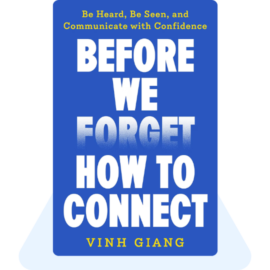
The full title is Before We Forget How to Connect: Be Heard, Be Seen, and Communicate with Confidence. It was published by Hay House on November 3, 2026, and the US hardcover edition has 352 pages. In India, Penguin Random House lists an edition under the Hay House Publishers India imprint. The book belongs naturally beside communication, self-help, psychology and personal-development titles, though its central focus is specific: building more effective human connection.
Vinh Giang is a speaker, magician and communication coach. He has described growing up shy in Australia as the child of Vietnamese refugees, with English as his third language. His early difficulty connecting with people helped shape his later attention to the skills involved in being seen and heard. He eventually developed a public-speaking and communication-teaching career, combining performance experience with instruction about voice, body language, stories and listening.
That background explains the tone of the project. This is not presented as a theory that charisma is inherited or that extroverts always win. It treats communication more like learning to play an instrument. Improvement takes noticing what you do, practicing deliberately, receiving feedback and adjusting in real situations. A person who speaks softly can learn to sound clearer. A person who avoids eye contact can learn to show attention more comfortably. A person who tells long, confusing stories can learn to create a beginning, turning point and meaningful ending.
The publisher identifies four recurring areas: vocal mastery, body language, storytelling and active listening. The author’s November 2026 Audible interview reinforces those four pillars and adds a warning about passive screen time replacing the practice we get from live interaction. Listening to a podcast can feel intimate, but it is not identical to being in a conversation where the other person can challenge us, surprise us or ask us to explain ourselves.
This summary does not reproduce the book’s chapters or pretend that a short preview can substitute for the complete work. Instead, it offers an independently written explanation of the publicly documented ideas, with practical applications and critical reflection. If a particular example or daily exercise appears below, it is an RBC application unless it is explicitly identified as something the author discussed. That distinction matters because good book summaries should make readers more curious about the original book, not give them a false impression that every added example came from the author.
The Core Message: Communication Is Not Just Speaking
People often define communication as the ability to speak fluently. They imagine a confident presenter standing on a stage, delivering polished sentences while an audience applauds. That is one form of communication, but it is only a fraction of what human interaction involves. A conversation also includes the pace of a sentence, the expression on a face, the timing of a pause, the story used to explain an idea, and the willingness to listen to an answer we did not expect.
Think of a colleague saying, “That’s fine.” With a warm tone and relaxed posture, the phrase may mean genuine agreement. Spoken sharply, with crossed arms and a distracted expression, it may suggest the opposite. Words carry information, but context helps listeners interpret what those words mean. This is why rehearsing perfect sentences is not always enough. We need to pay attention to the full experience we create for another person.
Connection is also different from performance. You can impress someone for thirty seconds and still leave them feeling unknown. You can speak imperfectly, ask a thoughtful question, and make another person feel understood. Neither form of conversation is automatically more valuable in every situation, but the distinction is important. Influence built only on excitement may fade quickly; trust tends to grow through consistent, respectful interaction over time.
At Readers Books Club, books are often discussed as tools for changing how we think. This title adds another question: what happens when our improved thinking must travel through our voice to another human being? A useful idea that remains hidden cannot help a team. A sincere apology that never gets expressed cannot begin to repair a relationship. Communication converts some of our private intentions into shared understanding. That makes it a practical skill for anyone interested in self-belief, coaching, leadership, friendship or a more meaningful life.
Lesson 1: Your Voice Is an Instrument You Can Learn to Use
The first powerful lesson in this Before We Forget How to Connect summary is that your voice is more flexible than you may think. Many people treat their speaking voice as a fixed part of personality. They say, “I always sound nervous,” “My voice is boring,” or “I am naturally too quiet.” But voice involves learnable choices, including volume, pace, emphasis, pauses and emotional expression. You may not control every biological feature of your voice, yet you can often improve how clearly and comfortably you use it.
Imagine a manager announcing a difficult change at work. If the message is delivered too quickly and without pauses, employees might feel that their concerns are being brushed aside. If the same information is shared calmly, with time for questions, people may feel more respected even if they dislike the decision. The content matters, but delivery influences the experience of hearing it.
Vinh Giang’s publisher specifically highlights vocal presence, emotion, clarity and influence. These ideas are more concrete than simply telling readers to “be confident”. You can rehearse a short explanation, record it on your phone and listen for places where your meaning becomes hard to follow. Perhaps you speed up when discussing an unfamiliar topic. Perhaps every sentence ends with the same flat tone. Perhaps an important word gets lost because you do not pause before it.
A useful starting point is to read a paragraph aloud in three different ways. First, read it mechanically. Next, imagine explaining it to a friend you care about. Finally, imagine presenting it to a small group that needs the information. Notice how your pace and emphasis change. You are not trying to fake a personality; you are discovering choices that help your intention become audible.
For a student preparing for an interview, this distinction is valuable. A good answer is not necessarily the one with the longest vocabulary. It is often the answer that begins clearly, includes one useful example and ends before the listener loses the point. When we slow down at meaningful moments, we create space for understanding. When we raise or lower emphasis naturally, listeners can tell which part matters most.
Confidence can sometimes follow repeated practice rather than arrive before it. If you are waiting to feel completely fearless before speaking, you may wait indefinitely. Instead, rehearse one sentence until it becomes easier, then practice in a low-pressure conversation and gradually expand. The goal is not a dramatic overnight transformation. It is the steady development of control and ease.
There is also an ethical side to vocal mastery. A powerful voice should not become a tool for intimidating or overpowering people. The same ability to sound assertive should help you say no respectfully, explain a boundary, comfort someone who is upset and express disagreement without humiliation. Strong communication works best when clarity and care grow together.
If you make videos, host podcasts or create educational content, the lesson becomes even more practical. People cannot see your intentions; they hear the energy you put into an explanation. An engaging voice helps a complex idea feel accessible. But the most useful question is not “How can I sound impressive?” It is “Can my listener understand what I truly mean?” That shift changes vocal practice from performance into service.
Lesson 2: Body Language Begins a Conversation Before Your First Word
A second lesson is that communication starts before someone speaks. Posture, facial expression, gestures, movement and attention can all influence the atmosphere of an encounter. These signals are not a secret code that lets you read every thought. Human expressions vary by individual, culture, disability and situation. Still, learning to notice your nonverbal habits can reduce avoidable misunderstandings.
Imagine greeting a new colleague while looking repeatedly at a phone. You might be friendly and even genuinely interested, yet your divided attention can create a different impression. Now imagine placing the device aside, turning toward the person and greeting them with a relaxed expression. The words might be identical, but the moment feels more personal. The difference is not complicated body-language manipulation. It is visible attention.
The book’s published description emphasizes posture, gestures, facial expression, movement and eye contact. Each has a purpose beyond looking polished. Gestures can help structure an explanation. A relaxed stance may help a nervous speaker feel more comfortable. An interested facial expression can reassure someone who is sharing a difficult experience. Eye contact can show engagement for many people, but it should never be treated as a rigid rule or a measure of honesty.
A particularly useful exercise is to notice what happens to your body when you feel pressure. Some people shrink into themselves and lower their heads. Others speak faster, move restlessly or keep their faces very still. None of these reactions makes someone a bad communicator. They simply provide information about what may need practice.
Suppose you are about to give a short presentation. Instead of trying to control a dozen gestures, choose one simple adjustment: plant your feet comfortably, release unnecessary tension in your shoulders and look toward the people you are addressing. Give yourself permission to pause. With repetition, these small choices may help you feel more present.
Nonverbal communication is especially important in relationships. A partner explaining a problem may want your attention more than an immediate solution. Turning toward them, reducing distractions and allowing space for their words can communicate care. Yet a respectful listener also asks rather than assumes. A tired face does not necessarily mean anger; silence does not always mean rejection. Good communication joins observation with curiosity.
In workplaces, body language should be understood with similar humility. We cannot reliably identify deception, leadership ability or trustworthiness from one gesture. Cultural backgrounds, anxiety, fatigue and personal differences can change how people appear. A thoughtful approach avoids turning body language into snap judgments. It uses nonverbal awareness to improve your own presence and to ask better questions of others.
For Readers Books Club readers interested in mindset transformation, the deeper message is that confidence is not only an internal belief. It also involves how we participate in shared spaces. Your aim is not to imitate a famous speaker’s gestures. It is to find an authentic, considerate way to make your attention and meaning easier for other people to recognize.
Lesson 3: Stories Make Information Memorable and Human
The third lesson is about storytelling. Facts tell people what happened. A well-chosen story helps them understand why it matters. This does not mean replacing evidence with emotional drama. It means giving ideas a human context so listeners can follow the situation, recognize a challenge and understand the lesson.
Consider two ways of describing teamwork. The first is an abstract statement: “We should improve communication across departments.” The second begins with a real but anonymized example: a deadline was missed because one team assumed another had received an update. The teams then changed how they confirmed handovers, and errors decreased. The second explanation is easier to picture. It gives the listener a specific problem and a response rather than a slogan.
The publisher describes storytelling as a way to create emotional connection, trust and memorable ideas. Vinh Giang’s performance background makes that emphasis understandable. A magician learns that timing, expectation and surprise shape an audience’s experience. But everyday storytelling does not require a stage, a dramatic revelation or an elaborate performance. It requires relevance and clear structure.
One simple way to develop a story is to identify three parts. First, what was the situation? Next, what changed or became difficult? Finally, what did you learn or do? You can describe all three in a few sentences. If the story is about learning to speak up, begin with the moment you stayed silent, explain why it bothered you and describe the small action you took the next time. The listener can recognize both the challenge and the change.
This is particularly helpful in job interviews. Someone asked to describe leadership might list qualities such as responsibility, teamwork and initiative. Those words are useful, but a specific example gives them credibility. A candidate could explain how they helped organize a delayed project, what trade-offs were involved and what the team achieved. The story makes the quality visible.
Stories also have limits. An emotional anecdote does not prove that a method always works. If you are discussing money, health, education or a serious professional decision, combine stories with accurate information. A moving story can open attention, but facts help the audience judge the claim. Responsible communicators know when a personal experience illustrates an idea and when stronger evidence is required.
In family life, storytelling can bridge generations. A parent explaining the importance of patience may connect more deeply by describing a time when they made a rushed decision and learned from it. Children do not always need perfect role models; they often benefit from real people who can explain how they changed. Likewise, friends may understand a concern more clearly when you describe a concrete moment instead of accusing them of “always” behaving a certain way.
If you create YouTube videos or podcasts, notice the power of starting with a relatable problem rather than a long introduction. A story gives viewers a reason to care before you introduce a framework. That is a lesson Readers Books Club can apply to book summaries: help the audience recognize a familiar situation, then show which idea from the book can illuminate it.
The best story is not necessarily the funniest or longest. It is the one that serves the listener. Before telling it, ask what it adds. Will the example clarify a difficult point? Will it make someone feel less alone? Will it help the other person remember an important distinction? If it serves none of these purposes, shorter may be stronger. Storytelling is a means of connection, not a competition for attention.
Lesson 4: Listening Is an Active Skill, Not Silent Waiting
Listening sounds simple until we notice what our minds are doing during a conversation. We hear the first few words, decide what the person means, and begin preparing a response. Sometimes we interrupt because we are excited. Sometimes we finish another person’s sentence because we believe we already understand. Sometimes we nod while thinking about the next task on our schedule. None of these habits is unusual, but they can prevent us from discovering what someone is actually trying to say.
Vinh Giang places listening alongside voice, body language and storytelling as a core communication skill. In his public interview about the book, he discusses the difference between hearing a conversation and actively participating in it. A podcast may offer insight and companionship, but the participants cannot respond to our specific questions. Real listening requires the patience to stay with another person’s meaning even when it changes direction.
Imagine a friend saying, “Work has been exhausting lately.” A quick response might be, “You should change jobs.” Perhaps the advice is reasonable, but it arrives before the situation is understood. A more attentive response might be, “What has been the hardest part?” The answer could reveal an unfair workload, an uncomfortable team dynamic, family pressure or a temporary deadline. Listening protects us from offering a solution to the wrong problem.
The author’s interviews also discuss following conversational threads and asking follow-up questions. The practical insight is that a conversation becomes richer when curiosity guides the next question. If someone mentions they started playing music again, ask what inspired them to return. If a colleague says a project has been difficult, invite them to explain where it became complicated. Thoughtful follow-up questions show that the other person’s answer matters.
Good listening also involves noticing tone and emotion, but interpretation must remain provisional. If someone sounds hesitant, you might ask whether they want more time rather than deciding they disagree. If someone becomes quiet, you can offer room to speak without demanding disclosure. The point is to develop empathy without pretending we can read minds.
For people exploring meditation and personal growth, there is a useful parallel. Mindfulness practices encourage noticing where attention has wandered and gently returning to the present. Conversation can be practiced in a similar spirit: notice when your mind begins rehearsing a reply, then return to the words in front of you. Meditation is not a requirement for active listening, nor does it automatically make someone an excellent listener, but deliberate attention can support both practices.
Try the simplest possible exercise in your next meaningful conversation. Let the other person finish. Restate what you understood in your own words, and ask whether you have understood correctly. This may feel almost too basic, yet it can prevent unnecessary conflict. A person who feels accurately heard often finds it easier to hear the other side as well. The goal is not to win a conversation. It is to make understanding possible.
Lesson 5: Confidence Grows When You Practice Being Seen
Many readers search for self improvement books because they want to build confidence. They want to stop freezing in meetings, speak more comfortably with strangers, or express their opinions without feeling ashamed. It is tempting to believe that confidence must come first and action second. But communication often develops in the opposite direction: repeated, manageable action can help us become more comfortable with uncertainty.
This idea is especially encouraging in Vinh Giang’s life story. He describes having been a shy child and gradually learning the skills he now teaches. That does not mean everyone will follow his professional path, and it does not erase the real challenges faced by people with anxiety or communication disabilities. It suggests that a painful starting point need not become a permanent identity.
Consider someone who rarely contributes in team meetings because they fear sounding foolish. A dramatic challenge to “become an amazing speaker in thirty days” may create more pressure. A smaller experiment may work better. Before the next meeting, they prepare one useful question. They ask it when the discussion reaches the relevant point. Afterwards, they reflect on what actually happened instead of replaying only what felt awkward.
Over several weeks, that person might begin offering a short observation, explaining a recommendation and eventually leading a brief discussion. Progress is not always linear. One meeting may go well while another feels uncomfortable. This is normal. A more stable form of confidence comes from learning that you can participate even when nerves are present.
Self-belief is not the same as assuming everyone will agree with you. It is the understanding that you have permission to make a contribution, receive feedback and improve. In a classroom, that might mean asking a question rather than hiding confusion. At home, it might mean expressing a preference without apologizing for having one. In professional coaching, it might mean explaining an idea honestly rather than imitating an exaggerated motivational style.
This is where the phrase mindset transformation can be useful, provided it remains practical. Replace the fixed statement “I am bad at speaking” with a testable one: “I am still developing this skill.” Then collect evidence through practice. Record a two-minute explanation. Join a small conversation. Speak at a manageable pace. Ask someone trustworthy what was clear and what could improve.
Not every uncomfortable interaction has to become a life lesson. Sometimes you simply have a difficult day. But across many attempts, experience can challenge old assumptions. You discover that being seen does not require perfection. A small, clear contribution can be enough to begin. The ability to speak with courage grows through use, much as a physical skill grows through regular practice.
Lesson 6: Trust Comes From Consistency, Not Communication Tricks
A great communicator can attract attention, but attention alone does not create trust. Trust develops when people experience honesty, respect, reliability and a willingness to understand. This is an essential distinction in any discussion of human connection. If communication is treated only as a way to make people like us, it becomes tempting to manipulate expressions or imitate interest. Such techniques may produce temporary approval without building a real relationship.
The book’s published description connects storytelling and listening with trust. Readers can take that seriously without turning trust into a formula. A trusted friend is not necessarily someone who tells perfect stories or maintains flawless eye contact. It may be someone who remembers what matters to you, admits when they were wrong and does not make every conversation about themselves.
Imagine a team leader who speaks beautifully at a weekly meeting but ignores questions afterward. Employees may appreciate the presentation and still hesitate to raise concerns. Now imagine a leader who occasionally struggles with words but follows through on promises, listens when people disagree and explains difficult decisions transparently. The second person may be creating a stronger foundation for trust.
The same principle applies to friendships and family relationships. Saying “You can tell me anything” sounds caring, but the statement becomes credible only when someone can share a concern without being mocked or dismissed. Trust requires a match between what we say and what we repeatedly do. Communication is therefore connected to character and conduct, not just technique.
There are also times when clarity requires boundaries. A thoughtful communicator does not have to agree with every request. You can tell someone you are unavailable, explain a decision or disagree with a suggestion while remaining respectful. Saying yes to everything may reduce immediate tension, but it can create resentment later. Honest limits can protect the relationships we want to keep.
For Readers Books Club’s audience interested in the Law of Attraction and manifestation, this lesson provides a grounded bridge. Positive intentions alone do not guarantee that other people will trust us. A desire to create harmonious relationships becomes more realistic when paired with accountability, honest communication and consistent behavior. Beliefs may influence how we approach others, but their choices and boundaries remain their own.
One practical question can improve almost any conversation: “What would make my words credible here?” Perhaps the answer is to acknowledge uncertainty. Perhaps it is to share the information behind a decision. Perhaps it is to apologize without adding excuses. When your communication supports genuine understanding, trust has space to grow. The most persuasive person in a room is not always the most reliable; learning the difference is part of emotional maturity.
Lesson 7: Difficult Conversations Need Clarity and Care Together
Communication skills are tested most when people disagree. Almost anyone can sound thoughtful during an easy conversation. The harder challenge is to remain understandable when emotions rise, a boundary is crossed or a decision disappoints someone. We cannot remove every conflict from life, nor should we try. But we can learn to approach disagreements without turning them into personal battles.
Imagine telling a friend that their repeated lateness has become a problem. A frustrated opening such as “You never respect my time” may invite an argument about whether “never” is accurate. A clearer opening focuses on the experience: “When our plans start much later than agreed, I feel stressed because I have other commitments. Can we find a better way to plan?” The second approach is not guaranteed to succeed, but it gives the conversation a practical direction.
In the author’s wider public discussion of communication, tone, pauses and reading the room matter during emotional exchanges. A person can choose better words and still undermine them by speaking with contempt. Equally, a gentle tone cannot replace directness when a serious concern must be addressed. Healthy communication requires both. People deserve to know what the issue is, and they deserve to hear it without unnecessary humiliation.
Listening becomes particularly important when you feel certain that you are right. Ask the other person how they understood the situation. You may discover relevant facts or different expectations. Understanding their perspective does not mean surrendering your own needs. It means gathering enough information to discuss the real disagreement rather than a distorted version of it.
Pausing can also help. A short silence after a difficult sentence may prevent you from filling the space with defensive explanations. If the discussion becomes overwhelming, it is reasonable to suggest returning when both people can participate more calmly. This is not avoidance when the issue is genuinely revisited. It is an effort to preserve the possibility of a useful conversation.
In families, emotional histories can make even ordinary topics complicated. Money, career choices, marriage, responsibilities and personal boundaries may carry expectations that are never fully spoken. A careful conversation recognizes that not everyone enters with the same experience or level of power. Speaking clearly is important, but so are safety, consent and respect. Communication advice should never be used to pressure someone to remain in an unsafe or abusive situation.
The practical lesson is to separate firmness from aggression. You can be clear about a deadline without insulting a colleague. You can express hurt without assigning a permanent label to a friend. You can refuse a request without turning the refusal into a speech about the other person’s flaws. These are not glamorous skills, but they protect the ordinary relationships on which much of life depends.
Lesson 8: Digital Connection Should Not Replace Real Participation
One of the most timely ideas associated with Before We Forget How to Connect is that our devices can provide enormous amounts of content while leaving fewer opportunities to practice human interaction. Vinh Giang discusses this concern directly in his November 2026 interview. The issue is not that phones, podcasts, videos or AI are always harmful. It is that passively consuming communication is different from actively making it.
Think about watching an interview with two gifted conversationalists. You may learn useful questions, enjoy their humor and feel encouraged by their honesty. Yet you do not need to respond when one speaker misunderstands you. You do not have to find words while feeling nervous. You do not need to observe whether your own tone has hurt someone’s feelings. Those difficult moments are often where communication skills develop.
The same distinction matters for social media. A person might confidently write comments online while struggling to explain their feelings face to face. Written conversation provides time to edit and distance from an immediate reaction; live conversation requires different abilities. Both forms have value, but one does not automatically train all the skills involved in the other.
For a creator community such as Readers Books Club, this insight is particularly important. Book summary videos and podcasts can introduce ideas to a large audience. They may inspire someone to pick up a book or question an old habit. But a video becomes more transformative when viewers use what they learn. After hearing an episode about listening, call someone and practice asking questions. After reading about storytelling, explain a real experience to a friend. Turn consumption into participation.
A practical digital habit is to identify one moment each day when you put the screen away and give someone your full attention. It might be breakfast with family, a conversation with a colleague or a walk with a friend. The value does not come from treating technology as an enemy. It comes from deciding that attention is a resource worth directing deliberately.
Technology can also support connection in meaningful ways. Video calls keep distant families in touch. Accessibility tools help people express themselves. AI can help users rehearse a presentation or brainstorm questions. A balanced interpretation recognizes these benefits while remembering that no tool removes the need to be curious, present and accountable in real relationships.
As we approach 2027, the challenge may not be to disconnect completely. It may be to become more intentional about when we are watching people communicate and when we are actually communicating ourselves. Digital content can be a classroom. Human relationships are where much of the learning is tested.
Lesson 9: The Goal Is Real Connection, Not a Perfect Performance
The final lesson brings the others together. Voice, posture, storytelling and listening can all be practiced, but they do not exist only to make us appear more impressive. Their deeper purpose is to reduce the distance between what we feel, what we mean and what another person experiences. If the pursuit of perfect communication makes us constantly monitor ourselves, it may become another source of anxiety.
A conversation does not have to be flawless to be meaningful. You may search for the right word, laugh at an awkward moment or ask someone to repeat a question. You may realize halfway through a story that it has become too long and gently return to the point. These moments are normal. Often, honest repair makes a connection stronger than an attempt to look perfectly composed.
The author’s own background offers a useful reminder about the difference between applause and closeness. He has described how performing magic brought attention, while deeper conversation met a different need. We can enjoy recognition without confusing it with being known. Social influence, audience size and professional success may bring opportunities, but none automatically replaces a sincere relationship.
This matters for people searching for motivation and self-belief. Sometimes the wish to be admired hides a more human desire: to feel accepted, to express an idea without fear, or to have someone understand a difficult experience. Communication practice becomes healthier when we identify that deeper need. Instead of asking how to dominate a room, ask how to contribute clearly and make room for others.
In coaching, teaching and leadership, the most meaningful communicators often combine preparation with responsiveness. They know what they want to explain, but they also notice whether the audience is following. They can simplify a point, admit uncertainty or ask a question. They are not performing the same script regardless of who is listening. They are participating in a shared experience.
Personal growth is therefore not just a private improvement project. It affects how we participate in the lives of others. When you learn to listen, another person may feel safer sharing an idea. When you speak more clearly, a colleague may understand a task. When you express appreciation sincerely, a relationship may gain warmth. These small changes are difficult to measure with likes or views, yet they can be deeply meaningful.
The lesson to remember is simple: practice communication so that people can encounter more of your real meaning, not merely a more polished version of your image. The most powerful conversation may be one in which you feel understood and the other person does too. That is a success worth developing deliberately.
A Seven-Day Communication Practice Inspired by the Book
You do not need to change your entire personality to begin improving communication skills. A simple weekly practice can make the ideas more tangible. On the first day, record a short explanation of something you know well. Listen for clarity rather than trying to sound impressive. On the second day, pay attention to your posture and phone habits during one conversation. Notice whether your body communicates the attention you intend to give.
On the third day, tell a short true story with a beginning, a challenge and a lesson. It could be about an ordinary mistake at work or a small decision that changed your thinking. On the fourth day, focus on listening. Ask a follow-up question, allow the person to finish and check whether you understood them correctly. Let curiosity replace the urge to prepare the perfect response.
On the fifth day, practice a low-pressure act of visibility. Share one idea in a meeting or ask a thoughtful question in class. On the sixth day, revisit a small misunderstanding with someone you trust. Explain the issue calmly, invite their perspective and aim for greater clarity rather than a quick victory. On the seventh day, reflect on what felt easier, what remained difficult and which practice deserves another week of attention.
These are RBC’s suggested applications, not a seven-day program claimed to appear in the book. Their value lies in repetition and honest observation. If the exercises bring up significant anxiety, scale them down, practice with supportive people or seek qualified help when appropriate. Progress should strengthen your ability to participate, not turn every social moment into a performance test.
How the Lessons Connect With Mindset, Meditation and Personal Growth
Readers Books Club explores a wide range of books on psychology, communication, productivity, spirituality and self improvement. Readers who follow Dr Amiett Kumar may also be interested in meditation, the Law of Attraction, manifestation, self-belief and the subconscious mind. These subjects overlap with communication at the level of attention and everyday behavior, but they are not interchangeable. Vinh Giang’s book is a guide to human communication, not a scientific endorsement of supernatural manifestation claims.
A person can use a brief meditation practice to notice tension before an important conversation. They can visualize themselves giving a clear presentation or prepare realistic self-talk before an interview. These practices may serve as preparation, but the outcome still depends on skills, context, other people and practical action. Neither a positive affirmation nor a life coach can guarantee that another person will like, trust or agree with you.
The useful connection is between inner awareness and outward expression. If you notice a habit of assuming rejection, you can question it and practice speaking anyway. If you want to change your environment, you can make small adjustments that support better conversations: put your phone away, choose a quiet place for sensitive topics and spend time with people who treat your voice respectfully. Motivation is most helpful when it supports real experience rather than replacing it.
Before We Forget How to Connect Book Review: Who Should Read It?
Based on its publicly documented themes, this book is especially relevant for people who have useful ideas but find it difficult to express them. Students preparing for interviews, working professionals hoping to speak up, leaders responsible for team communication, content creators, educators and people wanting more thoughtful relationships may all find its subject valuable. It also offers a refreshing counterpoint to self-help advice that treats charisma as something people either have or lack.
Its strength is the combination of four complementary skills. A good voice without listening can become self-centered. Warm body language without clarity can leave people confused. A memorable story without honesty can become manipulation. Listening without the ability to express needs can lead to frustration. Treating these skills as connected gives readers a richer definition of communication.
A reasonable limitation is that no single book can solve every social difficulty. Communication differences related to language, culture, disability, trauma, workplace hierarchy or emotional safety require more than generic confidence advice. Readers should adapt techniques to their own circumstances rather than judging themselves against one ideal of eye contact, posture or speaking style. The book’s practical focus is an invitation to experiment, not a requirement to become someone else.
This is therefore a promising addition to a list of best books 2026 for readers specifically interested in human connection and communication. It should be read alongside, rather than as a replacement for, deeper work on psychology, relationships or mental health when those subjects are relevant. The full book offers the author’s developed examples and exercises; this Readers Books Club summary is a guide to its principal publicly described ideas and practical implications.
Frequently Asked Questions About Before We Forget How to Connect
What is Before We Forget How to Connect about?
Vinh Giang’s book is about learning to communicate with greater confidence and human connection. Its central themes include the effective use of voice, body language, storytelling and listening. The message is that communication is a trainable skill rather than a gift reserved for naturally charismatic people. The broader purpose is not merely public-speaking success; it is helping people feel heard, seen and understood in everyday life.
Who wrote Before We Forget How to Connect, and when was it published?
The author is Vinh Giang, an Australian-based speaker, magician and communication coach. Hay House published the book on November 3, 2026. The US hardcover edition contains 352 pages, and an Indian edition is also listed by Penguin Random House India. Readers looking for a Vinh Giang book summary should check the full subtitle, Be Heard, Be Seen, and Communicate with Confidence, to identify the correct title.
Can this book help someone who is shy or nervous about speaking?
The book’s described techniques are relevant to people who struggle to speak up, freeze in presentations or feel overlooked in conversations. Deliberate practice with voice, posture and storytelling may help someone become more comfortable communicating. However, individual progress varies, and severe anxiety or other difficulties may require additional support. The helpful starting point is to practice manageable situations rather than demand immediate perfection.
What are the most important communication skills discussed?
The author and publisher emphasize four skills: voice, body language, storytelling and listening. Voice helps carry clarity and emotion; body language adds nonverbal context; stories give ideas structure and meaning; and active listening makes genuine exchange possible. The nine lessons in this article are Readers Books Club’s practical interpretation of those areas, not an official chapter-by-chapter outline.
How can I build confidence and improve human connection every day?
Choose one small behavior you can repeat. Explain an idea aloud, ask one thoughtful follow-up question, put a phone away during conversation or practice a short story about something you learned. Review what worked without turning awkward moments into proof of failure. Human connection improves when practice is paired with care, consent, curiosity and consistent behavior, rather than an attempt to control how other people respond.
Final Thoughts: Communication Is a Way of Making Room for Each Other
The most memorable lesson from Before We Forget How to Connect is that the ability to connect deserves regular practice. You do not have to become a charismatic performer to communicate more thoughtfully. You can begin by speaking a little more clearly, listening a little longer, telling a more useful story and allowing other people to feel genuinely present in the conversation.
For Readers Books Club, this is exactly why books about communication matter. Reading can introduce a powerful idea, and a video or podcast can make that idea accessible. But change becomes visible when you use it during a meeting, at dinner, in a difficult discussion or in a moment when someone needs to be heard. The test is not how many communication tips you remember. It is how respectfully and effectively you use them.
Explore more book summaries, interviews and conversations on personal growth, motivation, communication and mindset through Readers Books Club. Keep learning, but also keep practicing. The next meaningful connection may begin with something beautifully ordinary: putting down your phone, looking up and asking a question you truly want answered.
Contents