Introduction: When Did Our Phones Become the Centre of Everything?
Imagine a family sitting together after dinner. One person is watching short videos, another is replying to messages, and a teenager is switching between a homework assignment and social media notifications. Everyone is in the same room, yet each person seems to be somewhere else. A conversation begins, a phone lights up, and the conversation ends before it has properly started.
Now imagine the same family spending an evening without constant notifications. Someone tells a story about their day. The teenager complains about school, then laughs at something unexpected. There is a disagreement, a little boredom, and eventually a real conversation. Nothing extraordinary has happened, but everyone has been more present.
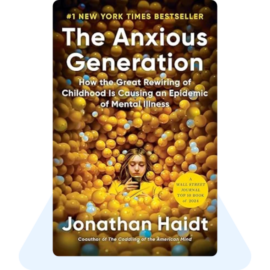
The difference between these scenes is one of the central concerns in The Anxious Generation by Jonathan Haidt. The book asks whether a childhood built around outdoor play, friendship and gradual independence has been replaced too quickly by one organised around smartphones, apps and online attention. It challenges parents, teachers and adults to notice what children may be losing while they gain unprecedented digital access.
If you are searching for The Anxious Generation Summary, you probably want more than an argument about whether phones are good or bad. You want to understand Screen Time Effects, Smartphone Addiction, Social Media and Mental Health, and what can actually improve daily life. You might also be wondering whether the lessons apply to adults who struggle with endless scrolling, poor concentration or constant comparison.
At Readers Books Club, we believe the most useful books help readers ask better questions and make better decisions. A powerful book summary should explain an author’s argument clearly while also showing where evidence is strong, where it remains disputed and how readers can use the ideas responsibly. That is especially important for a topic involving teenagers and mental health.
This Jonathan Haidt Book Summary explores seven lessons drawn from the book’s wider argument. They are not the book’s official seven chapters. They are an original editorial structure designed to make its key themes practical: the shift from play to phones, disrupted sleep, fractured attention, online comparison, the importance of freedom in childhood, collective responsibility and the need for real human connection.
The central message is not that technology must disappear. It is that a useful tool should not quietly become the architect of our relationships, routines and sense of self. If our devices begin deciding how we spend every spare moment, it is worth asking what we want those moments to contain instead.
About The Anxious Generation and Jonathan Haidt
The Anxious Generation: How the Great Rewiring of Childhood Is Causing an Epidemic of Mental Illness was published by Penguin Press in March 2024. Its author, Jonathan Haidt, is a social psychologist and professor at New York University’s Stern School of Business. His earlier work includes The Righteous Mind and, with Greg Lukianoff, The Coddling of the American Mind. In this book, Haidt turns his attention to a broad question: what happened to childhood as digital technologies moved from occasional tools to constant companions?
Haidt connects two historical developments. The first is the gradual decline of unsupervised outdoor play and independence. The second is the widespread adoption of smartphones and social platforms, especially during the early 2010s. He argues that the combination produced what he calls the great rewiring of childhood, with important consequences for young people’s social lives, attention, sleep and emotional development.
His argument is deliberately bold. He believes society became highly cautious about children’s physical independence while leaving them insufficiently protected in online environments built for engagement. In his telling, adults reduced ordinary opportunities to explore the real world while granting young people nearly unrestricted access to commercial digital worlds.
The book is not simply about measuring minutes of screen time. It is about what those minutes replace and what kinds of online experiences they contain. An hour of video calling a distant grandparent does not have the same meaning as an hour of hostile social comparison. Watching a lecture is different from staying awake until 2 a.m. because an algorithm keeps recommending content. These distinctions matter when we try to apply Haidt’s argument fairly.
It is also important to identify the nature of the evidence. Some of the risks Haidt describes, including interrupted sleep, cyberbullying and compulsive engagement, deserve serious attention. But researchers disagree about the extent to which smartphones and social media caused population-level increases in anxiety and depression. Later reviews have found that the average association between time spent online and mental health can be small, mixed or dependent on the individual and the activity. We will return to that debate rather than treating it as settled.
For readers interested in Psychology Books, Mental Health Books and Self-Improvement Books, this makes The Anxious Generation both valuable and provocative. Its strengths lie in the questions it raises and the practical conversations it encourages. Its limitations remind us why critical reading is as important as an engaging thesis.
What Is the Central Message of The Anxious Generation?
Haidt’s central argument is that modern childhood has become less grounded in direct, embodied experience and more organised around digital environments that compete for attention. He suggests that children need ordinary experiences of friendship, risk, boredom, movement and independence to develop confidence and social skills. When much of this is displaced by constant access to online platforms, opportunities for development may narrow.
The book identifies four foundational harms associated with a phone-based childhood: social deprivation, sleep deprivation, attention fragmentation and addiction. These are Haidt’s categories, not a clinical diagnosis that applies to every smartphone user. Social deprivation concerns lost time together. Sleep deprivation concerns late-night use and alerts. Attention fragmentation concerns frequent switching. Addiction concerns patterns of compulsion and difficulty disengaging.
His proposed solutions are famously direct: delay smartphones until high school, delay social-media accounts until age sixteen, create phone-free school environments and restore more independent play in childhood. These are the author’s recommended social norms, not universally established medical cut-offs. Families need to consider children’s maturity, safety, disability needs, local circumstances and access to essential communication when applying them.
A useful way to read the book is to separate three questions. First, what challenges are young people experiencing? Second, what role do digital environments play in those challenges? Third, what changes are low-risk and worthwhile even while researchers continue debating precise causal effects? Better sleep, meaningful friendships, calmer classrooms and opportunities for independent play are sensible goals regardless of whether one agrees with every part of Haidt’s explanation.
In the following seven lessons, we will connect his thesis with everyday experiences familiar to Indian readers and the wider Readers Books Club community. We will also consider adults, because many of the habits discussed in this book do not stop at age eighteen.
Lesson 1: Real-Life Play and Independence Build Skills That Screens Cannot Fully Replace
Think about a child who goes outside with friends to play cricket. The children must decide who bats first, argue about a boundary, make up a new rule when the ball disappears and eventually settle a disagreement without an adult managing every detail. The game teaches more than batting and bowling. It offers repeated practice in negotiation, frustration, cooperation and self-control.
Haidt argues that such ordinary experiences are essential to development. He contrasts a play-based childhood with one increasingly dominated by supervised schedules and digital entertainment. In a playful environment, children test their abilities, experiment with decisions, make small mistakes and discover that they can recover. Their confidence comes not from being told they are capable but from doing things they once found difficult.
A smartphone can provide enjoyable games and valuable learning. Online friendships can also be meaningful, especially when geography, disability or isolation makes in-person contact difficult. But not every online interaction offers the same freedom to explore physical environments, read facial expressions, negotiate live disagreements or experience the unpredictable rhythm of face-to-face relationships.
Consider how many adults remember learning to cycle. Someone held the bicycle for a while, then let go. The child wobbled, perhaps fell, and tried again. That small experience combined fear, support, physical effort and independence. Watching a hundred cycling videos could explain the technique, but the confidence of balancing comes through practice.
Haidt worries that adults increasingly protect children from manageable real-world risks while accepting unfamiliar risks online. His argument is not an invitation to ignore safety. It is a challenge to distinguish genuine danger from ordinary developmental difficulty. A child walking to a nearby shop in a reasonably safe setting may learn responsibility. A child managing a small disagreement with a friend may learn patience. Protecting young people from every uncomfortable moment can leave them less prepared for later challenges.
For Indian families, applying this lesson does not require copying a foreign childhood. A neighbourhood park, badminton in a shared courtyard, helping plan a family outing, visiting a library or participating in an organised but child-led activity can offer meaningful practice. The question is not whether children should roam freely in unsafe places. The question is whether age-appropriate independence can be increased with thoughtful boundaries.
Parents can begin with one responsibility that fits the child’s age. Perhaps the child plans a simple weekend activity, manages pocket money for a small purchase or resolves a minor scheduling problem independently. Adults remain available for help without immediately taking over. This balances care with trust.
Adults can learn something from the same idea. Personal Growth often requires experiences that cannot be fully simulated by reading another motivational post. You may understand confidence intellectually, but it grows through speaking, meeting people, creating projects and tolerating mistakes. A mindset transformation becomes meaningful when the environment offers chances to practice it.
Lesson 2: Protecting Sleep May Be More Important Than Counting Every Minute of Screen Time
Imagine a student who plans to sleep at 10:30 p.m. They check one message, notice a funny video, reply to a comment and then open another recommended clip. By the time they put the phone away, it is past midnight. The next morning, they wake up tired, struggle to concentrate and feel unusually irritated. The problem is not merely the number of videos viewed. It is the sleep the videos displaced.
Sleep deprivation is one of the four foundational harms Haidt highlights. Night-time notifications, emotionally intense conversations, endless feeds and a device within easy reach can all make it harder to disengage. The consequences of insufficient sleep can influence mood, learning, attention and everyday functioning. Poor sleep can also make it harder to regulate reactions to social situations, which may create another reason to seek distraction online.
The relationship works in more than one direction. A young person who is anxious or lonely might reach for a phone because they cannot sleep. An emotionally difficult day may lead to more online time rather than being caused by it. That is why it is useful to look at patterns instead of automatically blaming the device for every bad morning.
A sensible first step is to protect a consistent sleep opportunity. Families can agree that phones charge outside bedrooms overnight, or that notifications are silenced during a defined period. A regular wind-down routine might include reading a physical book, quiet conversation, drawing or preparing for the next day. The goal is not to establish a perfect ritual but to remove repeated interruptions.
A teenager may object that the phone is their alarm. A separate alarm clock can solve that practical problem. Someone may need a device for emergency contact, in which case the family can design exceptions or use settings that allow specific callers through. Good boundaries work better when they reflect actual needs rather than appearing arbitrary.
There is an important distinction between sleep hygiene and moral judgement. If a young person struggles to sleep, scolding them for having weak discipline will rarely help. Discuss what happens before bedtime, whether anxiety or school pressure is involved and what environmental changes might make rest easier. Persistent sleep problems deserve professional attention rather than another round of motivational advice.
Haidt’s lesson is that digital wellbeing should be judged by what happens to daily life. If an app is consistently taking away your sleep, the priority is not a more impressive screen-time statistic. It is to reclaim the rest that helps everything else function.
Lesson 3: Attention Is a Limited Resource, and Constant Switching Has a Cost
You sit down to study a chapter, reply to a notification, return to the paragraph, check a news alert and then wonder why the material seems difficult to remember. A similar pattern plays out in offices, classrooms and homes. The task itself may not be unusually hard. The challenge is that attention never stays with it long enough.
Haidt calls this attention fragmentation. He argues that many digital platforms invite rapid movement between small pieces of information, while alerts repeatedly interrupt other activities. For a young person learning how to concentrate, this environment may create a daily contest between long-term goals and immediate stimulation. An exciting feed can provide a quick reward; understanding a difficult chapter often requires patience.
This is not evidence that every short video damages the brain or that people who use phones cannot learn. A smartphone can be useful for research, navigation, language learning and staying connected. The point is to notice how the structure of an activity affects attention. Reading a long article with alerts disabled is different from switching among clips, chats and homework every few minutes.
Consider two students preparing for the same examination. The first studies for thirty minutes while responding to every message. The second keeps the phone out of reach and studies for the same amount of time with a clear goal. The second student has fewer interruptions to manage. That does not guarantee a higher score, but it creates conditions in which focused learning is easier.
The practical solution begins with the environment. If every app competes for your attention, relying only on willpower can become exhausting. Disable nonessential notifications, place the phone away during demanding work, and create designated periods for checking messages. A timer may help some people begin, but it is not compulsory. A quiet desk, a clear task and a realistic time block are often enough.
For students, parents and teachers can agree on technology rules for homework without making digital learning impossible. If a task requires online research, it can be completed in stages: gather useful material, close distracting tabs, then work on an answer. Students also benefit from learning to question sources and form their own conclusions instead of copying the first information they find.
Readers who enjoy Self-Improvement Books can test the principle directly. Choose a book and read for fifteen uninterrupted minutes. Afterwards, close it and explain the main idea in your own words. That short reflection can reveal whether you actually understood the material or merely moved your eyes across the page. It also connects AI and Critical Thinking: digital tools can produce instant summaries, but thoughtful learning still requires interpretation and attention.
Not every learner has identical attention needs. People with ADHD or other conditions may require different supports, and persistent difficulties should not automatically be attributed to phone use. The aim is to remove unnecessary distractions, not to blame individuals for complex challenges.
A useful question to ask at the end of the day is not simply, “How long did I use my phone?” It is, “Did my phone help me do what mattered, or did it repeatedly pull me away?” The answer gives you something specific to improve.
Lesson 4: Social Comparison Can Quietly Change the Way Young People See Themselves
A teenager opens a social app and sees classmates looking happy, attractive and successful. A friend appears to have the perfect birthday celebration. Someone else seems to own the latest gadget. Another person gets hundreds of likes for a photograph. The teenager knows that social media shows selected moments, yet the comparison can still feel immediate and personal.
Haidt devotes particular attention to how social platforms influence social relationships and self-presentation. He argues that public feedback, visible popularity measures, image editing and constant comparison can make adolescence more difficult, especially for young people who are highly sensitive to social approval. The book discusses differences in the online experiences of girls and boys, while its larger concerns also apply across genders.
It is important not to convert those patterns into stereotypes. Not every girl is harmed by appearance-focused content. Not every boy is consumed by gaming. Young people differ in interests, personalities, social support and vulnerabilities. Some find genuine friendship, creative expression and supportive communities online. Others encounter bullying, exclusion, pressure or disturbing material. What appears on the screen, how a person uses it and what is happening in their life all matter.
The practical lesson is to teach young people how online environments shape perception. An influencer may spend hours selecting a single image. A viral post may represent an unusually successful moment rather than everyday life. A follower count measures reach on a platform, not someone’s kindness, value or emotional maturity. Explaining these differences is a form of digital literacy, not merely a warning against social media.
Parents can begin conversations with curiosity. Instead of demanding, “Why are you always on that app?” they might ask, “How do you usually feel after using it?” or “Are there accounts that make you feel pressured?” A teenager may be more willing to describe an unpleasant experience if the first response is not immediate punishment or shame.
Some readers connect positive thinking, manifestation and the Law of Attraction with the desire to create a better future. Those topics can encourage reflection on goals, but a healthy mindset should not depend on pretending every comparison is harmless or expecting thoughts to change external events automatically. Real confidence is better supported by realistic self-assessment, supportive relationships and purposeful action.
Try changing your feed before trying to change your personality. Unfollow accounts that consistently trigger harmful comparison. Follow educators, artists or people whose work genuinely helps you learn. Take breaks from metrics such as likes and views. Make space for activities where the satisfaction comes from doing something rather than displaying it.
There is another important point: people who experience online harassment or exploitation should not be told to solve everything by developing a stronger mindset. They may need trusted adult support, school intervention, platform reporting and professional help. Responsibility also belongs to platforms and institutions that shape online conditions.
The deeper message is that social approval should never become the only mirror through which a person understands their worth. Friendship, character, competence and belonging develop in richer ways than any dashboard can display.
Lesson 5: Compulsive Scrolling Is Often a Design Problem, Not Just a Discipline Problem
Have you ever opened an app to check one detail and realised twenty minutes later that you were still scrolling? The screen did not force you to stay, yet leaving felt harder than you expected. For many people, this happens repeatedly. Sometimes the phone fills a boring moment; sometimes it becomes a way of avoiding an uncomfortable feeling.
Haidt’s fourth foundational harm is addiction. In discussing this theme, he focuses on features that encourage repeated engagement, such as endless feeds, automatic recommendations, variable feedback and social rewards. It is safer to distinguish everyday habit loops from clinical disorders: frequent smartphone use does not automatically mean that someone has an addiction. Still, the experience of losing control over time or repeatedly neglecting important activities deserves attention.
A useful starting point is to identify what happens immediately before you reach for the device. Are you waiting in a queue? Avoiding homework? Feeling lonely? Trying not to think about an argument? The answer matters because removing an app without addressing the underlying need may not create lasting change.
If boredom is the trigger, try having alternative activities within reach. Keep a book beside the sofa, carry a small notebook or take a short walk. If loneliness is the trigger, arrange a conversation or shared activity. If the phone helps you escape difficult emotions, consider whether you need rest, support, a calmer routine or a conversation with someone you trust.
You can also redesign the digital environment. Turn off autoplay where possible. Remove distracting apps from the home screen. Use browser access for services you need only occasionally. Keep the phone away during meals and focused work. These small changes create useful friction between an impulse and an automatic action.
The goal is not to make technology feel forbidden or shameful. Harsh restrictions can sometimes encourage secrecy, especially among teenagers. A collaborative approach works better when young people understand the reason for a boundary and have opportunities to help shape it. For instance, a family may agree on phone-free meals while recognising that a teenager needs access to a group chat for school coordination.
Some people enjoy using meditation to become more aware of impulses. Simple meditation or mindfulness practices can create a moment to notice the urge to check a device without immediately acting on it. These practices may support awareness and stress management for some individuals; they are not treatments that guarantee freedom from compulsive behaviour.
You might ask yourself, “What do I need right now?” Perhaps the answer is information, entertainment, social contact or a break. Once that need becomes clear, you can choose a response instead of letting a feed choose for you.
The core lesson is about agency. Discipline matters, but design matters too. When an environment is engineered to capture attention, improving the environment can be more effective than repeatedly criticising yourself for getting distracted.
Lesson 6: Healthier Digital Habits Need Families, Schools and Platforms to Work Together
A parent may want to delay giving a child a smartphone but worry that the child will be excluded from school conversations. A teacher may want students to put phones away but face pressure from families who expect immediate contact. A teenager may want to leave a social platform but fear missing invitations or group discussions. These situations reveal why digital habits are not simply a matter of individual willpower.
Haidt describes this as a collective action problem. When everyone around you is using a particular service, opting out can carry social costs. The book therefore argues that families, schools, communities, technology companies and policymakers should change expectations together instead of leaving each child or parent to negotiate alone.
His four proposed norms are straightforward: no smartphones before high school, no social media before sixteen, phone-free schools and more independent play. These proposals have become a major part of public discussion about the book. They are policy and parenting recommendations, not proof that every child is ready for exactly the same technology at an identical age.
The value of collective agreements is easy to understand. Imagine that several parents in a class decide together to delay personal smartphones and organise alternative ways for children to communicate. One child no longer has to be the only person without a certain app. Similarly, a school-wide phone policy can reduce arguments over why one student must put away a device while another keeps using it.
Yet implementation requires care. A family may rely on a phone for a child’s travel safety. A student with a disability may use a device for essential communication or accessibility. Older teenagers may need digital tools for work, education or community connection. Rules should include reasonable exceptions and should not ignore the realities of different households.
A strong school policy should also explain what students gain, not only what they lose. If phone-free time creates more focused lessons, face-to-face interaction and recreational activities, students can see the purpose. If devices are removed without offering any engaging environment, the change may feel like punishment rather than a genuine improvement.
Parents can support the same principle at home through consistent modelling. It is difficult to persuade a teenager to put away a phone during dinner when adults continue answering every notification. Families can begin by choosing one shared period without screens. Rather than turning it into a test, they can make the time worth protecting through conversation, games, reading or a simple walk.
For businesses and online platforms, the book raises questions about design responsibility. Features that maximise time spent may not always support wellbeing, particularly for minors. Safer default settings, effective reporting tools, transparent recommendations and meaningful protections are matters for institutional action, not just individual coaching.
This is also an important lesson for life coach and coaching conversations about habits. It is tempting to tell people that every problem can be solved through confidence, discipline or a change in the subconscious mind. But environments and social expectations influence what choices feel possible. Better systems can support better habits without requiring extraordinary willpower every day.
Change your environment where you can, and work with others when individual efforts are not enough. That is a more realistic form of personal growth than expecting one person to resist every digital pressure alone.
Lesson 7: Human Connection, Meaning and Inner Calm Need Space Beyond the Screen
The final lesson brings together the book’s concerns about relationships, attention and the quality of everyday experience. Digital tools can connect us across great distances. They can also fill the spaces in which people once reflected, noticed nature, had long conversations or simply allowed their minds to wander.
In a chapter on spiritual elevation and degradation, Haidt explores the importance of experiences that lift people beyond immediate self-interest: wonder, shared rituals, community, beauty and a feeling of connection with something larger. Readers do not need to adopt a particular spiritual belief to understand the broader concern. A person who never looks up from a feed may miss opportunities to feel part of the world around them.
Consider a quiet morning walk. You may notice a familiar tree, hear traffic slowly begin, meet a neighbour or think about a problem without needing an instant answer. Nothing on the walk has been optimised for clicks. Its value may lie in the absence of constant demands for attention.
The same can be true of reading. A thoughtful book invites you to remain with an idea long enough to question it. An inspiring podcast can begin a conversation, but the richest learning may happen later when you discuss the idea with a friend or apply it at work. Digital content becomes more valuable when it leads back to life instead of permanently replacing it.
For the Readers Books Club audience, this connects naturally with personal growth, meditation, spirituality and self-improvement books. Many readers of Dr Amiett Kumar content are interested in focus, self-belief and intentional living. These interests can support a healthier relationship with technology when they encourage presence, self-reflection and constructive action. They should not be presented as medical solutions for anxiety or as proof that changing thoughts alone can change external circumstances.
A brief daily pause may be useful. Sit comfortably, observe your breathing or spend a few minutes noticing your surroundings. If meditation makes you uncomfortable, a walk, music, journaling or conversation may serve a similar reflective purpose. Mental clarity can be supported in different ways, and no single practice is right for everyone.
Human connection also requires responding to another person’s reality. A friend may be struggling at school. A colleague may feel excluded. A teenager may need to talk about something embarrassing they encountered online. Listening without immediately offering a lecture can create the trust needed for a genuine conversation.
One useful question is, “What kind of life will my habits make possible?” If your attention always moves toward the next notification, you may have less room for friendship, patience, craft and reflection. If you create some protected spaces, those qualities have more room to develop.
This is perhaps the book’s most enduring invitation: do not let a tool designed for convenience become a substitute for the experiences that make life meaningful.
What Does the Research Actually Say About Social Media and Mental Health?
An engaging book can make a strong case without settling every scientific question. The Anxious Generation is widely discussed partly because Haidt argues that the rise of smartphones is a major driver of worsening youth mental health. Other researchers caution that changes in depression and anxiety cannot be explained by one factor alone.
In a 2024 review published in Nature, psychologist Candice Odgers questioned whether the available evidence supported the book’s broad causal claims. Her concern was not that online harms are imaginary; it was that correlation does not automatically establish cause. Teenagers who are already struggling may spend more time online, while stressful experiences online may worsen difficulties for some of them. Both directions can occur, alongside family, school and economic influences.
The US National Academies’ 2024 report similarly described a complicated evidence base in which risks and benefits differ across users. A 2026 European Commission review of longitudinal and experimental studies found no uniform relationship between social-media use and poorer mental health across all young people. It reported more consistent concerns around problematic use, harmful online experiences and particular pathways such as appearance pressure or sleep disruption. These findings support careful, targeted responses rather than assuming every minute online carries equal risk.
This does not make Haidt’s practical concerns irrelevant. Cyberbullying, unwanted contact, poor sleep and distraction deserve attention even if there is disagreement about how much they explain population-level trends. It does mean readers should avoid describing every anxious teenager as a victim of smartphone addiction or assuming that removing one app will resolve a mental health condition.
A good book review can hold two ideas together: digital platforms deserve scrutiny, and young people’s mental health is complex. If a child experiences persistent anxiety, depression, self-harm thoughts or serious functional difficulties, a qualified mental health professional can help assess the situation. Family support and digital boundaries may be useful parts of the picture, but they are not replacements for appropriate care.
Applying These Lessons in Indian Homes, Schools and Workplaces
For Indian readers, the practical challenge often involves balancing technology’s benefits with its demands. Students use messaging groups for homework, families depend on digital payments and directions, and young professionals maintain networks through online platforms. A complete digital detox may be unnecessary or unrealistic. Thoughtful boundaries are more useful than treating every app as the enemy.
Start by discussing how devices are used in your household rather than imposing a universal rule. Is the main concern late-night scrolling, online harassment, reduced outdoor play or interruptions during study? Different problems require different responses. A student who needs digital access for assignments has a different situation from someone repeatedly staying awake to watch entertainment videos.
Schools can create time and space for clubs, sports, libraries, group projects and real conversations. Families can support hobbies that do not depend on public engagement metrics. Workplaces can protect focused work by reducing unnecessary alerts and recognising that immediate online availability is not the same as productive performance.
The wider lesson is to change your environment so healthy choices become easier. Put books where they are visible. Make shared spaces welcoming. Encourage a conversation rather than assuming every bored moment needs a screen. Consider how the rules affect children with disabilities and those whose online communities provide crucial support. A balanced plan protects wellbeing without removing essential connections.
A Practical 14-Day Digital Reset Inspired by the Book
You do not need to transform your entire routine overnight. Treat the following fortnight as an experiment in noticing what helps you feel more present. The suggestions below are an original Readers Books Club practice plan, not an official exercise from Jonathan Haidt’s book.
During the first three days, observe rather than judge. Notice when you use your phone automatically, which apps keep you engaged longer than intended and how you feel after different types of online activity. Pay particular attention to bedtime, study sessions and shared meals. The goal is to understand your patterns before changing them.
For the next four days, protect one part of your daily routine. You might place your phone outside the bedroom at night, turn off nonessential notifications during work, or create a short screen-free period after dinner. Choose a change you can maintain, then explain it to the people who may need to contact you. Clear expectations make boundaries more practical.
In the second week, replace some screen time with a meaningful activity. Read twenty pages of a book, visit a friend, play a sport, work on a creative project or take a walk. The replacement matters because removing an established habit without offering anything satisfying can leave a gap. If a particular activity is unavailable, choose a version that suits your circumstances.
Finally, reflect on what happened. Did you sleep more consistently? Was it easier to finish a task? Did you enjoy a conversation you might otherwise have missed? Perhaps you discovered that certain online communities genuinely support your wellbeing. Keep the useful parts of your digital life, adjust the unhelpful ones and avoid measuring success through perfection.
This exercise also helps develop a healthier mindset about change. Rather than saying, “I have no discipline,” you can say, “I noticed a trigger and changed the conditions around it.” Small adjustments, repeated over time, may be more sustainable than dramatic promises to abandon every device.
The Anxious Generation Book Review: Who Should Read It?
The Anxious Generation is worth reading for parents, teachers, young adults, educators, policymakers and anyone who has wondered whether constant connectivity comes at a cost. Haidt writes with urgency, and the book’s strongest sections encourage readers to reconsider lost play, interrupted sleep and the social environments children need.
It is especially useful when treated as the beginning of a conversation rather than the final answer. Its proposals are memorable and practical enough to discuss with other parents or school leaders. Its central contrast between a play-based childhood and a phone-based childhood helps make the stakes understandable.
The principal limitation is the confidence of some causal claims. Researchers disagree about how strongly available studies connect smartphones with broad mental health trends. Different children and teenagers have very different digital experiences. An approach that is protective for one person may be unnecessarily restrictive for another. The book’s chapter on spirituality may also resonate more with some readers than with others.
For Readers Books Club, the strongest takeaway is not fear of technology. It is an invitation to become more deliberate about attention, relationships and childhood independence. This makes the book a distinctive addition to a reading list alongside books about habits, deep work, parenting and human connection. Read it carefully, compare perspectives and decide which changes are genuinely useful for your life.
Frequently Asked Questions About The Anxious Generation
1. What is The Anxious Generation about?
The Anxious Generation is a 2024 nonfiction book by Jonathan Haidt that argues the shift from play-based childhood to phone-based childhood may have harmed young people’s development and wellbeing. It examines social connection, sleep, attention and compulsive use while proposing changes for families, schools and technology companies. The book is influential, but its strongest claims about causation are disputed among researchers.
2. What are the four foundational harms in The Anxious Generation?
Haidt identifies social deprivation, sleep deprivation, attention fragmentation and addiction as four foundational harms of phone-based childhood. He uses these categories to describe ways digital environments might displace friendships, interrupt sleep, divide attention and encourage compulsive engagement. They are themes in his argument, not diagnoses that apply to every teenager who uses a phone.
3. Does smartphone use cause anxiety and depression?
Some online experiences can contribute to distress, particularly bullying, harassment, disrupted sleep and intense comparison. However, research does not establish that smartphone use causes anxiety or depression in all young people. Findings vary by person, content, context and research design. Mental health also reflects biological, family, social and environmental factors. Persistent symptoms deserve professional assessment.
4. What does Jonathan Haidt recommend for children and smartphones?
Haidt recommends delaying smartphones until high school, delaying social media until age sixteen, having phone-free schools and increasing opportunities for independent play. These are his proposed social norms. Families and institutions should consider accessibility, safety, educational needs and individual maturity when making decisions about technology.
5. What is the difference between screen time and problematic phone use?
Screen time describes how long someone uses a device. Problematic use concerns whether that activity is difficult to control or interferes with sleep, relationships, school or wellbeing. The content and context matter too. A video conversation with family and repeated exposure to online harassment should not be treated as equivalent merely because they last the same number of minutes.
6. Can digital detox improve focus and mental clarity?
A planned break from distracting notifications may help create a better environment for study, reading or conversation. A digital detox is not a guaranteed treatment for anxiety, depression or attention problems. It is more useful to test specific changes, observe the results and retain positive uses of technology. A small, sustainable routine is often more practical than a complete ban.
7. Is The Anxious Generation one of the best psychology books to read in 2026?
It is an influential and widely discussed entry among contemporary Psychology Books and Mental Health Books. Whether it belongs on your personal list of Best Books 2026 depends on your interests. It is particularly relevant for understanding the debate about screen time, childhood independence and digital wellbeing. Read it alongside research that questions or qualifies its conclusions.
8. How can parents encourage healthy screen habits without constant conflict?
Begin with curiosity and shared expectations. Identify the specific problem, such as interrupted sleep or online bullying, rather than treating all digital activity as harmful. Agree on realistic boundaries, explain exceptions, model the same habits as an adult and offer enjoyable offline alternatives. When a child needs help, keep communication open instead of making punishment the first response.
Conclusion: Use Technology, But Protect the Life Around It
The most valuable part of The Anxious Generation Summary is the question it leaves with us: what kind of childhood and daily life do we want technology to support? Phones can help people learn, work and stay connected. They can also compete with sleep, focus, play and meaningful conversation when boundaries are missing.
Jonathan Haidt offers a forceful explanation for these changes, and readers should examine his evidence critically. Even when the scientific debate is unsettled, it is sensible to protect rest, build supportive relationships and make space for independence and offline experience.
For Readers Books Club and readers interested in Dr Amiett Kumar, the lesson connects with a familiar goal of personal development: become more conscious of where your attention goes. Read books that challenge your thinking, use digital tools deliberately, and remember that confidence, friendship and purpose develop through lived experience.
The goal is not a world without screens. It is a world in which screens do not crowd out everything else worth living for.
Contents